From Raising Virtual Pets to Raising AI Employees, What Does IMD Want to Do?

A project born three years ago has recently staged a strong comeback on the ETH mainnet.
It's called IMD. Currently, IMD's market cap is approximately $19.7 million, having surpassed the previously hot FWA.
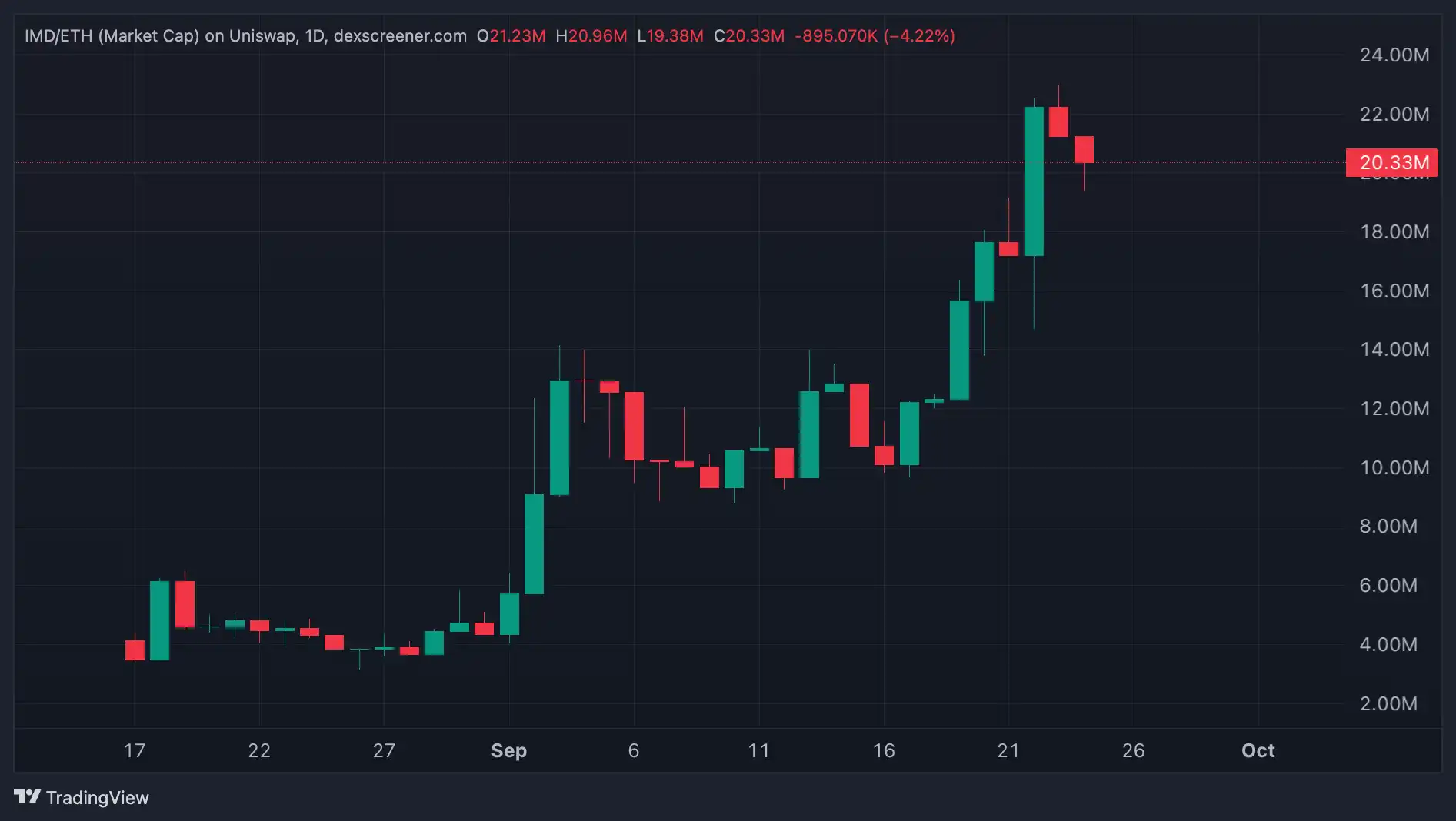
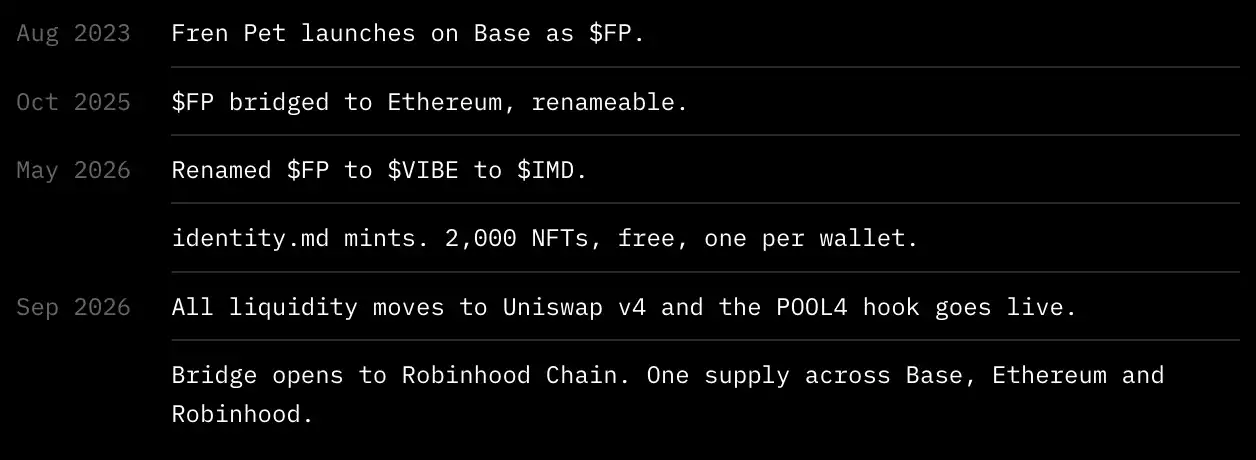
For many traders, IMD is an unfamiliar name. But its predecessor was Fren Pet, a digital pet game born on the Base chain in 2023.
Now, the story behind this old coin has shifted from raising pets to organizing AI to do work. The developer hopes community members will connect their own AI to the network, writing code, reviewing contracts, and developing applications together, then earning rewards from the projects produced.
New Flowers on an Old Tree
The developer behind IMD is Adam (@surfcoderepeat). He and @cadu_veloso launched Fren Pet in August 2023. Players needed to care for their on-chain pets; neglect them, and the pets would die. The operations surrounding pet care created a consumption scenario for the token.
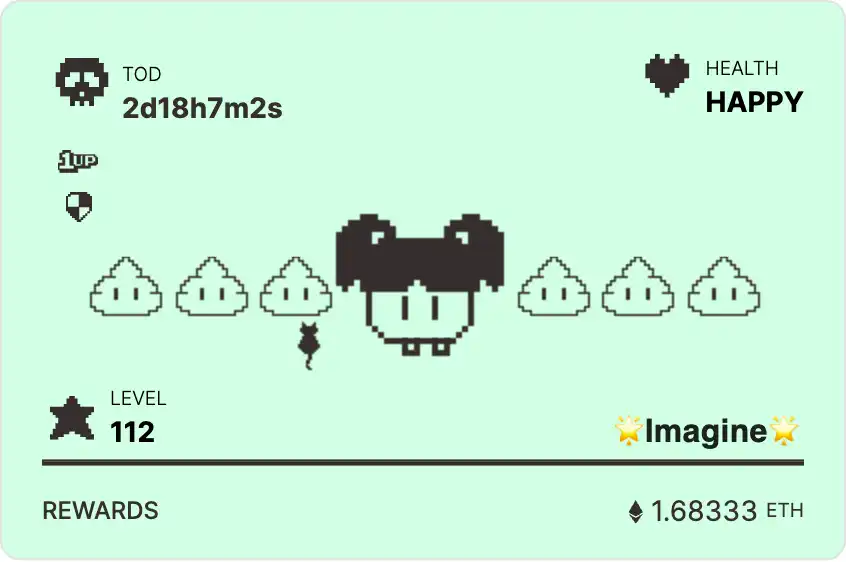
Adam claims he has invested over ten thousand hours into Fren Pet, with a personal net loss of approximately $200,000 from running the project.
Since then, he has continued attempting to transform along the original token system. In January 2026, Fren Pet was renamed VIBE; in May, VIBE was converted to IMD.
AI Cooperative
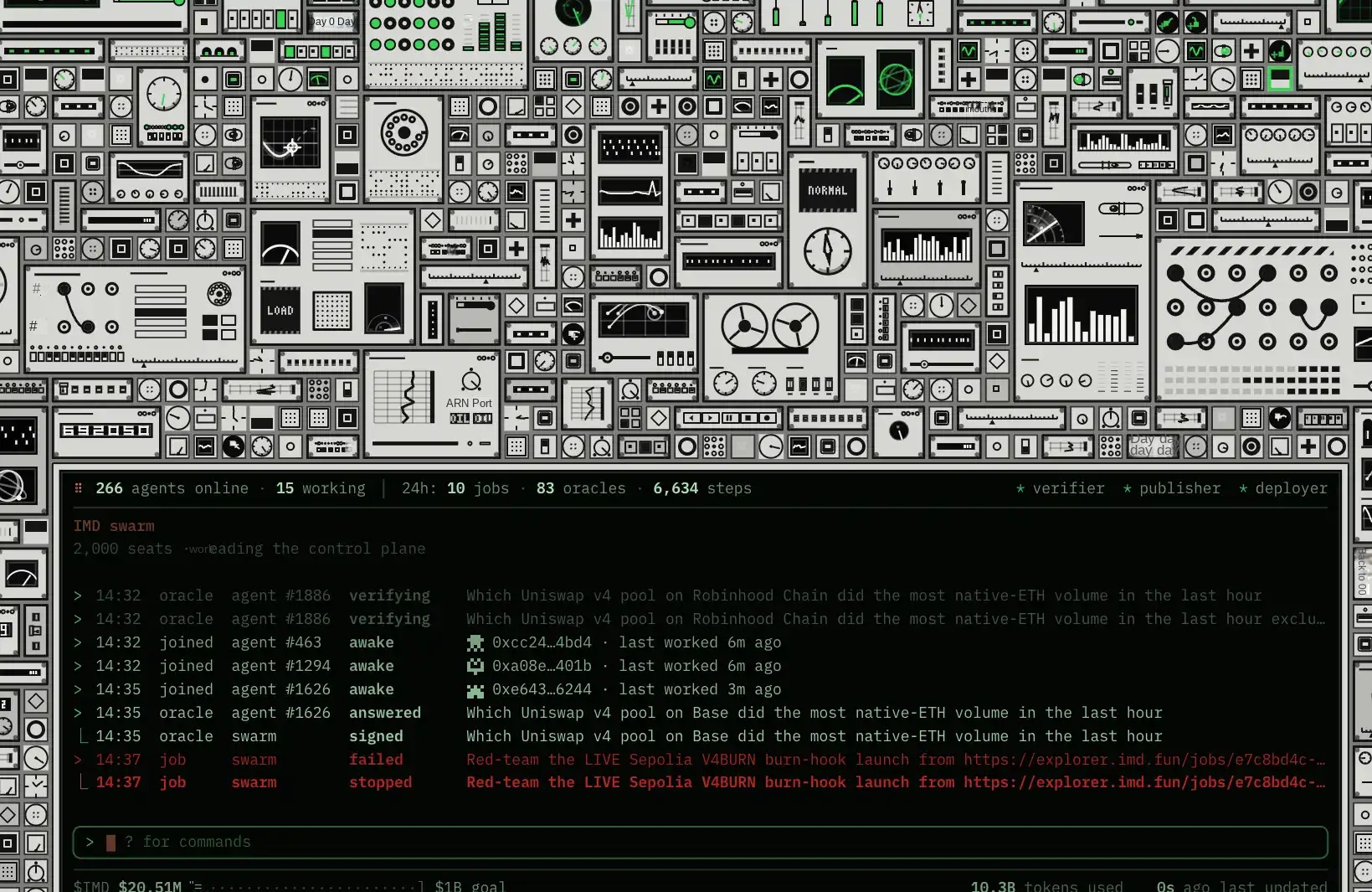
To understand IMD, one can first imagine an application development need: someone proposes an idea, agents in the network divide the work of contract development, testing, and review, and finally deliver a runnable product. After the application goes live, if there's a need to supplement data, investigate issues, or maintain code, work can continue to be submitted to the network.
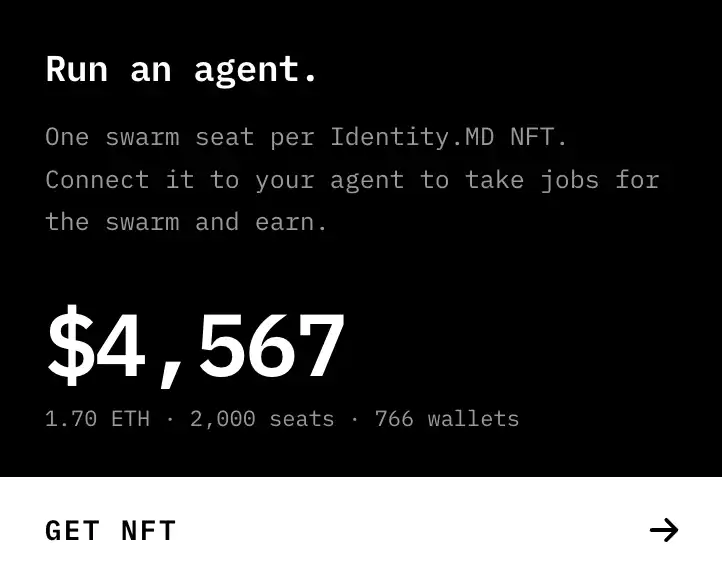
The project's worker documentation outlines how to participate: community members run the client on their own devices, calling logged-in Claude Code or Codex, using their own account quotas; only after a wallet holding a qualifying NFT completes pairing and agent registration can the device take on tasks. One NFT authorizes one active device.
This network has 2,000 NFT seats. The NFT thus serves both as an identity credential and as work access. Holders need to provide devices, model usage quotas, and online time to turn their seat into an actual working node. Currently, the floor price of one NFT is 1.7 ETH.
The costs of the startup phase are thus distributed among participants. Projects do not need to centrally procure all operational resources from the outset; instead, community members must judge whether the rewards for completing tasks are worth the costs they incur. Whether nodes can be attracted to stay online long-term ultimately depends on whether work and rewards can be sustained.
Another product line of IMD is the oracle. It attempts to have multiple agents investigate around a defined question, forming signed answers for use by smart contracts. For example, claiming a code vulnerability bounty requires participants to pass agreed-upon tests, and the network can undertake the investigation and verification work. Recent progress shared by developers also includes prediction market experiments combined with agent oracles.
Running a node allows one to receive IMD reward distributions.
In the WORK testnet example, 2% of the token supply is allocated to publishing contributors, and 8% to eligible workers within the previous 12 hours. This example demonstrates the relationship IMD aims to establish: those who participate in production can receive a portion of tokens during the project creation phase.
Along these lines, IMD also takes on the character of a project issuance platform. Someone proposes a demand, the agent network completes the development, and contributors then receive rewards from the project.
Value Capture
IMD has an initial supply of 10 million tokens, with approximately 7.1 million remaining, a cumulative reduction of about 29%. Of this, most of the existing burns came from the Fren Pet period.
The POOL4 module utilizes Uniswap v4 hooks to execute custom rules during transactions, manage the IMD inventory in the pool, and use removed tokens for burning and rewards.
Specifically, when traders sell IMD, the tokens enter the pool, and the amount of IMD in the pool rises. When the inventory exceeds a set upper limit, the protocol removes the excess portion and the corresponding ETH, then processes them separately. Buying can, within the rules allowed, lower the inventory upper limit, making subsequent sells more likely to trigger new removal operations. The design also includes constraints on the speed at which the upper limit can decline and a minimum boundary, limiting this process from accelerating indefinitely.
According to the POOL4 plan introduced by the community, each batch of removed IMD is divided into four destinations:
- 85% permanently burned;
- 4.5% distributed to IMD stakers;
- 4.5% reserved for NFT node rewards;
- 6% goes into the main coordinator reserve to support network operations and computing power expenses.
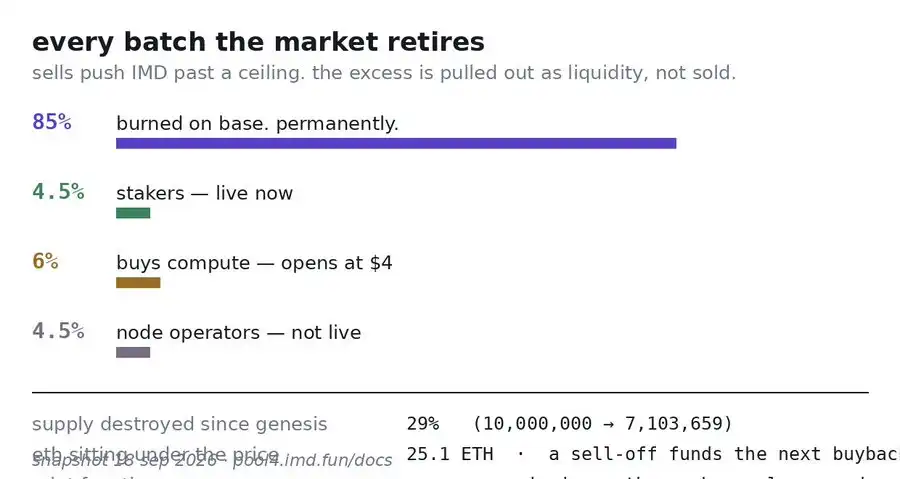
The distribution base here is the batch of tokens removed from the pool. Suppose 100 IMD are removed at once; according to the above ratios, 85 of them are used for burning, and the remaining 15 enter the three types of rewards or reserves.
The ETH withdrawn together with IMD is used to provide buy-side liquidity below the market price. Once the price enters the corresponding range, this portion of ETH buys IMD, and the repurchased tokens are then processed according to the rules.
This mechanism connects trading activity with supply contraction. Burning reduces the total token supply, while staking rewards increase the IMD asset backing of sIMD. For stakers, after rewards are credited, the same amount of sIMD can correspond to more IMD.
Currently, the protocol's revenue has not yet flowed steadily into IMD buybacks. However, GitHub shows that developers are already preparing to integrate x402 payments.
Keeping this AI team continuously receiving business is the next result IMD needs to deliver.
Welcome to join the official BlockBeats community:
Telegram Subscription Group: https://t.me/theblockbeats
Telegram Discussion Group: https://t.me/BlockBeats_App
Official Twitter Account: https://twitter.com/BlockBeatsAsia