Shanghai upgrade or will set off liquidity pledge boom, which participants can stand out?
Article Title: The Future Of Liquid Staking
Original article by Ben Giove, Bankless
原文编译:东寻, DeFi 之道
If there is one part of the DeFi that is getting particularly hot during the cooling, it is the Liquid Staking market. Yields may be falling across the board, but Ethereum's outlook is showing a bullish signal.
Is anyone close to unseating Lido's dominance? Who are the up-and-comers? What does Lido rule mean for Ethereum censorship? This article explores these issues and more.
The future of liquidity pledge
Text: Logan Craig
There's always a bull market somewhere.
While cryptocurrencies may be in the midst of a brutal bear market, ethereum pledge remains an area of long-term growth.
ETH's pledges soared 77.9 percent in 2022, including an increase of 14.4 percent since the merger.
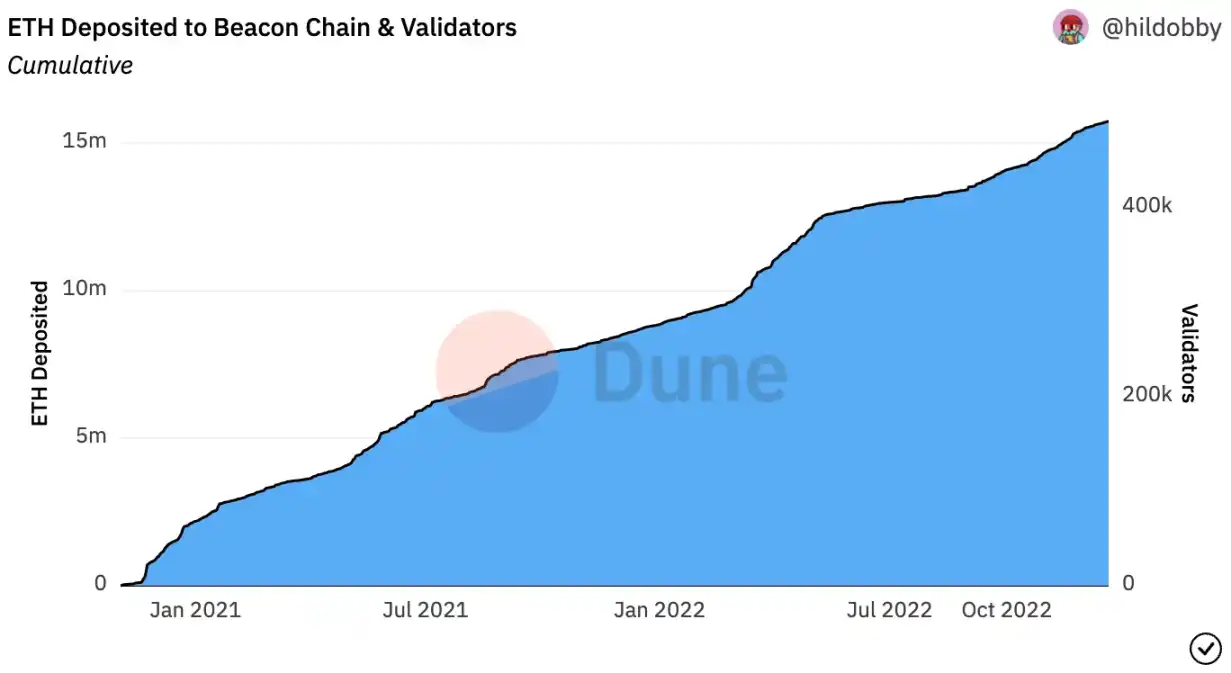
ETH Beacon Chain Deposits - Source: Dune Analytics
There are currently over 15.7 million ETH pledged, and while this number may seem large, it represents only 13% of the total supply. This is far lower than the average pledge rate of PoS network, that is. 61%.
ETH's pledge rate may never reach this average due to the highly distributed nature of its supply, but regardless, the Ethereum pledge story is clearly still in its early stages.
A major catalyst for accelerating this pledge rate is the Shanghai network upgrade, which will reduce the risk of pledge by enabling users to withdraw their deposits. This could result in the pledge of millions of ETH in the months following its expected implementation date of March-April 2023.
The entity most likely to benefit from the boom is a liquidity pledge agreement. These services represent the largest group of pledgers, accounting for 32.8 per cent of Beacon Chain deposits.
The industry has found a clear product market fit by eliminating the opportunity cost of collateral by issuing liquid pledged derivatives (LSD), an ERC-20 Token that represents claims on pledged ETH and allows its holders to receive incentives while still being able to deploy their assets within the DeFi.
As LSD issuers take a portion of pledge awards as revenue, their business models are influenced by ETH prices and block space demand, which means that when the market recovers and on-chain activity returns, their revenue figures will skyrocket with the addition of new pledges.
Which begs the question... Who is best able to take advantage of this pledge boom? After Shanghai upgrade, how will the competitive dynamics of pledge change?
Let's find the answers below:
Current situation of liquidity pledge
Lido reigns supreme...... But for how long?
Before we delve into how collateral will change and who will take market share after the Shanghai upgrade, let's look at the landscape of liquidity collateral today.
Until now, liquidity pledges have been largely dominated by one player: the Lido.

Source: Dune Analytics
stETH issuers are the largest entities on the beacon chain with 29.4% of the market, including 74.0% of the liquidity pledge share.
Several factors have contributed to Lido's dominance.
The deal benefited from first-mover advantage, as it was the first LSD publisher to launch at scale in December 2020. By doing so, they have built a key competitive advantage: deep liquidity.
Prior to the Shanghai upgrade era, liquidity had been a priority for the pledge, as the secondary market for LSD was the only way to exit the position.
stETH 无疑是最具流动性的 LSD,在 Curve、Balancer 和 Uniswap 上拥有数亿的 DEX 流动性。Lido 已经能够通过大规模的激励计划为 stETH 建立这种深度流动性,因为该协议从 2022 年年初至今已经花费了 2.08 亿美元的 Token 激励。
This helps build a very strong network effect for stETH, as users will want to pledge with the most liquid LSD to maximize their ability to exit, which in turn leads to more liquidity for Lido and therefore more market share.
This network effect has led to speculation that the protocol will become a monopoly, and while the latter is working towards licenseless verification, many have pointed out that Lido could be a centralized carrier for Ethereum, since LDO holders are the only ones who can add/remove node carriers.
However, it looks increasingly likely that these concerns will be misplaced, with a chink in Lido's armour as competition for post-merger collateral intensifies.

Source: Dune Analytics
Despite the largest total growth, Lido ranks "only" third among major LSD publishers in terms of growth. stETH publishers also lost market share during the period, with liquidity down 3.4% and overall down 1.0%.
A slower growth rate for Lidos is to be expected, as it is easier for a smaller agreement to grow at a faster rate than a larger one. However, when looking at who is attracting newly pledged ETH deposits after the merger, we can see signs that the agreement's controls on liquidity pledges may be starting to loosen.
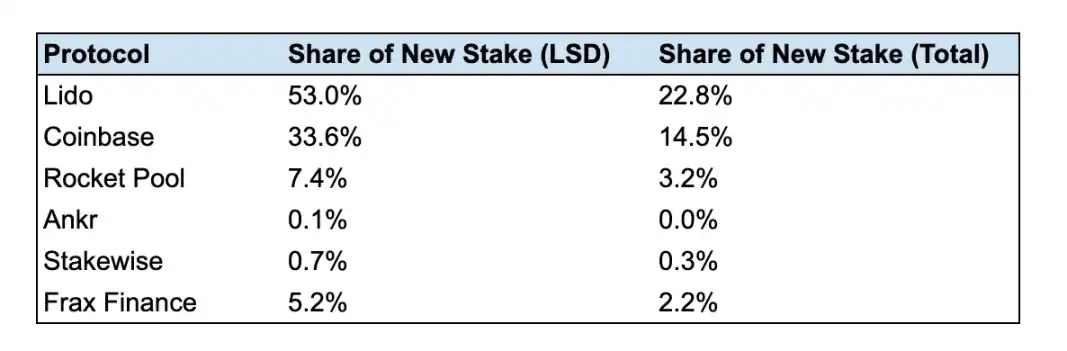
Source: Dune Analytics
While it had a 29.4 percent share of all pledged ETH, Lido "only" received 22.8 percent of the combined deposits. In addition, Lido has attracted 53.0 per cent of deposits to these agreements during the period, despite having a 74.0 per cent market share in liquidity pledges.
As we've seen, much of this market share loss can be attributed to Coinbase's cbETH growth. Since the merger, LSD issued by the CEX has received a 33.6% share of incoming liquidity pledges, possibly due to being able to convert its existing pledge pool to cbETH. As the largest CEX in the U.S., Coinbase has enormous resources at its disposal, and it's likely to remain competitive for the foreseeable future.
All in all, Lido is clearly still in the lead. However, the increased diversification of incremental pledges suggests that the market may be more Oligopoly than Monopoly.
Commercialization of income
Another factor that may contribute to an oligopoly of liquidity collateral rather than a monopoly is the commodification of yields.
A common argument for why pledges merge is that large pools of capital and professional validators benefit from economies of scale because they are able to execute proprietary MEV strategies. By doing so, these entities are able to generate higher returns relative to smaller pledgers, thus eliminating competition and leading to cartels (also known as monopoly interests, monopoly alliances, one form of monopoly organization).
While it seems likely that this will happen to some extent, in the long run, Ethereum protocol layers and developers are making a number of changes in technology that will democratize the proceeds of pledge, allowing individual pledgers and smaller protocols to generate competitive returns compared to larger competitors.
One change is the proposer-builder separation (PBS). PBS aims to separate Block production from block verification by creating a new Stakeholder called a Block Builder. The block builder is an entity that determines which transactions are included in a block, which means that the verifier does not need to order the transaction itself, but simply selects the builder that proposes the highest value block.
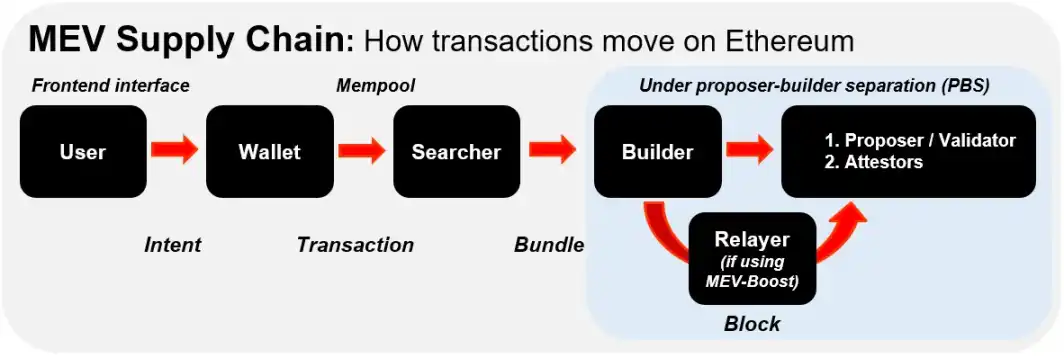
Source: Beginner's Guide to Ethereum censorship
By democratizing access to complex MEVs, this represents an important tailwind for the commodification of earnings. Although it will eventually be embodied at the protocol level, PBS is currently implemented through Repeaters such as MEV-Boost.
The second factor driving revenue commoditization is distributed validator technology (DVT). DVT acts like a verifier's multisig because it distributes the verifier key across multiple different nodes, not just one. In doing so, it improves the uptime and resilience of the validator by democratizing the point of failure and reducing the risk of a blanking event.
DVTS are especially valuable for individual pledgers, who are more prone to maintenance issues that can affect long-term returns. The two main DVT solutions are Obol and SSV, both of which are running on the test network.
Both PBS and DVT are still in their early stages, but when fully implemented should help reduce economies of scale in large pledge pools and commoditize returns for liquid pledge providers.
competitor
Since liquidity will become less important after the Shanghai meeting and yields are likely to become increasingly commoditised, in the long run liquidity collaterals will have to compete on products to attract depositors and validators.
In other words -- the design of the protocol and the LSD itself will actually start to matter.
There are a number of product features that will contribute to LSD's success:
The pledgee's validator selection
No license verification
Slashing protection
LSD capital efficiency
LSD tax efficiency
With that in mind, let's take a look at a few unmanaged agreements that are poised to seize the opportunity from this new competitive landscape.
Rocket Pool
Rocket Pool is the second largest liquidity pledge provider, with 5.2 per cent of Beacon Chain and 2.1 per cent of liquidity pledge deposits. The agreement's post-merger growth rate was 24.2 percent, the second highest among all LSD issuers, accounting for 3.2 percent of total deposits and 7.4 percent of liquid pledged deposits, respectively.
The Rocket Pool has been optimized for high decentralization. This protocol is the first to support permission-free verification, as any node operator can validate the network by providing 16 ETH collateral (½ of the verifier) and RPL bonds worth at least 1.6 ETH.
This overpledge creates built-in Slashing protection for rETH because NO bonds would be sold to protect the user from slashing events, in which case the verifier would lose part of the pledge as punishment for deviating from PoS rules.
Rocket Pool also benefits from tax efficiency, as rETH reflects pledged rewards by adding value (just like Compound cTokens) rather than leveraging a rebase model that creates a large number of taxable events.
The Rocket Pool's main weakness is capital inefficiency. Capital efficiency has been an important factor driving the dominance of stETH and cbETH, as each LSDS can be minted in a 1:1 ratio for each underlying ETH deposit (although these LSDS rely on weaker reduction mitigation measures such as insurance).
While LEB8 proposes to soon lower the collateral requirement for node operators to 8 ETH, this is still a huge hurdle and could cause the protocol to struggle to attract new verifiers as it is scaled up.
StakeWise
StakeWise is an existing stakewise agreement undergoing a significant transition.
虽然它目前使用的是双 Token 模型,但该协议很快将启动 StakeWise V3,它将采用模块化架构,用户可以在独立的金库中进行质押。
V3's design has several distinct advantages over single protocols such as Lido, Coinbase, and Rocket Pool, such as allowing the pledge to choose their validator.
The agreement also allows for better isolation of reduction risk, as losses can be more easily contained in a single vault, while providing further reduction protection through excess collateral, as users can only cast osETH with the LSD in the agreement, which makes up only a small fraction of their pledge.
These features allow authenticators to join the network without permission with low capital requirements, while also providing enhanced customizability to the vault, such as creating whitelists for institutions.
While StakeWise V3 may seem disruptive to the overall world order, it carries significant enforcement risk because it is essentially starting an entirely new protocol. Moreover, its design introduces more complexity for end users, as users who choose to "liquidate" their pledges, rather than simply hold NFT representing their deposits, will have to continually manage their mortgage rates to avoid liquidation.
Frax Finance
As the issuer of FRAX Stablecoin, Frax has expanded into liquidity collateral with the launch of Frax ETH. The agreement's product has grown like a weed, attracting 44,707 ETH deposits while capturing 0.7% of the LSD market.
Frax ETH 采用与 StakeWise V2 类似的设计,其中向质押者发行两种 Token ,代表其基础 ETH 存款的 frxETH 和产生质押奖励的 sfrxETH。该模型为 Frax ETH 质押者提供了更高的资本效率,使他们有机会在 DeFi 中部署多种资产以赚取收益。
Although its growth is undeniable and it has plenty of CVX to attract liquidity on the Curve, Frax ETH faces several obstacles that could make it difficult to gain market share over the long term.
一个主要问题是双 Token 模型效率低下,因为这会分散流动性并增加 LSD 发行商的激励成本。此外,在目前的状态下,Frax ETH 是高度中心化的,因为验证者完全由 Frax 团队运行,尽管这在未来会有所改变。
Other challengers:
Rocket Pool, StakeWise, and Frax aren't the only ones looking to challenge the dominance of Lido and Coinbase.
There are many other agreements that will soon launch unique products, these include:
Swell: This is the first protocol to ship modular, isolated vault designs to the test network.
Alluvial: An LSD publisher specialising in institutional clients.
Tranchess: a BSC-based liquidity pledge protocol that is expanding to Ethereum and hoping to be incorporated into the zk-proofs
Of course, we can't leave out the elephant in the room -- the very obvious, yet overlooked, thing -- Binance. Cryptocurrency's largest CEX seems likely to launch LSD in 2023. Given its reach and resources, its LSD is likely to grab a lot of market share.
A rising tide will float (most) ships
By enabling withdrawals, Shanghai Upgrade is expected to unleash a liquidity pledge boom and change the dynamics of the industry.
While Lido is dominant, it is facing increasing challenges from CEX such as Coinbase and unmanaged agreements such as Rocket Pool, StakeWise and Swell that bring product improvements, Examples include enhanced cut protection, permission-free verification, modularity, and greater tax efficiency.
The disruptive design of these new challengers means they should be able to grab market share and grow faster than Lido in the post-Shanghai upgrade era.
Another factor that increases the chances of success for these solutions is the potential commoditization of yields between pledge providers in the long run due to upgrades and technologies such as PBS and DVT.
That's not to say Lido won't retain its dominance. stETH's capital efficiency and liquidity-based network effects, when combined with the possibility of clogged withdrawal queues, coupled with potentially clogged withdrawal queues, mean it is unlikely to relinquish its position as market leader.
In addition, it, along with other well-capitalized LSD issuers such as Frax, Coinbase, and possibly Binance, should be able to leverage their resources to build liquidity-based network effects, even if they are less competitive on product.
In sum, liquidity pledges seem to be heading towards an oligopoly, not a monopoly. In this case, the surge in pledges after Shanghai's upgrade may well represent an upward trend that will lift many "boats" in the short and medium term.
How things will turn out remains to be seen. But it is even clearer that pledgers, validators and investors should prepare for a multi-SD world.
Original link
Welcome to join the official BlockBeats community:
Telegram Subscription Group: https://t.me/theblockbeats
Telegram Discussion Group: https://t.me/BlockBeats_App
Official Twitter Account: https://twitter.com/BlockBeatsAsia
 Related Articles