Written on the eve of Shanghai upgrade, look at Ethereum after Shanghai
If you look back at the beginning of this round of market upsurge, you will find that the funds first started in the LSD sector, which led to the activity of other funds in other sectors, and finally ushered in the 30cm of Bitcoin The trend of the Dayang line is reversed. LSD, along with the long-discussed Ethereum Shanghai upgrade, is bound to be the core track and milestone of Ethereum this year.
During the upgrade process of Ethereum and since the opening of staking, the pledge amount of Ethereum has been increasing. With the rise of LSD, other large and small encryption projects have also begun to adopt Liquid pledged derivatives. LSD can provide more liquidity and a higher rate of return, while also providing users with more flexibility and options. This makes LSD quickly become a hot topic in the encryption community, attracting more and more attention and investment.
Under the heat of LSD, there are many ups and downs in the middle, which is enough to prove that Ethereum The Shanghai upgrade has attracted much attention, injecting new vitality and impetus into the entire encryption community. The upgrade of Ethereum Shanghai is an important milestone of Ethereum 2.0. It can be said that the success of this upgrade marks the entry of Ethereum into a new era. Even though the Shanghai upgrade has been postponed several times and caused some concerns, the community's attention to this upgrade has not diminished.
Zhejiang testnet and Sepolia since February ) The testnet is progressing very smoothly. With the successful operation of the testnet and the active promotion of the community, Ethereum will finally complete the Shanghai upgrade in a few hours.
The origin of PoS Ethereum
From Vitalik Buterin in Released the white paper of Ethereum on November 27, 2013 and introduced the vision and technical implementation in detail, and the yellow paper released by Dr. Gavin Wood on April 1, 2014, after the technical definition of the Ethereum protocol, the development path of Ethereum 1.0 It's officially started, after many major upgrades and highly controversial events.
Subsequently, Ethereum conducted its first crowdfunding, and the Ethereum Genesis Block— — The first entry of the distributed ledger is loaded, marking the official launch of the Ethereum blockchain.
On October 16, 2017, Ethereum carried out a Byzantine hard fork to solve the expansion and The challenges brought about by growth have brought about a lighter and more efficient experience for developers and users. It solves many challenges faced by Ethereum during the expansion process, and brings a lighter and more efficient experience for developers and users.
In October 2019, Constantinople was upgraded to address the Byzantine implementation Any problems that may arise, lay the foundation for the transition from proof of work to proof of stake, which will significantly reduce the energy consumption of verification in Ethereum.
On January 2, 2020, Ethereum carried out the Muir Glacier upgrade, introducing a difficulty bomb Delay. The increased block difficulty of the proof-of-work consensus mechanism may reduce the usability of Ethereum by increasing the waiting time for sending transactions and using DApps. On October 14 of the same year, Ethereum deployed the pledge contract and introduced pledge, which brought major changes to the Ethereum ecosystem.
Ethereum 1.0 demonstrates the rapid development and change of Ethereum in terms of technology and community. Major upgrades and events in Ethereum, such as the DAO hard fork and Byzantium hard fork, have caused widespread controversy and discussion in the Ethereum community. These upgrades and events continue to promote the development and progress of Ethereum, bringing developers and users a better experience, and also laying a solid foundation for the upgrade of Ethereum PoS.
Impossible Triangle
Since the inception of Ethereum, new forms of technology such as decentralized applications (DApps) and other blockchains have been greatly promoted. More importantly, many of these technologies are built on the Ethereum network. The vast majority of major innovations in decentralized finance (DeFi) are running on Ethereum.
In the summer of 2020, the lending platform Compound launched the COMP governance token, which is used to Rewards its users during the mining process. With Aave's TVL soaring from $300,000 to ~$2 billion at the end of the year, $AAVE emerged as the best performing asset of 2020, generating a 5,000% gain in what came to be known as the Defi Summer.
However, when the number of interactions in Ethereum increases sharply, network congestion will occur, resulting in "GAS "War" made interaction extremely expensive and confirmed transactions extremely slow. In the "312" black swan incident, MakerDAO had a "zero-yuan purchase" due to the skyrocketing GAS fee. Network congestion and even the gas fee reached the highest average gas price in Ethereum history of 939.59 Gwei, which is extremely expensive, and no one wants to interact under such an expensive gas fee.
The most criticized of the POW proof-of-work mechanism is its energy consumption. Power is wasted in competing for block rights. As the transaction volume of the Ethereum network continues to increase, transaction costs continue to rise, and issues such as scalability gradually surface, the upgrade plan of Ethereum has also been proposed.
Stateless Ethereum and Early Merge
Three stages of Merge

1. Beacon Chain
< /p>
The focus of Phase 1 or Phase 0 is the launch of the Beacon Chain, which went live on December 1, 2020. The Beacon Chain is an important upgrade of Ethereum, moving Ethereum from a single blockchain It becomes a combination of two parallel chains. Only the deposit contract is the only way of communication between the beacon chain and the execution chain, and nodes need 32 pledged ETH to operate safely.

2. Shard Chain
By introducing Sharded chains allow validators to create blocks in the blockchain through Proof of Stake (PoS). After entering phase 1.5, the Ethereum mainnet officially introduces shard chains and begins the transition from Proof of Work (PoW) to Proof of Stake (PoS). Phase 2 is the final phase, where Ethereum 2.0 supports fully formed shards and becomes the official Ethereum network. Shard chains can run in conjunction with smart contracts, allowing DApp developers and other technologies to seamlessly integrate with Ethereum 2.0.
3. The Merge
The merger will be an important step towards Ethereum 2.0 and a sign of completion of the proof-of-work (PoW) transition. The merger of the Ethereum blockchain is the process of moving from a proof-of-work (PoW) to a proof-of-stake (PoS) mechanism.
With work on the beacon chain kicking off, it is clear that a phased Ethereum 2.0 roadmap It will take several years to fully deliver. This has led to a revitalized research program on proof-of-work chains, such as stateless Ethereum. Stateless Ethereum is a paradigm that limits its growth rate by removing untouched state from the network.
While people are increasingly concerned about how to make the proof-of-work chain sustainable in the long run, they are also aware of The idea that the beacon chain will be ready sooner than the rest of the Ethereum 2.0 roadmap led to the "early merger" proposal. In this proposal, the existing EVM chain will be launched as "shard 0" of the Ethereum 2.0 system. This will not only accelerate the transition to Proof of Stake, but also make the transition for applications smoother. Because there is no need for any migration on the application side to transition to Proof of Stake.
Why is Eth2 renamed the consensus layer?
According to the "The Great Renaming Plan: What's Changing for Eth2? " pointed out that the terms "Ethereum 1.0" (ETH1) and "Ethereum 2.0" (ETH2) will be eliminated and replaced by "execution layer" and "consensus layer".
Reasons for renaming Eth2 include mental model, inclusivity, scam prevention, and staking clarification. The problem with the Eth2 brand is that it creates a broken mental model for new users, leading to some scams on social media about the name "ETH2", so the Ethereum core team decided that a name change was imminent. A rebranding would remove these issues, while also helping to make things on Ethereum known to the widest possible audience. Because renaming can prevent new users from confusing the order of Eth1 and Eth2. Changing the brand name will not only clear up misunderstandings, but also more accurately describe the future direction of Ethereum.

Major upgrades and events
Since 2020, Ethereum has officially entered the road of upgrading. The upgrade process so far includes Berlin upgrade, London upgrade, Altair upgrade, Gray Glacier upgrade, Bellatrix upgrade and Paris upgrade.
On April 15, 2021, the Berlin upgrade was released, which reduces the gas for specific EVM operations Cost, adding support for multiple transaction types to optimize Ethereum.
On August 6, 2021, the London upgrade was completed and reformed by introducing EIP-1559 The market for transaction fees and changes to how gas refunds are handled and the timeline of the Ice Age. EIP-1559 allows each Ethereum transaction to burn a fixed amount of Ether, thereby reducing overall Ethereum inflation. This fixed amount is the base fee required for every Ethereum transaction, and miners are incentivized in the form of tips on top of this base fee. While EIP-1559 significantly reduces ETH's inflation, the merger will reduce the issuance of Ether, making Ethereum's base currency effectively deflationary.
On October 27, 2021, Altair was successfully upgraded, which is the first A scheduled upgrade that adds support for synchronous committees, enables light clients, and increases validator inactivity and slashing penalties as development of the merge progresses. It's also the first major network upgrade with an exact rollout date.
Ethereum’s upgrade process is not only a technological advancement, but also a promotion for the entire cryptocurrency market and promotion. 2021 is also a high-profile year for NFT, with projects such as CryptoPunks and BAYC sweeping the market, and the total value of encrypted assets locked in DeFi applications based on the Ethereum blockchain will peak in November 2021.
September 6, 2022: The Bellatrix upgrade is the second scheduled upgrade for the beacon chain , in preparation for the merge. It makes validators punishable for inactivity and slashable violations at their full value. Bellatrix has also updated the fork choice rules to prepare the chain for merging and the transition from the last proof-of-work block to the first proof-of-stake block.
September 15, 2022, the main feature of the Paris upgrade is the shutdown of the proof-of-work mining algorithm and associated consensus logic, instead open to Proof of Stake. Paris itself is an upgrade to execution clients, enabling them to take instructions from connected consensus clients. This requires a new set of internal API methods, collectively known as the Engine API. This is arguably the most significant upgrade in Ethereum history since Homestead.

New hope: shanghai upgrade and six phases
On July 21, 2022, V God attended the Ethereum Community Conference (ETHCC) in Paris and delivered a speech saying that Ethereum can achieve 100,000 after completing 5 key stages. TPS.
Six-stage Roadmap
On November 5, 2022, the roadmap was updated again. The latest six-stage roadmap is as follows:

< br>
1. The Merge stage
Withdraw: By the end of 2022, cross-client testnet implements revocation validators.
Fork-choice rule improvement: (Goldfish consensus protocol - a safe alternative to the PoS Ethereum LMD GHOST fork selection rule)
Single-slot finality (Single-slot finality ): At present, the Ethereum block needs 64-95 slots (about 15 minutes) to complete the finalization, which is the best time after considering all aspects - 15 minutes is not long, which is similar to the confirmation time of existing exchanges , allowing users to run nodes on regular computers, even with a large number of validators due to deposit sizes of 32 ETH (instead of the 1500 ETH required up front). However, there is still a more ideal way to reduce the finalization time to a single slot.
2, The Surge stage
EIP -4844: Proto-danksharding (aka EIP-4844) is a proposal to implement most of the logic and "scaffolding" (e.g. transaction format, validation rules) that make up the full darksharding specification, but has not actually implemented any sharding yet. In the prototype darksharding implementation, all validators and users must still directly verify the availability of the full data.
Rollup's training wheels (rollup temporary training wheels): There are currently many (optimistic and ZK) rollup projects in different stages of development. The common mode of these projects is the use of temporary training wheels: the project technology is still immature, and for the sake of ecological development, it has chosen to start this mode in advance instead of relying entirely on its fraud proofs or ZK proofs. In fact, rollup should have a route map.
DAS: Phase 1 Availability Data Sampling Proposal: Describes in more detail how to build a phase 1 proposal based on a "data availability-centric" approach. The Vector of ShardDataHeader is mainly added to the beacon chain, and each shard corresponds to a Vector. ShardDataHeader is a small database representing a large amount of underlying data (approximately 0-512 kB in size). A block is only valid if the underlying data pointed to by the ShardDataHeader is available - that is, it has been published to the network and anyone can download it. However, in order to maintain its scalability, the client does not attempt to download the full underlying data of each ShardDataHeader to verify the block, but uses an indirect technique called "availability data sampling" to verify whether the data is available.
3, The Scourge stage
High -level ide
Inclusion list
native PBS (proposer/builder separation): Adds diversity and censorship resistance to Ethereum.
MEV burn: The core idea is to auction the "right to build blocks" on the consensus layer through an in-protocol burn auction. Once the winning bidder is selected, their proposed execution block will be confirmed to cost at least as much ETH as their bid. The idea is that the highest bidder will naturally be close to the maximum extractable value (MEV) in the block, so most of the MEV should be burned directly.
4, The Verge stage
Verkle tree: Evolved from the Merkle tree, it takes advantage of the weakly stateless nature of Ethereum to make block verification completely stateless. Using verkle trie as a state commitment scheme, because of its small witness size and high verification efficiency, the gas cost is changed to state access cost (more or less) to reflect the cost of the witness.
SNARK for L1 EVM: Use ZK-SNARK technology to make encrypted proofs similar to Ethereum transaction execution, either to make it easier to verify the Ethereum chain itself, or to build An equivalent (closer) but more scalable zk-rollup to what Ethereum offers.
Fully SNARKed Ethereum: EVM, consensus, signatures, tree, all of it
Eventually STARKed Ethereum
< br>
5. The Purge stage
EIP-4444 (history expiry): Execution Bound historical data in clients: This proposal forces clients to stop serving old historical data via P2P. Make it clear that clients look for historical data from other sources, rather than relying on some optional behavior on the client side that may result in a loss of quality.
State expiry: State expiry mechanism is proposed, the core idea is that each state cycle has a state tree (imagine: 1 state cycle is approximately equal to 1 year) , when a new state cycle starts, for an initialized state tree, all state updates are written to this tree, full nodes in the network only need to store to the nearest two trees, on average, they only store The status of reading or writing for the last 1.5 cycles (approximately equal to 1.5 years).
6, The Splurge Stage
Account Abstraction: Account abstraction takes Ethereum from having two types of accounts (externally owned accounts and contract accounts) to only one — contract accounts. Contract accounts can initiate transactions and pay transaction fees, providing greater flexibility for user experience.
EVM Optimization
VDF (Verifiable Delay Function): VDF is a type of function that takes a certain amount of time, namely "Latency" to produce output (even if you add a lot of processors), but its output can be easily and quickly verified.
Shanghai + Capella Upgrade: Accelerating the Development of Liquid Staking Protocol
< /p>
Capella upgrade is the third step to the consensus layer (Beacon Chain) The next major upgrade, it supports withdrawals. Capella will happen concurrently with the Shanghai upgrade happening on the executive layer to enable withdrawals that are synchronized with each other. This consensus layer upgrade enables withdrawals to be made by stakers who did not provide withdrawal proofs in their initial deposits by providing withdrawal proofs. The upgrade also provides automatic account cleanup, which continues to process any available reward payments or full withdrawals from validator accounts.
Shanghai Upgrade brings pledged withdrawals to the executive level. Combined with the Capella upgrade, this enables blocks to accept withdrawals, allowing stakers to withdraw their ETH from the beacon chain to the execution layer. Lido is the leading liquidity staking protocol and the protocol with the largest market share of Ethereum staking. It currently accounts for 28.7%. Can be improved through capital efficiency.
On February 7th, Shanghai upgraded the public Ethereum test in Zhejiang (Zhejiang) First launch online. Barnabus Busa, a DevOps engineer at the Ethereum Foundation, said the activation was "very successful," stressing that the network encountered no issues during the upgrade.
The impact of the Shanghai upgrade on the Ethereum ecosystem is far-reaching. The EIP-1559 transaction fee reform improves transaction speed and fees on the Ethereum network, providing users with a better experience. Infrastructure upgrades have improved the security and reliability of Ethereum, helping to attract more developers and users to participate in the Ethereum ecosystem. The introduction of the PoS consensus mechanism will further improve the efficiency and scalability of Ethereum, injecting new vitality and impetus into its future development.
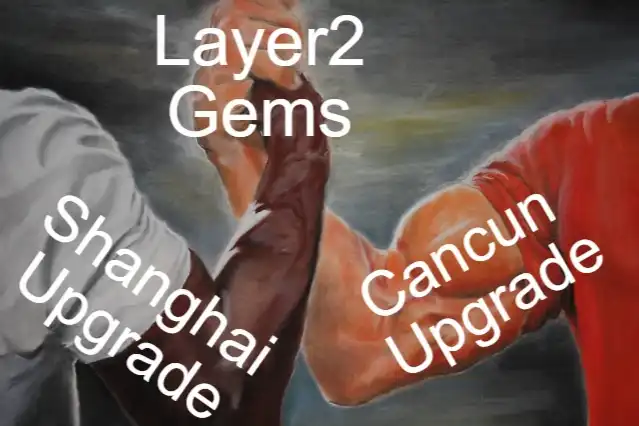
While Shanghai is upgrading, developers are also preparing to activate ether in the next Cancun upgrade Workshop Improvement Proposal (EIP) 4844.
Two Upcoming Ethereum Cancun Upgrades: EOF and EIP-4844
The EOF upgrade contains five EIPs, some of which have already been implemented in the previous Shanghai upgrade, while the rest will be included in the upcoming Cancun upgrade. EVM is the Ethereum virtual machine, which mainly executes the code of smart contracts. The current EVM has only one set of interpretation and verification rules to handle all existing contracts. EOF introduces a new smart contract format, the "EOF contract", and the client and EVM interpreter have been updated accordingly.
So now there are two sets of EVM interpretation and validation rules, and they exist simultaneously. The EVM will be able to handle both legacy and EOF contracts. The benefits brought by EOF include: EVM versioning; adding new control flow operations to improve cost performance; transferring the content of EVM verification at runtime to deployment time, thereby reducing overhead and making contract code safer; code and data separation.
EIP-4844 is designed for Rollup to ease the pressure on the main chain and reduce data and Validation overhead. Rollups are the only trustless scaling solution for Ethereum in the short, medium, and possibly long term. Transaction fees on L1 have been extremely high for several months, and there is an urgent need to do whatever is necessary to help facilitate the shift of the entire ecosystem to rollups.
EIP-4844 provides a workaround by implementing the transaction format, rather than actually sharding those transactions. Instead, data in this transaction format is only part of the beacon chain and is fully downloaded by all consensus nodes (but can be deleted after a relatively short delay). Compared to full data shards, this EIP reduces the upper limit of the number of transactions that can be included, corresponding to a target of ~0.25MB and a limit of ~0.5MB per block.
Although the upgrades of Shanghai and Capella are over, there is still a long way to go for Ethereum to switch from PoW to PoS, and the upgrade is still in progress. BlockBeats will also continue to pay attention to how Ethereum brings higher scalability and better performance, and how to promote the development and application of blockchain technology.

Welcome to join the official BlockBeats community:
Telegram Subscription Group: https://t.me/theblockbeats
Telegram Discussion Group: https://t.me/BlockBeats_App
Official Twitter Account: https://twitter.com/BlockBeatsAsia
 Related Articles