Ethereum Shanghai upgrade completed, will the LSD track double?

Original Title: "Ethereum Shanghai Upgrade Completed, Will LSD Racing Double?"
Original Author: CryptoBricks
Pledging is one of the core gameplay of DeFi, providing higher capital efficiency for the cryptocurrency market. Liquidity Staking Derivatives (LSD) provide the possibility of releasing the liquidity of assets pledged in smart contracts. Before the upgrade in Shanghai, the total amount of Ethereum pledged had exceeded 18 million coins, even though nearly 100,000 coins were withdrawn after the upgrade. However, higher liquidity is expected to attract more funds in the long run, and the increase in the total amount of Ethereum pledged may create a doubling opportunity for the LSD track...
Ethereum LSD's Origin
Last September, the Ethereum beacon chain merged with the mainnet, achieving a significant breakthrough in transitioning Ethereum from a PoW consensus mechanism to a PoS consensus mechanism. Unlike the PoW mechanism that relies on solving puzzles through computation, PoS reduces the hardware cost for network participants to participate in consensus verification, reducing Ethereum's energy consumption by over 99.9%.
However, in order to ensure the security of the network, the participating verification nodes need to pledge 32 Ethereum. This not only increases the threshold for participating in network verification nodes, but also the 14.5% pledge of verification nodes in the total supply of Ethereum has led to Ethereum entering a deflationary phase, causing liquidity tightening in the market.
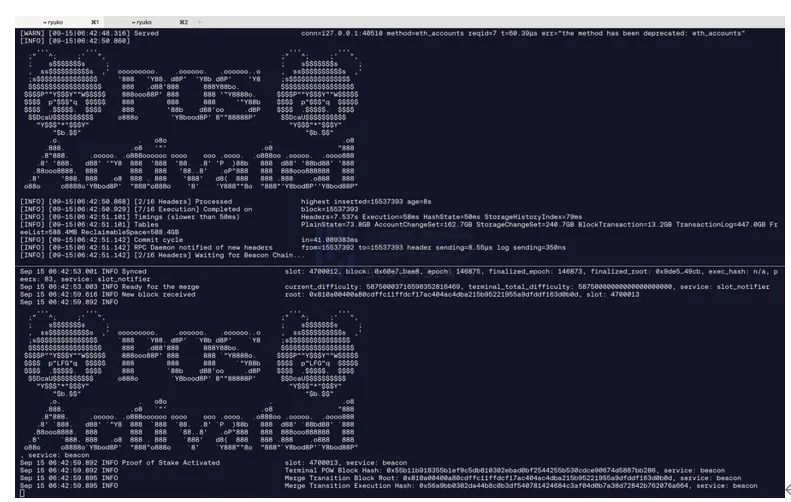
Participants can independently own private keys (responsible for participating in signature verification and receiving staked Ethereum withdrawal private keys), independently run verification nodes, and independently obtain all staking rewards. However, this solution has high operating thresholds and costs, and even after the Shanghai upgrade is completed, only about 1800 validators can cancel their stakes each day, which reduces the liquidity of participants' assets.
Therefore, in response to the needs of different users, the market has provided corresponding solutions.For users with high asset liquidity but do not wish to operate nodes themselves, they can choose the Staking-as-a-Service (SaaS) solution to hand over their signing private keys to service providers to operate and verify nodes, and receive a certain service fee. However, in this solution, there is still a threshold of 32 ETH for participating in verification, and this portion of liquidity is still unavailable.
In addition, although users retain the withdrawal private key, they still need to verify the signature private key when exiting the pledge. Moreover, the user's income is directly related to the platform's operational capabilities. Therefore, at the level of selecting service providers, the user's opportunity cost is increased.
Therefore, the joint collateral model solves this pain point, allowing users to pledge any amount of ETH and receive LSD, with DAO holding control and withdrawal private keys of the ETH, and third parties maintaining verification nodes. This solution almost eliminates the asset and operational thresholds for participating in verification, and disperses users' ETH to different operational nodes to avoid risks, but users lose direct control over the signing and withdrawal private keys.
LSD + DVT
For retail investors, LSD is undoubtedly a relatively popular solution due to its low threshold. Among them, Lido, with nearly 80% market share, accounts for nearly one-third of the total staked amount on Ethereum. Therefore, this article takes it as an example to explain the operation logic of LSD.
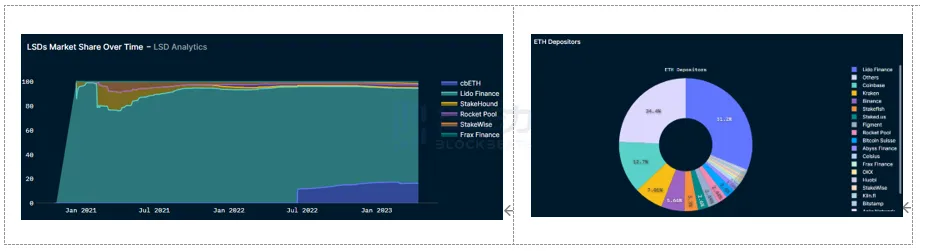
Firstly, users can stake ETH on Lido, and the protocol will send 1:1 stETH as the user's proof of participation in Lido staking. Although there was previously a decoupling of stETH-ETH, after the Shanghai upgrade, stETH can be exchanged for ETH at a 1:1 ratio in Lido, regardless of the price of stETH.
During the staking period, users who act as validation nodes receive validation rewards while also sharing the gas fees and MEV earnings obtained by Lido node operators as block-producing nodes. The dividend is determined based on the user's staking share, and the corresponding amount of stETH is updated daily and sent to the user's wallet. If the protocol encounters slashing, the loss will be shared by all users. After the upgrade in Shanghai, users can withdraw ETH from Lido. During this period, the protocol is managed by Lido DAO users who hold LDO, and they vote to provide a whitelist for operators and to upgrade or update the protocol.
However, as Lido's market share increases, the DeFi Lego based on stETH is also constantly developing, and its influence is no longer limited to the LSD single track. This poses higher requirements for operators: once black swan events such as regulation occur, causing large-scale paralysis (although Lido controls the share of each node and strives to maintain node decentralization at all levels), the scope of its impact will be uncontrollable. Therefore, Distributed Verification Technology (DVT) becomes more important.
Take SSV as an example. DKG technology enables multiple operators to share the same private key while not being able to directly control the entire key. BLS technology allows the fragmented private key to be aggregated into one signature during signing, while MPC ensures that operators can aggregate private keys without revealing their own private keys. IBFT consensus ensures consistency in block verification. SSV delivers the private key fragments to four operating nodes, and as long as the online rate is maintained at 3/4, the entire validation node can continue to operate.
Therefore, LSD Aggregated DVT can provide robustness for the protocol and further enhance the decentralization of verification nodes. In addition, although DVT provides the possibility of delivering withdrawal private keys to users for safekeeping, the current reward distribution mechanism of Lido determines that the withdrawal address is still controlled by the Lido DAO protocol, so the issue of withdrawal private keys may still require community proposals for further protocol improvements.
Upgraded LSD in Shanghai
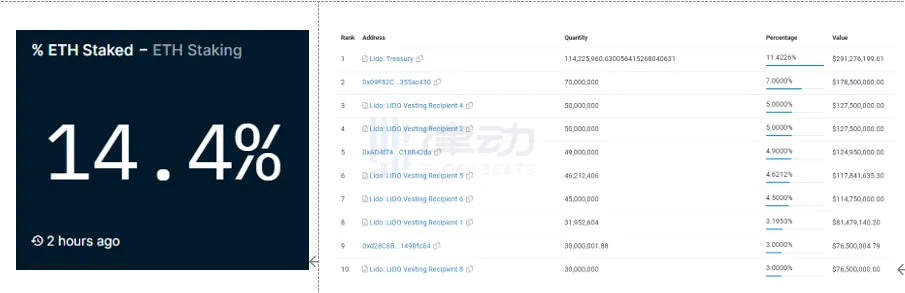
From a data perspective, on April 14th, the Ethereum staking ratio was only 14.4%, while the staking rates of PoS blockchains such as Solana and BNB were all above 60%. With the increased liquidity of Ethereum staking after the Shanghai upgrade, it is expected to attract more funds to participate in staking in the long term. Additionally, there is a possibility of doubling the LSD track based on Ethereum staking. Regarding the recent discussions on the impact of the Shanghai upgrade, the focus has mainly been on the following two aspects, and I will provide my response here:
1/ Threats to Ethereum security by Lido: Firstly, each node independently controls its own node, and each node's share does not exceed 2% of the total network staked amount. Currently, Lido has 29 whitelist node operators (with no affiliation), which is the first layer of decentralization. The Lido DAO is a decentralized autonomous organization controlled by LDO holders. According to the distribution of holders, the top ten holding addresses are relatively dispersed, and retail investors do not account for a high proportion, forming the second layer of decentralization.
With the integration with DVT in the future, Lido's decentralization may welcome the dispersion of the third layer. Therefore, although users may choose other protocols for decentralization, leading to a decrease in Lido's market share, the impact is still relatively limited in the overall LSD track market value doubling.
2/ Withdrawals are open, what is the value of LSD track: In my opinion, although Ethereum withdrawals are open, it is still restricted to withdraw all staked Ethereum. Even with the increase in total staked amount, the daily withdrawal limit will be increased, but withdrawals will still not be released in a short period of time. However, the opening of withdrawals has strengthened the price linkage between LSD and ETH, and the leveraged liquidity provided by LSD to users during the staking period remains unchanged. Similarly, in the case of doubling the track, this concern does not seem to pose a threat for now.
This article is from a submission and does not represent the views of BlockBeats.
Welcome to join the official BlockBeats community:
Telegram Subscription Group: https://t.me/theblockbeats
Telegram Discussion Group: https://t.me/BlockBeats_App
Official Twitter Account: https://twitter.com/BlockBeatsAsia

 Related Articles