Is Shanghai poised for an Ethereum apocalypse? LSD track prospect analysis
Shanghai Upgraded to Ethereum Catastrophe? LSD Track Prospect Analysis
Dynamic area dynamic trend
The Shanghai upgrade, tentatively scheduled for April 13, will allow validators to withdraw and withdraw money from the beacon chain for the first time. As expectations stack up, the market is once again focused on Ethereum liquidity. After the completion of Shanghai upgrade, whether there will be a wave of selling, whether there will be large price fluctuations, what is the prospect of Ethereum pledge track in the future, and what is the trend of pledge income? This paper analyzes and discusses the data of Ethereum coin price, deflation rate, pledge rate trend, supply rate trend, etc. The conclusions are as follows:
Shanghai upgrade after the completion of the short term may have a certain selling pressure (partial withdrawal), this part of the selling pressure on the market has immediate effect;
Only 40% of Ethereum pledges (illiquid pledges) are willing to sell. The cost of these 40% Ethereum pledges is relatively low, which will bring some selling pressure, but the process is slow, in extreme cases it takes 125 days to raise all the pledged Ethereum;
Ethereum's pledge rate can continue to increase in the next few years, and the growth rate will slow down after reaching a critical value.
Regardless of nesting and leverage, the ethereum pledge yield will decrease with the increase of the ethereum pledge rate, but as the blockchain industry continues to develop and more gameplay is derived from the liquidity pledge circuit, the ethereum pledge yield will be higher and the corresponding ethereum pledge rate will be higher than expected.
The impact on Ethereum prices
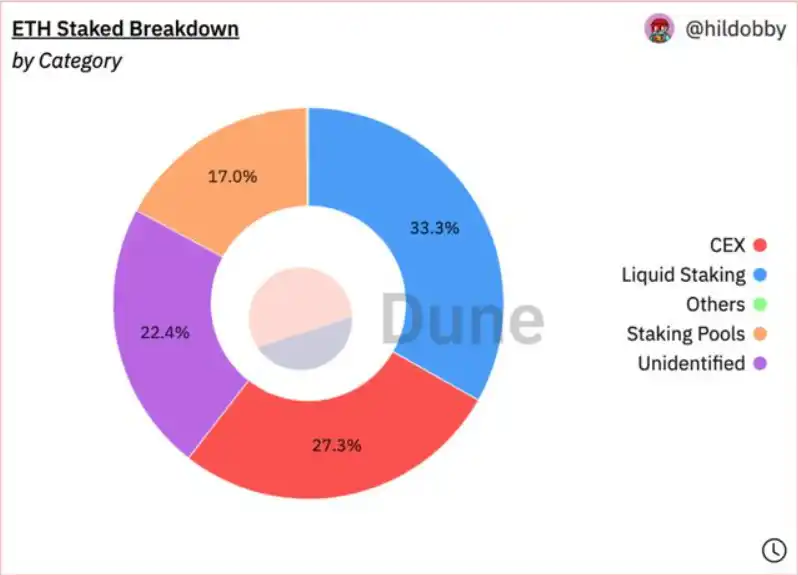
About 60 percent of Ethereum is currently pledged to service providers that provide collateralized liquid derivatives, while only about 40 percent of Ethereum belongs to independent verifiers and pledge pools, which are affected differently by the Shanghai upgrade.
1. Partial and full withdrawals
Withdrawals are divided into partial withdrawals and full withdrawals.
Partial withdrawal:Means that the balance of more than 32 Ethereum (earned rewards) will be extracted directly to the Ethereum address for immediate use, and the validator will continue to be part of the beacon chain and validated as intended;
Full withdrawal:When the verifier quits completely and is no longer part of the beacon chain, the verifier's entire balance (32 Ethereum and any other rewards) is subsequently unlocked and allowed to be used after the quits mechanism is complete.
It is also important to note that the beacon chain validator contains a field called the withdrawal credential, the first two bytes of which are called the withdrawal prefix. This value is currently 0x00 or 0x01, which is set when making a deposit through the deposit facility; Validators with 0x00 withdrawal credentials will not be able to withdraw immediately, and these validators will need to migrate to 0x01 to make partial and full withdrawals.
2. The possible impact of partial withdrawals on Ethereum prices
The partial withdrawal rate is 16 withdrawal requests per block, compared to the current 1 block in 12 seconds, 5 blocks per minute, 300 blocks per hour, or about 7.2k blocks per day; So assuming that each verifier is updated to 0x11 then you can expect about 115k of partial withdrawals per day from the verifier.
According to beaconcha.in data, so far there are 558062 verifiers, so it takes about 4 ~ 5 days to realize the withdrawal of partial withdrawals, the balance of each verifier average 34 ether coins, Thus, it is estimated that the pledgers have earned approximately "(34 -- 32) * 558062 = 1,116,124 Ether pledgers (1.1 million in total).
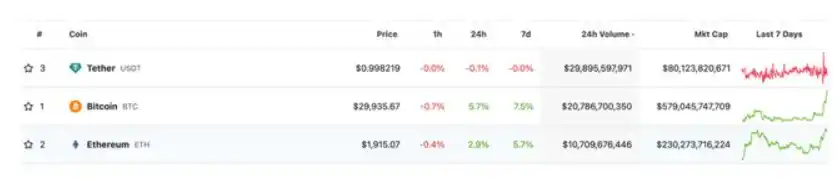
At the current Ethereum price ($1800), about $1.98b worth of ethereum coins will be released within 4 to 5 days, as shown in the figure below. According to CoinGecko data, the total daily spot trading volume of Ethereum is currently $10.4b. Therefore, the total value of partial withdrawals is about 19% of the total daily spot trading volume of Ethereum, with an average release over 5 days, and the daily release volume is 3% to 4% of the daily spot trading volume.
This part is predictable selling pressure, because unlike full withdrawal, which can be converted back into Ethereum through liquidity collateral derivatives before the upgrade in Shanghai, the pledge incentive part (partial withdrawal) can only be withdrawn after the upgrade in Shanghai. Therefore, there is likely to be a certain selling pressure in this part, but the impact of partial withdrawal on the currency price is relatively short-term. Does not affect the price of Ethereum in a long and sustained way; Second, at current Ethereum prices, given the other on-chain behavior of POS participants (who typically continue to compound interest), a significant number of long-term Ethereum mortgagors and holders are not likely to sell at this time.
Further, not all verifiers actually have 0x01 credentials. As shown in the figure below, as of 2023-01-29, approximately 20% of new verifiers did not set the 0x01 credential, according to Data Always.
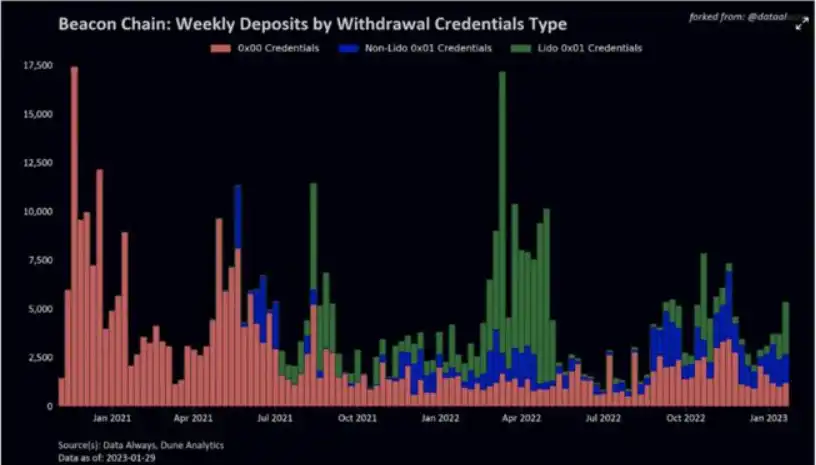
In addition, according to the animation in the study of Date Always, the peak conversion of 0x00 will be reached early the next day after the completion of the Shanghai upgrade and will last for about two days, not immediately upon the completion of the Shanghai upgrade; So in the most extreme case, the first day should see around 110k partial withdrawals of Ethereum (not including Lido 0x01 verifiers).
3. The possible impact of full withdrawal on Ethereum's price
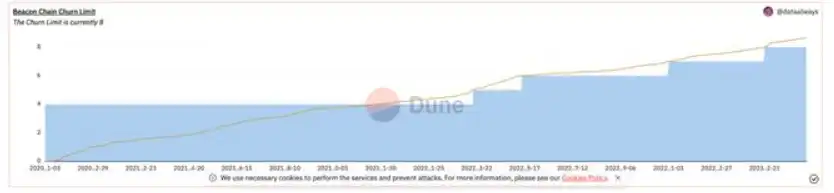
Full and partial withdrawals have the same priority and are in the same withdrawal queue as partial withdrawals, and if the verifier is marked "exited" while partial withdrawals are taking place, the full refund of the balance + award will be performed. However, different from partial withdrawal, the rate of full withdrawal is more restricted. As shown in the following two figures, the current loss limit of full withdrawal is 8, and the maximum amount of withdrawal is 57.6k Ethereum per day. At present, about 18M Ethereum has been pledged, among which LSD and CEX account for 60%. Because this part mostly exists secondary market exit channel.
Therefore, it can be assumed that only the other 40% of the pledged Ethereum that is willing to exit after the Shanghai upgrade will participate, namely 7.2M. Therefore, assuming that there are no more user deposits after the Shanghai upgrade and the daily withdrawal volume reaches the maximum, it will take 125 days for all pledged Ethereum to exit completely.
The two categories that account for 60% of supply are LSD and CEX, most of which issue collateralized liquidity derivatives, such as stETH, cbETH, rETH, bETH, etc.
Take stETH for example, the current exchange rate of stETH against ETH is 0.9996, the price difference is very small. Therefore, if the mortgagor wants to sell, he can convert the liquid derivatives into ethereum directly in the market and sell it without waiting for the upgrade in Shanghai. Because of this, the cost of Ethereum pledged at present is actually very dispersed and constantly changing. There are many people who hold stETH not by pledging ETH, but by trading in the secondary market. For these 60% of mortgagees, the Shanghai upgrade will not have much impact on them, regardless of oversold behavior caused by market selling pressure.
In the market, it is also believed that large pledges may sell at a discount due to concerns about the lack of liquidity of derivatives, so they will wait for Shanghai to upgrade and withdraw from the pledge before selling. This is a valid concern, but if we look back at the historical price of Ethereum, as shown in the chart below, we can see that there was a significant discount between March 2021 and June 2022. In March 2021, it was because the market was at a high and most of the sales were for users who had pledged at the end of 2020. Cash out here;
The discount in June 2022 was due to the 3AC and FTX events at that time, which made some institutions sell a large amount of stETH, leading to price unanching. It can be seen from this that investors with large capital will still have selling behavior in the case of insufficient liquidity, which depends on the market conditions rather than concerns about liquidity. Therefore, it would be incorrect to attribute Ethereum's potential future decline solely to expectations of a liquidity crunch.
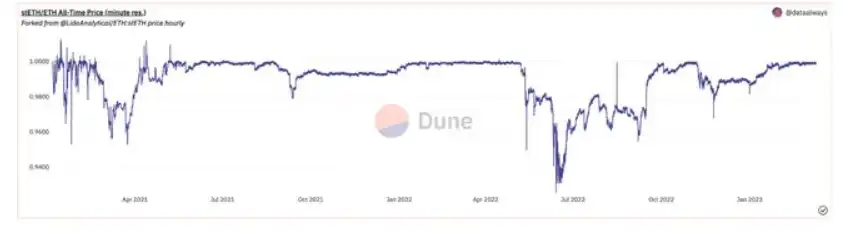
4. Influence of Ethereum deposit cost price on price fluctuation of Ethereum after Shanghai upgrade
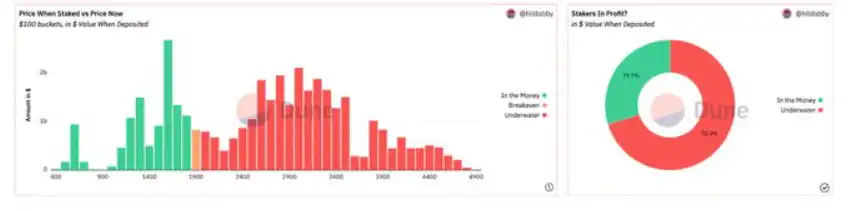
As the chart above shows, there are now more borrowers with deposit costs "under water" than "in the black", so there are two schools of thought: those who think these losses will take deposits to stop losses, and those who think losses will be more likely to hold because of "loss aversion".
As for Ethereum pledge, there is no cost problem for most of the Ethereum pledges (60%), because, as mentioned above, stETH can be converted into ETH and sold through the secondary market before the upgrade in Shanghai. Therefore, for 60% of the pledges, there is no impact.
But for the other 40%, most of them are early participants in Ethereum POS pledge, and the cost price of this segment is relatively low; Ethereum beacon chain main network deposit contract address was first launched In November 2020, at which time the ETH price was only about $400 ~ $500, and it was not until the end of March 2021 that the Ethereum token reached today's price. Therefore, it may be speculated that this part of the pledge accounts for a large part of "In the Money" in the above figure. And such a cost price to today's $1800 has increased by 3~4 times, so this part of people may bring certain selling pressure.
In addition, due to the market sentiment, the selling pressure of this part of people may cause FUD sentiment in the market, resulting in panic selling of 60% of the pledgors. However, as mentioned above, the exit rate of Ethereum pledge is limited, so the selling reaction of these pledgors is relatively slow in the market.
Impact on Ethereum pledge rate and pledge rate of return
The above mentioned Shanghai upgrade may have an impact on the price of Ethereum. In addition, the impact of Shanghai upgrade on Ethereum will also be reflected in the pledge rate and pledge yield of Ethereum.
1. Influencing factors of Ethereum pledge rate and pledge yield
After analysis, we believe that the pledge rate of Ethereum after Shanghai upgrade will be higher than now, but it is difficult to achieve such a high pledge rate (60% ~ 80%) as other public chains; In addition, with the increase of the pledge rate, without the calculation of nesting dolls, LSDFI and other gameplay, the pledge yield will decline.
Here are three factors that could be positive for Ethereum's pledge rate growth.
i) As shown in the figure below, Ethereum's pledge rate is only 15.52% at present, while other public chains have the highest pledge rate of 73%. Therefore, it can be judged that Ethereum's pledge rate is definitely low and has huge room for growth.
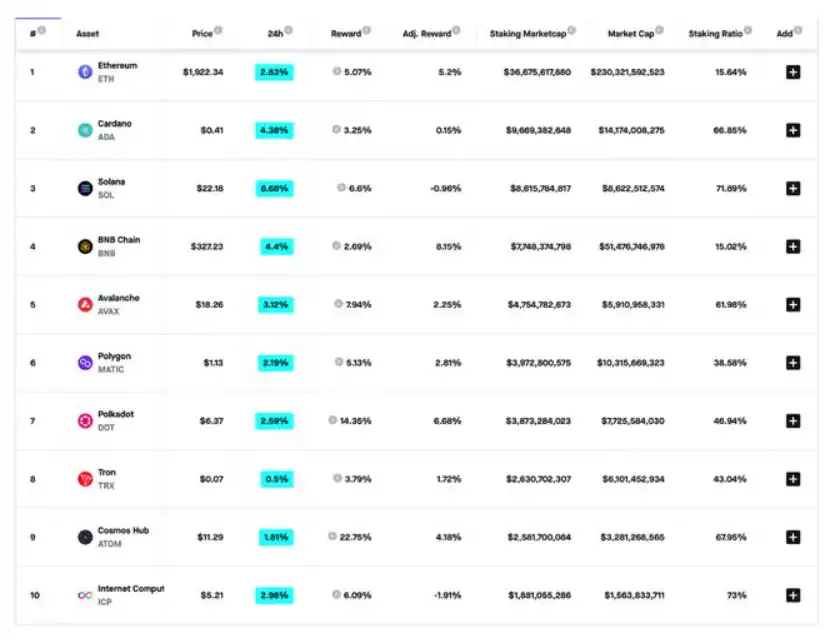
ii) Before the completion of Shanghai upgrade, Ethereum pledged in the beacon chain cannot flow, and a large amount of funds are locked in the beacon chain, leading to the inflexible use of funds, which may reduce users' desire to pledge; With the completion of Shanghai upgrade, this liquidity risk problem will be solved. Ethereum pledge will realize a closed loop from deposit to withdrawal, and the exchange rate of the mortgage liquidity derivative token to the Ethereum token price will return to 1: 1. This may attract the pledge of a large number of institutions and capital, but in fact, this point does not have much reference value in the current LSD prevalent pledge environment.
iii) Ethereum is currently in a state of deflation, and the current inflation rate is -0.62%, which indicates that the value of Ethereum is constantly increasing over time according to supply and demand relations, while other public chains have such a high pledge rate precisely because of their higher pledge yield, which is the result of the continuous issuance and depreciation of tokens, so from this point of view, For long-term pledges, putting money on Ethereum may be a more attractive option; It's still in a bear market, and the market is less active, so Ethereum is already in a deflationary state. In the bull market that followed, more gas was consumed per day, so the shrinkage of Ethereum would be more significant.
However, Ethereum pledge rate is not infinite growth, we believe:
i) Ethereum cannot offer as high a pledge yield as other public chains, so more users may be more inclined to pledge their assets to public chains with higher yield.
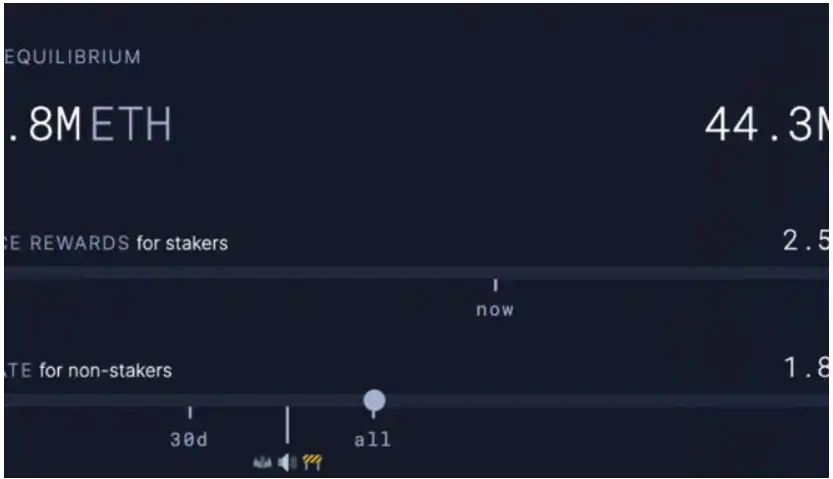
ii) In addition to the lack of advantage in the pledge rate compared with other public chains, the pledge rate of Ethereum itself will decrease with the increase of the pledge rate (regardless of the doll, LSDFI, etc.). As shown in the following two figures, the pledge rate and pledge yield of Ethereum are dynamically balanced. According to this model, when the amount of pledge of Ethereum reaches 44.3M ETH, the annual rate of return is only 2.5%, which is about 2.5 times higher than the current amount of pledge of 18.2M. The fact is that such a pledge yield is not enough to attract the majority of users, so this paper predicts that Ethereum's pledge rate will slow down after doubling from the current pledge rate.
2. Ethereum supply, pledge rate and pledge yield forecast
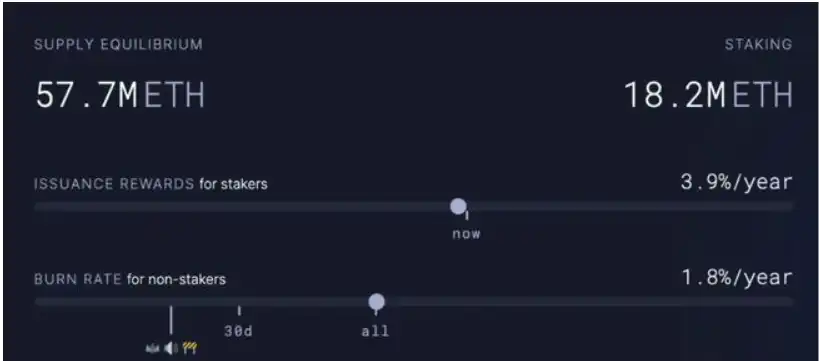
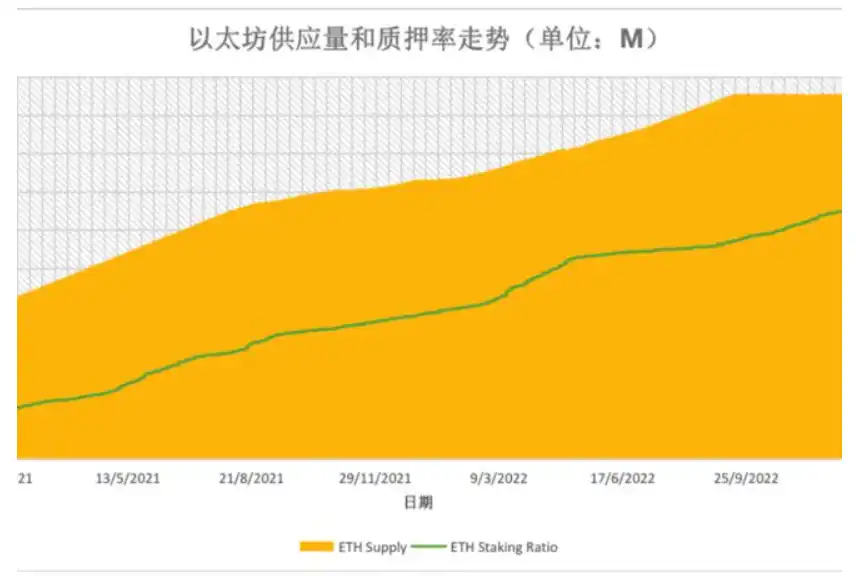
As shown in the chart above, it can be seen that since September 2022, the growth of ethereum supply has been flat or even declining. Since the opening of Ethereum pledge, the amount of ethereum pledge has been rising, and the upward trend of ethereum pledge has not slowed down so far.
Based on this, we believe that:
In the bear market where market trading is not active enough, the growth of ethereum supply gradually flattens out and has a downward trend. It can be expected that the arrival of the bull market, the sharp rise in trading volume and the increase in gas consumption fee will further accelerate the deflation of ethereum. Ethereum pledge rate will rise in the context of supply deflation. However, with the continuous increase of Ethereum pledge rate, the pledge yield of a single node will decrease. When Ethereum pledge rate reaches a certain value, it will enter a dynamic equilibrium state between the two.
However, we believe that with the continuous development of the blockchain industry, liquidity pledge, as the DeFi Lego component, will build and derive more gameplay on it, and the corresponding Ethereum pledge rate will be higher than expected. According to the model, when the amount of ethereum pledge reaches 44.3M, the pledge yield will drop to 2.5%; However, LSD will bring a lot of new gameplay including circular loan, nesting doll, etc. Therefore, with the development of LSD track and blockchain industry, more attractive comprehensive pledge yield will promote ethereum pledge track to a higher dynamic balance.
Original link
Welcome to join the official BlockBeats community:
Telegram Subscription Group: https://t.me/theblockbeats
Telegram Discussion Group: https://t.me/BlockBeats_App
Official Twitter Account: https://twitter.com/BlockBeatsAsia

 Related Articles