Mint Ventures: In-depth analysis of Shapella's upgraded yield, competitive landscape, and long-term impact of LSD-Fi.

Source: Mint Ventures
ETH Staking's Past and Present
Before we begin, let's briefly review ETH Staking. Unlike most PoS public chains currently online, Ethereum's PoS does not support native proxy delegation and limits the maximum stake size for a single node (which is profitable) to 32 ETH. The benefits of this staking method are obvious, as it can minimize the possibility of a single entity controlling a large node to manipulate Ethereum's consensus, thus maintaining the decentralization of the Ethereum network as much as possible. However, due to the high complexity of node operation for ordinary users, in addition to solo staking, three other types of staking have gradually emerged in practice: staking pools, liquid staking, and cex staking. The characteristics of these four staking methods are as follows:
- Solo staking refers to the method of staking where users handle the entire staking process and subsequent maintenance themselves. Its main disadvantage is the high requirements for equipment, funds, knowledge, and network.
- Staking pools to some extent relieve the staking users' demand for network and hardware. Staking users only need to pay a certain fee to professional staking service providers to stake their own 32ETH and obtain profits. At the same time, this method also ensures that the withdrawal private key is still controlled by the staker itself, and the degree of control over the funds is relatively high. However, it still has high requirements for the staker's funds and knowledge. In some categories, this staking method is also called Staking as a service.
- Liquid staking takes the outsourcing of node operation to professional node operators a step further in staas. It collects users' ETH for staking operations through a staking pool, allowing users to stake any amount. At the same time, the staking pool issues a staking derivative called LSD (Liquid Staking Derivatives/Tokens, which we will refer to as LSD in the following text), which has a wide range of use cases in DeFi, as we will discuss in detail later. Of course, in the liquid staking model, all staked funds essentially belong to the contract owned by the staking pool. Staking users need to trust the staking pool. In some categories, this staking method is also called Pooled staking.
- Cex staking is handled entirely by the cex, allowing users to stake any amount and typically issuing staking certificates (such as Coinbase's cbETH or Binance's bETH) to users.
The following figure shows the historical changes in the relative share of ETH staking.
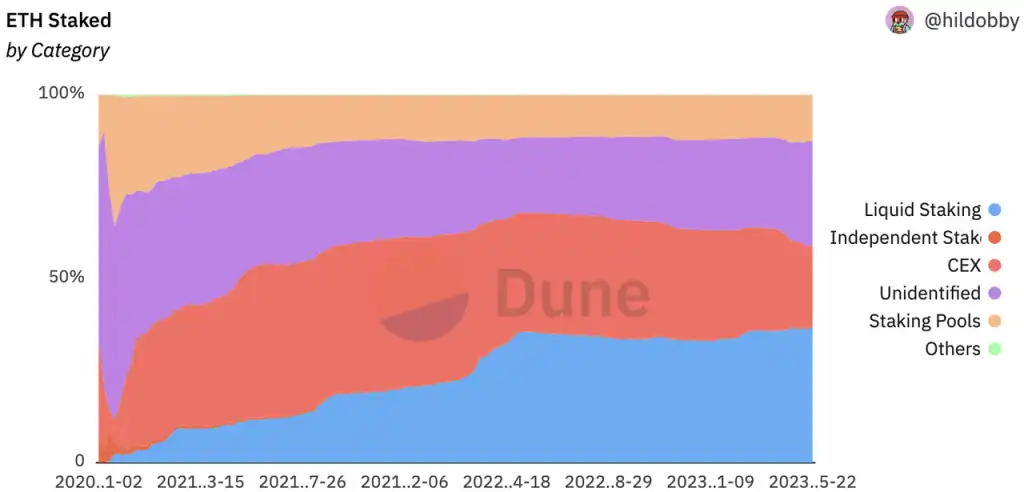
Source: https://dune.com/hildobby/eth2-staking (Note: Due to the complexity of statistics, the proportion of solo staking is difficult to calculate. In most of the statistics on staking classification, there will be a category called "Unidentified" (as shown in the figure above). According to the recent analysis by Rated, 6.5% of the total staking amount is provided by solo stakers.)
From the above figure, we can clearly see that, except for the first two months after the launch of the beacon chain, until April 2022, due to the natural interest channel provided by CEX Staking, which is based on the large number of ETH held by users, CEX Staking quickly became the leader in Staking, which is not what the Ethereum Foundation and community members wanted to see. With the investment of institutions such as Paradigm in Lido, as well as the good liquidity and composability gradually built by stETH, Lido quickly developed and subsequently drove the development of the entire liquid staking type. Until now, liquid staking has been leading in the race.
After the successful launch of Shapella, the stake share of CEX has significantly decreased. A considerable number of users who originally staked ETH on CEX have started to shift towards liquid staking and solo staking (Unidentified).
According to specific collateral entities, Lido currently occupies 31.8% of the total collateral market share, ranking 3rd to 5th are three centralized exchanges, ranking 6th is another liquid staking service provider Rocket Pool, and rankings 7-10 are all Staking pools.

ETH Staking Future Yield
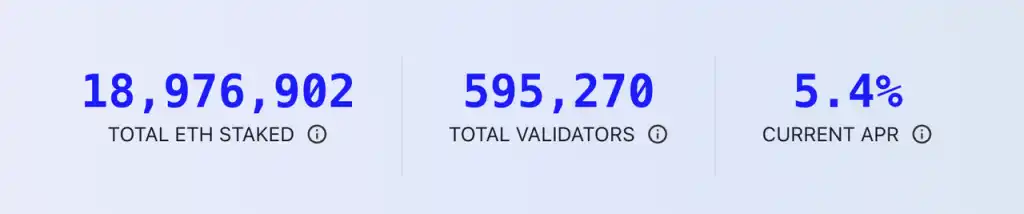
The level of pledge rewards is a determining factor for whether ordinary users participate in pledge. To explore the future development of ETH staking, we need to understand the composition of pledge rewards and future development trends. We know that after the Merge, in addition to receiving rewards at the consensus layer, pledging Ethereum can also receive rewards at the execution layer. Currently, the total APR of these two parts is 5.4%.
Source https://ethereum.org/en/staking/
The reward for the consensus layer is ETH, which is issued by the Ethereum network. The release of the reward increases as the total staking amount increases, but the APR of staking decreases as the total amount of staked ETH increases. Currently, the APR of the consensus layer reward is 3.4%. It is widely estimated that the ETH staking rate will be around 25-30% by the end of this year. When the staking rate reaches 30%, the APR reward for the consensus layer is roughly 2.4%. This reward is much lower than that of most PoS chains, and it is also a manifestation of the Ethereum Foundation's "minimization of ETH issuance" principle.
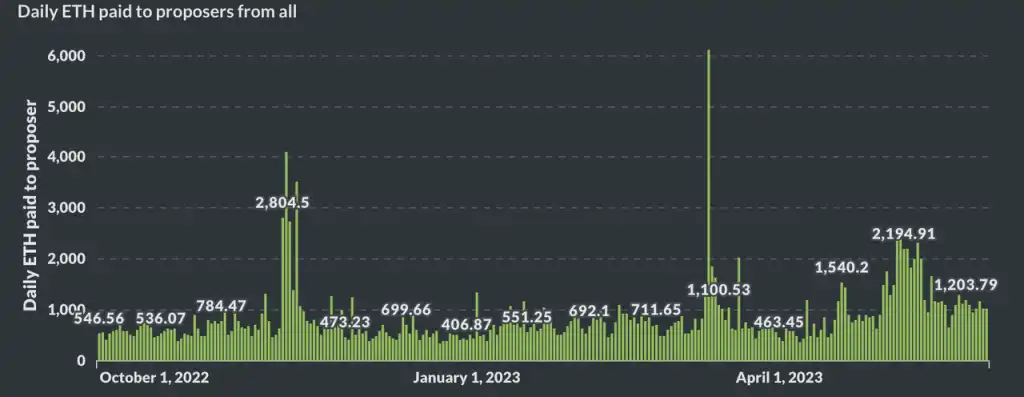
The rewards for Ethereum staking execution layer consist of two parts: 1) Priority fee, which is the portion of gas paid by users excluding the portion that is destroyed, and 2) MEV. The common feature of these two parts is that their profits do not increase with the increase of staked ETH. This part is the main variable of ETH staking rewards, and we need to further study it.
Source https://transparency.flashbots.net/

Source: https://dune.com/LidoAnalytical/lido-execution-layer-rewards CL_APR represents the yield of the consensus layer; EL_APR represents the yield of the execution layer.
Flashbots has compiled the total income of proposers (i.e. validators) since the Merge. Lido has also calculated the consensus layer and execution layer income APR since the Merge, with both showing a consistent trend. Lido has also compared the income of the consensus layer and execution layer, and we will analyze this in detail using Lido's charts.
We can see that after the Merge, the consensus layer's APR slowly decreases as the total staked amount increases, while the execution layer's APR fluctuates more, averaging around 1.5%, allowing for staking rewards of up to 5%. When there is frequent activity on the chain (such as during May's meme season), the APR from the execution layer can even surpass that of the consensus layer, resulting in Ethereum staking yields approaching 10%. As the "risk-free rate of return" for the Ethereum network (see Mint Clips | How to Define the Native Benchmark Interest Rate in the Crypto World?), staking rewards are highly attractive to ETH holders.
So how will the yield of the execution layer evolve in the future? First, we need to understand the proportion of priority fees and MEV that contribute to the execution layer yield for stakers. We can refer to the detailed analysis of income data for various roles in the Ethereum execution layer ecosystem in January-February 2023 by MEV data service provider Eigenphi:

Source: https://eigenphi.substack.com/p/value-allocation-in-mev-supply-chain
(This content contains HTML tags and an English URL in an anchor tag, which should not be translated.)
We can see that over a period of 2 months, the validator fee and MEV make up the Ethereum staking rewards on the execution layer in a ratio of 55% to 45% (44.12 million to 34.72 million).
We will explore the future trends of priority fees and MEV.

Ethereum network's priority fee Source: https://tokenterminal.com/terminal/projects/ethereum
Regarding priority fees, since the launch of EIP-1559, the current market has undergone a bull-bear transition. We can see that priority fees are closely related to market heat. During the bull market period in 2021, the daily average priority fee can reach nearly 10 million US dollars, while during the bear market period in 2022, the daily average priority fee is around 800,000 US dollars. During the Meme Season in May of this year, the daily average priority fee can reach around 3 million US dollars. In the future, priority fees will still fluctuate with market volatility, and this part of the income is denominated in ETH and will continue to fluctuate with the market in the future.
MEV is more complex, and its composition mainly includes arbitrage, sandwich attacks, and liquidation, in addition to MEV that cannot be completely analyzed on the chain. We have not found the latest trend data on MEV after the Merge. However, the Ethereum Foundation has been negative about MEV for a long time. One year ago, they proposed the PBS (Proposer-builder separation) plan, one of which aims to eliminate the impact of MEV on small stakers' income. Recently, Justin Drake, the research institute of the Ethereum Foundation, proposed a plan called MEV burn, which plans to destroy all MEV in the next 3-5 years as another force for Ethereum's deflation. Although this plan is still in the planning stage and involves many interests, from the successful transition of Ethereum from PoW to PoS, they have the ability to "convince" key stakeholders in the ecosystem to give up their interests and achieve the Ethereum roadmap.
Therefore, MEV, which accounts for approximately 20% of the total staking rewards, is likely to be reduced or even disappear in the medium to long term due to its inconsistency with the value orientation of the Ethereum Foundation.
Another marginal factor worth noting is L2. Under the driving force of the Ethereum roadmap centered on Rollup, more and more transactions will inevitably be transferred from Ethereum L1 to L2, which will inevitably reduce the MEV and priority fees on the Ethereum mainnet. Currently, the MEV/priority fees on L2 are handled by L2 itself and have nothing to do with the stakers on the Ethereum mainnet. Especially after the Cancun upgrade further reduces the cost of ETH L2, it may drive the further development of L2, and the overall fees+MEV that L1 can obtain may also be further reduced as a result.
Overall, in terms of the composition of ETH staking rewards, taking into account the impact of MEV burn and L2, when the proportion of ETH staking reaches 30%, the rewards for ETH staking are likely to decrease to a level of 3% (including 2.4% consensus layer rewards and 0.6% execution layer rewards). This reward rate will have a significant impact on the enthusiasm of users to participate in staking.
Liquid Staking
is still likely to be dominated by staking, and its concentration may further increase.Shapella has upgraded and activated the withdrawal function of ETH, providing liquidity for ETH pledged through Solo staking and Staking pool methods. The core factor behind the rapid development of Liquid staking from 2021 to 2022 is that the liquid staking protocol can provide liquidity for LSD, thereby indirectly realizing the exit of the pledge. Therefore, Shapella's upgrade has clearly reduced the advantage of liquid staking. Although solo staking still has a considerable operational threshold, the tools serving solo stakers are increasing, and the threshold for solo staking will gradually decrease. Moreover, solo staking has the legitimacy of maintaining the decentralization of the Ethereum network and has received strong support from the Ethereum Foundation.
Why do we still believe that liquid staking will maintain its advantageous position in the staking race, and even the concentration may further increase?
The main reason is composability. LSD has good composability, which means there is a possibility of obtaining higher returns/higher capital efficiency. Users who participate in Staking are naturally sensitive to returns and tend to choose higher-yielding staking methods. Due to LSD's high composability, it actually provides staking users with higher returns.
At the current base yield of 5.6% for staking, LSD can easily obtain an APR of 10%. Taking Lido's stETH as an example:
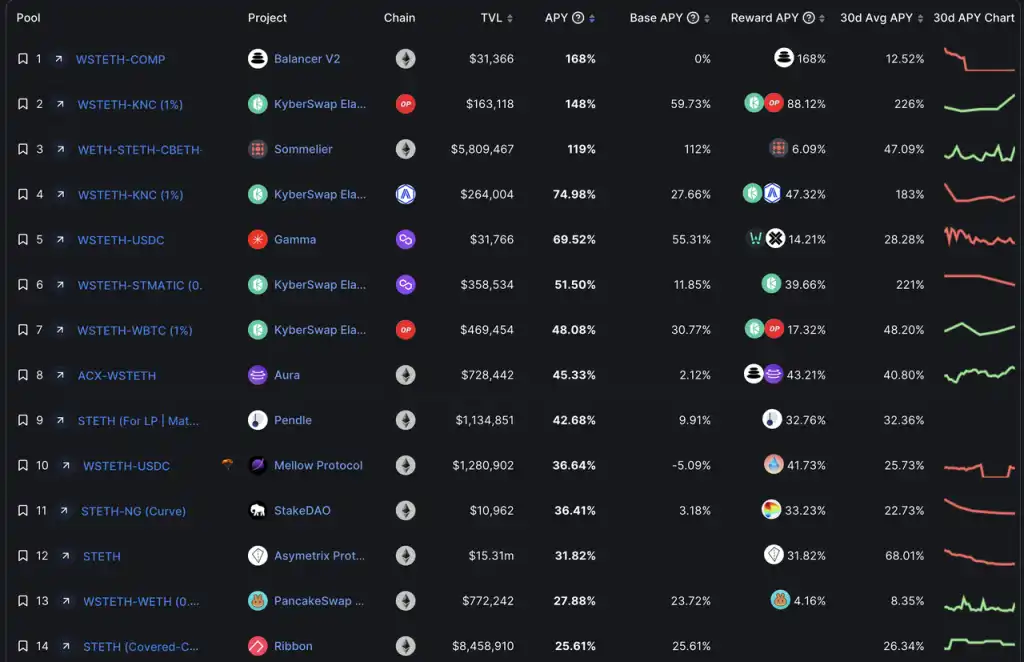
Source: https://defillama.com/yields?token=STETH
We can see that currently stETH LP can easily obtain an APR of over 50%, considering the capital occupation of paired assets, the total APR can also exceed 25%; while stETH single currency can also obtain an APR of over 25% in Asymetrix (LSD's pool together) and Ribbon (option protocol) (although it may face some risks), overlaying stETH's own 5.6% APR, which will make the total earnings of users who stake through Lido reach 30%.
Aside from its high yield, stETH is also widely integrated into DeFi blue-chip protocols: Maker, Aave, and Compound all support stETH (wstETH) as collateral, with little difference in collateral parameters compared to ETH. There is still over $1.1 billion in liquidity in Curve's stETH-ETH, making it more convenient to obtain liquidity whether through direct swaps or collateralized borrowing.
These advantages are not available for solo staking or staking through staking pools. Especially, if the ETH staking yield decreases to only 3% as mentioned earlier, people are likely to choose a simpler and more profitable option considering the equipment, knowledge, time, and effort that solo stakers and pool stakers have to pay for a 3% yield.
Ethereum community users are willing to maintain the decentralization of Ethereum, but they also need to consider opportunity costs. "Maintaining the decentralization of Ethereum is important and cool, but I still hope to choose 30%".
LSD and LSD-Fi
After the upgrade of Shapella, there have been many LSDfi projects in the market, which share the common feature of attracting users' LSD deposits for various financial applications. Many people believe that we will encounter an LSDfi summer.

Source: https://dune.com/defimochi/lsdfi-summer
We do not discuss the merits of specific LSDfi projects in this article, because in my opinion, LSDfi does not create a new business category, but only allows LSD to be used as collateral for many businesses. Essentially, what these protocols do is still stablecoins, yield aggregation, Dex, and interest rate services. Whether their business can be successfully developed still depends on their understanding of the stablecoin, yield aggregation, Dex, and interest rate service markets. In the LSDfi projects that have been launched so far, we have not yet seen any projects that can break away from Fork and simple Yield farming games. Of course, there are still more high-quality LSDfi projects that have not yet been launched, and we look forward to more innovations based on LSD in the future.
We want to discuss the impact of LSDfi on the entire Staking industry.
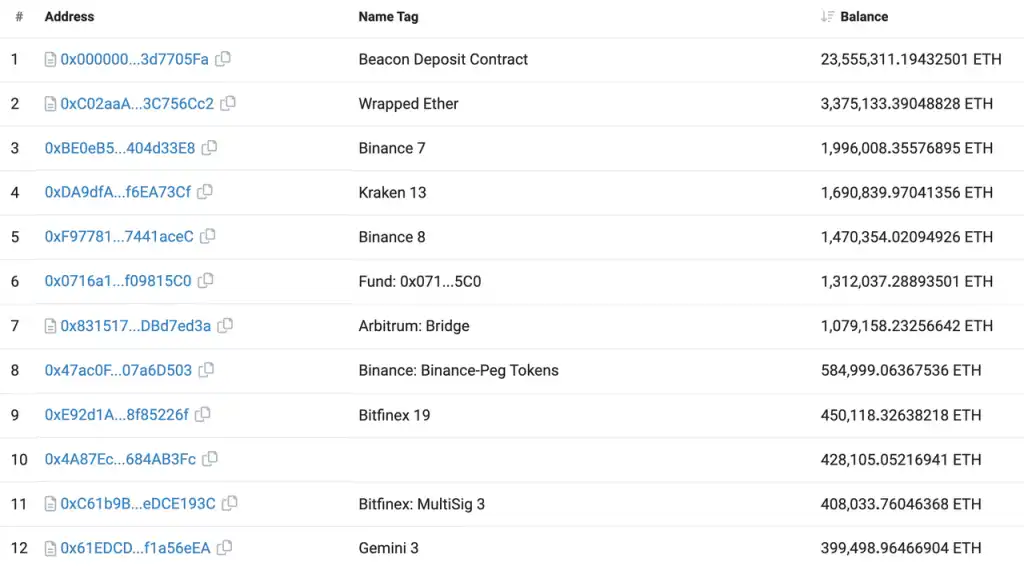
Source: https://etherscan.io/accounts
Based on this wave of LSDfi, more and more LSD projects will be launched with brand new tokens, which means they have brand new market budgets. What happened on unshETH, Agility, and Lybra may also happen in the next 3-6 months in LSDfi, and LSD will continue to appear with APR far exceeding ETH on the chain, which may form a self-reinforcing flywheel effect between LSD and LSDfi: the more LSDfi, the higher the yield provided, and ETH holders will be more motivated to convert their ETH into LSD; more and more LSD will also encourage DeFi protocols to target this group of users, attract them with high yields, and get through the cold start-up phase of the protocol.
Ultimately, all DeFi protocols may be referred to as generalized LSDfi, as they all more or less support LSDfi (in fact, currently, with the exception of a few stablecoin protocols, the vast majority of DeFi protocols are already associated with LSD). Clearly, LSD can capture the beta of LSDfi. The popularity of LSDfi will further promote the share of liquid staking in the overall staking track.
Ethereum Foundation's Attitude
Regarding issues related to staking, the Ethereum Foundation has shown the following attitude:
1. We do not want too much ETH to enter staking. Too much ETH entering staking will not only increase the release of ETH rewards at the consensus layer, which goes against Ethereum's "minimize viable issuance" philosophy, but also reduce Ethereum's economic bandwidth (economic bandwidth, a concept proposed by Bankless, referring to the market value of Layer1, which is the foundation for all Dapp operations).
2. Negative view on MEV. For every Ethereum staker, MEV is a huge reward that can come from the sky at any time with a very low probability. If not intervened, it is easy to appear forced centralization (such as BTC and ETH in PoW mining pools), thus establishing new alliances on top of Ethereum's consensus (such as the current MEV-boost), causing unnecessary and potentially unsafe complexity at the consensus layer. In the long run, the Ethereum Foundation will push for the destruction of MEV, turning it from a privilege of a few validators to a common reward for all ETH holders.
3. I don't want to see an LSD that is too powerful, powerful enough to "replace" ETH on the Ethereum mainnet. This will also bring more unnecessary security risks to ETH.
The main idea behind Ethereum is to maintain a decentralized consensus layer while not affecting the characteristics of ETH as the main collateral asset of the Ethereum network, and also not wanting the consensus layer of Ethereum to be affected by protocols built on top of Ethereum.

Source https://ultrasound.money/
stETH is currently the largest non-native and non-stablecoin asset on the Ethereum network. While USDT and USDC, which rank higher than stETH, have a very wide range of use cases, they are essentially maintained by the credit of Tether and Circle. If they encounter problems, it may indeed have a significant impact on Ethereum, but it will not consume Ethereum's credit.
However, the special thing about stETH is that it has been integrated as collateral similar to ETH by almost all DeFi protocols. Let's do a thought experiment. If Lido Finance's contract is attacked and all Lido withdrawal private keys on the beacon chain are controlled by hackers, will Ethereum need to undergo a hard fork like the DAO incident?
No one wants to see this, so it's understandable why the Ethereum Foundation needs to work hard to support solo staking, why the Ethereum community is discussing whether to limit the scale of Lido, and why Lido will make decentralization its main task going forward. However, the problem is that the emergence of a large liquid staking service provider is not the result of some evil centralized organization, but the natural result of market competition. Even if the Ethereum Foundation/core community can control the scale of Lido in some form, there will be Mido or Nido appearing as the next staking hub.
There are two worlds in front of us:
1. One is what the Ethereum Foundation originally hoped to see: the proportion of ETH staked is not high enough to maintain security, and most ETH is still used as collateral assets on the mainnet to maintain the normal operation of various Dapps. The main body of staking is Solo staker.
2. Another possibility that we may actually see is that due to the presence of one or more powerful LSDs, more ETH enters liquid staking, and this (or these) LSDs become collateral for various DAPPs, to a large extent, this (or these) LSDs "become" ETH.
From the current perspective, the probability of the latter appearing is much higher.
Reference:
https://eigenphi.substack.com/p/value-allocation-in-mev-supply-chain
https://www.youtube.com/watch?v=nb7x7n8Ga3U
Original article link
Welcome to join the official BlockBeats community:
Telegram Subscription Group: https://t.me/theblockbeats
Telegram Discussion Group: https://t.me/BlockBeats_App
Official Twitter Account: https://twitter.com/BlockBeatsAsia