After the Shanghai upgrade, how can the established DeFi app benefit from the LSD track?
原文标题:《 以太坊上海升级,老牌 DeFi 应用如何切入 LSD 赛道分一杯羹? 》
原文来源: 西柚,ChainCatcher
Ethereum will officially launch the Shanghai Upgrade at 22:27:35 UTC on 12 April (06:27:35 on 13 April), with a block height of 6209536. At that time, ETH2.0 will enable users to extract the pledged ETH and rewards on the main network. Compared with the previous locked state, the pledge has more options, which will encourage more users to pledge ETH to the chain.
According to Beaconscan browser on the chain, as of April 12, there are about 563,000 active validators, pledged more than 18.17 million ETH, worth about $34.5 billion, the number of pledged ETH accounted for about 15% of the total circulation.
StakingReward platform shows that the pledge rate of other mainstream POS networks on the same track is mostly around 50%. For example, the pledge rate of Solana is about 70%, Avalanche is 66%, Polygon is 39%, Near is 46%, etc. Compared to these POS networks, the current 15% pledge rate on the Ethereum chain has a lot of room to increase.
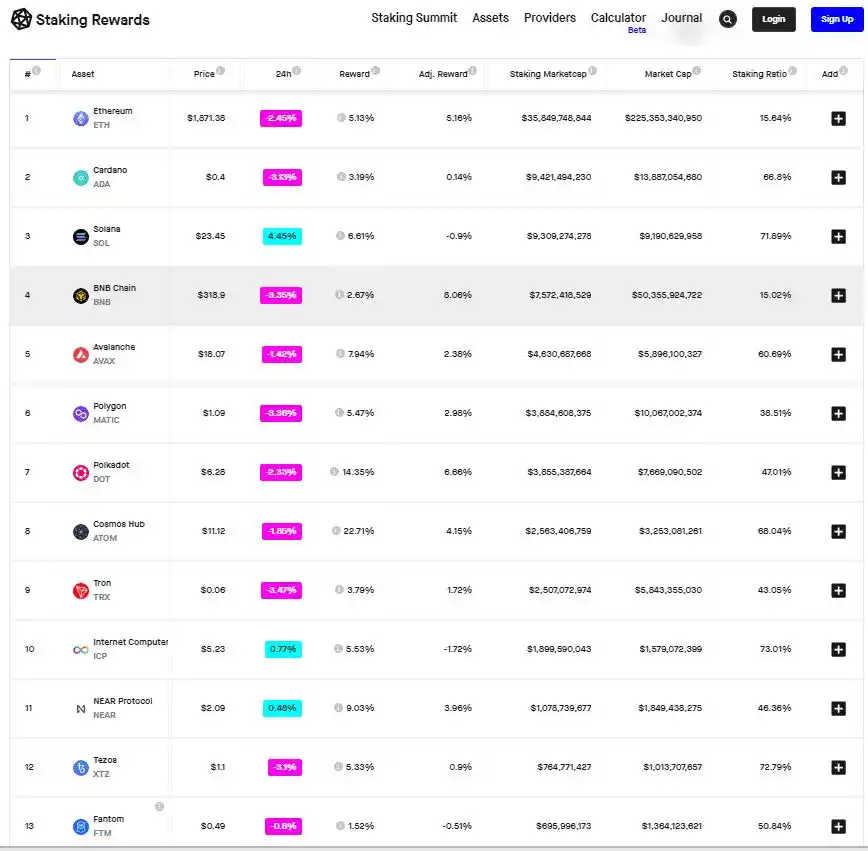
StakingReward platform pledge rate
There are many views that ETH pledge rate may reach 50%-60% in the future, compared with the current amount of pledge there is about three times more growth space, LSD is very likely to grow into a business volume of 100 billion track. This is why before Shanghai upgrade, LSD racetrack related crypto asset market first reason.
Currently, LSD product tracks can be divided into three categories:
One is Ethereum pledge infrastructure.DVT (Distributed validator technology) products are mainly represented by SSV, Obol and Diva. DVT products are designed to ensure the stability of Ethereum verification blocks while improving the degree of decentralization of the network. Through fragmented verification private key and lead node rotation and other technical solutions, the verification nodes are diversified and the single point of failure is reduced.
Second, liquidity pledge platform.It is mainly responsible for helping users to pledge Ethereum more easily and with higher capital efficiency. It can be divided into centralized exchange and decentralized liquidity pledge platform. Commonly seen Lido, Rocket Pool, and Stakewise platforms are decentralized mortgage platforms. They lower the barrier to entry, providing the opportunity for small funds and unfamiliar on-chain users to participate, while also freeing up liquidity through the stakeproof token.
The third is the DeFi application products built around liquidity pledge certificates (also known as LST, also refers to LSD assets, such as Lido's stETH).All kinds of DeFi Lego combination means will be used to improve the yield and liquidity of LSD liquidity pledge certificates such as stETH. MakerDAO, for example, is launching ETHD, a synthetic counterpart to LST, and yETH, which covers a basket of LSD assets, so on.
After the upgrade of Ethereum Shanghai, the pledge certificate LST can be directly exchanged back into ETH, eliminating the hidden danger of decoupling before. The price of LST anchored ETH will be more stable and become the same quality assets as ETH. LSTS can be used as collateral in lending apps such as AAVE, as leverage, and even as underlying trades in some derivatives apps.
Ethereum pledge may generate hundreds of billions of LST. This new asset is reconstructing and changing the revenue structure of traditional DeFi applications. DeFi products built around this new asset class may become new investment opportunities in the market.
In fact, these LSTS have already become an important object of contention for old DeFi applications. Now, many old DeFi applications are faced with the weak growth of users on the chain, and ETH2.0 pledge will promote the flight of locked ETH in their applications. So the old DeFi wants to maintain its TVL or new growth opportunities. Need to accept the LST assets, cut into the LSD track also share a piece of the pie.
Many DeFi applications benefit from these services. For example, the LST/ETH mobility may add new services to DEX such as Curve and Balancer. In the Aave v3 version of the lending platform, users can use LST assets (such as stETH) to lend more than 90% of ETH through e-Mode.
So, what are some of the ways in which established DeFi apps enter the LSD circuit? It can be mainly divided into two categories: one is to help improve the collated-related income and utilization rate of LST assets; the other is to help improve the liquidity of LST tokens.
MakerDAO, Frax and Yearn increase the return on LST tokens
At present, there are two ways to improve the pledge income. One is to improve the fund utilization rate and yield of LST token, and the other is to directly improve the income of LSD Ethereum pledge.
1.MakerDAO launched LST token synthetic asset ETHD and pledged to cast DAI to improve the utilization rate of funds
On February 9, MakerDAO co-founder Sam announced on Twitter that Spark Lend, the first of Spark's lending apps, will be launched, along with EtherDAI, a synthetic asset for LST tokens.
According to the MakerDAO Community proposal, the Spark Protocol is the first product developed by Phoenix Labs, a company founded by core members of the MakerDAO community to develop new decentralized products to integrate into MakerDAO and help it expand its ecosystem. All products it develops will be owned by MakerDAO.
Spark Lend is the first product of the Spark Protocol, a decentralized lending marketplace built on AAVE V3 open source code that allows users to borrow against Stablecoin DAI and other mainstream crypto assets (ETH, WBTC). Spark Lend is expected to complete product development in April.
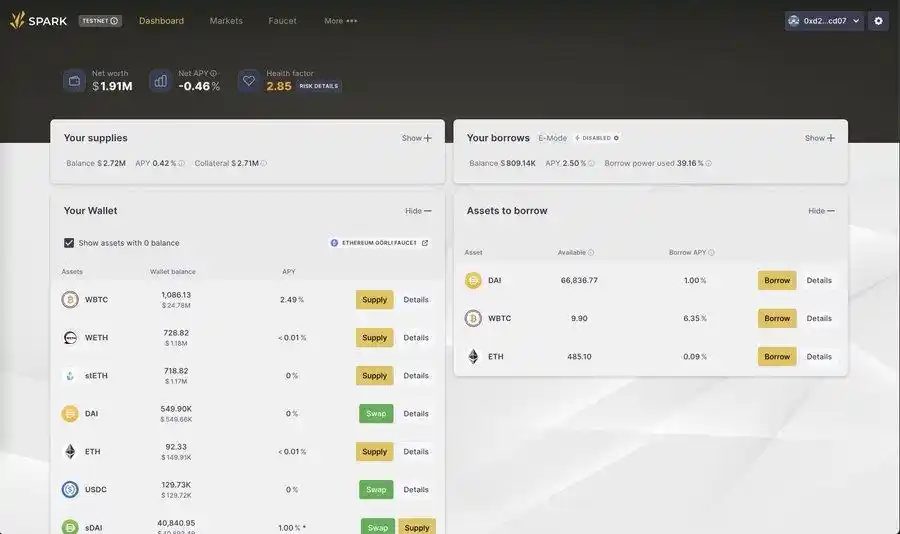
Spark Lend product diagram
On the LSD side, MakerDAO tapped into the LSD market with EtherDAI(ETHD for short), and then channeled ETHD's use through the Spark protocol, enabling ETHD to lend DAI as collateral.
ETHD is a liquidity pledge product launched by MakerDAO. It is a synthetic asset of LST tokens. It aggregates a variety of LST pledge voucher tokens in order to keep participating ETH tokens under the control of the MakerDAO application. Here, the user can encapsulate the LST as ETHD or convert the ETHD to LST.
According to the documents, there are two main ways to participate in ETHD: one is that users directly pledge ETH to obtain sETHD with pledge income; the other is that users cast or package their pledge voucher tokens (LST) into ordinary ETHD at 1:1.
Under this mechanism, on the one hand, users can directly pledge ETH on the platform to obtain sETHD with pledge income, or cast LST into ETHD, and then use sETHD and ETHD as collateral to lend DAI, improving the utilization rate of funds of LST tokens. For example, Lido's stETH, a rETH user in Rocket Pool, can encapsulate stETH and rETH as ETHD and use them as collateral to lend DAI.
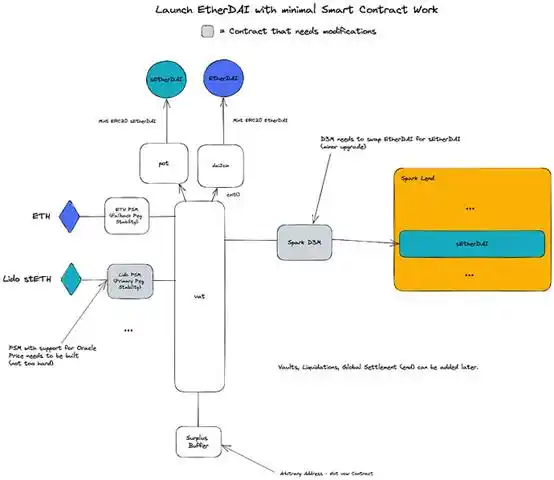
There are two forms of EtherDAI
MakerDAO will have backdoor access to ETHD collateral, as well as the ability to set ETHD casting and destruction permissions.
In order to generate a large number of DAI from ETHD vault, scale effect is formed and users are encouraged to use ETHD vault. The Spark protocol can guide the demand for ETHD by adjusting the stability fee for casting ETHD into DAI. For example, the stability fee for casting ETHD into DAI can be set to 0 for a short time to encourage users to use the ETHD vault to generate DAI. In addition, to enhance the liquidity of ETHD assets, ETHD/DAI pools can be created on Uniswap to enhance their ETHD liquidity and usage scenarios through liquidity mining incentives to attract users to ETHD.
In addition, because Spark Lend is built on AAVE V3 open source code, the Aave V3 e-Mode module is also introduced.LST assets can lend ETH at up to 98% mortgage rate (LTV). For example, pledged wstETH can lend up to 98% ETH to increase the efficiency of fund use.
This means that whenever MakerDAO contributes to the generation of DAI from pledged ETH in the form of synthetic asset ETHD, or accumulates pledged ETH in its Treasury in the form of ETHD, MakerDAO is directing and facilitating the growth of its TVL, and in the long run,ETHD is just as important as DAI.
After Shanghai upgrade, ETH assets will inevitably migrate on a large scale. MakerDAO supports the encapsulation of LST tokens as ETHD, which will prevent TVL shrinkage. Since TVL represents the lock-in value of funds within the agreement, when TVL within the agreement rises, it will be followed by an increase in liquidity and availability, and the agreement itself can also obtain more considerable earnings.
In addition, ETHD users can achieve revenue stacking, and Spark protocol can attract more funds to lock up and encourage users to use DAI. For example, when users pledge ETHD to lend DAI on Sparklend, they do not lose the ETH2.0 pledge income. They can also use circular lending to pledge the lent ETH and DAI again or use them for other DeFi to realize the overlapping of income and improve the utilization rate of funds.
As of April 12, MakerDAO's ETHD was not officially available.
2. Algorithm stablecoin Frax launches frxETH to improve ETH pledge income
The first LSD to make efforts is the algorithm stablecoin Frax.Finance. On October 21, 2022, it launched the Ethereum liquidity pledge product frxETH, which supports users to obtain Ethereum 2.0 (ETH2.0) block network pledge income and rewards on its platform locked warehouse ETH.
At present, users can lock ETH into frxETH on Frax platform. This process is irreversible and can only be converted into ETH on DEX trading platform. frxETH can be repledged into sfrxETH to obtain the pledge income. Alternatively, users can use frxETH to provide liquidity to frxETH/ETH pools on the Curve platform for profit.
The biggest difference between frxETH and Lido, RocketPool and other pledge platforms is that the pledge income of sfrxETH is higher than that of these platforms.
How does Frax make more money when Ethereum 2.0 block rewards are relatively equal?
Frax mainly adjusts the rate of return of "frxETH/ETH" and "sfrxETH" to balance the income balance between the two by influencing the discharge of the capital pool of Curve platform. The former refers to the transaction commission income obtained by users by using frxETH to form LP, while the latter refers to ETH2.0 pledge income obtained by sfrxETH after frxETH is pledged again.
For example, Frax can increase the reward of frxETH/ETH capital pool on Curve platform by voting to encourage users to use frxETH to provide liquidity. As a result, the proportion of frxETH choosing LP will increase and the amount of frxETH to pledge will decrease. sfrxETH pledge yield will increase accordingly.
Detailed regulation mechanisms can be found in the linkHow did the old algorithm Frax Finance regain its status with the popularity of LSD?"
3. It sells a basket of LSD assets, 'yETH,' to boost its yield
On Feb 22, aggregate income platform Yearn officially announced it would launch yETH, which covers a basket of LSD assets. According to the introduction, yETH contains a variety of LST, for users to diversify investment risk while improving investment returns.
According to community users' speculation, yETH launched by Yearn is built on ETH pledge voucher assets of liquid pledge platform LSD, such as Lido's stETH and Frax's frxETH.
Users can store LST pledge certificate assets, such as stETH and frxETH, in yETH. It is Yearn to maximize the income of such pledge certificate assets by using algorithm-based strategies. It also enjoys the Yearn of veCRV governance resources. For example, when creating a yETH/ETH LP capital pool on Curve platform, Yearn can vote to direct the maximum revenue from CRV emissions in the LP pool, because the number of VecRVs held by Yearn is high.
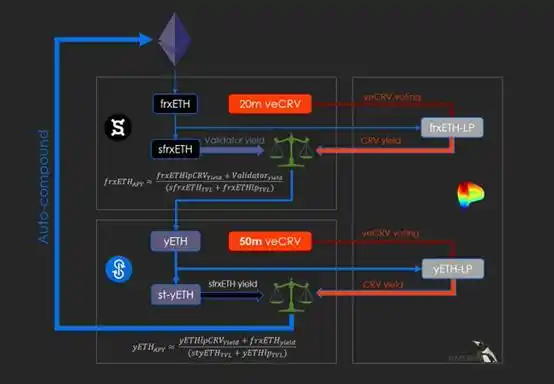
yETH product speculation diagram
In addition, the community explained that yETH and Frax's frxETH don't compete directly because the Yearn assets are LSD pledged assets such as stETH and frxETH, rather than ETH. yETH is offering higher yields to stETH and frxETH holders.
It's important to note that these product structures are just community speculation. As of April 12, yETH products that Yearn aren't online yet, and so much information isn't revealed.
Two: Curve and Balancer focus on increasing LST token liquidity
Whether the price of an LST asset can anchor the ETH is an important indicator of the quality of an LST asset, because it reflects not only market confidence, but also the stability and popularity of the LSD asset itself.
For example, stETH of Lido had the situation of price unanchoring in industrial events such as Luna crash last year. At that time, many users were worried about whether there would be serial liquidation. However, the anchoring was soon restored.
When Shanghai is upgraded, LST supports users to directly extract ETH on the chain, and LST price fluctuation will be greatly improved and the price will be more stable.
Before the upgrade in Shanghai, DEX was a necessary channel for LST asset withdrawal. After the upgrade, due to the limit on the number of ETH extracted daily on the Ethereum chain, DEX is still the most important channel for LST token withdrawal, because it is fast and convenient to exchange LST into ETH and other assets on DEX. In addition, LST token and ETH can be approximately treated as stablecoin trading pairs. LP has low market risk and considerable benefits.
At present, users mainly exchange LST assets on Curve and Balancer platforms. For LST tokens to maintain the stable price of anchored ETH and better user exchange experience, there needs to be sufficient liquidity in the capital pool on these DEX platforms.
LSD projects often attract more LP funds by offering higher income incentives for their capital pools through DEX, provide greater liquidity, and provide better exchange experience for users to seize more market shares. Therefore, DEX platforms such as Curve and Balancer naturally become an important battlefield for LSD projects to compete for liquidity. And the increment of LSD token will drive the increase of TVL, trading volume and revenue of DEX.
1.Curve and Convex -- The first battleground in the battle between LSD asset liquidity
Before the Shanghai upgrade, Curve platform had become the preferred trading platform for LST token exchange exit. In addition, it also supports users to provide liquidity for the LST/ETH capital pool to earn transaction commission sharing.
After the upgrade of Shanghai, although users can directly withdraw pledged ETH with LST, Curve will still be an important trading and exchange platform for LST assets due to the limited number of daily withdrawals and complicated withdrawal process.
The liquidity depth of the LST/ETH capital pool determines whether there is a price difference or slip point in the exchange price of LST to ETH. The decoupling of stETH from ETH price occurred many times before, because the liquidity depth of stETH/ETH capital pool is not enough.
This also means that if the project side wants to keep the exchange rate between stETH and ETH stable, the corresponding LST/ETH capital pool needs to be deep enough. At this time, the LST issuer needs to take some incentive measures to attract users to provide liquidity for the capital pool to support the exchange demand of its issued assets. On the Curve platform, the project side usually guides the CRV emission of the corresponding capital pool by voting through the weight of veCRV held, so that the yield of its capital pool is higher than that of other similar rival capital pools, which is the so-called LSD asset liquidity War.
As the earnings governance platform of Convex, which controls more than half of Curve voting rights (veCRV), can effectively determine the allocation of CRV awards, and has naturally become an important battleground for liquidity competition.
According to the official website of Curve.fi, on April 12, the daily trading volume of stETH/ETH capital pool on the Curve platform was 64.31 million dollars, while TVL was 1.67 billion dollars. Has far exceeded its main Stablecoin 3Pool(USDC/DAI/USDT) capital pool (TVL of $490 million), ETH/frxETH capital pool TVL of about $140 million. Such a huge TVL provides stETH with sufficient liquidity and guarantees stETH's repayment ability without worrying about the price of stETH's assets falling anchor.
Of that, stETH/ETH, which has been secured via the Convex platform, accounted for $895 million, while ETH/frxETH accounted for $136 million.
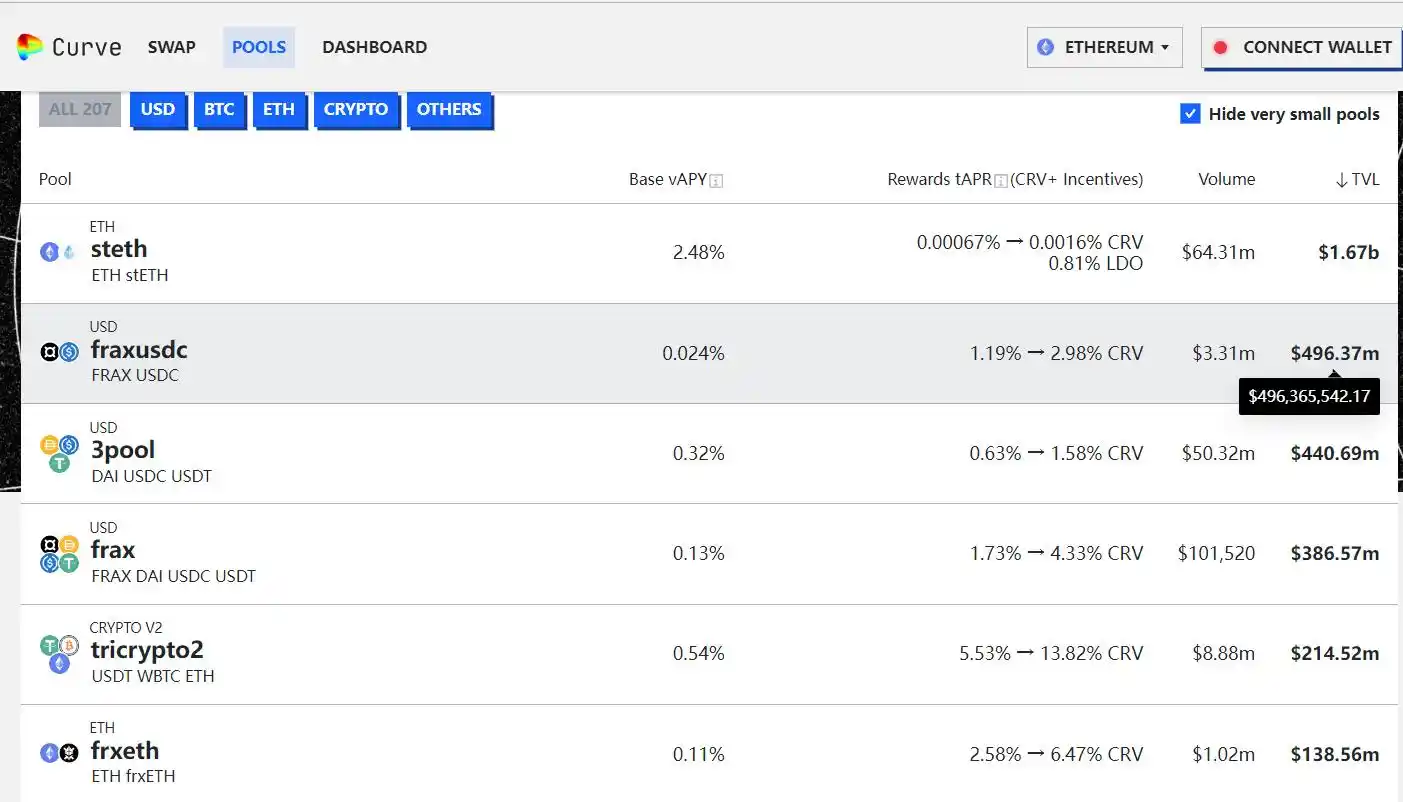
ETH/stETH has become the largest TVL capital pool on the Curve platform
At the moment, Frax's frxETH/ETH and Lido's stETH/ETH pools are competing for liquidity on the Curve platform.
Among them, CVX, held by Frax, accounts for about 20.5%. It votes CVX to influence the weight of incentive emissions from the capital pool CRV on Curve, in order to adjust the yield of its Curve LP capital pool. It can not only increase the depth of the corresponding capital pool but also adjust the yield of the asset pledge.
Based on yETH products launched by Yearn, this too will be caught up in the LST liquidity war: by creating a yETH/ETH capital pool on the Curve platform and then using the veCRV votes it holds to influence the pool's emissions.
It is reported that Yearn holds twice as many VecrVs as Frax, so that yETH/ETH can command a higher return than frxETH.
2.Balancer and Aura Finance: LSD asset liquidity battle for second place
According to Balancer's website, on April 12, The top three pools for liquidity on the platform are wstETH/WETH ($320 million TVL), BAL/WETH ($250 million TVL), and rETH/WETH ($80.17 million TVL); The first and third pools are both LSD assets, wstETH is Lido, and rETH is Rocket Pool. There are also LSD token pools such as Frax's sfrxETH and Coinbase's cbETH.
As a result, Balancer has become the other major trading ground for LSD tokens in addition to Curve. Of these, the Rocket Pool on the Balancer platform has the highest rETH/WETH funding pool of any DEX.
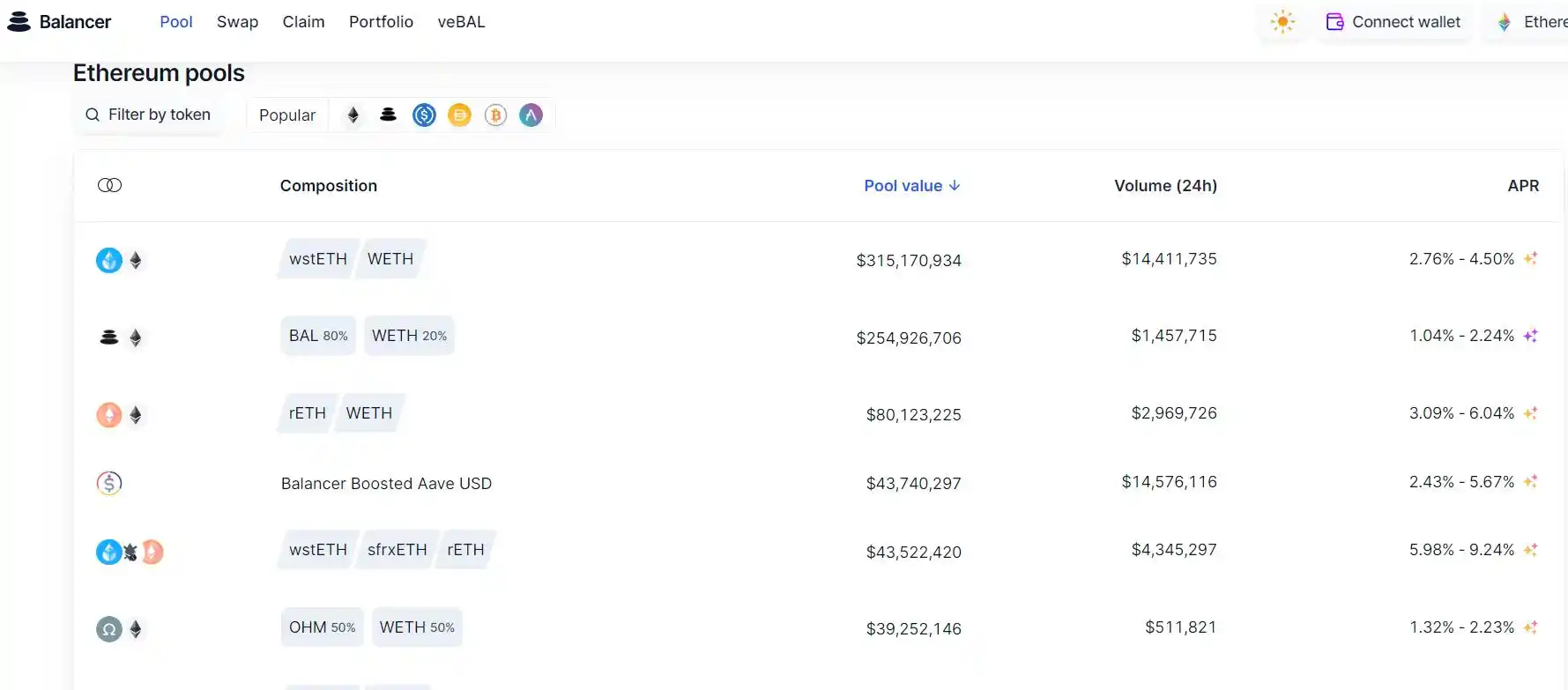
Balancer pools of money
In addition, compared with Curve, Balancer has a unique Valut fund pool mechanism on its product, which can reduce the GAS cost of transactions involving multiple fund pools, giving it more advantages in terms of user experience.
Balancer V2 separates the trading logic (AMM) from the pool Valut, and the trading logic (AMM) is stored in another smart contract. Valut manages tokens in each Balancer pool and calculates the number of tokens exchanged, added, and withdrawn.
In this mode, the trade logic AMM smart contract is more like a plug-in, Balancer's architecture becomes a "money pool + pluggable trade" architecture. In this architecture, the AMM transaction mechanism and logic can be customized at will, and the capital pool only needs to be executed according to the final result of the AMM execution of the transaction, which can save the multi-step GAS fee of the user's token transaction.
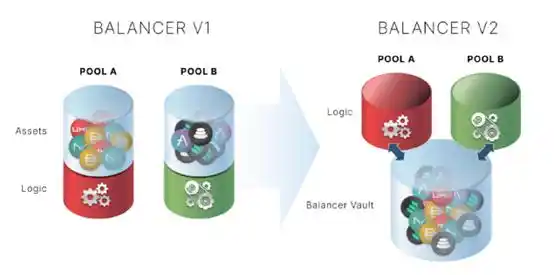
Balancer V2 architecture
On previous DEX platforms, asset exchange paths often involve exchange transactions in multiple capital pools to achieve the final exchange result. This process is called multi-hop trading, which consumes a lot of GAS fees.
For example, converting BTC to stETH on Uniswap, first, converting BTC to WETH in the BTC/WETH assets pool, and then converting WETH to wstETH in the WETH/wstETH capital pool to make the final conversion. In the process, you often have to pay a lot of GAS fees.
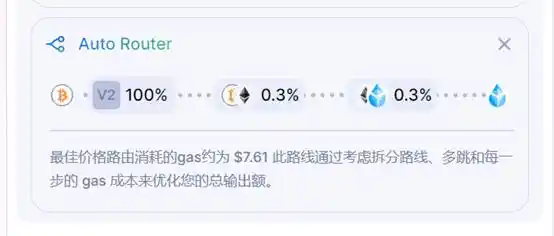
BTC conversion stETH path
However, in Balancer V2, all tokens in the pool on the platform are stored in this Vault contract, which can directly execute the transaction of converting BTC to stETH, saving the logical GAS fee of jumping across multiple asset pools, also known as BatchSwap (bulk trade).
This also means that all LSD assets deposited in Balancer's pool can also be seamlessly traded using its Vault liquidity Center, such as direct conversion of stETH to BTC or DAI, USDC, etc. However, in order to convert stETH into DAI on Curve platform, the transaction path needs to involve three capital pools. stETH should be converted into ETH in stETH/ETH pool first, and then ETH should be converted into USDT in ETH/BTC/USDT pool. Finally, USDT is exchanged for DAI in the 3crv pool.
In March 2022, Balancer launched the veToken model veBAL, which can be obtained by locking up LP assets with a 4:1 ratio of BAL/WETH (BPT).
For LSD projects that build pools in Balancer, if they want to maintain long-term vitality, they need to maintain sufficient liquidity in the pool. The best way to attract liquidity is to increase the BAL reward allocation weight of the pool. The only way to do this is to vote, or buy votes from veBAL holders. Or you can buy BAL/WETH to lock up and vote. At present, the LSD asset issuer influences the BAL emission of its capital pool by controlling veBAL voting, thus increasing the LP yield.
For example, Rocket Pool rETH, the corresponding Pool rETH/WETH on Balancer, the higher the BAL reward allocation weight of the pool, the more people will be attracted to earn rETH by pledging ETH in the Rocket Pool, Then, Balancer provides liquidity for mining, increasing Rocket Pool's market share on the LSD track. At the same time, the higher the liquidity of the capital pool, the smaller the risk of unanchoring of rETH and the better the trading experience.
Aura Finance is the veBAL revenue governance platform on Balancer, founded by former Sushiswap CEO 0xMaki.For Balancer, Aura Finance is similar to the relationship between Convex and Curve, and the core function of Aura is similar to that of Convex. Aura holds 26.2% of veBAL holdings, according to Dune, making it an important battleground for liquidity.
Balancer's LST liquidity war advantage lies in its higher bribe capital efficiency than that of Convex, which showed that Aura's capital efficiency was 47% higher than that of Convex.
However, according to Aura's website, the rETH/WETH pool TVL has only reached $7.456 million, which is still far behind the Convex token pool TVL.
Aura Finance has partnerships with almost all major LSD protocols including Lido, Rocketpool, Frax, Swell, Stakewise, Stader, Ankr and StaFi.
Source of original text
Welcome to join the official BlockBeats community:
Telegram Subscription Group: https://t.me/theblockbeats
Telegram Discussion Group: https://t.me/BlockBeats_App
Official Twitter Account: https://twitter.com/BlockBeatsAsia
 Related Articles