Analyzing the four levels of Web3 user experience: how to create a good user experience?
Original title: "The Levels of Web3 User Experience"
Original Author: Jon Crabb
Original compilation: ChinaDeFi
This article attempts to create a larger framework for Web3 UX.
There are too many new elements between Web3 and Web2, such as gas fee, Token, wallet and smart contract, we need to consider more than just UI. Now there are more layers to consider.
We need to improve all these layers to create a good user experience.
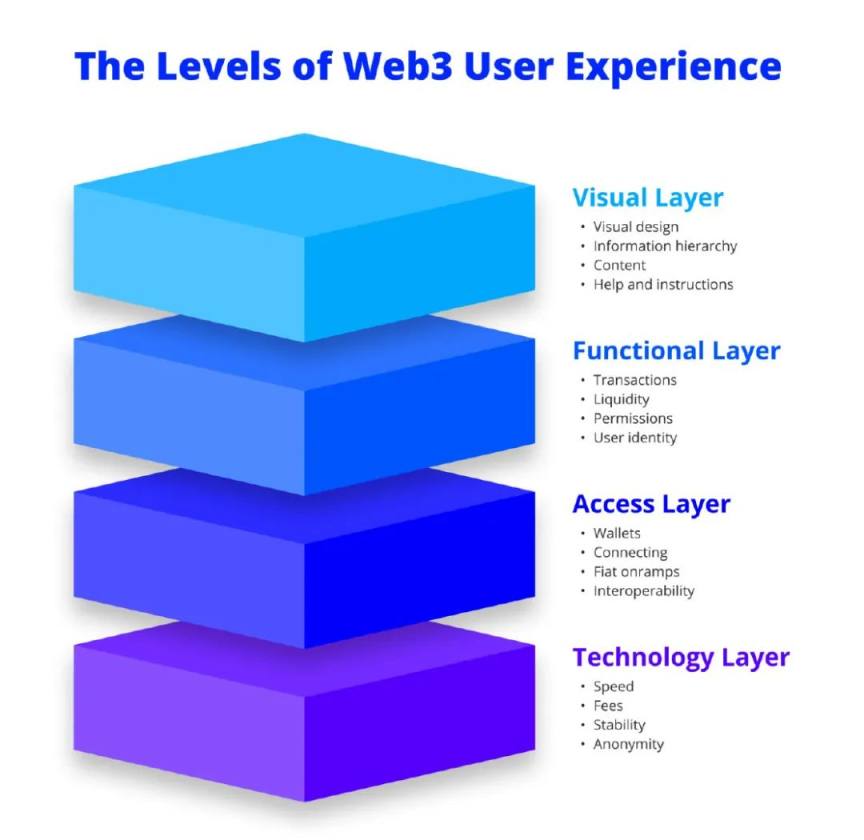
How to visualize the different layers of Web3 user experience
The user journey is a long and winding road
Consider a standard application. Not Web3, just popular apps on smartphones that we use all the time. The app's actual UI is just the last element in a long chain of experiences that begins in the real world, travels through countless physical spaces, enters digital interaction, and passes through a whole host of different hardware and software, before finally finding your thumb resting on the on buttons designed by others.
We may have an idea like "play music" or "see directions" or "buy clothes" that is influenced by something in our physical environment.
This "user experience" begins long before we even take our phones out of our pockets.
This is an underappreciated point when researching Web3, so to test this point, let's take an example.
International Money Transfer
One is the "user experience" of sending money to residents of other countries, and the other is the "user experience" of the specific application we use.
Sending stablecoins on the blockchain is already better than sending money. It's almost instant and the fees are low. In the case of sending currency, it can take several days, and there are fees charged for each step. Some money transfer apps are doing a good job these days. Understanding the process of such an application is much easier than understanding cryptocurrencies. Most people have smartphones and some local currency. But most people do not have exchange accounts, wallets and cryptocurrencies.
Some user experiences are better than current standards. But many other steps are worse than current standards.

In my estimation, cryptocurrency failed because it wasn't as accessible and didn't integrate well with the rest of the "system".
If we really want to understand Web3 UX, we need to look at the big picture and see which layers need attention.
Overall User Experience Model
The Nelson-Norman model has three levels:
Journey
Relationship
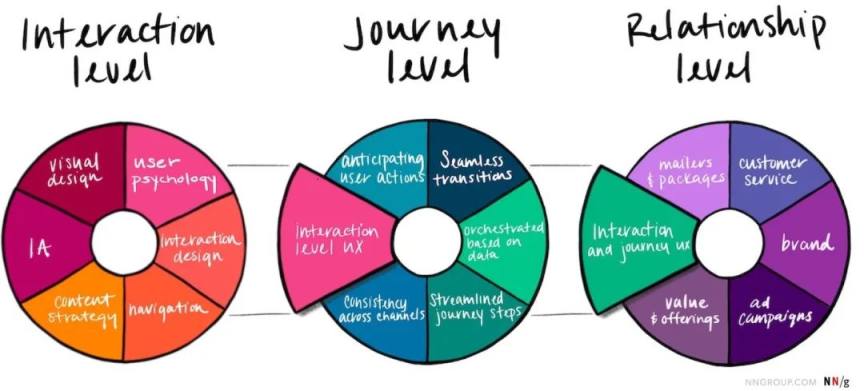
These three cover the entire user experience from the real world to the digital world. This framework is often used in CX design (customer experience) and service design. In most cases, users have already made many decisions before visiting our application or website.
If we further zoom in on a successful company, we will find that this company is usually solving a core problem. In real life, this is often a vexing problem, and this product has innovated ways to ameliorate this deep frustration.
Annoying_shit_irl --> thing/app_that_might_help --> the_actual_UI
Because pioneers solve the original problem, they make the greatest impact on people's lives. But doing so is actually much harder and often requires major shifts in technology, policy or society.
The classic example is a famous coined quote by Henry Ford:
"If I asked people what they wanted, they would say faster horses."
What people really want is to get to their destination faster. A car will do it. But this solution will only really take off if awareness is raised, a better road ecosystem is created, the entire manufacturing industry is overhauled, and proper laws are passed.
See the link here?
The final design of the car is obviously also important, but for this new form of transportation to ultimately succeed, its benefits must be demonstrated to everyone, and a host of infrastructure, process, regulation and related technology improvements must also be made .
If we look at a more modern platform like Netflix, we can see multiple layers of the experience. The core user story is something like "people want high-quality entertainment". The solution to this problem was originally the DVD, but now the solution is the digital streaming platform. This requires expert commissioning and planning. Users also want to watch high-definition video, which requires good compression on Netflix and a good network connection on the client side. They want to find something they like, which requires a good UI, excellent information architecture and clever recommendation algorithms.
In both cases, "user experience" includes a lot more than we think.
Four levels of Web3 user experience
In the Web3 example, I propose four different layers. Each presents specific user experience challenges.
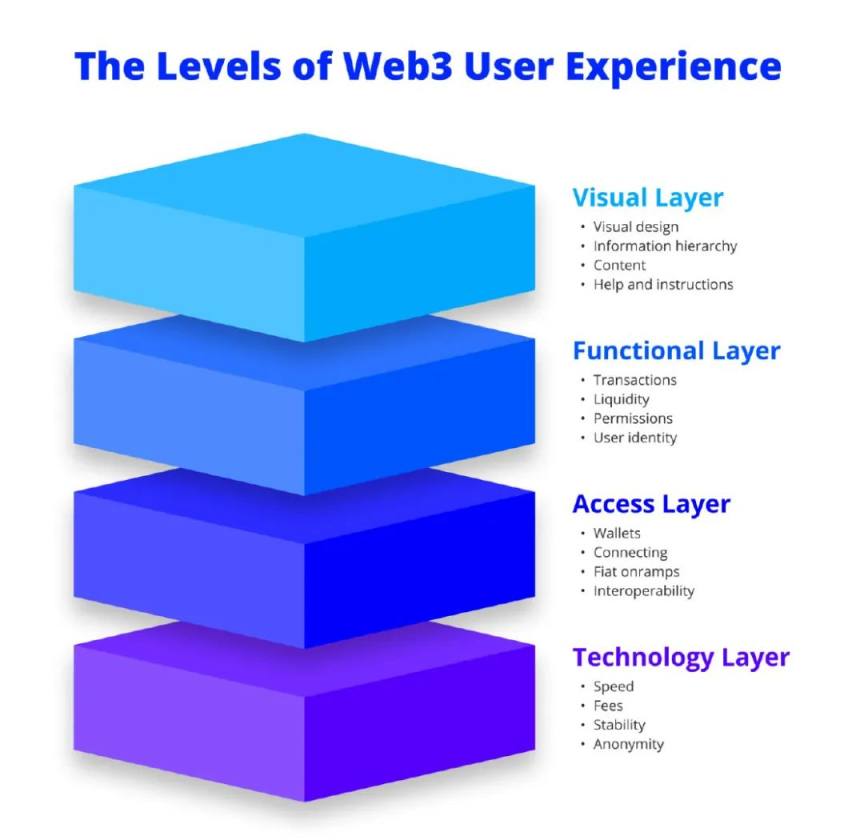
A simple framework for visualizing what to process Different layers
These layers stack together. The bottom layer is the most important, but also the hardest to influence, as it is most related to the technical limitations of any blockchain being used. The topmost layer is the visual layer, which can be easily modified - of course, what we put there depends entirely on the layers below it.
The following are some specific challenges that exist in each layer, from the bottom up.
Technical Layer
Speed
Cost
Stable
Anonymous
Access Layer
Wallet
Connection
Mnemonic and Security
Interoperability
Network extension
Mobile experience
Functional Layer
Transaction
Liquidity
Liquidity Mining
Smart contract interaction and permissions
User Identity
Governance
Token type
Web3 Login
Display NFT
Ownership of in-game assets
Send information across layers or chains
Visual Layer
Visual design
Information Hierarchy
Navigation
Content
Help and guidance
Decomposition analysis
Technical layer
When looking at the actual technical layer, I think the UX on DeFi is already better. Large remittances often involve waiting times, fees and, in some cases, security checks by intermediary banks. On the blockchain, it's fast to send, cheap (though not always), and verifiable by anyone.
The UX challenges at this level are:
Increased speed to match or exceed VISA network (tps)
Improve the stability and security of the blockchain
Fee reduced to less than Western Union or Wise
Make transactions verifiable
These are some of the biggest challenges that need to be addressed. However, they have nothing to do with the interface. In this case, layer 2 blockchains are a direct attempt to improve the overall user experience.
This kind of thing becomes even more important when considering non-deterministic things like on-chain identities.
Access Layer
Assume the year is 1995 and you hear about this wonderful new thing called the Internet. First, you'll need a PC with a modem, which you'll need to connect to a phone line. Once you "dial up" and "go online", you can no longer answer the phone. To actually do something, you have to set up an "email address", maybe "pop3" or "imap", use a "browser", and if you want to be a pro, learn "telnet" and "ftp". Once you manage, things will never be the same again.
The UX challenges at this level are:
Make a wallet as easy to use as a banking app and/or browser
Create Web3 single sign-on
Smooth currency channel
Unify the chain or create "layer x", no manual bridge required
Human-readable addresses (ENS is a step in that direction)
Educate people on self-regulation and privacy
Putting cryptocurrency into the hands of more people
Beyond the current Internet browser paradigm
Functional layer
When we talk about web3 user experience. One thing to consider is that something is bound to be weird because it's brand new. New features always seem to be hard to get started. A few years ago, no one had heard of NFTs or AMMs. Now that we have them, we need to figure out how to best use them.
The UX challenges at this level are:
Make transactions intuitive
Abstract complex strategy
Simplification (e.g. using zappers, autowrapping Token )
Create flexibility in the system (will Token sent to the wrong network)
Make participation in governance easy and rewarding
Making NFTs meaningful and useful
Create more "killer apps" outside of finance
Transfer ownership of in-game assets to the user, not the manufacturer
Add ways to share and display NFT
Improve cross-chain and multi-layer compatibility (most users probably don't want ten different forms of USDC)
There is an important caveat at this layer, some unmanaged encryption applications have partially solved some of the above problems. The downside is that in most cases we are trading some decentralization for a better user experience. Crypto.com allows us to send other Crypto.com users free Token . Most exchanges will let us choose which network to withdraw on (mainnet or Polygon, etc.), Binance will provide us with Token And give us some interest, but we can't control their strategy. Celsius does the same thing, but not quite as well.
Visual layer
Are we using consistent design patterns based on user research? Is the term too technical? Does everything look fine on the phone?
The UX challenges at this level are:
Follow accessibility best practices
Reduce the use of jargon
Highlight important content
Hide irrelevant things
Create easy-to-follow instructions
Promoting inclusion
Says 'friendly' and 'welcoming', not 'scary' and 'xenophobic'
Aesthetic
Preserve individuality while building for the masses
This is my first serious attempt at creating a larger framework for Web3 UX, which I plan to build upon.
"All models are wrong, but some are useful."
Original link
Welcome to join the official BlockBeats community:
Telegram Subscription Group: https://t.me/theblockbeats
Telegram Discussion Group: https://t.me/BlockBeats_App
Official Twitter Account: https://twitter.com/BlockBeatsAsia
 Related Articles