How can crypto companies meet compliance requirements under the new global regulatory policy?
Not long ago, a social media report reposted by CZ sparked a heated discussion among netizens. According to CoinDesk, Binance lost 90% of its users after implementing KYC (Know Your Customer), which also cost Binance billions of dollars in revenue.
And CZ is more blunt, saying Binance has spent more than $1 billion on compliance. Is it worth the expense? Despite the loss of potential users, CZ notes that "Binance has gained market share, not lost it."

What does compliance bring to the crypto world?
In recent years, major trading platforms have lavished costs on compliance. Some data show that the compliance cost of crypto business may exceed 50% of the total time and labor cost. The compliance demand of CEX, asset management, wallet and other racetracks is increasingly strong.
The increasingly stringent KYC has had a dramatic impact on the industry. But the counterintuitive thing is that instead of shrinking, the industry has grown in recent years after KYC blocked a large number of potential users. A large number of institutional investors and traditional capital continue to enter the encryption industry, and the industry scale is growing rapidly under the support of "compliance".
How best to help the crypto world come into compliance? KYC, AML is the first step into compliance. AI, on the other hand, provides the crypto world with a one-stop solution for authentication and risk management.Founded in 2016, it's easy to tell from its name alone that it's a high-tech company powered by artificial intelligence. AI is part of ADVANCE Intelligence Group, which operates in 12 markets, employs 1500 people, is headquartered in Singapore, and has local customer support teams in Indonesia, India, Philippines, Malaysia and Vietnam.
Without KYC, the project will be hunted down by regulators. For a trading platform or institution operating a crypto business, noncompliance can lead to suspension of business, payment of fines, or even legal consequences. Due to the lack of regulation, crypto related businesses suffer from the exclusion of traditional finance.
In the fall of 2019, Telegram, a well-known encrypted messaging app, engaged in a lengthy battle with U.S. regulators. The incident is often cited as a classic example of noncompliance that killed a project. In the end, the battle ended in a resounding victory for regulators. The TON network developed by Telegram was completely abandoned. Compliance is critical to the survival of crypto projects. In 2019, the SEC's case against EOS cost EOS a $24 million fine to settle. In 2020, the regulatory body's litigation dispute against Ripple is still not over.
As research and industry leaders have indicated, regulatory compliance, particularly anti-money laundering (AML) and counter-terrorism financing (CTF) for blockchain and virtual currencies, has been a huge barrier to their overall mass adoption.
AML helps Web3 avoid money laundering risks
Currently, $139 billion of crypto assets are traded on the chain every day, with millions of transactions taking place on trading platforms every day. Human analysis and monitoring alone would not have been enough to support such a high volume of transactions. Securing transactions against fraud and money laundering may be more difficult in such circumstances. Therefore, it is critical to have powerful tools to help these businesses meet AML standards.
Can VASP quickly and conveniently identify the risk of user address, just like the Web2 credit report to quickly obtain key information?
To address this issue, Advance.ai launched the Crypto Wallet AML risk reporting product. The product can generate AML risk reporting standards for crypto wallets based on historical transactions and regulatory sanctions data.
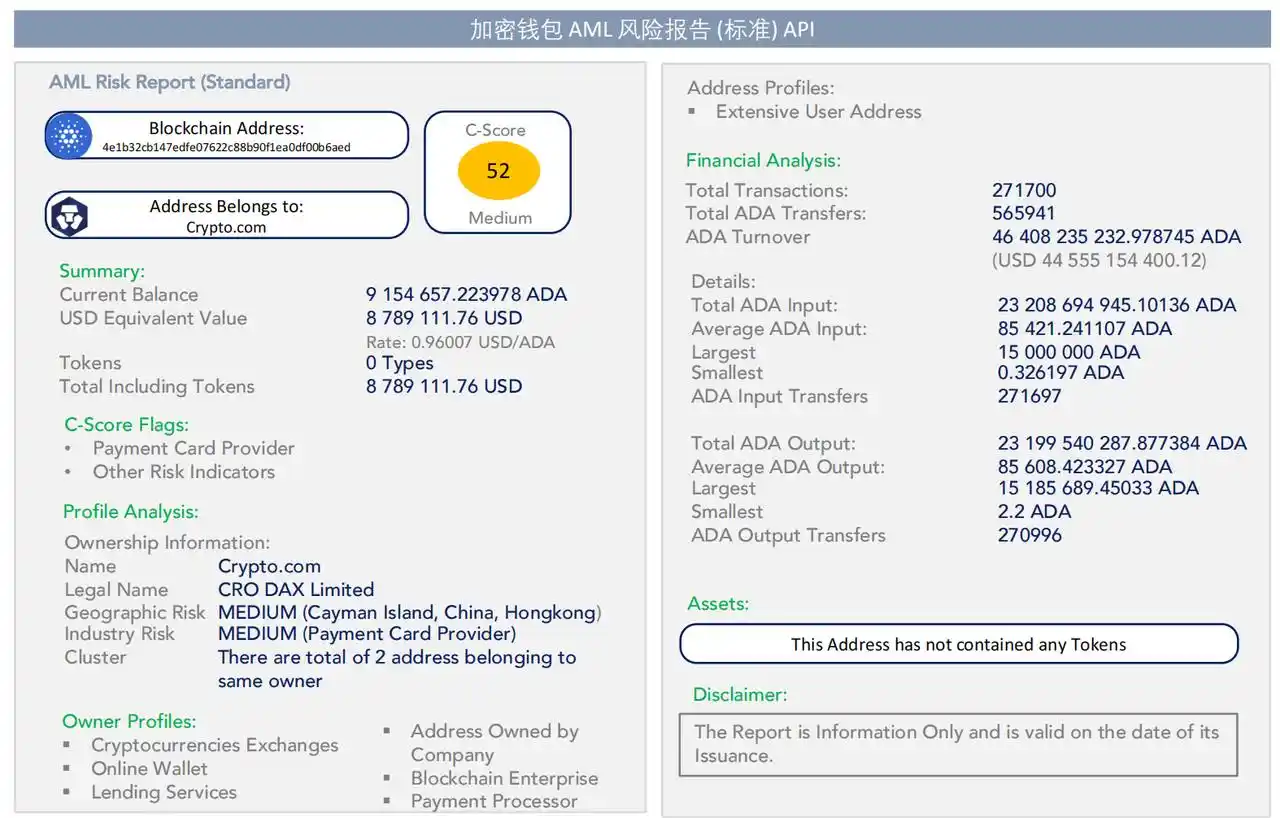
(Sample report)
Simply by entering the wallet address, the tool automatically produces an AML risk report and scores that address, using a value of 0-99 to reflect the risk of illegal encryption activity.
Clear the fog, trace the massive data on the chain
For a large number of businesses in the traditional world, entities handling blockchain business need to ensure that they are not exposed to high-risk transactions or counterparties, but they currently lack efficient solutions. Smart contracts, 1CO, Token crowdfunding, etc., which can be used for money laundering or terrorist financing, need to be properly evaluated before these activities begin, but there is currently no effective solution. This is mainly determined by the complexity of the on-chain transactions.
AI's on-chain analysis tool provides customers with on-chain address risk reports. Relying on intelligent risk control, automated anti-fraud system can be used to replace the previous risk control process that relied on a large number of manual audits. Identifying fraudulent customer accounts, tracking stolen proceeds, and even identifying links to dark web marketplaces can be automated through on-chain analysis.
This gives crypto businesses that cannot afford to develop AML modules on their own the ability to assess the source and destination of any illicit funds-- which is key to stopping cryptocurrencies from funding crime.
In short, the product enables continuous monitoring, review, and investigation of wallet addresses and transactions with a broad asset coverage. Through more than 350 proprietary risk algorithms, it provides a seamless, scalable solution to the stringent regulatory requirements of CeFi and DeFi. The product can also put a designated address into a monitoring list, monitoring all transactions at the address in real time, without manual analysis, to maintain 24/7 vigilance of the risk of a specific address.
How difficult are the FATF's "travel rules" for crypto compliance?
The regulation of encryption has evolved from scratch, and the regulatory framework is constantly iterating. As an example, the FATF (Financial Action Task Force) October 2021 guidance -- which is now the widely adopted regulatory strategy -- requires all VASPs (i.e., trading platforms) to have AML/CFT measures in place.
For crypto transfers, the platform needs to follow the Travel Rule. This rule means that data is transferred with assets. When crypto is transferred, not only crypto is transferred from sender to receiver, but also information of sender and receiver should be included. For example, when A needs to send crypto from A CEX to B CEX's account, CEX A and CEX B shall transmit the information of users A and B to each other.
"Travel rules" remain an important principle in FATF guidelines. The guidelines require all VASPs (i.e., trading platforms) to have AML/CFT measures in place.
Understanding the identity of the customer is the first step in fulfilling your regulatory obligations. For example, when a user uses a mobile phone number to register on a trading platform, how to verify the authenticity of the user, rather than a picture, a video, or a fake ID? In most non-financial scenarios, a mobile phone number or email address is sufficient for the usual needs. Apps don't have to make a strict, precise match between an online identity and a particular person, as the Internet has worked well since its inception.
In the crypto industry, increasingly stringent KYC compliance requirements are testing the risk control ability of original companies in the crypto world, and we find that the old rules are no longer workable. The authentication of user identity has become a difficult problem in Internet applications. The game between identity fraud and anti-fraud continues. AI, on the other hand, provides an excellent choice for crypto products to complete KYC.
Web2 is far more compliant than Web3. How can the crypto world learn from it?
However, when the use of crypto continues to expand, traditional markets, banks and regulators do not have the tools and information to deal with transaction risks and accept relevant customers. Due to compliance difficulties in blockchain-related businesses, these businesses will have problems entering the mass market and traditional financial services. With the help of compliance technology service providers with a large amount of Web2 compliance security experience and advanced artificial intelligence technology, the rapid establishment of risk control security system may be a feasible way for encryption enterprises to achieve compliance.
Take KYC as an example, whether to do a good job in this functional module, but the test of these new Web3 companies' abilities.
Fortunately, in the Web2 world, there are well-established solutions for digital authentication-based risk-free management.For example, crypto trading platforms need to use KYC to understand customers' real identity information to assess their credit risk, which is also important in the fintech sector; The wool party and brush volume trading that are prevalent in the world on the chain happen to be the pain point of risk control that global e-commerce platforms need to continue to face in their daily operations...
As a leading AI company, Advance. AI seeks to leverage its extensive global security compliance experience in the Web2 world to help crypto enterprises solve digital authentication and business risk management problems.
Specifically, ADVANCE.AI Real-time Photo Quality Inspection (IQA), guide and remind the user whether there is reflective or incomplete image acquisition problems, help customers upload high-quality images, to improve the effectiveness and accuracy of subsequent verification;Document Identification (OCR)It can quickly and automatically identify and extract the text in photos within 1 second, and store it as structured data for subsequent processing and analysis.Live testingThe camera can capture real-time dynamic images, recognize facial expressions of people, avoid the problem of fraudulent users using photos of others or pre-recorded videos to show in front of the camera and cheat the system, and significantly improve the credibility of remote online transactions.Face thanThrough rapid recognition, extraction of face image features and comparison, calculation of the similarity of face images, in order to verify the face image of the real user belong to the product, improve the accuracy of identification and live detection link.
In addition, by connecting to authoritative data sources,AI provides ID Check products covering more than 200 countries or regions in the world, identifying ID cards, driver's licenses, passports and other documents. The call price is only 30%-50% of other suppliers.At the same time, ADVANCE.AI has local support teams in many parts of Southeast Asia and uses a variety of instant communication software flexibly.It can respond to and solve product operation pain points and customization needs within 15 minutes, saving more than 50% of compliance risk control costs for Web3 enterprises, and improving more than 80% of business operation efficiency.
In today's bear market environment, ADVANCE.AI can effectively help Web3 organizations save compliance costs and improve the security efficiency of business risk control.
Despite its short time in the game, Adva. AI has already gained the trust of a number of Web3 head players.One of the top "Big three" trading platforms known to investors is already using Advance. AI's identity verification and eKYC products in Southeast Asia.
It can be said that in the compliance process of crypto products,ADVANCE.AI, a company focused on financial risk control, has been ahead of the crypto world by building the Web2 infrastructure required for compliance for crypto companies.This valuable experience gained from the Web2 legacy industry makes Advance. AI's leading KYC and AML solutions easier for crypto products and organizations on the path to compliance.
In September 2021, ADVANCE Intelligence Group, of which ADVANCE.AI is a part, completed a $400 million Series D funding round led by SoftBank Vision Fund Phase II and Warburg Pincus Capital, with a valuation of more than $2 billion. The core team of ADVANCE.AI graduated from Stanford, Tsinghua, Fudan, National University of Singapore and other first-class universities, with diversified technology and financial experience including Amazon, Tencent, Goldman Sachs and other companies.
Advance. AI can help crypto enterprises learn from Web2 to complete some processes necessary for compliance, build a perfect compliance regulatory system, and help the whole blockchain and cryptocurrency ecosystem better integrate into the traditional economy and be accepted by a wider range of financial markets. Advance. AI hopes to build a bridge to adapt to new business models and adopt Blockchain and crypto in a security-compliant manner, aiming to create global standards for the entire industry.
Welcome to join the official BlockBeats community:
Telegram Subscription Group: https://t.me/theblockbeats
Telegram Discussion Group: https://t.me/BlockBeats_App
Official Twitter Account: https://twitter.com/BlockBeatsAsia

 Related Articles