Why royalty reform marks the next evolution of the NFT industry?
Original title: "Thousands of Words: Why Royalty Reform Marks the Next Round of Development for the NFT Industry? "
Original author: starzq
Let’s see the current situation clearly with 4 questions
1. How did NFT royalties (Royalties) appear?
NFT royalties (Royalties) are the most important weapon to attract artist-based early projects, which perfectly solves the problem that creators have no income after the subsequent price surge ;
2. Do all NFTs need to rely on royalties?
Art project: Royalty is its basic business model
Non-art project
・Royalty must not As the main source of income, it is essentially inconsistent with hodler's interests
・PFP projects can not rely on royalties at all, and need to have independent business income, so as to be consistent with hodler's interests
・Non-PFP projects such as tools may still need to rely on royalties as an important income at present, but in the future they need to have a better business model in the NFT world
On the one hand to maintain their own competitiveness (GEM integrated sudoswap with 0 royalties on the same day) On the other hand, it competes for users and gains a larger market share
4. Why did it cause another round of controversy on the entire network?
・The transaction volume of x2y2 is larger, which will affect the interests of more project parties. Previously, the transaction volume of sudoswap was small and more people were waiting to see
< p>・Give buyers a choice of royalties, but the communication on the seller’s side is a little less thoughtfulFinally, let’s answer this question, why is the royalty reform a sign The next round of development in the NFT industry?
The next 4 key parts of the NFT industry will be reshaped
・Business Model reshaping, high-quality supply increased
・Reshaping the relationship between project parties and users
・Reshaping the relationship between project parties and trading platforms
・Reshaping smart contracts
After this round of remodeling, high-quality supply has increased, project parties and trading platforms have become more mature, projects and users have shifted from investment to consumption, and the vast market is about to Open.
The following, enjoy slowly
1. How did NFT royalties (Royalties) appear?
There are many reasons Simple, early NFT project parties are mainly artists, and Royalties is the most important weapon for the NFT industry and OpenSea to attract project parties.
As mentioned in the previous article, there are three great innovations in the history of web3, blockchain, smart contract and ERC-721 protocol , are indispensable, making artwork the most perfect use case in the early stage of NFT, but as a creator, there is a huge pain point:
There is a difference between artist income and artwork value gap: The most typical example is Vincent Van Gogh, who lived a poor life with no one interested in his paintings, and his value skyrocketed after his death, but there was no feedback to the creator and his family. I guess this is also the reason for the inflated prices of many unknown works of art. If the price is set low, creators will definitely suffer losses. If the secondary market becomes popular after a while, the money earned by traders and the trading market has nothing to do with the original creators.
Here we must thank the NFT industry and OpenSea, which innovatively introduced the concept of Royalties. Every time an artwork is sold, the original author will be divided according to a fixed ratio (not just The first income), which solves the problem that creators have no income after the subsequent price surge. At the same time, this mechanism will also encourage creators to sell their works with a lower threshold to gain more attention.
For NFT art projects, royalties have become their basic business model.
Second, do all NFTs need to rely on royalties?
It can be seen that the use case of royalties is closely related to artworks, which better solves the problem of unreasonable income for artists. But with the development of NFT to the present, artwork (1/1, Art) is only one of the tracks, do other types of projects (PFP / Pass / Tools / ...) necessarily require royalties? The following "items" are all considered as non-artwork items by default.
Royalty is the revenue method of the project party, so this question can be converted to whether the project party must need royalties as the main revenue method?
Here is the conclusion first
・Royalties must not be used as the main source of income. The hodler’s interests are inconsistent
・PFP projects can be completely independent of royalties, and need to have independent business income, so as to be consistent with the hodler’s interests
・Non-PFP projects For example, tools may still need to rely on royalties as an important income at present, but in the future, we need to have a better business model in the NFT world
Let’s first see what the project party can have what kind of revenue. At the same time, it can be compared to a company, and the company itself has a history of hundreds of years. We will also compare the revenue methods of the two.

You can clearly see
1. There are 3 types of revenue methods for NFT projects, and transaction royalty income is only one of the secondary market revenue
3. The transaction royalty income is indeed unique to NFT, the company does not This income. Will you give the company a rebate for stock trading?
Royalty It must not be used as the main source of income, which is essentially inconsistent with the interests of the hodler
Make two extreme assumptions
1. A certain NFT project is particularly good, everyone is a diamond hodler and does not trade, and the royalties of the project party are 0. And basically all projects are Encourage everyone to be a hodler with diamond hands.
2. In the bear market, almost no one trades, and the royalties of the project party are 0. But the project needs funds to continue BUIDL support to get out of the bear market
p>
So the project party must use other types of income to help continue the BUIDL project, otherwise the above situation will occur
PFP projects are completely independent of royalties
At the same time, let's take a look at how Yuga Labs, the current Top1 project of PFP NFT, earns revenue. It predicts a revenue of 550 million US dollars in 2022, plus 450 million US dollars in VC financing, a total of 1 billion.
It can be seen that the primary market financing accounted for 45%, business income accounted for 42%, and royalties income was only 13%, and the bulk still depends on the issuance in 2021 BAYC and MAYC (2.5% royalty)

In fact, Yuga Labs only got $2.2M from the original project BAYC primary market mint, which is less than 4/1000 of the revenue in 2022.< b>Relying on continuous BUIDL, we have the confidence to continue to develop new projects for business income, and also raised 450 million US dollars from VC. On May 1, 2021, the price of BAYC mint is 0.08ETH, and it will be released for 12 hours Within the period, all 10,000 apes were sold out, with a total income of 800ETH. The price of ETH at that time was $2.2M. On March 23, 2022, Yuga Labs, the parent company of BAYC, completed a new round of financing of US$450 million at a valuation of US$4 billion. This round of financing Led by a16z, with participation from Animoca Brands, Coinbase, and MoonPay, Yuga Labs previously announced plans to create a virtual world called “Otherside.”
On May 1, 2021, the price of BAYC mint is 0.08ETH. Within 12 hours of the sale, all 10,000 apes were sold out, with a total income of 800ETH, based on the current ETH The price is $2.2M
On March 23, 2022, Yuga Labs, the parent company of BAYC, completed a new round of financing of $450 million at a valuation of $4 billion. The financing was led by a16z, with participation from Animoca Brands, Coinbase, and MoonPay. Yuga Labs previously announced plans to create a virtual world called "Otherside."
In addition, for 10k PFP projects, the project party itself retains a part of NFT, and makes it appreciate through BUIDL, which is also a healthy way of revenue, and there are many KOLs have expressed similar views. In fact, many well-known projects have used this model, including LarvaLabs (CryptoPunks/Meebits) and 8liens, setting the royalty to 0 and reserving 10%-20% for subsequent income.

Summary
>・(10k) PFP projects can not rely on royalties at all
・Through continuous BUIDL to increase the value of IP, the project party can reserve a part of NFT, or Develop new projects to continue to earn income, even through VC financing
Non-PFP projects need There is a better business model
Applying the above method to non-PFP projects (such as tools) will There are some problems
1. The floor price of the tool will not be particularly high, and the quantity may be very small (Trait Sniper Lifetime 3333), the project party itself reserves Part of the NFT gains are still limited
2. The scalability of the tool is not as strong as that of the PFP class, and the chance of launching new projects is small
However, continuous BUIDL of the tool also needs funds, so it may still need to rely on royalties as an important income at present, but in the future, it needs to have a better business model in the NFT world. Because based on the above assumptions, a certain This NFT project is particularly good for everyone, and the royalties may be 0.
Here you can refer to the web2 world, there are 3 main business models of tools, toC paid subscription , toB payment and advertising, in fact, many products are also referred to
・The validity period of Premint Collector (toC) is 2 years, and it is quite With an annual subscription, there will be new income every 1-2 years
・Premint Creator (toB) can also help it continue to earn income
Third, why x2y2 now allows buyers to choose 0 royalties, why has it caused another round of controversy on the entire network
< /p>
This part is relatively long and is divided into 4 subsections:
1. Introduction to the background of the royalty dispute ;
2. What is the specific function of x2y2 this time
3. Why x2y2 now allows buyers to choose 0 royalties
4. Why does it cause Another round of controversy on the entire network
Background introduction to the royalty dispute
There will definitely be readers who are curious, is there a way for me not to pay royalties?
The answer is Yes
Here is a concept first, Quoting Punk6529, royalties are a social convention, not a technical convention
< br>
1. The royalties are not written in the NFT smart contract, so the project party must set the royalties on each trading platform
3. The most vivid metaphor is "Tips (tips)", most restaurants do not require tipping, but it has become a practice in Western society as a reward for waiters.
・However, it can be seen from the following controversy that royalties have not become a common practice for all projects, especially when soft rug project parties and users cut meat
p>
・Users always have ways to skip royalties, such as over-the-counter trading (OTC)
Another controversy about royalties 2 weeks ago with The 0-royalty release of sudoswap has just begun. Let’s summarize it (see the Reference section for details)
KOL Perspective
・For works of art, everyone basically has a consensus that royalties are needed to motivate artists
・For other projects, especially 10k PFP, there is also a consensus that royalties are not the best revenue solution. The reason we mentioned above is that this will cause the project side to carry out second-level hype to make money through royalties instead of real BUIDL. We can also see that countless project parties can continue to make money from royalties after soft rug, and finally users are cut leeks .
User Perspective
・If the project party does things in a down-to-earth manner, the floor price rises, and the royalties are barely acceptable Accepted; but in the current bear market, the floor price has fallen, and the royalties should not be paid if they are forced to cut their meat
・The royalties of many projects are too high and unreasonable: many soft rug projects have received 5%-10% royalties, but BAYC's royalties are only 2.5%
Project perspective
・Artists strongly resisted,
・Other types of project parties don’t speak much, it’s very interesting
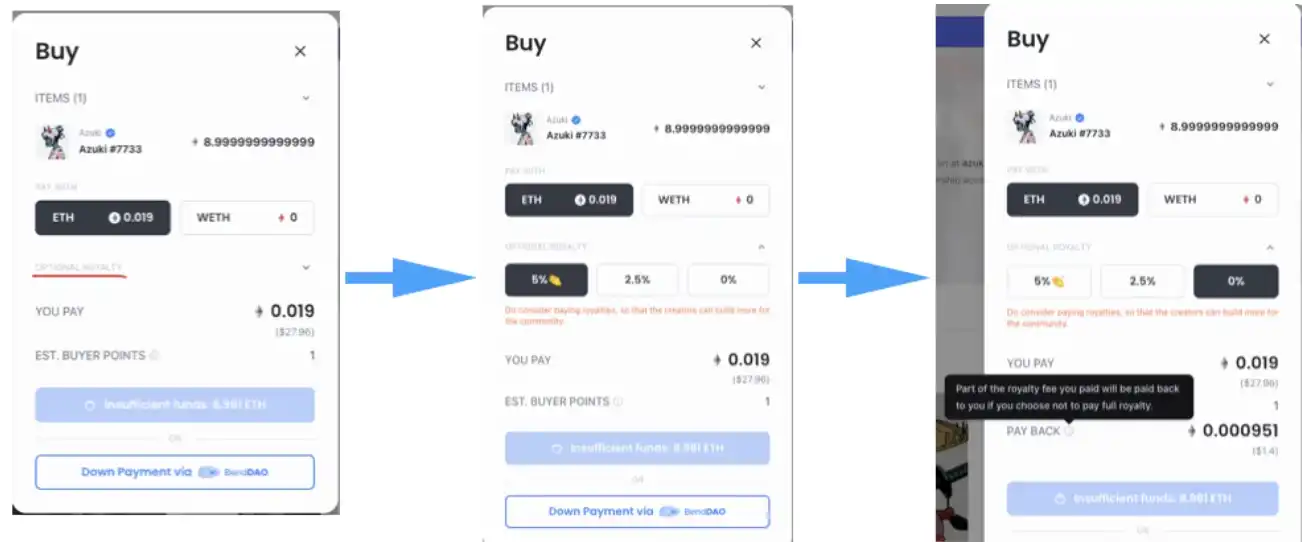
First of all, let’s take a closer look at x2y2 The second added function, it is up to the buyer to choose the proportion of the royalty distribution
1. From the UI design, this function uses a smaller gray The font is folded by default; at the same time, the name is "OPTIONAL ROYALTY" (optional royalty), indicating that the current positioning is a secondary or even tertiary function. First test the feedback from users who actively discover this function. According to the common sense of click conversion rate, the usage rate of the secondary function is about 10%.
2. After the user clicks "OPTIONAL ROYALTY", the default selection is 100% of the royalty to the project party (the royalty set by Azuki is 5%), and the following is A red text emphasizes "Do consider paying royalties, so that the creators can build more for the community." (Be sure to consider paying royalties so that creators can create more content for the community), informing users of the importance of royalties In other words, the choice here should be cautious
3. The user has 3 royalty options, 100%/50%/0%. If you choose 100%, The royalties are still all given to the project side; if you choose 50%, half of the royalties will be given to the project side and half will be returned to the users; if you choose 100%, all the royalties will be returned to the users
Expand a little , why let the buyer choose when buying, instead of the seller choosing the royalty rate when listing? The following are my own thoughts
1. The buyer is the one who really pays for the project, and it is more fair for the investor to choose. Is it worth paying royalties
Soft rug project owners and users must pay royalties when cutting meat?
2. If the seller chooses, it will make things complicated, unless it is one size fits all like sudoswap. Specifically, there will be two problems
・The listing process becomes complicated, and the seller needs to calculate the price set under different royalties based on the income. In addition, if the seller wants to list 2 versions at the same time, one with royalties and one without royalties, this is even more complicated
・The buyer's selection process becomes complicated. It is not ruled out that some buyers just want to choose NFT with royalties, and an additional screening process is added to reduce user experience and transaction success rate
To sum up, x2y2 uses A secondary function has been introduced to give users the right to choose royalties. At the beginning, we will test the feedback of about 10% of users. At the same time, we have also established the ability to adjust royalties, which is better than the seller’s choice of user experience. This also matches the attitude of CEO TP in the last AMA when he talked about royalties and said that "we will see how the situation develops" .
p.s. Many voices say that users here will definitely choose 0 royalties. This is indeed a place to test human nature. I actually don’t think so. From a social and cultural point of view, Western society itself has a consensus on "tipping"; as a user, a good project owner, especially a good artist, I am willing to pay royalties (the consumption attribute is also added here), and I am curious about the specifics What will the data look like, and whether x2y2 can be used as a social experiment for sharing and discussion: )
 < /p>
Why is x2y2 now allowing buyers to choose 0 royalties
The official line is that "mainstream aggregators intend to offer similar functionality in the near future. To ensure that X2Y2 is ready and on top of market trends we Made the above update"

My own understanding, there are 2 reasons here, X2Y2 is only mentioned here 0.5, the other 1.5 is inconvenient to say directly
1. Mainstream aggregators intend to provide similar functions in the near future, this sentence only Half said. The "mainstream aggregator" here should refer to GEM. On the same day, GEM integrated sudoswap, and the floor prices of popular projects were all occupied by sudoswap, which will greatly weaken the competitiveness of x2y2. x2y2 started as a GEM and had to follow in some way. Interestingly, GEM has integrated sudoswap. I haven't seen it under these two official Twitter accounts. I guess it should be a low-key test user response
2. Currently In a bear market, both users and project parties are losing, and the market leader Opensea’s trading volume is also very bleak, which is also a good opportunity for the second echelon to attack. In this way, x2y2 can compete for users and gain a larger market share. And this function itself is also a topic that is easy to spread, so x2y2 officially tweeted the announcement.

< br>
Why did it cause another round of controversy on the whole network
The royalties The topic had been discussed vigorously for a round two weeks ago and gradually calmed down. As a result, the new wave was more violent. At the same time, according to my own observation, the last wave of discussion was more about royalties themselves, and this wave is basically aimed at x2y2 , why? I have summed up 2 reasons myself
1. The transaction volume of x2y2 is larger, which will affect the interests of more project parties. The trading volume of sudoswap is small and more people are waiting to see
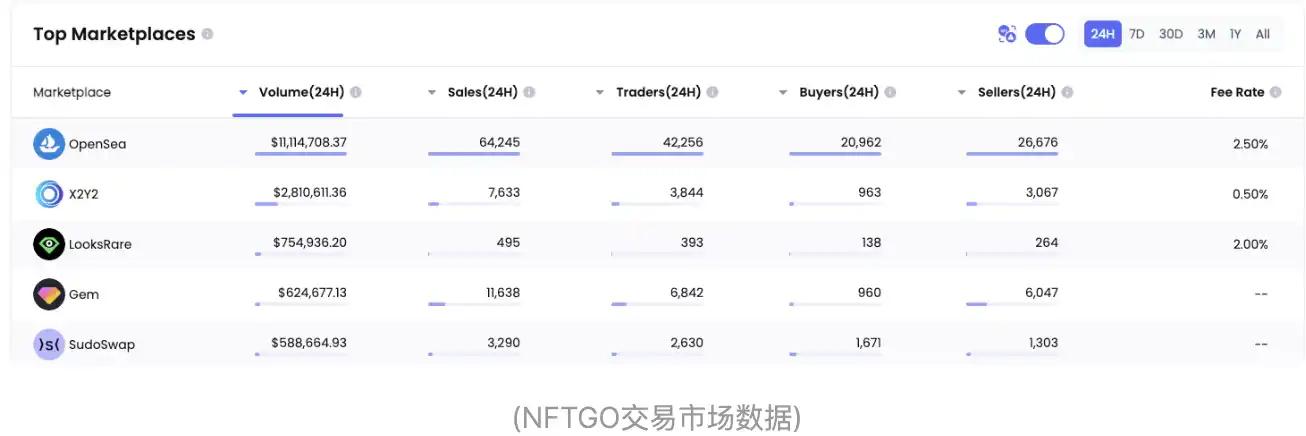
According to the data of nftgo, in the past 24 hours, the trading volume of OpenSea, x2y2, LooksRare and sudoswap in the past 24 hours were respectively $11M, $2.8M, 0.75M, and $0.6M (excluding wash trades). x2y2 is almost 30% of OpenSea's volume, while sudoswap is only about 5% of OpenSea's. zeneca33 It was also mentioned in the previous article that the current share of sudoswap is still small, and everyone is still waiting to see the development of the situation
2. The buyer is given the choice of royalties, but the communication on the seller's side is a little less thoughtful
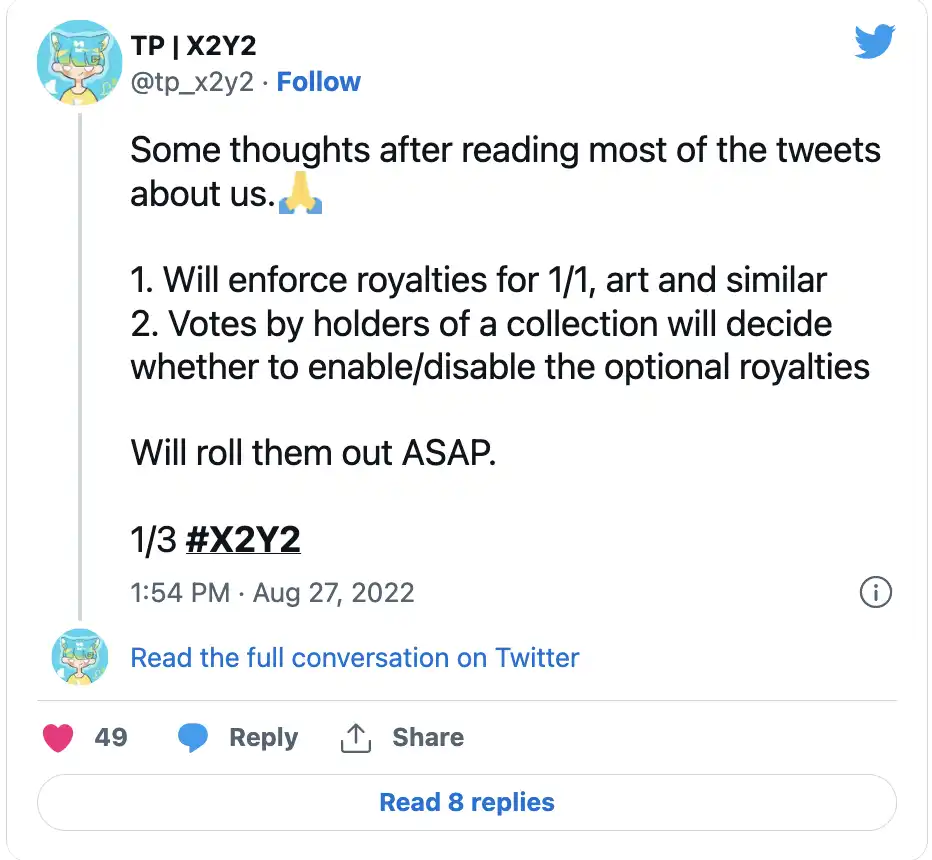
・From the perspective of project categories, it is true that PFP projects can be less dependent on royalties. There is a strong consensus on art royalties, which are easy to be caught and criticized; tools are indeed still needed at this stage, This is why Coniun CEO is so excited; x2y2’s reaction speed is indeed very fast, the next day CEO TP tweeted about mandatory royalties for art. But it is true that some consideration and communication are missing in this area
・From the point of view of the right to choose, TP tweeted that holders can vote to decide whether there is a royalty. The participation of project parties is also missing
・From the perspective of time rhythm, subsequent new project parties can optimize their business models based on this, but stock project parties are indeed affected Influence, especially those creators who rely on royalty serious BUIDL
Finally back to the title of this article, the next 4 key parts of the NFT industry will be Reshaping
Fourth, why does the royalty reform mark the next round of development of the NFT industry?
1. Reshaping the business model and increasing high-quality supply
2. Reshaping the relationship between project parties and users
3. Reshaping the relationship between project parties and trading platforms
4. Reshaping smart contracts
After this round of remodeling, high-quality supply has increased, project parties and trading platforms have become more mature, projects and users have shifted from investment to consumption, and a broad market is about to open.
1. Business model reshaping, high-quality supply increased
・All projects in the industry It is definitely unreasonable to collect royalties, especially many soft rug projects have received 5%-10% royalties, but BAYC's royalties are actually only 2.5%
・Different types of projects need to design a healthier business model. As has been analyzed above, royalties alone cannot support long-term BUIDL. New projects based on IP, reserved NFT, subscription and toB charges are more diversified and healthier revenue methods
・The cost of project distribution will be higher, and the model of soft rug eating royalties will gradually die out after relying on the 0-cost blind box freemint; but the logic of free mint itself is established, as long as there are high-quality works and utility , the project party can make revenue by reserving NFT. Simply put, the number of Tugou projects has decreased, and high-quality projects have increased
2. Reshaping the relationship between project parties and users: setting user hierarchical rights and interests, users Whether to pay royalties will become an important distinguishing behavior; the increase in user consumption behavior
The project party will introduce a series of incentives (or equity degradation measures) to encourage users to pay normally Royalties, including utility, airdrops and offline events. Of course, this also requires the project party to be sufficiently competitive, otherwise users can choose similar but lower-cost projects
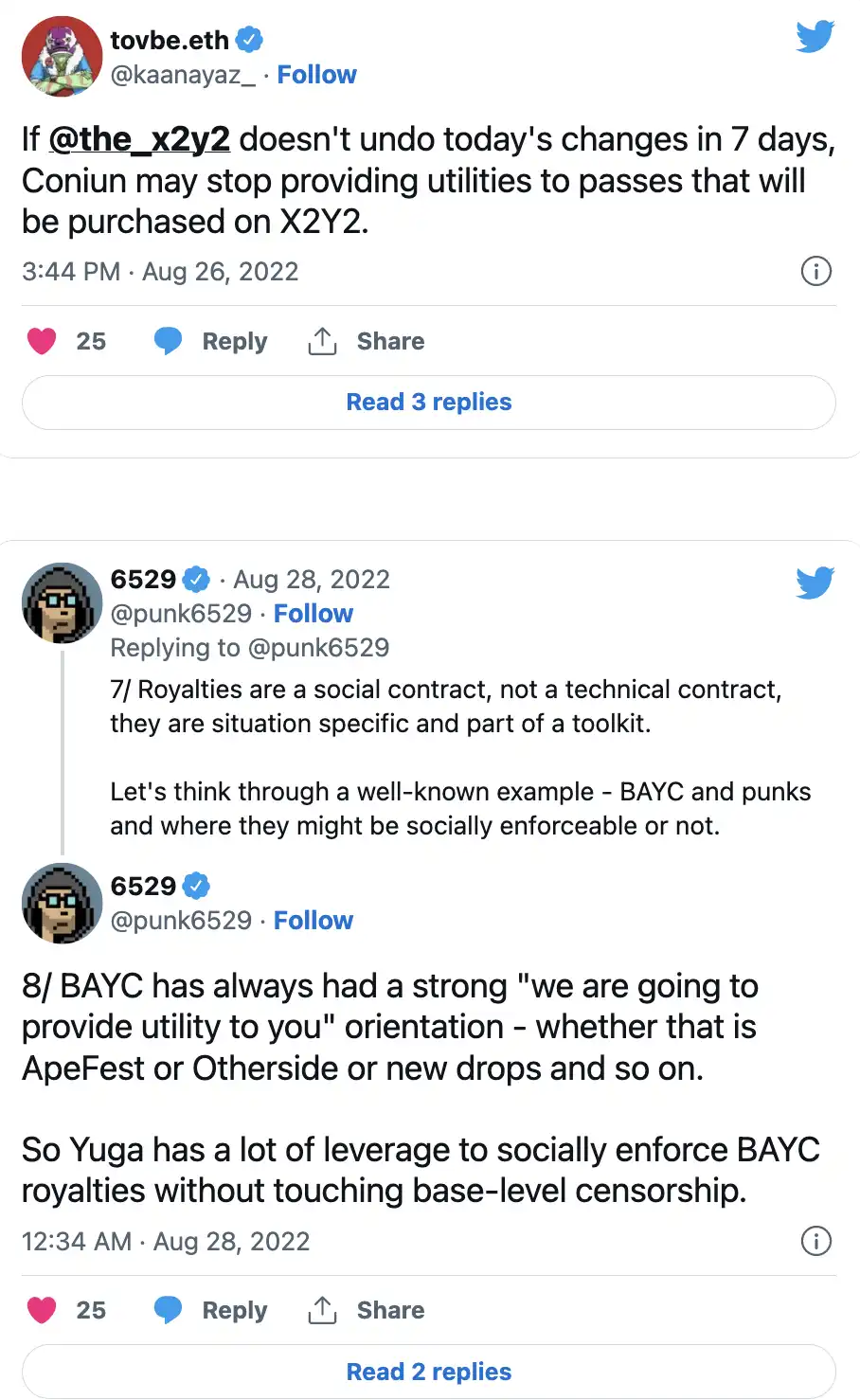
・The CEO of coniun tweeted Do not provide utility to purchase users on x2y2 (really turned into JPG T_T)
・6529 (joking) said that BAYC can ban users who have not paid royalties to follow up airdrop, enter otherside, and participate in offline activities
This is a good thing. On the one hand, it strengthens the competition between project parties; on the other hand, it also Encourage users' "consumption" behavior, not just "investment" behavior
3. Reshaping the relationship between the project party and the trading platform: a small number of powerful project parties will accelerate the launch Own marketplace
・Truth Labs co-founder Alexander Taub announced on Twitter that it will launch in a few weeks goblintown.wtf Ecological NFT trading market, better regulate royalties, platform fees and suspicious NFT, build yourself Ecology
・It has been rumored for a long time that Yuga Labs will also launch its own trading market
・Azuki developer tweeted that there is a way to set a whitelist, only in which The trading platform is listed
・This is also a good thing. Competition accelerates the innovation of trading platforms. Now there are too many slots, especially in terms of governance (suspicious NFT and Suspicious item)

4. Smart contract reshaping, implanting royalties?
Currently the closest is EIP-2981 realizes standardized royalty payment information retrieval, and each trading platform can choose to directly call to distribute royalties, but it can also choose to use its own logic
< br>
A standardized way to retrieve royalty payment information for non-fungible tokens (NFTs) to enable universal support for royalty payments across all NFT marketplaces and ecosystem participants.
I don’t think that smart contract upgrades can completely solve the problem of royalties. As punk6529 said, "Royalties (Royalties) is a social convention, but not a technical convention." What is controversial is whether royalties are reasonable and which scenarios are reasonable. Users will always have ways to avoid or even hack what they think is unreasonable.
Of course, better technologies may appear in the future to promote a new round of changes.
End
I have communicated with many friends, the royalty event is actually an opportunity, Let everyone calmly review what is unreasonable in the current situation in the bear market, what the future-oriented NFT project and trading market should look like, and accelerate the process of BUIDL. I believe that after this round of bear market, the projects that come out will be healthier, and topics such as "what is the value of small pictures" and "rug projects are lying to make money" will no longer be questioned. The world will never be perfect, but the future of NFT must be better than the present, let us meet in the bull market!
Original link
Welcome to join the official BlockBeats community:
Telegram Subscription Group: https://t.me/theblockbeats
Telegram Discussion Group: https://t.me/BlockBeats_App
Official Twitter Account: https://twitter.com/BlockBeatsAsia

 Related Articles