



Inventory of subtle changes and future developments in the 2022 NFT trading and aggregation field.
Original Title: "A Detailed Look at the Subtle Changes and Future Development of NFT Trading & Aggregation in 2022"
Original Author: Betalpha Labs
Table of Contents
1. Introduction
2. Introduction to NFT
3. NFT Market Overview and Policy Updates
3.1 Trading Platform
3.2 Aggregation Platform
4. Mergers and Aggregations at the Transaction Level
4.1 Opensea&Gem
4.2 Uniswap&Genie
5. Reviewing updates and royalty processing methods
5.1 Updates on anti-theft fraud, intellectual property, and review
5.2 Persist in charging creator fees.
6. Income Distribution
6.1 Creator Fee Data
6.2 Zero Creator Royalties
7. Traditional Industry Layout of NFT and Introduction of New Technologies
7.1 Web2 gradually enters the NFT brand market.
7.2 AI + NFT
8. Future Development
9. Summary
10. Reference
1. Introduction
In recent years, the NFT track has attracted a lot of attention from investors. Top CEXs such as Binance, Coinbase, and Kraken have announced their entry into the NFT field. In the past, DeFi formed a complete ecosystem including DEX, lending, stablecoins, oracles, derivatives, cross-chain bridges, etc. within just one year and continued to move towards energy aggregation based on traffic. In 2022, NFTs further accelerated the speed of ecosystem aggregation. Currently, the track is trending towards maturity and development, expanding in multiple dimensions within its own ecosystem, from review updates to zero-tax reforms, brand collaborations, and even mergers and acquisitions.
Against the backdrop of the bear market in 2022, there has been significant volatility in the data related to NFTs. Since the second half of the year, the overall data of the NFT market has continued to decline. Therefore, there have been voices in the ecosystem suggesting that NFTs are about to enter a period of decline. However, the rise and fall of NFTs can predict market trends to a certain extent and reflect the value logic of the industry's overall development. For example, this article will discuss the merger and development trends of the aggregated track. The NFT market has now entered a period of stability and transformation, requiring time to settle and continue to take root.
This article will start with the origin and basic knowledge of NFT, summarize the historical milestones of the NFT track, introduce the current situation of the NFT market, and discuss recent merger activities at the transaction level. It will also summarize the latest policy updates and attitude changes towards royalties on various platforms, analyze the latest related technological updates in the field, and provide an overview of the entire track and its future development direction.
2. NFT Basic Introduction
When people think of NFTs, they most commonly see them as images or personal profiles (proof of pictures, PFP) on social media. However, traditional NFTs in the traditional sense have been around before 2021 - just not many people really knew about them.
What is FT
Homogeneous Token (FT) is a type of Token that can be replaced, has uniformity, and can be infinitely split. To explain homogeneity, a good example is currency - because of its homogeneity, people can easily exchange a $5 bill for another $5 bill. The US dollar, as a homogeneous Token, can be easily exchanged, even if the serial numbers are different, and if the values are the same, the denomination of the banknote does not matter to the holder. These items can be exchanged because they are defined by value rather than uniqueness.
What is NFT
NFT is the abbreviation of non-fungible token, which is a significant feature of non-fungibility. Compared to fungible tokens, NFTs cannot be replaced with each other. It is a data unit stored on the blockchain and can represent unique encrypted assets such as artworks. Each NFT has a unique identifier that distinguishes it from other NFTs, which is also proof of authenticity and ownership in the digital realm.
There are various frameworks for creating and publishing NFTs. Among them, the most popular frameworks are ERC-721 and ERC-1155 on the Ethereum blockchain. Without the owner's permission, NFTs cannot be copied or transferred, even by the issuer of the NFT.
NFT Development History
The concept of NFT can be traced back to "Crypto Trading Cards" in 1993 and "ColoredCoin" in 2012. "Crypto Trading Cards" proposed the idea of collecting digital cards created by transactional mathematical models, while "ColoredCoin" gave Bitcoin more utility and was an excellent experiment in off-chain asset mapping.
From the initial exploration, to the subsequent explosion and stabilization stages, the concept of NFT gradually became more widely known. Today, the appearance of NFT is very different from the original concept, but it is precisely through continuous innovative attempts that Crypto has been created as it is today.
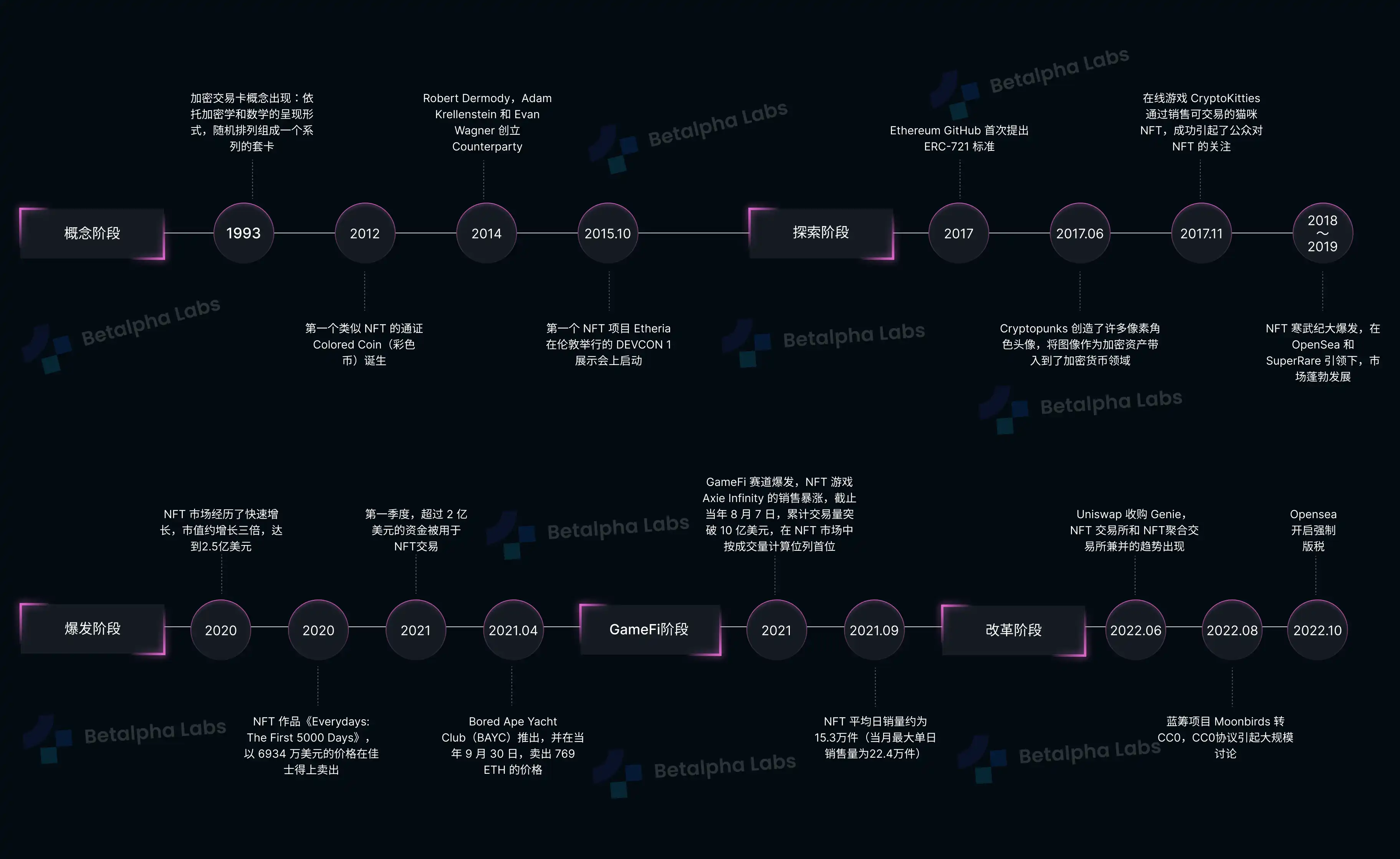
Figure 1: NFT 5 Major Milestones
NFT Track Division:
If we divide the NFT market by protocol functionality, NFT platforms can be classified into five major categories: trading, aggregation, lending, data tracking, and social.
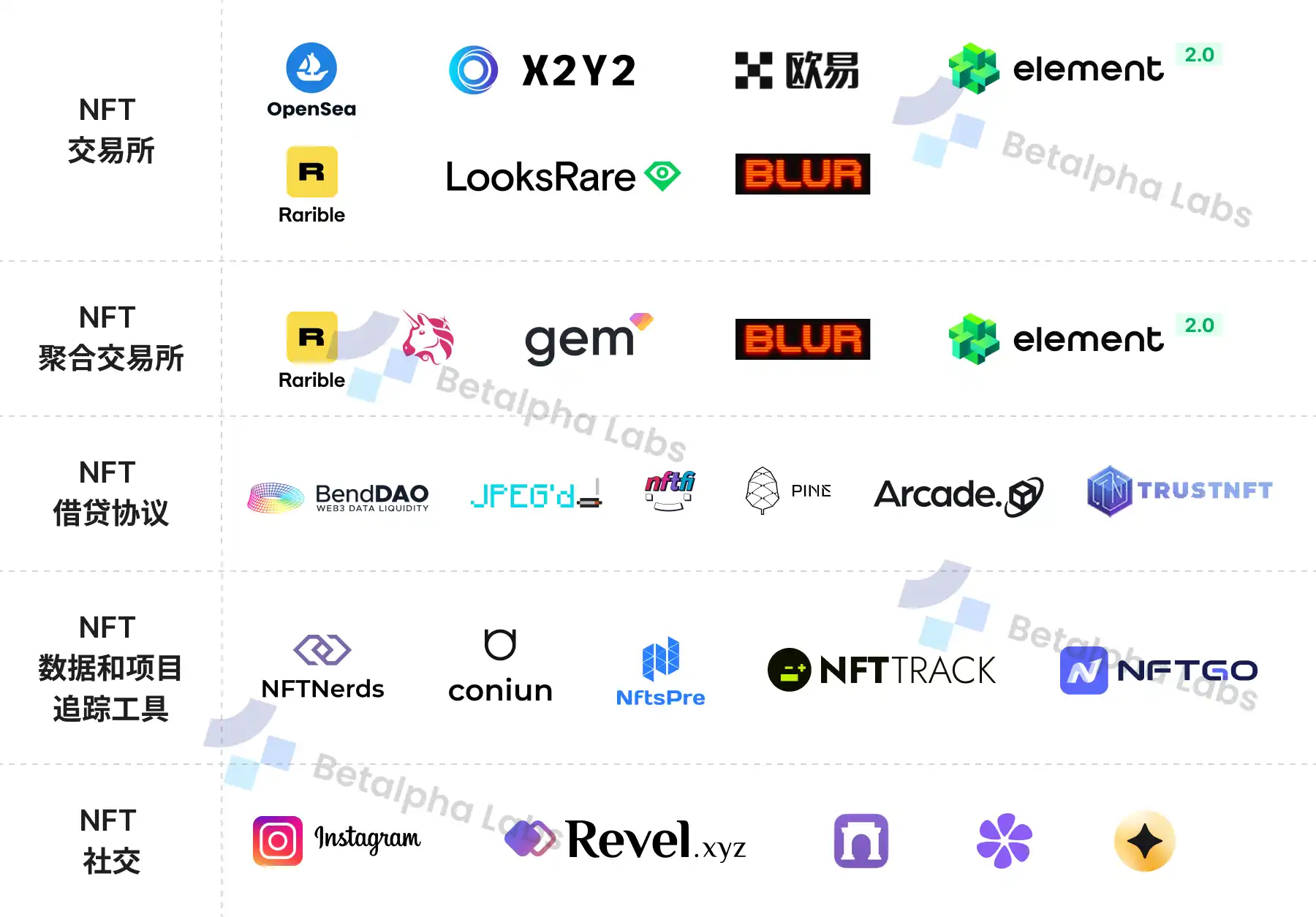
Figure 2: NFT Track Division
3. NFT Market Overview & Policy Updates
3.1 Trading Platform
According to data from CoinMarketCap, the total trading volume of 14 NFT trading platforms in the market increased from $85.7 million in 2020 to $19.6 billion in 2021, an increase of nearly 23,000%. 2021 is undoubtedly a year of unimaginable growth in the NFT field.

Figure 3: Trading Platform Data
However, 2022 is a difficult year for the NFT industry. From the early-year Luna scandal to the year-end FTX bankruptcy, although new NFT projects continue to emerge and explore, the overall downturn of the crypto ecosystem has also dragged the NFT market into a bear market.
The total market value of the NFT market reached a peak of $34.96 billion in March, but has been in a slump since May, with the total market value remaining between $21 billion and $23 billion. In November, it fell to a low of only $20.82 billion, a decrease of 40.5%.
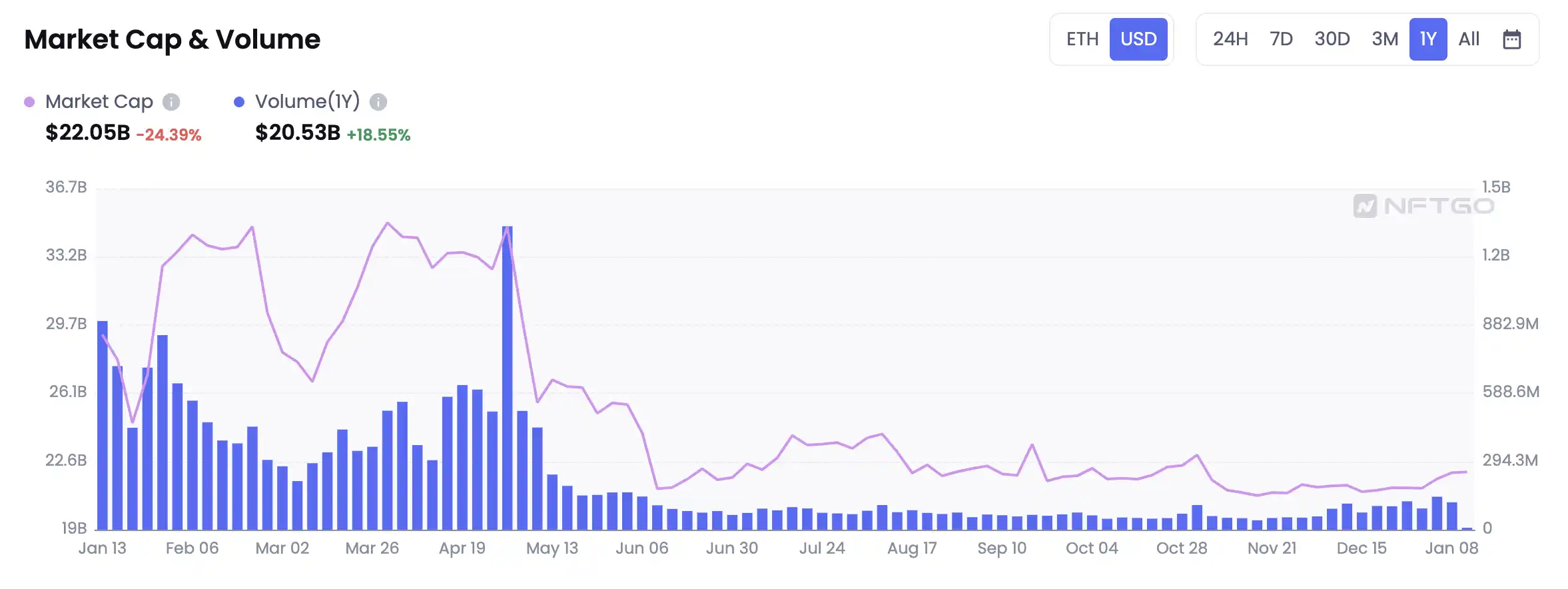
图 4: market cap & volume
Figure 4: market cap & volume
OpenSea
Established in 2018, OpenSea is a blockchain-based global marketplace for buying and selling digital items, and is a leading project in the NFT trading market. OpenSea positions itself as a leading decentralized trading platform, providing peer-to-peer (P2P) trading of non-fungible tokens (NFTs). In 2022, OpenSea will focus on copyright protection. In June, OpenSea updated its NFT copyright protection plan and launched multiple measures to continuously improve and protect the rights of NFT owners. In addition, OpenSea also launched a new verification system that can
More prominently identify real accounts and content.
In November 2022, Opensea announced that it will launch an on-chain mandatory royalty tool. According to the rules of Opensea's on-chain mandatory royalty tool, NFT project owners must use Opensea's mandatory royalty contract if they want to collect royalties on Opensea. However, this contract will blacklist all platforms that launch custom royalties. If NFT project owners do not want to blacklist other trading platforms, Opensea will directly reduce all royalties generated by the project on Opensea to 0.
Magic Eden
As the NFT trading platform with the highest transaction volume on the Solana chain, Magic Eden will expand its supported blockchain list by integrating Polygon. Game NFTs have always been Magic Eden's strength, and in December, Magic Eden hosted multiple Polygon-based projects on its Launchpad platform. According to the information released by Polygon, after the Polygon project Launchpad is launched on the platform, Magic Eden users will be able to trade NFTs using Matic. Magic Eden has also made updates in terms of royalty protection. In December, the official announcement was made to launch a new protocol that will levy royalties on all new collections that choose to use the tool. The open-source tool Open Creator Protocol (OCP) will allow creators who publish collections to choose whether or not to protect royalties. For creators who do not adopt OCP, royalties will still be optional on the platform.
In addition, Magic Eden has officially introduced a discount and reward system, allowing users to receive rewards, discounts, and other benefits based on their activity on the platform. Magic Eden is collaborating with ecosystem partners to add new features such as invitation codes and trading research tools. Despite OpenSea's support for Solana in April 2022, Magic Eden undoubtedly continues to lead in trading volume on Solana.
3.2 Aggregation Platform
Aggregation platforms are gradually emerging in the market. From the development process, many professionals believe that it is not a few heavyweight cryptocurrency trading platforms, not Rarible that launched the Token mechanism very early, not the art markets Superare and Foundation that will change the status quo of the NFT market, although they still have considerable potential, but their target market is relatively niche.
What really shook the OpenSea market were teams that implemented Aggregators through tools and boldly experimented with Token Incentive mechanisms, such as GEM and Element, as well as reward mechanisms for transactions like Looksrare, including the impressive newcomer Blur.
In traditional sense, aggregator is mainly used for data aggregation. It can collect data across websites and present the information in a categorized manner on a single platform to meet the needs of different users. Essentially, it is a search engine that can collect and compile useful information while removing irrelevant information.
With the development of technology, certain aggregators can also create valuable metrics through the use of machine learning. These metrics are calculated from processed data. Professional NFT aggregators need to collect all NFT transaction information from different public chains and integrate them into one platform. This provides users with a smooth trading experience and improves transaction efficiency.
Compared to traditional trading markets, NFT aggregators have some obvious advantages, including:
Highly Aggregated Information - Users can view, trade, and purchase NFTs across all markets through a single platform. They can also view all information related to NFTs, such as trading volume, floor price, transaction price, quantity, top holders, top buyers, etc.
Improve trading efficiency - users can easily browse trading information from all trading platforms and filter out the most high-quality trading prices.
Diversified payment methods - users can use any token they want to pay on the NFT aggregation platform (ideally), and can also save gas fees by bundling transactions.
Overview of the Aggregation Platform Market
NFT has become one of the hottest topics in the entire cryptocurrency industry, as well as in the fields of financial technology and entertainment. Just like bulk trading in traditional financial markets, there is an increasing demand for more convenient ways to purchase a basket of NFT assets or to conduct batch buying and selling of NFTs.
It is not difficult to see that more and more platforms are focusing on the NFT aggregation market through acquisitions or updates, and batch trading of NFTs has also become a market trend.
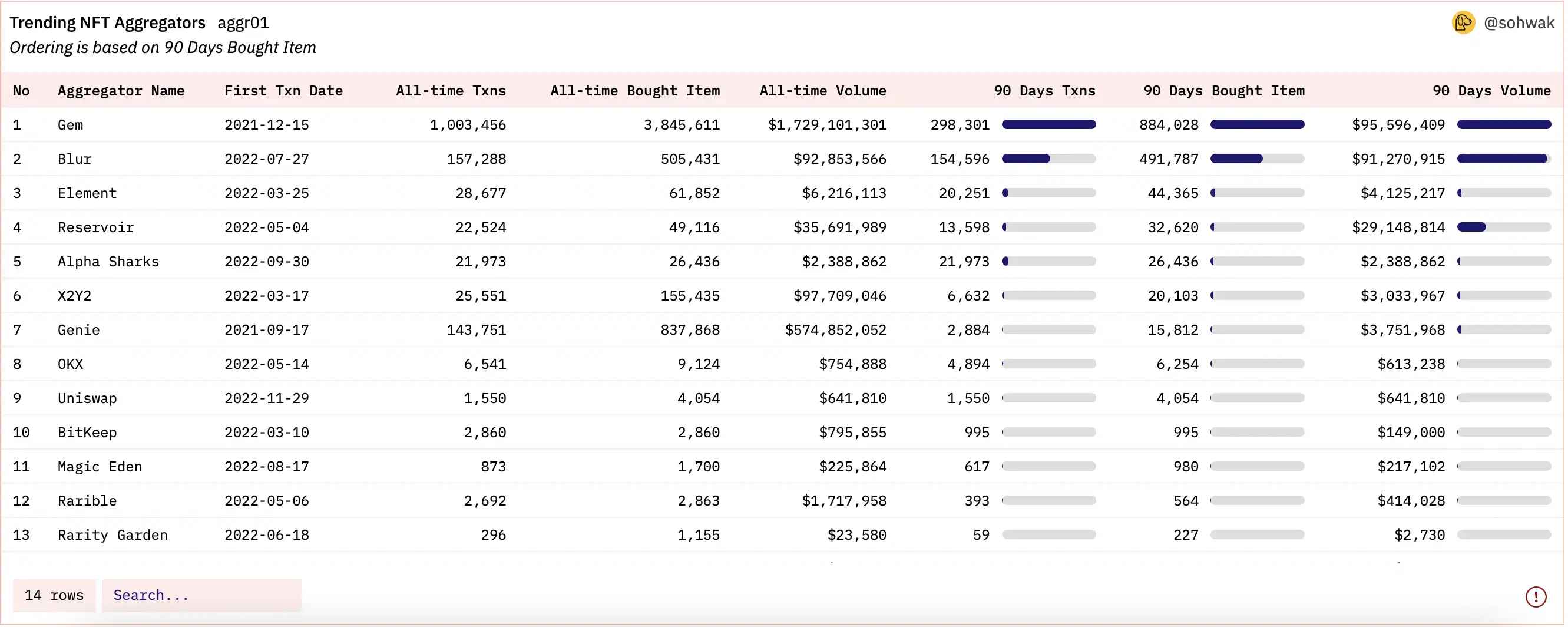
图 5: trending nft aggregator
Figure 5: trending nft aggregator
From the above data, it can be seen that Gem has been performing well since its beta launch on December 28, 2021, with total trading volume ranking first. The official announcement of its acquisition by OpenSea was made in April 2022, but it still operates as an independent brand. However, in October 2022, Blur emerged and broke Gem's monopoly by attracting a large number of users in a short period of time through its "custom royalties + zero fees + airdrop expectations" model, becoming the largest NFT aggregation trading market on the chain and putting unprecedented pressure on major platforms.
In addition, in the latest month's data, the aggregated market trading volume accounted for only 11.92% of the total NFT trading market, and with the market downturn in the bear market, the overall trading volume decreased by 26.7% compared to the previous month, and the market entered a stable stage with no explosive growth. Among them, the trading volume of Blur also reached an astonishing 73.6% in the aggregated market, surpassing half of the aggregated market share and firmly occupying the first position. And from the perspective of user numbers, in the latest month's data, Blur's share reached 61.7%, followed by Gem (33.8%) and the recently launched Uniswap Aggregator (5%). There is still a huge gap in the number of users using other aggregation platforms compared to Blur and Gem.

图 6: aggregator marketplace
Figure 6: aggregator marketplace
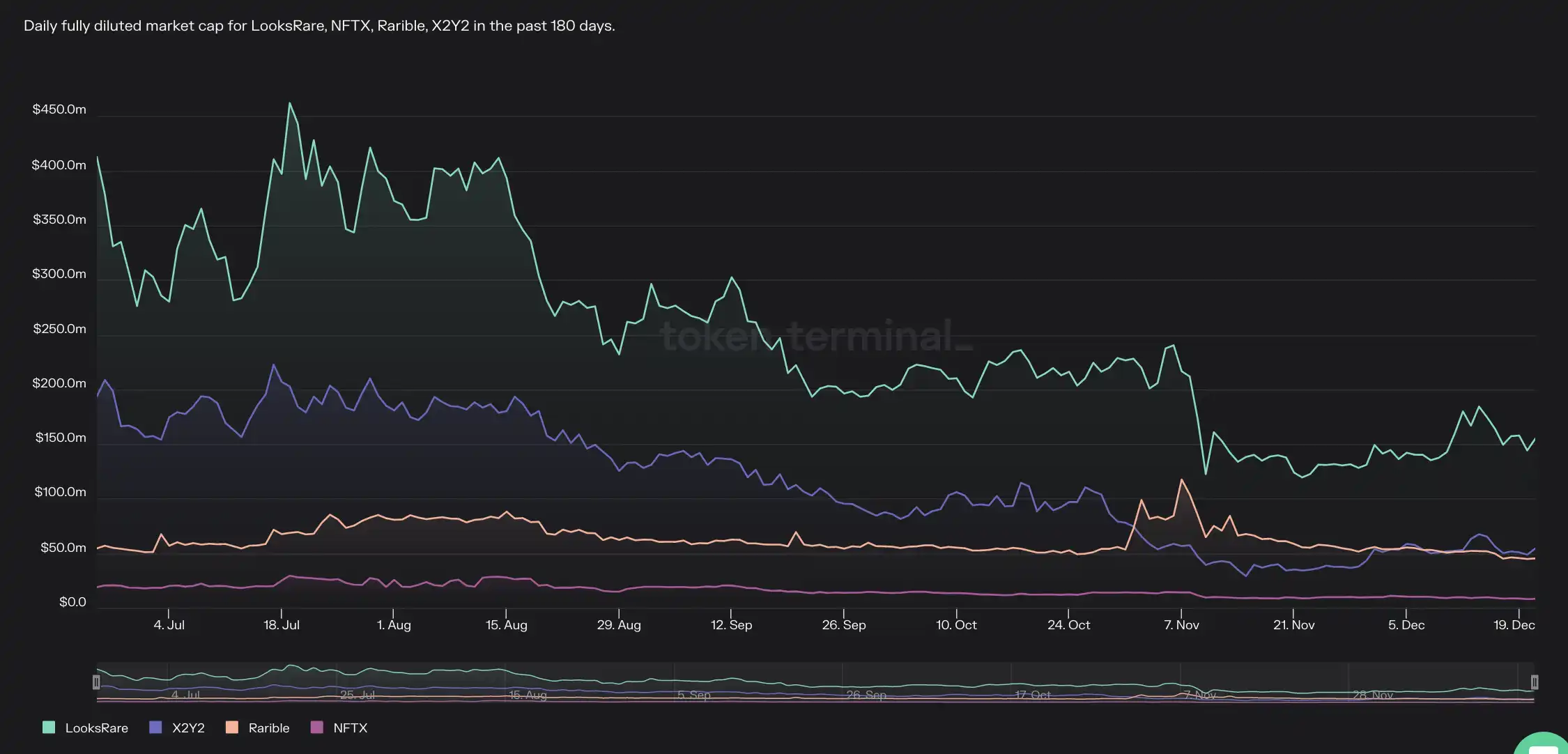
Let's take a look at the performance of other platforms. Except for Blur and Gem, X2Y2 and Looksrare have also shown relatively stable performance in various data indicators. Their fully diluted market values are around $55m and $150m respectively, with Looksrare being about three times that of X2Y2. In terms of earnings, X2Y2's average recent earnings are $18K, a decrease of 24.4% compared to the same period 30 days ago, but an increase of 70.2% compared to 180 days ago. Looksrare's average recent earnings are $90k, a decrease of 15.3% compared to the same period 30 days ago, and a significant decrease of 96.2% compared to 180 days ago, indicating that it has entered a bottleneck period.
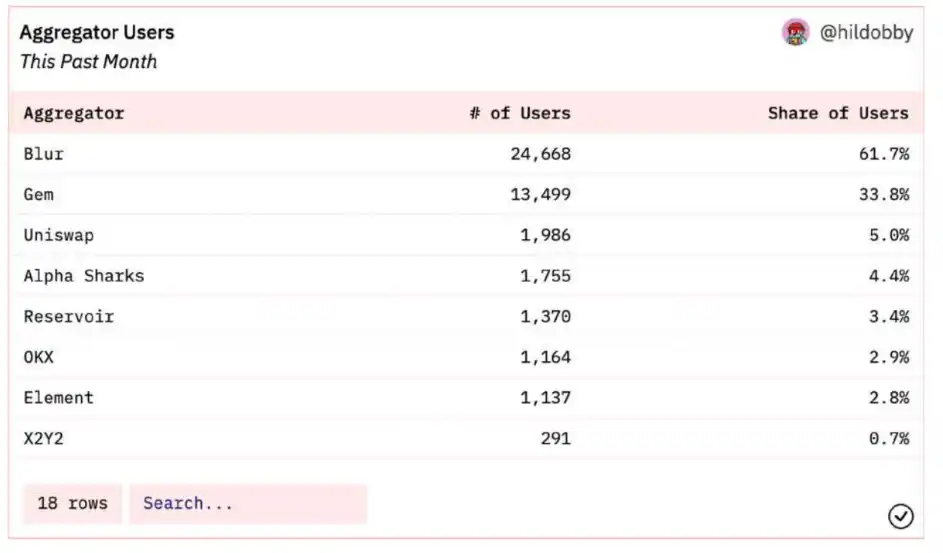
图 7: aggregator users
Figure 7: aggregator users
Overall, in the market, 82% of trading accounts directly choose to trade from the NFT market, while 18% choose to trade from aggregated trading markets. From the graph, it can be seen that the number of aggregated trading accounts had a significant increase in October 2022, which coincides with the launch of Blur and has a significant impact on the data.

图 9: Txns Count Ratio
Translation:
Figure 9: Txns Count Ratio
Next is the proportion of NFT purchase quantity, with 72.6% of NFTs purchased directly in the NFT market and 27.4% purchased in aggregated trading markets. The peak of aggregated purchase occurred on May 6th, with aggregated proportion at 37.2% and MA proportion at 84.2%. That day was the opening day of Azuki airdrop project Beanz Official, and more people tended to choose to scan blue-chip NFT projects on aggregated trading platforms.

图 10: Bought Item Count Ratio
Figure 10: Bought Item Count Ratio
Finally, let's take a look at the market trading volume data. Currently, the aggregated market trading volume accounts for 11.7% of the total, which is about 16% lower than the previous purchase volume data (27.4%). Therefore, we can boldly speculate that the majority of the trading volume in the aggregated market comes from low-priced NFTs. People choose to buy in bulk on the aggregated platform for products they believe have potential and are currently priced low. However, for blue-chip NFTs, people still tend to go to trading platforms like Opensea to reduce risk, especially when there are no platform activities.
However, the long-tail market cannot be underestimated. For example, Amazon and Netflix have both accumulated their total volume through the long-tail effect, eventually leading to explosive growth. The NFT aggregation market may also experience its own small peak with the future development of NFTs.

图 11: Volume ratio
Figure 11: Volume ratio
Aggregation Platform Trend Segmentation
Blur
Blur is undoubtedly one of the top newcomers in the market. Since its launch, it has quickly and successfully captured a portion of the market share and sparked widespread discussion on various platforms. Like Uniswap, they chose to promote and advertise at the same time, claiming to have a smooth interface experience and the background strength to purchase multiple NFTs at once. After a round of airdrops in November, Blur has accounted for about 15% of the Ethereum NFT market transactions.
After the second round of airdrops in early December, as of December 19th, the trading volume of Blur's NFT has exceeded Opensea, accounting for 33.02% of the entire NFT market share, becoming the largest NFT aggregation trading market on the chain. According to NFTGo's data, its trading volume has reached 240k ETH in the past month, surpassing Opensea's accumulation in just 3 months since its launch.
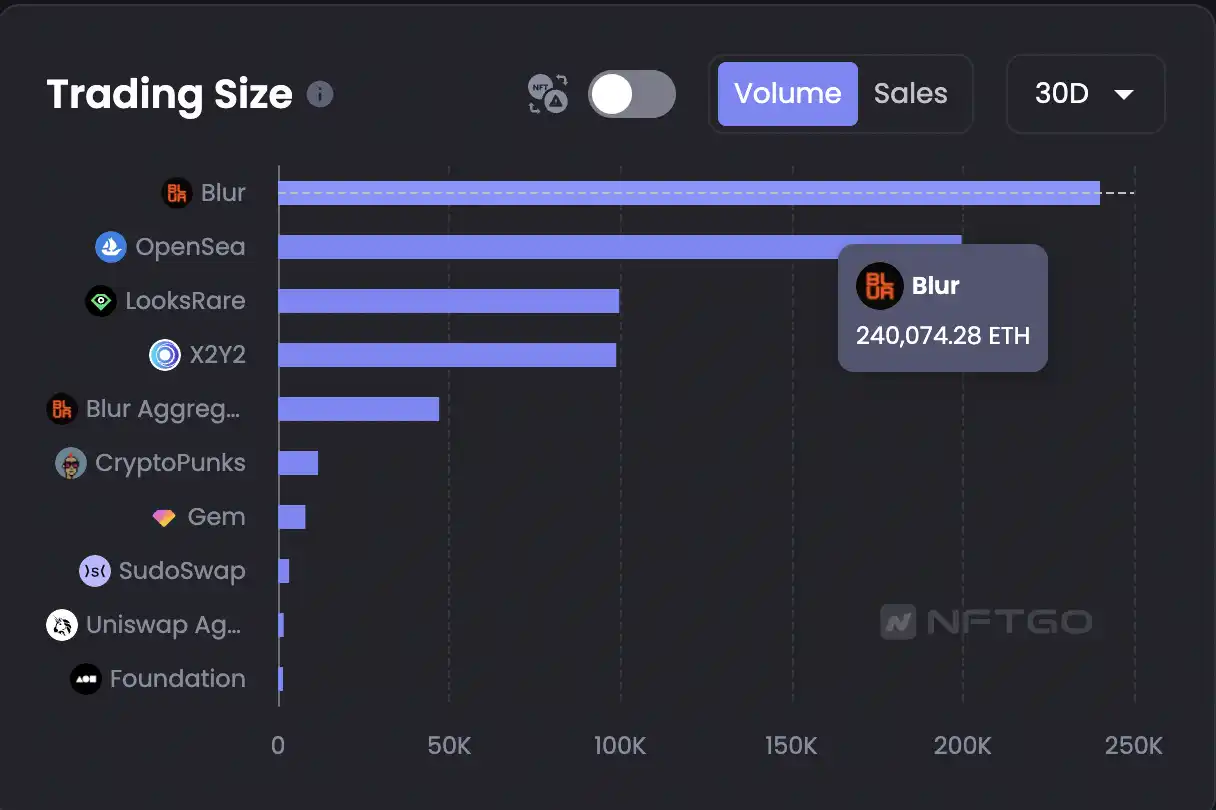
图 12: trading size
Figure 12: trading size
In addition, Blur also has its unique way of operation. Most of the airdrops on the chain are to attract more traffic, but Blur has already gained a lot of attention in the first round of airdrops, and has clearly stated that the second round of airdrops will be directly related to the interaction with users on the platform, which is also the direct reason why it attracts a stable user group to place orders and trade.
The royalty mechanism of Blur is different from most NFT markets. Here, NFT traders can set their own royalties. This means that they can choose not to charge royalties if they wish. Therefore, the original creators of NFTs do not receive any income from secondary sales. On the other hand, the incentive mechanism rewards traders who like to use licensing fees. For example, traders who pay higher royalties will receive more airdrops.
In the second round of airdrops, users of Blur who set higher royalty rates will receive higher loyalty and more airdrops. As for users migrating from zero-royalty platforms like Sudoswap, traders who pay royalties can place orders on Blur and set the royalty to Sudoswap's platform fee (0.5%) to earn the same amount of profit and receive larger airdrops than other methods. However, according to data after one airdrop, this expected incentive did not actually prevent low or even zero royalty behavior. The overall average royalty rate of Blur is only 0.65% (as shown below), which has led to a decline in overall NFT market royalties (as shown below).

图 13: effective royalty across exchanges
Figure 13: effective royalty across exchanges
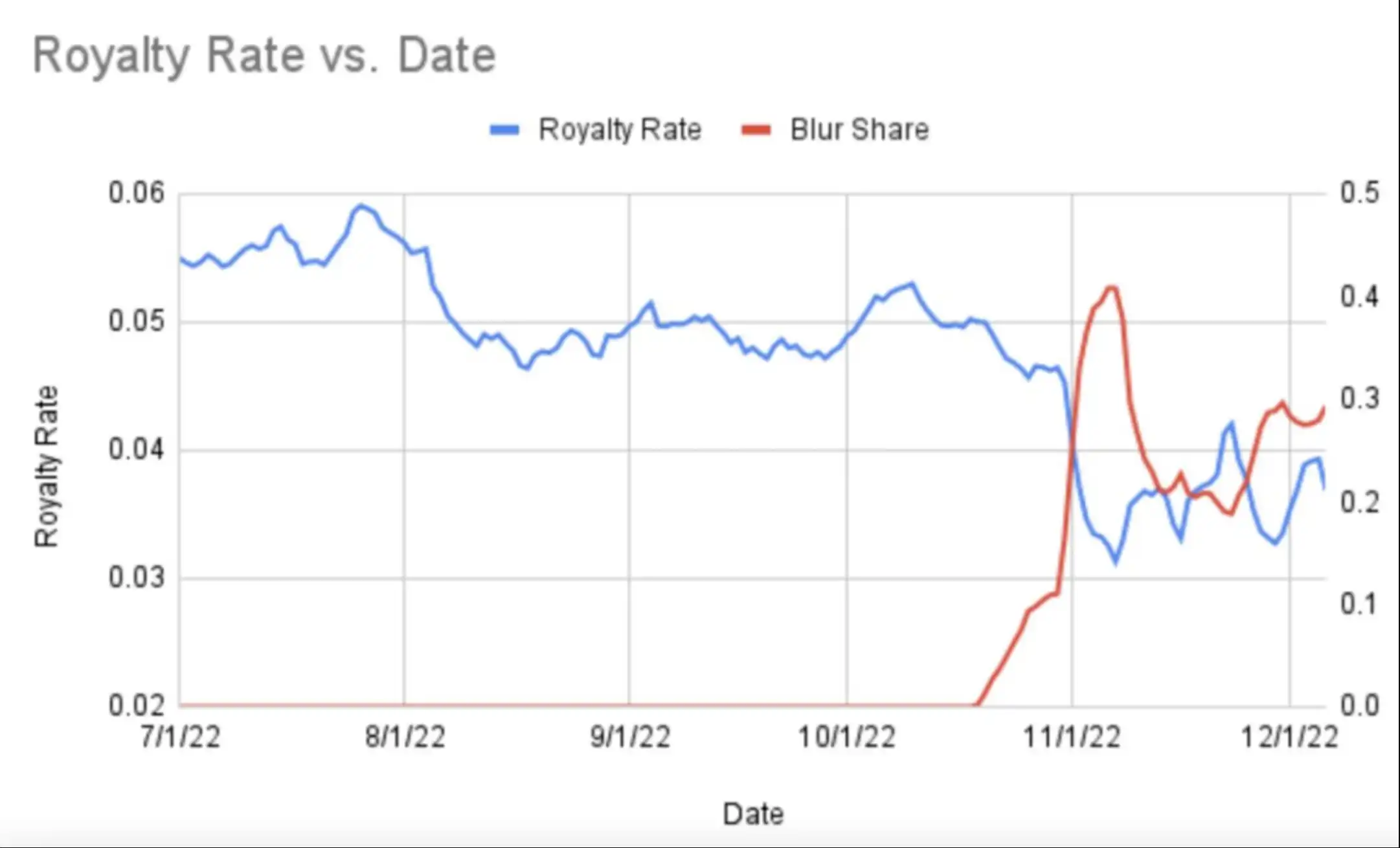
图 14: royalty rate vs. date
Figure 14: royalty rate vs. date
As for how long the "custom royalty, zero cost" model will last, Blur officials stated that they will wait for the Token to go online before voting on specific royalty and cost plans through community governance. Before that, Blur will not make a penny. Unlike Element, where the gas fees for purchasing a single NFT and purchasing multiple NFTs in bulk are equivalent, Blur's gas fees for purchasing multiple NFTs in bulk increase with the number of NFTs purchased. This may be why Blur's bulk purchase of NFTs is almost never unsuccessful.
LooksRare
LooksRare is a community-centered NFT trading platform that actively rewards all platform users. It was tagged with various labels when it first launched, such as "100% transaction fees shared by Looks Token stakers", "massive airdrops", "By NFT people, For NFT people", and so on.
LooksRare highlights its native token LOOKS and offers airdrops to all NFT users who have traded at least 3 ETH on OpenSea within the past 6 months. The LOOKS token airdrop has nine levels, and the more a user trades on OpenSea, the more LOOKS tokens they can receive.
According to the latest data on Token Terminal, the native Token LOOKS has experienced a 65.35% decline in price within the past 180 days. Although there has been a 23.98% increase in price in the past month, it appears to be of little help compared to the significant decline in the past.
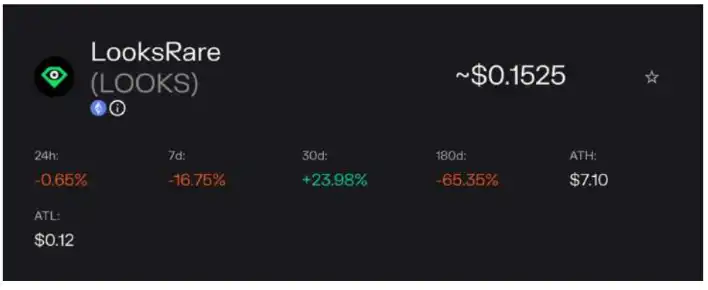
Figure 15: LOOKS
Since May, LooksRare's trading volume has also experienced a cliff-like decline.

图 16: LooksRare Volume
Translation:
Figure 16: LooksRare Volume
However, LooksRare still distinguishes itself from other NFT markets in some important aspects, such as platform transaction fees: LooksRare has set its transaction fee at 2% since the beginning of the year, while OpenSea's transaction fee is 2.5%, and it promises to distribute 100% of all platform fees to users who stake $LOOKS Token, which has led to positive staking response from users in the short term after its launch.
LooksRare's approach to derivative NFT projects is different from other platforms. In other words, NFTs that imitate existing NFT series products and LooksRare's position is not to take down or freeze their related derivative projects in the case of "no malicious behavior". Compared to OpenSea, which has absolute discourse power in listing NFT projects and has also taken down highly popular NFT project derivatives in the past. Of course, there are bound to be many different opinions within the community regarding derivative projects, with some believing that they should not exist, while others believe that attempting to prevent the derivation of NFTs violates the principles of Web 3.0.
X2Y2
X2Y2 is an NFT comprehensive trading market built on Ethereum. It went live and conducted a Token airdrop to conduct vampire attacks on Opensea. It also launched a series of order rewards, gas fee refunds, and transaction mining rewards to seize market share. Transaction mining is only an early customer acquisition method and cannot form a moat. The platform charges a 0.5% transaction fee and focuses on a low-price strategy to attract users, but has been questioned for its fake trading volume and false transactions.
X2Y2 launched order reward when it went online, but it did not attract users to the platform. The Gas fee subsidy activity launched in April also did not bring an increase in trading volume. However, with the launch of trading mining activities, the platform's trading volume has rapidly increased, with the highest weekly trading volume reaching 20,000 ETH. When trading mining reaches a certain stage, the platform accumulates a certain number of users and market visibility, and the data can maintain a stable upward trend for a period of time. Currently, according to data statistics on Dune Analytics, the cumulative trading volume has reached 1,689,188 ETH. However, since June, there has been a significant downward trend in trading volume.
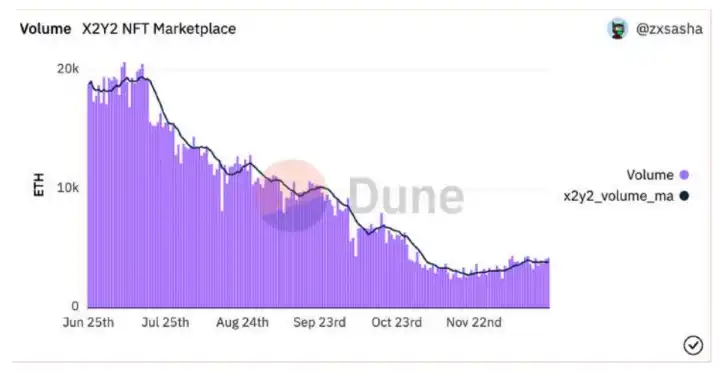
图 17: X2Y2 Volume
Translation:
Figure 17: X2Y2 Volume
According to the pure on-chain data provided by 0xScope Insight, the proportion of real users (entities/addresses) is shown. Among them, the data for X2Y2 shows that its real user rate is only about 55.85%, which is the lowest compared to Opensea (64.23%), Looksrare (66.15%), and Blur (67.72%). This means that out of every 10 user addresses, there may only be 6 real users, and the problem of fake transactions and volume manipulation is quite serious.

图 18: X2Y2 protocol user statistics
Figure 18: X2Y2 protocol user statistics
One way is for users to choose NFTs without creator fees and trade them through a buy-and-sell process to complete transactions and mine rewards. Another way is through a peer-to-peer trading function introduced by the platform, where users frequently convert NFTs between two addresses to obtain rewards. Neither of these methods has brought liquidity to the market and has also suppressed the enthusiasm of real users to participate in transactions. From all perspectives, if the issue of false transactions is not addressed, the development of X2Y2 will be greatly limited.
Rarible
Rarible also introduced aggregation functionality in October 2022 to enhance user experience. The aggregator can help users find the best prices for NFTs across markets and chains, and Rarible does not charge any additional buying or selling fees for these transactions outside of its platform.
Rarible's aggregator also includes filters that can narrow down the scope of NFT projects based on multiple criteria. Users can browse NFTs on Ethereum, Solana, Tezos, Flow, Polygon, and the second-layer scaling solution Immutable X.
Rarible expanded its game NFT product range in September through a partnership with Immutable X, adding the ability to buy and sell game-related NFTs. On November 11th, Rarible's proposal to build a zero-fee Apecoin market did not pass, with 85.65% of the votes against it. This may have been part of its expansion plan, but it has now fallen through.
Element
The difference between Element and other aggregation platforms is that it has its own trading market and supports multi-chain transactions. In October, Element ranked third in the entire NFT market in terms of user growth rate, with a user growth of 86% and a total of 57,600 users in 30 days. In the three months since July 15th, the total number of independent users of Element has reached 70,124, with a total of over 170,000 transactions and a total transaction volume of nearly $150 million, which is a very impressive achievement.

图 19: user growth
Figure 19: user growth
However, its decline is also very obvious. In the past two months, with the launch of other platforms, the trading volume of element has gradually declined, and the trading volume in the past three months is even less than that of the newly launched Uniswap Aggregator. The market is constantly changing, and many projects are unable to successfully gain market share, so they can only quietly withdraw from the competition.
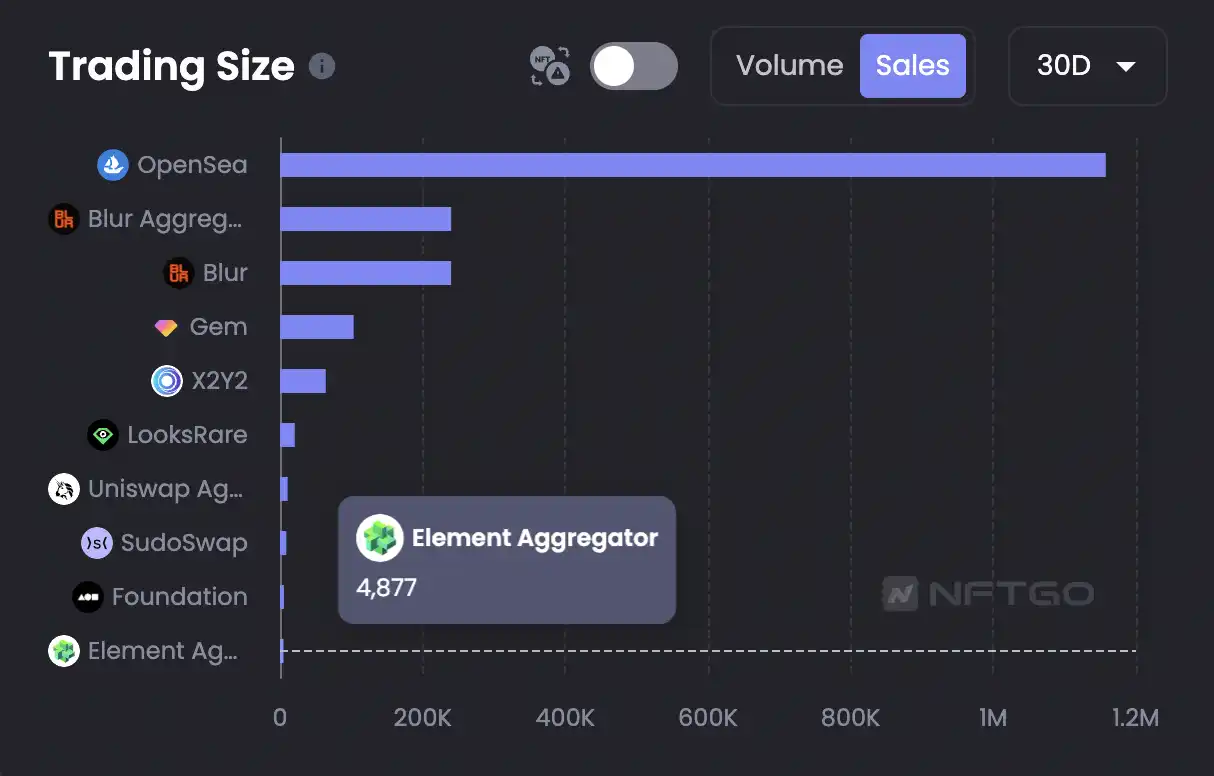
图 20: element trading size
Translation:
Figure 20: element trading size
4. Merger and Aggregation at the Transaction Level
4.1 Opensea & Gem
Just like what monopolies often do, OpenSea acquired Gem to nip the threat in the bud. This is seen as a highly centralized approach by many.
Although Gem will continue to operate as a standalone product separate from OpenSea, OpenSea plans to integrate more Gem features into its NFT marketplace in the future.
As an aggregator, Gem has excellent data. Since its launch, Gem has accumulated a trading volume of over 246,000 ETH as of the acquisition date, which is twice the trading volume of the earlier Genie. The main reason why Gem can achieve such a rapid growth is due to its market depth. Gem has aggregated more mainstream NFT markets such as OpenSea, LooksRare, and X2Y2 earlier than Genie. Genie has been mainly focused on OpenSea and some smaller markets for a long time, which has caused it to lose market share until it integrated LooksRare in early April 2022. In addition, Gem has also aggregated Dune Analytics' analysis data dashboard and comes with anti-sandwich bots, which is also ahead of Genie. Gem has achieved a curve overtaking of Genie. Despite its excellent data, NFT aggregators do not charge platform fees or other fees, and the profit model is still being explored and planted as a seed for acquisition.
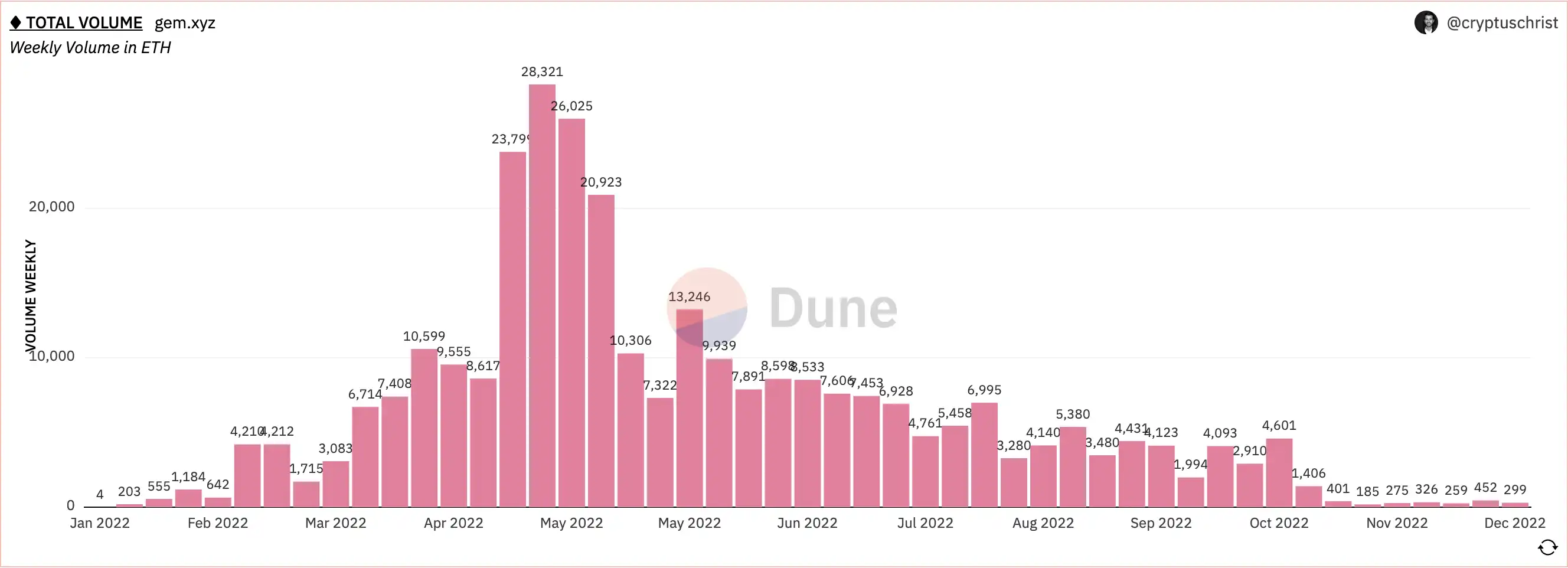
图 21: gem total volume
Translation:
Figure 21: gem total volume
OpenSea also stated before acquiring Gem that it would focus more on community experience, meaning it wants to serve more experienced professional users and provide more flexible services and levels for users with different levels of NFT purchasing experience. In other words, OpenSea's strategy this time is mainly for future business layout considerations, and Gem is not just an NFT market aggregation platform, but also an investment portfolio platform. It is precisely this point that meets OpenSea's needs.
In addition, among the various speculations before, most people believed that the layout of OpenSea and Uniswap was similar. However, it now appears that Uniswap has clearly chosen a different path, focusing on the integration of FT and NFT layouts. As a platform that still operates as an independent brand, Gem has always occupied a major share in the aggregated market. Now, its main competitor seems to be the formidable Blur.
Since the launch of Blur, Gem's position as the top aggregator has been broken, even within a few days. Blur quickly captured Gem's market share, and its previous advantages are almost non-existent.

图 22: shares by volume
Translation:
Figure 22: shares by volume
From the latest month's data, it can be seen that most users who trade using Gem are collectors who choose to sell their items through limit orders, while there are relatively few users who come to buy. The buying and selling structure also reflects some issues - the market activity of Gem is declining, and the first choice of collectors has changed.

图 23: traders
4.2 Uniswap & Genie
Figure 23: traders
4.2 Uniswap & Genie
Uniswap Labs acquired NFT aggregator market Genie in June 2022 and has expressed early on that it will integrate NFTs into Uniswap products, allowing users to purchase NFTs on the market through the Uniswap network application.
However, as the first NFT aggregation platform, Genie has been almost silent since announcing its acquisition by Uniswap in June. It wasn't until more than five months later that it finally went live on the Uniswap NFT market aggregation platform. Perhaps it did not meet everyone's expectations, as the discussion it generated did not last long and the platform's products were relatively single and lacked highlights.
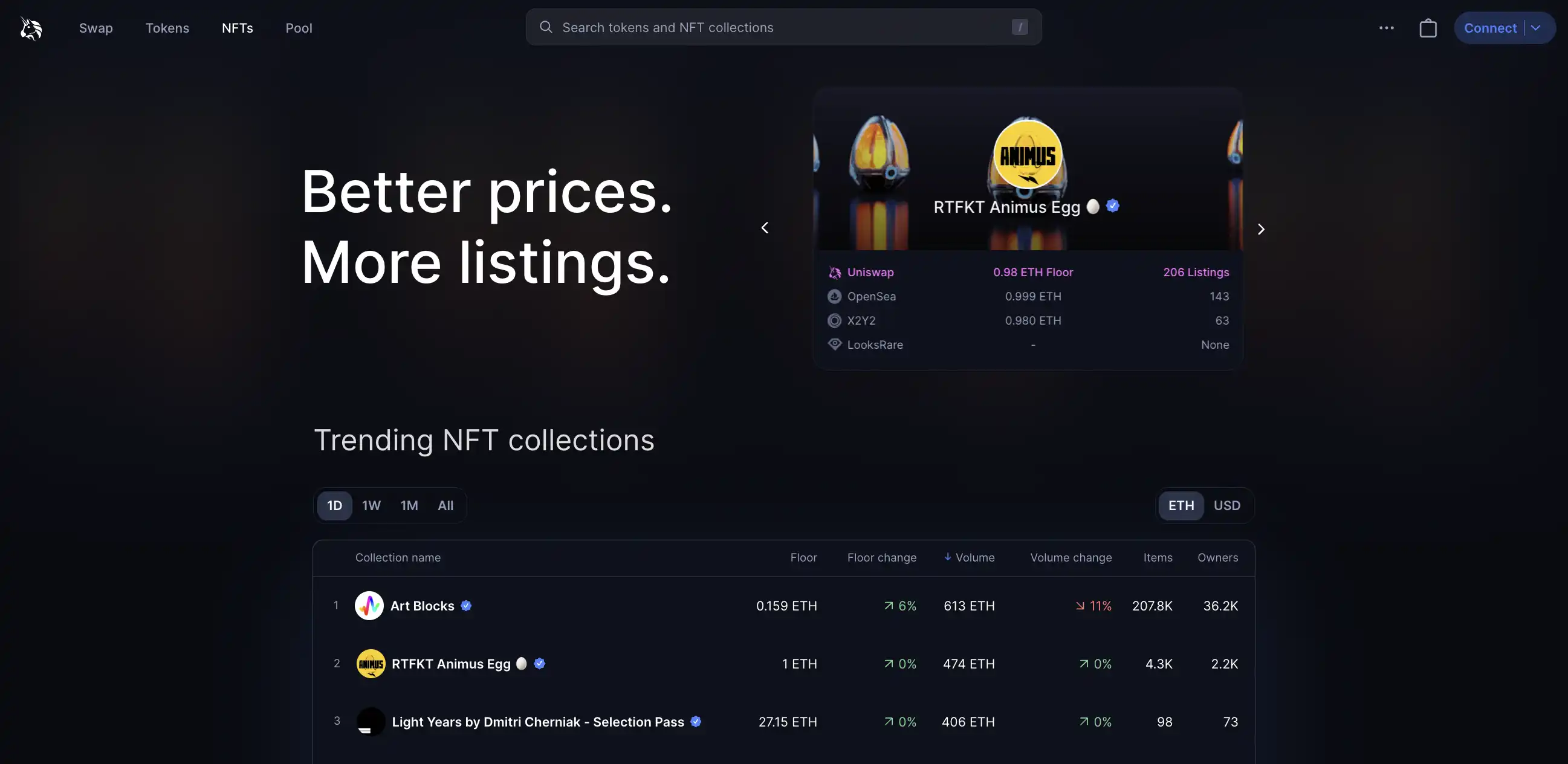
图 24: uniswap aggregator
Translation:
Figure 24: uniswap aggregator
The Uniswap page is not much different from other aggregation platforms, containing most of the important data indicators for user reference. Compared with Gem, Element, and even Genie itself, Uniswap NFT does not provide related chart data analysis functions. Data dashboards are essential in other markets or aggregation platforms, but Uniswap NFT has surprisingly ignored this aspect of construction, especially after its acquisition of Genie, which is somewhat lacking in sincerity. The homepage only provides two functions, Items and Activity, which is a bit monotonous.
However, these may all be related to Uniswap's product layout - Uniswap's ambition is not just to be a simple NFT aggregator. What they really want to do is create an ecosystem that can connect FT and NFT transactions seamlessly.
Connecting FT and NFT transactions is not a simple task. NFT and ERC-20 Token exist as two independent ecosystems within the cryptocurrency industry, but both are essential for the development of the digital economy. Launching NFT on Uniswap is a step towards building more interoperable experiences between the two, and is used to optimize user experience.
In addition, Uniswap's new generation router "Universal Router" unifies ERC20 and NFT exchanges into a single exchange router. With integration with Permit2, users can exchange multiple tokens and NFTs in one transaction, while saving gas fees. The entire process can be executed as a single transaction.

图 25: flow chart
Translation:
Figure 25: flow chart
In the past, people subconsciously regarded FT and NFT as two very independent experiences, thinking that they had a big difference. However, Uniswap NFT opens up a new perspective for the public - both are digital assets, and the goal is to bring universal ownership exchange to users. FT and NFT are just two different ways of releasing value in the digital world, and they can be connected. Uniswap itself, as a leading decentralized trading platform, can provide a better pricing option for NFT at the end of this process. The aggregator's positioning change is also to improve the user experience of a large user group and provide faster services, between FT and NFT, rather than trying to seize market share in the gradually declining NFT market.
In just the past two months, Uniswap has had 864k unique addresses, which is a huge presence in the entire blockchain universe. Uniswap's ambitions for its layout are not just a simple aggregator. Although Genie's latest airdrop did not rekindle the enthusiasm of users, it is also integrated into the Uniswap ecosystem as part of the territory. Whether there will be new FT and NFT connection forms or trading models that break traditional cognition in the future may become the key to the development of UniswapNFT in this field.
5. Review of updates and royalty processing methods
5.1 Update on Anti-Theft Fraud, Intellectual Property, and Review
As the NFT trading and aggregation platform continues to grow and advance, OpenSea, as the once stable first trading platform, may also feel the pressure, as can be seen from the frequent updates and adjustments made by the official this year.
In June 2022, OpenSea updated its NFT copyright protection program and introduced four protective measures to make efforts in protecting its users and NFT copyright in the technical field. The specific details are:
1. Theft prevention and fraud prevention: OpenSea will automatically hide suspicious NFT transactions to reduce their visibility.
2. Intellectual property infringement issues on the Internet: We plan to build a proactive solution in the next quarter.
3. Scalability review and management issues: OpenSea has established a dedicated review team and is adding key automated detection methods for copyright issues and other fraudulent media.
4. Invest more funds in key areas of user issues and reduce the average response time to within 24 hours.
OpenSea launched a new copy detection system in November 2022, which can identify fully matched, flipped, and blurred NFT copies in seconds. In May, they also introduced an automated system to proactively identify and remove NFTs suspected of plagiarism, using image recognition technology and specialized human review, with the aim of improving authenticity and reducing changes to copies on OpenSea.
The platform is committed to achieving the goal of verifying the identity of any real creator and excluding fraud from the system. Copymints is also another problem that currently plagues many trading platforms, with strong misleading characteristics, making it difficult for many users and community members to find genuine creative content.

图 26: opensea creature
Translation:
Figure 26: opensea creature
5.2 Persist in charging creator fees
In the fierce market competition environment, after X2Y2 launched the first shot of royalty reform, many trading platforms have successively added the function of customizing royalties, giving the right to choose royalties to users. Although it can be observed that NFT collectors in the current market are more inclined to trade NFTs in the no-royalty NFT market, in order to save money and maximize income during the bear market. As a result, the payment of royalties has been continuously declining.

图 27: royalty
Figure 27: royalty
OpenSea has taken a strong stance on this behavior, stating that they will continue to collect creator royalties for all existing NFT series and will assist creators in enforcing royalties through on-chain mechanisms. Additionally, they suggest that creators develop more incentives for the community and refuse to link to non-royalty NFT markets from official project websites.
Magic Eden also followed suit to express its attitude, announcing that it will launch a new protocol starting from December 2nd to impose royalties on all new collectibles that choose to use the tool. In fact, creator fees did not exist when the NFT standard was created in 2018. OpenSea initially hoped that more creators could enter this field. However, in the past few months, it can be seen that the voluntary creator fee payment rate has dropped to less than 20% in some markets where creator fees can be chosen. In other markets, many people even choose not to pay creators at all.
Costs.

图 28: fees
Figure 28: fees
During the bear market, many people who hope to raise funds will want to sell NFTs to alleviate anxiety, so they naturally choose to sell their NFTs in non-compulsory fee markets to gain more income.
For collectors, this means that the NFTs they truly desire are increasingly likely to appear in markets where creators are not required to charge fees. Even if these collectors say they want to pay creator fees, they will actually become more and more inclined to purchase in such markets.
For creators, the consequence of this ecosystem shift is that the Web2 business models used by the vast majority of creators in this industry are now subject to market enforcement discretion, rather than code. And for new creators hoping to enter the Web3 space, they may find that their set fees are not always executable, and the so-called creator economy becomes a pipe dream. OpenSea states that if the current trend continues, the fees paid to creators in the Web3 space are likely to decrease significantly, even to zero, and once this behavior occurs, it will be almost impossible to take measures to reverse the situation.
Given the roles of OpenSea and Magic Eden in the ecosystem, they believe that they need to take a thoughtful and principled approach to address this issue, and will prioritize solutions.
Obviously, almost all creators would like to enforce fees on the chain. The common ground between OpenSea and Magic Eden is that fundamentally, they believe that most attributes of all works (including royalties) should be chosen by the authors themselves, rather than the market making decisions for them, because NFTs are the products of the creators themselves, and they have the right to make their own decisions. Therefore, the platforms will hope to achieve market balance as much as possible by empowering creators with more power and equipping them with tools to control their business models.
OpenSea and Magic Eden launch mandatory royalty tool
OpenSea
Firstly, OpenSea has launched a new tool called Operator Filter Registry to enforce creator fees for new collections on-chain, which is their 3rd on-chain implementation. They have also promised to transfer ownership of the on-chain creator royalty enforcement tool, Operator Filter Registry, to a multi-signature controlled by the "Creator Ownership Research Institute (CORI)" before January 2, 2023. CORI is a collaborative project initially created by ZORA, OpenSea, Manifold, Foundation, SuperRare, and Nifty Gateway.
Opensea enforces on-chain royalty tool regulations. If NFT projects want to collect royalties on OpenSea, they must use OpenSea's enforced royalty contract. However, this contract will blacklist all platforms that have custom royalty options. If NFT projects do not want to blacklist other trading platforms, OpenSea will reduce all royalties generated by the project on OpenSea to 0.
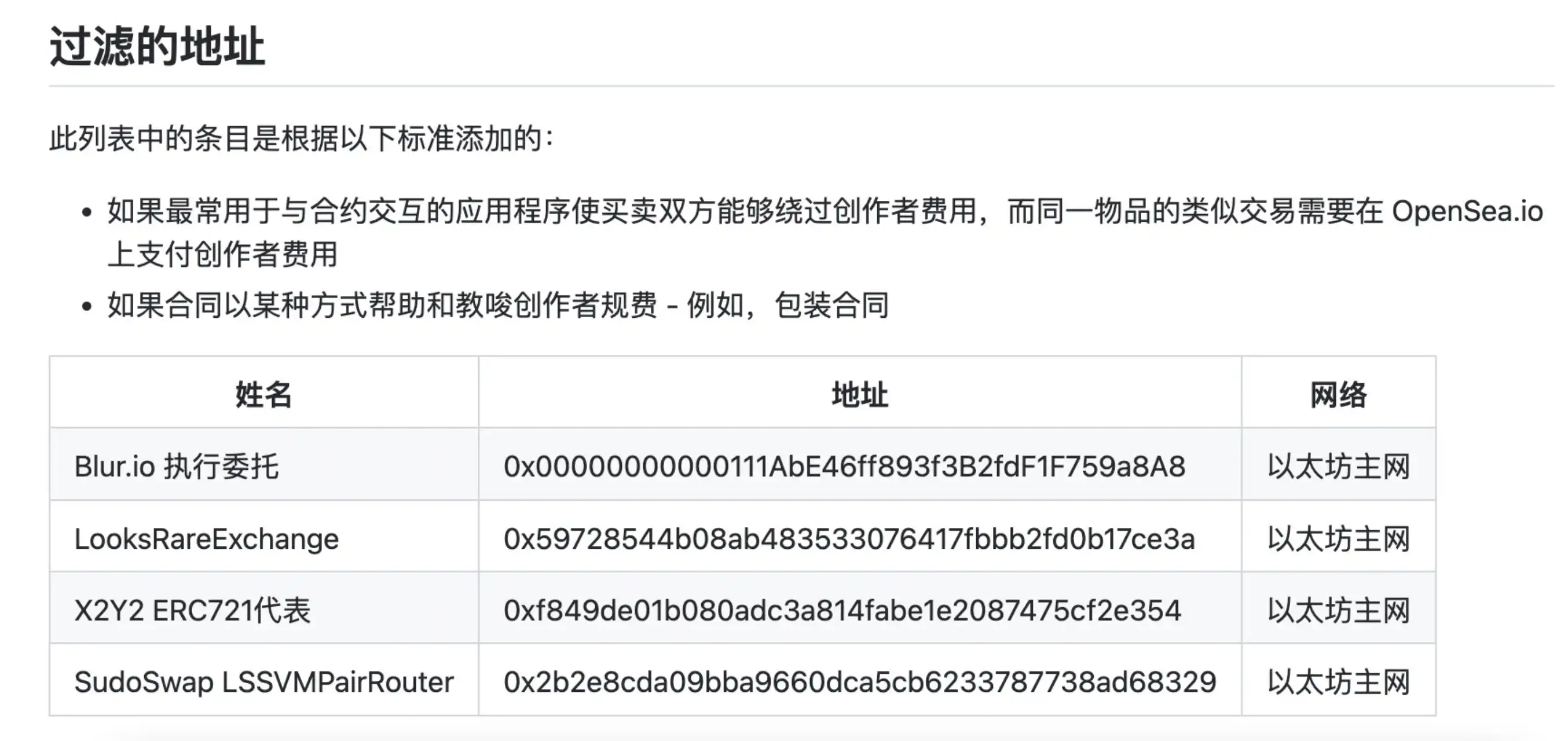
Figure 29: Filter Address
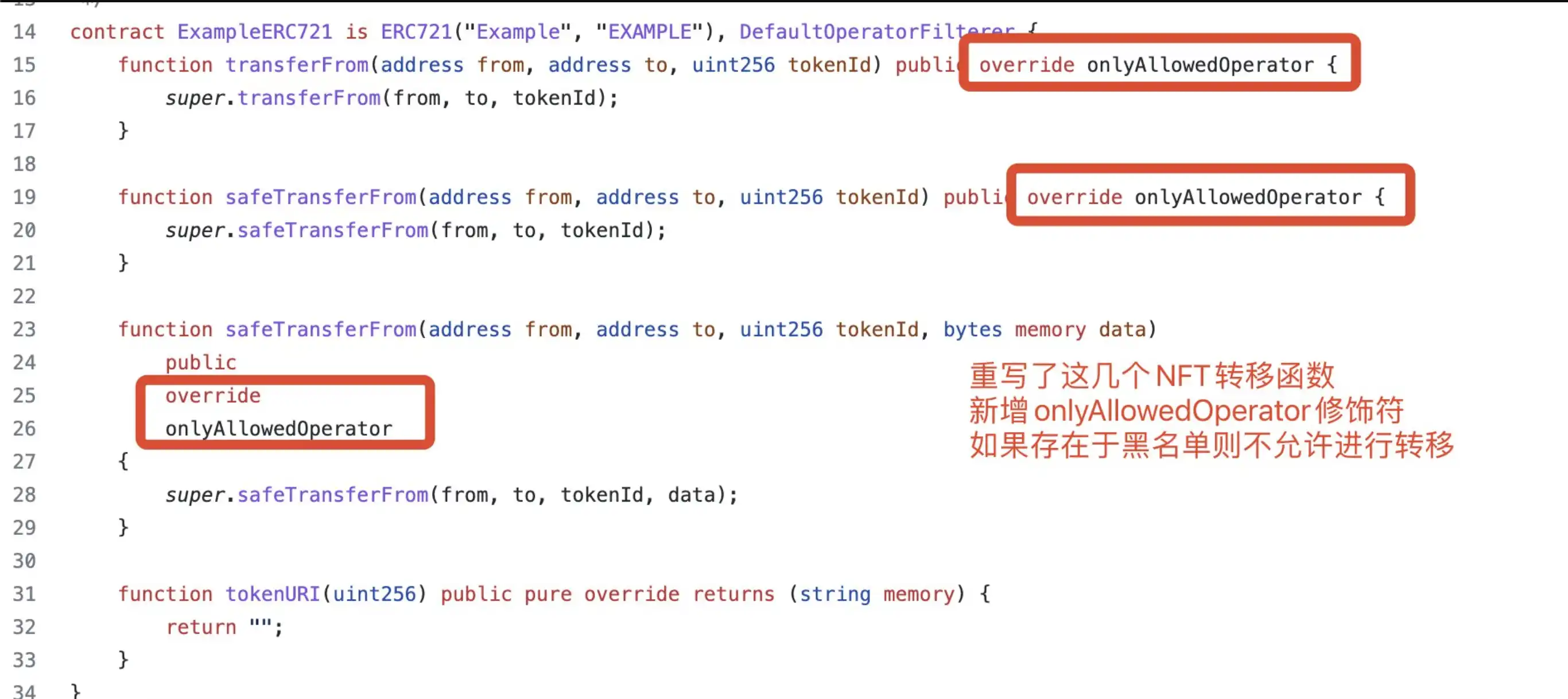
Figure 30: Filtering Process
This is the first step taken by OpenSea, but considering the difficulty of charging existing collections on the chain, no changes will be made to existing collections for the time being. However, future choices, including forcing fees on certain existing collections, allowing for discussion of optional creator fees, and even other online collaboration options for creators' chain enforcement, will all be openly discussed and even voted on by the community.
Magic Eden
Magic Eden announced in mid-October that it would no longer strictly enforce the royalty set by the creators of NFTs sold on its platform due to public pressure. However, the following month, its attitude towards royalties took a big turn, possibly due to the firm stance taken by OpenSea. Jack Lu, co-founder and CEO of Magic Eden, proposed a new NFT standard at the Lisbon Solana Breakpoint conference, which will enforce royalties at the technical level.
Starting from December 2nd, Magic Eden has launched a new protocol that will levy royalties on all new collectibles that choose to use this tool. The open source tool Open Creator Protocol (OCP) will allow creators who publish collectibles to choose whether or not to protect royalties. For creators who have not adopted OCP for their NFTs, royalties will still be optional on the platform.
Open Creator Protocol is built on top of Solana's SPL Token standard, which includes dynamic royalties (changing royalty percentages based on project sales volume), frozen transactions until coin minting is complete, and customizable token transferability. Once launched, the platform will host a free "Magic Mint" for users to test Open Creator Protocol and its features.
6. Income Distribution
6.1 Creator Fee Data
For a long time, NFT royalties have been a major selling point for independent artists and creators to join the Web3 wave. They can convert their hard work and efforts into income, and so far, more than $1.8 billion in royalties have been paid to creators of NFT series based on Ethereum.
In 2022, OpenSea officially released a set of data showing that creators earned over $1 billion from creator fees using OpenSea, and these revenues do not include sponsorship income, participation rewards, or donations. These revenues are directly generated from the creator fees of resold works and settled on-chain immediately between buyers, sellers, and creators. 80% of the creator fee revenue flows to collections outside the top 10.
In July 2021, Meta announced that by the end of 2022, it will pay over $1 billion to creators on Facebook and Instagram.
In 2020, TikTok promised to pay approximately $1 billion to creators over the next three years.
Snapchat pays top creators $1 million per day, and even reaches $365 million within a year.
Patreon has paid a total of 3.5 billion US dollars to creators in its nine years of operation (as of 2021).
Compared with Web2 platforms, OpenSea does not have much difference in royalty payments, and the average royalty percentage paid to creators has doubled from 3% to 6% in the past year. OpenSea is currently the platform that pays the most royalties to creators in Web3. The main brands in NFT, including traditional players and native cryptocurrency organizations, have earned hundreds of millions of dollars in revenue from royalties generated from secondary sales. In fact, only 10 entities account for 27% of all royalty income, while 482 NFT series account for 80% of all royalty income so far.
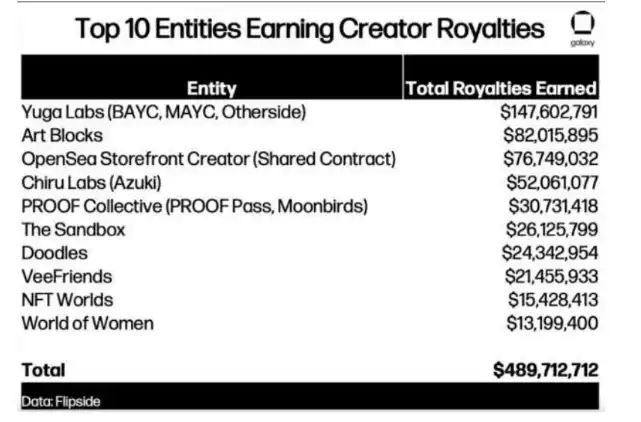
图 31: top 10 entities earning creator royalties
Translation:
Figure 31: top 10 entities earning creator royalties
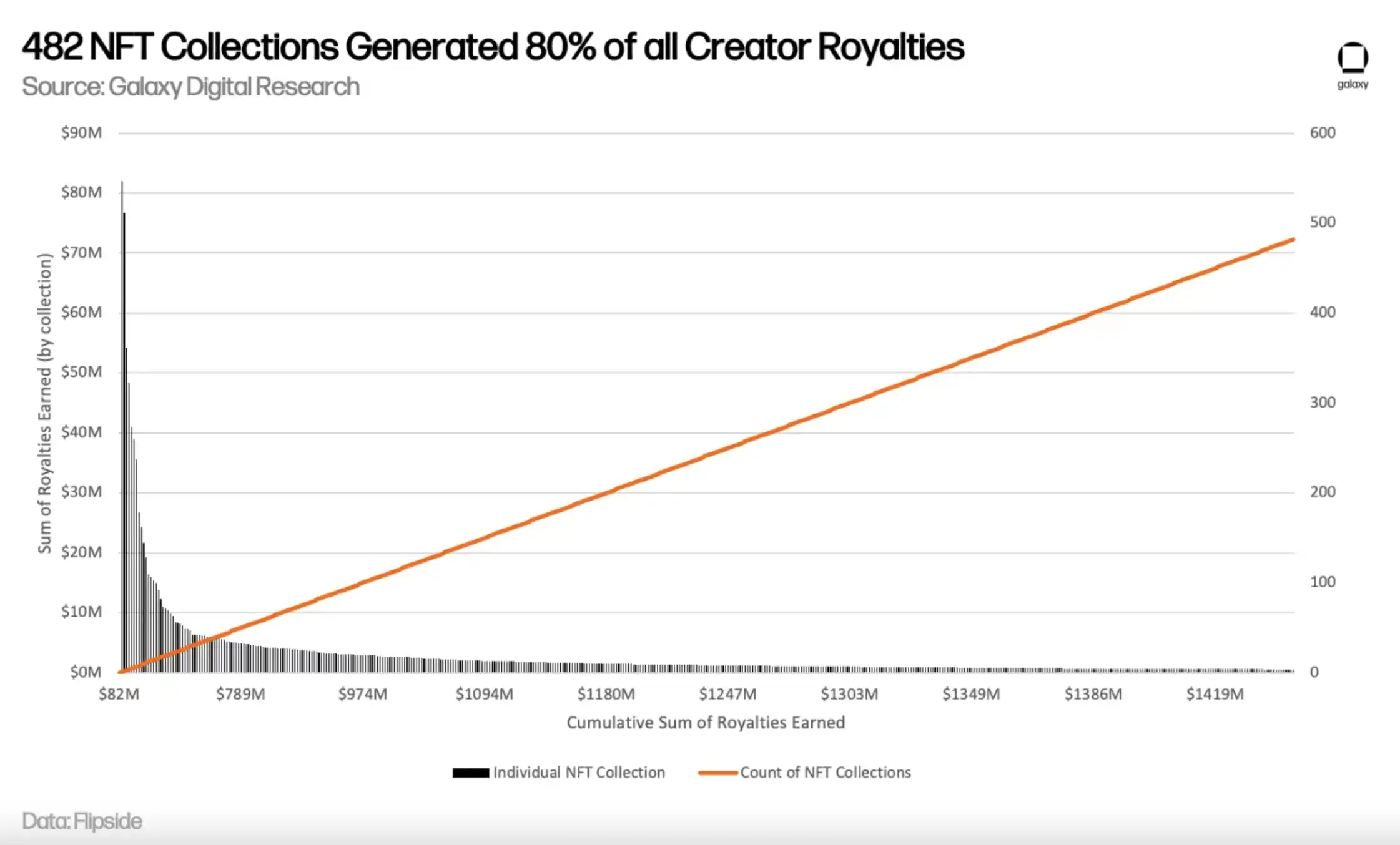
图 32: creator royalties
Translation:
Figure 32: creator royalties
6.2 Zero Creator Fee Data
In the NFT bull market, it used to be common to pay a royalty of 8%-15% for each NFT transaction. However, with the worsening global market conditions, the overall NFT transaction volume of all mainstream ecosystems has significantly decreased. Compared to the historical weekly high of $6.1 billion in January 2022, Ethereum's weekly NFT transaction volume has dropped by over 99%, to $85.2 million. As a result, traders have become less willing to pay creator royalties and have opted for more cost-effective alternatives.
SudoSwap is the origin of the anti-royalty movement in the NFT field. SudoSwap was launched in July 2022 and uses the AMM model for NFT transactions (similar to Uniswap's operation for homogeneous tokens). They use the AMM model to increase the liquidity and market-making ability of NFTs while minimizing costs. SudoSwap not only charges a relatively low 0.5% transaction fee (compared to OpenSea's 2.5% transaction fee), but they also do not support any NFT royalties. Although SudoSwap's model is best suited for floor-priced NFTs, it has proven to be very popular among sellers seeking to increase profitability. Sellers do not have to incur up to 12.5% in royalties and platform fees, but instead only need to pay a maximum of 0.5% fee on each sale.
When SudoSwap became the preferred destination for selling NFTs, Gem took notice. This meant that Gem began to include SudoSwap in its aggregator list. This small move prompted the wider NFT community to interpret the integration of Gem and SudoSwap as some form of recognition from OpenSea. Shortly thereafter, another NFT marketplace X2Y2 followed suit, allowing both buyers and sellers to choose to pay royalties. Around the same time that X2Y2 canceled NFT royalties on the Ethereum chain, Yawww announced on the Solana chain that royalties would be optional.
Although there are many discussions about the chain reaction that may result from not fulfilling the creator's royalties in the encryption industry, we can first look at the discussions raised by people about this market behavior change. The most obvious advantage of this change is that it reduces the cost and fees of active NFT traders. Based on the cancellation of the creator's royalties, many markets have greatly reduced their market costs to attract more trading volume. This provides better prices and profit margins for speculative traders, as other indirect costs such as creator's royalties, platform fees, and gas fees become irrelevant.
7. Traditional Industry Layout of NFT and Introduction of New Technologies
7.1 Web2 Brand Market Gradually Enters the NFT Space
In early 2022, Google's search trend for NFT continued to rise. In such a trend, many technology companies also plan to enter the NFT market, including Facebook and Instagram, which have already laid out their plans early on.
Technology companies hope to build a bridge between Web2 and Web3 through NFTs, integrating their communities and technology into their brands. This is currently the fastest and easiest way for the public to understand and accept entry into Web3. The first fashion brand to ride the NFT wave is Bored Ape Yacht Club (BAYC), which is currently a leader in the NFT field and requires NFT ownership to become a member. Bored Ape Yacht Club has become popular worldwide due to its strong marketing ability, and many celebrities, such as NBA star Stephen Curry, Shaquille O'Neal, football star Neymar, singers Justin Bieber, Eminem, and Asian superstar Jay Chou, own NFTs from this series and actively display them on their personal social media platforms.
Brand Collaboration
The fastest growing business under the sports brand NIKE is NFT. According to Dune Analytics, NIKE ranks first in the highest NFT revenue brand list, with a total sales of 186 million US dollars. The second is the luxury brand Dolce Gabbana, with a total sales of 23.69 million US dollars. The well-known American jewelry brand Tiffany Co. also made a successful debut in NFT, with a monthly revenue of over 12 million US dollars for its NFT series.
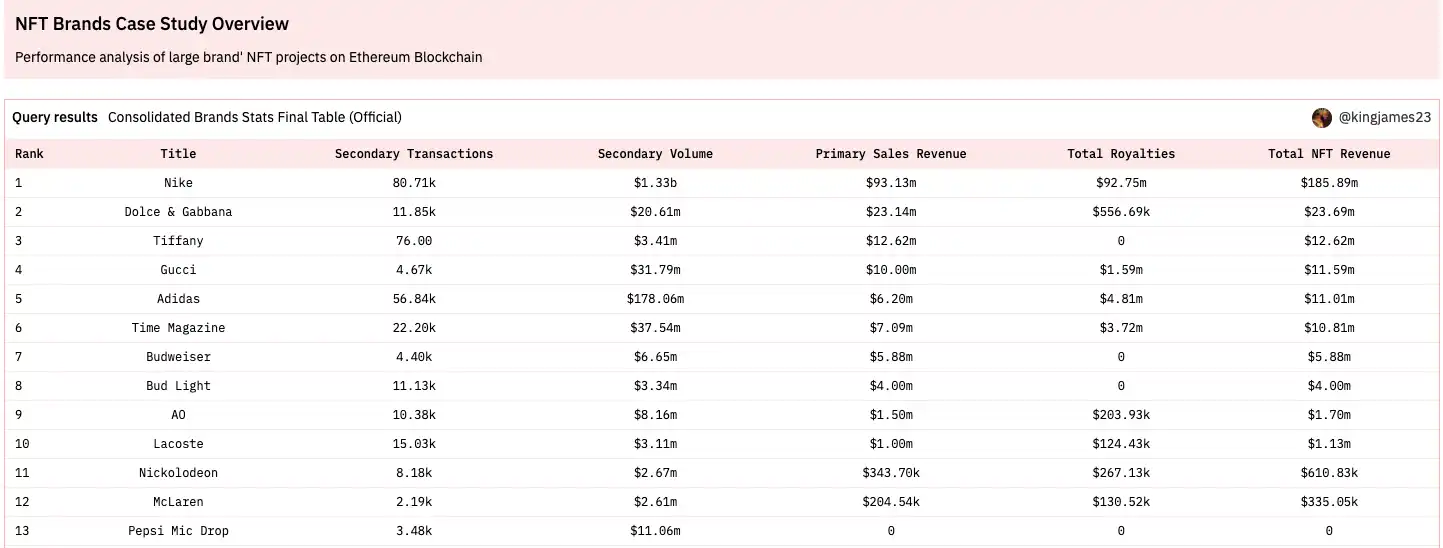
图 33: NFT Brands
Figure 33: NFT Brands
In the professional sports industry, NBA is also making a fortune with NFTs. According to Cryptoslam data, the total sales of NBA Top Shot NFTs have exceeded $1 billion this year, with a trading volume of over 20 million transactions, making it the sixth NFT project in the world to surpass $1 billion.

Figure 34: NBA
The English Premier League also hopes to get a share of the NFT market. The English Premier League is a leader in the professional sports industry, pioneering pay-per-view and becoming a giant football league with annual revenues of billions of dollars. Now, the German Bundesliga, Spanish La Liga, and Italian Serie A have all created NFT platforms directly facing consumers, but the English Premier League is still watching from the sidelines. After all, the global economy is not doing well this year, the US Federal Reserve has raised interest rates continuously, the pound has continued to fall, the UK economy may fall into recession, and cryptocurrencies have continued to decline, causing a significant drop in market confidence. The English Premier League is choosing to proceed with caution and avoid short-term losses.
Technology companies enter the market
Google is forming a team dedicated to digital asset development. Google hopes to have an impact on blockchain and provide services to blockchain companies. They aim to be a one-stop-shop for developers to host remote procedure call (RPC) nodes and allow users to deploy blockchain validators through Google Cloud with a single click. Through such cloud services, Web3 elements such as wallets and other blockchain functionalities can also be integrated. In the future, Google may deploy blockchain infrastructure to create user-friendly digital products.
Apple is expanding its augmented reality business in preparation for the Metaverse opportunity. The Apple VR headset will be released to compete with Facebook and Microsoft. It is likely that Apple has been studying blockchain technology for some time and may eventually prepare to enter the Metaverse.
As the former Facebook company, Meta has long been focused on the next stage of the internet. In 2014, the tech group acquired Oculus - aimed at putting its endless resources and the expertise of the Oculus team into launching an entry-level VR headset for the mass market. The platform's recent update allows some creators to sell their work in the form of NFTs on Instagram, as a new attempt. Instagram has expanded its support for its NFT sharing feature, including more than 100 countries by August 2022, just a matter of time before ordinary users gain the ability to sell NFTs on its upcoming creator marketplace platform. By then, Instagram can take the lead in the existing NFT market on the internet. Although there is no exact news on when and how Facebook plans to deal with on-site NFT transactions, its recent efforts to simplify how creators on the platform get paid indicate that Meta wants to have everything arranged before it truly opens up.
7.2 AI + NFT
Last year, a series of NFTs created by a robot artist named Botto sold for over $1.1 million. It is undeniable that generative AI is currently one of the hottest topics in the industry.

图 35: Botto
Figure 35: Botto
For the encryption industry practitioner, I will translate the following content from Chinese to English without considering the context or industry-specific terms. English words and phrases, as well as capitalized English words and phrases, should not be translated or omitted, for example: ZKS, STARK, SCROLL -> ZKS, STARK, SCROLL. If there are English characters in the a link, do not translate and return directly. When there are only punctuation marks in the content, return the punctuation marks as they are. HTML tags in the content should not be translated, such as
, , ,, etc. If there are English characters in the HTML tags, omit the translation and return directly. The content in the a link should be preserved. All Chinese characters should be translated. The content to be translated is:
Gartner's definition of Generative AI is: using various machine learning (ML) methods to learn the components (elements) of artifacts from data, and then generate completely new, original, and authentic artifacts (a product, item, or task) that are similar to the training data but not copied. Simply put, Generative AI is using existing text, audio files, or images to create...
The technology for creating new content uses AI generation to detect and input basic patterns related to computer detection and generates similar content.
Text-to-Image generation is an important part of its commercial application scenarios: AI can abstract visual patterns from artworks and then apply these patterns to virtual image reproductions with the characteristics of the artwork. These algorithms can also transform any rough sketches into impressive drawings, making them seem as if they were created by professional human artists who depict the real world. The digital representation of NFTs relies on digital formats such as images, videos, texts, or audios, which are cleverly mapped to different AI sub-disciplines such as deep learning, computer vision, natural language understanding, and speech recognition.
In the current NFT ecosystem, there are three fundamental categories that can be immediately redefined by integrating artificial intelligence capabilities:
AI Generated NFT
AI generated NFT technology is the first implemented scenario and the most obvious beneficiary of AI technology in the NFT ecosystem. By utilizing deep learning methods in computer vision, language, and speech fields, the experience of NFT creators can be enriched to a level we have never seen before.
NFT Embedded AI
Embedding AI functionality into NFTs is another market dimension - the intersection of AI and NFT technology trends can open up new market dimensions. For example, NFTs that combine language and speech functionality - can engage in conversations with users, answer questions about their meaning, or interact with specific environments.
AI-first NFT infrastructure
The value of NFT deep learning methods is not only reflected at the individual NFT level, but also in the entire ecosystem. Adding AI functionality to building modules such as the NFT market, oracle, or NFT data platform can lay the foundation for gradually realizing the entire lifecycle of NFT. NFT data APIs or oracles, which provide intelligent indicators extracted from on-chain data sets or NFT markets, offer intelligent suggestions to users using computer vision methods. Data and intelligent APIs will become an important part of the NFT market.
8. Future Development
Aggregation Trend
Batch trading of NFTs is gradually becoming a market trend, and more trading platforms are focusing on aggregation functions to achieve further reforms through acquisitions or updates. Of course, the future of NFTs is not only PFP, but also more practical use cases. However, some projects have a negative attitude towards aggregators, such as X2Y2. It publicly criticized the practice of doing both NFT aggregation and opening an NFT market at the same time, believing that this is an unreasonable behavior that plays both the game and the referee, which will inevitably lead to conflicts of interest. Therefore, it actively blocked some aggregators and prohibited access requests from Blur.
However, in the latest AMA held by X2Y2, its CEO TP stated that the platform's current economic model may be changed and derivatives may be developed after receiving tens of millions of financing, and the attitude has been somewhat eased. However, all predictions need to be left to the market to answer.
Royalties
The monopoly that OpenSea once had is gradually being broken. The market is large, and when the monopoly is broken, benign competition begins. Appropriate competition within the industry will bring positive cycles to the ecosystem to promote development. For example, the hotly debated update of the copyright agreement by a16z, discussions on the traditional cc0 agreement, differences in copyright fees and tax amounts among different platforms, and changes in attitudes towards charging models (copyright fees) are all new attempts brought about by competition. OpenSea has always been a benchmark in the field of trading platforms, and its recent active updates and efforts to provide users with a better experience may once again stimulate the enthusiasm of the NFT market.
For the future development of royalties, perhaps the NFT market is at an important collective turning point: it will be up to everyone who stays in this ecosystem to decide whether creator fees should be retained.
Platforms such as OpenSea continue to firmly stand on the side of royalties from the on-chain contract level, while also recruiting project parties. On the other hand, platforms such as X2Y2 that insist on zero royalties are recruiting traders. Balancing the interests of these two parties is currently difficult.
The creator economy is a significant innovation of web3, which can help creators monetize their works more effectively. However, the market may not enforce business models on creators, and creators should have independent control and decision-making power over their works. Platforms like OpenSea are also essentially taking steps in this direction.
Creator Economy
The creator economy is developing, and NFT technology enables creators to access new and sustainable business models that can be layered on top of existing web2 revenue streams. In this new ecosystem, creators need to have more ownership of their projects, more control over their long-term business, more direct contact and interaction with their fans, and a new, dynamic canvas to turn their most creative ideas into reality.
Collaboration and Innovation
Nowadays, in addition to the combination and innovation with AI technology, there are also many projects investing in research and development of technologies that make the display pages more realistic and rich through visual, sound, and motion aspects, enriching the presentation forms of NFT, attracting new users through more discoverability tools, creating more powerful sources of income for creators, and contributing to the new standards for realizing new revenue streams. The trend of cooperation with Web2 enterprises is also proceeding in an orderly manner. NFT is gradually evolving into a brand bridge between traditional companies and Web3. This brand shaping is building a strong community that can support its brand and participate in activities to receive rewards. For example, brands like Apple portray themselves as drivers of innovation and excellent design, and NFT can provide assistance and gain their support through open interaction with users, promoting such brands to new heights.
9. Summary
From a macro perspective, there is no doubt that the entire NFT industry is rising and gradually entering a stable transformation period. As early as the end of 2021, the NFT sector has become a unicorn track with a market size of billions of dollars. However, its long-term development direction is still unclear. Since entering 2022, especially in the late Q1 and early Q2 stages, the high-speed development of the NFT industry has entered a turning point, and the growth rate of NFT holders has gradually slowed down, while the number of traders has begun to show a cliff-like decline. Coupled with the continuous market crashes in the bear market, people's desire to trade NFT assets is gradually decreasing.
Therefore, in the market's attempts and explorations, the NFT market may gradually enter the "aggregation era". Aggregators in Web3 are a very important component. Although there is a fundamental difference between NFTs and FTs, this logic also applies to the NFT market. Even Uniswap Aggregator is working hard to break down the barriers between the two. The market is at a critical period of transition in the NFT reform, and the NFT aggregator race has become a trend.
Regarding the creator economy, the digital property attributes of NFT have brought new wealth and opportunities to many artists and creators. However, royalty reforms and censorship systems are also tightening, and the interests between project parties and communities are constantly being pulled, and the final outcome is still unknown.
In the future, the dark horse of the NFT industry may be the new combination of AI and NFT collision. Perhaps AI-generated NFTs have the potential to become the best creators and monetizers in the digital realm, changing the game rules.
10. Reference
https://zh.m.wikipedia.org/zh-hans/NFThttps://www.binance.com/zh-CN/nft/what is nfthttps://new.qq.com/rain/a/20210911A07JFI00https://uniswap.org/blog/uniswap nft aggregator announcementhttps://uniswap.org/blog/permit2 and-universal-routerhttps://www.theblock.co/post/190930/uniswap aims to break-down barrier between nftsand-tokens with-new-marketplace?utm_source=twitter&utm_medium=socialhttps://www.theblockbeats.info/news/32762?search=1https://mirror.xyz/wheart.eth/XQKwIPHtDvqE593ISpf7v3hVhOptaY-Nh40M6iUMB1I
This article is from a submission and does not represent the views of BlockBeats.
Welcome to join the official BlockBeats community:
Telegram Subscription Group: https://t.me/theblockbeats
Telegram Discussion Group: https://t.me/BlockBeats_App
Official Twitter Account: https://twitter.com/BlockBeatsAsia


