Bixin Ventures: Delve into NFT market data and explore new trends in NFT market iteration
Original title: The road ahead for the NFT marketplaces
Original article by Henry Ang, Mustafa Yilham, Allen Zhao & Jermaine Wong, Bixin Ventures
Evan Gu, Wayne Zhang, Bixin Ventures
As more and more new NFT markets emerge, Opensea's position as the number one player in the NFT market is constantly being challenged. Increased competition has led to more changes and innovations in the space, with projects such as X2Y2 and Magic Eden announcing outright royalty waivers. Opensea used to collect royalties and blacklisted NFT's that didn't pay royalties. With the advent of X2Y2, Opensen changed the original rules. In this industry-wide wave of innovation, changes around royalties are just one of many strategies being used to maintain price competitiveness in the NFT market segment. Other strategies include reducing transaction fees and incentivizing NFT trading and listing through airdrops of tokens.
As competition continues to heat up, a few key questions are worth asking: What does the future of the NFT market look like? Will Opensea continue to dominate the NFT market? First, this article will examine the current landscape by comparing three major stakeholders, including the direct market represented by Opensea, the aggregator represented by Gem.xyz, and the new form of market represented by Sudoswap. We will then examine some of the gaps in the NFT market project and discuss emerging trends that may influence future iterations of the NFT market.
What are direct markets and aggregators?
Direct market
Opensea, X2Y2, Looksrare and Magic Eden can be considered direct markets as NFT initial listings and trading take place here. The goal of direct marketplaces is to attract as many creators and users as possible to achieve high transaction volumes, as their main revenue comes from transaction fees. The main problems that direct markets aim to solve are:
1. Royalties need to be balanced between creators and users. Direct markets need to maintain royalties to attract NFT creators, but there is a risk that small but active users may be alienated.
2. Protect users from malicious NFT projects and phishing sites. A lot of scammers could come in and steal user assets, so direct markets need safeguards to help users.
3. Provide a stable API for Web2 marketplaces and Web3 aggregators - Direct marketplaces are considered NFT trading infrastructure and need to be combined with other platforms.
AMM NFT market
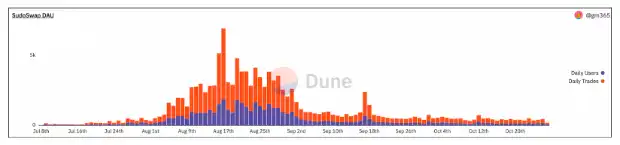
Similar to how Uniswap helped solve Defi's liquidity problem, new marketplaces like Sudoswap enable users to buy and sell NFT from a pool of liquidity, rather than trading with other users. The AMM model has several advantages over the traditional order book model, for example, it frees up instant liquidity for the user because the transaction is automatically executed instead of waiting for a matching order on Opensea.
Another key selling point is that, in contrast to most off-chain order-book direct markets, markets like Sudoswap are decentralized and on-chain. On the other hand, NFT AMMs may not be compatible with some categories of NFT (such as those with a greater emphasis on rarity and for art collections), as sellers often want greater control over the transaction price. Another downside is that AMM can be much more complex for the average consumer user, especially non-encrypted native users.
NFT Market aggregator
Similar to aggregators in DeFi, where aggregators like 1inch began to evolve after users found it difficult to choose the best DEX from multiple products, NFT market aggregators such as Gem and Genie make it easy for users to purchase NFT from a variety of markets through a single interface. Aggregators can also prevent transactions from being modified. As Delphi has shown inThis article"Encouraging users to list NFT at a reasonable price leads to a smaller price gap. A smaller spread means that traders and collectors experience the best price, and the best price creates engagement and positive feedback." One way to avoid market manipulation of fake trades is to use an aggregator. When using an aggregator, users have the following concerns:
1. User interface: Displays all the best prices from each market.
2. User interaction: Optimize latency, Gas rates, and API connections to relevant markets to show the latest price updates
3. One-stop tools: Useful tools that complement the purchase process, such as analytics, chat boxes, lending, BNPL services
Direct Market Analysis: Why is Opensea still the King of the Market?
Overview of the Top 3 NFT markets and emerging new markets
As an industry pioneer, Opensea built a sizable user base from the start with ease of creation, a wide variety of NFT projects, and easy navigation of the directory system.
Opensea also leverages its initial user base with popular features such as the inclusion of well-known NFT projects and the implementation of multi-chain marketplaces.
In order to acquire users from Opensea, Looksrare not only uses a strategy of trading to earn coins, but also allocates token airdrops specifically for Opensea traders. In the short term, they finally gain market volume26% ~ 37.2%Share of. Looksrare also takes a more decentralized approach to revenue distribution, where 100% of transaction fees go to the $LOOKS pledge. While the rewards incentivized an increase in trading volume, they also led to a large number of fake trades. When the incentives finally dropped along with the volume of transactions, Looksrare failed to retain its user base, which now accounts for only about the entire industry0.7%The user.
Similarly, X2Y2 initially used a List-to-earn strategy to attract new users and offer lower transaction fees than Opensea and Looksrare. This brings up another set of problems, including the inclusion of many low-quality NFT's that are simply meant to earn rewards. The X2Y2 eventually moved to a rewards system based on transactions, which again led to a proliferation of transactions solely for interchange fees. Similar to Looksrare's situation, although X2Y2 redistributes 100% of its revenue to users, the low transaction volume and low fees subsequently earned are not enough of an incentive to stay. As of this writing, X2Y2 has only retained the entire industry2.2%The user.
Looksrare and X2Y2 are not the first markets to experiment with market liquidity to earn tokens. Rarible, an NFT marketplace launched in early 2020, also tried to attract traders with their $RARI token, but largely suffered the same fate.
Case study: Why did Rarible lose the Opensea race
By the end of 2020, Rarible was tied with Opensea with more than 4 million monthly transactions.
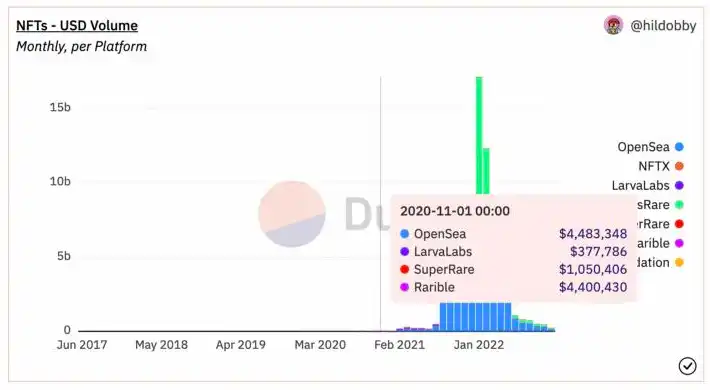
Since then, the gap between Opensea and Rarible has widened, with the latter losing 75% of its trading volume by the end of Q1 2021. Proposed with OpenseaIPO routeInstead, Rarible chose to become more decentralized by issuing their $RARI token. Following a similar strategy to X2Y2 and others, Rarible's token rewards not only incentivated volume growth but also gave itself a lot of wash-and-sell trading in the initial phase. There are other reasons for Rarible's growth entry disadvantage compared to Opensea, in particular Rarible's lack of partnerships with well-known IP's, resulting in low mobility in the market deployment, and their inability to handle fake IP type NFT. Opensea, on the other hand, has moved faster to combat fraud, launched limited-time orders, and partnered with multiple ips to position itself as a trusted NFT marketplace. The difference in popularity between the two markets can be seen in the following data, which shows that from December 2020 to November 2022, blue-chip NFT BAYC made 27,442 and 72 trades on Opensea and Rarible, respectively.
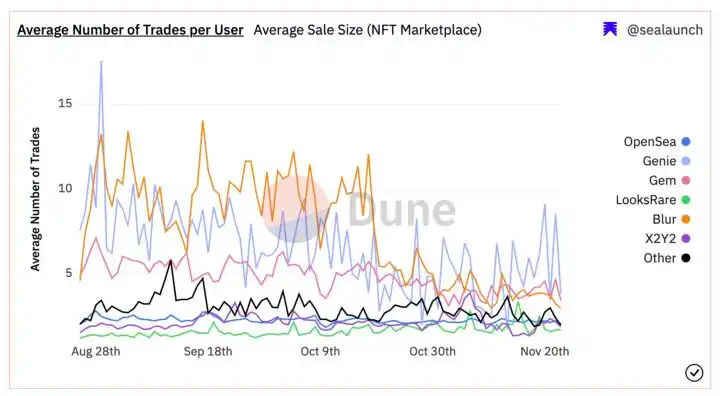
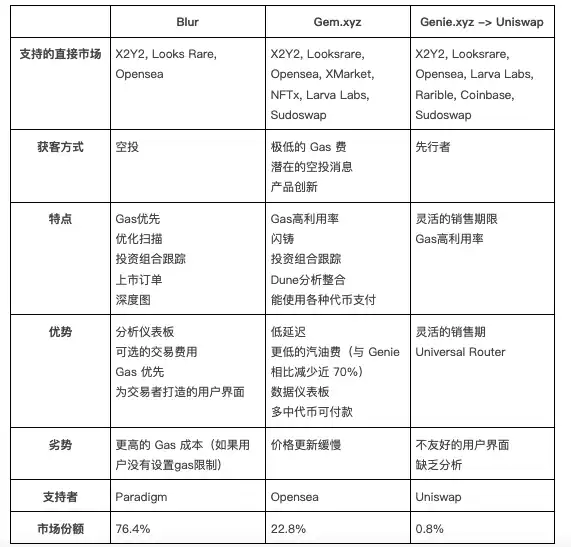
The newest marketplaces, Blur and Atomic0, attract new users with zero transaction fees, optional royalties and airdrops. It is important to note that Blur is not only a direct local market, it is also an aggregator, which we will examine in greater depth in the following sections. Blur also tries to motivate users by using a list-to-earn strategy. BlurprovisionsThose who try to game the system by offering unrealistic prices or getting certain "dead NFT" back on the market will not be entitled to airdrops. Other ways to get $BLUR airdrops include paying royalties and getting Blue Chip collections on the shelves. With the actual airdrop taking place in January 2023, only time will tell if their strategy will suffer the same fate as previous markets. From a product perspective, the main differentiating factor for a market like Blur is the great user experience -- NFT data such as quotes, sales and metadata appear in real time, scrolling and loading lists is much faster, and users are able to view the NFT series across multiple NFT markets and make informed decisions through advanced portfolio analysis and more. Unlike previous competitors, Blur has not followed the Opensea model in terms of UI/UX.
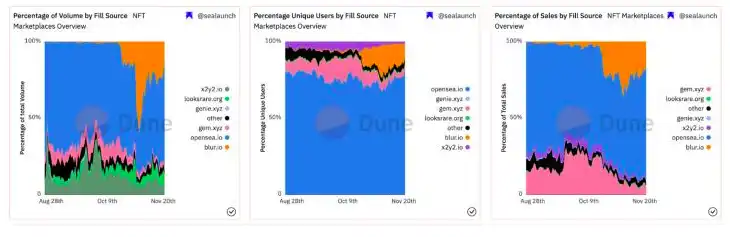
Despite this, as of this writing, Opensea is still the leading platform, with roughly the same number of transactions, independent buyers, and transactions, respectively72%, 82.7% and 75.7%Share of.
How can Opensea retain users with new competitors?
Although Opensea's market share has declined, it still has the largest share of the market with more than two-thirds of transactions. Opensea has certainly built a strong brand moat in the NFT space over the years. For example, we've noticed that most NFT projects are always officially listed on Opensea for legitimacy reasons, simply because people recognize and trust the brand. Whether on Twitter or Discord, most projects choose to direct their users to Opensea to purchase their NFT. This leads to more listings, which leads to more users, which leads to more listings, which leads to a flywheel effect.
The competition is ultimately about liquidity -- meaning the market with the most projects wins. Even with the poor user experience and lack of token incentives, people still choose to publish and buy on Opensea because this is where you can find the most projects and traders. We believe that token incentives are not a long-term solution, as they are a strategy that only attracts opportunistic traders and does not build brand loyalty and product stickiness. Since users trade in these markets solely because of incentives rather than believing it to be a good trading platform, they will leave once those incentives inevitably dry up. Token incentives may be a good way to get an initial head start, but ultimately only a great product and user experience can truly motivate users to stay for the long term. Historically, this statement has been repeated many times before, as not only has the NFT market opted for a liquidity mining strategy, butCryptocurrency ExchangesThis strategy was also adopted, but it failed miserably.
Case study: First-mover advantage isn't everything - Magic Eden
Given that Opensea is the first NFT market, it begs the question that they are the market leader primarily because of their first mover advantage. We can look at Solana's NFT market ecology from a historical perspective to further appreciate the value of first-mover advantage. Magic Eden is currently the leading NFT market on Solana, but contrary to popular belief, it is actually the third market to launch on Solana. The first two markets were Solanart and Digital Eyes in 2021, which initially accounted for the majority of trading volume at that time. Ultimately, Solanart lost the trust of the community after incidents such as fake listings and the theft of Digital assets, prompting users to switch to Digital Eyes. Magic Eden can replace Digital Eyes because of its superior UI/UX and user experience. Magic Eden continues to grow on its moat with the release of features such as launchpad, which incubates the new NFT line and integrates with all wallets on Solana. This is why Magic Eden has leapfrog its competitors to become the dominant Solana ecosystem, close at the time of writing98%Daily active users.
Product innovation leads growth
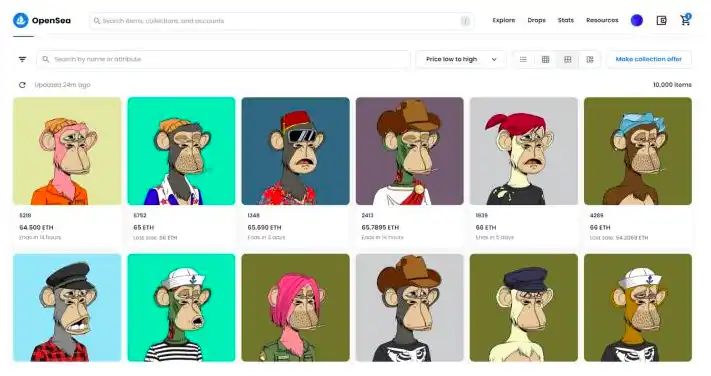
Drawing insights from the case studies above, we realized that product-led growth is a sustainable way to gain market share over the long term. Common complaints about the Opensea user experience include high gas and transaction fees, high latency, slow loading of the interface, and so on. We believe that unless these issues are corrected and a better user experience is delivered, Opensea's brand equity will continue to dilute as other platforms such as Blur innovate. As mentioned earlier - in addition to liquidity in their own market, Blur also aggregates liquidity from other markets, which makes it more convenient for users. On the other hand, while competitors like X2Y2 and Looksrare offer low transaction fees, the general user experience isn't really that different from what Opensea offers. For example, the following snapshots of the BAYC series in each market clearly show which market has a differentiated user interface. Ultimately, the markets that offer the best user experience will attract the most listings and traders, and form the moat of the brand later on.
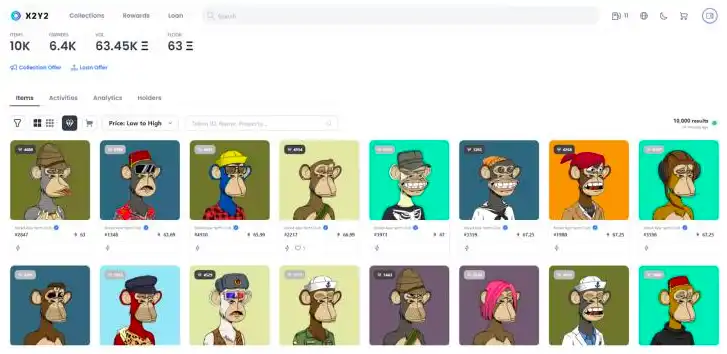
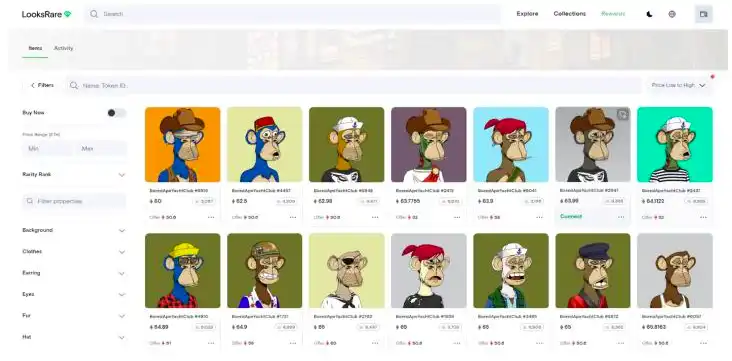
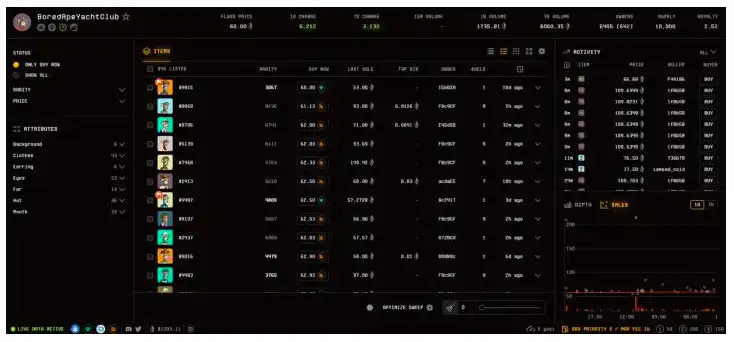
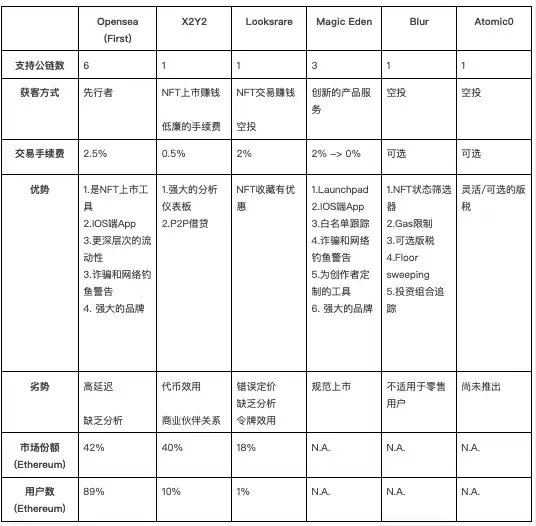
The following is a comparison of services in several NFT markets:
Aggregator analysis: Why did the Aggregator model never really rise?
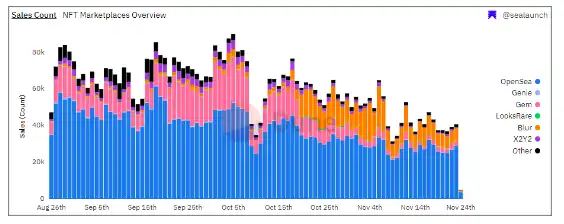
With multiple direct markets, the development of aggregators makes sense because they provide integrated information across all markets. Instead of manually combining Opensea, Looksrare, and X2Y2 to get the best price, it's easier to use an aggregator. But as we can see from the data below, the majority of transactions are still done on Opensea. The data also shows that while aggregators such as Gem and Genie saw an initial spike in trading volumes, they have since fallen compared to Opensea. We think there may be several reasons for this. Before diving in, it would be helpful to identify two big demand-side profiles
(1) NFT community users, who know exactly what they want from an NFT collection, often start their purchase journey by clicking on an official link on Twitter or discord.
(2) Speculators looking for good deals. Such as buying a good collectible with a low base price or a mispriced NFT
First, given that most NFT projects currently use Opensea links to gain legitimacy, we believe that the NFT community's first port of call will be Opensea more often than not. Second, we believe that aggregators are more likely to be used by opportunistic traders, as they usually do not consider NFT collections and want to look for good value deals.
While Gem and Genie saw a decrease in transactions, another aggregator, Blur, saw an increase in transactions. It's still too early to tell if Blur has created a successful aggregator model.
Case study: How can Gem replace Genie as the new leader
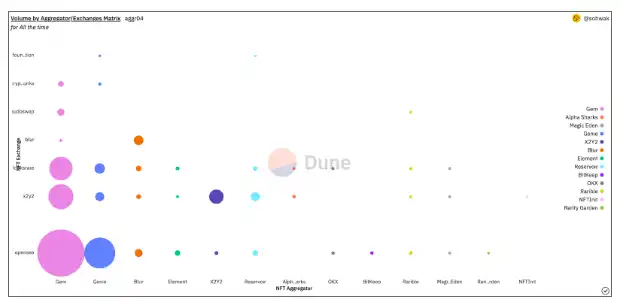
Genie was an early mover in the aggregator market, but it did not address some product optimization issues, such as UI/UX layout and high gas costs. Gem helps customers save up to 40% on their gas costs.

At present, Gem has become the largest traffic window of Opensea, X2Y2, Looksrare, Larva Labs and other direct markets.
Why hasn't Gem taken a bigger share of the market?
The figures below show that approximately 33% of NFT purchases were made through aggregators, and prior to Blur's launch, Gem transactions accounted for approximately all previous aggregator market share.70-80%.
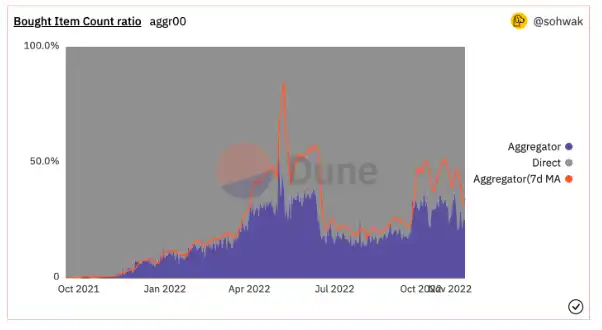
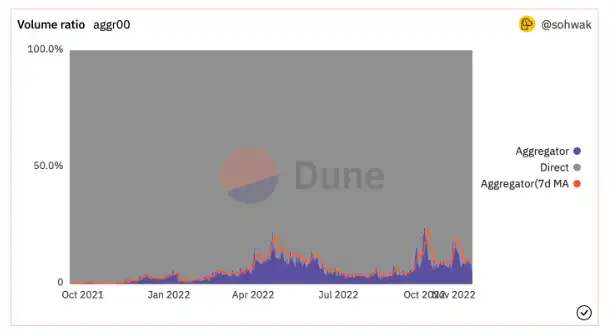
Although 33% of the NFT is traded through aggregators, the data below interestingly suggests that 90% of the value of the transaction is traded through the direct market. This means that most high-value transactions occur in direct markets rather than aggregators. This may reflect the trading preference of users to trade blue-chip high-priced NFT on the direct market and low-value NFT on the aggregator.
The following additional data highlights the user stratification of the NFT market. It shows that less than 5% of users visit other markets after visiting Opensea. On the other hand, 74.76% of Gem visitors visit Opensea later, as do Blur and Genie (43.76% and 40.55%).
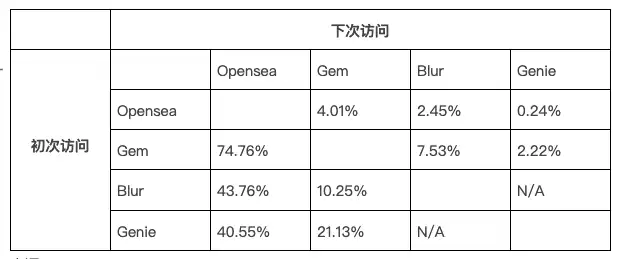
Source: similarweb.com
Will Uniswap's new market compete with other aggregators?
Genie was acquired by Uniswap in June 2022 and officially joined the Uniswap ecosystem recently. Users can now trade NFT on various markets, including Opensea, X2Y2, Sudoswap, and more. Uniswap's NFT interface is fully open source and claims that their aggregator can help users save up to 15% on gas costs compared to other NFT aggregators.

Visually, their user interface is simple and clean, with a look and feel similar to most markets. One significant difference is the ability for users to switch between ETH and US dollar pricing, which may be more friendly to non-encrypted local users.
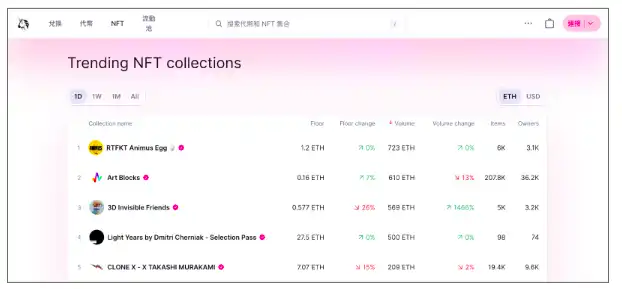
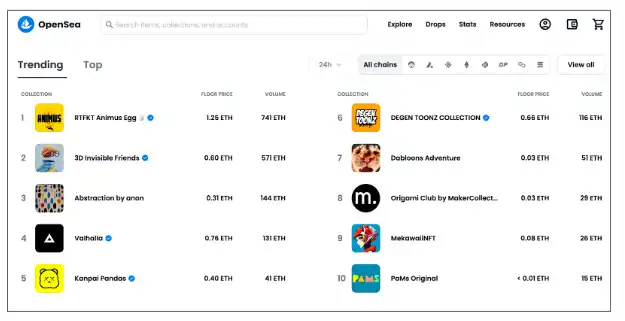

As an aggregator, Uniswap's NFT market has fewer features than some of its competitors. Most notably, Uniswap lacks advanced analytics such as underlying depth, transaction and price history. It is also argued that in today's low gas rate environment, lower gas rates may not be enough to attract customers.
On the other hand, we think Uniswap's moat is theirsUniversal Router, which allows fusion between FT and NFT. With the Universal Router, users can perform multiple token exchanges on Uniswap V2 and V3 and purchase NFT from multiple markets in a single transaction. For example - users must themselves convert their USDC, ETH, and DAI into WETH through multiple transactions before they can complete their NFT purchase. Uniswap can do the following with a single transaction, as shown below:
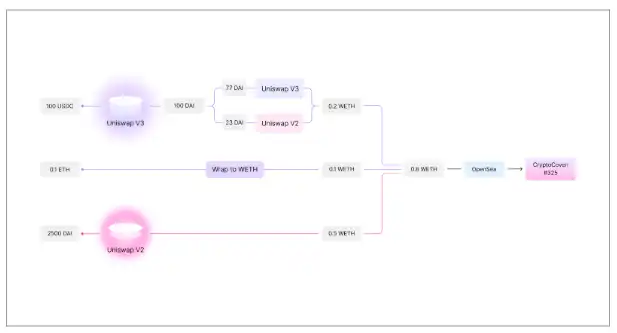
This is critical as Uniswap has the deepest FT liquidity on a decentralized exchange as well as a significant amount of encrypted user traffic. This natural conversion of FT and NFT can provide users with more convenience in the purchase process. This is really a game changer because it greatly reduces friction for users, especially in a multi-crypto asset environment. The inability to purchase NFT using ERC-20 tokens remains a huge pain point for other users of the NFT aggregator.
Based on their experience with AMM and the ground-breaking innovation of the Universal Router, possible future developments include offering consumer-facing products independent of current NFT aggregators. Unlike Sudoswap's single-currency, single-pool transactions, Uniswap can offer mixed payments and AMM-like multi-currency transactions that rely on the Universal Router. Uniswap can also deploy new AMM pools -- providing NFT project owners with additional liquidity options in addition to ETH. These products set Uniswap apart from other aggregators. It is still early days for Uniswap and NFT, and time will tell if users will embrace them.
The gap between different models in the current NFT market
After taking an in-depth look at the current industry ecology of the NFT direct market and aggregators, in this section we will focus on user pain points and the gaps between projects.
Transaction fees and royalties
From the NFT project's point of view, the market's 0.5-2% cut adds virtually no value to them. Most importantly, because these markets decide whether to charge royalties, NFT projects have recently been at the mercy of the market. The lack of decision-making autonomy in royalties has long been a problem for NFT projects. For transaction fees, NFT projects ideally want to be retained so that they have more resources to add value to the community. In addition, users may be more willing to contribute back to the NFT project in order to accumulate more value for their NFT.
The tokenomics of the NFT market needs to be reconfigured
As discussed many times above -- we believe that while there is a need for a decentralized community-owned market, no market has been able to effectively implement a token model to stimulate organic growth. Most existing token economics is used only to encourage behavior that is detrimental to the community, such as fake transactions or the listing of low-quality collectibles. As Jhackworth details here - 85% of the $LOOKS airdrop holders no longer hold the tokens. The market needs to implement a model that goes beyond "free money" governance, and users will find more utility in holding them for a long time.
The market is too general
While most of the NFT industry is currently focused on PFP, we believe the market will continue to expand to include other categories such as games, art, fashion, utility and brand-centric NFT. If all these NFT's are traded on a general market like Opensea, there are other problems. For example, brands like Starbucks and Nike want to provide customized experiences for their customers, and buying a game NFT should not be the same as buying a PFP. The experience of buying an NFT should not be like a homogeneous consumer product that can be traded on a common platform.
The latest craze, Blur, is a market for traders, and some of its services follow the trend towards financialisation in the NFT industry: NFT loans, derivatives, indices, grading. This confirms that there is demand for markets that treat NFT as a commodity or financial asset. For a multi-faceted product such as NFT, the current market lineup can be too general, thus potentially isolating different types of user /NFT projects.
Lack of social function
If you look back at the user's journey: from discovering new NFT projects on Twitter to participating and learning more about the community on Discord to finally making a purchase on Opensea, you'll realize that the entire journey is highly social. However, there is currently no easy way to communicate with counterparties in the market if a user tries to buy or sell an NFT. Understandably, there is a reason the market has chosen not to enable chat, as this makes them redundant, as buyers and sellers can deal directly with each other. But it is still a feature that can greatly enhance the user experience, and the industry has yet to find a balanced solution.
NFT infrastructure needs further development
The emergence of different types of markets, whether direct or trader, will mean a more specific and targeted integration of all the fragmented liquidity, order and on-chain information in the future. Lack of complete API integration will negatively impact transaction speed, listing price accuracy, and order aggregation, resulting in a suboptimal user experience. For most users, a well-developed infrastructure would include user-friendly wallets, allowing encrypted and legal transactions (or a combination of both), the ability to use alternative payment methods such as BNPL, loans or even rented NFT, user-friendly secure methods, and so on. The existing infrastructure creates barriers to entry for new retail users who are used to the intuitive and concise interface of e-commerce sites in web 2.
What will the future model of the NFT market look like?
Vertical market and infrastructure
Vertical markets are not a new concept. Axie Infinity is the best known vertical market, and it gets huge volume from axies sales. In fact, the industry has slowly seen the emergence of community-owned marketplaces, such as those built specifically for the BAYC and Otherside communitiesApecoin DAO Market. Apecoin's marketplace not only charges less than existing markets (ETH transactions charge 0.5%, ApeCoin charges a 0.25% fee on transactions -- and holds 0.25% of each transaction in a multi-signature wallet to fund future DAO initiatives) and also creates a loop of benefits for ApeCoin holders.
Infrastructure and tools that allow projects to easily launch their own niche markets are also slowly emerging. One example is Reservoir. Reservoir is a developer platform that aggregates NFT orders from across the Ethereum ecosystem and provides and fills this mobility through apis and SDKS. Similar to Blur's strategy of gaining early traction, tools such as Reservoir help solve the cold start problem of their own projects by allowing them to showcase merchandise not only in their local markets, but in other markets as well.
As Multicoin Capital didThe article"The market should map to the unique characteristics of the community, not the other way around." As more and more NFT categories come into focus. We expect specialized markets to emerge that will slowly gain market share at the expense of generic markets like Opensea. Moreover, there is likely to be a long list of community-owned markets that follow in Apecoin's footsteps. The next related question is: what will help tie all this together in the future NFT market ecosystem? We believe that the next iteration of the NFT aggregator will be one that effectively provides a unified experience without compromising the user experience.
Membership exchange
Mooar is a new membership-based NFT exchange developed by the STEPN team that sits between a community-centric vertical market and a direct market like Opensea. Mooar is a membership system with a 0% transaction fee and a 2% copyright fee (which can be adjusted by creators), allowing members to benefit from lower transaction costs while giving back to creators. Moocars generate revenue by charging subscription fees. Members can vote for their preferred launchpad project and gain access to exclusive NFT listings. For example, if members have a preference for high-value generative art projects, the market will list more similar projects accordingly. Despite skepticism about its viability and scalability, this marketplace category certainly offers more autonomy to users and creators on the platform.
A trader-centered exchange
As discussed in the increasing financialization of the NFT space, there is also a need to cater to the needs of these users. The next generation of dealer-centric exchanges must prioritize liquidity, speed, and analytical tools. Examples of functionality could be instant buying and selling (AMM model or better liquidity), better pricing, enhanced collection sweeping, and more refined analysis.
Features comparable to or even better than the current e-commerce shopping experience
In the next wave, we expect a large influx of ordinary consumers who are already used to the way Web 2 e-commerce works, such as Amazon and eBay. Outside the NFT market, client-side infrastructure such as wallets should be safer, easier, and more intuitive to use. Possible features include social and customer support chat boxes, multiple payments, P2P transactions, live streaming, push notifications, mobile apps, fraud detection and more. We also look forward to further integration with existing web 2 applications and commerce, such as the ability to seamlessly connect your wallet to apps like Instagram, TikTok, Twitch, etc., to buy NFT directly from brands or creators.
Further borrowing from web2 e-business, another possible development is to adopt the Shopback business model for the aggregator. Shopback is essentially an e-commerce aggregator for major markets - they take a commission for any transaction made through their platform. Shopback gives a portion of the commission back to users through cashback. In a similar sense, NFT market aggregators can consider this business model to create more of a value proposition for their users.
Summary and Reflection
We are still in the early stages of the entire development cycle for NFT and the market, after all, the first wave of NFT really didn't start until 2021. As analyzed in this article, we discussed the various reasons why Opensea is still the dominant player in the market, as well as the drawbacks it has. Whether or not Opensea is able to maintain its moat, what is certain is that there are gaps in the NFT user experience that will need to be further improved to attract the next wave of adoption. Future winners in the market will be driven by product-led growth, innovation in user experience, and the need to adapt to different categories of NFT.
At the end of the day, our main goal should be to build an NFT ecosystem that can achieve a perfect fit in the product market. Whether it's an NFT, a marketplace, a wallet, a community, or a project, the whole user experience should be seamlessly integrated to attract and reach the next million users.
If you find this discussion interesting and would like to participate, please feel free to let us know. If you are an NFT infrastructure project and want to optimize for the next wave of users, please contact us as well.
Note: This article is not intended to and does not constitute financial advice, investment advice, trading advice or any other advice or proposal
Link to original article
Welcome to join the official BlockBeats community:
Telegram Subscription Group: https://t.me/theblockbeats
Telegram Discussion Group: https://t.me/BlockBeats_App
Official Twitter Account: https://twitter.com/BlockBeatsAsia
 Related Articles