Royalty War
Original title: "The Royalty Wars"
Original source: Decentralised.co
Original author: Joel & Siddharth
Original compilation: Kxp, BlockBeats
When I think about our economy and society today, I often liken it to a network of interconnected actors such as workers, SMEs, banks, customers and regulators composed of a large biological system. Among them, each participant plays its own key role. When a business or employee is no longer beneficial to the system, it leaves the system due to competition, lack of resources, or self-interest. For example, if a rational actor believes that his investment is doomed to fail, he will choose to stop the loss immediately, which is to protect his own interests.
Of course, the parallel between markets and biological evolution is not a new concept. Adam Smith's economic writings, which inspired Darwin to become a naturalist and redefined modern biology, inspired me endlessly. I often imagine having discussions with both of them, delving into the parallels of market and ecosystem evolution. However, since time travel has not yet become a reality, I can only continue to use it as a beautiful fantasy in my spare time.
This article will be co-authored by me and Siddharth, who has been exploring the future of the NFT market lately , especially with regard to creator royalties. Before we dive into this topic, though, let's take a step back and look at developments from a few years ago.
Early years
It was the Crypto winter of 2019, and the bear market made most people lose interest in Crypto, even the girl you matched on Bumble was no longer interested in your Bitcoin interest. Decentralized finance (DeFi) was just a group of financial geeks discussing in a hidden corner of the Internet at the time. People were keen to use their "useless" Tokens to obtain Internet loans. The most common type of NFT at that time was the Simple Agreement for Future Tokens (SAFT), which for venture capitalists was an investment contract for them to obtain more Tokens in the future.
However, most founders postponed their Token issuance, and venture capitalists pretended to continue to support the founding people, while looking for buyers to purchase their Token agreement. The only NFT collectible series most people know of is a cat-themed series NFT that repeatedly clogs the Ethereum network. The consultants who tried to bring new use cases to businesses and authorities are now gone, people no longer believe that using blockchain to store land records is a good idea, and a decentralized version of Uber for rides has never materialized.

Cryptokitties were one of the earliest NFT primit ives that captured public pysche. Source : Quartz
The NFT market faced major challenges in 2019. While Tokens became popular due to the ICO craze in 2017, users have gotten used to transferring, trading, and even losing their Crypto in cyberattacks. In contrast, NFTs have not been widely adopted, only a small group of people in Silicon Valley are discussing them, and even avid Crypto enthusiasts have not paid much attention to these non-fungible assets.
In the real world, artists can only sell their work once and earn money once , so it is necessary to continue to produce works to make a living; on the other hand, NFT transforms art into financial assets, and every time someone trades artwork, it creates value for the creator.
How is this done? Royalty is key to its operation. Below I will use an example to explain to those who are not familiar with the NFT market: Let's say you buy a pizza painting from someone for $100, and the artist gets $100 from this sale . Now, by some chance, a hedge fund manager comes to your office the next day and decides to bid up the price of this pizza painting to $1,000. You sell it to this manager for a $900 profit. Unfortunately, the artist was not compensated for this sale.
If a friend of the hedge fund manager (who happens to be good at speculative Crypto investing) notices the artwork the next day, Think it's worth $1 million and buy it, neither the artist nor you are compensated. While you may regret underestimating your assets, regret alone won't help.
A royalty is a percentage of income an artist receives from each sale of his work, usually Between 3% and 5%. When tens of thousands of NFTs are released for a new collectible series, the amount of royalties can be substantial enough to support an entire team. Due to speculation, these NFT assets may be traded hundreds of times a day, similar to the stock market. The aforementioned pizza painting artist would have made $50,000 on the million-dollar deal had he minted his creations into NFTs that brought in creator royalties.
Before you decide this is a classic Ponzi scheme, consider that only artists Earn royalties from the sale of his art, while the intermediary dealer earns only the difference in the price of the asset. While this seems like a good example of the Boss theory, I should be stretching it too far.
Incentives of this kind have been instrumental in driving the NFT market over the past few years function, bringing in hundreds of millions of dollars in revenue. In fact, Yuga Labs, the creator of the Bored Ape Yacht Club, raked in $107 million last year alone.
The following figure is an example of Token transfer:
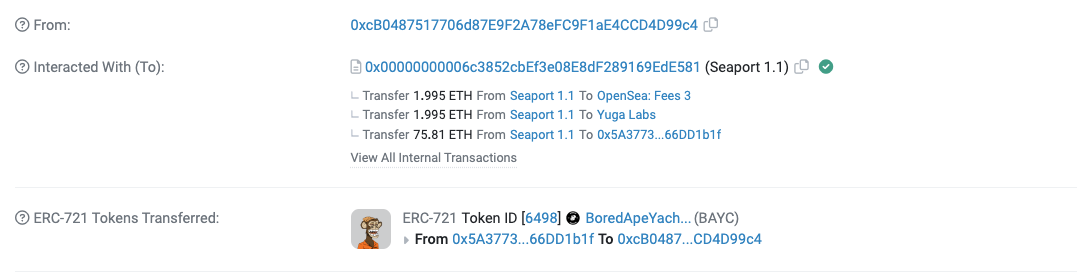
Image source: Etherscan
As you can see from the fee breakdown above, OpenSea made about 2 ETH, while Yuga Labs made about the same by selling the Bored Ape NFT for almost 80 ETH. In my opinion, this recurring income should not be underestimated by anyone. Buyers willing to pay $140,000 for a picture of an ape may not be buying just for its artistic value; rather, they are more likely to be looking to make a profit, or to speculate on its potential value. They want to use today's consumption to obtain higher income in the future, so as to achieve a win-win situation for all parties. However, this could change if the market changes.
OpenSea introduces the concept that NFTs can enforce royalties and empower creators, which There's a lot of appeal for everyone, and we see nothing against it. The problem, however, is that NFTs cannot transfer royalties to end users on their own.
Typically, royalties are passed through smart contracts created by marketplace platforms such as OpenSea. The reason for this is that it is difficult to discern a simple assignment from a transaction. Users will no longer want to move their precious NFTs to cold wallets if they are charged a 5% fee on each transfer. As such, royalties are generally collected by the marketplace platform that facilitates the transaction.
However, if the market platform does not want to enforce royalties to reduce transaction costs for users, we can do what? This is the core issue plaguing the NFT world right now.
Market New Star
In 2022, driven by sufficient liquidity and incentive fees, the NFT market has undergone major changes and explored many new models. It all started in January when LooksRare released its token with a simple value proposition that users who get the token can use it to transact on the platform.
LooksRare users can use Token to manage the platform and gain benefits as Token holders, Instead of spending money on building a brand, running ads, and educating users. Additionally, the token has a liquid market. I previously analyzed the platform’s game theory in the article "Token Marketplaces".
“Every trader on the platform is required to pay the artist a 2% platform fee and 5-10% royalties. False traders can use these mechanisms to acquire assets at discounted prices in the spot market. If the sum of platform fees and royalties paid is greater than the reward price of Token, users have no incentive to continue trading on the platform. LooksRare generates generated about $11 billion in transaction volume and $220 million in revenue, even though they have only a fraction of OpenSea's users."
At that time, LooksRare received a lot of attention because of its high liquidity Token, but OpenSea failed to do so. Despite a poor initial product (limited ability to sort NFTs by price), LooksRare has gained traction. However, due to the arrival of the bear market and the decline of Token rewards, the product struggled to compete with OpenSea this year.
OpenSea's management may recognize the potential threat to the company's dominance of new-age platforms, So they acquired Gem a few months later. As of the acquisition, Gem was one of the fastest growing deal aggregators in the market.
At this time, the market has made many attempts with Token. It is well known that using tokens as an incentive to transact on the platform can help improve metrics. However, we still have another aspect to explore: creator royalties. During this year, several exchanges began to gradually reduce the percentage of creators’ promotion points.
DeFi markets provide tools to explore this idea, such as SudoSwap, which enables the creation of Uniswap-like The NFT pool becomes possible. Users can buy or sell large quantities of specific NFTs by trading them in the pool. In order to compete with major players such as OpenSea, the platform’s cut is reduced to 0.5%.
Assuming you are a trader interested in buying Bored Ape NFT, if you can cancel 2 ETH paid to the creator, and a reduced fee of 2 ETH paid to the platform, which other traders may move to your platform.
And that's exactly what happens in reality.
On certain markets outside of OpenSea, the purchase price of NFT can be reduced by 5%, Thus greatly saving the cost. Suddenly, the traditional royalty model of empowering artists began to fall apart, and the previous vision and narrative no longer existed.
Despite the disruption caused by low-price NFT market platforms, OpenSea, the dominant player in the NFT world was not significantly affected. A few hundred traders and their small trades pose little threat, and most of them are fake trades. Financial incentives are the main driver of trading activity on OpenSea. One might think that as incentives are reduced, transaction activity for new competitors such as X2Y2 will also decrease. However, in October 2022, the industry is about to face a formidable opponent - a new player is about to enter the market with a superior product tailored for traders, and it is Blur.
Blur has been optimized in several ways, including:
< br>
1. Provide users with the possibility of airdrops to increase the liquidity of buyers and sellers, which is closely related to the settlement price of NFT and ETH Correspondence, attracting traders flocking.
2. Focus on professional NFT traders rather than retail traders, and provide several advanced trading options that traditional platforms cannot provide, similar to starting from a The spot market for altcoins turns into a comprehensive set of trading products that meet all professional trading requirements.
3. Integrate a series of charts and data functions into its core products, similar to what Gem did when it was launched, allowing traders to Get historical pricing, book depth, rarity, and general volume trends all on the same platform.
Although you may think these improvements are insignificant, but the strategy of playing with Token and building a superior product Let Blur realize about 40% of weekly NFT transactions on the Ethereum network. As of February 2023, Blur accounted for approximately 77% of transaction volume, compared to OpenSea's 16% during the same period.
It is worth noting that Blur also launched a Token, which means we should be cautious the data it provides. The launch of Token includes several innovative elements. They abstract away the concept of Token and provide users with a "box" that may generate Token at some point in the future. Users do not know how many tokens they will receive between October and February, and this makes users behave differently.

Data from @hildobby on Dune.xyz
In a quarter, Blur Two important things are accomplished. First, it erases the need for royalties for a short period of time, and traders have become more and more accustomed to not paying creators royalties in market transactions. Paying creators royalties on every transaction doesn't seem reasonable when you just want to speculate. Second, Blur has eliminated its royalty program entirely, with no royalties at all on the platform until December 2022. After that though, they switched to a 0.5% royalty model.
To understand Blur's long-term impact, it's worth looking at the evolution of royalties. A user named Beetle created a Dune Dashboard that measures effective royalty rates. Beetle defines the Effective Royalty Rate (ERR) as "the total royalties earned across all marketplaces divided by the total volume traded across all marketplaces." Since marketplaces like Blur were initially launched with no royalties, an increase in transaction volume coupled with a decrease in royalties would lead to a downward trend in ERR - which is exactly what is happening now.
The data in the figure below shows the royalty payment of Boring Ape during a specific period. It started August with less than 5%, as some marketplace platforms have embraced royalty-free trading. However, that trend reversed when Blur launched in October.

The data comes from 1kBeetleJuice
It is not only the royalty rate that is affected, it is on various market platforms , the number of deals generating royalties for Boring Ape has been declining, as illustrated by the data below.

Royalty evolution
Those involved in the NFT ecosystem are in the midst of a major upheaval right now. A new player enters the market, takes away your users and transaction volume, and upends your business model. Several NFT marketplace platforms briefly took a commendable stance, guaranteeing creators income.
OpenSea has established an operator filter registry, if platforms such as Blur allow users to avoid paying creator royalties for the same item on OpenSea, then these platforms will be included in the table.
The attitude of the market towards paying royalties has clearly changed over time. OpenSea is now dealing in a fraction of the size of its original deal, and was forced to cancel its royalties three days ago.

We may need to hire someone to make a better puzzle< p>
Despite the turmoil, OpenSea is not a helpless bystander. In fact, the platform launched a full and acquired an aggregator to cater to market demand. OpenSea’s Seaport, launched in May 2022, is a pure market contract, similar to DeFi’s 0x. It functions as a communication protocol, in various markets Find liquidity and route orders. In Web2 terms, this is the API equivalent of listing the same item on eBay, Amazon, and other regional e-commerce platforms.
Why does a market platform like OpenSea publish an agreement? This is because they want to create more ways for more people to join the NFT market. If the entire market develops, OpenSea is still the largest market platform, then they will gain more users.
However, This decision has had unintended consequences for OpenSea. Previously, creators could easily blacklist Blur; now, whenever a collectible series bans Blur, Blur makes that asset available through OpenSea's agreement. Liquidity. Also, there is basically nothing we can do to prevent Blur from entering the protocol and finding liquidity for the asset. Twitter user PandaJackson at .

PandaJackson has some great tweets, be sure to follow him
Blur completed more than 4,000 Sewer Pass transactions without paying OpenSea a fee of $220,000, resulting in a loss of about 40%. This use of Seaport to circumvent the Blocklist registry is an obvious mockery of the mechanism. Even if OpenSea found a way to stop Blur from querying Seaport for liquidity, that would defeat the reason why they introduced Seaport in the first place. (Also, OpenSea cannot modify Seaport on a whim)
Although you may think this is not what Big deal, but given the evolution of order fulfillment rates and sources over the past few months, the conundrum becomes impossible to ignore.

A forked dashboard from SeaLaunch
From SeaLaunch
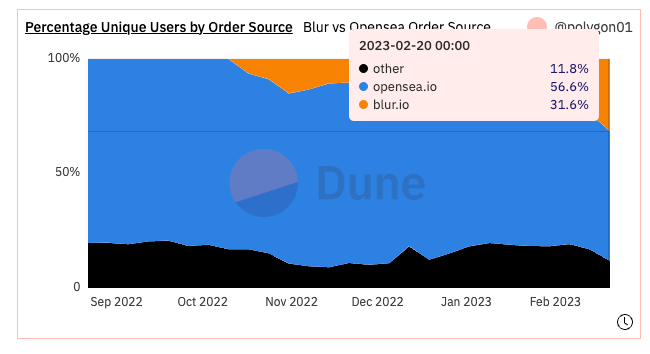
The first graph shows the The percentage of trading volume divided by order source, that is, which market platform the order originated from. As the chart shows, when Blur opens to the public in October 2022, it dominates nearly 60% of order sourcing. However, as of February 2023, it has dropped to about 21%. This shows that more and more users are using Blur's marketplace platform to place orders. Still, this is not a significant threat, as users can place orders through any aggregator, and liquidity can be sourced elsewhere.
From a B2C investor perspective, Blur may not pose a significant threat to OpenSea. As the second graph shows, most independent users are still using OpenSea. As a new platform, Blur couldn't immediately replicate OpenSea's brand equity. The problem, however, is that Blur has transitioned from a platform for initiating orders to one where users can find liquidity within a quarter.
In the data shown below, Blur is the orange part, which accounted for 83% of trade execution volume. However, on February 20th, it dropped to 26%, a drop caused by the fact that Blur’s initial token airdrop had just ended.

The chart above provides a clear breakdown of this fact. Wherein, the term "execution source" refers to the market from which the order is fulfilled. If your platform is an emerging aggregator, you may be able to fulfill orders, but orders may also be executed through third parties. When a platform has the ability to do most of the order matching itself, it becomes a marketplace in its own right. As of February 2023, only 16% of orders on Blur were fulfilled using liquidity on OpenSea.
Blur's shift from aggregator to platform is at the heart of what is jeopardizing OpenSea's future. With the massive loss of market volume to third-party platforms, these marketplace platforms are no longer willing to maintain high fees. OpenSea has transitioned from publishing a registry, which blacklists marketplaces that fail to enforce creator royalties, to an optional royalty fee structure.
The evolution of this market - from one that sees creator royalties as divine rights, should be in An ecosystem that protects and enforces across all marketplaces, transforms into a place driven by finding innovative ways to avoid paying creators. It’s amazing how in just six months, a startup has convinced the global NFT marketplace to remove royalties, even if it’s only a temporary phenomenon.
Future Development
A year ago, when we first discussed LooksRare, people thought that the introduction of Token could completely subvert the NFT market. The strategy seems simple: eliminate rake and introduce tokens. This allows teams to profit from issuing tokens, rather than from any revenue they generate. Over the past year, however, the platform has seen a sharp drop in daily active users, down to around 200.
Blur poses a greater threat to the market because at the time, it accounted for 70 % of the transaction volume, while LooksRare only has about 11%. OpenSea went from testing a registry to block marketplaces that don't offer fees, to minimizing its own platform's cuts, in response to the threat posed by Blur. At the same time, this also proves Blur's efforts from the side. What we are not sure, however, is whether Blur's transaction volume and users will remain at that level as the market develops.
There are mixed opinions on this issue: some believe that Blur can bring traders With better products, users will stay loyal. A great product and the ability for users to "own the product" through Token will allow Blur to achieve amazing growth. But others believe that this may be short-lived, and OpenSea may regain its dominance in a few months, for the following reasons:
OpenSea has kept its fees to a minimum, so those who left for financial reasons may now consider coming back. Additionally, an OpenSea IPO may no longer be viable given the current state of the tech stock market. In this case, OpenSea can consider issuing Tokens.
Instead of tokenizing OpenSea itself, the company can explore tokenizing its assets, such as one year The previously acquired aggregator gem.
If tokenizing its assets is not enough, OpenSea can explore Protocol SeaportTokenization. It may be beneficial to OpenSea to tokenize the protocol and incentivize the small market. As long as Seaport becomes the industry standard for NFT transactions, the protocol could enforce royalties at the protocol level and blacklist bad actors.
Similar to Ronin, any protocol released by OpenSea can be issued by game studios, large NFT A consortium of retailers and traditional retailers manages to determine how shared standards will evolve.
The reason for the deadlock in the market is that both major players have raised large amounts of venture capital, The amount is enough to keep them afloat for several years without income. This situation negatively impacts creators and smaller products that rely on the royalty model. As mentioned earlier, NFT royalties promise to enable a market for user-generated game content.
Without NFTs, this market may fall apart. Games will operate their own closed marketplaces to avoid regulation and circumvent app store policies on digital assets.
Another point to consider is that intellectual property plays an important role in the NFT market. Companies like Yuga Labs and Nike are motivated to continue developing their NFTs because they earn revenue from royalties. In fact, over the past year, the two companies have earned more than $100 million from royalties alone. Without this revenue model, no company would want to improve these primitives. Therefore, we will only set back the development of the current market by several years by blindly staying away from royalties.
Artists can choose to launch their own marketplace, using existing tools to create a storefront and publish Royalty rules. However, this may inevitably leave artists in the same situation as in the past, with gatekeepers and intermediaries taking a cut of their earnings. A lack of industry understanding of two important factors may be at the crux of the problem:
Transactions play an important role in the digital asset ecosystem, and most of the funds invested and revenue generated come from financial applications, which will continue to trend towards lower fees to acquire users and transaction volume.
Not all assets are subject to substantial transactions, especially non-homogeneous assets like music album rights. Higher royalties are only justified when assets are traded less frequently.
Different user groups will require different royalty models depending on the assets they trade. To address this, creators could be empowered to receive their royalties at the protocol level, allowing the market to decide whether to overtrade assets. Despite the many innovations we've made with NFTs over the years, very little has been done in this area. Canto's contract-guaranteed revenue model enables developers to earn a portion of the fees generated by users of a specific DApp, and we may have the opportunity to apply this model to NFTs in the future.

Back when Jay-Z realized that royalties were one of his 99 problems
sarcasm Unfortunately, this kind of thing is not new. In 2015, Jay Z launched Tidal to address music artists’ diminishing income from streaming. The €25 app failed to take off despite having the support of nearly every major artist in the US. For a while, people could only get some old Jay-Z albums by paying on Tidal. As a result, the app quickly struggled, dropping 700 positions within a month of its launch. A few years later, Jack Dorsey from Square bought it for $300 million.

< br>
The idea is that as an artist, you want to earn income, but not at the expense of distribution of your work. Typically, artists optimize their work for streaming on YouTube, as it counts towards their ranking on the Billboard charts. However, once a platform gains a lot of attention, it begins to dominate creators. If you want to get more distribution, you need to make it easy for users to discover your work, such as listing on OpenSea, or not setting a payment threshold for your content.
(We don't have any plans to charge, but we would like to give a big thank you to the You surprised us with $200 for your work.)
Currently, Blur is valued at $3.2 billion, Higher than some protocols. This phenomenon raises the question of whether we are moving from the era of "fat protocols" to the era of accumulating value in applications. The success of the team behind Blur shows that standalone applications can often outperform entire protocols in terms of user numbers and services. This has led to an emerging trend of launching a marketplace with minimal or no fees, incentivizing user volume through tokens, and using tokens to provide ownership to users in exchange for their activity on the platform.
Essentially, instead of building what people might build, focus on building what people actually need something. In today's market, we have finally reached the stage where we have optimized our products to attract professional users.
We do not believe that a royalty-free market will ultimately succeed. As mentioned earlier, iteration is the norm in the market, and apps will continue to evolve and compete for niche users. The hype around Blur may die down in a few months, and the NFT market will return to normal. Of course, there is also a possibility that the creators will no longer issue NFTs, leaving us with only some previous works, although the industry has experienced many innovations and developments in the past three years.
The current market situation is difficult to predict. But if we follow the advice of a contemporary rocket technologist and a dogecoin enthusiast, the most interesting result may be is the most likely thing to happen.
Next we will discuss some of the work we have done in artificial intelligence and blockchain .
Welcome to join the official BlockBeats community:
Telegram Subscription Group: https://t.me/theblockbeats
Telegram Discussion Group: https://t.me/BlockBeats_App
Official Twitter Account: https://twitter.com/BlockBeatsAsia

 Related Articles