Explore 12 types of Web3 gamers based on their interaction patterns in games
Original title: " Web3 Gaming Player Archetypes "
Original source: Medium
Original author: Vader Research
Original compilation: Moni, Odaily Planet Daily
Web3 games allow trading in-game items and earning income on a permission-free decentralized market, which creates investment opportunities for participants, It also enables game developers to use economic rewards to "incentivize" certain player behaviors.

As the open game economy matures, Web3 games also emerge a whole new class of players with different motivations and behaviors—this paper aims to compare the typical roles of P2E game participants The typical roles of F2P game participants are specifically classified so that developers can build better game economic models based on different player types and interaction behaviors.
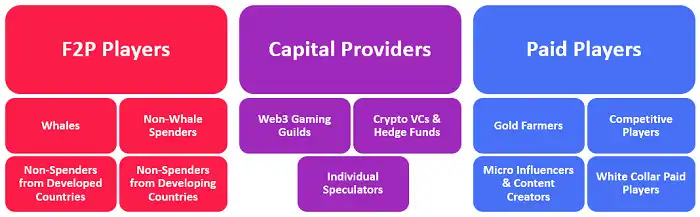

Free-to-Play Players
Free-to-Play (F2P) players, usually traditional video game players - they play games because they simply enjoy games without expecting financial rewards.
Some F2P players are more valuable to game developers than others because they prefer to spend more on in-game transactions, or they more valuable to advertisers.

1. F2P giant whale players
There is no doubt that F2P giant whale players are the best—— They spend huge sums of money in games on a regular basis, and are more than willing to pay if it comes to experiences related to game power, social interaction, etc.
The financial support provided by such players actually accounts for most of the revenue of F2P games. Due to the extravagant consumption behavior of such players, advertisers are willing to spend a lot of money to attract their attention and sell them various Products/services, they can spend anywhere from $5 million to $100,000 per month.
2. F2P medium consumption players
If a F2P game wants to have a healthy and long-term We need to pay attention to those "non-whale" consumers, because they are the mainstay of the game. Although such players do not spend a lot of money in the game, they spend more time in the game than "big whale players" Much more, these players spend anywhere from $5 to $100 per month on battle passes, microtransactions, and in-game items.
3. F2P non-consumption players from developed countries
F2P non-consumption players Those who don't spend money on the game, but because they have some disposable income, such players are also valuable to advertisers, and can turn into consumers at any time. The total ad revenue the game can generate from the average non-consumer player in the developed world is probably $5-20 per month.
4. F2P non-consumer players from developing countries
From developing countries The average non-spending player of , is generally considered to have little disposable income, and the possibility of converting it into consumption is relatively low. Generally speaking, the advertising revenue available to such non-spending gamers is only about $1 per month.
In short, most F2P players have a net deflationary impact on the economy, as they tend to pay more money in the game than they receive in the game Much more (if they get paid at all).
Capital Provider

1. Web3 Game Guild
Any for-profit institution exists to make money - institutions have no emotions (and morals). Founders , executives and some shareholders may have "a little affection", but they must also have a fiduciary duty to their stake/token holders to maximize franchise value.
Therefore, they always have to give priority to maximizing the profit/price of the game, not "doing charity".
A brand may appear to support charitable causes (environment, peace, racial/gender equality, etc.), but in reality, their reasons for doing so may Was trying to do a PR campaign as executives concluded that if there was some financial and social cost invested in philanthropy, there would be a positive return on investment for the brand, resulting in increased employee and customer retention and profitability , resulting in higher franchise value.
The same is true for Web3 gaming guilds, who need to allocate their money, time and labor to maximize revenue and franchise value. Guilds will buy in-game NFTs and lend them to gold users to earn income and invest in early game tokens/NFTs for capital appreciation.
Although guilds spend the same amount of money in the game as F2P whales, unlike F2P whales, game guilds have a clearer investment purpose, they are not for Leveling up or acquiring in-game items, but positive returns for a reasonable return on investment - the logic is simple; a VC-backed guild with a publicly listed token has a fiduciary duty to its institutional and retail token holders to maximize Improving earnings and long-term fully diluted market capitalization.
Therefore, the game guild cannot waste money to buy game props or other in-game products for the personal interests of an executive.
However, a guild that makes millions of dollars in profits from P2E games may also buy game items from the game-but this practice is more Landing is a PR tactic to get more early game token/NFT investment opportunities.
The guild economic model is deflationary for any game economy, with one exception: a zero-sum betting model. Example: Guild A bets $10, Guild B bets $10, the winning guild gets $18, the game developer gets $2, and the losing guild gets nothing. Through various token projects, this model has grown in popularity, resulting in guilds willing to make significant investments in player teams.
Despite the high disposable income of guild owners, the advertising value generated by guilds is usually low, and the players who play the game and watch the ads are guild members, These people generally have low disposable income and mainly come from developing countries.
2, Encrypted venture capital and hedge funds
Encrypted venture capital and hedge funds are " Institutionalized investors”, their financial motives are simpler and cruder, that is: buy low and sell high, according to time frame and asset preference:
VC may prefer early stage 2-3 years;
Hedge funds may prefer tradable tokens/NFTs with a term of 1-180 days .
These institutions are usually not very active in the game itself, and the purpose of providing funds is to find investment opportunities in the game market.
3. Retail speculators (retail investors)
In blockchain games, retail investors The financial motives of speculators are similar to those of the aforementioned institutions. They will join game chat groups, communities/forums, DAO and participate in collective actions in the game community. They can also become "lone wolves in the game". These NFT and IDO "Whitelist Hunters" are always on the lookout for the next big game investment, and do extensive due diligence on projects and spend hours participating in Discord channels to get a whitelist for the next big game's major NFT sale.
We have seen a lot of retail speculators in blockchain games like Axie Infinity , Thetan Arena, OHM, Luna, STEPN, they know the benefits Where do you come from, enjoy excitement and high returns, and are very optimistic about the future development prospects of blockchain games.
Pay Player

In blockchain games, gold players have purely economic motives - They play games to make money, and these players participate in games based on how much they can earn per hour, how much effort they need to put in, and what is the probability of making money. If driving an Uber guarantees them $5 an hour, but only $3 an hour playing Axie Infinity — they might choose to drive an Uber instead.
F2P players are very different. They usually participate in the core game life cycle all the way, and are willing to "give back" the financial rewards to the game to help the game itself become better. In contrast, chain game gold mining users want to get economic rewards as soon as possible so that they can cash out and extract value from the economy.
1. Gold players
For the blockchain game economy, institutionalization Goldsmiths are an even bigger problem, as they are a more organized and efficient form of individual goldsmiths.
Blockchain games may pay players in low-income countries a flat fee, or help them build complex bots, incentivizing them to continue to benefit from the game economy Extract value until game profits are drained.
2. Competitive players
We always look at the game rankings When you see some top skilled players, they are competitive players. These people don’t necessarily have economic motives to participate in the game, and they don’t just play games for making money. Many of them are F2P players at the beginning, but as they grow up throughout Progressing and performing well in the game, these players climb the ranks and can earn money through other means such as winning tournaments or streaming games.
Once such players start to build their personal brands, they are likely to be poached by e-sports teams and start working for them in exchange for a stable salary and extra Welfare. However, as with any professional sport, competitive player earnings will be limited by the size and spending behavior of the audience willing to watch the sport.
NBA and soccer league players earn millions of dollars a year because of the large audience willing to spend hundreds of dollars a month on satellite TV to watch them. However, spectator consumption is not the same for badminton or squash - so professional badminton players earn far less than professional football players. The same applies to the esports industry – even though the esports audience for the top esports tournaments may exceed the FIFA World Cup, the number of viewers willing to spend money on games is significantly lower than the average football audience.
That is to say, competitive players do not necessarily bring much benefit to the game economy, but they can attract new players.
3. Game "Internet celebrities" and content creators
Game "Internet celebrities" and content creators represent the game distribution channel, game "influencers" can attract, attract and retain players through various activities, they play the role of community leaders, and can often promote new games/products to their audiences Obtain a very high user conversion rate.
Unlike competing players who earn their income primarily through tournaments funded primarily by game developers, gaming “influencers” and content creators promote new games/ products/services to earn income.
4. White-collar paying players
White-collar paying players are a new type of player. They have strong social skills. What such players like to do most is to actively interact with other players, and then increase the overall retention rate and expenditure of game players. Therefore, "white-collar paying players" can also gain certain benefits in blockchain games. remuneration.

Conclusion
At this stage, there are three main challenges facing Web3 games:
1. Maintain an open economy
2. Optimize the distribution of financial incentives
3. Keep players/community happy to maximize lifecycle Value
Blockchain games with a permission-free open economy will inevitably attract economically motivated profit. For Web3 game developers, it is necessary to carefully evaluate and analyze game player types and participant behaviors, so as to design targeted reward and punishment mechanisms to ensure sustainable development of ecological value.
Original link
Welcome to join the official BlockBeats community:
Telegram Subscription Group: https://t.me/theblockbeats
Telegram Discussion Group: https://t.me/BlockBeats_App
Official Twitter Account: https://twitter.com/BlockBeatsAsia
 Related Articles