Countdown to the Ethereum fork
The introduction
Recently, there have been many voices about the Ethereum fork. After all, the date of the merger is basically confirmed. The computing power of more than 800 T of the whole network is still in doubt.
Yangyang interview micro blog posted the old generation of bitcoin player Guo Hongcai's statement about fork in the community, which seems to have determined that Ethereum will definitely fork, revealing that this is a big probability event. It is interesting that Guo Hongcai has long been away from the market line of sight, this seems to be prepared. I'm sure he's not the only one. There must be others trying to take advantage of this rare opportunity to engineer a forking of the miners.
The last time the whole web saw a fork, it was BCH versus BSV, but that was Bitcoin. Ethereum, if it does fork, will not look at computing power, but assets. As the world's largest application chain, the initiative of ETH has already shifted to the asset side, they are the decisive key.
Here's a BlockBeats post from last December, and it's not out of date, hopefully helping readers understand what's going on in the Ethereum community.
以下为正文内容
Anyone who sees the term "Ethereum 2.0" thinks it's an upgrade, and that's exactly what Ethereum was supposed to be. Like Iron Man 2 must be the sequel to Iron Man. But perhaps, for some, Ethereum 2.0 is not a sequel.
"It's actually another new project." "It's not the Ethereum it used to be," said Brother T, a heavy Ethereum participant.
Such a view is at odds with current market sentiment.
The penultimate fifth week of 2020 will definitely be mentioned again and again in the future of the cryptocurrency field. In this week, the market capitalization of the first Bitcoin refreshed its all-time high, and the market capitalization of the second Ethereum also officially opened its next new stage -- Ethereum 2.0 phase 0.
"Ethereum 2.0 went live pretty quickly." This is the most consistent view of the upgrade. Ethereum upgrades are notoriously inaccurate. Phase 0 was expected to be launched next year, but it happened so soon.
The early timing has brought a lot of confidence to market sentiment, with Phase 0 setting a start-up threshold of 524,000 ETH mortgages before they can go online. With the rise of ETH price, the value of at least 32 ETH pledged by each node is close to the value of a bitcoin. The locking of more than one hundred thousand RMB has not affected the mood, and the startup threshold is completed without resistance. As of December 8, more than 1.2 million ETH have been mortgaged.
Technology, prices, sentiment, confidence, and now Ethereum 2.0 looks perfect.
But the Ethereum community, it seems, isn't so optimistic.
The puzzle of Fragmentation
Ethereum 2.0 upgrade, the most recognizable changes are two: one is the change of consensus, from PoW to PoS; Second, the sharding technology is introduced to expand the network performance.
"It made sense to introduce sharding in the first place." "But now it needs to be rethought," said Miao Shu, head of products at Spark.
At present, Rollup technology occupies the highest position among the solutions for extended performance in the Ethereum community. From the founder Vitalik Buterin to the ecological application team, everyone has almost the same consensus, and the project side even put the focus on Rollup before Ethereum 2.0. "We're not focused on 2.0 right now, we're focused on Rollup." DForce founder Yang Mindao said on Rhythmic BlockBeats.
Shards have been relegated from data execution to data storage, compared to Rollup, and Vitalik agrees. During the Ethereum 2.0 core developer conference call in mid-November, the core developers discussed that Ethereum 2.0 May be shelving its phase 2 plans until the Rollup solution for the data sharding layer is proven to be feasible.
That is to say, Rollup has been recognized as the most potential expansion tool of Ethereum, and everything is developed with Rollup as the first step. In case Rollup's path fails, consider using sharding for data execution. The current sharding function is only for data storage.
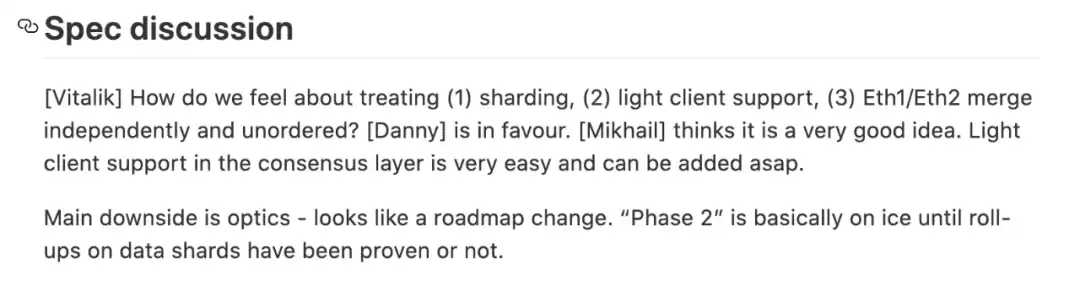
Note: Transcript of Ethereum 2.0 developer conference call from mid-November 2021
"But if sharding is only for data storage, then in order to solve the data availability problem, the research objectives and feasible solutions should be reset, rather than directly using sharding that was originally used for performing capacity expansion." Uncle Meow raised his doubts.
Regarding this issue, the domestic Ethereum community once discussed with Vitalik, but the dialogue was not fruitful and the two sides did not convince each other. After all, this is on the scale of the project roadmap, which is impossible to discuss in a few words, and the issue is so far away that Ethereum 2.0 has only just entered phase 0 and phase 2 is still a few years away.
But now there's a much closer and trickier question than that: Will the Ether fork if the consensus is changed?
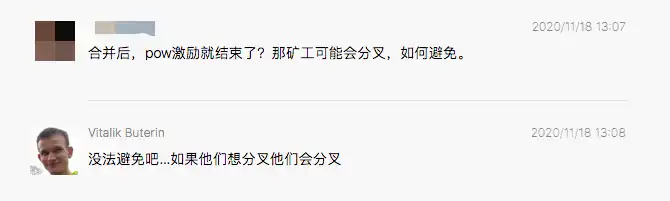
Note: Vitalik expresses his views on fork in the community.
The persistence of the PoW
This is not a fork in the normal sense.
"If The fork does happen, unlike The DAO before it, it's not an accident, it's a road map." Another question for Uncle Meow is the change in the consensus level of Ethereum 2.0: why on earth use PoS when all the technical improvements can be made based on the PoW consensus?
Vitalik's point is clear: "Upgrading PoS is about improving security and efficiency." He responded in the Ethereum community.
A few days ago, there was a heated discussion on this topic in the community. Similarly, the two most mainstream contemporary consensus used by the most projects must have some points that can be played against each other. Not everyone agrees with the conclusion that "PoS must be safer than PoW".
In Vitalik's plan for Ethereum 2.0, Ethereum 1.0 chain (now Ethereum PoW chain) and Beacon chain will merge at some point. At present, the specific merger is just a proposal. The idea is roughly as follows: Everyone votes for a block height, at which point Ethereum 1.0 stops tracking the state and starts tracking the state of 2.0.
"He has made it very clear that, in theory, the Ethereum 1.0 chain can continue to operate unaffected as long as miners continue." Uncle Cat explained.
In other words, following this scenario, we would see two chains called Ethereum running at the same time, one using PoW and one using PoS. This is not a regular fork, but in the end, it is a fork. "I think the odds are pretty high." Yang Mindao said.
What is now a chain will become two chains in the future, what is now a 1:1 ETH transferred to Ethereum 2.0 will be two ETH with different prices in the future, and what is now a huge Ethereum community will be split in two.
Regular fork is the need to use computational power to make choices, the choice of the protagonist is the miner, and if there are really two Ethereum chain at the same time, this time need to make a choice, is the overall ecology of Ethereum, is the project side, is the user, is the investor.
The Ethereum ecosystem of choice
DeFi projects have accounted for half of the Ethereum ecosystem, but DeFi projects are based on the assets on the chain, "the protocol side is mainly following the asset side." Mindo Yang explains the DeFi project's perspective.
The so-called asset side refers to on-chain assets such as USDT and USDC. The mortgage lending ecology of DeFi is basically based on the asset side. For example, USDT is pledged to lend other coins. But from the asset side, it looks like a conundrum.
Using USDT with a current market capitalization of nearly $20 billion as an example, the issuer Tether cannot directly announce that the issuance of USDT has directly doubled due to the emergence of another Ethereum chain, and if Tether distributes more than $10 billion of ERC-20 USDT between the two chains, In what proportion, you need to think, and the asset side of the Ethereum chain is not only USDT. Most protocols support multiple assets, and if the USDT chooses Ethereum 1.0 and the USDC chooses 2.0, the protocol will be in a bind.
"The asset side should collectively choose the same chain." Yang Mindao said. In other words, a choice needs to be made within the ecosystem to pick a network that can truly continue to be called Ethereum.
If only one chain is chosen, leaving it as it is seems the optimal solution. "Forks are not going to take the heat out of Ethereum 1.0." T elder brother said.
As a miner, investor, and founder of DeFi project xDeFiLabs, he doesn't see the advantages of Ethereum 2.0. In his view, the current pain point is something that Layer2 or Polkadot can solve, and if they can't solve it, Ethereum 2.0 can't solve it either. "I see no reason why people would leave Ethereum 1.0." "I even invested in an Ethereum ASIC mining machine project," he said.
Unlike Bitcoin mining machine, the current Ethereum mining machine uses GPU mining, the better the performance of the graphics card, the higher the mining efficiency, ASIC chip concept, has never really appeared in the Ethereum ecosystem.
However, at the same time as the launch of Ethereum 2.0, the development of Ethereum ASIC chip mining machine is also in full swing. "Bitmain, Rin and Motrin are all working on Ethereum ASIC mining machines." A source told Rhythmic BlockBeats, "The main process is 14nm or 16nm."
Miners pursue profits, and mining machine manufacturers must develop ASIC chips because they can ensure profits for miners. Before Ethereum turns to PoS, there is still a PoW period of two or three years, during which miners can have profits by mining with ASIC, but from another perspective, Why bother developing a whole new concept when a mining machine manufacturer has judged that it will only last two or three years?
"I would definitely support Ethereum 1.0 if there was a fork." Brother T's view is representative of the vast majority of Ethereum miners. "We don't have any miners who are asking us to offer PoS." "The miners of the Ethereum PoW and the nodes of the PoS don't seem to intersect at the moment," said Meow.
So who's supporting PoS on Ethereum?
The new force of PoS
Like many, Mr. Li, an Ethereum enthusiast, believes that Ethereum 2.0 is an iteration of the current version and that to improve the performance of Ethereum itself, it is necessary to move to a POS-based system. "Even with the uncertainty, PoS is a necessary step."
In his opinion, although there are many Layer2 solutions on the market, they are more like system "plugins". "The power of the plugins does not necessarily reflect the power of the underlying infrastructure itself."
In November, the etheric lane 2.0 startup has become the focus of the community, the hand hundreds of pieces of the ETH ze-lin li consider now that he has decided to hold the etheric fang for a long time, also is better than do something involved in the ecosystem, and itself has the technology base, self-built node, become the verifier in pledge system should not be a problem.
The preparation went well, and he also set up an Ethereum PoS wechat group to exchange ideas. At 20:00 on December 1, the Ethereum 2.0 network creation block was officially launched. Five minutes and 23 seconds later, Li Zelin's node successfully dug out its first slot. He was so excited that he even posted a screenshot on his moments.
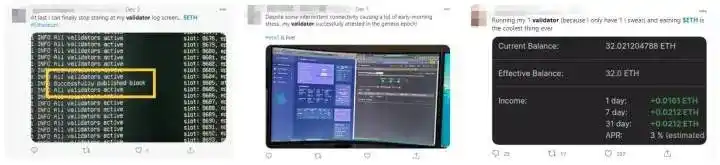
Many people on Twitter shared that they had become verifiers
李泽林是幸运的,以太坊 2.0 启动的第二天,全网超过 600 个节点因为各种各样的问题而遭到惩罚。这也是以太坊 2.0 被人诟病的一点,节点必须 24 小时在线,不管因为任何原因离线都会遭到惩罚。这也导致了节点服务商的兴起,因为个人能力有限,提供 24 小时在线且专业的节点服务商成了以太坊 2.0 网络中最活跃的群体。
But Mr Li sees this as no reason not to recognise PoS. In his experience, choosing a node in Hong Kong, China, rather than a machine in the mainland can reduce the probability of block synchronization delays, and setting up backup machines are all ways to avoid accidents.
"The miners are very likely to initiate a fork." Li, who is on the PoS side, agrees that forks are possible, but his bet is clearly on the PoS chain. "Users will choose Ethereum's new chain," he says.
His tone was as firm as an Ethereum 1.0 proponent's bet on the PoW chain.
Of course, the possible fork is still far away, and the PoS consensus has to go through many tests, proposals, discussions, proof-of-concept, client-side implementation, attack scenario verification, etc., before it can actually be used. There is even a possibility that people will find that PoS doesn't work on Ethereum, Ethereum 1.0+Layer2 is accepted by the whole community, and after a few years, the consensus will come back to the same, everything about PoS is a trial and error.
"Ethereum is still the strongest public chain. It's not the technology that has the first mover advantage, it's the consensus and market confidence that has the first mover advantage. After so many years, people in all communities can embrace the possibility that Ethereum will fail in exploring new directions." Meow uncle said.
The DAO 事件、Parity 钱包事件,到现在的 DeFi 黑客事件,以太坊用户已经接受了以太坊冒险的可能,同样,以太坊 2.0 也是一场冒险。这是一场涉及价值千亿美金生态、数万用户与开发者、区块链最强公链的大冒险。
Welcome to join the official BlockBeats community:
Telegram Subscription Group: https://t.me/theblockbeats
Telegram Discussion Group: https://t.me/BlockBeats_App
Official Twitter Account: https://twitter.com/BlockBeatsAsia