As the biggest "water seller" in the multi-chain world, how does the second half of the cross-chain track narrative continue?
How does the second Half of the cross-chain Track narrative continue as the biggest "water seller" in a multi-chain world?
Original author: Crypto world enthusiast Poplar tree
Earlier, Bankless released its 2022 crypto industry forecast, and its founder Ryan Sean Adams believes that in 2022, the value of cross-border bridge will be billions of dollars, and cross-border bridge projects (such as Hop, Connext, Across) will issue tokens and be worth billions of dollars.
At the same time, in the first week of The Cross-chain bridge activity of Arbitrum Odyssey launched on June 22, due to the high enthusiasm of users across the chain, the corresponding cross-chain NFT award cast more than 50,000 in the first week, which leads to high load on the chain, Arbitrum network Gas fee soaring, So Arbitrum development team had to suspend Odyssey activities, plan to resume after Nitro release.
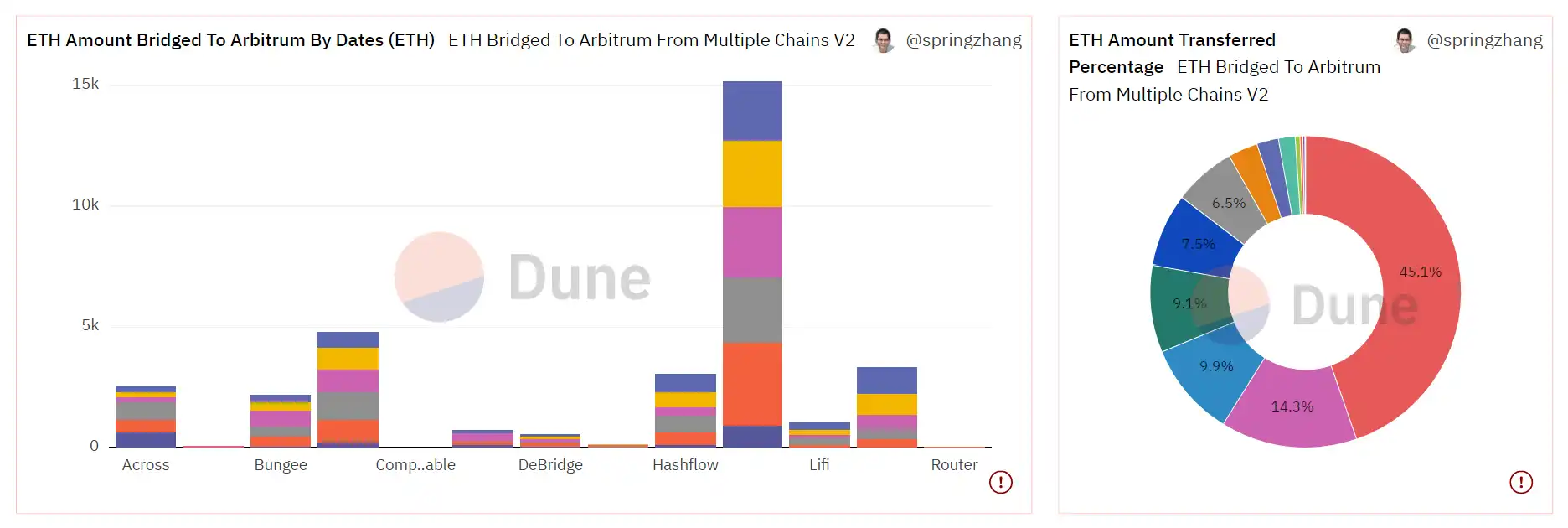
The potential of cross-chain bridge users is also evident. However, there is no unified narrative in the crypto world. Some people believe that "without the bridge, there will be no diversified development pattern in the crypto world", while others believe that "the emergence of the bridge is the beginning of centralization and vulnerability".
But at least in the present and foreseeable future, the crypto world is destined to be a multi-chain pattern. Cross-chain is like a bridge to get through the contact between each other, to achieve the connectivity of assets, data, transactions, communications and so on. It is an indispensable key participant in the diversified development of the crypto world.
I. The future of "multi-chain" is inseparable from "cross-chain"
Essence, across different chain core is refers to the chain bridge, bridge is a bridge of chain and chain connection tool, it allows tokens, assets, or any information from a chain transfer to another chain, because the two chain can have different protocols, rules, and governance model, while the bridge provides a way to communicate with each other and compatible to securely interoperate on both sides.
In general, since 2021, thanks to the rise of EVM compatible competitive public Chain and Layer2 network such as BNB Chain (formerly BNB Smart Chain) and Arbitrum, the explosive growth of cross-chain plate has been driven, and the importance of cross-chain bridge track as a market demand has gradually emerged.
In addition to official cross-chain Bridge projects such as Optimism Bridge, Celer Bridge, Hop Exchange, and Degate Bridge also provide rich and diversified cross-chain services.
Even though the entire crypto market and DeFi track have been impacted recently due to the continuous downward trend of the secondary market, the overall scale of the bridge has shown enough resilience to grow, and even expanded against the trend of DeFi track:
According to DeFi Llama, as of June 20, 2022, the total lock-up volume of DeFi Ecology on Ethereum was close to $70 billion.
At the same time, BNB Chain (the former Binance Smart Chain), Solana, Avalanche, Arbitrum and other public Chain or Layer2 schemes have also attracted nearly 30 billion DOLLARS of funds, and the development has formed a scale that can not be underestimated.

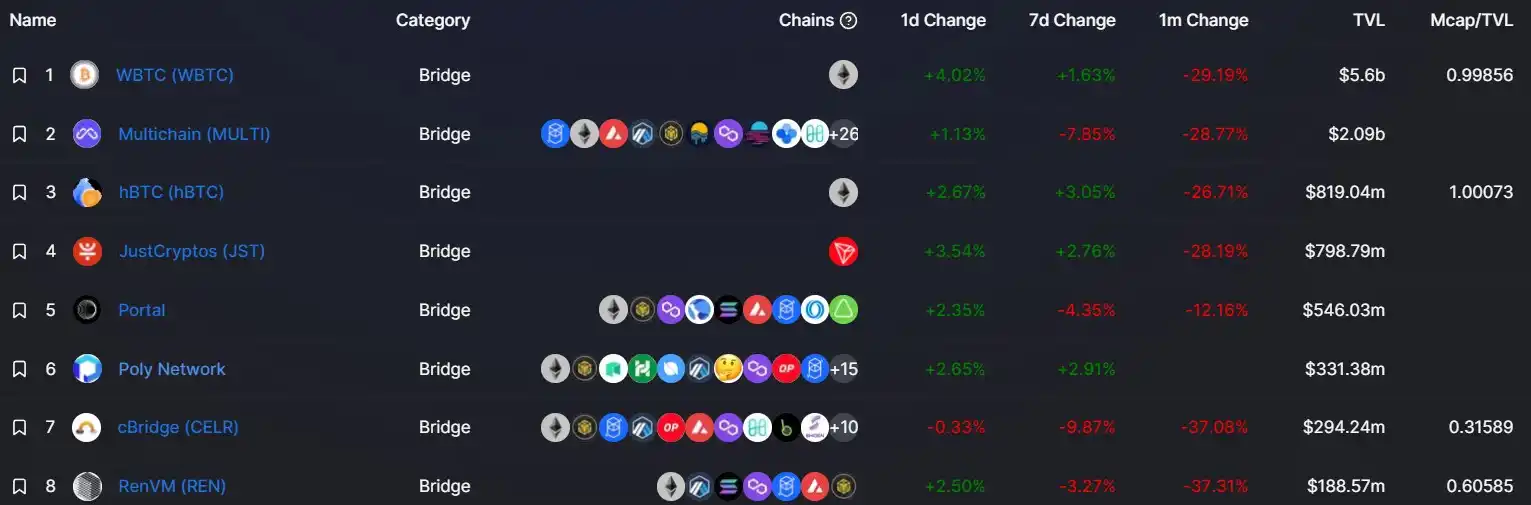
According to the statistics of Defi Llama cross-chain bridge lock-up volume, the total value of TVL, the top eight cross-chain Bridges, is about 10 billion DOLLARS, accounting for 50% of Defi's total lock-up volume.
Remember that when DeFi was in the $100bn or even $200bn range, cross-chain was only 10-20% of that, meaning that cross-chain liquidity activity increased during market downturns.
In addition to WBTC, which accounts for more than half of the total of $5.6 billion, excluding hBTC and other single-currency cross-chain Bridges and official cross-chain Bridges, Traditional cross-chain products such as Multichain, Poly Network, cBridge and RenVM rank among the top in terms of user penetration and transaction activity.
Reason is also very directly, for most of the etheric fang male chain, the chain transfer of assets between is the use of the biggest obstacles, ecological chain of the relatively weak in the absence of interoperability, it is difficult to get liquidity, and no liquidity means that the agreement abolished, so the importance of cross chain section and growing with the size of the market size of fluctuations.
However, it is obvious that the flow originally gathered on Ethereum is divided up step by step, forming separate islands of value. This means that with the increase of the number of public chains and Layer2 in the future, the degree of fragmentation of liquidity will be further intensified, and cross-chain will continue to become a rigid demand.
Therefore, to some extent, "cross chain" is the "water seller" of "multi-chain" competition.
No matter what kind of fierce competition the current and subsequent public chain war will bring, no matter whether the new public chain (including Arbitrum, ZkSync and other Layer2) will have a new narrative way and valuation space, as long as ethereum is not a dominant, as long as the "multi-chain" story will continue to tell, "cross-chain" will be the eternal melody.
Two. The refinement trend of cross-chain services
In short, with the further expansion of Ethereum L2 and the self-establishment of the public chain ecosystem such as Solana and Avalanche, cross-chain demand in the multi-chain and multi-layer market pattern will continue to maintain the market demand status.
In this context, cross-chain refined products and services become the main direction of competition:
For most users, in the actual cross-chain operation, in the face of different Bridges, how to choose the least cost and the best experience is undoubtedly a headache. For developers and project parties, when they access cross-chain services to empower their businesses, how to access them at a lower cost and enjoy customized cross-chain services according to different demands will also directly affect their product attractiveness in the face of different protocols.
Cosmos and Polkadot, which spearheaded the traditional cross-chain concept, offer a more specialized blockchain cross-chain solution by designing a cross-chain architecture that allows the blockchain to communicate.
However, many blockchains may not connect to the framework natively, so the Cosmos Ecosystem, Boca Ecosystem, Ethereum and Bitcoin networks cannot communicate directly with each other because they are all heterogeneous blockchain systems.
In terms of the whole cross-chain field, third-party bridge is a segment field developing rapidly at present, such as Poly Network, Celer, Multichain, Hop Protocol, etc.
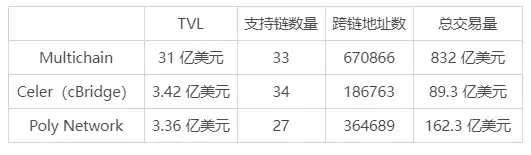
Data as of 2022.6.30
From the data level, as the current cross-chain protocol leader, both TVL and historical total transaction volume, Multichain is unparalleled.
However, although cBridge and Poly Network are close to each other in TERMS of TVL, Poly Network is obviously better in terms of the number of users and total transaction volume, and slightly inferior to cBridge in terms of the number of supported chains.
From the point of view of specific cross-chain services, the homogenization competition of various cross-chain products is very serious. In addition to the brand and stickiness of some leading products, the services provided by the vast majority of products are almost the same, and only rely on the temporary token incentive to maintain the temporary prosperity.
Therefore, for most cross-chain products, how to achieve differentiated competition for users and provide more personalized cross-chain services is actually the key to determine whether they can survive and become stronger.
Here we take Poly Network as an example to see how cross-chain protocols are winning the second half of the competition with increasingly refined services.
Poly Network, an established cross-chain protocol, offers a comprehensive cross-chain solution that is a bit like Cosmos Hub in function. It can connect multiple blockchain networks, but the difference is that it can not only connect to specific blockchain networks, but hopefully support all blockchain networks.
1. Support heterogeneous information flow across the chain
Poly Network is a heterogeneous chain cross-chain interoperability protocol, which adopts the mode of information flow cross-chain:
By deploying smart contracts on each chain, the relay chain is responsible for transmitting and verifying the validity of the information between chains, and then transferring the information to the target chain, so as to realize the cross-chain exchange of assets and realize the value flow between different application ecosystems more quickly.
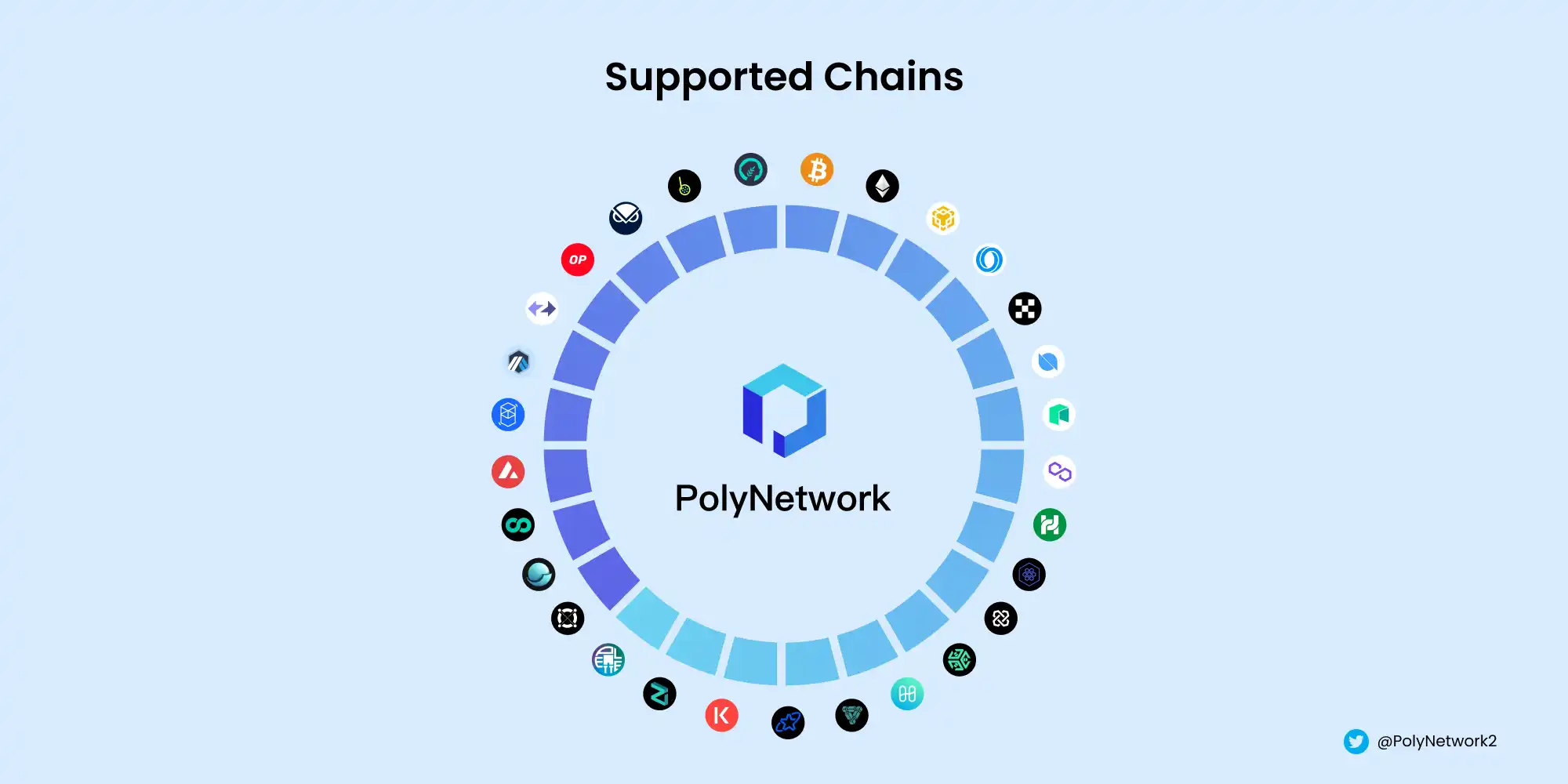
The main body of cross-chain will focus on information transfer and interaction, so as to achieve the effect of linkage and even cross-chain expansion. This is also the development trend of cross-chain, which can rapidly expand to support different heterogeneous chains.
In addition, PolyNetwork adopts multi-point external verification design, which reduces the possibility of collective "error" and is theoretically more reliable than single point verification.
2. Expanded to nearly 30 chains, and total cross-chain assets exceeded $16.2 billion
For the products of the same track, the influence of historical first-mover advantage and in-circuit word-of-mouth certification is quite obvious.
As an established cross-chain product launched on mainnet in August 2020, as of June 17, 2022, Poly Network has realized nearly 30 mainstream heterogeneous blockchain exchanges including bitcoin, Ethereum, BNB Chain, Neo, Arbitrum, Metis, Optimism, etc. In about two years, the total amount of cross-chain assets exceeds 16.2 billion, and the number of cross-chain addresses exceeds 360,000. Total lock-up volume (TVL) once exceeded $1 billion.

Celer Network, also in the first tier, has cBridge cross-chain assets of about $8.7 billion and 180,000 cross-chain addresses. However, it supports 33 blockchain networks, slightly higher than Poly Network.
3. Test the market
At the same time, the cross-chain track, which is just needed by the industry, has actually experienced round after round of security doubts in the past year, and has become the hardest hit area of hacking incidents:
On February 2, 2022, Wormhole, a cross-chain bridge for multi-chain ecology, including Solana and Terra, was hacked and 120,000 ETH (about $326m) were stolen. On March 29, NFT game Axie Infinity side chain Ronin Network discovered that Sky Mavis' Ronin validator node and Axie DAO validator node were hacked on March 23. Resulting in the theft of 173,600 ETH (worth more than $600m) and 25.5m USDC in two transactions;
The Poly Network main Network was also attacked by hackers on August 11 last year, and was finally properly resolved, without loss of user assets, and its robustness in the face of sudden risks was tested.
Now it will be a year, Poly Networks & NBSP; Not only has TVL maintained its daily activity, but also remained stable and stood the test of the market when the secondary market was in a downturn.
3. How to reduce users' "cross-chain feeling"?
In fact, the best cross-chain service is to let users "cross the chain without knowing it" and reduce the "cross-chain feeling" of users -- whether from the perspective of user operation or developer access, the smoother the experience, the more competitive it will be.
Because cross-chain services are a "black box" from a user experience perspective: most users don't care much about the underlying architecture of cross-chain protocols and just want to be able to move their assets quickly, cheaply, and safely.
So for every cross chain services, how to help the user to achieve seamless, safe transfer of assets, particularly fast enough to ensure that across the chain, more than enough liquidity across the chain, support chain between assets exchange, one key from the user need to set aside each strand Gas Fee assets obstacles, safe enough, and so on a series of experience on the optimization, Is the key to the differentiation competition with massive cross-chain products.
Still in & have spent Taking Poly Network as an example, based on the above perspectives, we will simply analyze its current differentiated competitive advantages in cross-chain services.
1. Assets on nearly 30 chains cross the chain arbitrarily
The most direct is the number of blockchain access, which directly determines users' service experience -- the more comprehensive the access chain, especially the mainstream chain, is, the more convenient it is for users, and the lower the sense of cross-chain will be.
While & have spent Poly Network Since the launch of the main network in August 2020, nearly 30 mainstream heterogeneous blockchains have been interconnected, covering the vast majority of mainstream blockchain networks, and users' common cross-chain needs can be almost met.
This ensures that ordinary users can cross any chain of assets in the rich cross-chain services according to their own needs, and can directly exchange almost all assets on the commonly used chain without feeling and instantly.
2. Fast access to any new links
If having access to nearly 30 chains is an existing competitive advantage, the anticipation of new links in the future is the key to ensuring cross-chain service advantage.
The heterogeneous chain cross-chain design of Poly Network can get through the mainstream public chain from the protocol layer, and even the communication and transaction between different heterogeneous chains. This means that in addition to EVM compatible networks such as BNB Chain and Polygon, Poly Network can also be implemented across non-EVM compatible chains such as Neo, Elrond, Ontology and COSMs-SDK. This reserves enough space for the future to access the new public chain at any time, so that flexible adjustment and fast access to the new chain can be realized.
3. NFT seamless cross chain
At present, in addition to its own identity, community IP, etc., NFT also plays a key role of props and equipment in the chain game and meta-universe by virtue of its non-homogeneity of asset attributes. Therefore, cross-chain NFT is also the basic requirement of the future multi-chain meta-universe.
In 2021, Poly Network launched its own NFT cross-chain Bridge to facilitate efficient flow of NFT across heterogeneous blockchains with better liquidity and lower fees as the NFT market became increasingly active
On April 6, Poly Network launched the New Poly Bridge, which supports NFT standards such as ERC-721 and ERC-1155, as well as OpenSea apis. The Poly NFT Bridge currently supports seamless cross-chain transactions between users and project partners across more than 20 public chains.
4. Interoperability as a service
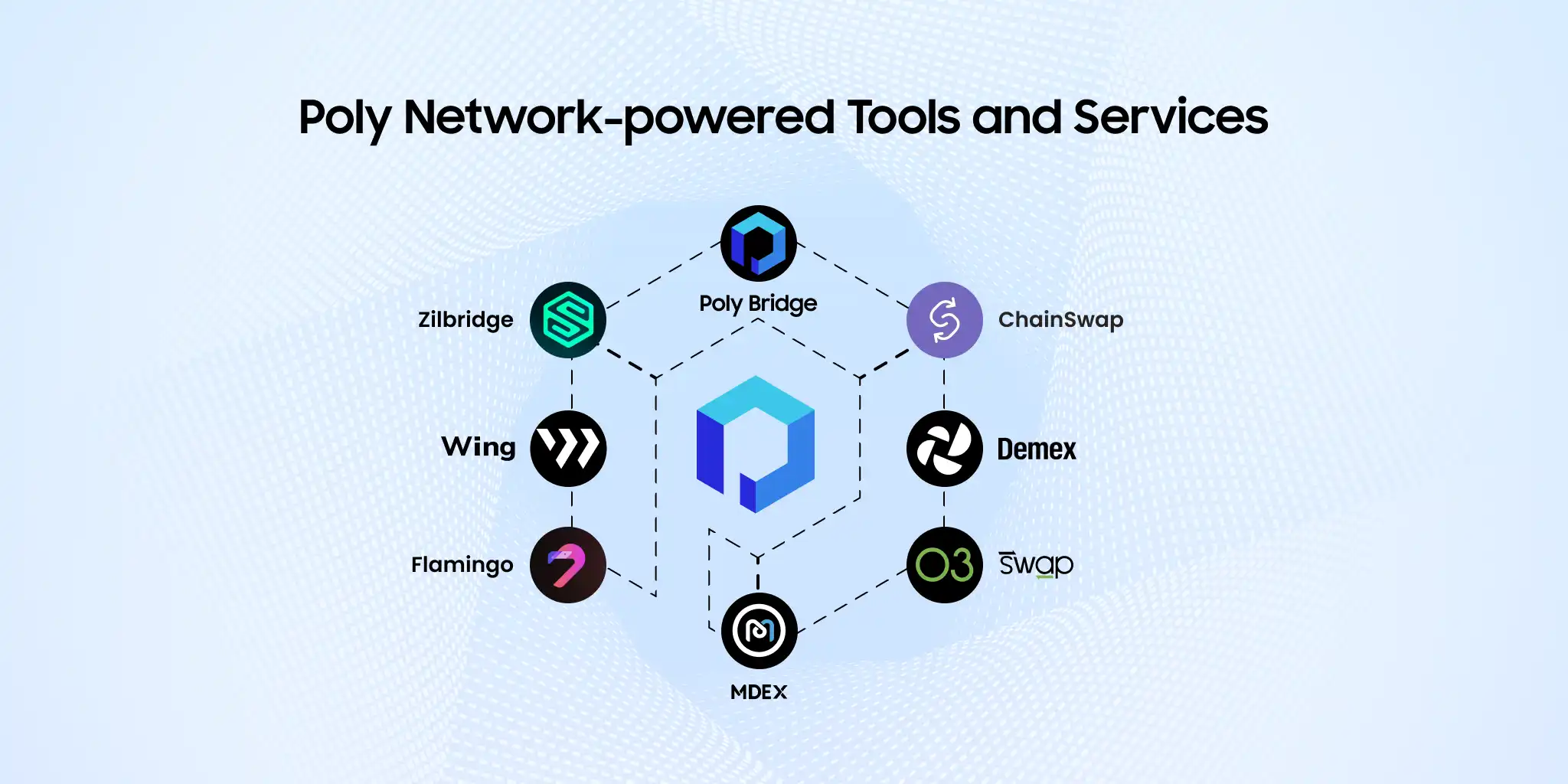
In addition, Poly Network has launched a developer-friendly cross-chain development framework that encapsulates interoperability as AN API service and is now available to the publicTechnical documentation.
Just like EVM-compatible BNB Chain (the original BNB Smart Chain), it provides developers with as convenient access as possible in the early stage of ecological startup, and promotes the subsequent ecological translation to undertake the stock development resources, so as to realize the rapid rise.
The systematic development framework of Poly Network also has similar positioning, technical documentation and unified API interface, which is equivalent to the universal cross-chain development template of Poly Network, with which developers can quickly build complete cross-chain services and conveniently access the Poly Network ecosystem.
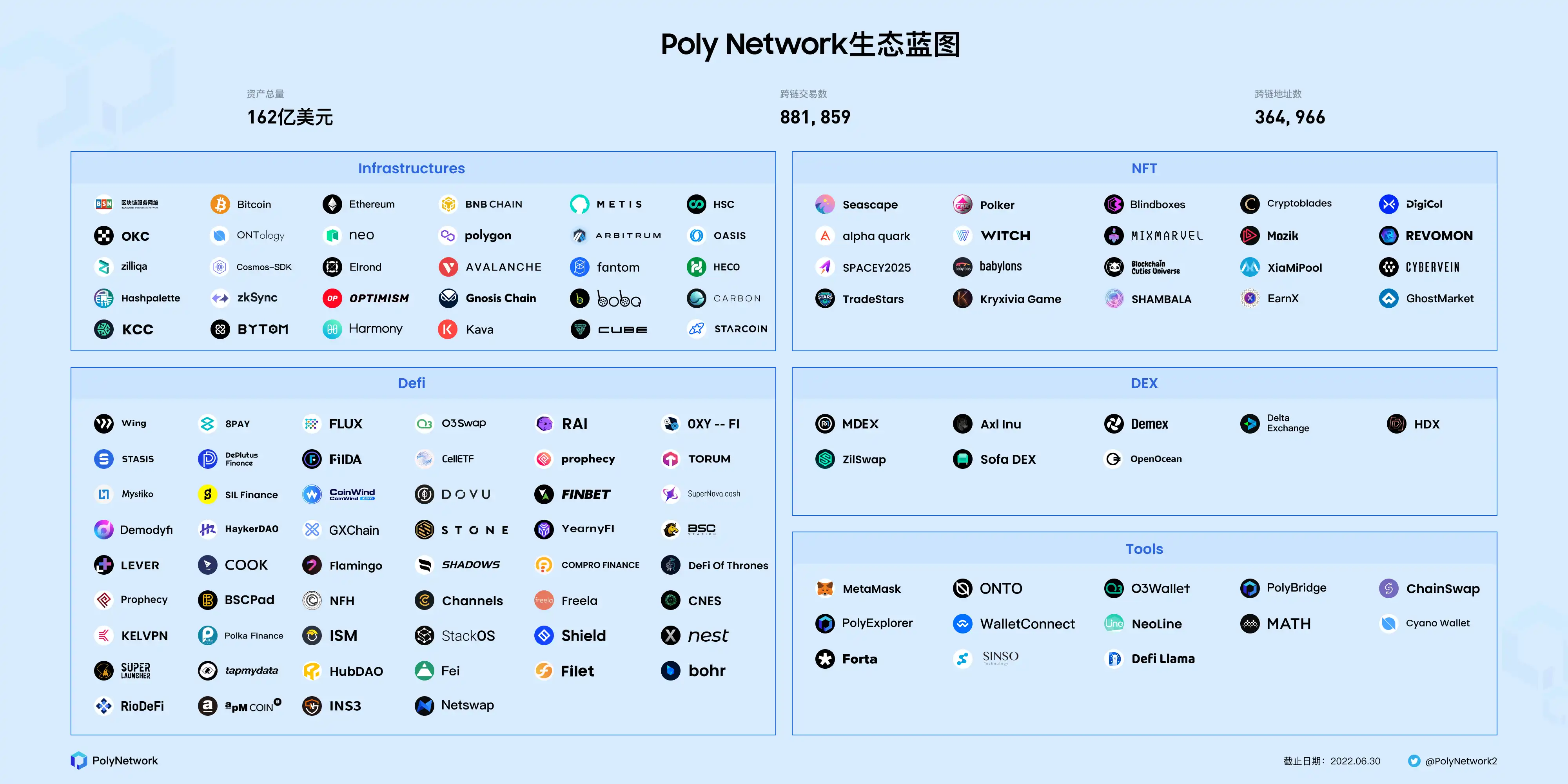
Based on the complete and low-threshold Poly Network underlying infrastructure, developers can create Poly Network side chains and develop rich DApps with very low learning costs, so as to quickly access the Poly Network ecosystem and achieve synergies between mobility and dApp products.
In short, Poly Network provides a systematic development framework for developers at all levels, including infrastructure, smart contracts and applications, and integrates the global developer community to build Poly Network ecosystem.
The second half of the cross-chain narrative
For example, Poly Network's "interoperability as a service" has a greater space for imagination, which not only realizes the free flow of assets across chains, but also provides the possibility of cross-chain transmission and interoperation of dApp information between chains. Dapps like Aave and Instadapp, for example, can easily allow users to transfer their mortgage funds from different blockchain networks, allowing developers to easily build their own use cases.
In addition to providing real-time price data for DeFi projects and random numbers for games and NFT projects, like ChainLink, We are also actively exploring providing reliable signaling channels and asset transfers to different dApps (such as ChainLink's CCIP).
Therefore, cross-chain subjects are focused on cross-chain information transfer interaction between different DApps, so as to achieve linkage and even cross-chain interoperability. This is also the next development trend of cross-chain, and Poly Network's "interoperability is service" may also mean this.
In general, the consensus of the crypto world in the future is bound to become increasingly fragmented and diversified. Specifically, there will not be a monopoly of one or a few companies on the public chain, but at most there will be a super strong equilibrium situation, which is destined to be a long-term and fierce war between the public chain and the industry ceiling preset in advance.
Therefore, in the current multi-chain era, cross-chain bridge is just needed and has been developing in controversy. Although there is no optimal solution yet, it is also developing in the direction of safer, more interconnected, faster, more capital efficient, more cost-effective and resistant to censorship.
Whether cross-chain solutions like Poly Network and Celer, which aim to become the largest "water seller" in the multi-chain world, will be one of the ultimate solutions still needs to be tested by practice and market. Let's wait and see.
This article is submitted and does not represent the views of BlockBeats
Welcome to join the official BlockBeats community:
Telegram Subscription Group: https://t.me/theblockbeats
Telegram Discussion Group: https://t.me/BlockBeats_App
Official Twitter Account: https://twitter.com/BlockBeatsAsia

 Related Articles