Comprehensive analysis of the cross-chain track under the multi-chain pattern
Original title: "Panoramic analysis of the cross-chain track under the multi-chain pattern"
Original author: @jesse_meta
One, one super multi-chain future
At the beginning of 2020, Ethereum’s fees are still friendly to most DeFi users. However, with the rapid development of the Ethereum ecosystem in DeFi Summer, the rapid growth of TVL and new users has also led to an increase in the gas fee for contract interaction, which discourages new users with less capital. Ethereum's limited transaction speed and block generation speed also limit the efficiency of interaction. This has also led investors and developers to start looking for cheaper and faster Ethereum alternatives to undertake value spillovers. From the data in Figure 1, we can intuitively see that Ethereum’s TVL’s TVL share in the entire market continues to decline (excluding the impact of the Terra crash in mid-May).

Figure 1: All public chain TVL data sources Defilama
According to the data of Blockchain-Comparison.com, as of May 14, 2022, there are already 115 Layer 1 public chains in the market. For some users, low transaction fees are the most important consideration, and decentralization is not necessarily important. This gives the Layer1 public chain an opportunity to support EVM. According to Defillma's data, BSC, Avalanche, and Fantom are the top-ranked major EVM public chains, with a large amount of funds locked. As far as the EVM public chain market is concerned, EVM Layer1 public chains other than Ethereum will grab about 25% of Ethereum's share between January and May 2021. However, it can be seen from Figure 2 that Ethereum's market share has remained at around 75% since May 2021, and its leading position in the market is solid.
Figure 2: Comparison of Ethereum TVL and EVM Layer 1 TVL. Data source Defilama
According to the data of defillama, the ratio of TVL of Non EVM Layer1/(TVL of Ethereum+TVL of Non EVM Layer1) will increase from 24 in February 2022 % rises to 30% on May 3rd, 2022 (due to the collapse of Terra's algorithmic stablecoin, it drops to 16.8% as of May 14th). Non EVM chains such as Solana and Near have seen significant TVL growth with capital support, and low Gas fees have attracted a large number of new users outside the circle and old Ethereum users who cannot afford high fees.
According to l2beat's data, Layer2's TVL increased from US$890 million on May 3, 2021 to US$5.99 billion on May 2, 2022, an increase of increased by 6.7 times. Ethereum’s TVL only increased from $90 billion to $110 billion over the same period. With the Token incentive plan of Optimism, the continuous improvement of Arbitrum, Zksync and StarkNet ecology, the TVL of Layer 2 will continue to increase.
Figure 3 Layer 2 TVL data source: L2beat
From the above data, it can be seen that due to the pain points of high Ethereum Gas fees and slow speed that cannot be solved in the short term, the major Layer1 public chains and Layer2 have gained value overflow. Ethereum's biggest moat is its TVL of 110 billion US dollars. Important native lending platforms stick to their base camps. The status of large liquidity pools cannot be shaken in the short term. Ethereum will still be the first choice for outstanding developers. For a long time Li will still be the largest public chain, taking on the role of the blockchain world data settlement layer and consensus layer. Other public chains will seize this opportunity, combine their own mechanisms, and develop into unique application-specific blockchains to seize part of the market share. For example, Terra and Kava have developed into financial chains, Avalanche and WAX are deeply involved in games, Flow and Immutable focus on the NFT field, and Aztec and Oasis provide privacy options. The huge demand of users for Metaverse has provided a large enough market, and the future will be a multi-chain pattern where a hundred flowers bloom.
Second, cross-chain requirements and cross-chain concepts under the multi-chain structure
Major Due to its high valuation ceiling, the chain has won the investment of major institutions, and the ecology has achieved great development in the past year. However, due to technical and competitive reasons, most public chains cannot directly communicate with each other, making users, assets, data and Dapp scattered in their respective ecosystems, like a stand-alone computer, forming an island effect. This is contrary to the spirit of blockchain interoperability and scalability.
Under this circumstance, the cross-chain needs of blockchain aborigines began to awaken, thinking about the feasibility of interaction between blockchains.
Cross-chain and cross-layer
We must first clarify the definition of cross-chain and cross-layer and difference.
Cross-chain refers to the transfer of messages between different blockchains. Different chains have different ledgers and accounting units. The accounts recorded by the side chain will not be reported to the main chain. The side chain only communicates with the main chain when a cross-chain occurs.
Cross-layer refers to the transfer of information between Layer1 and Layer2. Cross-layer refers to the change of the accounting place under the same set of ledgers. Layer2 is the same as its Layer1 accounting unit, and the account will be regularly notified to the main chain.
However, in actual operation, many users ignore the conceptual distinction and classify cross-layer as cross-chain.
Classification of cross-chain specific behavior
User cross-chain behavior can be divided into narrow cross-chain behavior Chain behavior and generalized cross-chain behavior. Narrowly defined cross-chain behavior refers to token cross-chain (token exchange, token transfer), and broadly defined cross-chain behavior refers to message cross-chain.
Narrowly defined cross-chain behavior
- Token exchange
Each public chain has a native token as a value carrier, and users can exchange tokens within the chain. Before the birth of the cross-chain bridge, users could only exchange cross-chain tokens through a centralized trading platform. For example, if Alice wants to exchange BTC for ETH, she needs to recharge BTC to the centralized trading platform, convert it into ETH, and then mention it on the Ethereum chain.
With the atomic swap technology of hash time lock, Alice can directly perform decentralized token exchange on the chain, and exchange BTC for ETH. Inter-chain token exchange is an important prerequisite for blockchain to realize the Internet of Value.
-Token transfer
The public chains are closed, one chain Native assets cannot be passed directly to another chain. With the help of cross-chain bridge technology, users lock the original assets on the source chain, and issue equivalent mapping assets on the target chain to realize the transfer of tokens. A typical example is wrapped BTC on Ethereum.
Both token exchange and token transfer solve the pain point that value cannot be exchanged between chains. In addition, token transfer makes DeFi more open. For example, encapsulated BTC implements DeFi applications on other public chains, transfers DAI to a faster, cheaper, and higher-yielding Venus for mining, and transfers ETH to the Oasis chain to seek transaction privacy.
Generalized Cross-chain Behavior
Message Cross-chain
The message here refers to any complex cross-chain requirements raised by users.
The essence of cross-chain behavior is a combination of a series of message passing. Through cross-chain information transfer, chain A can read the state and information of chain B, and use the state and information of chain B as the trigger condition for execution. For example, token transfer is completed by two cross-chain messages. The first is to lock the position on the A chain and transmit the locked position information to the B chain. After the B chain verifies the authenticity of the message, it casts the mapped token, and then feeds this state information back to the A chain.
Through cross-chain information transmission, chains are no longer closed, and one chain can read and verify the information and status of another chain to realize cross-chain lending The combination of cross-chain NFT, cross-chain aggregation, cross-chain governance, and cross-chain derivatives makes the vision of blockchain as a value Internet possible.
Third, important cross-chain message transmission protocol
What we learned in the previous chapter The essence of cross-chain behavior is message transmission between chains. In this chapter, we will learn more about how several important cross-chain information transmission protocols in the market realize information transmission.
The Inter-Blockchain Communication protocol (IBC)
If we say that Ethereum is a super computer, then Cosmos is a blockchain Internet that connects independent servers into a network. Cosmos itself is not a blockchain, but an underlying protocol for designing application-specific blockchains (called Zones).
Cosmos consists of three major components: Tendermint consensus protocol, Cosmos SDK and The Inter-Blockchain Communication protocol (IBC).
Cosmos SDK (Software Development Kit) provides the basic functional modules of the blockchain such as pledge, governance, and Token distribution, which reduces the cost of repeated development for users and focuses on the development of application-specific chains.
Figure 4 Cosmos SDK module
As can be seen from the figure above, IBC is actually an important module of the SDK. Each chain in the Cosmos ecosystem can perform interchain interoperability through IBC for reliable and orderly transfer of tokens, proof of cross-chain data availability, and shared security. As shown in Figure 5, between Hub1 and Hub2, the Hub communicates with the application-specific blockchain (Zone) through the IBC protocol.
Figure 5 The structure of Cosmos Hub and Zone
It should be pointed out that the blockchain must have fast finality (transactions are packaged quickly and can be tampered with) in order to be compatible with IBC. The Bitcoin and Ethereum proof-of-work chains are not suitable for the IBC communication protocol. Such blockchains communicate between chains through Peg-Zones and Cosmos. This article is limited by length and will not be expanded.
The specific working mode of IBC. The blockchains that communicate with each other run lightweight clients to receive the block header of the other chain and track the verification set of the other chain. When blockchain A transfers tokens to blockchain B, it must be pledged in blockchain A first, and the pledge certificate must be sent to blockchain B. Blockchain B verifies the proof based on the block header of blockchain A. After the confirmation is correct, the token on chain A will be locked, and a mapping token will be established on chain B. When the pass is returned to blockchain A, a similar mechanism is used to unlock the pass.
LayerZero
LayerZero wants to solve the pain points of the intermediate chain and IBC and connect each chain Every smart contract on .
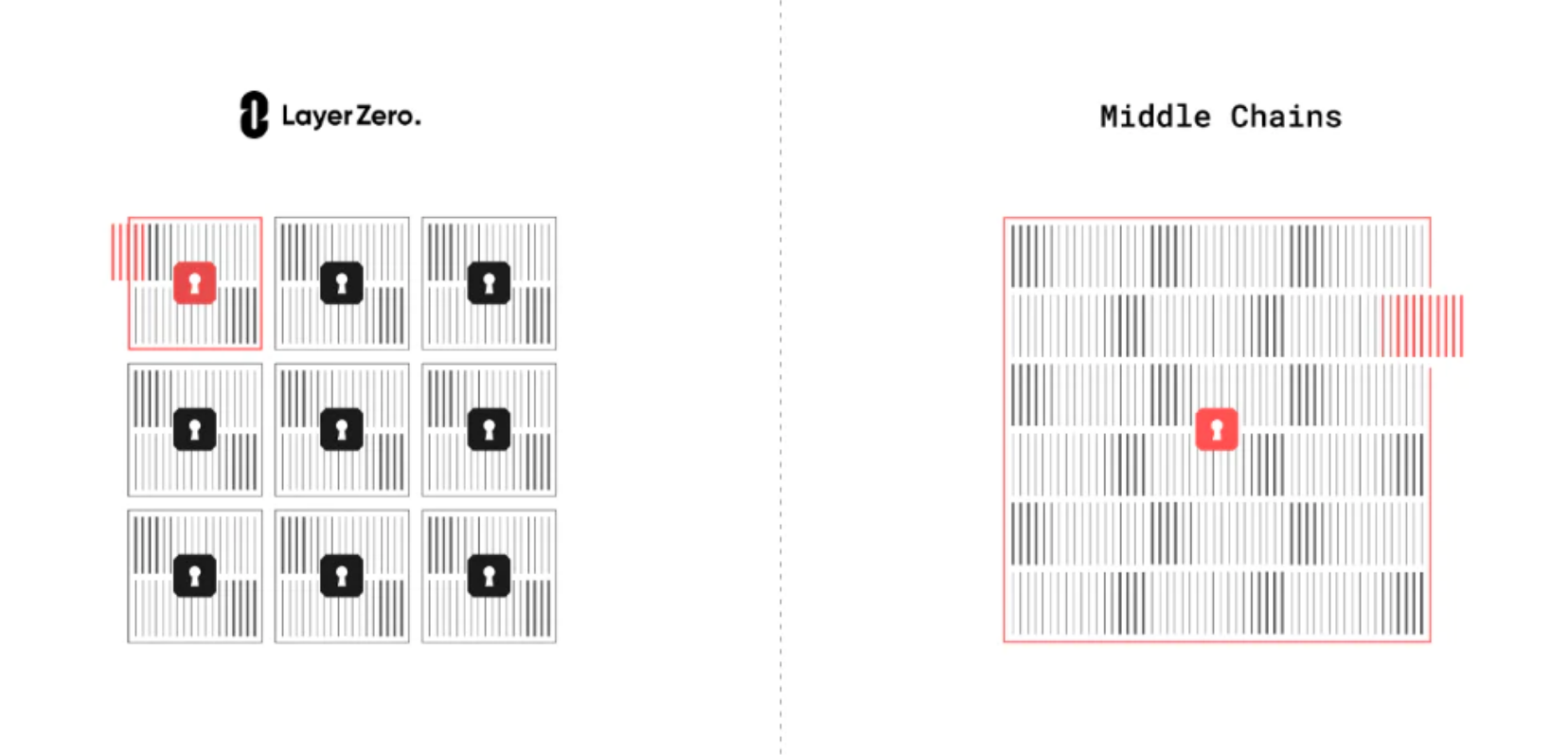
The intermediate chain has the signature authorization of all information between the chains, and it is only a matter of time before it is attacked by a single point. Cross-chain fees are cheap but not secure.
Through the transport layer of Cosmos IBC to connect Ethereum and other EVM-based blockchains, although it is safer than the intermediate chain, the cost is relatively high, which limits the use of IBC used by the transport layer. In addition, it has been mentioned above that the IBC transport layer only allows direct communication between blockchains with fast finality.
LayerZero is a message transmission layer for smart contracts to communicate between blockchains, through oracle (Oracle) and relay (Relayer) To complete asset transfer and ensure security, it can seamlessly cooperate with deterministic and probabilistic transactions, allowing applications to have a community-driven cheaper and faster full-chain communication standard.
So, how does LayerZero realize this vision?
LayerZero introduces an ultra-light node (hereinafter referred to as ULN), by performing the same verification method as the light node on the chain (to ensure security), the block header is changed to On-demand streaming by decentralized oracle machines (rather than keeping all block headers in order, reducing fees) achieves both safe and cheap effects. LayerZero is an on-chain terminal configurable by user programs, that is, a communication point deployed on each chain (equivalent to a broadcast station in each village). It relies on independent oracles and relays for inter-chain information transfer.
When the user program wants to send information from blockchain A to blockchain B, the information is sent by the terminal of blockchain A (LayerZero) to notify the user The oracle of the program (notifies part of the information), the repeater (notifies all the information). The oracle machine forwards the block header to the terminal of blockchain B (ie, LayerZero), and the relayer then submits the transaction proof. After the transaction proof is verified in the blockchain B chain, the information is forwarded to the destination address.
Figure 6 LayerZero message transmission process
Adding an independent repeater system on the basis of the existing oracle machine increases the safety factor (because the repeater can make the blockchain B verify the occurrence of blockchain A again things). It is not easy to beat Chainlink DON. Even if the oracle is compromised, there is still repeater verification. The worst case is that oracle A and repeater A collude, and all risks are only borne by user programs that receive oracle A and repeater A, and user programs that use other repeaters or oracle machines will not be affected. Influence. (The entire system will collapse after the intermediate chain solution is attacked by a single point) Applications can choose their own trusted oracle machines and establish their own repeaters. Currently chainlink is used as an oracle by default.
Figure 7 LazyZero's multi-point configuration and intermediate chain single-point configuration
Celer cross-chain message framework
The newly launched Celer Inter-chain Message Framework (Celer Inter-chain Message, hereinafter referred to as Celer IM) at the end of April is a cross-chain infrastructure , a cross-chain application development framework for developers. Celer IM SDK is developer friendly, plug and play. Applications that have been independently deployed on multiple chains can use a simple contract plug-in to transform the original DApp into a native cross-chain DApp. For all applications inserted into Celer IM, users can stay on one chain to achieve cross-chain interoperability with one click, eliminating the need for complex blockchain switching jumps.
The overall structure of Celer IM mainly has two parts, one part is The Message Bus smart contract on the chain, this part acts as a "receiving and receiving mailbox", and the other part is the State Guardian Network (hereinafter referred to as SGN), which is the "messenger" that links each chain and transmits information. SGN itself is a POS chain based on Cosmos tendermint. Nodes need to pledge CELRToken to join this POS chain as part of the consensus process.
In Celer IM, users no longer directly interact with the existing smart contract of dApp, but interact with the new dApp Plug-in contract (marked in Figure 8 A), to express the cross-chain logic you want to execute. This is also usually the only transaction issued by a user to interact with this cross-chain dApp. This dApp Plug-in becomes part of the entire dApp business logic and interacts with the existing smart contracts of the dApp on the source chain. The dApp Plug-in sends the user's cross-chain request to the "outbox" smart contract Message Bus on the source chain in the form of a message. This "outbox" smart contract will be monitored by SGN, and all verification nodes will reach a consensus on "whether the message exists" and generate a weighted multi-signature certificate at the same time. Then, this proof is stored on the SGN chain, waiting for the Executor subscribing to the message to relay to the Message Bus on the target chain. This "inbox" contract will verify the validity of the message, and deliver the message to the recipient contract of the dApp in the target chain on the target chain. The dApp that receives the message will execute the corresponding logic or task according to the message.
Figure 8 Celer IM message transmission process< p>The security of the Celer message cross-chain framework depends on SGN. The security model provided by SGN is similar to Cosmos, Polygon and other Tendermint-based L1 blockchains. As long as there is a node doing evil, this node will be eliminated by the de-cross-chain consensus protocol that has been verified countless times in actual combat, and it will suffer huge loss of deposit. This is more secure than other multi-sig solutions like LayerZero because there are no financial penalties for malicious behavior. Celer IM's SGN-based security model is the most lightweight security model, running fast, and the consensus algorithm that SGN relies on has already guarded hundreds of billions of assets in other blockchains today.
What if the majority of pledged nodes do evil? The probability of this event itself is relatively small. Celer IM also uses a second security model similar to the Optimistic Rollup design to prevent black swan events in extreme cases. This mechanism enforces a period of "quarantine" for each cross-chain message. When a cross-chain message reaches the target chain through SGN, the message will not be immediately sent to the relevant application to execute the corresponding logic, but will be isolated for a period of time. During the isolation period, the developer of the application, as well as the operator of each SGN node, can go to the source chain for verification. This mode uses additional isolation delays for a stronger trust-any security model. As long as one of all SGN nodes and monitoring nodes running applications is still running normally, the entire system is still safe. In practical applications, Celer's cross-chain bridge cBridge combines the use of two security models. For small transfers, it relies on SGN to execute immediately, and for large transfers, it executes through this mandatory isolation period. We will introduce the technical principles of Cbridge in detail below.
From the introduction above, we can know that layerZero is a simple message cross-chain layer, which crosses messages from chain A to chain B. Celer IM has an intelligent message delivery layer. In the process of sending a message from chain A to chain B, it will pass through the SGN chain. SGN performs comprehensive calculation and conversion based on information on itself and other chains, and puts it into the target chain. perform more complex operations. For example, in ChainHop, a cross-chain decentralized trading platform based on Celer IM, the price function for calculating prices occurs entirely on SGN. Because SGN has the most direct real-time grasp of the liquidity available on each chain, SGN can monitor and adjust it to achieve more powerful applications than simple cross-chain messaging.
The above are the three more important cross-chain message transmission protocols. We mentioned above that the essence of cross-chain behavior is a combination of a series of message passing. Next, let’s talk about how to realize the token cross-chain that is often carried out in the cross-chain process.
Fourth, Token cross-chain solution
-centralized transaction Platform, this is the cross-chain solution with the highest security, and there is no worries after the cross-chain is completed. However, there will be problems such as centralized management, exposure of user privacy, limited number of supported public chains, and cumbersome operations.
-official cross-chain bridge, such as Avalanche’s Avalanche-Ethereum Bridge (AEB), Solana’s Wormhole, NEAR’s Rainbow Bridge, This type of bridge is relatively safe under the protection of relevant security mechanisms, but it is more expensive than third-party cross-chain bridges, and it is not so convenient to use. For example, if Arbitrum's assets are returned to Ethereum, it will take a seven-day waiting period if the official bridge is used.
-Specialized asset type bridge, the original Token of the public chain without smart contract function or smart contract compatibility (such as BTC, Dogecoin, Zcash) cross-chain to the public chain with smart contract functions to realize DeFi applications. Protocols that focus on this aspect include BitGo, Ren Protocol, Keep Network, etc., but such cross-chain bridges have the risk of centralized management.
-Third-party cross-chain bridge, which specializes in providing cross-chain services for tokens, with low handling fees, fast speed, and supported tokens many. But the level of security they offer varies. The projects on this track include Celer Network, Hop Protocol, Multichain, Synapse Protocol, etc.
-Cross-chain bridge aggregator, aggregates mainstream cross-chain bridges, and helps users recommend the best cross-chain bridge according to user needs Chain bridge scheme. (defieye's cross-chain tool can help users find the lowest-cost cross-chain solution among mainstream cross-chain bridge projects)
Types of third-party cross-chain bridges
Types of third-party cross-chain bridges
In the third-party cross-chain bridge token cross-chain solution, the subdivision field that attracts the most attention from capital is also the most used tool by users. Let's take a look at the main types of third-party cross-chain bridges.
Atomic Swap Based on Hash Timelock
< p>Hash time lock is a cryptographic method, and users use hash locks to realize the atomicity of transactions. The steps are as follows:
1. User A generates a random password r, and calculates the hash value m=hash(r) of r, and sends the m value to User B.
At the same time, user A initiates a transaction to transfer 1 BTC to user B. The condition for the success of the transaction is that user B needs to be within the preset time Show the password r, otherwise the transaction will automatically fail.
2. After seeing the transaction initiated by A, user B transfers 10 ETH to user A. The condition for the success of the transaction is that user A needs to be in the preset Present r within the time to succeed, otherwise the transaction will automatically fail.
Note: The hash operation is irreversible, knowing m cannot deduce r. But user B only needs to know m to create a transaction whose success condition is to present r value. After user A presents the value, the contract calculates whether the hash value matches m, which can verify whether A really has the r value.
3. After user A sees the transaction initiated by B, he presents the r value, making the transaction initiated by B successful, and obtains 10 ETH transferred by B, r value was disclosed.
4. User B also obtained the r value presented by A in the previous step, making the transaction initiated by A successful and obtaining 1 BTC transferred by A.
The transactions on the two different chains so far are integrated into one event, either succeeding or failing as a whole. This is considered the safest and most trustless method of token transfer.
This approach has 4 disadvantages.
-If you cannot find a peer-to-peer counterparty, you have to wait, which is less efficient.
-In the actual transaction, the counterparty can choose whether to complete the transaction according to whether the exchange rate is beneficial to itself, which is not suitable for large transactions.
-Due to the complexity of the low-level mechanism, the handling fee is relatively high.
-Only cross-chain token exchange can be realized, but token transfer cannot be realized.
cBridge1.0 uses this method.
Liquidity Aggregation
This type of cross The chain bridge will deploy smart contracts on multiple blockchains, incentivize users to provide liquidity in these smart contracts, and then deploy funds according to actual needs.
This type of cross-chain bridge avoids the disadvantages of liquidity fragmentation under the atomic swap method, with low capital costs and high cross-chain efficiency. The key factors for its success are: decentralization of asset management rights, efficient balance of funds in each chain, and sufficient liquidity.
The potential risks lie in whether the cross-chain bridge can always maintain control over assets, and whether there will be loopholes in the smart contracts on each chain.
Locking + Minting
In source chain After the specified smart contract locks the original pass, the synthetic Token is minted on the target chain. This cross-chain bridge method is mainly used for token transfer. Examples of applications include $WBTC and $WETH.
Let’s take a look at the pass pass process:
1. The user sends the pass to the cross-chain bridge’s contract on the source chain , inform the contract of its receiving address in the target chain.
2. After the verifier on the target chain verifies this information, the token will be minted at the receiving address on the user's target chain to complete the pass transfer.
3. To send the passed pass from the target chain back to the source chain, the user will send the mapped pass to the contract of the cross-chain bridge in the target chain , inform the wallet address of the source chain.
4. The verifier on the target chain destroys the mapping token, the cross-chain bridge unlocks the token locked on the source chain, and sends it to the user's wallet address.
The security of this model relies on network validators. If the verification node is malicious or too centralized to be controlled by hackers, it will cause serious economic losses.
Analysis of typical cross-chain bridge
Gravity Bridge
Specially built for the Cosmos ecology, the neutral bridge connecting Ethereum and the blockchain based on the Cosmos SDK fills the gap that the Cosmos ecology cannot communicate with the POW chain . Gravity Bridge creates non-upgradeable Solidity contracts that cannot be tampered with by any malicious actor. The user locks the pass in Ethereum, uses the validator set to sign the transaction, and mints the mapping pass on any blockchain in the Cosmos ecosystem (such as Cosmos, Osmosis, Stargaze, etc.), such as $wBTC, $wETH, $DAI, $USDC. These tokens can be used on Cosmos dapps such as Akash Network, Sentinel, Regen, Osmosis. Similarly, tokens in the Cosmos ecosystem can also be transferred to Ethereum for DeFi mining.
Why use Gravity Bridge?
-Security. An advanced slashing mechanism ensures that validators cannot sign or submit bridged messages that have not been agreed upon by consensus. The Cosmos ecology has active validator nodes, and each validator must pledge valuable collateral, and any malicious node will be punished financially. Anyone can slash validators by submitting signature proofs via non-protocol messages. Node staking is permissionless and uncensorable. Every validator attests to every deposit event that happens in Ethereum.
- Unmanaged. There is no third-party manager to manage the funds. When the token crosses the chain, you only need to trust the security of Ethereum and Cosmos, and the security of the two is beyond doubt.
- Interoperable. For a long time, BNB was the only token that existed both in the Ethereum and Cosmos ecology. It was not until the Gravity Bridge was opened that the applications on the Cosmos ecology were opened to users on Ethereum.
- Neutral. The validator set controls the bridge, and the focus of the Gravity community is to ensure the safety and efficiency of the cross-chain bridge, rather than the DeFi application of the local chain, which brings together multiple blockchains and liquidity.
- Low fees. Gravity fetches transactions in batches, combining multiple messages in a single batch, reducing gas costs by 96%.
Stargate
Stargate is the first protocol built on LayerZero that enables users to safely , Quickly transfer and exchange native tokens between blockchains conveniently.
Currently, most of the cross-chain bridges that map tokens on the market cannot support inter-chain interoperability, cannot interact with the smart contracts of the target chain, and have high transaction costs , the cross-chain time is long, resulting in poor user experience.
Stargate innovatively solves the impossible triangle problem of cross-chain transfer:
-Instant transaction confirmation: Instantly confirm the source chain and Token transfer of the target chain.
-Unified liquidity: For the same currency, different blockchains share one liquidity.
-Cross-chain of native tokens: There is no mapped token, and all interactive tokens are native tokens.
LayerZero helps Stargate achieve cross-chain messaging, completes instant transaction confirmation with one click, and has a good user experience. The specific principles have been mentioned above.
Stargate uses its own Delta algorithm to solve the problems of unified liquidity and native token cross-chain. For the same token, all chains use a unified liquidity pool, and each chain can access the liquidity of other chains. The Delta algorithm is a balance algorithm that supports the native Token pool. It manages liquidity with a "soft partition" method to prevent multiple simultaneous transactions from running on the liquidity pool. For example, in a network consisting of chains X, Y, and Z, the $100 of liquidity available on chain X is simulated split into $50 on chain Y and $50 on chain Z. The Delta algorithm monitors the "virtual balance sheet" of each chain, allowing users to borrow and repay on different chains as long as liquidity is not overdrawn. However, when the partition balance drops below the initial value, "arrears" occur. When a transfer request from source chain A to target chain B occurs, the tokens deposited in source chain A will first fill the "arrears" on A, and the remaining funds will be distributed among all pools according to the weight.
Stargate is a star project in the cross-chain bridge, and has received investment from many first-line institutions such as FTX, A16Z, Sequoia, Binance, and Coinbase. Within 10 days of going online, there are nearly 4 billion TVL, ranking 11th among all protocols. (ranked 18th on May 14th)
It is worth noting that Stargate uses a 2/3 multi-signature mechanism with fewer verification nodes. It will encounter the risk of management key attack similar to Ronin Network.
cBridge 2.0
cBridge is built on The cross-chain bridge on Celer IM, State Guardian Network (SGN) is the core component of Celer IM. It is a PoS chain based on Tendermint, which is used to monitor events on the chain. Its security is higher than that of multi-signature or Private key sharding.
SGN as the arbiter of cBridge node gateway
In 1.0, cBridge uses centralized Gateway to quickly learn the operation experience of various scheduling strategies, and provide users with "for reference only" suggestions to use cBridge nodes. However, if the node goes offline before the cross-chain is completed, the node will not be punished, and the user will not be compensated for waiting.
Version 2.0 uses SGN for decentralization and efficient cBridge node scheduling to solve the problems of 1.0. cBridge nodes register with SGN based on their fee preferences, available liquidity, etc., and no longer register with centralized gateway services.
The process when the user makes a cross-chain request:
-The user queries the current status of SGN , to get estimated transaction fees and available liquidity.
- If the user accepts the estimated fee, send the first half of the hashed timelock contract transfer and limit the maximum acceptable fee.
-SGN monitors and receives transactions. It assigns one or more cBridge registered nodes for transactions according to node scheduling rules. This transaction allocation is recorded on the SGN chain and in the user's hash timelock contract transfer.
- The allocated node accepts the allocation and responds by completing the remaining conditional transfers.
-SGN continues to monitor and track the transaction, until the transaction is completed, the state related to this transaction will be cleared from the SGN chain. If the node goes offline without completing the transfer, SGN can confiscate its deposit as compensation for the decline in user experience and the opportunity cost of liquidity.
In addition, cBridge 2.0 also built a "node quality score" formula, which refers to factors such as node cost, response time, and success rate. Based on this score, nodes are prioritized to improve user experience.
The above is the design scheme provided by cBridge2.0 for self-hosted LPs that run their own nodes.
SGN as a shared liquidity pool manager
Most LPs and users want to provide Mobility but don't want to run cBridge nodes myself. In cBridge 2.0, the decentralized SGN manages shared liquidity pool contracts on multiple chains. LP regards SGN and the liquidity it manages as a single node, and provides liquidity acquisition fees to it without running the node itself.
So, is it safe to use SGN as a single point shared liquidity pool manager? First of all, SGN adopts the PoS consensus, and the transfer of tokens requires CELR pledge-weighted multi-signatures. Only when more than two-thirds of the total equity nodes are malicious, the fund pool will be at risk. With the increase in the number of cBridge cross-chain transactions and the growth of the cBridge network value, the cost and value of nodes doing evil will increase accordingly, which is one of the highest level security solutions at present. This is fundamentally different from other solutions that use multi-signature or private key sharding in terms of security, because multi-signature verifiers and private key shard holders do not bind Token pledges, and their security cannot grow with the value of the network. In the face of huge economic benefits, multi-signature verifiers or private key fragment holders have the potential risk of private collusion. SGN allows new validators to be elected and join the set of validators through the pledge governance process, no special coordination process is required. However, when the pledged asset is in a market depression, its Token price may drop severely. At this time, the pledged value may be far lower than the liquidity on the cross-chain bridge. Users and project parties should be alert to the potential risk of validators doing evil. However, as mentioned in the Celer IM chapter above, the "test isolation" security model similar to Optimistic Rollup design, for small transfers, it relies on SGN to execute immediately, and for large transfers, it is implemented through this mandatory isolation period. Make sure to double check.
Part of the existing cross-chain bridge solutions require LP to put Token liquidity into the AMM pool on the chain together with another protocol-controlled settlement Token, Such as Thorchain and Hop Protocol. Under this model, liquidity providers still face additional operating costs when adding, removing and rebalancing liquidity across multiple chains. Thorchain requires LP to use the unstable settlement TokenRune, and liquidity providers have the risk of impermanent losses. Hop Protocol needs the bonder to provide liquidity, and the liquidity efficiency is low, because the actual demand for liquidity for cross-chain transfers is twice the necessary liquidity.
When cBridge 2.0 processes cross-chain requests, SGN uses the liquidity of the entire pool to calculate slippage and pricing, and then SGN regards LP as a "virtual cBridge node ”, and distribute cross-chain requests according to the liquidity of LPs. At this point, the LP liquidity balance of the target chain will decrease proportionally to its available liquidity, while the liquidity balance on the source chain will increase. In addition, 2.0 also uses methods such as random sampling and approximation algorithms to minimize state changes and costs, and maintain statistical fairness among LPs. This design allows each LP to clearly see how their liquidity is distributed at any given time. This allows them to fully understand what is going on when they choose to remove or add liquidity to any chain.
In cBridge 2.0, LP directly uses native Token liquidity to avoid impermanent losses. Compared with Hop Protocol, cBridge does not require any additional bonder liquidity locking requirements, and obtains the highest liquidity efficiency.
From the above content in this section, we can see that cBridge2.0 relies on the security of the SGN public chain level to monitor the message transmission in the cross-chain process, and provides "" SGN as The cBridge node gateway arbitrator "" self-hosting mode and the "SGN as a shared liquidity pool manager" mode take into account user groups with different needs.
cBridge is used as the default bridge of BAS in the side chain BAS of BNBChain. If there are game items connected to BAS, cBridge is used by default, which reflects the Endorsement of Celer technology.
V. Other cross-chain application scenarios
Cross-chain message transmission protocol, in addition to being applicable Since we are familiar with cross-chain bridges for cross-chain tokens, there are many other interoperability scenarios between chains.
Cross-chain aggregator
Help users filter out cheaper and faster Cross-chain solutions. Provide such services are Bridge Eye, Bungee, XY Finance developed by the defieye community
Cross-chain DeFi
-ChainHop supports users to exchange Arbitrum's ETH into BNB on the BNB chain with one click.
-Join Ethereum’s Yearn smart pool on public chains such as Solana and Avalanche for revenue farming.
-Aperture, a community-driven DeFi strategy marketplace, enables users of any blockchain to access supported DeFi strategies with one click
< br>
-SynFutures enables multi-chain futures trading.
-Collateral assets on Ethereum’s Compound, and lend DAI on Polygon.
Cross-chain DAO
-AAVE governance results in Ethereum, through AAVE cross-chain governance The bridge, the bridge executor transmits the proposal data to achieve the feasibility of Aave Ethereum governance being able to control the Aave Polygon market, replacing the original multi-signature solution.
-FutureSwap, an AMM-based decentralized trading protocol, completes cross-chain governance through Celer IM.
Cross-chain NFT
-Transfer NBA Top Shots (NFTs) on the Flow chain from Send to Ethereum's NFT mortgage marketplace NFTfi for mortgage lending
-ENS Name Service for blockchains other than Ethereum
6. Noteworthy risks
On January 8, 2022, Vitalik Buterin posted on Reddit that he is optimistic about the future of multi-chain , but pessimistic about cross-chain. He believes that even if the blockchain is attacked by 51%, the original certificate will not be affected. Based on the rules of the protocol, even if 99% of the hashing power wants to take away your native tokens, it cannot. Every running node follows the 1% of blocks that obey the rules of the protocol. However, if Ethereum is attacked by 51%, the Solana-WETH contract will no longer be 100% guaranteed by the locked tokens on Ethereum, and originally 1 WETH cannot be exchanged for 1 ETH in full.
Vitalik is right. The cross-chain method of "locking + casting" has its inevitable risks. At present, the cross-chain ecology is still in an incremental market stage. As the number of blockchains connected by cross-chain bridges increases, the systemic risks that may be brought about by 51% attacks are also increasing. The underlying protocol of cross-chain messaging should pay attention to the security of the connected chain, continuously develop the core code, and increase the mechanism of preventing problems before they happen. Users should try to use bridges that can cross native assets.
Vitalik also mentioned that when the cross-chain bridge has huge liquidity, hackers have the motivation to launch attacks to obtain huge economic benefits. Therefore, liquidity providers should assess risks when providing liquidity, and users should develop the habit of canceling authorization after using cross-chain bridges. There was a loophole in the Multichain contract, and the assets of users who did not cancel the contract in time were stolen.
Seventh, summary
In 2021, major public chains will support capital and developers Build the next hundred battles. In the next step, each public chain will carry out deep cultivation in the dedicated field according to the mechanism designed by itself to gain a firm foothold. The multi-chain pattern has been established and is difficult to reverse. Although it may be potentially risky, the cross-chain messaging protocol that connects closed blockchains is an indispensable underlying infrastructure in a multi-chain structure. Users have a strong demand for good cross-chain solutions. In the future, we will see more cross-chain applications built on this basis. I believe that the interoperability and composability between blockchains will bring us new surprises. Let us look forward to the infinite blockchain possibility!
Reference article:
Blockchain Bridges: Building Networks of Cryptonetworks
https://medium.com/1kxnetwork/blockchain-bridges-5db6afac44f8
The Interblockchain Communication Protocol: An Overview
https://ibcprotocol.org/documentation/
What is Cosmos?
https://v1.cosmos.network/intro
Cross-Chain Bridges Explored
https://medium.com/momentum6/cross-chain-bridges-explored-929e6b68dcd1< /a>
Everything You Need to Know About the Gravity Bridge Chain
LayerZero- An Omnichain Interoperability Protocol
https://medium. com/layerzero-official/layerzero-an-omnichain-interoperability-protocol-b43d2ae975b6
Why is Cosmos the future of the multi-chain universe?
https://www.panewslab.com /zh/articledetails/N9262086.html
Panoramic view of cross-chain technology and application forms
https://www.theblockbeats.info/news/26317?search=1
cBridge 2.0: based on Universal cross-chain platform for the Celer State Guardian Network
https://www.theblockbeats.info/news/26703?search=1
Celer message cross-chain text record of Defieye AMA series
https://medium.com/@defieye/ama series of celernetwork text record-f6943d1cfb57
Original link
Welcome to join the official BlockBeats community:
Telegram Subscription Group: https://t.me/theblockbeats
Telegram Discussion Group: https://t.me/BlockBeats_App
Official Twitter Account: https://twitter.com/BlockBeatsAsia




 Related Articles