ZetaChain: A Bitcoin-compatible smart contract platform, a dark horse in the cross-chain race.

With the steady development of strong public chains BNB Chain, Polygon, and Cosmos, the rapid rise of the new public chain systems Base, Atpos, and Sui have provided users and developers with rich choices, and Ethereum's market share is gradually declining. At the same time, the percentage of the total market value of cryptocurrencies represented by Bitcoin has reached 46.9%, the highest point of Bitcoin's dominant position in nearly two years.

Data source: coingecko
This indicates that the fragmentation between various chain systems seems to be increasing, and this fragmentation has also brought many problems. Users must have corresponding tokens on different chains, which increases the cost of learning and usage, and it is also very inconvenient for assets to flow between different chains. Secondly, it hinders the innovation of applications. Most blockchain applications are locked on a specific chain and cannot use data and execute logic across chains. Creating a cross-chain application is both complex and expensive. Moreover, network effects are fragmented and wasted. The liquidity cannot be shared between chains, and true resource interoperability cannot be achieved.
The lack of interoperability between blockchains has become a major obstacle to further development. The so-called "interoperability is the future" is not an empty slogan, but a judgment made by Vitalik Buterin many years ago. The coexistence of multiple chains has become the trend, but the current cross-chain bridges are only solving the transfer of funds between EVMs. How to build bridges between heterogeneous chains is still a problem that has not been truly solved.
Cross-chain issues
In addition, cross-chain bridges still face a major problem: the risk of being exploited or attacked by hackers. In the past two years, cross-chain bridges have been like "cash transport vehicles" on the move, and almost all mainstream projects have been "robbed" by hackers. According to SlowMist Hacked statistics, there were a total of 15 cross-chain bridge security incidents in 2022, with losses as high as 1.21 billion US dollars, accounting for 32.45% of the total losses in 2022, which shows the destructive power of cross-chain bridge security vulnerabilities.
Currently, most solutions such as sidechains, relays, notarization schemes, HTLC, BoB, etc., have made packaged assets and centralized insurance repositories vulnerable, overly reliant on centralized intermediaries, only applicable to certain specific scenarios, and require modification of the underlying blockchain. For developers, developing a cross-blockchain application or utilizing functionality and components available on another blockchain is a challenge. For example, the most popular solution is to package tokens and use a wormhole-like bridge to transfer the value of tokens between two different blockchains. These bridges create ideal attack vectors for malicious actors looking to exploit security vulnerabilities, making them vulnerable to attacks or hacking risks.
One of the noteworthy attack incidents is last year's Wormhole, which resulted in a loss of approximately 320 million US dollars, making it the second largest hack in DeFi history and even reported by mainstream financial media such as CNBC. At that time, the vulnerability of Wormhole was specifically due to an error in the signature verification code of the core Wormhole contract on the Solana side, which allowed attackers to forge messages from "guardians" to mint ETH packaged in Wormhole. Fortunately, Jump Crypto invested 120,000 ETH to compensate for the stolen loss of the cross-chain bridge Wormhole, allowing Wormhole to continue to develop.
The largest theft case in the DeFi field to date occurred on a cross-chain bridge. In 2021, Poly Network was attacked and suffered losses exceeding 600 million. Fortunately, the hacker returned most of the funds. The hacker later published their thoughts and asked themselves, "Why did we choose to attack Poly Network?" "Because cross-chain protocol attacks are too popular."
The most recent large-scale cross-chain bridge attack also occurred on Poly Network. On July 1st, the attacker exploited a vulnerability in Poly Network and minted assets worth $42 billion on multiple chains. Fortunately, due to low liquidity and the freezing of some project tokens, the attacker's profits were controlled at $10 million. On January 8th, 2022, Vitalik Buterin posted on Reddit, "Optimistic about the future of multi-chain, but pessimistic about cross-chain." Since then, some community members have even expressed the sentiment that "cross-chain is dead." However, it is clear that users and chains themselves have a strong desire for interoperability between chains, and this desire will never be exhausted.
Can Omnichain resolve the problem of cross-chain?
Going back to what we said at the beginning, the total market value percentage of cryptocurrencies represented by Bitcoin has reached 46.9%. This not only indicates the increasing fragmentation between various blockchain systems, but also demonstrates Bitcoin's strong dominant position.
More and more traders and investors are "returning to basics" and returning to the Bitcoin ecosystem.
How to bridge the gap between heterogeneous chains is still a problem that has not been truly solved. For users who want to cross between EVM-compatible chains such as Ethereum and non-EVM heterogeneous chains, current cross-chain bridges are not very effective.
Fortunately, the implementation of blockchain interconnectivity has undergone many years of development, and there have been some breakthroughs and foundational directions. Starting with LayerZero's implementation of fast cross-chain message verification, there has been a subtle change in the approach to cross-chain: shifting towards building an AMB bridge (any message bridge), with asset bridges serving as an application layer on top of the AMB bridge, which can achieve cross-chain message transmission by calling a common interface. More importantly, it seems that starting from LayerZero, a concept that is more ambitious than cross-chain has frequently emerged - omnichain (the entire chain).
When dealing with multiple blockchains, a common method for dApp development is to build an application for each chain. This can become impractical, especially as the number of blockchains in use continues to grow, leading to cross-chain interactions. If Uniswap were to be deployed on three different chains, according to a typical cross-chain solution, a bridge would need to be deployed between each pair of chains, resulting in the need for three bridges and the code for each bridge to be written separately. This would ultimately result in three independent interfaces and three different security attributes. The workload would be even greater if more chains needed to be deployed. This is where omnichain comes into play.
The main difference between Omnichain and cross-chain is similar to the difference in architecture. Taking DeFi as an example, the common approach is to deploy on Chain A, then on Chain B, and so on, which is equivalent to deploying contracts on various chains with different liquidity pools. However, the logic of Omnichain is based on supporting the entire chain protocol and then building DApps on top of it.
There has been a lot of research on LayerZero in the concept of omnichain. Therefore, in most of the following content, BlockBeats uses ZetaChain, which recently announced the completion of a $27 million equity financing, as the main case study to explore and explain how they achieve omnichain.
Currently, the only smart contract platform that is compatible with the Bitcoin network
Obviously, Bitcoin is the pioneer of blockchain technology and has the largest liquidity and highest market value in the cryptocurrency market.
When the market is sluggish, it always exchanges other liquidity for Bitcoin to hedge and maintain a Beta strategy, waiting for the market to recover. When the market starts to rise, Bitcoin is exchanged for other liquidity to seek Alpha opportunities and try to gain higher profits. Therefore, Bitcoin trading is very frequent, and regardless of bull or bear, the market always revolves around Bitcoin.
If Bitcoin can circulate and participate in complex logic on other chains, it would be a good thing for users and the entire crypto ecosystem. However, the current scripting language of the Bitcoin network is not equipped with the necessary functionality to support complex smart contracts, which makes centralized exchanges the main place for Bitcoin exchange. In addition, some other DeFi projects can only use "wrap btc" to encapsulate Bitcoin into another token for use.
This is also the difference between ZetaChain and other cross-chain projects: when ZetaChain achieves compatibility with Ethereum smart contracts and the Bitcoin network, it does not encapsulate Bitcoin into another token, but completes a "native btc swap" based on omnichain. It can be said that ZetaChain is currently the only smart contract platform that can be compatible with the Bitcoin network. This allows the Bitcoin network to be integrated into the smart contract environment and unleashes greater potential for Bitcoin applications.

Source: ZetaChain
Specifically, ZetaChain is a blockchain with universal smart contract support. It can connect not only to smart contract blockchains such as Ethereum, Ethereum L2 rollups, Solana, Terra, and Algorand, but also to non-smart contract blockchains such as Bitcoin and Dogecoin. ZetaChain has a unique advantage in supporting chain-agnostic full-chain DApps. This is because it can handle complex tasks such as message passing and state synchronization between heterogeneous chains, and allows developers to easily build cross-chain applications as they would on a single chain, allowing them to focus more on the logic of the application itself.
Interoperability Across the Entire Chain: ZetaChain is the Culmination
When transferring value on ZetaChain, there is no need to package assets. Due to the lack of interdependence between packaging/locking, all of the user's static funds are not at risk. Additionally, all transactions and activities, including cross-chain transactions, are completely transparent, verifiable, and operate with minimal trust.

Source: ZetaChain
What are the specific differences between ZetaChain and LayerZero in achieving omnichain communication?
First of all, LayerZero adopts a lightweight client verification mechanism, which only requires verification of the block header and does not require storage of the complete blockchain data. This reduces the cost of use. ZetaChain requires each node to run a full node of the external chain to achieve active observation.
The most important thing is that LayerZero relies on two third-party entities, relayers and oracles, for cross-chain transmission. This increases the trust requirement. ZetaChain achieves trustless off-chain communication through observers and consensus mechanisms, not only providing message transmission, but also allowing assets to be directly held in smart contracts and managed by smart contracts.
Meanwhile, LayerZero has solved the problem of cross-chain communication by providing a low-level communication mechanism that focuses more on providing a universal cross-chain messaging mechanism. ZetaChain not only provides message transmission, but also implements asset custody and direct off-chain state modification through smart contracts. It can be said that ZetaChain has further built a framework for cross-chain asset management and smart contracts on the basis of communication mechanism, aiming to become an application-layer cross-chain platform.
It can be said that with the help of the omnichain solution, ZetaChain has cleverly solved the problems of "cross-chain" and "multi-chain". As a major public blockchain that supports omnichain, universal smart contracts, and communication between all blockchains, ZetaChain also provides users with a more seamless user experience, lower risk, and lower costs.
除了安全,用户最在意的永远是体验
Other than security, user experience is always the most important concern
In the Web3 world, the common complaint is that it is filled with too many industry terms and confusing user experiences. Even the most technically advanced products cannot deceive users when it comes to user experience. It is clear that Web3 users also crave a simple, smooth, and seamless application experience, but the current cross-chain bridge experience is not great.
Therefore, in addition to the efforts made at the level of linking EVM and non-EVM, ZetaChain also places great emphasis on user experience. In an interview with Blockbeats, the ZetaChain team expressed why they did not consider joining a cross-chain bridging team, but chose to start from scratch. This is because ZetaChain is more focused on the product. ZetaChain founder Anker previously led the product team at Coinbase and shares the same view. Although everyone has high expectations for cryptocurrencies, when we focus on the product itself, we find that not many people are actually using these products. Users are just buying these tokens. Therefore, ZetaChain's theory is to focus on the number of users, not the total locked value (TVL).
Next, let us demonstrate the interaction of cross-chain wallets through the ZetaChain test network as users, and also interact with the transparent airdrop project.
Before proceeding to the next step, some necessary preparations need to be made. First, you need to prepare some ether (ETH) for the Goerli test network. Second, add the Mumbai test network in MetaMask or other wallets to ensure smooth connection. In addition, click "Get ZETA" on the Zeta official website and authorize to retweet relevant tweets on Twitter to obtain MATIC test coins. Here, make sure that your Twitter account has been registered for more than one month to obtain ZETA test coins. ZETA test coins can also be obtained from the official DC Faucet ZETA channel.

After ensuring that the above preparations have been completed, we can proceed with the Swap experience. Click on Zeta official website to enter SWAP, select the network and token to be crossed through Cross-Chain Swap, and then click Review Order. In our demonstration, we will swap ZETA on the Goerli network for tMATIC on the Polygon Mumbai network, and then confirm the transaction in the wallet.
Confirm the transaction in the wallet and wait for the cross-chain to complete. The entire process is exceptionally smooth, simply select the desired asset on the chain without the need to switch back and forth within the wallet. By tightly connecting all chains, we may not even notice that we are performing cross-chain operations. This innovation will help expand existing and emerging decentralized applications beyond the EVM and non-EVM categories.

Related reading: "ZetaChain, which can be zeroed out if you miss the Arbitrum airdrop". After completing this process, you will receive a certain number of points, which can be done several times a week to increase your account points. In order to vividly present a seamless Web3 experience, ZetaChain has created a cross-chain ODApp, through which users can easily send ZetaChain's native token ZETA on supported networks.

BlockBeats found that according to internal data from ZetaChain's Zetachaim Explorer, as of August 10th, the number of users who have joined the ZetaChain testnet and the traffic on-chain for contract execution are very impressive: zEVM transaction volume reached 7 million; dApp contract quantity reached 27,000; cross-chain transaction volume reached 12 million; single zEVM address reached 280,000; and block height reached 1.1 million. This data has been rapidly increasing.

Source: Similarweb
Currently, the development of the ZetaChain ecosystem has far exceeded that of other competitors with seemingly larger volumes. This is confirmed by data from Similarweb, a public network traffic query platform. The data shows that as of August 17th, ZetaChain's total traffic was 751.3K, while LayerZero's total traffic was 394.2K. It can be seen that ZetaChain's network traffic is 2-3 times that of other similar projects. In the past month, ZetaChain's daily active data has even exceeded LayerZero's four times.
Welcome to the era of full-chain ecology
As mentioned earlier, ZetaChain not only connects smart contract blockchains such as Ethereum, Ethereum L2 rollups, Solana, Terra, and Algorand, but also non-smart contract blockchains such as Bitcoin and Dogecoin. Therefore, it can be said that ZetaChain's functionality in this regard is almost unique.
Full-chain interoperability: ZetaChain allows for infinite platform building of full-chain and cross-chain applications, functioning as if everything exists on a single chain. While some systems like Cosmos offer interoperability in the IBC ecosystem, ZetaChain brings seamless interoperability to all chains, including non-smart contract chains like Bitcoin and Dogecoin. ZetaChain's structure enables decentralized applications (dApps) across the full chain, which can facilitate liquidity across multiple networks and update the state of connected networks.
Full-chain message transmission: With just a few function calls, developers can transmit messages (data + value) between heterogeneous chains. dApp developers can use message transmission to create powerful cross-chain applications by adding some simple methods to their current smart contracts, greatly simplifying the difficulty of building cross-chain applications.
Full-chain smart contract: ZetaChain allows locally deployed smart contracts that can read and write to linked chains, which can be said to be a major innovation in the public chain field. ZetaChain provides a programmable public computing layer that can directly access the state of all connected chains. The application logic mainly exists in ZetaChain, while the state mainly exists in external chains.
Embrace all developers positively
For any project, protocol, or ecosystem, developers are a crucial "lifeblood" and even more important than users.
ZetaChain provides developers with EVM-compatible smart contracts, so they don't have to learn another language to customize existing Ethereum dApps to work on all connected networks. Therefore, ZetaChain has also attracted many developers. Some application examples include: cross-chain DEX without packaging, decentralized and fault-tolerant bridges, full-chain smart contracts that can monitor and execute external events, cross-chain lending and yield protocols, etc.
Perhaps one day, we may also witness the birth of interesting full-chain NFTs like Gh0stly Ghosts due to ZetaChain.

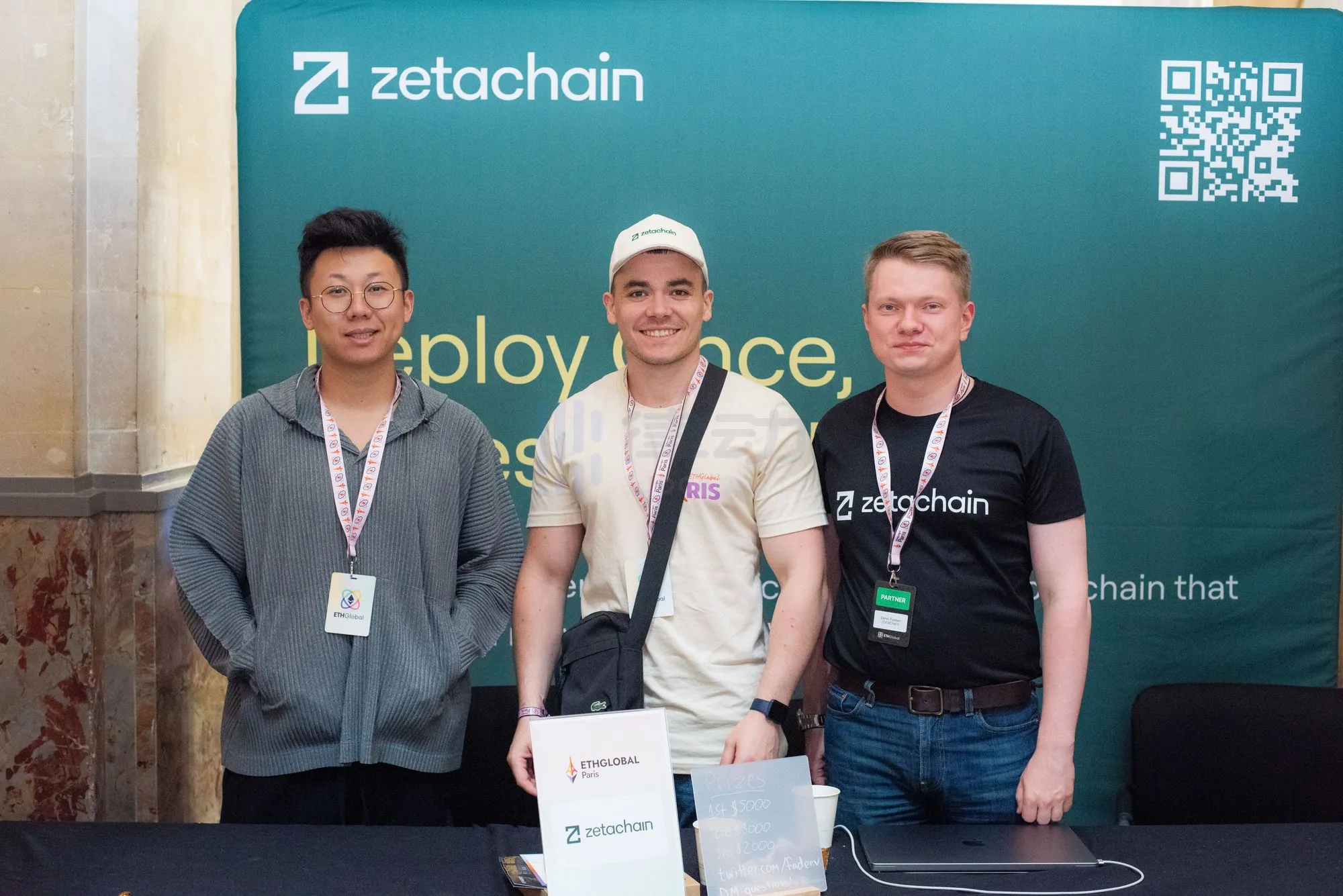
In order to continue the thriving development of the ecosystem and emerge more high-quality full-chain applications, ZetaChain has not only launched a $5 million full-chain ZETApps development funding program, but also held numerous hackathons and developer competitions. At the recent Paris ETHGlobal hackathon, three projects built on ZetaChain won awards, each receiving a $10,000 prize: Kinetex lightweight client, Omnichain Governor Standard, and Cash Out Protocol. "ZetaChain easily allows us to transfer cross-chain tokens as a protocol," said the developer of the Cash Out project, whose entire basic architecture revolves around ZetaChain.
Denis Fadeev, the developer experience lead for ZetaChain, is optimistic about the future of ZetaChain: "The Paris hackathon project showcased the potential of ZetaChain, and we look forward to more developers joining."
ZetaChain is leading the blockchain into a new era of interoperability through its unique full-chain support. It provides developers with a brand new application building platform, which is expected to solve the fundamental obstacle of blockchain incompatibility and achieve true integration of off-chain resources.
Perhaps due to the smooth and seamless user experience and the emphasis on developers, the ZetaChain ecosystem has made great progress. There has been a significant increase in development activities on the ZetaScan testnet browser, with thousands of new dApp contracts deployed. It can be said that ZetaChain is currently at the peak of the full-chain hackathon. In a blog post on ZetaChain, the rich full-chain ecosystem of the Zeta network is also displayed.
Implementing Hardcore Technology for Omnichain
Cosmos SDK and Tendermint: ZetaChain is built on top of the Cosmos SDK and Tendermint consensus engine, which provides fast block times and instant finality. The Cosmos SDK (Software Development Kit) provides basic blockchain functionality modules such as staking, governance, and token distribution, reducing the cost of user development and allowing for the focus on developing application-specific chains. The Tendermint PBFT consensus engine has already proven to be scalable to around 300 nodes in production environments and may be further increased in the future through BLS threshold signatures.
Hyperlink node: ZetaChain observers on the node track all transactions on the linked chain. The network can use ZetaChain's TSS design as a wallet to sign and verify transactions on any linked chain. These hyperlink nodes provide developers with a seamless full-chain environment to create cutting-edge and powerful cross-chain applications by securely and decentrally reading and writing on the connected chains.
Hosting external assets: ZetaChain's network and the dApps created on it can handle assets and insurance pools from other linked chains. This makes it possible to manage assets on any chain, just as a smart contract on a single chain can manage assets on that chain. Therefore, dApps running on ZetaChain can coordinate and introduce smart contract logic into any linked chain. All chains, even non-smart contract chains such as Bitcoin and Dogecoin, are affected by this feature.
The three roles of validators: ZetaChain validators consist of three different roles: basic validators, observers, and TSS signers. Transaction and reward fees will be allocated to validators in exchange for their services in processing transactions and maintaining network security. Observers scan relevant events, transactions, and statuses of external chains at a certain point in time and reach consensus on observation on ZetaChain's blockchain. Signers collectively hold a threshold signature scheme (TSS) key, which allows them to send verified messages to external chains and hold assets on external chains like regular accounts/addresses.

Multi-party threshold signature scheme: ZetaChain collectively holds a threshold signature scheme (TSS) key, which can represent the entire system to sign externally. During the TSS key generation and signature process, no private information of any node will be leaked, avoiding the risk of a single point of failure. Having the TSS key allows ZetaChain to hold accounts on external chains, enabling smart contracts to manage external chain native assets like managing internal assets. Developers can achieve cross-chain computation and state migration between heterogeneous networks through ZetaChain's smart contract platform.
In order to store funds (management pool, treasury, etc.) on external chains and perform privileged operations (destruction, minting, transferring funds out of the treasury, etc.), ZetaChain needs to hold an account on the external chain. This is necessary for universal cross-chain smart contracts, as the core function of smart contracts is to autonomously manage assets. ZetaChain hosts assets on external blockchains that may not have sufficient smart contract capabilities, such as Bitcoin and Dogecoin. This feature allows smart contracts on ZetaChain to orchestrate assets like Bitcoin in the same way as any other token on any chain. This capability is similar to Ethereum, where smart contracts can manage assets based on predetermined logic. The difference is that ZetaChain's full-chain smart contracts can manage assets from anywhere, not just assets on a single chain. Therefore, you can effectively own a Bitcoin smart contract or a smart contract that manages many different assets on different networks simultaneously.
Endorsement from Star Capital
The money will flow towards the network with the best developer experience, strongest network effects, and strongest security.
ZetaChain's thriving ecosystem has attracted the attention of many top investment institutions, including the low-key fund VY Capital, which previously supported Musk's acquisition of Twitter, and Lingfeng Capital, an investment partner of JD.com. According to official news recently released, ZetaChain has completed a $27 million equity financing round, with participation from Blockchain.com, Human Capital, Sky9 Capital, Jane Street Capital, Smrti Lab, VistaLabs, CMT Digital, Foundation Capital, Lingfeng Capital, GSR, Kudasai, Krust, and others.
According to the ZetaChain team, the current focus is on planning the launch of the mainnet, and several new rounds of audits are currently underway. The exact time of the mainnet launch is still uncertain, but news will be announced at an appropriate time and will strive to go live within a few months. After the mainnet launch, the next major development for ZetaChain will be at the application layer. Cross-chain primitives, lending, decentralized trading platforms, NFT markets, and more should all seamlessly integrate for users, while also expanding to several other chains.
Not only for ZetaChain, for all cross-chain message transmission underlying protocols, the current blockchain cross-chain ecosystem is still in an incremental market stage. It is necessary to pay attention to the security of the connected chains, continuously develop core code, and increase preventive mechanisms. Of course, any single mechanism is difficult to solve all the problems of cross-chain interoperability. Cross-chain interoperability needs to be considered from multiple levels, not only the underlying communication mechanism, but also asset representation, state management, smart contract models, etc. This requires systematic design to meet the needs of different application scenarios, which is a challenge for all cross-chain platforms.
At the time, Vitalik's view of being "optimistic about the future of multiple chains, but pessimistic about cross-chain" received a lot of opposition, but now it seems that he was right. The emergence of omnichain seems to have also confirmed Vitalik's words. The cross-chain method of "locking + minting", "locking + unlocking", and "burning + minting" has inevitable risks. Omnichain has used a more elegant solution to complete cross-chain operations.
It can be said that Omnichain surpasses existing cross-chain interoperability standards, hoping that the entire chain application can be compatible with enough chains, even bringing together all EVM-compatible and non-EVM chains to build an interconnected multi-chain ecosystem for dApp and DeFi protocols, and support multi-chain decentralized exchanges (DEX), multi-chain lending, liquidity mining, and new use cases such as multi-chain NFTs.
In the foreseeable future, the circulation of digital assets will no longer be limited by a single chain. The emergence of Omnichain also has the potential to replace cross-chain bridges with secure and seamless inter-chain asset flow and value transmission.
Reference:
1. https://www.zetachain.com/whitepaper.pdf;
2. https://www.zetachain.com/docs/;
3. https://github.com/zeta-chain;
4. https://old.reddit.com/r/ethereum/comments/rwojtk/ama_we_are_the_efs_research_team_pt_7_07_january/hrngyk8/;
5. https://www.theblockbeats.info/news/35537;
6. https://fraxcesco.substack.com/p/on-greek-mythology-and-trustless;
7. https://mp.weixin.qq.com/s/TWkpEA9f0Vwu01BdI8YAiQ;
Welcome to join the official BlockBeats community:
Telegram Subscription Group: https://t.me/theblockbeats
Telegram Discussion Group: https://t.me/BlockBeats_App
Official Twitter Account: https://twitter.com/BlockBeatsAsia

 Related Articles