Multi-chain game, cross-chain final battle
Original title: "Cross-chain Endgame"
Original author: Jackson, Prophet Lab
This issue of SeerLabs (Twitter: @seerlabs_crypto) will take you into the cross-chain The Battle of the End of the Chain
Preface:
Before discussing the topic of this article, we need to declare that this article only represents the author's personal opinions and ideas. And the starting point of the analysis is product and technology design without capital operation, marketing and other considerations. Therefore, this article is not an investment suggestion, nor is it a short-selling report. The main issues discussed in this issue are more infrastructure. This kind of track is often atomic, and it either meets the demand and takes off very quickly, or the direction is wrong and no one cares about it. Therefore, the projects mentioned in this article cannot be used as investment reference provided by the author. Purely industrial research. I hope everyone will discuss it together.
01 Synthetix's L1 and L2 data compatibility triggers information cross-chain thinking
The origin of this research report is the sip156 and sip165 published in the synthetix community in July and December this year respectively. The links are posted here:
https://sips.synthetix.io/sips/sip-156/
https://sips.synthetix.io/sips/sip-165/
At present, these two proposals are still in the stage of Feasibility, which means that although they have not been actually implemented, they are feasible have been recognized to a certain extent. The main reason for these two proposals is to solve the data compatibility problem between Synthetix's layer2 and Layer1. Users who have read the synthetic asset research report I did in October should know it. As the most complex DeFi project in the Ethereum community, Synthetix was officially deployed on Optimism, a layer2 solution, this year. However, a pattern of multi-chain competition has gradually formed. Although layer2 and layer1 can achieve a certain degree of cross-chain communication, this communication cannot be extended to other sidechains or even heterogeneous chains such as solana for the time being. Causes the global debt adopted by Synthetix to be out of sync. This has caused a huge "liquidity waste".
This kind of "fluidity waste" is exactly the era of the public chain Warring States period where all the heroes are competing. One of the biggest problems faced by various DAPPs. Especially global debt projects like Synthetix (projects with shared risk like pool 2 user will encounter the same problem). When adopting multi-chain deployment, the liquidity of multiple chains has to be separated from each other. And re-incentivize the generation of liquidity from scratch.
Take the "DeFi For All" fund that is often whipped by us as an example, Polygon passed this plan Aave, Curve, Sushi, and most recently Uniswap were introduced. However, these leading projects still need to re-motivate liquidity and deposit funds on Polygon.
Maybe you will say that for miners, the more new economic incentives the better, But for users with actual needs, it will cause a lot of trouble. For example, the types of collateral and deposits supported on other chain versions of Aave are much lower than ETH, and Sushiswap has better liquidity on other chains. Assets are also still well below Ethereum.
From the perspective of the project side, if I want to experience a better Deploy my original mortgage lending protocol on the side chain of EVM such as heterogeneous chain or Polygon. Then I will face a big problem, that is, the types of collaterals that can be adopted are insufficient, because there are not many assets on the chain that have sufficient liquidity to support large-scale liquidation.
Also, at present, there will be some mainstream token trading pairs AMM pools on multiple chains , taking ETH as an example. At press time, the asset has a total TVL of 1.41B on Uniswap V3 and roughly 0.3B on Pancake V2. When conducting the same ETH transaction, the slippage pressure on the Pancake transaction is nearly 5 times that of the Uniswap V3 Ethereum version. The larger the amount, the larger the slippage gap. This is why the adoption rate of transaction aggregators is getting higher and higher, and even the adoption rate of cross-chain transaction aggregators is getting higher and higher.
Another example, the interest rate that users bear when they use Aave of different chains for mortgage lending This is because the data on each chain cannot communicate with each other, and the contract only adopts the original data of the chain when calculating the interest rate. It may seem that there is not much difference in use, but in other words, it is like, when you use a bank deposit in this city, the interest rate is 4%, but you go to other big cities and find that the deposit interest rate is actually 6%. The same bank, the same currency, this situation is impossible in the traditional financial market. However, due to the data island problem of the blockchain, similar situations are not uncommon.
Therefore, it triggered our thinking:
< /p>
Since the multi-chain game, compatible and coexistent ecology is a foregone conclusion, the future war may even be more chaotic. So is the information communication between chains the next track that is about to explode?
For this reason, the developers of my team and I focused on the research of various types of current solutions (mainly selected some representative solutions, others More homogeneous schemes are not within the scope of this report). Hope to be able to analyze the advantages and disadvantages of various solutions from different aspects.
The following content involves a variety of technical primitives, we will try to use plain language to help you understand. The infrastructure track sounds very "technical", but in fact, the blockchain solution is essentially a philosophical problem of organizational form and production relationship. After understanding the basic process and logic, you don't need to understand the code to understand these infrastructures realization meaning.
02 Some of the existing Cross-chain communication infrastructure
(1) Lightweight Plug-in communication protocol—LayerZero
LayerZero is a cross-chain that SeerLabs came into contact with in August this year Communications infrastructure, which caught my attention at the time, but then missed investing in it due to other things (sorry). Later, I saw that this protocol has received investment from Binance, Mulitcoin, and Delphi Digital, so if I look for it again, I will ignore me.
1. Brief description of the plan
LayerZero focuses on a lightweight communication layer-based solution. It is mainly aimed at DAPP on each chain. Help them solve the intercommunication problem of information between chains.
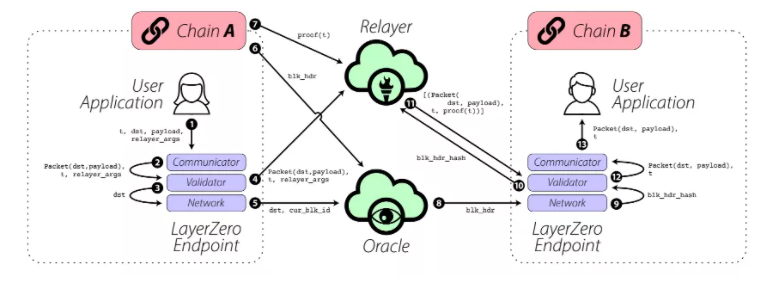
LayerZero’s white paper roughly describes this solution (I try to translate)
 < br>
The figure above illustrates the steps involved in efficiently delivering a single LayerZero message, with each number in black representing a step.
Step 1: User application on chain A (AppA) as transaction t part of a sequence of actions. We uniquely identify a transaction T by a transaction identifier t, whose format may vary depending on the type of chain A. A step included in transaction T is valid delivery via LayerZero transport. For illustration purposes, and without loss of generality, let's assume that Appa uses our template repeater in this scenario. AppA sends a request to the LayerZero communicator with the following information:
t: represents a unique event Identifier
dst: represents the global identifier pointing to the smart contract on the chain
payload: It represents any message data that the chain A application wants to send to the chain B application
relayer_arge: represents that the chain A application wants to use the template repeater shown in the figure ( A customizable repeater provided by layerZero)
Step 3: The Validator sends t and dst to the network. This step notifies the network that the block header of the current block on chain A needs to be sent to chain B.
Step 4: Validator (Validator) will package (dst, payload), t and The relayer_args is forwarded to the relayer (Relayer), notifying the relayer (Relayer) that it needs to prefetch the transaction proof of T and finally send it to chain B. This happens at the same time as step 3.
Step 5: The network sends the block ID of the current transaction (cur_blk_id) to the Oracle. This will tell the oracle to fetch the block header for the current block on chain A and send it to chain B. If multiple LayerZero transactions occur within the same block, step 5 is only performed once.
Step 6: Oracle reads block header (blk_hdr) from chain A.
Step 7: The relayer (Relayer) reads the transaction T associated with the chain A Proof of transaction (proof(t)), and stored off-chain. Step 6 and Step 7 happen asynchronously with each other.
Step 8: Oracle confirms that the block corresponding to blk_hdr is submitted stably on chain A, and then blk_hdr Sent to the network on chain B. The mechanism for determining when this happens is different for each chain, but usually involves waiting for a certain number of block confirmations.
Step 9: The network sends the block hash designated as blkJhdrJhash to the validator (Validator) .
Step 10: The Validator forwards blkJhdrJhash to the Relayer.
Step 11: After receiving blk_hdr_hash, the relayer (Relayer) sends the current block A list of all packet(dst, payload), t, proof(t) tuples that matched. If multiple users are simultaneously sending messages between the same endpoint, there may be multiple data packets and associated transaction proofs within the same block.
Step 12: The validator (Validator) will receive the transaction proof and the block header stored in the network Used together to verify that the associated transaction T is valid and committed. If the block header and transaction proof do not match, the message will be discarded. If they match, the packet (dst, payload) is sent to the communicator.
Step 13: The communicator (Communicator) sends the data packet (dst, payload) to AppB.
2, The main advantages of this solution are:
(1) Lightweight Level, lower cost
Its solution does not need a node based on the upper chain of chain A and B to provide protocol communication like other solutions. Instead, it can be freely deployed by the project party, using templates provided by LayerZero and even repeaters can also be designed by users themselves. Moreover, the white paper mentions a ULN ultra-light node, which is lighter than a light node, and I have not found a particularly detailed implementation. However, from the description, this is also a manifestation of ultra-lightweight deployment.
(2) Communication layer-based solution
This is one of the main selling points of the project party. LayerZero believes that its solution is a new communication protocol based on Layer0. We do not agree with this point. Its level is not a communication protocol like TCP, but just an inter-chain data transmission protocol. In the layer setting, I prefer to place it at the application layer, between layer2 and layer3 between.
(3) Do not rely on third-party credit
< /p>
Anyswap, THORChain and other cross-chain protocols are mentioned in the white paper. LayerZero believes that the aforementioned two partial notary mechanisms (mentioned in the next example) actually rely on an intermediate consensus layer. It is necessary to rely on the services provided by this intermediate consensus layer. However, LayerZero is a peer-to-peer communication primitive that does not need to rely on this intermediate consensus layer.
(4) Summary
3. Question
(1) We do not agree that this is a communication-based Layer solution
This project is not a communication protocol at layer0, the main tools it provides include two parts: endpoint and relayer, the endpoint is responsible for communication verification, relayer Responsible for delivering messages. This is just an inter-chain data transmission protocol. In the layer setting, I prefer to place it at the application layer, between layer2 and layer3.
(2) LayerZero also relies on an intermediate consensus layer
LayerZero adopts the method of mutual verification between the relayer and the Oracle oracle in the design of the scheme to ensure security. However, the white paper also mentions the so-called extreme situation - the situation where the repeater and the oracle machine jointly do evil. LayerZero believes that maintaining relative independence can reduce this risk, but repeaters are generally deployed by the project side. And LayerZero believes that the oracle machine can choose a service like Chainlink. Not to mention the cost of using Chainlink to communicate, in essence, it is trusting that Chainlink will not cooperate with the project party to do evil, and Chainlink is also an intermediate consensus layer.
4. Subjective outlook judgment
(1) Most users cannot know Differences in technical details
Therefore, the subtle induction of storytelling in publicity is often harmless. There are also "technical" projects that are more ruthless. For us, we have seen too many "writer" founders.
(2) Lightweight deployment is conducive to promotion and application
Compared with Anyswap, THORChain, Polkadot, Cosmos, and another project to be discussed, Axelar, the LayerZero solution has relatively less technical and ecological investment and operating costs. There is no need to build a node and absorb other validators. The cost of organizing an intermediate consensus layer is definitely much greater than just providing tools.
Under the premise of equal resources, I am more optimistic that LayerZero will have a better application in the cross-chain ecology.
(3) Low narrative and ecological potential
Similar to auxiliary products such as Anyswap and Chainlink, although LayerZero can play a big role, it is not strong enough because of its product's characteristic narrative ability and ecological expansion ability.
For example, Chainlink's own intermediate consensus layer ecology is actually complete enough, but because its oracle image is too deep-rooted, the overall story It is not as good as layer 1 such as Solana. In fact, Chainlink is fully qualified to be layer 3 of all chains.
LayerZero is also the same, tool-based product positioning makes it less narrative, and some clues can be seen from the two subsequent articles published on medium. When the founders and the team thought about the scalability of LayerZero, the first thing they thought of was the form of IBC collaboration with Cosmos.
This is about defining yourself at the same narrative level as one of the components of Cosmos.
(2) Heterogeneity Cross-chain communication protocol - Axelar
This project is very interesting, from the overall title and delivery The concept coincides with the issues we are discussing today. What he hopes to do is to empower DAPP developers and the blockchain ecosystem. From the beginning of the design, some incompatibility of different heterogeneous chain ecosystems under the current situation are considered. question.
1. The official vision
(1) For bottom-level developers
Plug your blockchain into all other blockchains
(2) For DAPP developers
Deploy your DAPP anywhere, and realize cross-chain assets and information between any chains through Axelar.
(3)For users
Interact directly with all blockchain ecological DAPPs from the wallet.
2. The basic principle of the project is as follows

This picture comes from the official document, It just seems too complicated. We simplify it to the following text flow.
3. Axelar cross-chain protocol process
Assuming there are chains S and D, Axelar provides cross-chain services for these two chains
Status information cross-chain
Axelar obtains and synchronizes each zone through validators running nodes in different chains in the Axelar network Status information in the blockchain system, such as a block hash, current block height, etc. The core process of cross-chain status information is as follows:
(1) Chain D users initiate cross-chain bridge accounts or directly on the Axelar blockchain through the API provided by Axelar The request to obtain the state information data of chain S is denoted as Q.
(2) Each verifier of Axelar must run the node software of chain S and D. Axelar validators query the API of their chain's S-node software for answer A, and send A to the Axelar chain.
(3) Once a verifier with a weight greater than a certain weight reports the same answer at block R, the threshold signature technique will be used at block R+11 Publish SignatureS on Answer
(4) Anyone can take out the answer S with a signature from block R+11 and publish it to D network. Users on the D network can query the answer through the API provided by Axelar.
Asset cross-chain
Assume that the user requests to exchange x amount of tokens on the source chain S for x amount of pegged S tokens S' on the target chain D, and store them in the user's address on the D chain W<sub>D</sub> up.
The workflow is as follows:
< p ql-global="true" line="wc5D">(1) The user sends a cross-chain transfer request to the cross-chain bridge account (x, W<sub>D</sub>), the request is captured by the listener and routed to the Axelar network.
(2) Axelar current validator cluster use The threshold signature technique together creates a new deposit address D<sub>S</sub> on S. and broadcast it to the Axelar network.
(3) Users monitor the Axelar block The chain gets D<sub>S</sub>, and then sends x amount of S tokens to address D<sub>S</sub>.
(4)The verifier checks whether the user is successful Transfer, if in the Rth block the verifier with a weight greater than a certain weight broadcasts that the transfer has been successful, the verifier signs the transaction tx<sub>D</sub>, which sends x amount of S' tokens from W< ;sub>D</sub>, and broadcast the signature result in block R+11.
(5)Anyone can come from the district In block R+11, the signed transaction tx<sub>D</sub> is taken out and published to the D chain, thus completing the transfer of cross-chain assets.
This solution is more complicated than the aforementioned LayerZero, and has more verification processes and logic. In general, the big difference is that LayerZero uses an external oracle as part of the verifier, and the external oracle guarantees security and plays a role similar to an intermediate consensus layer. Axelar uses the BFT Byzantine consensus to build a third-party chain. Axelar synchronizes the information of other chains to the Axelar network through CTP, and then the nodes on the Axelar chain pass information on other chains through threshold signatures.
This scheme is not much different from the scheme adopted by Anyswap and THORChain in essence, and it can also be represented by a notary mechanism. This type of scheme is almost the most important genre among all cross-chain communication schemes.
4. Advantages of this solution
(1) Independent third-party chains can play Greater imagination
The Axelar network for heterogeneous chains is essentially a blockchain network , although it supports a DAPP on chainA to cross-chain to ChainB through Axelar as a transfer method, the optimal solution for developers is still to deploy the DAPP directly on Axelar. In this case, no matter where the subsequent version is deployed, it will only diverge downward, not connect upward.
If Axelar can integrate its own ecosystem If the development is very good, then Axelar may have the ability to become the so-called Layer3. This status is similar to the relay chain in the Polkadot ecosystem. At that time, ETH and BTC may even have the opportunity to be called sub-chains of Axelar.
(2) No need to rely on third-party oracles, and the efficiency and overall cost may be lower
LayerZero's solution has low deployment costs for endpoints and relayers, and is very lightweight. However, the cost and efficiency of using the oracle machine will become an important factor affecting the choice of DAPP developers.
Example: If project A wants to pass LayerZero And Chainlink transmits the debt data of the main contract on ChainA to ChainB. However, Chainlink calls may require payment, and Chainlink push data does not directly monitor the block data of each chain like Axelar, but pushes it regularly or according to rules. For example, one push per minute, or no push if the debt fluctuation is not higher than 1%.
This part of the behavior requires payment to Chainlink , Chainlink has a market called Chainlink market. There are many data providers here. The data provider has a contract for each type of data. If you need data, just call this contract and pay for the link. The data provider will query it off-chain and then feed the data. Come to your contract (so the query is asynchronous, there is at least a block delay), the link paid is probably the gasfee that feeds the data and a little more profit, for example, Ethereum receives about 1 ~ 3 links at a time, on bsc About 0.1 link at a time.
The frequency of this kind of asynchronous heterogeneous chain communication is very high, and the corresponding cost will be high. Therefore, the comprehensive cost of Axelar's general solution may be much lower.
5. Subjective outlook judgment
(1) From the perspective of the overall product design idea, the product form of the Axelar project is closer to projects like Anyswap, because most users have a higher tolerance for the decentralization of the intermediate consensus layer. Chainlink, the service provider and ecological situation of the chain where anyswap is located, 99% of the users may not be very clear. Users will only pay attention to which cross-chain communication solution with the highest adoption rate is recommended by the chain. This shows that the real test of the general heterogeneous cross-chain solution is the To Layer1 ability of the project side. For now, we haven't seen much action from Axelar. And in terms of technical solutions, we don't think it has enough advantages to produce self-propagation effects.
However, compared to polkadot, The difficulty of promoting the Axelar ecology will be much lower than that of other Layer1s. It can be used as a tool layer and it is not recreating the ecology.
(2) In terms of narrative ability, the upper limit of narrative ability temporarily displayed by Axelar is much lower than that of cosmos and polkadot. Although both are cross-chain, and Axelar may even be more practical, both Polkadot and Cosmos have proposed standardized blockchain protocols. This makes its overall narrative ability far surpass Axelar.
(3) Polkadot and Cosmos
< /p>
1. Basic information
Polkadot Hecosmos is the project with the loudest voice, the richest ecology, and the highest market value in this market. Generally speaking, the values and product concepts expressed by these two projects are much higher than the aforementioned layerZero and Axelar.
The specific solutions of Polkadot and Cosmos are not discussed here, and there are so many documents in various languages. We demonstrate from the overall plan.
Both Polkadot and Cosmos narratives mention The cross-chain scheme between heterogeneous chains, such as the cross-chain between substrate and Tendermint chains and ETH, BTC and other chains, the basic principle is not much different from Axelar and LayerZero, and both require an intermediate consensus layer to be completed through the notary mechanism cross-chain.
But Polkadot and cosmos talked about another look A more attractive story - standardized blockchain and isomorphic cross-chain solutions. To put it another way: create an ecological Wanchain interconnection.
2. Compared with LayerZero&Axelar shape
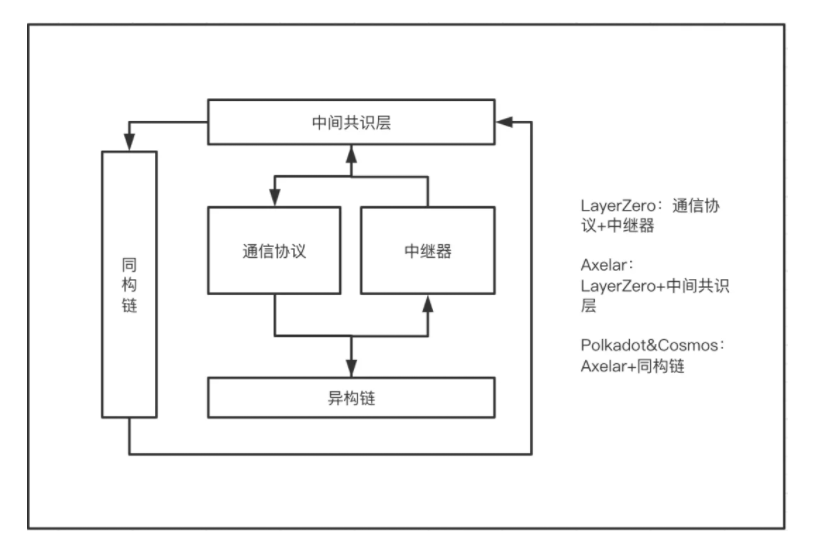
As can be seen from the figure above, after I simplified the complex process (the identification on the thread is not accurate, such as Polkadot’s heterogeneous cross-chain requires a bridge chain instead of directly interacting with the relay chain of the intermediate consensus layer), I can get Results: The above three types of solutions are not essentially different on the issue of heterogeneous cross-chain, but the three types of thinking on the big topic of cross-chain are different.
Polkadot and Cosmos believe that isomorphic cross-chain security and stability are the best, and the future Therefore, although it also supports heterogeneous cross-chain, the focus is indeed the isomorphic cross-chain in the system of substrate and Tendermint.
Axelar believes that unified standards are the most efficient and safest way to solve heterogeneous cross-chain, Therefore, Axelar's Network was established. It inherits cross-chain communication and relayer services, and provides an intermediate consensus layer that interacts with heterogeneous chains.
And LayerZero believes that the lightweight cross-chain communication protocol for developers is just needed, Therefore, only relays and communication protocols are provided, and the oracle machine is used to act as an intermediate consensus layer.
Which solution will attract more attention in the market competition in 2022, What about bigger prospects?
(4) Prospect synthesis Analysis
1. The current market competition pattern
a. Heterogeneous chain competition incentives, multi-chain parallelism is a foregone conclusion
b. Giant whales are settled in ETH, and users are settled in multiple layers with lower cost and better experience——BSC , AVAX, Solana.
c. Combined innovation has become the mainstream of innovation
d. EVM has a very high ecological share< /p>
2. Reference model benchmarking
From From the perspective of ecological development, these three schemes are all different in terms of narrative and ecological development strategies. Let's compare and analyze each dimension in the form of a table:
< /p>
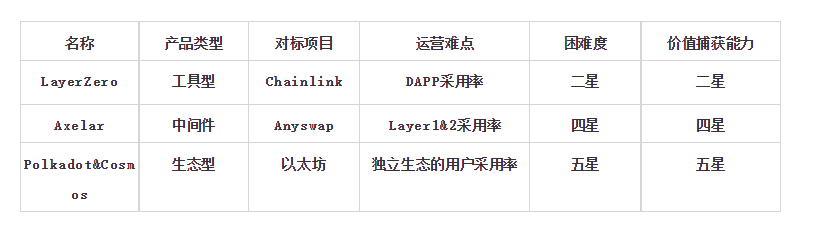
From the table, we can see what is the future prospect of the biggest difficulty faced by each program. And the user base that needs to be expanded.
Polkadot&Cosmos faces greater challenges due to its greater ambition and ambition.
Conclusions can be made with certainty, unless its own tools are perfect enough and the ecology is active enough to form its own school. Otherwise, it will be difficult to accomplish the vision described in the white paper.
At least in the current multi-chain competition, it seems that the isomorphic chain core solutions of Polkadot and Cosmos are not in line with the current mainstream.
However, Cosmos and Polkadot still have some subtle differences in some designs. For example, Cosmos provides a set of solutions that use IBC and pegs to complete heterogeneous chain cross-chain.
In short, the functions provided by Cosmos can already establish an Axelar-like network very quickly and efficiently. And this network also has the possibility to interact with other isomorphic chains in the future.
The advantage of this is that even if the core isomorphic cross-chain cannot be completed, the efficient adoption of heterogeneous cross-chain can also be regarded as the result of the Cosmos ecology.
The consensus coupling between Polkadot’s XCMP (not yet finished) and the relay chain is relatively large , which is difficult to separate independently. Developers need to build a cross-chain system with heterogeneous chains such as BTC and ETH. While this makes the intermediate consensus layer less expensive to develop, it is indeed far from the described vision.
So, on the whole, the design of Polkadot may be difficult at the moment, slot auction After completion, Polkadot needs a lot of incentives and DAPP on the original substrate chain to break through the current fierce battle. This difficulty should be the greatest of all the projects I have seen so far.
Of course, the capabilities of Parity and Web3 foundation are beyond doubt, this article only analyzes the difficulty from the product and technical level. Not intended as investment advice.
(1) LayerZero's solution may be the fastest to market
Because LayerZero's solution is closer to the actual needs of DAPP developers in the current market, taking the situation of Synthetix at the beginning of the article as an example, Synthetix can adopt the method of LayerZero+Chainlink to quickly Complete Layer1&2 debt pool integration.
(2) Axelar faces the greatest homogenization competition
Compared with LayerZero as a lightweight and fast-deployment entry point, Axelar's solution is more homogeneous, with Polkadot&cosmos on it, and Anyswap&THORChain in parallel. The adoption rate of Layer1 will be its biggest obstacle, and I don't think Axelar can beat Anyswap in this regard. Because although the latter is currently focusing on asset cross-chain, it is not difficult to upgrade to message cross-chain from the scheme design, and it already has a very high Layer1 adoption rate. Down Axelar is not content to be just a lightweight communication component, because the overall storytelling and value capture capabilities are poor.
(3) The expected adoption rate of Cosmos will be higher than Polkadot
The more flexible architecture of Cosmos makes it less technically difficult, and the more application-oriented design style has resulted in many excellent products based on the Tendermint ecosystem, including the recently popular LUNA (Terra ).
(4) The Polkadot ecology is facing a huge challenge
Among all the above-mentioned solutions, Polkadot faces the greatest publicity pressure, and the complex technical solutions have caused delays again and again and are constantly consuming users' confidence. It can really prove that what Polkadot expects may be the kind of "killer product that fully utilizes inter-chain composition". Of course, there are many stakeholders involved in the Polkadot ecology, and perhaps the latecomer advantage will help Polkadot do better.
< /p>
Original link
Welcome to join the official BlockBeats community:
Telegram Subscription Group: https://t.me/theblockbeats
Telegram Discussion Group: https://t.me/BlockBeats_App
Official Twitter Account: https://twitter.com/BlockBeatsAsia

 Related Articles