Pay attention to the mental health of DAO practitioners, how to deal with the stress caused by mental debt?
Title: Cultivating Mental Fitness In DAOs & NBSP;
Original author: Twoplus
shaun@DAOrayaki.org, DoraFactory
Good mental health is essential to our life and career. It is a prerequisite for us to achieve our lofty goals, maintain our relationships and make meaningful contributions to our communities.
Today, however, DAO's mental health at work is under siege. There are many challenges in the DAO and contributors' lifestyle that seriously undermine the future of this wonderful work.

Our mission is to empower digital communities to thrive and make a positive impact by putting mental health at the heart of collaboration.
"Mental health is the modifiable ability to use resources and skills to flexibly adapt to challenges or strengths in order to flourish (optimally functional)"
We believe that mental health enables us to become aware of ourselves and sustainably unleash our full potential. As a community, we are leveraging DAO's early strengths to make mental health culture the default in the DAO space.
In this article, we will make an argument for mental health in DAO and Web3.
- Introduce mental health
- Cost of mental health in DAO
- Infuse mental health into the DAO's and contributors' lifestyles
Mental health
Mental health changes our view of mental health from something we endure to something we can deliberately cultivate. Just like physical fitness, adopting mental health practices means training our brains for better mental strength, resilience and flexibility.
Mental health is relevant to everyone, but it is especially important for DAO contributors. We are constantly processing information, shifting contexts, and being pulled in all directions even when "offline." Our massive consumption of "junk information" leaves us "mentally overloaded" and constantly looking for more stimulation or dopamine hits.
Past work may have been physically exhausting, but in DAO, most of the drain is on our brains. This new pattern of work comes at a huge cost, as our brain health declines over time and we become no match for a healthy version of ourselves.
At this point, working in DAO and Web3 requires a certain amount of "fitness." The mental fitness approach was designed to help us adapt to this new environment and turn the challenges of DAO's life into opportunities for growth.
Better handle number relationships and ambiguous interactions through heightened awareness of our own triggers and emotional intelligence -- psychological "flexibility"
By knowing how to shut down our nervous system, we can cope with the intensity and events of the day, and ultimately prevent burnout -- psychological "resilience"
Re-managing our immediate concerns and trying to align our work better with our strengths and values over the long term -- psychological "strength"
By improving our emotional intelligence, self-awareness, and spontaneous mental health skill sets, we get better at dealing with certain situations, whether it's an event like a market crash or a strained relationship with another contributor. We can be more objective and better problem solvers. We can also manage our energy sustainably, avoiding tragic injuries like burnout or conflict.
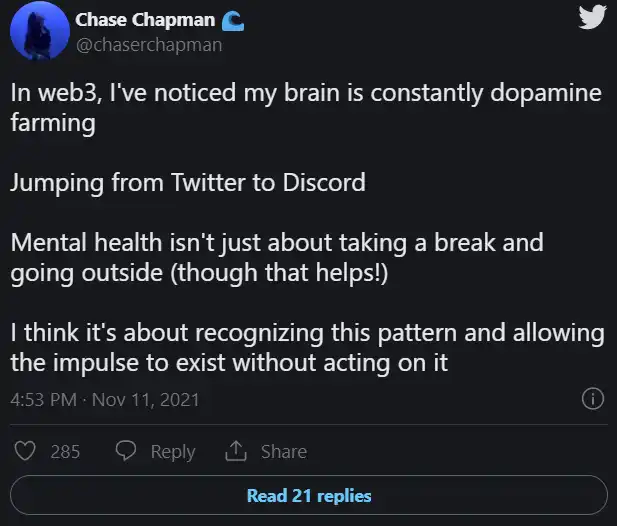
Cost of mental debt in DAO
Let's use a simple and quick historical analogy to highlight the importance of taking an intentional approach to mental health in the DAO space.
In the 1950s, Americans moved toward an overly rich and sedentary suburban lifestyle. This sudden change has led to a surge in health conditions across the states.
Today, DAO contributors are pioneers of a new way of life. This time, the digital or DAO realm also has the potential to be a dangerous externality.
- We're glued to Discord and Twitter first thing in the morning -- rival platforms designed to cultivate your attention span.
- We stuff ourselves with too much "junk" information.
- We're in constant context switching, which depletes our brain's processing power.
- We are subject to a high degree of uncertainty caused by market conditions and the transient nature of the project.
- We evaluate ourselves based on followers and good reviews, and constantly feel like we're not doing enough to miss out on opportunities that seem "unique."
So while the DAO space is highly free and rewarding, working in DAO means being more aware of our environment, routines, and rethinking our mental hygiene.
It's easy to tell when the American body is changing. But for Web3 workers, the damage to our brains (and overall health and well-being) is hidden until it's too late to spot it in the form of chronic stress or burnout.
Mental debt can become more stressful over time:
Short term: inertia in cooperation and discomfort in daily work
Middle stage: Burnout, conflict and tension affect creativity and productivity
Long-term: reputational damage, loss of ability to attract talent and loss of competitive advantage
Inject mental health elements into daOs and contributors' lifestyles
We think there are two main ways to inject mental health into daOs:
Experience of contributors - organizational level
Training of contributors - personal level
First, organizations with mental health as a core principle will reduce the stress of psychological debt through people-oriented organizational design. They will strive to provide a better contributor experience, which is critical for DAO to remain relevant in the global competition for talent.
Daos are contributors' products, and user experience rules apply in many ways. The iterative contributor experience begins with having close relationships with the people doing the work, understanding their pain and prioritizing solutions.
Secondly, training contributors with mental health practices is the next highest standard today. Whether one wants to become a world-class DAO builder or an occasional participant, adopting mental health exercises is an opportunity to learn more about oneself and learn more about oneself. We believe it is an important foundation for self-management and working in a self-directed manner, as is often the case with daOs.
Fortunately, the freedom and flexibility provided by the DAO creates room for intentional injection of mental health practices throughout the day: in the morning, after lunch, or between meetings, for example.
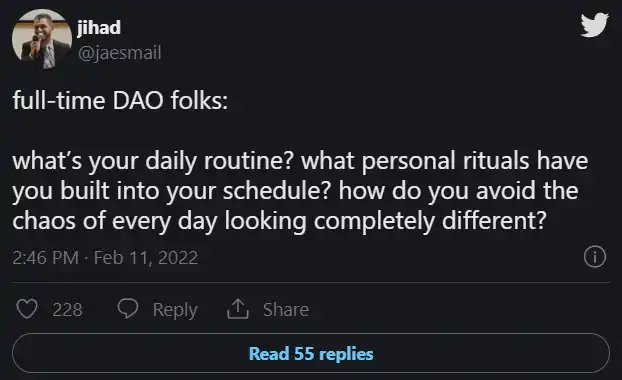
Whether it's meditation, breathing, NSDR, flow combing, or journaling, it's good to adopt any kind of practice, such as scheduling your day to expand your mental capacity over the long term. It's important to start with the details and build habits around the exercises that work for you.
The original link
Welcome to join the official BlockBeats community:
Telegram Subscription Group: https://t.me/theblockbeats
Telegram Discussion Group: https://t.me/BlockBeats_App
Official Twitter Account: https://twitter.com/BlockBeatsAsia
 Related Articles