[Article] DAO will encounter 14 fatal challenges and 8 change methodology
原文标题:《 国人 DAO 大败局:放心吧!我们都实现不了去中心化自治 》
Original text author: Dinghui's little linger
Every participant who believes in a DAO has encountered the following problems:
- Call yourself DAO, but no different from the community
- Centralized control of core team
- Recruit volunteers, pay no attention to labor
- Meetings are cumbersome, difficult to agree on, and nobody does anything
To put it simply: there is no centralization, no autonomy, and no good incentive mechanism, so it is a problem to survive. Flaunted in the name of DAO, it is actually nothing.
If we believe that DAO is the future and that more commercial companies and ngos will transform into DAO, we are playing hoodlums if these issues are not addressed.
If you want to address these issues, you need to rethink what a DAO is
(1) What is DAO?
As @felixZhou.eth put it:
"In my opinion, Bitcoin is the perfect DAO based on the following three characteristics:
1. All participants are equal and abide by the same rules. There is no special participant.
2. Participants' contributions to the system are objective and quantifiable, without subjective judgment;
3. All behaviors of participants are recorded in the system (on the chain) without reference to activities outside the system;
Daos without these characteristics either have inherent defects and have doubtful sustainability. Or it's self-deceiving and forcibly rubbing DAO's concept."
Blockchain innovation can create a technology-enabled system that allows DAOs like Bitcoin to be born. However, in the face of broader human social activities, it can only provide Token, NFT, smart contract and a series of tools. Although these tools have the nature of encryption, the right to confirm the attributes, but also can not be used to cut leek zhuang, and even achieve more depth of mental control.
So in my opinion, there are two paths for DAO development:
1. Build technology-based systems to replicate the wonders of BTC in more scenarios.
2. Build human-based systems, use a variety of tools, and constantly approach the ideal of regional centralization and autonomy.
Because I'm not very technical, but the second one is my home turf and the subject of this article.
Before discussing specific solutions, we need to ask ourselves:
What is holding people back from joining forces to create truly decentralized, autonomous organizations?
(2) Obstacles in the development process of DAO
In my opinion, there are four key dimensions that constrain the creation of a DAO:
1. The natural formation of poor power
A. Authority projection:
Therefore, the sponsors of a DAO often do not want to be dictatorial, but because the relationship mode and relationship narrative in the mind of participants do not change, instead, participants project power. If the leader of a DAO accepts this projection of power, it means that he is responsible for serving and satisfying other participants. If he shows that he needs to take on such responsibility, the participants who project power tend to be happy to be served and arranged, because that's what they're used to. Although it may not be what they want.
B. Interpersonal influence:
From the perspective of social relationship network, the central node of a system and the bridge node (structural hole) linking two groups will have greater influence on the whole network, thus forming the power difference. Many DAOs are naturally aggregated because of one person's personal influence, or are a combination of multiple organizations. Participants have to rely on a few of these key people to do things, and outsiders will contact them first when they want to work with the DAO. Over time and the Matthew effect, the key people became more and more dependent and became the core assets of DAO, which naturally resulted in the center of power.
C. Solidification of strata:
After the class is solidified, people who join DAO often feel away from home. Before being recognized and accepted by DAO, they naturally feel that they are in a low position of power. Indeed, the first person to join the DAO is more familiar with other people in the DAO, and the first person to arrive defines the Vibe of the DAO at this stage, which is a symbol of power and advantage. Therefore, with the development of DAO, the retention rate will be lower and lower, and it will be more and more difficult for new people to enter the core. It is natural to start to solidify in the circle.
2. The inner tension of a leader
A. Battle between ideal and reality:
An idealistic leader often has a lot of ideas about what a DAO should look like. At the same time, if a DAO wants to be decentralized, it must rely on the strength of the community to grow a lot of things from the bottom up. Often, however, these naturally grown things fall short of the leader's personal aesthetic, or are completely beyond expectations. In this case, an authoritative leader will often take a set of steps to change the community toward its desired state. If the community is vibrant and not overwhelmed by the wave, leaders themselves tend to fall into a deep sense of self-blame and powerlessness.
B. Fear, jealousy, and feelings of control:
Do you get upset when people in DAO you don't trust form their own clique by spreading their influence and gain the power to influence DAO's development? Do you get jealous when your partner does a lot of outreach work and all the docking, interviewing, and collaboration is coming his way, but you're doing all the dirty work inside the DAO? When a DAO develops multiple power centers and the influence and benefits of everyone are unbalanced, it always means the loss of the sense of control for the founder, and fear, jealousy and other emotions often arise.
C. Be bitten with vision plus leverage:
In order to bring more people together, the founder would draw a big pie and describe a good vision to attract people to participate and make voluntary contributions. However, once the expansion period passes, the development of DAO falls into a stagnant state, or the founder is exhausted physically and mentally because of obsession, fear and jealousy, and it is easy to break the trust of the public and betray his family. All of the contributions made to the vision before now have turned into debt that the founders can't repay, and have even been reviled, losing their reputations in angry accusations from contributors.
D. The dilemma of management and neglect:
If they manage themselves, they will become centers of power, which is contrary to the ideal of decentralization. If we leave it alone, we may lose our humanity in different ways, and democratic decision-making may be inefficient when problems arise, and the project may be cold before the vote is cast. So care or not care?
3. Participants' wandering and entanglement
A. Low self-efficacy:
A decentralized community means delegating governance and decision-making to its members. But in fact, because of the lack of opportunities and space for civil autonomy, Chinese people have long been in a low power during education and work. Often used to dealing with the management of others, arrangements, or become the power of management arrangements for others, or when the lonely fight alone........ Lack of experience, consciousness and ability to participate in community governance.
For example: how to effectively integrate the collective wisdom to form consensus, division of labor and cooperation? How can I influence the whole team effectively with my ideas? How to listen, question, clarify, summarize, and feedback effectively in communication? If these abilities are lacking, they will naturally not know how to participate in a community, and they will naturally form a sense of low self-efficacy and do not know what to do when they see the development of the community.
B. Survive first:
In a society where material is not abundant, most people are slaves and have exhausted most of their efforts to live. It is a luxury to talk about dreams and creation. There is no chance to find out what you really want, nor to sit down and imagine what a "free association of free people" could create, let alone contribute for free within a DAO. If the fewest idealists could do it, it would often be very unstable.
C. Goal confusion and motivation ambiguity:
If I want to contribute to our DAO, what is a contribution? If my understanding of the DAO's goals conflicts with the founders' goals, then my efforts are breaking? If I'm doing a lot of work behind the scenes, and no one knows about it, is there no incentive? Is the benefit determined by the hours worked or by the results of the work? These are difficult questions to answer.
4. Systemic flaws in the community
A. Build a city in the desert:
Some areas are not suitable for DAO construction, just like deserts, there is no bottom-up growth ecology. But for a variety of reasons and obsessions, founders come to these places to build projects, to attract a group of consumers with money, vision, products and services, and to create a DAO by fooling them into being contributors, which is just wishful thinking.
[B] Generating electricity from love is not sustainable:
Participants generate electricity from love, with no financial gain except for honor and empty promises. This is often the result of a failure to develop a mature business model and unlock cash flow from zero to one. This tends to doom contributors to a gradual lapse.
C. Lack of appropriate co-governance space and tools:
Unfortunately, wechat has too few features and a low DC retention rate. Platforms such as Snapchat, Dework and Coordinape are fragmented and require learning costs, making it difficult to popularize.
D. Deficiencies in organizational systems:
In addition to these, some overseas DAOs seem to have some deeper challenges, such as democratic tyranny (carving up the whale), the site tragedy of community funds.
How many of these problems can be solved by blockchain?
I'm pessimistic because this is a problem that is deeply rooted in human nature and organizations.
In fact, before the emergence of DAO, there were many people in the world who were exploring management methods matching with the 21st century, including the pursuit of decentralized, decentralized and more autonomous organizational forms, which produced excellent cases, which can be collectively referred to as the "ideological trend of organizational change".
We have developed our own tools and methodologies based on organizational behavior, management, and psychology, such as Facilitating, Coaching, Facilitating, U theory, and Facilitating....... There are some success stories, such as Shuguang Village in India, which has been in development for more than 50 years, and Blog Group, a care worker service company in Northern Europe.
I believe that with the growth of blockchain-based applications and Web3er's belief in decentralization, there is an opportunity for more DAO tools to be developed, inherits the methodology left behind by the organizational change ethos, and together create real DAOs in the future.
So how do these dilemmas break through?
What tools and approaches can help DAO operators overcome these challenges?
Before we get started, let's look ahead: What would a DAO, based on governance of people, look like?
(3) What is a DAO based on the rule of man that is closer to the ideal state?
Development path
For the long-term development of a DAO:
An ideal DAO first needs to choose to grow on a fertile soil.
For example, GenZ DAO, which I have been deeply involved in recently, focuses on the new generation of young people born in 1995 and 2000. This token of identity naturally leads to a cohesive identity and is easier to support from other Web3 predecessors. At the same time, even without GenZ DAO, there are all kinds of web3000 generation in the world to form their own cliques, and they are more willing to cooperate with each other than compete with each other.
Choosing a fertile soil can easily lead to a steady stream of automatic attention for the DAO.
All sorts of things can happen in a DAO, such as GenZ DAOs where people want to find partners, people want to work on projects, people want to share secondary market investment information, and people want to learn Solidity. These are all good things, but they are not DAO's vocation. A DAO should define itself as a public service provider of the city, providing services for the ecosystem in which the DAO is located.
So at an early stage of ecological development, the most important thing was to get as many people together as possible to build Rome. We need to do a good job in publicity, design a good conversion path for new people, and create a community experience that can meet everyone's needs.
With the development of ecology, it will also be a very important responsibility to promote information flow in DAO, create a public discussion space for more people to get to know each other, and thus form a relationship network and emerge from organizations.
When a DAO has some influence, more resources to the core team together, have a positive cash flow in, on the basis of the core team run at this time, do we have to match the corresponding distribution mechanism, autonomy, and the convergence of resources, the core team gradually became other players can apply for to use in ecological infrastructure.
Eventually there will be teams that generate cash flow, and teams that are more focused on reaching out. The users in the SERVICE DAO form a multi-center, mutually nested network structure, which is united by the symbiosis of the relationship network + common vision. At this time, the core team needs to further encourage community autonomy, give more power and responsibility to community autonomy, and focus more on maintaining the consensus and autonomy of the whole community on goals and visions. The implementation of cooperation mechanism, distribution and fairness of incentives, as well as the initiative to find potential crises and organize forces to deal with them when necessary.
Beliefs of leaders
For a DAO founder to have the following beliefs & Enlightenment:
What DAO ultimately becomes is a matter of collective consciousness rather than individual will, and it is normal to not meet one's own expectations.
My job is to put the bureau together so that everyone can get what they want in the system, to bring together a consensus on decentralized autonomy, and to help everyone truly become self-governing.
The attention, resources and support gained by myself in the initial stage of doing DAO are all resources leveraged with vision, which will be returned sooner or later. If the DAO is lucky enough to get off the ground, it should become the infrastructure itself, providing those resources and influence to those in need in the community.
Go all out
It is normal for the DAO to die in the middle of the process, or for the DAO to be kicked out. There's always going to be someone in the ecosystem, someone willing to provide basic services to more people, but it's just another person, another team making that vision a reality. Either way, live to die while doing your best.
Only by deeply understanding the goals, pain points, expectations, and obsession of everyone in the network can we return to reality from our idealized imagination of DAO and create truly valuable services for individuals in DAO.
If you are not capable enough to fulfill your responsibilities as a core team, you have two choices: one is to give up bravely, or the other is to find the right person to do it and give enough money.
I have to say that being a truly idealistic DAO is undoubtedly a practice.
Participant status
And, a DAO's ideal participants should be a "free association of free people."
Free people are no longer enslaved, both materially and economically, they know what they want, have their own passions, aspirations and personalities, dare to look authority in the eye and raise their middle finger, and walk this planet with their own skills and resources, free and self-respecting.
When this group of free people are close to each other, they can see each other's external goals, abilities, and value choices, as well as each other's internal characteristics, wounds, and relationship patterns. Moreover, they can go further in communication. They can not only exchange superficial information and opinions, but also see the belief, care, fear and consensus behind the language. The free men saw each other and chose to stand together with those who shared their own goals and appreciated them. They found the point where their own wishes coincided with DAO and made mutual achievements with DAO while creating their own visions into reality.
Everyone more or less their own not free, not perfect. However, I believe that an ideal DAO should help its participants gain greater freedom, improve themselves, and realize the integration of body and mind.
Other realistic options
Of course, there are more realistic options beyond this idealistic DAO, such as:
Change a company's equity to Token, issue cryptocurrency companies to employees, use more on-chain tools to governance, maintain legal compliance, and claim to transform themselves into DAO.
In a small team whose business is fixed and has passed SOP, the value of each link is fixed and written into a contract. The roles in the team are fixed and people can be changed. After receiving the payment, each role will be automatically allocated according to the proportion in the contract.
The project side of the product handed over the governance of part of the product to the community, and issued a reward to encourage community members to participate in the contribution to get incentives, and claimed that their product was jointly governed with DAO.
An influential KOL or media will form a fan community and hand over the governance of the community to excellent fans to form an interest group DAO.
All of these are feasible and, to some extent, make traditional projects a small step towards decentralization and autonomy. I believe there will be a large number of such "DAOs" in the market in the future. Maybe this is it. The fate of DAO after the concept was created.
With the possibilities out of the way, let's take a look at the methodology and tools the "idealistic DAO" can use when landing
(4) Methods and tools in eight specific scenarios
Scenario 1: Proposal system
In the general community, if a member sees a problem, he will often raise it and wait for the DAO team to resolve it.
If he is in the desire of creation. Responsibility. If you want to try it out on your own, you usually need to get multiple opinions, hold meetings, and get authorization from your core team before you can start. There will be a lot of energy expended and action constrained.
Especially for members with little influence within the DAO, they often feel powerless and don't think they can take action.
How to encourage the voluntary participation of ordinary community members in governance?
How do you get the people who want to do things to get rid of the inefficient meetings of the consensus-building process and focus on action?
How to give influence within DAO to each member?
"Proposal system" can solve these problems well.
Basic rules:
Every DAO member has the right to contribute proposals to DAO governance.
Every qualified proposal will be considered, discussed, voted on, and publicized.
A qualified proposal should include:
Why was the proposal put forward?
【 Objective 】 What problem does this proposal solve? What is the value to the community?
[Solution] How to solve it?
[Responsible person] Who is responsible for the implementation of the scheme?
[Reward] What kind of reward can the responsible person get after completing the task?
A rank-and-file member, for example, publishes a proposal that is riddled with holes around a proposition. On this basis, everyone spoke, gave feedback and proposed amendments. Perhaps after 4-5 iterations of the proposal, there will naturally be a general consensus.
As opposed to aimless meetings, the proposal system encourages everyone to build on the final consensus at the start of the discussion. The discussion is about how to iterate on a better consensus. This will greatly improve the efficiency of the discussion.
After a proposal is thrown, there are four ways to respond:
Endorse the proposal
Object to the proposal
[Inbound] on the basis of support, issue amendments, and personally become [responsible person] to undertake part of the responsibility of the proposal landing
[Veto] To point out the unreasonable parts of the original proposal on the basis of the objection and propose a revised and more reasonable amendment

The pros and cons only say yes, while the ins and outs mean action, so the latter two have more weight on the proposal itself. For example, the sponsor of a proposal, if he receives [no] votes and corresponding amendments, he has to face them and respond to them.
A typical scenario: if the sponsor of a proposal sets a high reward for the proposal, but the organization's Treasury is limited, the partners who know the DAO's funding situation well will be motivated to vote against it and offer reasonable amendments.
Of course, [responsible person] can also write others, but unless the other party approved, it will not be effective.
When the proposal system is popularized, any community member who has an opinion about the DAO and is willing to make trouble can use this tool to publish proposals, attract more people's attention while participating in the governance, and thus develop their own influence within the DAO.
PS: Blankless DAO has a more complete proposal template, which can be viewed by clicking on Bankless DAO (at the end of this article)
Scenario 2: Bootstrap techniques
What if every meeting is inefficient?
How can everyone be equally represented in meetings, while simultaneously being efficient and productive?
How do you get the community to generate a consensus vision instead of giving it to participants as a product?
In a community, founders often need to give confidence early on, so they will use their personality to make people feel that something is going to happen. But at the same time, it often takes over the voice and makes community participants feel like: This is your project and I'm just a participant.
Ideally, the founder will figure out what to do, lead the participants to think about the organization's vision, goals, and plans, and then help the participants who are thinking about the question to come up with the same answer. In this way, the consensus will make everyone involved in the discussion feel: this is my idea, there is my wisdom in it, this is my creation, AND I am willing to make efforts to turn this vision into reality.
To achieve this effect, it would be better to have [Facilitator Facilitator] involved in the construction of a DAO. The series of [workshops] they brought to DAO could create a more equal and enlightening field through a series of precise agenda design, helping more truth and love emerge in the organization. Imperfect inspiration needs to be stimulated in the illuminating field; Repressed emotions and opinions need an open and inclusive field to be voiced; Doubt and self-defence often make a meeting long and smelly, and also need to be avoided through the process. There are typical private board meeting, review meeting, vision consensus meeting, small work incubation and so on.
Based on the study of human nature and meetings, a Facilitator can also customize the meeting process for a variety of goals based on the organization's situation through precise agenda design,
For a participant, having the opportunity to express himself in a meeting and finding that the ideas he has come up with are actually part of the consensus is more likely to feel that HE is needed and valuable by the DAO than having the right to vote.
All kinds of operation details, classic procedures, heart method with a book could not be finished.
As a Facilitator who has conducted over 50+ sessions and designed workshops for over 10+ teams, I am just getting started.
More on Guiding: A Practical Guide to Teamwork, Group Psychotherapy
Scenario 3: The leader abdicates
When community members rely heavily on the founder and project authority, the founder's presence has begun to restrict the development of the community, what should we do?
How to promote the formation of bottom-up power relations and autonomous order in DAO? How to break the authority projection of the participants?
[Founder abdication] may also be an option.
Once the absolute authority is hollow, people who care about DAO will have the imagination and motivation of autonomy.
I hope that one day I can create a self-directed "glorious revolution" for my DAO members and help more members feel the sense of sovereignty after their authority is defeated. Specific operations are as follows:
Run 2-3 identity engagement communities at the same time. One of them, as the founder, helped DAO run from 0 to 1, actively enhanced his authority, and made other members of DAO feel the founder's repression of the community through some words and deeds. At this time, I took the initiative to plan an event to cause conflicts, and launched a revolution with my other status as an ordinary member. I was kicked out of DAO as the founder, and I popularized proposal system together with other CONTRIBUTORS in DAO, and held a community meeting to clarify our mission, vision and goal. Let everyone involved experience the pleasure of breaking authority and learn the basic skills of community autonomy.
There are softer options, such as fading out of the community, making proposals more popular, and supporting partners who are willing to participate in governance.
Scenario 4: Three incentive mechanisms
How to create incentives?
If the boss doesn't pay the payroll, how about decentralized, autonomous incentives?
How to match rewards for self-organizing behaviors that emerge in the community?
In the DAO organization, I currently see three relatively matched compensation distribution mechanisms:
1. [Community Reward]
Identify the problems that the DAO core team needs to solve at this stage through the monthly meeting, and issue rewards according to the funding status.
There are two types of rewards: 1. There are very specific targets, SOP cases, based on the issue. 2. Release based on roles when objectives and SOP are vague.
2. [Custom proposal System]
By Posting proposals, community members customize goals, tasks, accountability, and rewards for completion. Encourage people to define pay according to their needs. The DAO's core team also makes recommendations based on funding. Amendment.
3. [Coordinape decentralized subjective reward]
A 10-member co-creation team in DAO spent 3 months to develop an NFT project and cut 30EHT from leek. Now we want to share the money. How should we share it?
Because we do not exist a clear relationship between superiors and subordinates, are based on their own background, assume the design, operation, media, overall...... And other dimensions of responsibility. Some have taken on a lot, others have offered helpful help. While there is no clear set of metrics to quantify everyone's contributions, each member has his or her own ideas. After all, after three months of cooperation, who created the indispensable value, who was paddling, who did a lot of groundwork, who helped the team resolve conflicts, everyone saw and remembered, and this is the basis of subjective reward.
At the same time, because everyone's values will be slightly different, some people care more about the realization of the goal, some people care more about the growth of the team, some people especially want to thank a member for their help........ These different perspectives result in different rules for subjective tipping. This diversity also further promotes the fairness of reward results.
That this kind of subjective reward specific ground how to operate?
For the above example, we can do this:
Each of the 10 people in the team gets 100 points in Coordinape and gives all the points to nine other people.
After all the giveaways are completed, the credits received by the owner are counted and the percentage of credits held by each person at that time is calculated.
You can use the ratio directly to determine the reward distribution.
In the actual use process, some people will receive a lot of points, because everyone feels the TA's efforts and contributions, or appreciate the ta's contribution to the team. Less engaged members tend to receive fewer points, while those with greater influence on the team may aim to "encourage more team members" by distributing points more evenly, or by giving more to less influential but hardworking members of the team. This makes the whole distribution model more equitable.
And that can be done through Coordinape's website.
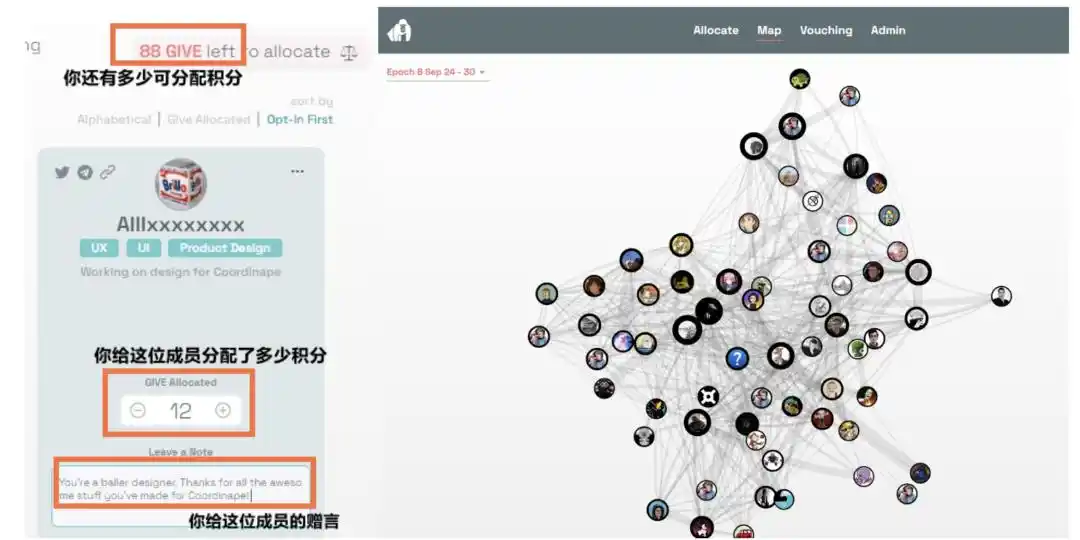
Coordinape can even create a network of relationships for the community by assigning records to each person.
Who is at the heart of the community and connects to more members? Are there small groups in large organizations?
All can be clearly presented in this way.
From another perspective, this subjective assessment is actually internalizing the appreciation economy within an organization.
Because when we give away our points, it is actually a very direct way to show our appreciation and gratitude to each other.
So instead of subjective assessment, I prefer to call this a team reward.
For Coordinape, you go one step further: you can leave a message to your colleague when you allocate points, expressing your appreciation for him or her by real name.
It is also a great encouragement and empowerment for a team member's efforts to be recognized and seen.
Especially in the early stages of a DAO's development, when we may not have the financial benefit to offer to community contributors, this perception and recognition becomes even more important.
Because it means the realization and affirmation of a person's self-worth.
And through this kind of team members to reward each other, confession to achieve the way of seeing each other, can be said to be very good.
Therefore, [subjective quantitative contribution] + [team empowerment] can be said to be the most effective way for Coordinape to create value for an organization.
Scene 5: Live team dynamics
How does the DAO core team help community members understand the challenges they are facing and form a consensus on their goals?
How can more people understand what the core team of DAO is doing and spontaneously get involved in creating it?
Many DAO teams, like Web2 companies, separate themselves from the community, have a strong sense of executive identity, remain secretive to the community, and regularly release new events and products with big plans. But the subtext of this is: we hold the power, we decide the development of DAO, our DAO has aesthetic and quality control, want to participate in the co-creation need to obtain our permission.
To a large extent, the community also feels like it's on a schedule, waiting for something new to happen, not knowing how to help. The core team also feels isolated at times, why so few people are doing things.
At this time, a very key action is to blur the boundary between the core team and participants, and tell everyone through chatting in the community and opening the Space voice that as a core team member:
What problem am I trying to solve?
What a mess I'm going through. challenge
What is my vision? How do I want this to work out?
My feelings and vulnerability?
What kind of support and help do I want?
My next plan and action list
Here is a recommendation dedicated to open a core team broken read wechat group & AMP; DC channel.
When you share these internal issues openly and openly like a journal, you create countless opportunities for others to help you, as well as for more members and outside supporters to get involved.
When others continue to see your sincerity, vulnerability, desire, and effort, trust will naturally grow
Scene 6: Information map
How can you facilitate more self-organizing actions within a DAO?
How to promote the DAO's network to be more decentralized and form a multi-core, deep-link nested "starfish" network?
The emergence of self-organization needs to be seen by each other, and multiple cores need to be formed from one thing to another.
To achieve these two goals, DAO can promote the openness and transparency of information and create deep social opportunities.
Such as:
[DAO Internal Roster]
Put together in-depth members' self-introductions and personal application manuals and expose them to other DAO members.
[DAO project map]
Put together the project groups, groups, introduction of fellowship community, and ways of joining, and make a map for newcomers who want to get into THE DAO
[Team Division table]
Disclose the team's role, division of labor, and collection of information about the core responsibilities of each project to both internal DAO partners and external people who might want to talk about collaboration.
Scenario 7: Integral Depreciation & AMP; Exit mechanism
How to boost the metabolism of a DAO?
How to encourage new members to innovate?
How do you prevent early contributors from becoming whales in decisions and dividends through their accumulated contributions?
There are two typical ways
1. [Withdrawal mechanism of the project team]
An exit mechanism should be specified at the start of the project, for example, if you do not attend for two consecutive weeks.
2. [Depreciation of Integral in dual Token Mechanism]
Some DAOs will use dual Token mechanism: integral Token participation in governance and gain, corresponding weight in voting, can get bonus gold Token; Gold tokens are earned through investment or dividends and can be traded without participating in governance.
In order to prevent early contributors from accumulating a large number of point tokens to become giant whales and still occupy decision-making power even after quitting the project, depreciation mechanism can be adopted. For example, set a attenuation rate for point tokens, and the effective part that can participate in decision-making and share out dividends gradually decreases over time. In this way, newcomers can also make contributions to gain a large number of effective points to participate in governance and dividends.
The size of the decay rate may need to be selected according to the project development objectives.
We are currently looking for a DAO tool that supports this functionality.
Scene 8: Improvisation
How to reduce the cost of operating a DAO?
How to get unexpected nonlinear growth?
How do you enjoy creating with more daOs instead of making daOs a job?
Even DaOs like Blankless can suffer from burnout: people feel they have too much on their plate, their enthusiasm seems to be dissipated by specific tasks, and they become tools to achieve their goals.
However, due to the community nature of DAO, people naturally have more opportunities to share and express their body, mind, emotions and interests here, instead of pursuing professionalism and professionalism and separating work and life like traditional companies.
So there's an opportunity for more improvisation rather than planning. For example, if I'm High today, let's start with "Space"! Group chat out of a terrier, screenshots do an expression package! You are a very interesting person, would like to invite you to make a phone call, other friends are also welcome to listen ~
In fact, if you don't set goals and give your life free time, it's easy to improvise ideas that can be immediately implemented and implemented when you have the greatest enthusiasm for the idea. This way of doing things, often bring you unexpected surprises.
Eight scenes are almost shared.
I believe that there are many more scenarios and methods to achieve more decentralized autonomy at the operational level, and I look forward to exploring them with you in the future!
(5) Is decentralized DAO the future?
Some suggestions for DAO Tool development
Having said all this, what does blockchain have to do with it?
In fact, I believe that there will be suitable for Web3 era, digital nomads & AMP; Telecommuting companies emerge and pay their salaries in cryptocurrencies. Most of them will call themselves DAOs, but it is rare to see a truly decentralized and autonomous organization that can break through the limitations of human nature and organization.
At the moment a lot of DAO Tool development is also going in the direction of finding data that can be monitored in daOs and designing reward mechanisms. Behind this is actually the instrumental rational thinking with technology as the core. However, we have to face that in the real application scenario of social DAO, contribution cannot be quantified like BTC and cannot be motivated based on fixed results and actions.
A more practical development direction is to promote collaborative processes, more decentralization and autonomy of relational networks. Such as:
Optimize the proposal system, for example
The proposal is bound to the community wallet through a contract. If the proposal is judged to be completed, the responsible person will be automatically paid from the community wallet according to the [reward] set in the proposal.
A better interactive space for publicizing proposals, voting, and proposing amendments
At the relational network level, identify key nodes that are growing in the DAO and remind the core team to take care of them. To reward
Provide identification and calculation tools for depreciation mechanism of dual Token system, and embed other voting tools.
For example, business owners with nail services need to manage their employees, flying book service organizations & AMP; Team, we also expect to see a platform that brings together various DAO tools to provide governance space for DAO.
.
Expect to see more DAO Tools developed in the future that are deeply linked to organizational collaboration, and find out how they can be used!
6) About me
Finally, a little gossip about myself
Why do you study daOs?
In the first two years, I have been trying to innovate the direction of education: learning should not be confined to the classroom and be handled by authoritative teachers. As a teenager, I need to find out what I really want, receive telegrams when I am confused, get opportunities and resources to explore the world when I am curious, and find my value in working with outstanding seniors and seniors in the society.
At that time, I created an online community that gathered hundreds of Homeschool, dropout and drop-out teenagers, holding the wish of equality and autonomy for all, and inadvertently walking on the road to practice DAO. In this paper, most of the difficulties encountered in making a DAO are blood and tears experienced by myself.
So I was surprised to meet DAO in 2021, so I fell into the pit, and now it is All in Web3. Although I know that making DAO in Web3 will also face the same challenges, and more DAO tools may take 3-5 years to gradually improve, I am fortunate to meet a series of partners and predecessors who I admire in this hot land, and I feel it is worthwhile to start building at this moment. Maybe one day, Can also give Web3 industry practitioners and their children, create a service for the growth of teenagers DAO!
I'm currently working on a project
We've already had smart contract vetting companies in Singapore tell us: If we can get together a group of people, we can produce Solidity for big idity and proofread the code for free. If we can find 1,000 young participants, we can do a hackathon together.
In our DAO, there are also more and more post-00s with their own projects to develop. A teenager who was still in high school in 2005 is trying to help disabled people release their paintings with NFT. A team from Shanghai University of Finance and Economics is also cooperating with us to carry out research on the relationship between the post-00s and the meta-universe. A podcast [Web3 Youth Talk] is being launched, and a series of in-depth co-learning groups are doing group interviews......... In the bear market, a group of post-00s are in full swing to Build, struggling to grow.
I feel that I have come to the right place. I am willing to practice my thinking on DAO in GenZ DAO together with other post-00s generation as a co-creator.
Finally, thanks to each read this article partners, predecessors.
You can contact me if you have any questions about doing DAO. I am glad to have a deeper discussion with you, share my experience and even enter some DAO workshops as a Facilitator guide.
If you are interested in Gen Z DAO, want to cooperate, join, interview, small donation/investment, please feel free to contact me!
Special thanks:
VION WILLIAMS, Lamp, Soil, 1 Jiang, xi xi, Ryan, bear, 7166, Bruce, felixzhou. Eth, jia fei zhong, Ming hui, zhi ya, Newman, Flower, Jackey, DZ, JZ, Tommy, VT, Elaina, zhang zixuan, moon, Simon, Dian, rufeng, Mars . And so on the way to inspire my fellow travelers!
This paper illustrated from Bratislav Milenkovic: https://www.synergyart.co.uk/artists/bratislav-milenkovic
My address: 0 x991b1ade06d49454fd7a2caeaf31f908e00d1c63
The original link
Welcome to join the official BlockBeats community:
Telegram Subscription Group: https://t.me/theblockbeats
Telegram Discussion Group: https://t.me/BlockBeats_App
Official Twitter Account: https://twitter.com/BlockBeatsAsia
 Related Articles