The DAO operating system is combed in 12 areas
原文标题:《Updating the DAO Operating System 》
Originally written by Siddhearta
SueT@DAOrayaki.org, DoraFactory
This article delves into DAO's operating system. The author believes that all organizations need an operating system, and DAO is no exception. This paper first analyzes the characteristics of a good operating system and a bad operating system, and compares it to the DAO organization. "Daos offer an opportunity to change the way we work, but if they're going to be the future of work, we need to upgrade the way we organize. We need a new operating system." The author then goes on to introduce TEAL, an evolutionary organizational system, and argues that DAO and TEAL organizations are very similar in that they share many core elements in common. Then, based on the evolutionary organization, the operating system of a newer and better DAO is sorted out from 12 areas, including purpose, power, structure, strategy, resources, workflow, meeting, information, community membership, mastery and compensation. Finally, the author thinks that the future of DAO is very bright and worth imagining, and we should update the way we work (i.e. the operating system) to build a better DAO world.
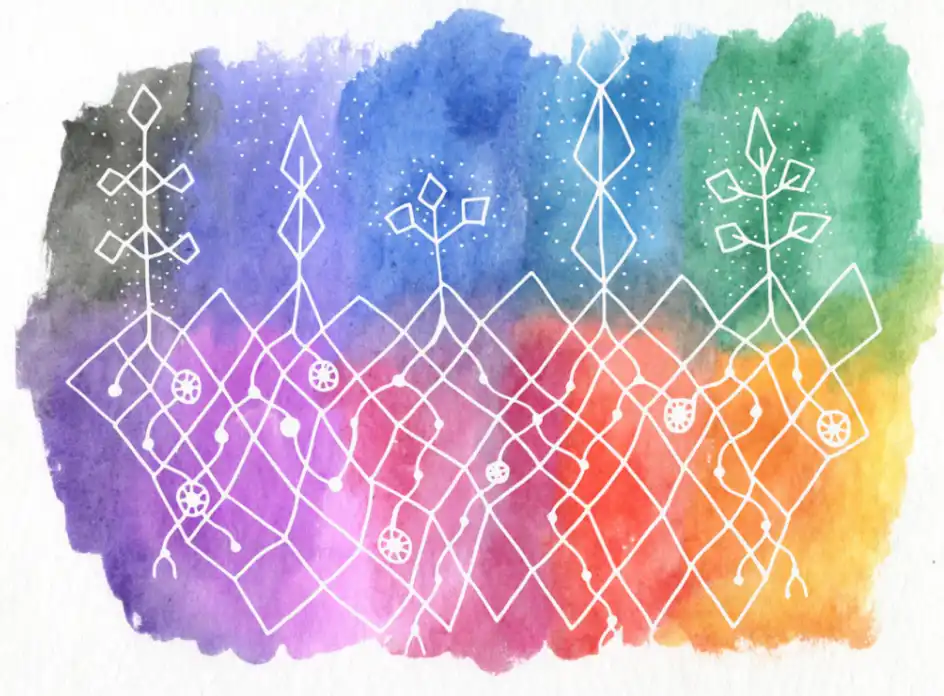
Source: Circlesandsticks
Your DAO already has an operating system
We are all familiar with the computer operating system (OS), which is the interface between the user and the computer. A buggy or poorly designed operating system can lead to a poor user experience and render an otherwise powerful tool useless.
Organizations also have operating systems. An organizational operating system determines how people will work together within an organization and how the organization will function. Just as in computer operating systems, bugs in an organization's operating system can make the entire system fail, inflame team conflict, and destroy the atmosphere of the community.
You may be familiar with the word "operation" in the DAO, but there is much more to an effective operating system than just "operation". The DAO operation is part of your operating system, but it is not the whole of your operating system. An operating system is the entire system, the coordination layer that allows DAO members to work effectively and achieve their goals in their organization.
What makes a good operating system?
Every organization has a way of coordinating its organizational functions, which is essentially its operating system. It's just that they may not realize exactly what the operating system is or how it was created. Most likely, operating systems emerge over time based on a set of decisions and procedures, implemented in conjunction with an organization's mission and values. Usually, no one can say exactly how the operating system came to be, but people who use it know it exists because they usually say "that's the way we do things around here."
We can use the experience of computer operating systems to understand organizational operating systems.What makes a good computer operating system:
High safety
User friendly
Available resource sharing
Easy to access
multitasking
A functional DAO operating system would include similar elements. The operating system should provide an intuitive and interactive experience for members of the organization, especially as it increases the knowledge and confidence that new members need when they start working. The system should be secure, with governance mechanisms to resist coercion or attack, for example. The system should be open, transparent, without permissions, allowing resources to be shared and easy to use. The system should also be flexible and adaptive to meet the changing needs of many users and teams over time.
What are the signs of a bad computer operating system:
High cost (organizational and technical debt)
unreliable
complex
Fragmentation of
Vulnerable to attack
Incorporate the DAO that you are now helping to build. Do you see any signs of a broken operating system? Does the governance of these DAOs seem fragmented? Do new members complain of feeling lost? If DAO has a lot of organizational debt, what happens if outdated structures or policies reduce DAO's productivity and culture? The effects of a bad operating system are easy to illustrate:
Culture will suffer. Efficiency will suffer. People will be affected.
Culture is traumatized, efficiency is impaired, people are affected
- Sarah Starrenburg
Daos offer an opportunity to change the way we work, but if they are going to be the future of work, we need to upgrade the way we organize. We need a new operating system.
Evolutionary (TEAL) organization
Translator's Note: Teal -- Guiding metaphor is biological system. These are goal-driven organizations, where purpose evolves, and members control groups through self-management. You don't need rank or consensus.
While DAOs are an emerging organizational structure, they actually share many core elements with so-called evolutionary or Teal organizations. Traditional organizations are hierarchical and tend to be profit oriented. Evolutionary tissues are more like living systems or superorganisms and tend to be purpose-oriented.
"I think that's the beauty of DAOs. They're constantly evolving. If it stopped evolving, I wouldn't call it DAO."
I've started to call it organism and tissue. I think this reflects the fluidity of the DAO and its ability to adapt through the participation of its members."
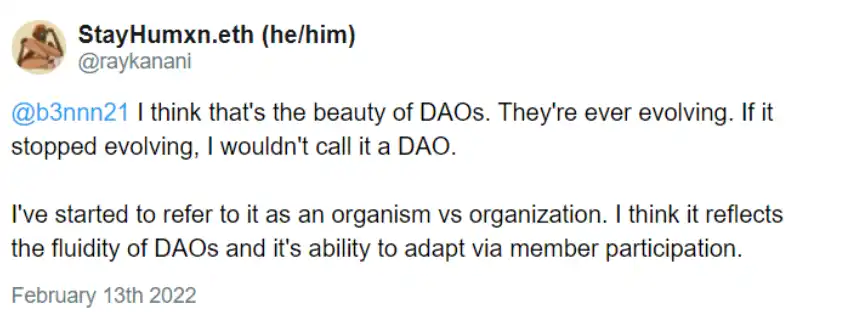
-- From Stayhumxn.eth (he/him) & NBSP; Twitter (https://twitter.com/raykanani/status/1492703208665460736?s=20& T = SiqqL6r_8lEg8h1siXt3Pw)
进化型组织是一种复杂的组织,其基础是感知和反应动态,而不是指挥和控制机制。与传统组织相比,它们的特点是有三个主要突破:
- Self-management: Individuals and teams actively promote healthy and conscious ways of working.
- Wholeness: allows members to regain their freedom and agency and work towards self-realization.
- Evolutionary purpose: An organization has a life of its own, evolving through its perception and response to the environment.
There have been many examples of evolutionary organizations whose successful operating systems are rooted in decentralized decision-making, flat organizational structures, open source information systems, and a drive to promote human prosperity rather than profit. Examples include Buurtzorg in the Netherlands, Favi in France, and Patagonia in the United States. All of these companies have proven successful, not just in terms of making money but, more importantly, in allowing people to do work they find more meaningful.
If the DAO is the future of work where people are free to pursue creative self-expression, then we need to design systems that support sovereign living.
"The best way to predict the future is to invent it." Peter Drucker
- from MMA Chennai Twitter quotes this week (https://twitter.com/MMA_4u/status/1015241605236903938?s=20& T = juHXkOUXkcxmJQC1_qBx0A)
A new operating system canvas
Aaron Dignan is The founder of The Ready, an organization design company that reshaps organizations around The Teal element of evolution. They identified 12 areas to rebuild the organization's operating system from scratch.
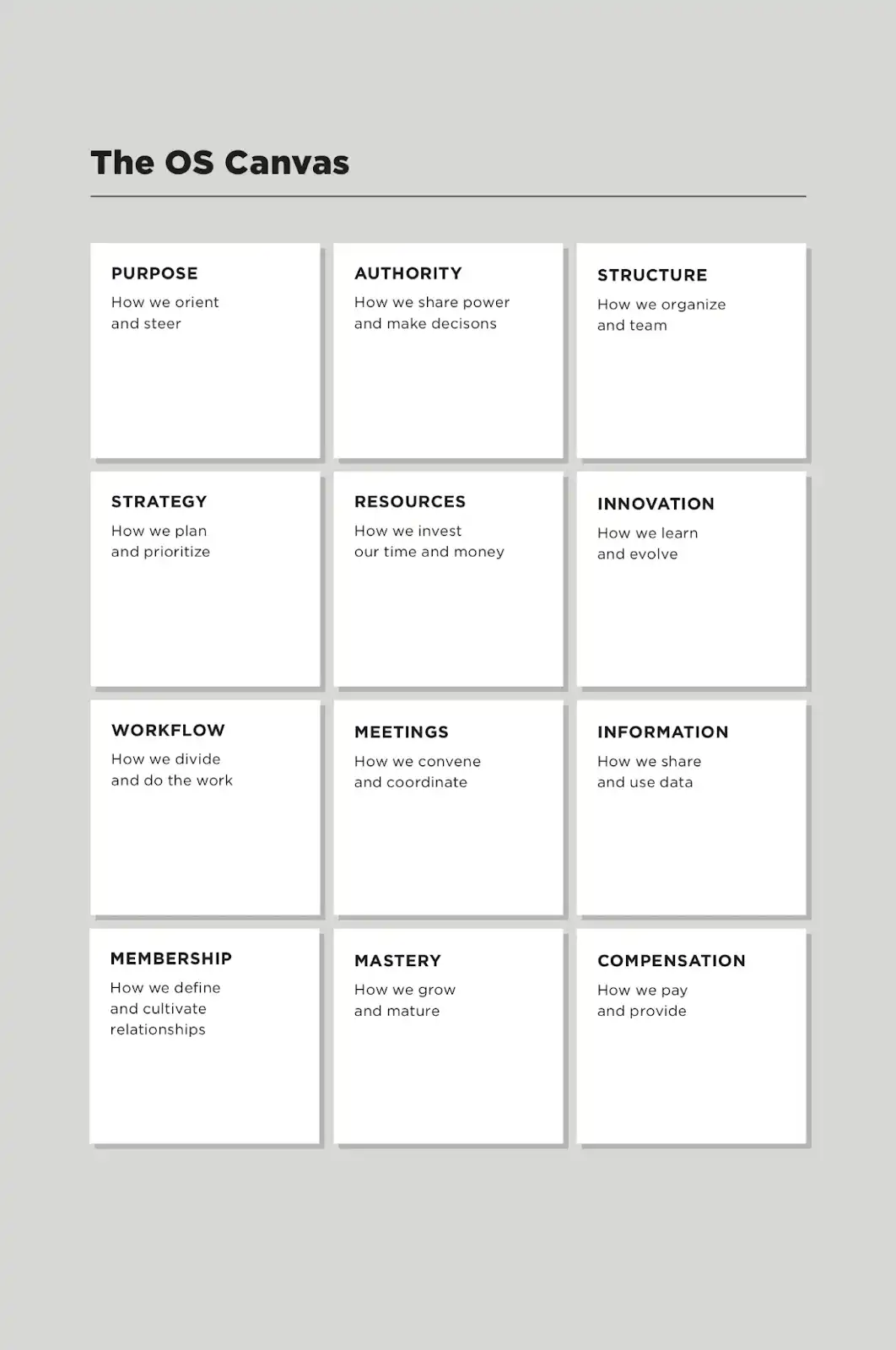
Source: The Ready OS Canvas
One way to understand these 12 areas is that each area encodes values and principles related to specific aspects of the organization. The operating system domain is the composable building block upon which DAO tools, governance, teams, projects, products, and cultures are built. By learning the key elements of the operating system, members can consciously update and upgrade their current system, perceive what the problem is in the ongoing process, and learn new ways of dealing with it.
Unlike computers, DAOs cannot download the latest and greatest operating systems. The reality is that in new, complex living systems, we will always need to apply the principles of perception and response. Change doesn't have to be dramatic reform from the top down. Instead, it can start with incremental improvement, meeting by meeting.
By understanding the core areas of the operating system canvas, you will find your way and be able to participate in pathfinding techniques. By perceiving and responding to problems and stresses in your organization along the way, you and the DAO can work to build a healthy community around common goals.
Update the DAO operating system
Purpose: How do we position and guide
Evolving organizations are goal-oriented, so they need a visible north star to guide contributors. A clear purpose enables organizations to organize around a shared vision and promotes defined direction. No one in the organization knows the next best step, but with a clear purpose, daOs can collaborate to ensure that steps are taken in the right direction.
Power: How do we share power and make decisions
Governance, or how we make decisions, is a key part of the DAO operating system. DAO distributes power and authority to communities based on shared values of freedom and autonomy. If everyone has the power to create change, then we need systems that facilitate decision-making and self-management teams.
DAO uses a variety of governance models to facilitate decision making: suggestion-based, permission-based, threshold voting, quorum requirements, soft and hard consensus. Each pattern has its own strengths and weaknesses, and there is no one-size-fits-all pattern for DAOs. Daos are complex and adaptable systems that require continuous improvement cycles of governance. They are constantly learning and experimenting, sensing and responding to what is happening in order to find their way forward.
Structure: How do we organize and collaborate
The DAO can be thought of as a multicellular organism, with many people, projects, and teams creating a dynamic living organism. As decentralized organizations, DAOs tend to be flat rather than hierarchical, and thriving DAOs will be built on open, composable structures. In many DAOs, self-managed teams are responsible for their own governance processes and determine how and why they work. Individuals often play multiple roles throughout daOs, even in different DAOs.
In many ways, DAO's structure can be compared to fractals, which are complex patterns with self-similarity at different scales. Self-managed individuals work in self-managed teams, projects, and communities, pursuing a shared vision. That's what fractal sovereignty is all about.
"I've been thinking about the same thing and really appreciate the idea. Fractal sovereignty through DAOs reconfigures the shape of human coordination -- the more interesting boundaries are not around DAOs themselves (like companies), but around working groups."
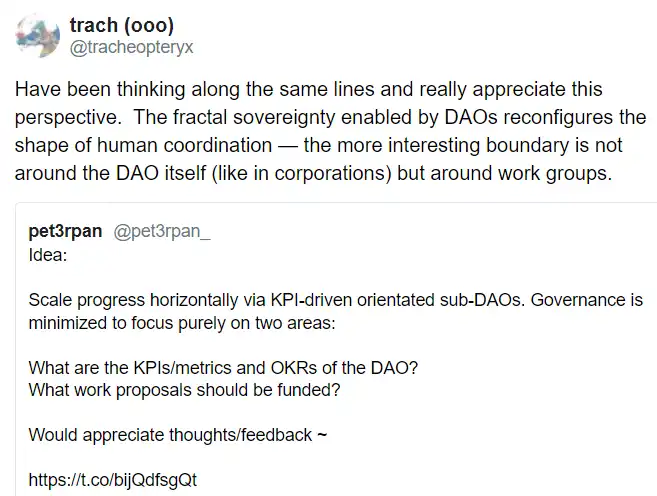
- Twitter from trach (https://twitter.com/tracheopteryx/status/1478700165221466121?s=20& T = VhRYhZKrI4yEjevK5vQglA)
Strategy: How do we plan and prioritize
Traditional organizations have been so obsessed with profit and success for so long that we have forgotten what an alternative strategy might look like. In understanding DAO's strategy as a superorganism, we need to start thinking about infinite games instead of finite games. The goal of infinite games is to keep playing, not to win or maximize profits. Similarly, the goal of the superorganism is to thrive and survive, that is, to play for the long term.
Evolutionary organizations often talk about perception and response, not command and control strategies. Individuals and teams are encouraged to develop awareness, feel the pressures and opportunities in the organization, and then find workable solutions and iterate on the best use of opportunities.
In complex systems, we can try to find the best solution. In complex systems, we need workable solutions and rapid iteration.
-- Frederic Laloux
Resources: How do we invest time and money
In an evolutionary organization, profits are not created for profit purposes. Profit provides the impetus for purpose and enables the organization to expand its influence and achieve its purpose.
In the DAO, resources such as time, money, attention, energy, and skilled labor nourish potential and possibility. Ecosystems are very efficient at using resources, transporting energy through communities and recycling waste. What has nature taught us about how DAO should invest our resources?
In nature, healthy soils contribute to thriving ecosystems. In the DAO, healthy humans, a nutrient-rich zero layer, contribute to human flourishing. The DAO needs to create renewable systems and continuously reinvest in human potential.
Innovation: How do we learn and develop
BanklessDAO encourages everyone to form a team around an idea. Before completing the proposal process and seeking funding for the project, start by building something and see what sticks.
The DAO should encourage the infiltration of creative ideas and the formation of communities around them. Many of these groups will disband, but some will continue to produce "whimsical innovations". Often, we think of innovation as the result of an organization's work output, but sometimes the most important innovation is the work done in the organization.
"The whole concept of how you build a company is fascinating. I find that the best innovation is sometimes the company, the way you organize."
-- Steve Jobs
Workflow: How do we divide and do work
Projects are where magic happens. The value created by projects is what drives task-driven organizations, and that's where people spend most of their time and energy.
Self-managed teams in DAOs often struggle with basic project management issues. Coordination can be difficult, and in a team where members have free access, getting work done on time and to specifications can be a challenge. High-performing teams often have a core group of contributors who contribute to a strong cultural drive to deliver services consistently.
Meetings: How do we convene and coordinate
Conferences provide such an opportunity for community members to bond, expand the community atmosphere, foster trust, and provide a space for the wisdom of collective consciousness to occur. Even if the agenda is AD hoc, the meeting should have a clear purpose. The BanklessDAO writers association holds three types of meetings each week:
Governance meeting: Focused discussion around changes in structure, strategy and resources.
Team synchrony: Project-focused discussions around workflow, innovation, information, compensation, and retrospectives.
Writers' Committee: a community teleconference to discuss purpose, authority, information, membership and mastery.
Information: How do we share and use data
The DAO is an open source, transparent organization, so it is standard practice to provide all information and work openly. DAO uses collaboration tools such as Notion and GitHub to distribute and store information, create community manuals to align contributors' common mission, hold AMA information sessions regularly, and be more efficient when using pull-based information systems.
Community members: How do we define and nurture relationships
Community and culture are the glue that holds the DAO together. The DAO, which failed to create a strong atmosphere, also worked hard to grow the community and keep members engaged. Design an intuitive, opt-in onboarding system to bring new members into the work team, where they can quickly turn their attention to contributing and finding or creating roles. Members should be encouraged to take on roles in the project, or even multiple roles throughout the DAO.
Status and subordination are a core component of our relationships with others, and based on our ingrained cultural habits, decentralized, self-managed teams can easily fall prey to centralized, top-down command and control mechanisms. Teams organized around core participants and status often make it difficult for new members to join because they can quickly perceive how group structure and authority affect decision-making and power distribution. A good onboarding experience will equip members with the knowledge and confidence to know what they want to contribute to the community.
Mastering: How do we grow and mature
The future of work is not so much about HODLing your role and sticking to it as it is about role-playing. Members should be encouraged to go beyond their comfort zone, explore the edges of what they can contribute and learn to continue working under pressure and resistance. Just as children learn through play, members should learn by doing, take on roles and grow, and then hand those roles over to explore.
This type of role-playing promotes self-sufficiency and competence, but it also creates a flexible community where many members can step in to fill gaps as needed. This flexibility reduces the risk of founder syndrome, in which a single person or core group holds the key to an organization's success. It is common practice for BanklessDAO Newsletter teams to have members in a role for a period of time, and then train and impart knowledge to new members who take over the role.
As people explore new ways of working in DAO, they also need new reputation and decentralized identity tools that can serve as your Web3 passport. The on-chain reputation gained through Meritverse, NFT and POAP can serve as a proof of work resume in an anonymous ecosystem.
Compensation: How do we pay and provide it
Compensation is the last area of the DAO operating system, and probably one of the most challenging. Payment in cryptocurrency provides unique incentives, such as ownership and equity in the organization, but when DAO members work full-time on DAOs, members often struggle to make ends meet. There's nothing worse than exchanging your equity for fiat money to buy groceries.
While actual money is the primary motivation for work, DAOs provide other incentives that are often hard to find in traditional organizations. Many people who work at DAO emphasize the recognition they receive for their contributions, the meaning of finding work as an individual, enjoy participating in decision-making, and witness and experience the rapid personal growth and development that takes place in DAO.
Most self-managed teams in daOs adopt the practice of participatory budgeting, in which team members work together to determine the compensation structure. By making compensation and compensation transparent and open to discussion, consensus can be formed on various levels of compensation that are appropriate for the type of work being done. The DAO would do well to make compensation transparent across projects and teams in order to standardize compensation and try to move the organization toward incentives based on internal growth rather than external money.
Next big unlock
Crypto natives are familiar with Moloch, the god of coordination failure, as a concrete manifestation of the failure of community collaboration. When areas of the operating system become dysfunctional or fragmented, people suffer, work suffers, and organizations struggle to achieve their mission.
A poorly designed operating system can create islands of domain isolation or fragmentation that do not connect well to other domains. An organization with a decentralized structure that purportedly distributes authority and power may still restrict information, hold meetings, and make most decisions in the dark. In this example, structure and authority are treated as theoretical ideals, while the organization itself operates according to other values and principles.
A well-functioning operating system is one in which each domain is well integrated and interconnected to form a complex, evolving system. When distributed power is aligned with a decentralized structure, people have the ability to act on available resources and information in innovative ways based on perception and response strategies. Teams naturally form around ideas and coordinate effectively to get things done in a productive way. This culture attracts talent and organically absorbs new members. People have rediscovered their dignity, feel validated for their work, and have a sense of meaning and purpose. As people grow and develop, organizations become more productive, and that value generates revenue and profits. Profits fuel goals, and organizations thrive.
Daos can open up new ways of working in the Web3 world, but only if they move away from traditional enterprise operating systems. By creating an operating system that fosters open, composable, and collaborative workspaces, DAOs can usher in a new era of flourishing around productive, creative, and happy human organizations.
The DAO is what communities will look like in the future. They can be playgrounds for creating change and solving our greatest challenges.
The way of working in the future looks bright. Let's renew the way we work together to build a better world. We all know it can be done.
The original link
Welcome to join the official BlockBeats community:
Telegram Subscription Group: https://t.me/theblockbeats
Telegram Discussion Group: https://t.me/BlockBeats_App
Official Twitter Account: https://twitter.com/BlockBeatsAsia
 Related Articles