Web 3.0 is about data ownership, not decentralization
Original title: " Web 3.0 is about data ownership, not decentralization "
Original author: IDZ
Original compilation: heyyawn@DAOrayaki.org, DoraFactory
We all like to go The concept of centralization. Decentralization makes us feel like we are in control of our lives. Many even believe that decentralized platforms will be the future of the internet because they allow us to own our own data. However, this is a misunderstanding. In this article, the DAOrayaki community will discuss the extent to which blockchain technology allows us to control our own data and introduce readers to the ID ecosystem.
We use multiple platforms and services every day. We can often assess the centralization/decentralization principles of a service provider or network creator by looking at their controls. We consider its services to be decentralized when there is no central control. Conversely, when there is central control, we consider its service to be centralized. But no matter in a centralized or decentralized system, we all need an independent existence that can be fully controlled by us. And this independent existence is our account or wallet. In both cases, identity is essential to create an account or wallet. For example, we need to use an email address or phone number to create an account, or we need to use a mnemonic phrase to create a wallet. By its nature, "identity" is a centralized concept where users are in control of their data.
When evaluating the concept of centralization/decentralization, you as a user should focus on accounts/wallets that you have full control over, not those that you do not (i.e., data that is not controlled by others such as companies or user pools). In the best case, you need a single entity (account or wallet) that gives you full control over all your data and assets. We believe that to achieve this state of control, it doesn't matter whether a service or network is centralized or decentralized. Centralized and decentralized platforms have different usage scenarios, and both have advantages and disadvantages. You can't choose one and ignore the other.
We named this independent existence: ID. Full control over all assets is named: data ownership. The entire system supporting this framework is named: ID Ecosystem. We believe that once this framework is adopted, you will have full control over your data, peer-to-peer transactions will become passive, and true decentralization of data will happen naturally. A single "protocol" becomes an organized exchange of assets between two (or more) parties, governed by a transparent "contract", operating in a binary fashion and ensuring impartiality for all parties involved.
The concept of "identity" is bigger than "access control" of digital accounts. The concept of identity is closely related to ownership. Anything you own forms part of who you really are. Your online accounts, the artwork you make, the music you listen to, the services you provide, the physical objects you own, etc., are you. You are your data. It is useful to refer to Will.i.am's point on the importance of data (see here).
“Our data should be treated as a human right – and be compensated for it” (will.i.am, The Economist, Jan 21)< /p>
The ID ecosystem stems from a school of thought that has grown over the years, solving the same problems that blockchain networks face. The ID School believes that "data should belong to its rightful owner" so that the new Internet will be realized, and that users should "trust no one" when dealing with data.
1 The concept of identity
"centralization"
< br>
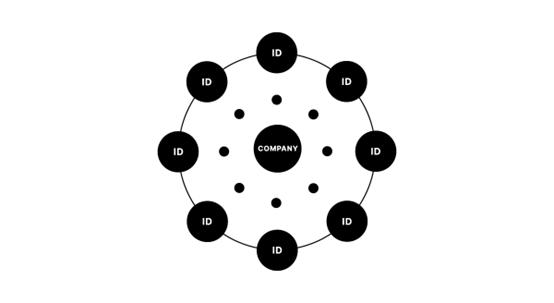
The picture above is a typical framework of Web 1.0 or 2.0 application. A company can decide to create a product/service where you as a user can create an account. This company gives you access to your data. For example, your creative content accumulates in social media platforms and companies give you access to your data. Fitness data collected from fitness trackers accumulates in apps that you can access. If you no longer have access to your account, your data will remain with the company. You cannot perform any operations on this data. The schema of the data is usually customized for the platform providing the service, so you cannot use the data elsewhere. You also cannot trade this data, donate data to medical research, etc. No wonder such frameworks always lead to privacy and data misuse issues wherever they are used.
「Decentralization」
< img src="https://image.blockbeats.cn/upload/2022-06-01/74178323e303e62ca4c2ac9262ff8627906369d8.png?x-oss-process=image/quality,q_50/format,webp">
Blockchain technology has taken a big step forward in solving the shortcomings of traditional systems. When blockchain technology was first invented, it was primarily used as Bitcoin's public transaction ledger. The rapid development of blockchain technology brings great value to users seeking data control. According to the core value of blockchain technology, it has recently transitioned to solve the problem of ownership. In other words, we use a transaction ledger to enable users to own and control their data. This is what we are currently seeing in the NFT space.
Although blockchain technology solves some problems well, it also has shortcomings. For the purposes of this article, the drawbacks we've described are primarily scalability and a fragmented user experience. Regarding scalability, we note the achievements of some networks and the good speed at which they process transactions. However, the current focus is only on low-weight metadata that can be replicated across multiple nodes/blocks. Data ownership should not be limited by size. Whether it's a few KB (kilobytes) of text or a GB (gigabyte) of high-definition video, anything you own is part of you. We believe that as we create more data and use newer hardware, the concept of ownership based on a decentralized network framework will struggle to keep up.
Regarding user experience, we noticed that different networks have different frameworks and protocols, which makes it cumbersome for users to manage their assets across networks. It can take hours for users to "bridge" assets across networks, and throughout the process, the user experience is problematic. In our view, everyone is trying to create their own network for their own benefit, without thinking about co-creating a "global" system that can meet the needs of all users.
"Ownership"

in IDZ , we trace the root of nearly every problem in today's technological world back to the identities we use. Email addresses are almost 50 years old, but are still active for account creation in different services. The new ID not only allows users to create accounts in different services, but also allows different services to create assets in the user's ID. If you no longer use a service, you still have your valuable data with you forever, and you don't need to ask the company's permission to delete or encrypt it. By default, your data never leaves your ID, and you can manage it however you like.
We define "data ownership" as follows.
Zero Knowledge
The data you have Cannot be decrypted by the ID Cloud where your ID is hosted.
Encrypt
Each file, asset , contracts or chats are all encrypted with different keys. When you share a file with another ID, you share their unique key. The data never leaves your ID and is processed by the devices you use.
Key Ownership
Encrypted Data All of your keys are in your hands and not controlled by ID Cloud or the service provider.
Open Source
Source of any ID cloud The code must all be open source to ensure there are no backdoors.
Full Control
You can at any time Export, import or migrate your IDs and data such as assets, contracts, chats, files from the ID cloud you use to another ID cloud.
You can choose not to store any data in the cloud and encrypt everything locally.
You can modify permissions, set who can access your data, and revoke access at any time.
Authenticity
Your asset is Authentic and always associated with your ID. You can distribute, own or request assets.

Currency beneficiary
You are the primary beneficiary of your data if it generates any revenue.
In short, if the blockchain technology is built on the core of decentralized transactions to achieve data ownership, then the ID ecosystem is to achieve The data ownership of passive decentralized transactions is built at the core. For comparison purposes, an "identity asset" in an ID ecosystem is similar to an "NFT" in a blockchain network.
Since you control which IDs communicate with you, which assets you own, and one operation in the system is "identify", you can Build any protocol within. Instead of a developer building a smart contract for you, you can build any protocol yourself in seconds.
So an email address or phone number allows us to create accounts in Web 1.0 and 2.0 applications. Wallet addresses and seed phrases allow us to use wallets, giving us access to the decentralized web. One ID allows us to use one ID cloud, giving us access to the ID ecosystem. So why is this important?
2 A new era begins with a new ID
Please imagine such a world. In this world, anything you own can become an asset under your full control? All the services you use revolve around you rather than against you? You can execute any protocol with one click, regardless of its complexity? This world will change our internet today.
Your money, your membership cards, your office access, your car, your agreements, your logins, etc., all of these can be "Assets" that you control within the ID Ecosystem. Opening a door, buying a cup of coffee, signing a document, etc. can all be "contracts" that you execute in the ID ecosystem. If you take a few minutes to reflect on your life and day-to-day activities, you'll see that establishing an ID begins with everything you do, whether it's unlocking a device, signing up for a new service, checking out at a retail store, etc. You always share what you have that identifies you.

Your ID Cloud app running on your local device can Alternative to "miners" as your data never leaves your ID. Sharing data becomes super fast because you only share the key that encrypts it, not the data itself.
All ID clouds share the same protocol and architecture as they all become nodes in the ID ecosystem for a smooth user experience. You are free to change where IDs are hosted and where assets are stored at any time. Cloud frameworks are always open source and available for review by anyone.
We envision a future where users own their data and have full control over their digital and physical assets. You can build an "agreement" from your ID in seconds and send it to the other party who can sign it on the spot. In the future, when you buy a new electronic device, you "recognize" it, "download it yourself" and configure the device in seconds. If you don't like your new device, you can quit and it's a new device ready to be used by someone else in seconds. Equipment and machines become the most important things you own and become your ID boosters.
If an attacker manages to compromise the email address you use, he can reset the passwords for all accounts associated with that email address. If an attacker manages to capture your wallet "seed phrase", they can access/transfer the assets in the wallet at any time, and there is nothing you can do about it. The concepts of identity and security are inextricably linked. There is no "insecure ID" because once it's not secure, it's not an identity.
In traditional Web 1.0 and 2.0 applications, those looking for more security would often purchase a security key (such as a YubiKey). In the decentralized world, cold crypto wallets are often used by those looking for more security. And in the ID ecosystem, those looking for more security will buy IDZ-enabled devices.
IDZ has created an ID ecosystem, and this is only a small part of it. IDZ is an ID cloud that acts as a database enabling users to own and control their various data. You can change where your ID is hosted at any time, or even just store your data locally on your device. ID Ecosystem is free for all users. 01 does not force you to use the ID ecosystem. The 01 and its successors are for those looking for the ultimate in safety.
Reference
https://www.economist.com/open-future/2019/01/21/we-need-to -own-our-data-as-a-human-right-and-be-compensated-for-it
Use Cases: https://idz.com/use-cases< blockquote>Twitter: http://www.twitter.com/idz_01
Discord: https://discord.gg/idz
Original link
Welcome to join the official BlockBeats community:
Telegram Subscription Group: https://t.me/theblockbeats
Telegram Discussion Group: https://t.me/BlockBeats_App
Official Twitter Account: https://twitter.com/BlockBeatsAsia
 Related Articles