Starting from the social graph, what is Web3.0 up to?
Original Title: "Starting from the Social Graph, What Is Web3.0 Doing?"
Original Source: LD Capital
Value of the Social Graph
The social graph is a mapping of social relationships between individuals, reflecting who users know through various means: family members, coworkers, classmates, etc. Facebook CEO Mark Zuckerberg introduced the concept of the social graph at the first Facebook F8 Developer Conference, where it was used to explain how the newly launched Facebook platform would leverage interpersonal relationships to provide a more user-friendly web experience.
Today, the social graph has become the most core value of every social platform. When users register and log in to a social platform, the platform will use the user's registration information to find people they might know, recommend topics of interest, record all the content they have browsed on the platform, their interactions with others, and based on this information, form a user-centric social graph. In other words, this graph will contain your social relationships, interests, lifestyle habits, etc., and the platform can roughly outline your user profile based on this data.
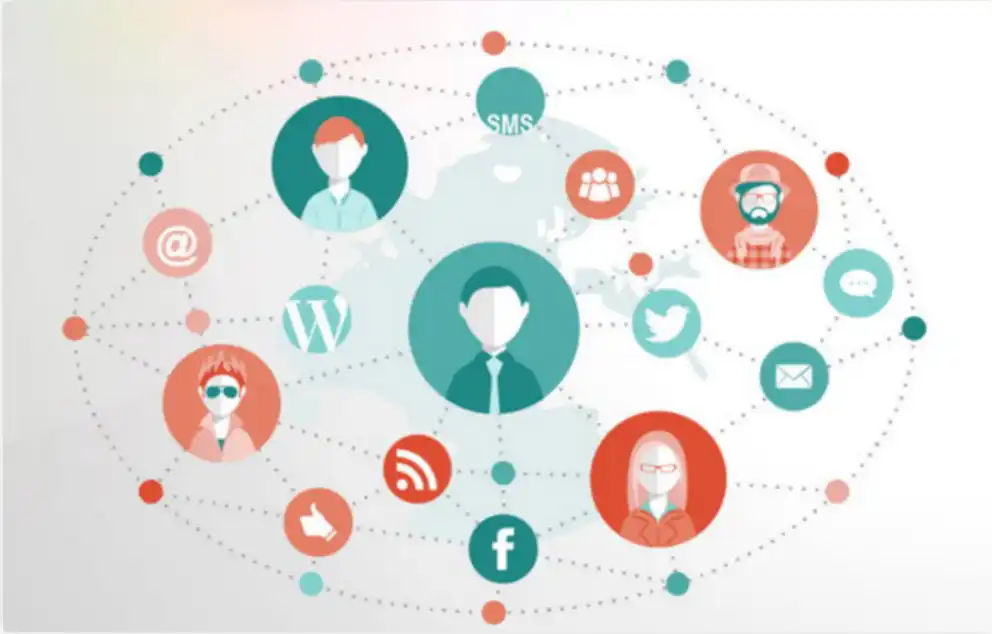
Image sourced from the internet
So, what's the use of this? Let's start with a set of data:
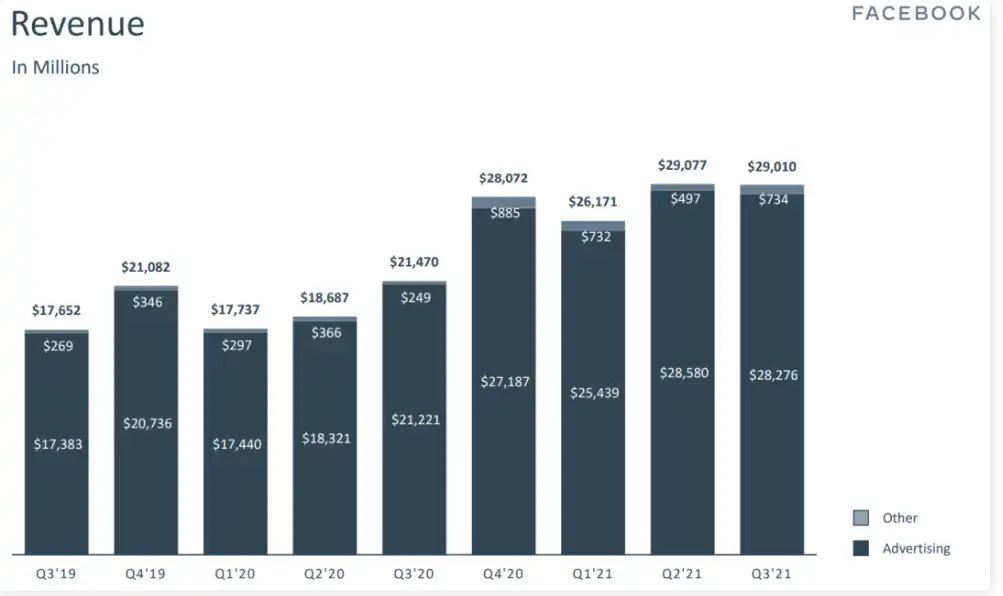
Image Source: Internet
This is Facebook's financial report for Q3 2021. According to the report, Facebook's total revenue in the past year was about $209 billion, with advertising revenue reaching $205 billion, accounting for over 90%. This is because the core profit model of most Web 2.0 applications is to provide free services to users, collect user data, and earn advertising revenue from advertisers. Taking Facebook as an example, personalized ad recommendations and content suggestions generate hundreds of billions of dollars in revenue each year, all of which are actually monetized using user behavioral data as leverage.
A Discussion on the Pain Points of Web 2.0 Social Graph
Due to the nature of Web 2.0 application architecture, which stores all data in a centralized database, the social graph data formed by each user on social platforms is controlled by the platform's owning company. When users register for a social app or any application, they are required to sign a "Terms of Service" and "Privacy Policy," which means that you agree that the platform owns your data and has the right to interpret it. Even in cases where users make inappropriate comments, they may face the risk of being banned. Therefore, for users, their social behavior creates value for the platform, but the value is not shared with them. They only have the right to experience the product.
Furthermore, platforms constantly monitor users' every behavior, collect user data, and while much of the data may not have a specific purpose at the time of collection, with the increasing maturity of big data technology, privacy breaches frequently occur, leading to serious social issues. Large-scale fraud cases in pensions, healthcare, charity, and more have all been caused by information leaks. Facebook user information has been exposed and exploited by the data firm Cambridge Analytica, and Facebook has faced multiple lawsuits for privacy breaches.
Additionally, in the Web 2.0 world, user data is like isolated islands, making it difficult for these islands to communicate with each other. To retain users and increase user engagement, social media giants spare no effort and expense to build moats around their platforms. Once a user switches to another app, they must abandon the social graph they've built. Therefore, every time a user creates a social account, they must reconfirm their identity information, start from scratch to build their social relationships on a new platform, incurring high migration costs.
Explore the Web 3.0 Social Graph
The goal of Web 3.0 projects is to return data ownership to users. Based on blockchain technology, user data is very transparent. Information such as how many transactions you have made, which DeFi projects you have participated in for mining, etc., is all hidden in your wallet address. An address can log in to numerous applications, and the actions taken within each application are clearly recorded. By mining and analyzing this data, a complete user profile of each address can be outlined. The Social Graph Protocol aims to organize and present users' on-chain profiles and behaviors in different ways.
Lens Protocol
The Lens Protocol is a social graph protocol built on Web3 smart contracts on Polygon, developed by the Aave team. It advocates for creators to have ownership of their relationship with the community, forming a permissionless, composable, and user-owned social graph.
The Lens Protocol primarily operates around the Profile NFT. The Profile NFT is key to users controlling their data ownership. Its metadata includes all user-generated posts, shared articles, comments, and other behavioral history. When a user logs into an application based on the Lens Protocol, they can synchronize all the data inside the Profile NFT, obtaining the user's on-chain activity trail. If a user changes their address, the NFT can also be transferred.
Users connect their wallets to the Lens Protocol, create a homepage, which is then minted as a Profile NFT. Only users holding the Profile NFT can create and publish content, comment, and share. Other users without a Profile NFT can only follow favorite bloggers and collect the content creators' posts.
User categorization within the Lens Protocol:
Content Creators: Must link their profiles to the protocol to create a personal Profile page and receive the Profile NFT accordingly to publish content, share content, and comment;
Non-Content Creators: Can only follow their favorite bloggers and collect the content they publish. When a user follows a content creator, they receive a Follow NFT, which records the order and quantity of users following. However, content creators can determine whether followers can receive the Follow NFT, such as through payment or completing certain tasks. When users collect a creator's content, they receive a Collect NFT, which records which fans have collected or purchased what content.
Developer, provide modular components for developers to customize these components to build social products, so Lens is more like a backend product.
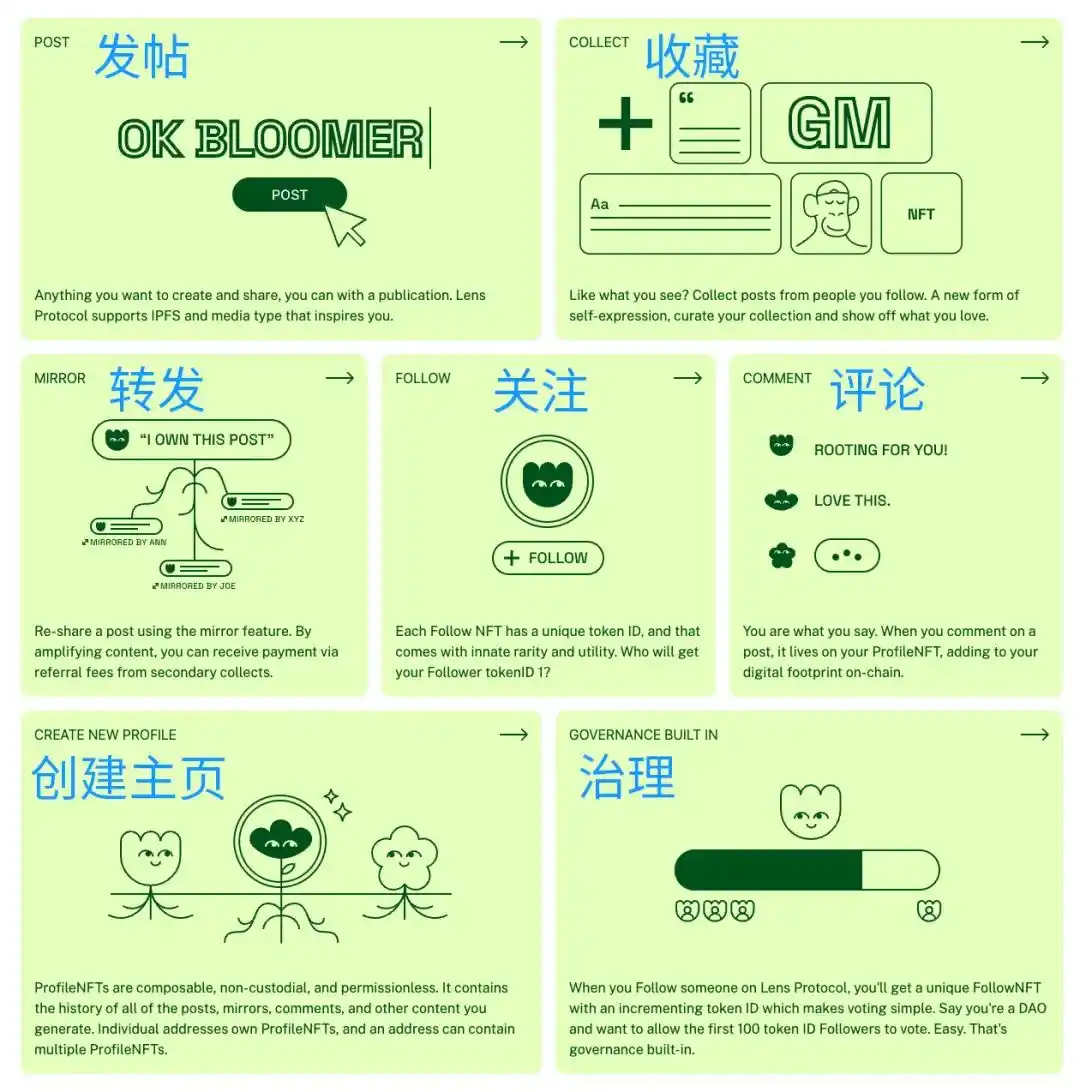
Lens Protocol Base Module
Lens is currently not open to the public, only some addresses are eligible to mint Profile NFTs, with a total of 44,525 minted and a total of 93,335 posts. Other data is shown in the figure below:

Image captured from the Lens official website
There are 9 applications built on the Lens protocol, currently no tokens.
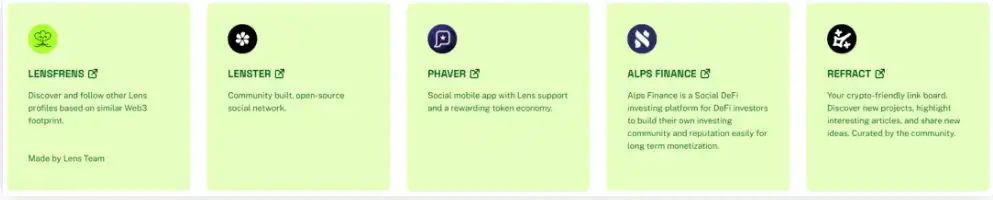
Image sourced from the Lens official website
Lens Protocol Features:
Content, Data Ownership Tokenization: Built around NFT as the core, the interaction of multiple NFTs manifests social behaviors such as likes, reposts, collections, forming a graph. Users can autonomously control the ownership of these NFTs, e.g., transfer, sell, or participate in governance, and can carry them into any application built on the Lens protocol, making data migration more advantageous.
Component Modularization, Strong Composability: Social functions are modular, following whitelisted smart contracts called in specific execution steps, e.g., when a user views a profile, it triggers the Follow smart contract, when a user likes or collects content, it triggers the Collect smart contract, allowing developers to use these modular components to build their own apps on Lens.
Limitations:
Every step of operation when using the Lens protocol requires wallet address signature verification, especially for high-frequency applications like social media, which brings some troubles: first, user actions such as follow, comment, or collect all incur fees, so Lens opted for a solution based on Polygon. Although the gas fees are relatively low, this design makes the user experience somewhat less smooth; second, users need to constantly confirm the wallet address, which significantly affects the user experience.
The social graph of users on Lens is built around the NFT of their profile, so the establishment of social relationships is entirely from scratch, making the construction process quite challenging.
Apps built on the Lens protocol can share user data; however, developers still need to fetch on-chain data themselves, then restore it using a database, incurring a certain cost.
CyberConnect
The CyberConnect protocol was founded in September 2021 and in November received a $10 million investment from institutions such as Multicoin Capital, Sky9 Capital, and Animoca Brands. It is the first decentralized social graph protocol.
The social module of CyberConnect is relatively simple, mainly composed of a [Follow Button] and [Follower List]. Users can follow each other through the Follow button to establish relationships with each other. The core of the protocol is a decentralized and tamper-proof social address book, which can effectively promote user-centric data creation, update, query, and verification. Its technical architecture focuses on three aspects:
1) Storage: It adopts a customized IPFS mutable data stream storage by Ceramic to achieve decentralized storage of the graph and data update function;
2) Identity authentication and authorization: It designs a secure key scheme to distinguish identity keys from user transaction keys, avoiding fund risks;
3) Data fetching: Data indexers aggregate on-chain and off-chain data.
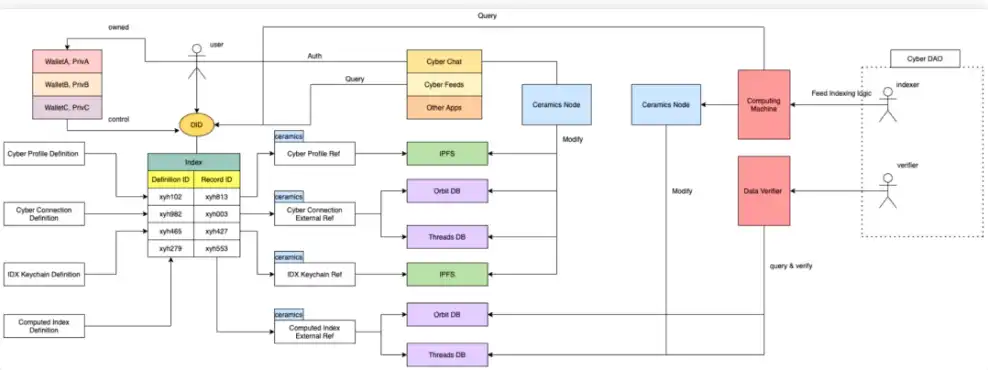
CyberConnect Official Website
CyberConnect's data sources mainly include three aspects: firstly, data from off-chain sources and transaction data sources are fetched, organized, and integrated; secondly, indexers form new data based on the existing off-chain social graph; additionally, when users authorize the use of CyberConnect to log in to DApps, the data of the user's social graph on DApps will also be fetched by CyberConnect. Therefore, CyberConnect combines existing social graph data to form a social graph on Web3.
CyberConnect supports address binding on both Ethereum and Solana blockchains (BSC chain data not included), with a user base of 1.49 million and indexed users of 1.89 million. CyberConnect is moving towards a multi-chain direction. Additionally, the protocol has incubated ecosystem applications, currently supporting over 30 projects covering various sectors including social, NFTs, decentralized identity, wallets, and more.
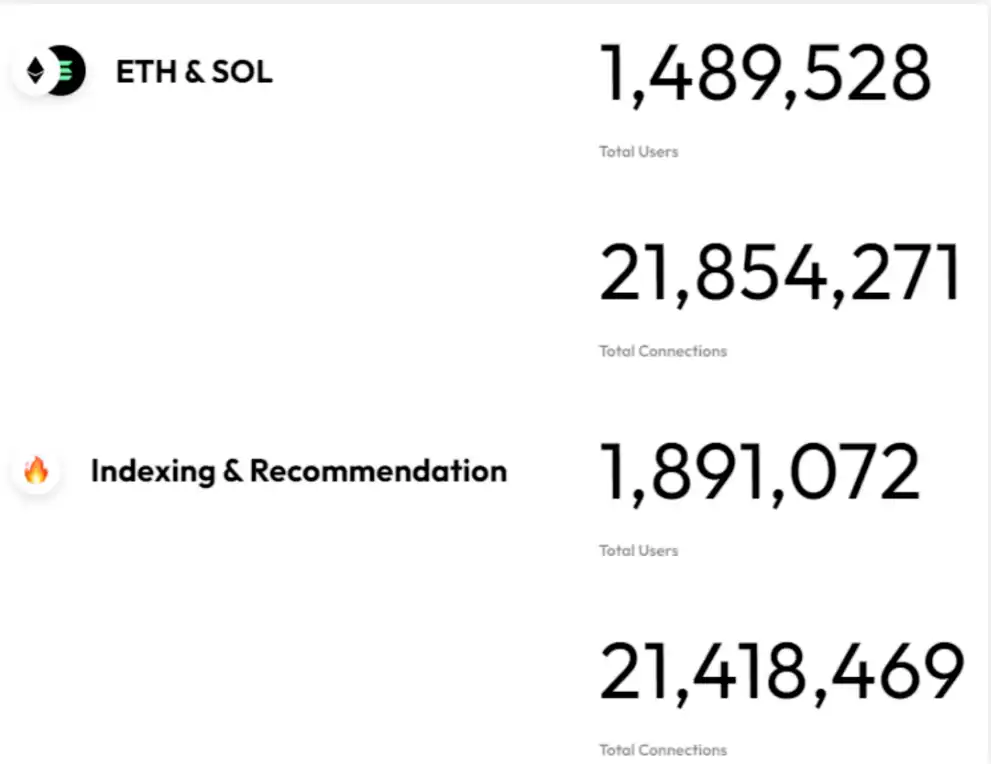
CyberConnect Official Website
CyberConnect Protocol Features:
CyberConnect is a multi-chain, multi-platform social graph protocol that automatically links users' accounts from Opensea, Mirror, and others. It focuses on providing infrastructure integration services for developers of different applications, enabling these applications to efficiently and quickly adopt CyberConnect's social graph data.
CyberConnect addresses the user social data sovereignty issue with a centralized storage solution, better suited for storing large data where data creation and modification are relatively straightforward.
Limitations:
CyberConnect currently has limited functionalities, and the cost-free social graph read/write feature contributes to potential protocol data redundancy.
CyberConnect utilizes the Ceramic storage solution, which experienced downtime due to a surge in user activity, highlighting the need to validate its high-concurrency solution.
5Degrees
5Degrees is a social graph protocol incubated by the TokenPocket wallet, built using the ERC-1155 standard, and transforms users' core data (such as the following address list and other user relationships) into Profile NFTs, thereby forming an infrastructure for a social relationship network.
The 5Degrees protocol implementation is quite similar to Lens, operating around Profile NFTs and providing basic social functional modules. However, this protocol only offers a [Follow] function; when users follow a creator, they can receive the creator's personal NFT, namely Follow NFT.
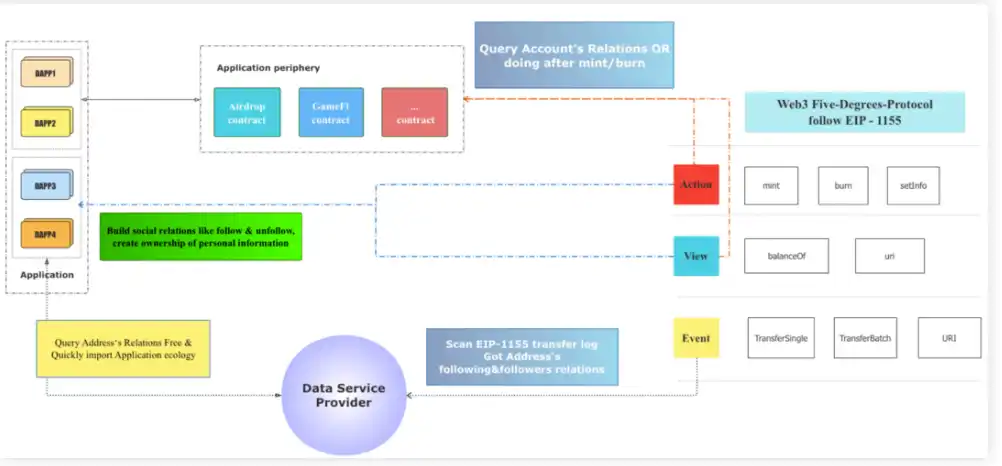
5Degrees Official Website
Currently, 5Degrees has released the Fans3.0 personal homepage product. After connecting their wallet, users can access their personal page, which will directly display all assets in the user's wallet address, including NFTs, POAPs, as well as interacted DeFi protocols and identity verification protocols.
In addition, there is Uniswap and PancakeSwap with added social modules, where all users can intuitively access detailed transaction data of the people they follow.
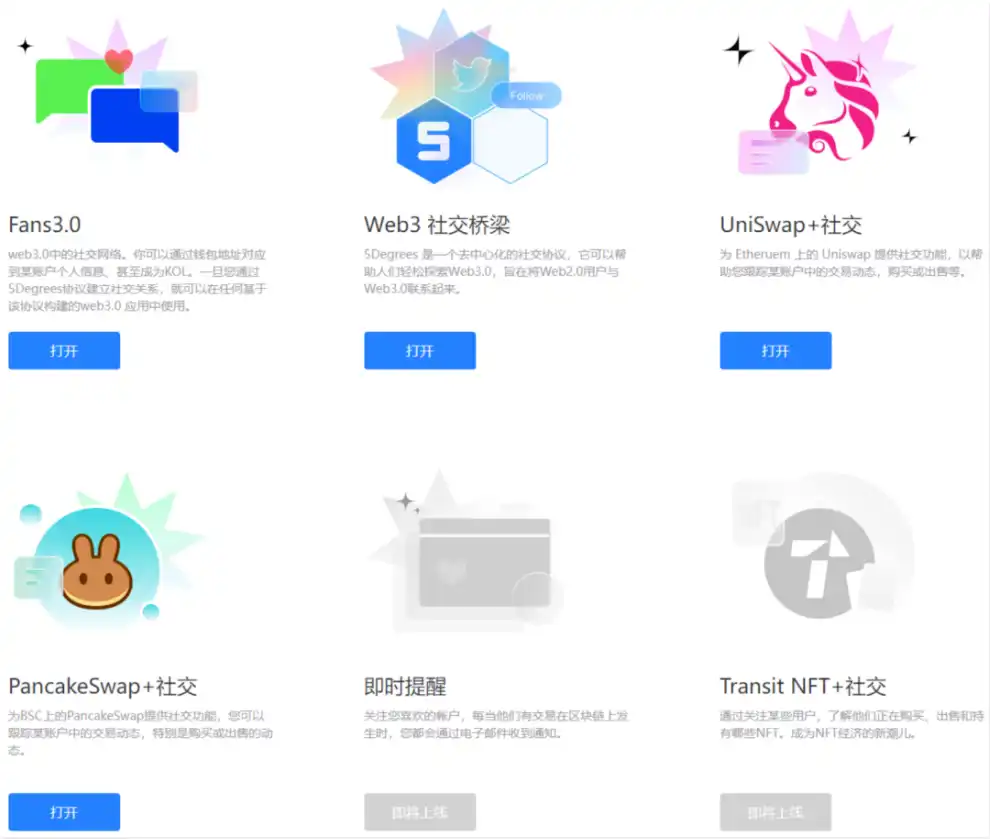
5Degrees Official Website
5Degrees Protocol Features & Limitations:
The implementation principle of the 5Degrees protocol is largely similar to Lens, but the provided functionality is relatively simple, still some distance away from building a social graph.
It allows other applications to access it, and any project that supports the ERC-1155 standard can integrate this protocol.
The above are the most representative projects of social graph protocols. Currently, there are mainly two implementation approaches for social graph protocols: one is to tokenize user data as NFTs, and the other is to adopt decentralized storage technology solutions. The former's advantage is to directly turn user data into NFT assets without the need for more complex encryption technology, while the latter is more conducive to big data storage and facilitates easier data modification.
In Conclusion
Looking at the current Web 3.0 social ecosystem, it can be roughly divided from bottom to top into the underlying public chain application carrier, decentralized data storage, a decentralized identity layer presenting on-chain user identities and relationships, upper-layer social application products, and user entry tools and plugins. Among them, the social graph captures the relationship between on-chain users and accumulates data, making it an essential component of building Web 3.0 decentralized identity infrastructure.
However, the current construction of the decentralized social identity layer is not yet perfect and is still in its early stages due to technical barriers and application promotion issues. No one knows what Web 3.0 will be like, and most Web 3.0 users do not know what they want. Still, one undeniable fact is that cultivating users' decentralized identities is crucial, although this process is certainly not immediate. As Foresight puts it, the accumulation of quality relationships and network effects must reach a turning point to undergo a qualitative change, and we will always maintain an optimistic outlook on this!
This article is a contribution and does not represent the views of BlockBeats.
Welcome to join the official BlockBeats community:
Telegram Subscription Group: https://t.me/theblockbeats
Telegram Discussion Group: https://t.me/BlockBeats_App
Official Twitter Account: https://twitter.com/BlockBeatsAsia