Chatting about digital identity and Web3
Original title: "Calling on Digital Identity and Web3"
Original author: Cat who loves fish, chain thinking
"Man is the measure of all things" - Protagra (Ancient Greece)
"Identity is the measure of man, and numbers are the measure of the world" - Web3
< /p>
Talk about identity
From ancient society to modern society, people are born with identity attributes, and the sources of identity are mainly two aspects: nature and society. Therefore, identity attributes have different stages and connotations in the process of human evolution.
The first stage: the society of consanguineous marriage relationship. Typical social forms include primitive group society, blood-related family tribal society, and matrilineal clan tribal society. At this stage, human beings are still in the era when the means of production are extremely scarce and require group hunting, so that they can barely live in the era of mammoths and saber-toothed tigers. The concept of identity is relatively vague and fixed.
The second stage: the society of economic form. Typical social formations are familiar and lasted until modern times, including slave society and feudal society. In these two social forms, the development of human productivity has almost solved the problem of food and clothing, and has produced a surplus. But it is precisely this only surplus that changes the relations of production and gives birth to a spiritual world in which the exploiting class is very centralized in nature and suppressed by theocracy. This is especially evident in the West. Before the Renaissance, all creations in the West were looking for miracles and God. The change of dynasties in the East is also under the banner of the divine right of kings. Later, the West took the lead, such as Dante's Divine Comedy, Mona Lisa's smile, and Van Gogh's Starry Sunflowers. In essence, they all explored democracy and human rights and weakened theocracy. As for the Eastern civilization, the Manchu Qing Dynasty entered the customs because the number of troops was only 130,000 to 48,000, and it was necessary to rule 60 million people. It was impossible to liberate your identity in the feudal closed country, and it was considered to have missed the window period of modern civilization. At this stage, the concept of identity in the East is still solidified, but the concept of identity in the West has been loosened, and there is a trend of diversification of identities.
The emancipation of the Renaissance (in web0) stimulated the creativity of the people, and the progress of post-modern science promoted the Western era of great navigation, colonial era, industrial revolution etc. For hundreds of years, capitalist society has created a large amount of social wealth. Capitalism has weakened the natural attributes of human identity, but the social attributes have become more and more important. At this stage, human beings are inevitably carrying out collective production. However, the rapid update and iteration of productivity is accompanied by sheep cannibalism in the enclosure movement, and machine cannibalism, human cannibalism, and human encroachment in currency wars. Human beings cannot avoid it. Bearing the pains of development.
The fundamental reason is that the ruling class and the leaders of the world rules do not fundamentally pay attention to each group and each individual as an equal part of the larger collective, The objective reason is that the development of production tools and development of production concepts is still immature.
With the development of infrastructure such as blockchain, AI, cloud computing, 5G, Internet of Things, and Industrial Internet of Things at the technological level, the world's competitive landscape and The philosophy of development is changing. The creative ability and enthusiasm of individual creators will be greatly released, and the cost of learning, trust and creation will be greatly reduced. This is the charm of global large-scale infrastructure. Although what we see in the short term is full of gunpowder, but the inflection point has already appeared.
A new trend of thought comparable to the Renaissance is coming, and the concept of identity that comes with it is unbound here, and it is necessary to pay attention to different groups and different races and Individual minds develop and more human rights are given to human beings.
The third stage: a society where individuals develop in an all-round way. The third extremely important point is not only to increase the spiritual attributes of people, but also to develop the human spirit. With the advancement of science and technology, innovative thinking will completely liberate manpower, and at the same time, it will be equipped with development tools and development concepts that are in line with the development of the times. This area is still in the exploratory period, which is a process of co-construction, co-creation, sharing and co-prosperity.
Looking at the three stages of development, the development of human identity has experienced identity centralization and identity unbundling, and is in the early stage of the third stage of identity equality. DID, the peer-to-peer identity infrastructure tool, controls the ownership of the data in its own hands; it controls the bargaining power of the data through the decentralized mechanism of the blockchain.
1. Cryptography: the source of decentralized infrastructure
( 1) Modern Cryptography
Steven Levy explained in his landmark 2001 book Cryptography Over the past 50 years of cryptography development, from the initial cryptography serving the political circles, the US National Security Agency (NSA); then the cryptography monopoly was broken by academia. In 1967, David Kahn published The Codebreaker, a how-to book on cryptography—the NSA blocked its publication.
In the 1970s, academia developed the concept of public key cryptography. Shortly after the birth of public key cryptography, Ralph Merkle (Ralph Merkle) conceived the earliest public-private key protocol. Merkle is the "Merkel" in the Bitcoin data structure. In 1977, three MIT professors invented public key digital signature technology and founded RSA Security, which was later sold to EMC for $2.1 billion. In the 1990s, public key-based infrastructure (SPKI) was developed and it was realized that encrypted credentials could serve as authentication credentials. This is where blockchains, SSI verifiable credentials, and zero-knowledge proofs come in. With the publication of the Pretty Good Privacy (PGP) book and source code in 1991, encryption attracted a large following, cryptography began to be democratized, and the cyberpunk movement began.
(2) Cyberpunk Movement
Cyber The term punk was coined by Bruce Bethke from his 1983 short story of the same name. Cyberpunk is a literary movement, a quasi-countercultural genre of literature in the 1980s to be exact. Cyberpunk is a group of people who defend freedom of speech, freedom of information, and communication privacy through exaggerated methods. The more familiar cyberpunk emails should be. The cyberpunk movement also uses emails to transmit information in the world of hackers. The content of the discussion involves mathematics, cryptography, computer science and privacy encryption. By 1997, the email had more than 2,000 subscribers, some of which became Part of the SSI community.
(3) Digital Freedom: Digital Currency and Decentralization
Cypherpunks' exploration of digital privacy and freedom has prompted some people to enter the field of digital currency. Among them, Wei Dai is the creator of b-money, Nick Szabo is the creator of Bit Gold, and Hal Finney is the creator of Reusable Proof of Work (RPOW). Satoshi Nakamoto, the creator of Bitcoin, made the first Bitcoin transaction with Hal Finney.
Digital currency transactions are inseparable from cryptography, not only for digital security, but more importantly for decentralized control. Intrinsically linked between privacy and decentralization, only cryptography can protect your data to the death. Address user privacy issues in data protection by building appropriate encryption tools. What the SSI community is realizing: Through decentralized digital wallets, everyone can control their own identity, data, relationship and their own keys. W3C proposes a solution DID, and is building a decentralized key relationship system to replace centralized password management facility.
(4) Encrypted Currency and Encrypted Credentials
From From the NSA to academia, from cryptography academic research to entrepreneurs, from the cypherpunk movement to cryptocurrency creation, to verifiable cryptographic credentials for the SSI community. The purpose is to provide digital citizens with more digital privacy protection, safeguard digital sovereignty and digital bargaining power, which is also a key part of the decentralized economy.
2. The Internet and Digital Identity
In the 1960s and 1970s, Maxwell et al. The exploration of the basic theory of electromagnetism has opened up a new way of connection for human beings. In the feudal period, people used vehicles, horses, post stations, etc. to solve the end-to-end transmission problem in the long-distance process. The breakthrough in electromagnetism provided a new way for the subsequent information transmission. Information can be transmitted in human society through electromagnetic signals, which greatly promoted the development of the Internet later.
The development of the Internet has created a new digital world for human beings. The end of Web2 or the era of mobile Internet is the starting point of data assetization. In the digital world, data is the factor of production, and the circulation of data is the process of creating value. Among them, the most important production relationship is the ownership relationship of data, which needs to clarify the sovereign identity of data. The most popular concept among them must be self-sovereignty management (SSI). The community derived from cryptography has promoted the democratization of digital identity.
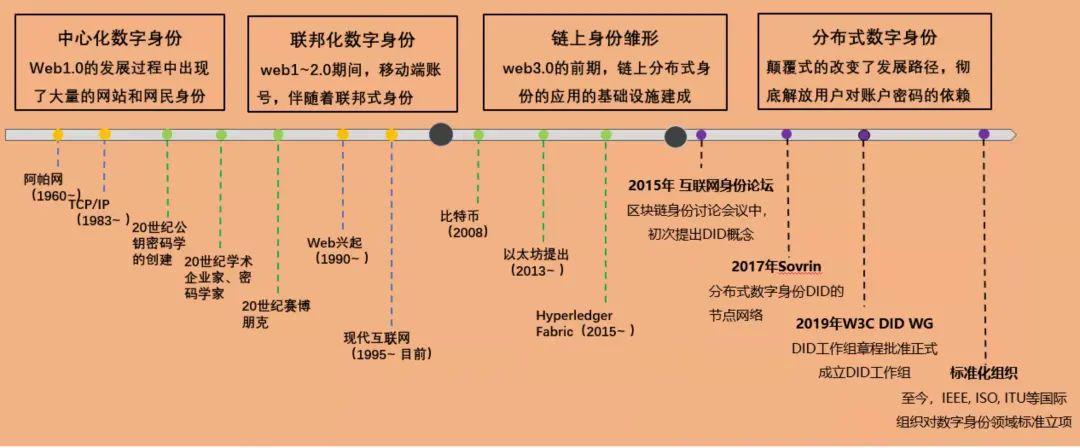
Digital identity is the only mapping mark of human beings in the Internet space, carrying digital rights and digital obligations at various stages of development, along with the centralization and centralization of the Web The development of centralization and decentralization can also be divided into three stages: centralized identity, federated identity and distributed identity. Following the transformation of human identity relationship in social development, it is divided into digital farmers and landlords Web1&2, and digital identity peer-to-peer relationship web3~X.
(1) In web1
Web 1.0 is a static Internet, the main Apps are online media. Various online media employ a large number of online editors to publish content with both pictures and texts as web pages. Readers visit portals to browse news, novels and other content, but they can only read but not write, and cannot participate in the creation of content. The entire Web 1.0 media is equivalent to the digitization of traditional newspapers and magazines.
The main body of this stage is that commercial companies transfer human knowledge to the Internet through commercial power to realize knowledge sharing. Commercial companies earn huge click traffic, such as Google, Sina, etc. provide services such as search and advertising.
(2) in web2
Web2.0, It is an interactive Internet, and its main applications are social networking and e-commerce. This stage enters the user production stage. The platform only provides an infrastructure, and there is very little content created by itself. Most of the content is created by users.
However, the platform has secretly expanded its rights, relying on its own control over the technical infrastructure, subtly exploiting the cognitive gap of information asymmetry , Transfer the ownership of user data to your own hands. Domestic Web2 industry giants such as Modong, Mouxun, and Moudi use the data of Chinese people to go public in the United States because they sell data. Foreign Facebook steals user privacy, and Twitter affects voters' freedom of speech. The essence is that centralized identities can be modified by service companies at will.
The above two stages are centralized identity systems, the interests of creators are divided by platforms and media, and centralized institutions such as platforms have absolute identity control. It is completely possible to add, delete, modify and check the creator's content, abide by the rules, and respect the interests of users depends entirely on the moral bottom line of capital.
(3) in web3
web3.0, It is the Internet of Value, which mainly confirms the rights of the content created by users, or the rights of residual value, and then according to the specific data agreement, the user selectively authorizes the data to a third party to get paid, thereby stimulating the creator economy. At this time, the change of data control has changed from the platform to the user, and the data has been transformed from user information to user assets, and the pricing power and bargaining power are in their own hands through the blockchain protocol.
Data goes to digital assets, content creation goes to pure market economy, value exchange is realized based on blockchain protocol contract, the monopoly position of the platform is broken, and creators are The mainstay of the times, rather than a middleman platform across the supply and demand ends.
(4) In WebX
Web3 is the creator The technical base of the economy, Metaverse is its various scene applications, and the creators are all web3 netizens. At present, in Web3, the controllers of production factors and production tools determine the production relationship. Due to the existence of information inequality and poor cognition, middlemen make a difference and even monopolize the market. In the real Web3, creators will dominate their own digital sovereignty. In WebX, they will gradually regain the sovereignty of land, capital, technology, and labor force, realize the freedom of production factors, eliminate exploitation in production relations, and achieve equality between social relations and production relations.
But especially after domestic detoxification, the blockchain infrastructure BTC, ETH, etc. cannot be decentralized, and are even easier to be manipulated. Blockchain is an equity tool that changes production relations and distribution. It is impossible for a truly completely decentralized infrastructure to be produced in a social soil with such productivity. Multi-centralized decentralized services are more in line with productivity, or perhaps decentralization is just a utopia, which requires a clear understanding and a solid consensus of the collective. Deliberately pursuing a completely decentralized underlying infrastructure is out of the current status quo of social development, and the cost is too high and difficult to achieve. It should turn to ask for more digital asset control and bargaining power from other underlying facilities.
The control and bargaining power of the data mapped under the identity layer will be reflected in all parts of the next-generation Internet metaverse: the real world, the virtual world, the fusion of virtual and real, Fiction and reality alternate. Digital identity is the infrastructure to solve the chaos of identity development, and it is also a key part of solving the chaos of decentralized power at the bottom of the blockchain. A large number of new identities will inevitably be born in these four parts. Human beings urgently need a tool to describe and regulate such a huge digital world and establish a global identity system network.
There is a problem:
(1) National differences, there is a political game between countries, fighting for the living space of the nation in the physical and digital world.
(2) Cognitive differences, ordinary people have cultural and ideological differences, and it is difficult to reach a consensus.
(3) Class differences, the ruling class may not necessarily implement web3 and webX without incentives.
(4) Method differences, there are 112 digital identity DID methods in line with W3C.
(5) Underlying differences, DID method realizes optional blockchain, DLTs, P2P.
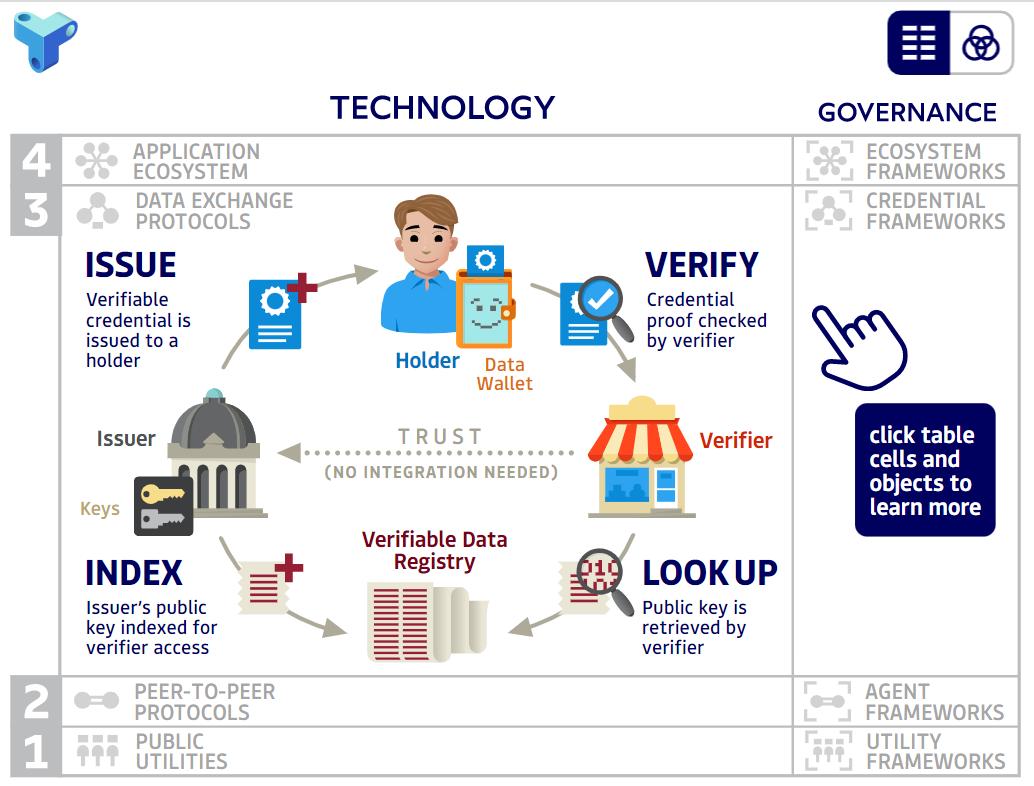
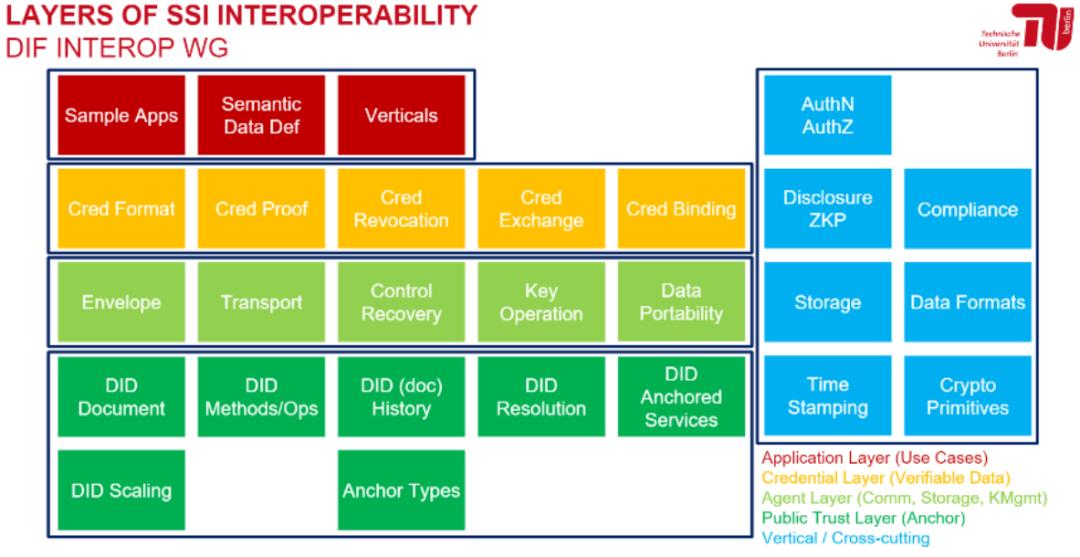
3. The underlying scheme of digital identity
How to ensure that the underlying digital identity is credible, the design of the blockchain is largely Solve the problem of decentralized trusted data sets. BTC, designed by Satoshi Nakamoto, proposed a solution to the double-spend problem that has plagued the development of digital currency protocols and electronic cash systems for a long time. Among them, the workload proof method is a combination of technology and game theory, which solves the Byzantine general problem: how to reach a consensus when the communication channel is untrustworthy and insecure. Vitalik elaborated on the three parts of decentralization and trustworthy decentralization: architecture, logic, and governance must continue to maintain a decentralized design in the process of project development, otherwise decentralized power will inevitably be concentrated and centralization will occur.
The DID method implementation of the Sovereign Identity (SSI) community can choose blockchain, DLTs or P2P. Blockchain and DLTs have lost most of their meaning after the hype cycle of the blockchain. Now we should abandon the label and focus on how to achieve decentralization through various technologies. We should act as a "believers" rather than "advocates" or " staunch supporter." The pursuit of decentralization is a process, a state, and should not be superstitious about a certain project, technology, or founder.

As technology develops, some solutions require hybrid modes. First of all, because its technology is mature enough, and in addition, the government and institutions allow citizens and companies to do it under the current or foreseeable future social framework, and at the same time solve the management problems of traditional institutions. This will be the consensus of the global government.
4. Digital Identity and Currency
(1) The missing protocol of the Internet
The missing transaction layer and identity layer in the Internet Web2 protocol. Until Satoshi Nakamoto combined different cryptographic techniques such as cryptography and Merkle trees to realize electronic cash transfer. Although BTC is not a legal currency, it makes up for the transaction layer of the Internet at the protocol layer. The same principle W3C develops standards: the combination of verifiable certificate VCs and distributed identification DIDs fills the identity layer of the Internet, and combines blockchain and distributed storage to solve the problems of trusted verification and data control.

(2) Identity and currency settlement
Before modern civilization, identity was usually determined by family, religion, and clan, and the distribution of social wealth depended on blood relationship and marriage relationship. When allocating in the original hunting scene, the history of allocating is calculated according to the IOU ledger of human subjective psychology. Money is useless in this situation. Later, as the tribe gradually expanded and the social network became more and more complicated, a unified settlement unit currency was required for settlement. Currency at this stage is only a tool for settlement and storage of value, and it is necessary to discover and mine minerals in order to increase issuance. However, in modern civilization, people do not know each other, so people must use intermediate equivalents such as currency and anti-counterfeiting technology to establish trust and a medium of exchange. Identity turns settlement between acquaintances into relationship settlement, and currency turns settlement between strangers into settlement based on technical trust.
The three functions of money: store of value, medium of exchange, and unit of account. Looking at the function of currency separately, currency is actually a technology, a technology that drives social efficiency and balances the information gap between supply and demand subjects in society. Like electricity, pipelines, networks, drilling and other technologies, the advancement of currency technology will inevitably greatly increase productivity and improve production relations. Decentralized cryptocurrencies based on blockchain cryptography are less costly than traditional centralized base currency technology under limited conditions, which is one of the reasons why each country needs to build its own CBDC.
When the identity technology of the SSI community is atomized and decentralized, identity and cryptocurrency overlap extremely, so Dave Birch (Dave Birch) ) declared that "identity is the new currency". Doc Searls, in The Intentional Economy, envisions an attention- and relationship-driven distributed P2P economy where both money and identity will converge into the human relational graph. The fusion of identity and currency is beyond the boundaries of current human agency operations, and this key will unlock more of the fringes of the future.
(3) Identity on the chain
Identity on the chain Mainly used for work, professional status and reputation. Based on multi-chain transactions, FT, NFT, domain names, and DAO participation records, it is used to represent on-chain identities, serving DAO management, NFT and domain name trading markets, project party recruitment and training, project short-selling, and establishing on-chain and off-chain data links , biological living features, data aggregators, etc.; Lit protocol and Ceramic data protocol are dealing with issues such as ownership privacy on the user data chain.

(4) Identity Empowerment
In addition, digital identity provides a new mode of decentralization, verifiability and process automation, which can be applied to social networking, education, scientific research, IOT, industrial Internet, Medical care, traceability, Internet of Vehicles, etc. combine to build Web3 and Metaverse.

5. Digital identity issues
(1) Identity Solidification
Web3 will not solve the problem of identity and class solidification, and may even exacerbate it further. The base blockchain of Web3 is essentially driven by financial transactions, and the 28th rule of finance cannot be changed, unless a virtual world is continuously re-established or a supply chain system is re-established in parallel in the real world, and at the same time, it is continuously provided to subsequent participants. excitation.
(2) Reputation Evaluation
How to establish a centralized Reputation Management System (RMS), which deals with on-chain and off-chain reputation in some quantitative form, established and stored, applicable to trust relationships between parties. Quantifying reputation can help facilitate interactions between distrusting parties. The basic idea is to allow all parties to evaluate each other. When cooperating with one party, you can consider whether to cooperate based on the credit rating.
(3) Public issues
The identity system project is still It is early days, but the development of governance rules has already begun and will have a clear position. The digital age has the potential to create a greater digital identity divide.
Original link
Welcome to join the official BlockBeats community:
Telegram Subscription Group: https://t.me/theblockbeats
Telegram Discussion Group: https://t.me/BlockBeats_App
Official Twitter Account: https://twitter.com/BlockBeatsAsia
 Related Articles