10 information mining strategies for Web3 creators
How Web3 Writers Do Research & NBSP;
Samantha BanklessDAO is a writer and editor
Gu Yu, chain catcher
Enter Web3 research
Research looks different when all the information you might want is unrestricted and unlicensed.
From the Wall Street Journal to JStor to The Pew Research Center, do you need a subscription to get information like you need as a Web2 creator? No. Does that mean information is easier to find? There is no.
In fact, finding information in Web3 is harder than it looks. This is because we lack the aggregators and archaeologists we are used to relying on in the traditional world. Instead, you must be your own aggregator and archaeologist. You need to be more than just a creator -- you can be an on-chain ontologist, a Discord deep miner, and a Medium article miner.
Of course, this takes practice. But start with these ten tools I use to dig for the gold of information buried there.
1.Dune Analytics
2. DM and join server on Discord
3. Advanced Twitter search
4. Forum posts and comments
Token explorer
6. Crypto philosophers of our time
7. Encrypted native publications that we now have
8. Podcasts that broaden your thinking
9. Absurdly specific, keyword filled Google searches
Block browser
1.Dune Analytics
Dune Analytics, in my opinion, is the closest thing we Web3 creators have on earth to a gift from divine power. Anyone can create queries that run forever. Since this is probably my most common source of information gathering, I'll take the time to explain it.
Reason 1: Dashboards are very creative, which means you can include a lot of cool new information in your articles.
Please refer to:Tip economy, my favorite dashboard, made by Bankless itself@paulapivat Yes, where else can you find this extremely unique dashboard? Centralized services? I don't think so.
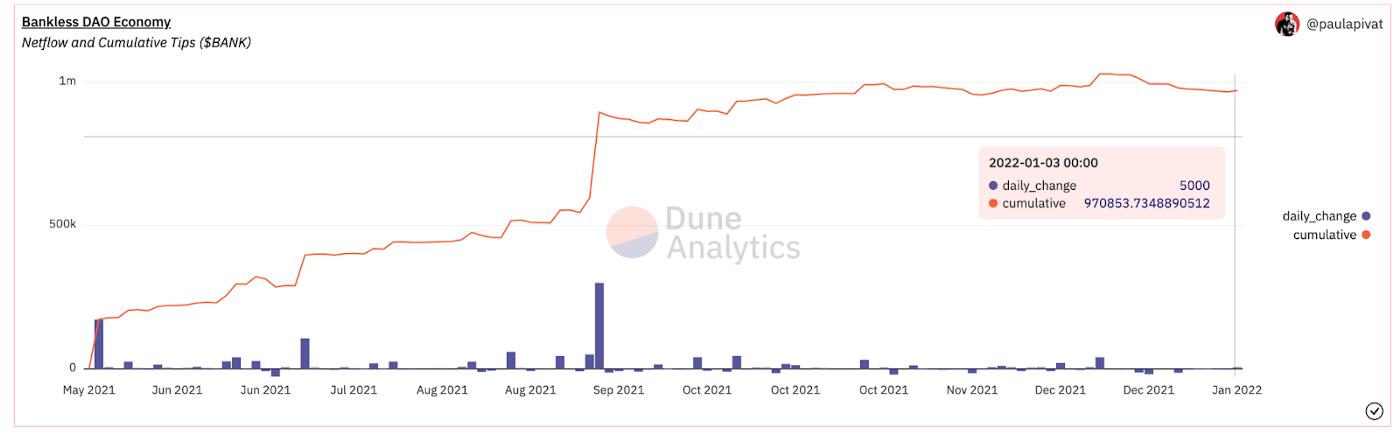
Reason 2: You can learn SQL and make your own dashboards.
If you're willing to put in the work, pleaseLearn some SQL(completely out in the open -- I'm not ready to work yet) and make my own dashboard. The great thing about Dune is that you don't have to rely on anyone else to get the necessary information - Web3 Archaeology 101.
Reason 3: Because Dune is crowdsourced, people update these methods faster than traditional analytics services
One thing I like about Dune is that contributors can update content there at lightning speed. Even natively encrypted but still centralized analytics services have some lag time. I was recently writing an article about OpenDAO and was pleased to see that contributors to Dune started querying almost the same day the DAO was launched.
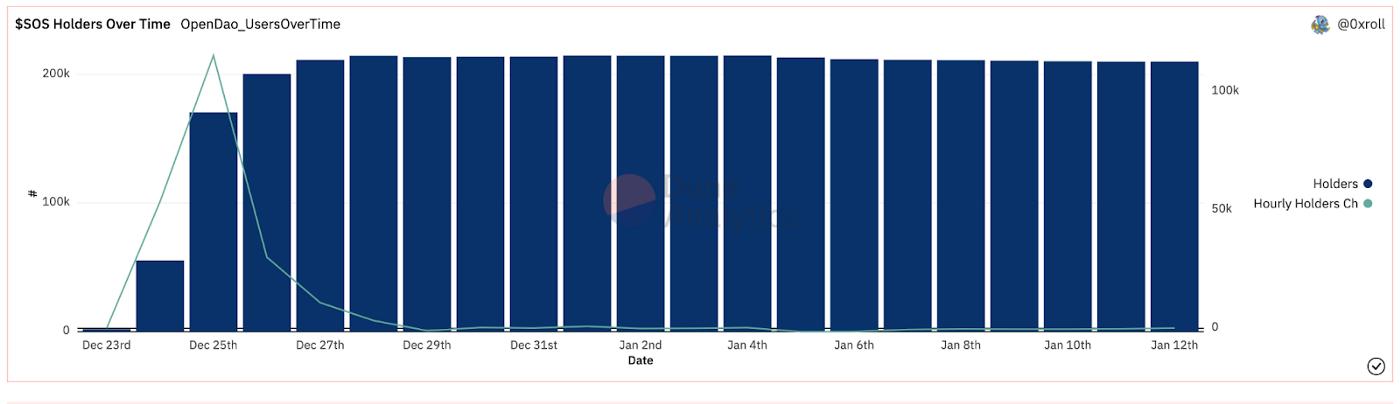
这张图表显示了 SOS Token 持有人随时间变化的情况
Reason 4: You can search for the person who created the dashboard and draw some interesting conclusions based on the information they chose to include and exclude.
如果创建仪表板的人与 Token 或 DAO 的成功有一定的关系,那么你可以得出一些结论,说明为什么他们可能包含某些仪表板而忽略了其他仪表板。但是在这里要小心,因为你不想对你得出的结论太疯狂。对制作仪表板的人进行一些钱包搜索(参见策略 #3)和推特跟踪(参见策略 #10)只是一个有趣的练习,然后批判性地思考他们为什么这样做。
Reason 5: You can befriend creators and ask them to make specific dashboards for you.(成为朋友通常意味着发送一些 Token 。但是,嘿,没关系!)
如果你正在寻找特定的数据,只需询问即可。真的,就是这么简单。我建议联系你最喜欢的仪表板创建者,作为创建你需要的仪表板的交换,向他们发送一些他们选择的 Token 。请记住,分析专家也在努力赚钱。学习 SQL 可能会更便宜,但我敢打赌,与仪表板创建者交朋友会更有趣。
Yes, Dune. It's fantastic.
2. Spit on Discord and ask for their opinion (get bonus points if you join their server)
Did you know cryptocurrency enthusiasts love to talk about themselves? Shocking, I know. (And guilty of talking about yourself.) But cold DM is really one of the best ways to get information, especially if it's about something that's too early to find reliable information. (We're early, aren't we?)
When you ask interesting questions, you'll be surprised at the verbosity of the contributors. Interviewing people over a Discord chat is also less intimidating because both the interviewer and the intervieee have time to think about their responses and really craft their words.
Joining the Discord server itself is another good way to do research. Hang around like the DAO lurker you are now (or the lurker you've always wanted to be) and see what happens. Listen to meetings (I recommend listening to large community conference calls or amphitheater-style meetings, since smaller ones may require you to introduce yourself) and see what people are talking about.
I'm not going to quote anyone directly at random meetings, but if someone is giving a prepared speech, maybe pull out your notebook. Be polite in these situations and don't be too happy - I wouldn't be very happy if someone quoted me in a random meeting where I didn't know I was being quoted. Remember, this is the office and the stage. But be sure to embrace the atmosphere, get to know the DAO, and start looking for contacts to interview.
3. Advanced Twitter search
If you haven't tried it yet, it's fun. By properly searching the beast of Crypto's twittersphere, you can unearth some super weird, fun, informative and downright wild stuff. That noisy place can sometimes feel like searching for a tiny fish in a vast ocean: what you're looking for can be deep. Advanced Twitter search is your gold panning device. (Admittedly, I don't know what people actually use to mine gold.)
Bookmark this URL now before you forget to do it:https ://twitter.com/search-advanced?lang=en
When you click on it, this dialog appears in the center of the screen:
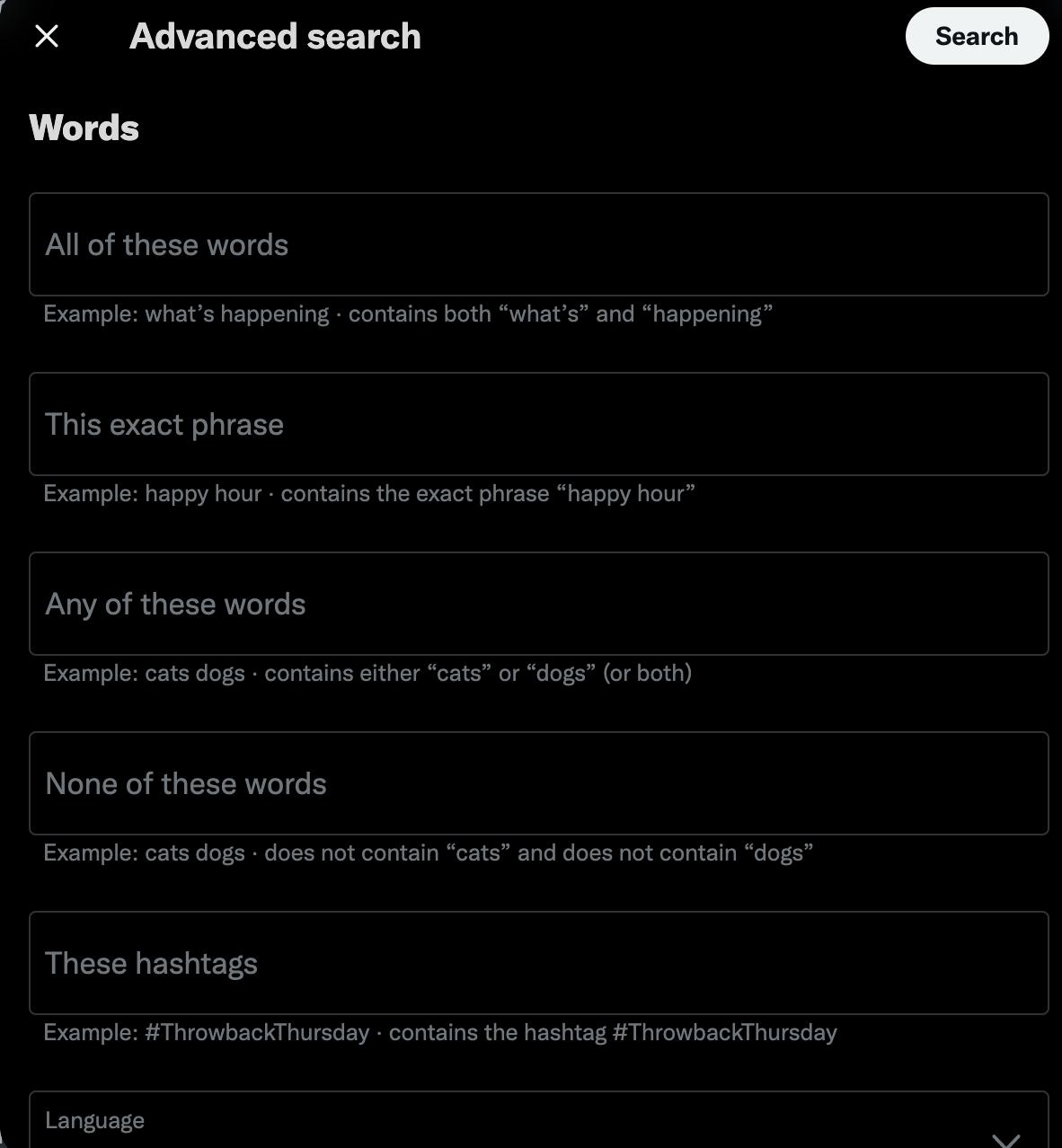
I usually fill in the box under "all of these words" and/or "any of these words". I'm usually looking for some particular event or topic that people are tweeting about, and I want to see what the most popular tweets are.
Advanced Twitter searches are a great way to gather an overview of an idea. For example, I recently wroteAn articleArticles on the MakerDAO/SocGen collaboration. I wanted to see what people on Twitter were saying after the initial announcement, so I separated search terms with commas, and I typed in:
All these words: Maker, DAO, SocGen
Any of these words: OFH, Tokenized Bonds, SG-Forge, DAI, DAI
Through this search, I found:
1. General feelings about cooperation.
2. The Twitter accounts of the people involved in the collaboration, which can easily lead to more information (and potential sources for interviews).
3. People talk about a rough time frame for such cooperation.
You can also change the language at the bottom, which helps to report DAOs and protocols that run in multiple languages, or to find sentiment in other parts of the world and among different people. (As mundane as I may sound, I'm not proficient in any other language and haven't used the feature yet.)
If you're starting out and don't know where to go, I suggest you do an advanced Twitter search. Then you'll have a lot of interesting hot spots and ideas.
4. Forum posts and comments
Forums are where high-signal, low-noise DAO conversations take place. (Ok, sometimes it's noisy.) These are Reddit-style open publishing platforms where daOs make governance decisions prior to on-chain approval. Think of them as digital town squares, where thought leaders and key members of the DAO share ideas and reach consensus on anything from new projects to protocol collaboration to governance concepts.
Forums are an important place for Web3 creators to spend time. If you're writing about DAOs and not digging into their forums, are you really writing about DAOs?
You can find the DAO forum in the following ways:
1. Visit the DAO's website and check whether the footer contains "governance," "Forum," "Community," or "conversations."Example: MakerDAO has a footerGovernance section.
2. Access the DAO's Twitter account and see what their links are.Sometimes you get lucky and it's a link that helps you find the forum. If it's Discord, you may not be able to join unless you hold the required number of tokens. So, DM DAO twitter accounts or contributors and ask them where their forum is. Or write tweets and @them. You're likely to get a response. DAO loves publicity!
3. Type the search engine [DAO NAME] + [Forums] or [DAO NAME] + [Discourse].Google doesn't like our Web3 content (yet), but sometimes it shows.
4. CoinGecko!B: Yes, really. Read Strategy #5.)
5. CoinGecko and CoinHall
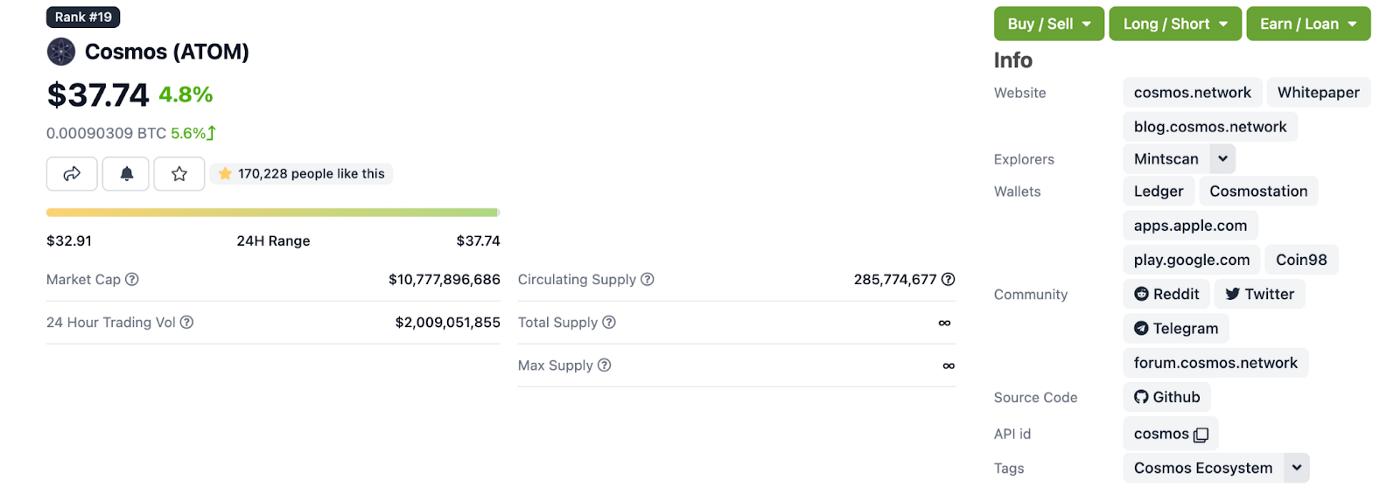
这两个 Token 浏览器是 Web3 编写器工具箱的经典补充。在这里,你可以获得有关正在寻找的任何 Token 的详细信息。我总是从 CoinGecko 开始(非常适合蓝筹股,几乎拥有你想要的一切),如果我在那里找不到 Token ,我会迁移到CoinHall. Both should be bookmarked on the browser of your choice.
我喜欢使用 Token 浏览器来查找:
1. Token 市值波动。
2. Price fluctuations.
3. Trading volume.
4. Supply: flow, total and maximum.
5. I am trying to mine the forums and other links. (If you skipped here from Strategy #4: CoinGecko does have forum links!)
6. Heavyweights: Vitalik, Balajee, Chris Dixon and Bankless writers Wednesday/Thought Thursday
If you're not digging for specific information, but looking for more general, thoughtful ideas, I'd go for heavyweight helpers, including:
3.A16z's blockchain and cryptocurrency section
4.Writers from Bankless Wednesday and Thought Thursday
But really, it's not easy to find really good "thinking pieces" for crypto audiences. Bookmark these gems and you'll use them again to help shape your ideas and shape your writing again and again.
7. Crypto native publications: Messari, The Defiant, Decrypt, CoinTelegraph and CoinDesk
The nice thing about the speed at which Web3 is growing is that information aggregators are also growing fast: we're just starting to get some information. But the problem with Web3's speed is that these guys can barely keep up. Add these to your informational diet, but sometimes they tend to be very price-focused, with a major emphasis on ETH and BTC. If you write on ETH and BTC, that's great... Not very friendly to anything else.
5.CoinDesk
8. A podcast: Uncommon Core, Bankless, Collectively Intelligent, On the Other Side, Citizen Cosmos, The Defiant, Crypto Sapiens and Terra Bites
I love podcasts, but I don't always use them as a research method because most Web3 podcasts are so long.
A healthy diet with a variety of Web3 podcasts will help shape your own opinions and essays, which will inform your writing. What they're not good at is looking for specific information. Instead, use these to challenge your beliefs, form your ideas, and hey, maybe learn something!
My suggestions are included in your rotation to get a comprehensive and thorough diet of educational podcasts:
1.Uncommon Core: Applies to technical concepts and first principles.
2.UpOnly: Great for interesting, unique conversations with crypto thought leaders.
3.Bankless: Suitable for interviewing cryptocurrency thought leaders and people in or near Capitol Hill.
4.Collectively Intelligent: Suitable for organization-centric DAO and Web3 discussions.
5.On the Other Side:Suitable for daO-centric everyday conversations about how Web3 affects people.
6.Citizen Cosmos: Suitable for interviewing people in the Cosmos ecosystem (who are notoriously hard to pin down).
7.The Defiant: Suitable for interviewing people with one foot in the traditional world and one foot in Web3 to provide some perspective.
8.Crypto Sapiens: Suitable for interviewing the founders of interesting protocols, mainly in Ethereum and adjacent Spaces.
9.Terra Bites: Applies to Terra ecosystem renewal and technology concepts.
9. Very specific Google searches that sound like gibberish because Google is terrible at indexing encrypted content
You may have noticed that sometimes when you search for topics that are ingrained in Web3, you'll see a bunch of Forbes, New York times, and WikiHow articles that are nowhere near what you're actually looking for. It's such a new symptom of our industry that Google's algorithm is having a hard time keeping up. So to avoid getting what the algorithm thinks you want, you need to tell it exactly what you want in order to find certain articles on platforms that many people have access to, like Medium, Notion and Reddit.
Very good at using keywords. A lot of them. Very soon, you'll find Notion pages in a Google search. (really! Maybe!) That's all MY advice for googling cryptocurrencies. Good luck.
10. Block browsers (I find these a bit boring)
I've found that block browsers don't help you much unless you know exactly what you're looking for. Honestly, if I have a transaction stuck somewhere and have a classic panic attack and I want to know if I sent money to the wrong address, I use these. However, since block browsers are a unique feature for collecting data on a chain, I thought I would include them.
Bookmark these:
4.ATOMScan
6.ApeBoard
Now that you're equipped with all this gold mining equipment, you're ready to dig! Good luck on your journey to becoming a real Web3 creator -- whatever it means to be a real Web3 creator -- and safe as always!
The original link
Welcome to join the official BlockBeats community:
Telegram Subscription Group: https://t.me/theblockbeats
Telegram Discussion Group: https://t.me/BlockBeats_App
Official Twitter Account: https://twitter.com/BlockBeatsAsia

 Related Articles