Web 3.0 will not be realized without the Internet of Workers
Original title: "The Internet of Jobs is coming "
Original author: Ryan Sean Adams
Original translation: Kxp, Rhythm BlockBeats
Internet of Jobs, Rhythm translates it into the Internet of Jobs, readers can understand it with the help of the concept of the Internet of Things) is the product of the collision between Web3 and the long-standing labor exchange in the digital field. It creates a new and improved labor market and integrates value Transfer is integrated as a native function, creating a peer-to-peer relationship between us and our workforce, reducing our reliance on unilaterally controlled intermediaries.
This article will shed light on the size, scale and scope of the Internet of Jobs (IoJ).
Overview
·The Internet of Jobs (IoJ) is coming soon
·The Internet of Jobs (IoJ) is coming soon
·The Internet of Jobs (IoJ) will make blockchain mainstream
·The design space of the Internet of Jobs (IoJ) is very open
·The Internet of Jobs (IoJ) ) has arrived
The Internet of Jobs (IoJ) is coming soon
What I am saying here are some basic principles:
1. The characteristics of the blockchain network make Token "monetary";
2. One of the main uses of currency is convenience It’s buying labor or skills, or what people call “jobs.”
3. Therefore, one of the uses of the blockchain is to create the "Internet of Jobs (IoJ)"
The Internet of Jobs (IoJ) will come soon
IC0, NFT, and DeFi are all major use cases for blockchain and have already been proven. They have created a multibillion-dollar market for their products, and their associated emerging industries have created a large number of knowledge workers who are not only native to Crypto, but are also paid in Crypto.
Many Crypto projects have chosen to form their own DAOs—a type of Internet-native organization. As these new digital organizations employ many Crypto natives, DAOs are also catalysts for the Internet of Jobs (IoJ).
The TAM (Total Addressable Market) of the Internet of Jobs (IoJ) is huge, there are more than 7 billion people in the world, most of them want to earn money.
The Internet of Jobs (IoJ) will make blockchain mainstream
When most Internet citizens think about how to obtain a stable income and achieve financial independence, they still think about finding a suitable job, rather than how they should invest . NFTs, liquidity mining, and meme coins provide effective ways to communicate with the Crypto community, but this is not enough for people to integrate Crypto into their daily lives.
For 99% of the world's people, they earn money primarily from their work, not from their investments. So my guess is that Web3 won't be mainstream until the Internet of Jobs (IoJ) is mainstream.
The design space of the Internet of Jobs (IoJ) is very broad
1. Determine the framework of the design space
The advent of the Internet of Information, which allows computers to send information anywhere in the world, has fundamentally transformed those areas of society that depend on information (entertainment, media, politics, social media). The Internet of Finance allows computers to send value across computer networks, and this fundamentally changes areas of society (banking, insurance, finance, arts, employment) that depend on the transfer of value.
Of course, if you were looking into the future in 1997, you would have hardly predicted the rise of Google, Facebook, Twitter or the iPhone. But if you look back, it all feels logical again. The same thing is true for the Internet of Jobs (IoJ), if we look ahead this year, it is difficult to accurately predict what breakthrough developments the Internet of Jobs (IoJ) will have.
2. Some Internet of Jobs (IoJ) tools will be simulated
Skeuomorphism is a commonly used term in user interface design to describe interfaces that can find real-world counterparts in appearance or interaction design element.
Whenever a new category of computing emerges, its first products are often designed with simulation in mind.

The original version of iBooks looks like this, so why do we How about setting up a bookshelf for e-books too? The answer is, in order to be closer to reality, such a design is our bridge to the future, but it is by no means the final form of the design.
For example, when the Internet appeared, Yahoo and Google both wanted to organize the world's information, but they both How is the specific operation different?
(1) Yahoo just moved the library’s card catalog system online (using a way to restore reality to solve the problem)
(2) Google invented a A new way to retrieve information with the search bar (a more Internet-like way to solve problems)
From this we can see that the value of the Internet of Jobs (IoJ) will be realized in disruptive, non-emulation use cases such that other Ways to deliver value will also become more enticing and novel.
The following is an example of simulation vs non-simulation mechanisms in the Internet of Jobs (IoJ) era:
(1) LinkedIn is an example of emulation, it just transfers people's paper resumes online.
(2) Quadratic Funding is an example of talent funding in a non-simulation way, which would not and could not have occurred in the past.
3. The Internet of Jobs (IoJ) is not a gig economy
People often mistake the Internet of Jobs (IoJ) for a type of gig economy, because gig sites like UpWork, Fiver, Uber have indeed always been Web2 iconic market.
But the development of these sites has been limited because they rely on the old financial system and the traditional Internet. Without the simple tools that Ethereum provides for these markets, they would not be transparent, robust, international, and community-governed, and their design space would be very limited.
Now that we have Ethereum, we have the ability to build the Internet of Jobs (IoJ) even more:
(1) International, means you can participate no matter where you are
(2) Stable, means you
(3) Transparency means no more information asymmetry issues
(4) Can be managed by the community, creating a fairer incentive mechanism
(5) Efficient, because intermediaries have been replaced by smart contracts
The Internet of Jobs (IoJ) does not only include the gig economy, it is only a part of the Internet of Jobs (IoJ), not all of it. design space.
4. Extract the good things in the traditional basic employment system and incorporate them into the Internet of Jobs (IoJ)
In most parts of the world, employees have the following basic welfare guarantees for employment:
(1) Insurance
(2) Medical care
(3) Retirement
(4) Various types of personal protection
There are several important elements in the traditional basic employment system:
(1) Taxation
(2) Regulatory Compliance
(3) Equal Opportunity
The above-mentioned systems will be re-incorporated into the Internet of Jobs (IoJ), each of them is of great importance, and it is worth writing a separate post carefully tell. In this area, the Opolis Employment Commons was the first vehicle to transfer traditional employment systems (insurance, healthcare, etc.) to the Internet of Jobs (IoJ).
As the Internet of Jobs (IoJ) develops, new infrastructure will emerge to run these systems, and the establishment of infrastructure will further encourage People work in the Internet of Jobs (IoJ), thus creating a virtuous circle.
5. Clarify the value function of the Internet of Jobs (IoJ)
Then comes the really interesting part: designing mechanisms for the native world of the Internet of Jobs (IoJ). Here is a generalized function of how all Internet of Jobs (IoJ) era projects work:
Token issuance=f(time, materials, skills, work output and other variables)
In simple words, the Token you earn is determined by the input value, and the input value refers to time, materials, skills, and your The value of the work output.
Bounty platform
The bounty platform is a type of platform in the Crypto ecosystem, such as:
Gitcoin Bounties, Ethereum Bounties, BanklessDAO Bounties.
Bounties are a common primitive in the Crypto ecosystem. Gitcoin Bounties have been used over 8,500 times on Gitcoin, transferring over $5.55 million worth of tokens.
In the bounty example, the social contract of the mechanism is to use Token to exchange some completed work, whether it is a pull request (pull request), security Vulnerability, or asset design.
Donation platform
Contributions are another commonly used crowdfunding mechanism, and many Web3 projects have their own donation programs to compensate entrepreneurial teams for building protocols.
Gitcoin Grants will match your donations to projects you like with funds from the GitcoinDAO pool. Gitcoin Grants has distributed $25 million in funding to hundreds of projects and has had over 2 million lifetime donations.
In this example, the social contract of the mechanism is that you get money proportional to how willing your peers are to fund your project.
Payroll management platform Coordinape
Coordinape will reward those who complete the work with Token, which is a very unique tool. Whereas the former two platforms will only compensate discrete packages of work, tools like Coordinape distribute tokens based on the value peers find in your work.

In addition, Coordinape is a P2P compensation tool, the community Members can reward each other without being uniformly controlled by a central authority. Thus, the platform turns compensation into a community-building exercise.
6. The impact of the Internet of Jobs (IoJ) is far more than money
Of course, you'd be foolish if you thought it was all about money. The Internet of Jobs (IoJ) also has implications for public welfare, which we will also explore. Therefore, the formula for Internet of Jobs (IoJ) is not only:
Token issuance=f(time, material, skill, output, other variables)
When the above effects are included, the formula becomes:
Token issuance + reputation + learning + influence = f (time, materials, skills, output and other variables)
So, its design space does have multiple dimensions, and there are infinite possibilities. So, how should we further explore this design space? What pitfalls should we avoid? I think we should start exploring with those mechanics that fit our values.
7. What are our values?
Blockchain allows us to create different smart contracts, and with these smart contracts we can write our own values into our own rules for making money. So, what exactly are our values?
This matter is worth discussing in an article, and questions about values include: What is the relationship between capital and labor? How do supply and demand match each other? How do we define success? How to balance the relationship between short-term incentives and long-term incentives? Where should social safety nets come into play? Where can we further adjust incentives? Answering these questions requires analysis of complex political theory and economic history, as well as the development of an argument from first principles.
In this case, I would like to talk about my views on this issue (what are our values?).
Please note that this is my personal opinion and subject to change.
My current personal opinion is that the ultimate goal of the Internet of Jobs (IoJ) should be to build a human being for as many people as possible for as long as possible A world in which the eight circuits of human consciousness are quite rich.

When you combine the native mechanics of Web3 with the eight consciousness loops, you get:
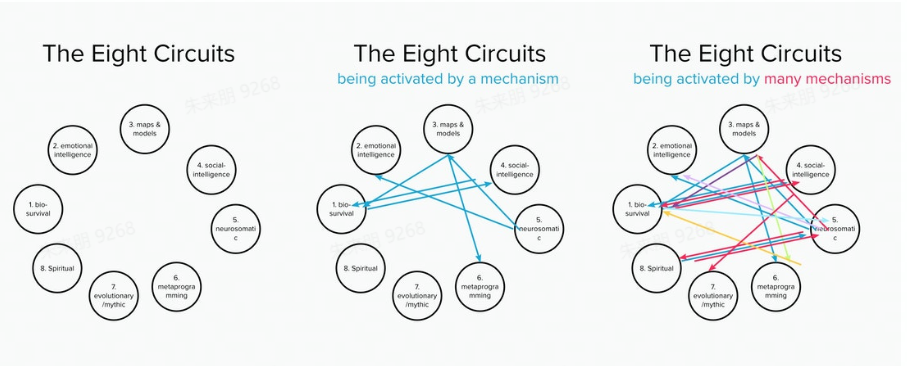
When you realize that every transaction on the Internet of Jobs (IoJ) has multiple people involved, Need to pay attention to more details.
In my opinion, the key criterion for a design is whether it allows people to:
Mutual benefit
Equitable benefit based on individual sharing
Freely choose to end any relationship
This is not just a theory anymore, because it has actually happened. The image below is just the tip of the iceberg of the Gitcoin contributors spectrum:
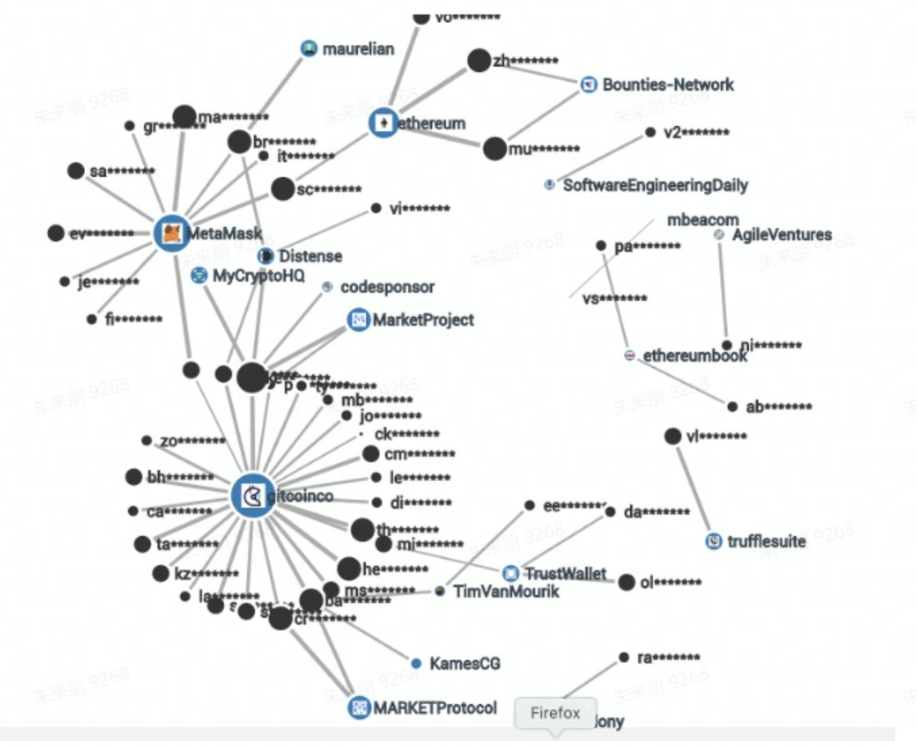
Even such a complex relationship network is not enough to explain the diversity of personnel under the Internet of Jobs (IoJ) sex. Will the Internet of Jobs (IoJ) be responsible to us as people, or are we responsible for it?
Will the Internet of Jobs (IoJ) bring new prosperity to people?
I believe that we are designing this regenerative internet of value that can bring prosperity to people all over the world, and each of us is different values, aspirations, backgrounds, nationalities, psychological preferences, economic power, privileges, abilities, and reality archetypes. While we celebrate diversity, we also recognize that living in healthy ecosystems, achieving economic empowerment and maintaining individual sovereignty are universal human needs.
I personally believe this, and if others are willing to believe it, we can take this opportunity to reach a North Star Consensus and build together toward this goal .
The Internet of Jobs (IoJ) has arrived
The Internet of Jobs (IoJ) is already in operation. The following is the list of products of the Internet of Jobs (IoJ) that I know:
· SourceCred: A tool to measure the consensus among subjects of value creation in the community and create Token rewards for them
· Radicle: Allow open source software developers to earn Token
· Opolis: An Employment Commons Platform for Public Interest and Regulatory Tasks
· Coordinape: An Intersubjective Consensus Measuring Value Creation within a Community, and A tool for them to create Token rewards
OpenSea: NFT marketplace for artists to sell their work
ETHGlobal: Hackathon organizer that allows people to complete coding Tasks or start new projects to earn Tokens
Gitcoin Grants: Crowdfunding + matching tool based on 2D funds
Gitcoin KERNEL: A Web3 University < /p>
·Gitcoin Hackathons: Hackathon organizers that allow people to earn Tokens by completing coding tasks or starting new projects
·Coordination Party Kit 7: A project being developed on Gitcoin Employment Toolkit in the DAO Era
Bounty Board: A tool for assigning bounties to discrete tasks
Some of these tools are similar to previous tools, while some are fundamental and brand-new infrastructure in the era of the Internet of Money. If something is missing, please contact us.
Welcome to join the official BlockBeats community:
Telegram Subscription Group: https://t.me/theblockbeats
Telegram Discussion Group: https://t.me/BlockBeats_App
Official Twitter Account: https://twitter.com/BlockBeatsAsia
 Related Articles