Take a closer look at Terra ecology
原文标题:《 邻家有链初长成,详解 Terra 生态系统 》
原文作者: Florian Strauf
原文编译: 深潮 CryptoFlow
In short, Terra provides a decentralized algorithm stablecoin.
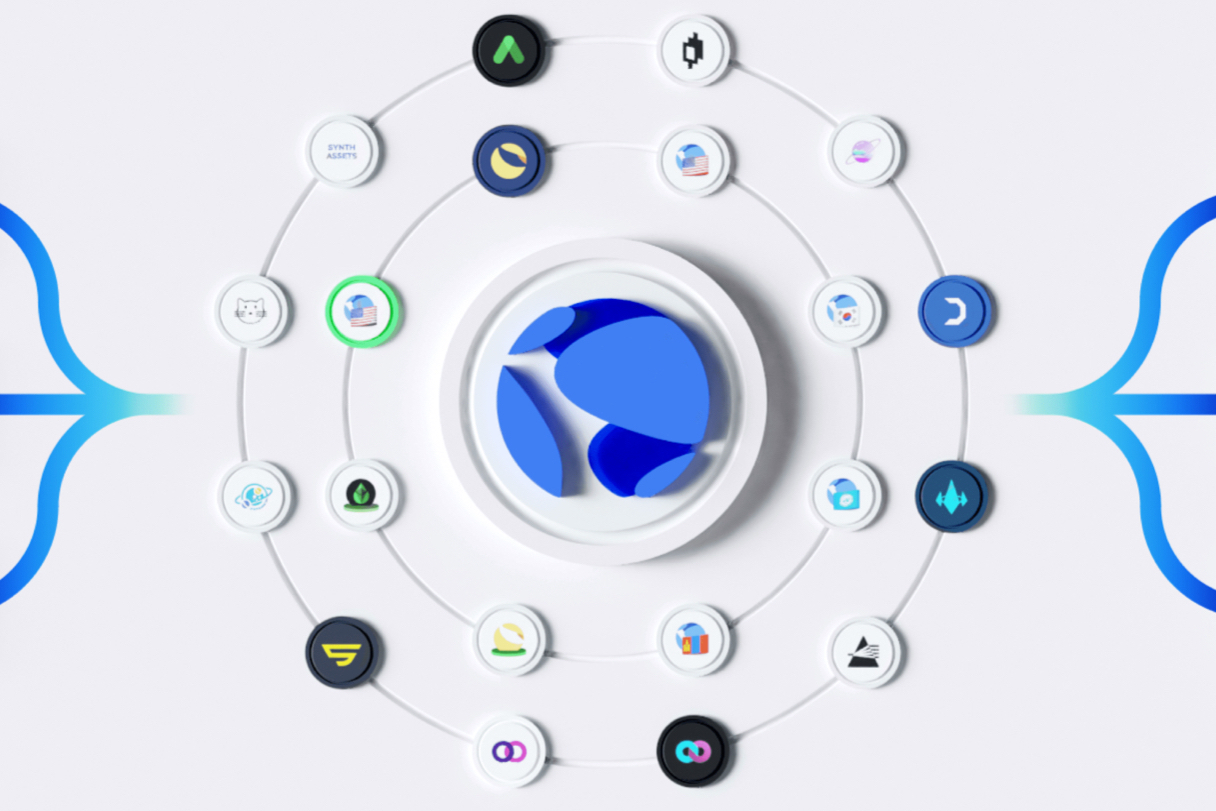
To ensure that its stablecoins serve a practical purpose, Terra has built an entire ecosystem around them. The ecosystem currently includes a payment app (Chai), a savings agreement (Anchor), a synthetic stock market (Mirror), and an insurance agreement (Ozone), all of which use Terra's stablecurrency, increasing its demand.
Chai is a South Korean e-wallet app that allows users to pay in Won at South Korean stores. Transactions in the program are processed in the background through the Terra blockchain, and the transaction fees are paid to the Terra network rather than VISA or Mastercard. The process moves from the supplier to the customer's wallet much faster and at much lower transaction costs than a bank account.
Chai now has 2.5 million users, about 60,000 daily active users, and about $42 million in transactions in June 2021. Its real-world application is clearly orders of magnitude behind VISA and Mastercard, but far behind most other cryptocurrency projects.
This article details the token economy rules for Terra, Mirror, and Anchor and shows how complex they can be. One might ask, why use multiple tokens and protocols?
This obviously makes the design more complex than an all-in-one solution. Do Kwon, one of Terra's founders, has a good explanation:
'Our goal is to create a diversified and self-sustaining Terra economy,' he said.
"An economy made up of people fighting for their own interests tends to do better than an economy made up of people working for the country."

Terra / Luna
Terra refers to stablecoin and Luna refers to a reserve or governance token that is linked to Terra. It is a core part of the Terra ecosystem and aims to grow beyond its scope by allowing multiple stablecoins to be used in other ecosystems such as Solana, a mechanism that is a bit more complex than Ethereum and Bitcoin.
Luna's initial supply is 1 billion, split as follows:

The purpose of the stable reserve token is to manage the early stability of the network and to intervene by injecting Luna when needed. Therefore, if demand increases rapidly, the Terra team can destroy Luna from its reserves to supply more Terra (more on that later).
Terra can be linked to a variety of fiat currencies, and has been linked to the main popular fiat currencies. The US dollar-linked UST accounted for the largest market value and transaction volume, while the Won-linked KWT was available for the Chai payment app. I have explained this mechanism in terms of UST in this article, as well as other Terra stablecoins.
Each time there is significant demand for UST, agreement market makers will provide arbitrage opportunities through Terra coin-mining. High demand would cause THE price of UST to rise in the market, causing it to lose its peg to the DOLLAR. After that, arbitrageurs can exchange Luna for Terra at a ratio of 1:1, thereby selling newly mined UST for arbitrage at a price above the pegged market price. Meanwhile, part of Luna was destroyed and the rest moved to the national Treasury or foreign exchange reserves.
This process will continue until there is sufficient supply to bring UST back to its peg price.
In contrast to the expansion process just described, the contraction process acts in reverse. The contraction process allowed arbitrageurs to buy UST cheaply in the market and then swap Luna for 1:1. UST will be destroyed during the contraction process, resulting in reduced supply of UST until it returns to the pegged price.
The contraction may bring in a lot of Luna and cause its price to fall. The Terra agreement aims to achieve growth through economic, real-world use. Holders who believe this will have to endure short-term fluctuations in exchange for the long-term development of the ecosystem, the adoption of UST, and Luna's gradual move towards scarcity and price increases.
Seigniorage pays for validating exchange rate oracles, for ecosystem stability, and for fiscal stimulus. In the upcoming columbus-5 release, seigniorage will be destroyed.
The verifier may vote on the exchange rate of legal tender pegged to Terra. Accurate voting is rewarded and inaccurate voting is punished.
Transaction costs include miners' fees and taxes. To avoid spam on the Internet, the miner's fee is set by the verifier. Taxes are set by the agreement itself and can be changed by a vote of up to 1%.
The verifier is responsible for running a complete node and signing transactions into a block. They receive fees from transactions as a reward, and inflationary mining tokens cannot be used as a pledge reward. Only the 130 validators who pledge the largest amount and meet the activity rules will be rewarded from transaction fees. Those who do not comply with safety and activity rules may be punished accordingly for the amount pledged.
Luna holders may entrust their Luna to verifier in exchange for a reward (approximately 10%/ year), thereby relieving themselves of the responsibility of acting as verifier and contributing to the verifier's total pledge amount. The entrusted verifier takes a commission from his reward and passes on the remaining amount to the client.
The Treasury collects Luna from seigniorage and can use it as a fiscal stimulus to support applications in the Terra ecosystem. The specific use of the Treasury funds will be decided by the verifier's proposal and vote. The idea is to generate economic growth by supporting applications in the economy.
Mirror
The Mirror protocol is designed to bring synthetic assets to the Terra ecosystem that are replicas of real world stocks. It allows people outside the United States to invest in American stocks and profit from them. The protocol is built around the use of UST, but has its own token, MIR (primarily for governance).
MAssets track the prices of real world stocks listed on nasdaq and are backed by collateral. Users of mAsset who want to be whitelisted for mining need to support an excess mortgage equivalent to the current asset price plus a percentage.
Users who meet the above conditions can hold or trade mAssets on Terraswap. Holding and trading on Terraswap can take place even outside real-world stock market trading hours. If the mAsset price deviates too far from the duplicated asset price, an arbitrage is used to incentivise the user to pull the price back.
Collateral is paid to a collateralized debt position (CDP), which will track the mortgage rate and liquidate the position if asset prices rise too high without further support. MIR, UST, mAssets, ANC and LUNA all provide support for users.
Mirrors come with built-in prognostics machines that are incentivized or penalized for reporting actual asset prices.
Mirror has a governance mechanism that determines which Massets to whitelist for mining.
Pledges already in place will be allowed to participate in governance. The pledgee can vote and receive the MIR reward (APR) for the pledge.
The MIR mortgage is funded by a 1.5% agreement fee. An agreement fee is charged each time a withdrawal is made from a collateralized debt position (CDP).
Contract collectors charge 1.5% in UST and sell it on Terraswap to buy MIR, creating demand for MIR and balancing supply and mortgage incentives.
The second form of collateral involves exchanging each currency for a liquid token from the mine. The liquidity provider will receive LP tokens representing the percentage of its contribution to the currency to the liquidity pool. Liquidity providers can pledge these tokens to receive MIR, which gives them more incentive (farms) than regular commissions for liquidity providers.
The liquidity provider pledge incentive is funded by the initial supply, which is distributed among multiple parties and paid off over four years.

Like a real stock market, Mirror allows users to short assets. The structure of a collateralised debt obligation (CDP) position is itself a short position. If the price of an asset that mAsset mines by Posting 200 per cent collateral rises, it must maintain a 200 per cent collateral ratio by Posting more collateral -- just like shorting an asset in a real world stock market. If the collateral ratio is not maintained, the position is liquidated and auctioned.
Anchor
If the Mirror agreement is the stock market, then the Anchor agreement is more focused on fixed income. It provides a fixed return of 19% per year on deposits in UST or other Terra stablecoins. There aren't many other deals that offer fixed returns, but they come from:
Deposits in Terra stablecoins such as UST or KRT will earn a fixed interest rate of 19% per year. The stablecoin pool is a collection of currencies. After depositing currencies in the stablecoin pool, users can receive Terra tokens representing their share of the instruction pool and the right to claim interest on their deposits.
The Anchor agreement aims to keep deposit rates in a range of about 19 per cent by taking a subsidy from yield reserves that incentivise borrowers to put more assets in if they need to.
The borrower receives the Anchor's governance token ANC as a reward for borrowing, usually to repay the interest due on the loan. This is because the initial supply of the project issued ANC tokens to strengthen the ecosystem. At a later stage, such incentives will be provided from the yield reserve if necessary.
The revenue reserve collects excess returns in the form of Terra stablecoins and converts them into ANC tokens in exchange for Terra stablecoins on Terraswap. This approach creates demand and balances the supply generated by rewarding ANC tokens to equity holders, liquidity providers and borrowers. The yield reserve only converts and supplies part of the ecosystem when needed. When supply is high, the yield reserve will be collected and allocated as an incentive.
Borrowers can borrow Terra stablecoin by paying interest and depositing collateral. Collateral is issued in the form of bAssets, which are mortgaged assets in proof of interest agreements. Currently only Luna is supported, but plans are under way to open other pledged assets.
The bAssets will use excess collateral to ensure liquidity. BAssets are pledged assets and will generate a pledge reward. This reward is held and paid into the earnings reserve or distributed as a pledge reward by the Anchor Agreement and constitutes a substantial amount of income in the Anchor Agreement. The Anchor agreement collects pledge incentives from all assets that are overmortgaged. While it will lend only a certain amount of money to borrowers, it can get more than 200% of the amount pledged.
The liquidator monitors the overcollateralized ratio, and if the ratio is not maintained by Posting more collateral, the position will be partially or fully liquidated. In this case, 1% of the collateral will be paid to the yield reserve.
The Revenue Reserve is also responsible for the payment of pledge incentives to ANC's pledge holders (the current APR is 5.8%), and allows stakeholders to participate in the governance of the agreement.
The Anchor protocol, like the Mirror protocol, requires liquidity of its token ANC on Terraswap. ANC: LIQUIDITY providers of UST currency pairs currently receive an APR of about 38%, partly subsidized by initial supply.

The initial total supply for the first four years is 1 billion, with most of the supply being used to incentivate borrowers to ensure that the price of the bAssets is constantly updated to keep up with the collateral ratio.
The original link
Welcome to join the official BlockBeats community:
Telegram Subscription Group: https://t.me/theblockbeats
Telegram Discussion Group: https://t.me/BlockBeats_App
Official Twitter Account: https://twitter.com/BlockBeatsAsia
 Related Articles