Top 10 in market value! Will Terra revolutionize modern finance?
原文标题:《 Terra Money: Stability and Adoption 》
原文作者: Mario Gabriele
原文编译及来源: siqi,penny,Jessie;海外独角兽
There is a natural barrier between the crypto world and the real world: the huge price fluctuations of cryptocurrencies prevent them from being applied to real life.
Terra, which was born in South Korea, is trying to solve this problem. Terra is unique from other public chains in that it introduces blockchain technology to traditional payment scenarios such as e-commerce and retail, allowing ordinary people to interact with the Web3 economy without even realizing it. This is where Terra's potential lies. By incorporating cryptographic applications into the everyday financial needs of ordinary people, Terra has perhaps the largest user base in the crypto space.
What is Terra? It can be a public chain, a digital bank, a payment processor, a pioneering financial innovation idea. Terra Ecology's developers even see it as the Y Combinator of cryptography.
Since its launch in the summer of 2018, Terra has amassed a lot of money from its Stablecoin ; UST currently has the fourth largest lock-up volume in the world. Terraform Labs, the company behind Terra, is also building various infrastructures along different financial scenarios, giving Terra a wider range of application scenarios and perfectly leveraging the powerful network effects of currency.
Founder Do Kwon is a gifted leader who inspires Terra's contributors and articulates the project vision in a compelling way. The vitality of the Terra community is the long-term driving force of the entire ecosystem, and the core of the community atmosphere is the personality of Do Kwon, who has been called the Jobs of the crypto world.
While Terra has the potential to revolutionize the use of modern finance and mainstream cryptocurrencies, some see its "algorithmic Stablecoin" mechanism as an inevitable endogenous risk that could cause the project to collapse.
In today's article, we will examine Terra from different perspectives, exploring its history, flourishing ecology, strengths and weaknesses.
The following is the table of contents, and it is suggested to read it according to the main points.
01. How was Terra constructed
· Do Kwon: The pursuit of decentralization
· Daniel Shin's business intuition
02.Terre's Stablecoin "Family"
· Stablecoin significance
UST and Luna
· Is UST reliable
· How is Terra's Stablecoin widely used
Terraform Labs: Seeding Ecosystem
4.Terra's ecological prosperity
05. Understand Terra
· Lego in finance
· Y Combinator in Web3 era
· "Top-down" evolution
06.Terra's Risks and Challenges
· Is the algorithm Stablecoin really "stable"
· Possible lagging throughput
· Too low-key product and team
07. Crypto "Jobs" : Terra's Unique Strengths
· Do Kwon's personal charm
· Strong community cohesion
· Build for multi-chain future
01. How was Terra constructed
Terra could not have been born without Do Kwon and Daniel Shin. Terra is Do Kwon's second startup. Based on his first startup experience, Kwon began to contact the concept of "decentralization" and entered the Crypto field and founded Terra. Shin, on the other hand, approached Kwon and Terra because of his e-commerce startup experience, and quickly helped Terra identify an application scenario that would generate significant business value: e-commerce payments.
Terra's supporters have this to say about Terra:
"Terra's founding team saw several pain points in the financial system: slow customs clearance and high payment fees. Blockchain is the perfect choice to solve these problems, and Terra is a model for applying blockchain technology to financial problems."
Do Kwon: The pursuit of decentralization
After graduating from Stanford with a degree in computer science, Do Kwon went to work at Microsoft, a giant company where he felt uncomfortable. In his opinion, only four of his team of 40 engineers are doing what he considers "real work". Kwon quickly quit and started Anyfi.
Anyfi provides end-to-end network sharing services. The company's mission is "Connect the world for Free". Through Anyfi, users can define themselves as a new node and share their network bandwidth. For example, if you are in your wifi range and set Anyfi function, your phone can act as a "sub-router" to extend the range of the signal and provide access to people outside the wifi range. In fact, Anyfi can also be viewed as a decentralized network.
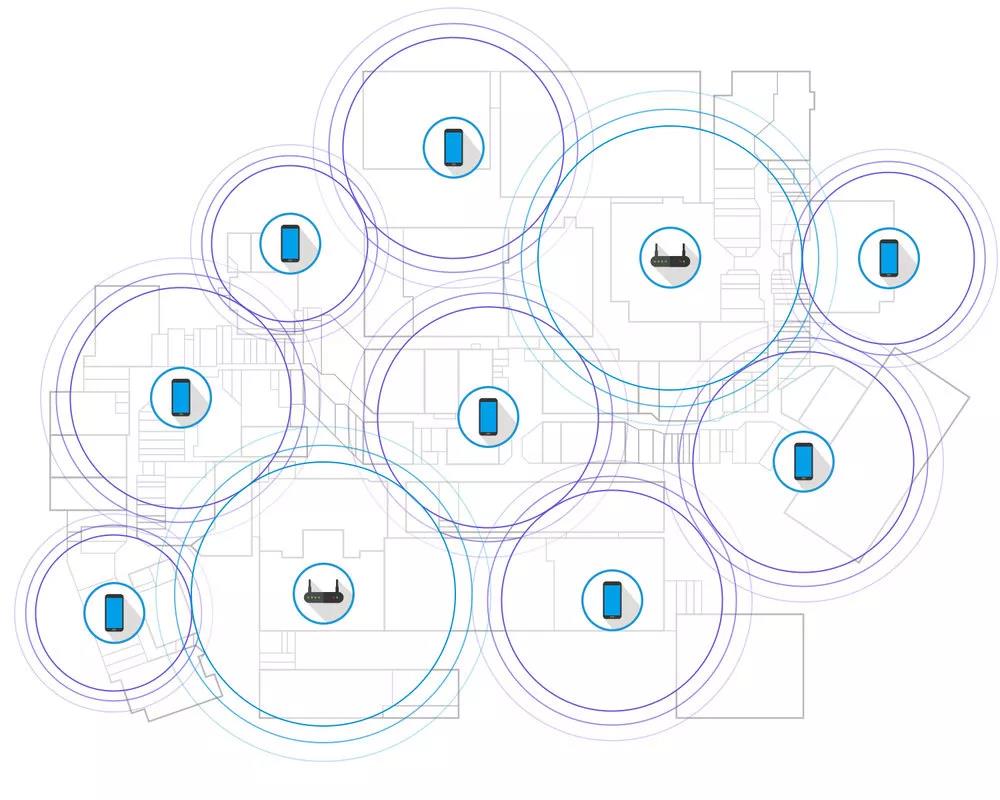
Anyfi
Do Kwon got off to a good start, raising $1 million in 2016 from the South Korean government, angel funds and some early clients.
Because of Anyfi's distributed nature, when Kwon was researching "decentralized" and "peer-to-peer networks" for product and business development, he was also exposed to blockchain and the whole cryptography behind it, and became very interested in it. In 2017, Kwon and his college friend Nicholas Platias wrote a white paper that mapped out Terra's prototype.
Combining his observations of cryptocurrencies, Kwon wanted to make a project that could be used as an actual currency. Like the real world, crypto needs its own "medium of exchange of value," which can be simply defined as "money," but most of these "digital currencies" cannot be directly used peer-to-peer due to the huge volatility of their value, like Bitcoin.
But Kwon didn't really think about how to commercialize his idea until he met Shin, his future partner.
Daniel Shin's business instincts
Daniel Shin had already had one successful startup experience before joining Terra.
Shin founded Ticket Monster (TMON), a group-buying platform in South Korea, in 2010. TMON is one of the earliest e-commerce platforms in South Korea and has beaten rival Coupang in the Korean Groupon market. After a series of financing rounds, TMON was sold to Living Social 18 months after its launch as part of its business layout in South Korea. TMON was later sold to Groupon for $260 million.
Since selling TMON, Shin has been consulting and incubating Internet companies in South Korea and Southeast Asia as a mature entrepreneur, which led to his exposure to Do Kwon and his interest in Crypto and Kwon's project itself. TMON's business practices led Shin to see a particularly suitable application scenario for Kwon's theory: e-commerce payments. In Shin's view, a decentralized solution is possible, rather than having a huge server to manage a huge volume of transaction information.
Terra was born.
Despite the low ebb of the global crypto market, Terra's clear usage scenario and Shin's endorsement enabled it to close a $32 million round in the first half of 2018. Its early investors included not only binance, OKEx, and Huobi, It also includes TechCrunch founder Michael Arrington, Polychain Capital, Hashed and others.
It was also in this round that Shin pitched Terra's venture as "The Alipay of blockchain," a clever shorthand for the financial products Terra hopes to build. Terra wants to provide services directly to consumers and merchants, breaking down the barriers of encrypted apps and the traditional business world, and has similar plans for Alipay to build its own ecosystem in addition to being a payment tool.
At the same time, Terra has signed partnerships with 15 Asian e-commerce companies, including Woowa Brothers, Pomelo and Tiki, which handle $25 billion in transactions per year. These resources helped early Terra to complete its cold start.
02.Terra's Stablecoin "Family"
In a nutshell, what Terra is doing is dramatically improving the payment process for e-commerce companies using blockchain technology, but doing so is not easy and requires a very complex back-end setup. Stablecoin is at the heart of this complex process.
As mentioned earlier, Terra was founded because Do Kwon realized that the volatility of digital currencies made it impossible for most of them to exchange value in the same way as real currencies. So Terra Protocol is a Stablecoin Protocol based on algorithms. It provides a Stablecoin system.
Unlike most stablecoins, which focus on dollar-pegged stablecoins, the Terra Stablecoin is a rich portfolio of currencies linked to the world's major currencies to meet the needs of stablecoins in different regions and scenarios, given the strong regionalism of fiat currencies. Currently Terra offers stablecoins that are linked to the US dollar, Korean won, Mongolian Tugrik, Thai baht and IMF Special Drawing Rights (SDR).
To understand Terra's value, it is important to understand the important role Stablecoin plays in cryptography and its current state of development.
The significance of Stablecoin
While bitcoin was originally intended to provide a digital alternative to cash, its limited supply and volatility caused by speculative mentality make it impossible to mirror fiat money, even as a medium of exchange. After all, no one would choose to buy in a currency that could appreciate 20 per cent in 24 hours. The same goes for other cryptocurrencies.
Imagine a scenario: If you choose to buy a $1,000 tablet with BTC, you'll pay 0.01724 BTC when BTC is $58,000, and 10 minutes later, bitcoin hits $60,000, meaning you're actually paying $1,034 for the pad, Two days later, when bitcoin hits $69,000, that payout will be $1,190.
In practical business applications, such fluctuations are certainly very scary. Therefore, the concept of a "Stablecoin" is quite important.
Stablecoin is a form of cryptocurrency. Unlike Bitcoin and other speculative currencies, Stablecoin's core goal is to simulate fiat currencies that are more stable than cryptocurrencies, thus making it less susceptible to extreme price fluctuations. Stablecoins try to anchor the price of a fiat currency as much as possible by some mechanism, and most stablecoins peg to the dollar.
Stablecoin's presence provides a medium for the crypto ecosystem and a way for crypto investors to store assets in the crypto world, and DeFi's growth has also benefited from Stablecoin.
Fundamentally, Kwon and Shin's design for Terra is a solution to the "BTC buying TV" problem, a solution that began when Terra launched its own Stablecoin.
How does a Stablecoin keep himself stable? Different types of Stablecoin choose different value mechanisms, but in general, they can be quickly classified by whether they are decentralized or not, and the type of asset collateral. It should be emphasized that this is not a simple binary classification.
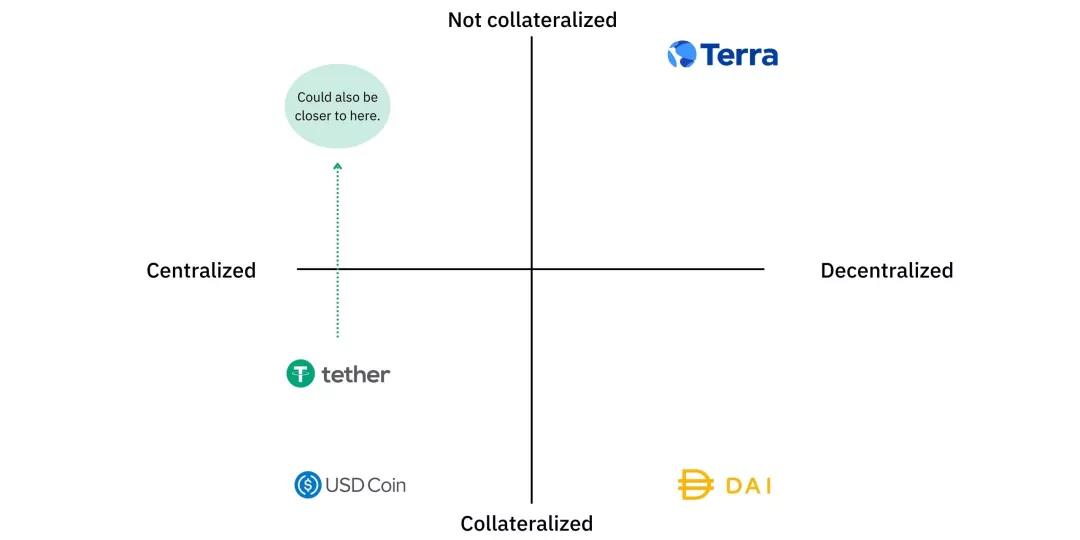
1. Centralized vs. decentralized Stablecoin: According to the different release subjects, Stablecoin can be divided into centralized Stablecoin and decentralized Stablecoin. USDT and USDC are the representatives of centralized Stablecoin, which are issued and operated by Tether and Circle. The basis behind the centralized Stablecoin is still fiat money. A Stablecoin published by a decentralized entity (such as DAI published by MakerDAO) or in some way (algorithmic mechanism) is a decentralized Stablecoin.
2. Collateral vs. algorithmic mechanics: Based on Stablecoin casting and value anchoring mechanics. DAI, UST and other stablecoins are basically overpledged by crypto assets to avoid the impact of cryptocurrency value fluctuations, while some stablecoins are completely controlled by code. Compared with stablecoins with mortgage mechanism, "algorithm" method has higher capital efficiency, but also greater risk.
Some mainstream stablecoins currently include:
· Tether: Teda coin, also known as USDT, is the largest Stablecoin at present, with a market value of $76 billion and a daily trading volume of nearly $70 billion, that is, the corresponding volume of fiat coin is used in the Crypto field in the form of USDT Token. USDT is directly linked to US dollars. The issuing mode is that users remit a certain amount of US dollars to Tether's bank account, and Tether will transfer the same amount of US dollars to the user after confirming receipt of the corresponding funds. The price change of USDT mainly depends on the credit recognition degree of Stablecoin holders to the issuing company, depository bank and US dollar. As a centralized institution, Tether cannot get rid of problems such as transparency and compliance.
USDC: The USDC is a similar Stablecoin from Circle, managed by a consortium that includes Coinbase and Bitmain. Like the USDT, the USDC claims that it "can be traded 1:1 for the U.S. dollar."
· DAI: DAI is a Stablecoin developed by MakerDAO. Unlike Tether and USDC, DAI is collateralized by on-chain assets and is decentralized.
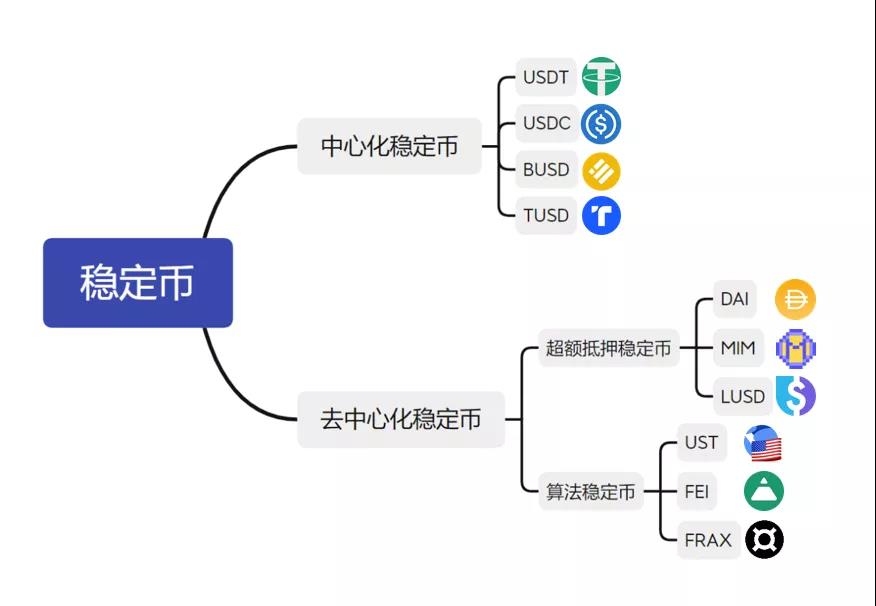
Classification of mainstream Stablecoin & NBSP; Source: the footprint
UST and Luna
Terra uses a dual Token model: TerraUSD (algorithm Stablecoin, also known as UST) and Luna (Governance, pledge Token).
Note: Depending on the country/entity in which Terra's products are launched, Terra's Stablecoin is actually linked to a number of national fiat currencies, such as TerraUSD (UST) anchored to the US dollar, TerraKRW (KRT) to the Korean won, Stablecoin anchored Mongolian Guglik; MNT, and Stablecin & NBSP, which anchors the IMF's Special Drawing Rights SDR; SDT. All the different stablecoins basically work the same way, so for the sake of discussion we'll just use UST was discussed on behalf of Terra Stablecoin.
Unlike Tether, USDC, or Dai, UST does not pledge fiat money or certain on-chain assets as collateral. As a representative Stablecoin algorithm, the value stabilization mechanism of UST is linked to Luna: for every UST cast, one dollar worth of Luna must be burned, and Luna's arbitrage mechanism ensures the UST and dollar anchor.
As a Stablecoin, UST is stable at $1, but Luna is no different than any of the other volatility coins.
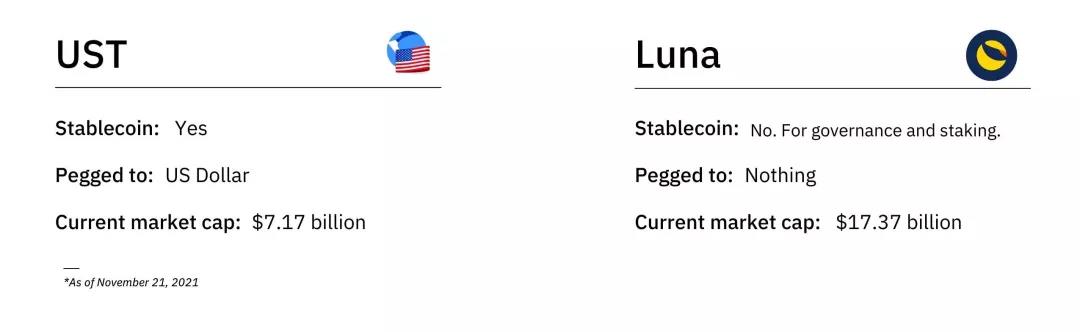
In addition to varying degrees of volatility, as a governance and pledge Token, Luna holders can participate in the governance and decision-making of Terra Public chain if they pledge their Luna Token on Terra Station, which is essentially a platform portal that helps Terra systems work. They also earn a percentage of their fees through governance.
Here is a specific example:
When a customer buys a $100 sweater on the Seoul-based clothing company Great Fox's website with a credit card, Terra's payment eco-product clears the transaction and transfers the money in six seconds. In a traditional banking system it may take 5-14 days. The whole process has no impact on the purchasing experience for the consumer, and Terra's transaction fee for the enterprise is only 0.5% (compared to 2% to 3% with traditional methods). This 0.5% or $0.50 is given to the miners who participate in the transaction verification. These people are qualified to participate in governance by mortgaging their Luna to Terra Station. Obviously, it is the reward after governance that encourages governance participation to a large extent.
This feature gives Luna a lot of value as it becomes an asset that generates consistent income for its holders and thus solves the problem of "low governance engagement" that many projects face.
Luna also plays an important role in stabilizing UST.
The usD-linked UST and Luna exchange relationship is that each UST can be exchanged for the equivalent of us $1 Luna. Arbitragers can take advantage of this ratio mismatch to gain profits, and the price of UST will therefore remain stable in the long run.
In the exchange between UST and Luna, there is also a prerequisite that creating UST requires or destroys a certain Luna Token.
· When the price of UST increases more than the peg, that is, 1 UST & GT; For $1, arbitrageurs can send Luna equivalent to $1 to the system to exchange for a UST. The arbitrage space in this link is that more UST will be exchanged for the same value. As the market supply of UST increases, the price of UST begins to decline, while the price of Luna increases because the supply decreases.
· When UST falls below $1, i.e. 1 UST < For 1 dollar, the same thing would happen in reverse, and arbitrageurs could choose to exchange 1 UST for 1 dollar worth of Luna, meaning that the equivalent dollar would get more Luna.
· Then, due to the decrease in the supply of UST, the price rose, while the price of Luna dropped again, and finally reached 1 UST = $1 again.
Terra's stabilization mechanism also includes a "seigniorage," a fee charged each time Luna is burned to create UST, and the proceeds will eventually be paid to miners who pledge Luna on Terra Station. Kwon explained in a recent tweet that "burning Luna to get Terra's exchange fee paid to a pledgee who has mortgaged Luna for more than 2 years" reimburses the pledgee for the cost of Terra's fluctuations.
It should be noted that this fee was paid by UST. According to Kwon, if Luna's price falls, "the return on the pledge goes up linearly."
This is a very elegant system, even if it takes a while to understand. Because UST has no collateral, it can expand indefinitely. In contrast to collateral, Terra's Stablecoin system does not require the accumulation of a Treasury the size of a Scrooge McDuck to serve a large population. It is also decentralized.
Is UST reliable
Terra's Stablecoin is undoubtedly a success in terms of its wide use. The latest market value of UST is $8.542 billion, which is currently the fourth largest Stablecoin in the world. Its market value ranks behind the Token launched by USDT, USDC and binance. After BUSD. If you narrow it down to "decentralized Stablecoin", UST recently overtook DAI at number one.
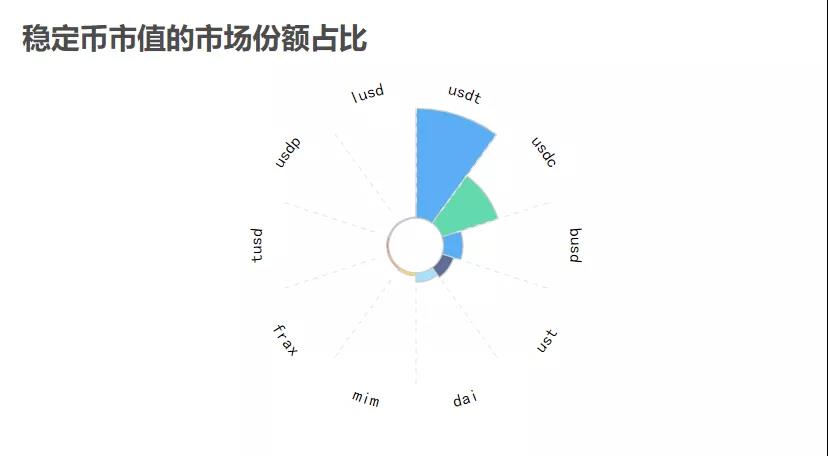
Market share of Stablecoin by market capitalization
However, it should be acknowledged that as an algorithmic Stablecoin, Terra's UST showed greater fluctuations than other Stablecoins.
As shown in the table below, the value fluctuation range of UST is 422% larger than that of USDT (Tether) in the past year, which is related to its value mechanism, especially when experiencing large market fluctuations. Terra's Stablecoin system is supported by LUNA. When the LUNA price fluctuates greatly, it is very likely that the Stablecoin will drop anchor, which is a common doubt of Terra system in the market.
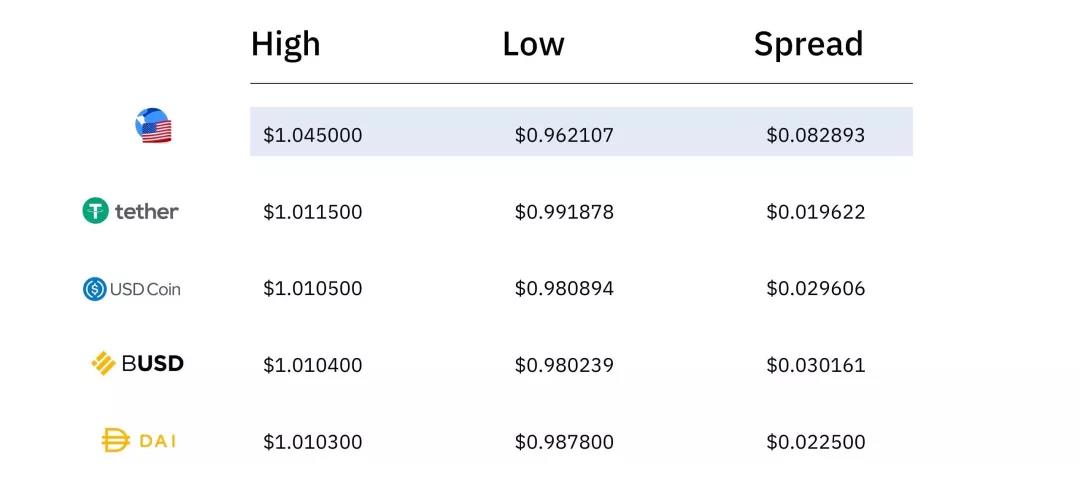
Data from CoinGecko and CoinMarketCap
How is Terra's Stablecoin widely used
Stablecoin is just one of Terra's answers to the question "how to better solve payment". In order to truly realize the vision of "Alipay ecosystem in blockchain", Terra's team needs to create more usage scenarios for UST.
Stability is necessary to make the new currency a viable means of payment, but this is not enough, because "money has value only when it is spent", which means that external participation is also needed to achieve a consensus on the value of the currency across the market.
CHAI It's the first and best application model.
As a separate entity from Terra, CHAI is run by Daniel Shin, who specializes in e-commerce, as CEO. In December 2020, CHAI raised $60 million in funding. In addition to its $15 million Series A round in February, CHAI has raised $75 million from SoftBank, HOF and others.
Although underlying CHAI is blockchain technology, it is designed to solve real-world payment problems and is targeted at ordinary businesses and users. Users of CHAI do not need to have any knowledge of blockchain.
In an interview, Mr Shin said CHAI's API helped companies integrate up to 20 payment options in a one-stop shop for local payment gateways, digital wallets, wire transfers, carrier withholding, PayPal and debit and credit cards. It saves companies a lot of time and network engineering costs. Meanwhile, CHAI's transaction fee is around 0.5%, much lower than the 2-3% transaction fee charged by other credit agencies in Korea, and its extremely fast settlement process is another advantage.
More than 2,000 companies are using CHAI, including Nike Korea and Philips. For compliance, CHAI has a fiat payment gateway regulated by the Korean government that connects to about 15 large banks.
For C-end customers, CHAI also provides digital wallet and debit card services. For users, spending through the CHAI App or CHAI debit card at partner merchants is no different from any other bank card, and they can get discounts or points back. So far, CHAI Pay has amassed more than 2.5 million users.
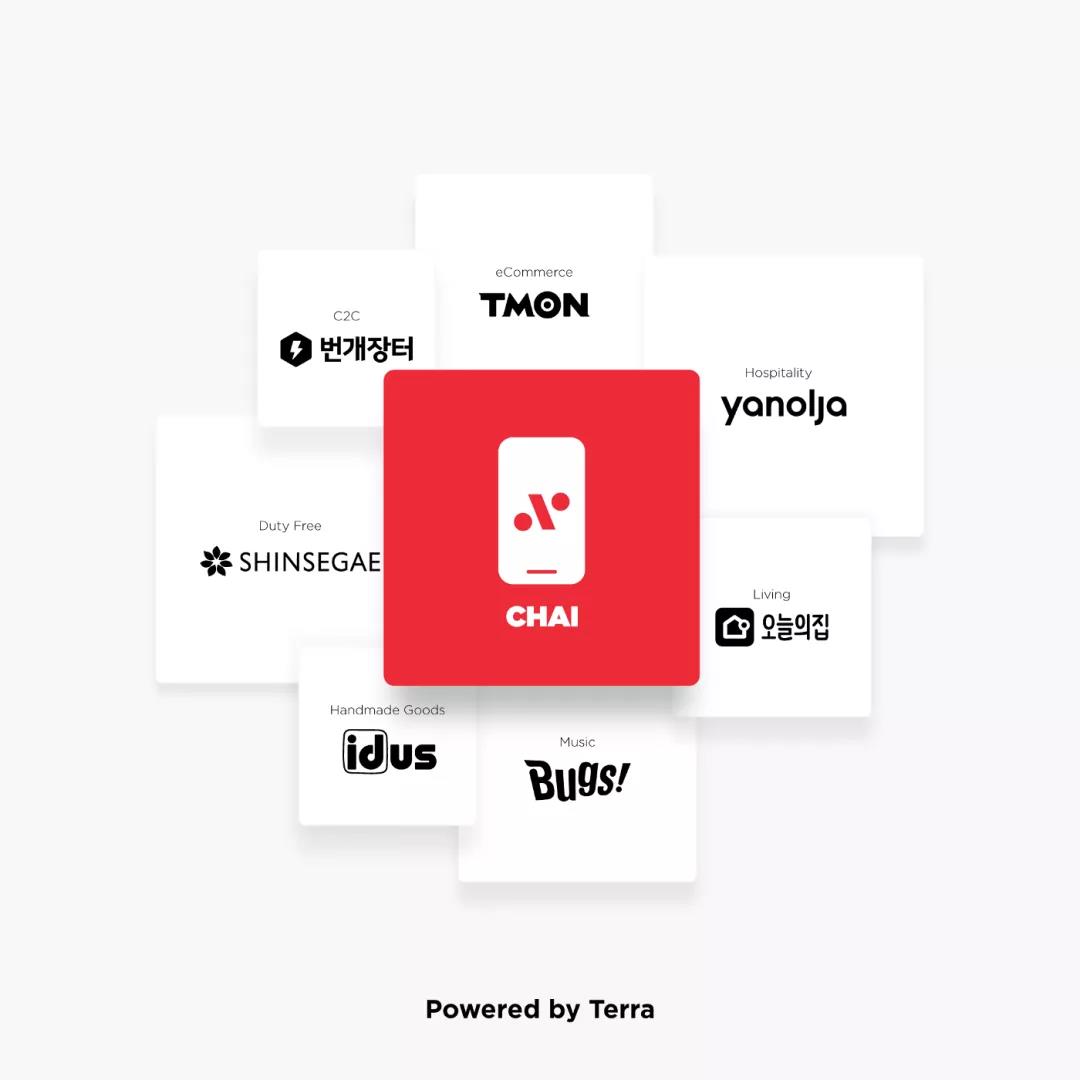
CHAI This is a good example of Terra's core philosophy of abstracting complexity into simplicity. CHAI first accepts payment in any fiat currency on the front end, which is converted into a Stablecoin in Terra's own system, such as UST, on the back end and transferred into the corporate account in the form of local fiat currency.
Here's a straightforward example:
A consumer in Seoul pays ₩7,000 won for a cup of coffee. She chooses to pay via CHAI, and the won payment from her bank account becomes 7,000 KRT (Terra's won-linked Stablecoin) within CHAI's processing system. KRT was eventually seamlessly transferred to merchants in the form of won. Neither the consumer nor the merchant needs to know that the payment has been briefly turned into a Stablecoin. At the same time, ₩7,000 worth of Luna was destroyed, reducing the supply of Luna to the market and making Lunatics' holdings more valuable.
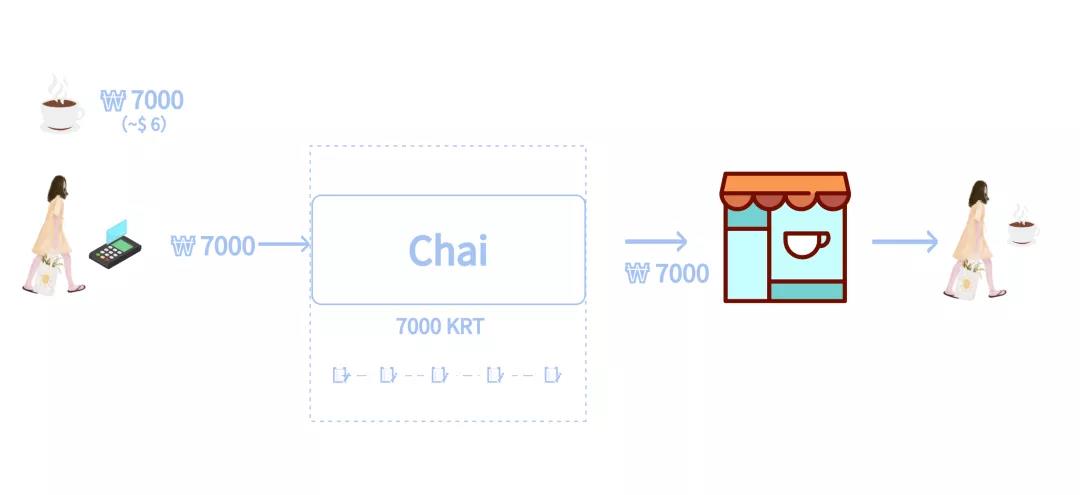
This is where CHAI is amazing: it allows ordinary people to interact with the Web3 economy without even realizing it.
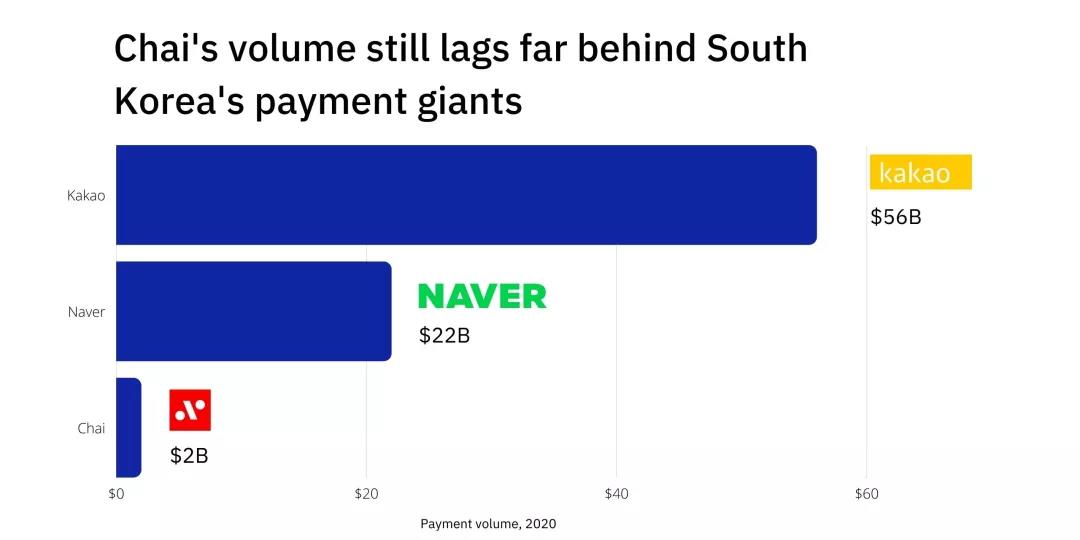
Most of the public links are targeted at crypto natives or those interested in crypto secondary investments. Terra brings ordinary users from outside the crypto world into its system without having to interact with blockchain or crypto. For the majority of CHAI users, CHAI is no different from Kakao Pay and Naver Pay, but it is easier to use.
However, CHAI has a long way to go compared to traditional payment tools, and lags far behind Web2 products in terms of absolute users. Kakao Pay is the largest payment tool in South Korea, reaching 35 million users and processing more than $56 billion in 2020. In second place is Naver, which has 28 million users and handled $22 billion in transactions in 2020.
CHAI is not the only payment system developed on Terra protocols. Shortly after CHAI started operating in Korea, Kwon and Shin also launched MemePay, a local version of CHAI, in the Mongolian market. MemeChat is the most popular local instant messaging app. MemePay is a companion payment tool, similar to wechat Pay, but completed on Terra chain.
Terraform Labs: Seeding Ecosystem
Although there are a variety of currencies, Terra is not just a coin or loan agreement. Around its underlying currency system, Terra is building and introducing a larger financial service system. Therefore, Terra is evolving into a public chain ecosystem focused on DeFi. Terraform Labs plays an important role.
Terraform Labs Is the parent company of Terra's UST and a range of products such as CHAI, and plays a vital role in Terra's success. Not only does it provide financial support, but for the prosperity of the entire Terra ecosystem, Terraform Labs & NBSP; Also actively build the required solutions. The aforementioned payment system CHAI is a good example, and there are many others like it. The company has also raised multiple rounds of funding since 2018. Earlier this year, Terraform raised $25 million from Galaxy Digital and others.
It should be noted that Terra's logic for building ecosystems is not the same as that of most public chains.
While most of the public chain acts as an open decentralized platform providing underlying protocol support, Terra is more of a Stablecoin before being defined as a public chain ecosystem, and all of its ecosystem applications (at least those developed by Terraform) point to a common Polaris metric: Make Terra as widely adopted globally as possible. Money has a natural network effect, and when Terra's Stablecoin is popularized to a large extent, the enrichment of the whole public chain ecology becomes a natural result.
The ability of Terra's Stablecoin to achieve cold start in such a short period of time and to join the competitive front row array of Stablecoins is largely due to its ecological power, providing a sufficient source of demand for cold start and rapid growth of UST. Besides CHAI and memeChat, there are many similar cases.
Terra Station
Terra Station is Terra's official digital wallet, through which users can convert their LUNA into UST and other Terra Stablecoin. In addition, Terra Station is also the entry point for LUNA holders to participate in on-chain governance. At its core, Terra Station is, as its name suggests, a site that links individual users to the entire Terra ecosystem.
Anchor
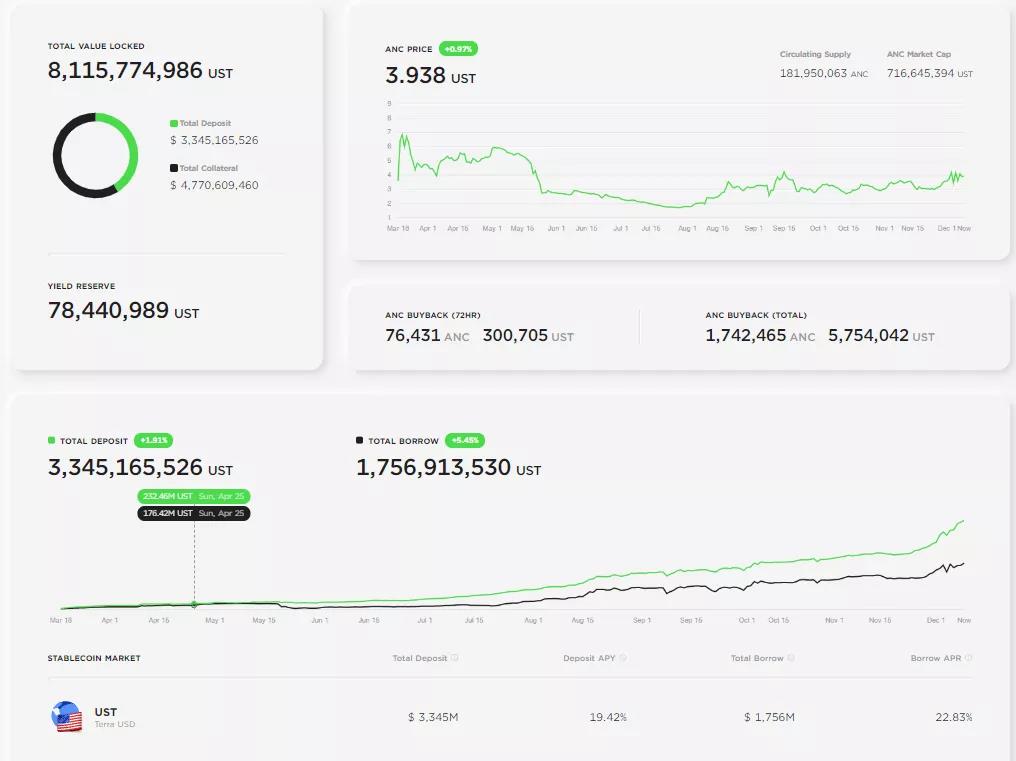
Anchor was launched in March 2021, and its biggest highlight is that it offers a stable savings yield of about 20% annually. Perhaps the 20% return rate is only moderately attractive to crypto users who have experienced the DeFi mining boom, but for users in the traditional financial world, 20% is quite attractive, so Anchor attracts a large number of users and funds for Terra.
Up to now, the total value locked (TVL) of Anchor has reached $6.64 billion, ranking the 10th DeFi in the world.

In order to generate income, Anchor will lend out deposits, but it only accepts assets with primary pledge income as collateral for borrowing, such as Terra's core Token . Luna, along with the recently backed stETH (through a partnership with Lido, a pledge service provider), allows Anchor to receive additional pledge income for collateral tokens to subsidise depositors. It is equivalent to the actual income of the system, including the pledge income of the pledged Token in addition to the borrowing rate.
After Anchor goes online, it also starts a four-year lending and mining mechanism. When the actual rate of return of the system is 20% lower than the target savings rate, the system will increase the intensity of lending and mining to stimulate borrowing behavior, thus improving the utilization rate of deposit funds and finally raising the lending rate to the target range (such as the current 19.46%). Meet depositors' demand for income.
Apart from being an independent product, Anchor also provides open source SDK to support product integration of other encryption projects. For example, a new developer of encryption wallet can realize the functional service that allows its users to get 20% return on savings by joining Anchor's SDK on the product.
Anchor
Pylon is a DeFi product from Terra Ecology, also incubated by Terraform Labds. Pylon's business base is also based on Anchor, and all UST deposits from Pylon, Will be automatically deposited into Anchor to earn a fixed income (~ 20%), which Pylon can use to link to more service providers or entrepreneurs, etc.
A more specific scenario is that you can choose to invest 1 million UST directly in a start-up or deposit the 1 million UST in Pylon first. The income of 20,000 UST/ year will be paid annually to the enterprise you choose to invest in as the investment amount. Project parties can also choose to use the Pylon conducts IDO.
Like CHAI and memeChat, Terraform Labs is also preparing Anchor products targeted at different countries and regions, including Tiiik, a savings application that also targets at 20% savings interest rate (preferentially open to users in Australia). Saturn Money, a fixed-interest product targeted at consumer apps, supports sterling and euro deposits.
Mirror
Mirror is the Robinhood of Terra. Terra chain users can trade US stock indexes through the Mirror Protocol. Mirror Protocol will be Terra Stablecoin UST serves as the main collateral for casting synthetic asset tokens, which serve as the mirror image of various financial assets such as stocks and ETFs. Any investment demand in the Mirror based on synthetic assets such as U.S. stocks will eventually pass back to UST, providing value to Luna and UST.
Mirror has several obvious advantages over traditional trading platforms: it is open 24*7 and has no borders, which means any equity can theoretically be used, it is simpler to split and trades are faster. Mirror's launch this year saw an influx of users, with an average of 2,000 registered accounts per day.
As with Anchor, other products can use Mirror to build new products, Spar being an example.
Mirror's challenge to regulators was also straightforward, leading to SEC lawsuits against Do Kwons and Terraform Labs. Individual defendants Do Kwon and Terraform Labs subsequently countersued the SEC, alleging violations of SEC rules and defendants' individual rights under the U.S. Constitution.
Prism
Although not yet online, Prism is considered Terraform's most innovative product. Through the Prism protocol, users can "refract" their assets into principal and return. For example, Luna can split pLuna (representing principal) and yLuna (marking return).
Prism's idea of asset separation brings a new form of market liquidity. For example, people in need of liquidity could sell their assets or yLuna's future earnings. Similarly, someone can decide they want a income-producing asset without the potential liquidation risk and buy pLuna. In essence, Prism creates a vehicle for interest rate swaps.
Ozone
Ozone Protocol is a decentralized insurance Protocol for Terra Ecology.
Ozone is set to provide protection in the event of a technical failure in the Terra DeFi ecosystem, covering a variety of risks in the Terra ecosystem. To put it more bluntly, if for some reason something goes wrong that prevents users from accessing their Luna or UST, So Ozone will cover potential losses. Currently, Ozone is being audited by Oak Security and Certik to launch.
The presence of Ozone makes it possible to further enrich Terra's ecology. With Ozone protocol, users' assets are protected in the event of an accident, their risk of trying a new Terra dApp is almost eliminated, and their natural engagement increases. For developers, Ozone's presence allows for a faster cold launch of their products.
One of Ozone's first big clients was Michael Arrington, an early investor in Terra. Arrington Anchor Fund will deposit institutional capital into Anchor Protocol first, and the withholding is guaranteed by Ozone. Under Terra's revenue regime, the equivalent of LP's revenue has increased by another 20%.
In early November, Risk Harbor, a DeFi Risk management marketplace and insurance protocol, announced it would take over Ozone. Risk Harbor plans to open source the core code of the protocol and will soon release a timeline for Ozone's launch.
In a press release, Kwon told us a lot about how Terraform wants to operate. Instead of fighting for more and more power, it seeks to decentralise and let the ecosystem take over.
4.Terra's ecological prosperity
In the view of many Terra protocol supporters, Terra is on the eve of a major explosion, thanks to the recent release of Columbus 5.
In September, Terra announced the completion of the Columbus 5 upgrade. This is an upgrade to Terra's core system to facilitate the transfer of IBC's chain assets. Also included in this upgrade are other core attribute improvements: burn all seigniorage; Upgrade to Stargate; Integrate Ozone (Terra Ecological Insurance Agreement) and Wormhole. Among them, Terra's Interchain communication (IBC) integration is expected to improve its Stablecoin Application of TerraUSD (UST) in the Cosmos ecosystem.
Columbus-4 versus 5
In addition to these technological upgrades, Terra, like most public chains, is actively using capital to energize its ecosystem.
In July 2021, Terra announced its launch. $150 million ecological Fund & NBSP; , the fund will be used to invest in Terra's ecological projects to take It to the next stage of development.
Here are some projects to watch:
Mars
Mars Protocol is a financial services product on Terra's chain. More specifically, Mars will operate as a "cross-chain lending platform." Mars, managed by Martian Council, provides borrowers with both secured and unsecured assets and a new way for lenders to earn interest on mortgage funds. One of the Mars team's key innovations is that its yields will respond to market conditions.
Lunatic Papi shared his thoughts on Mars: "I am very bullish on Mars... it will be the first universal lending platform on Terra. Mars enables leveraged long-term liquidity providers to pledge for yield, bringing leveraged liquidity to the ecosystem while creating high-return collateral opportunities."
Mars' longer-term vision for itself is to become a fully functional decentralized bank.
Astroport
Astroport is a decentralized trading platform on Terra's chain, similar to Terra Eco-'s Sushi or Uniswap. As the Terra ecosystem grows, so does the need for popular "automated market makers" (AMM). Astroport not only brings new functions to the Terra ecosystem, but will also increase the demand for Stablecoin such as UST.
Flood Capital, a Twitter user associated with Delphi, said its arrival was significant:
"Astroport is definitely the most interesting project I know of so far. You can think of Astroport as a cross between Uniswap and Curve. It will provide a typical AMM pool as well as a stable swap pool and hopefully concentrate liquidity in the future." What makes Astroport really interested in Terra is that the main trading pair will be based on UST, which means that the majority of Astroport's funds will increase the supply of UST and the burning of Luna. In order for Terra DApps to really take off, you need a DEX, so I think this is going to be one of Terra's cornerstones and an important moment in its history."
Levana
Jeff Kuan, head of business development at Terraform, describes Levana as "built on Mars, providing leverage for those who want to 'play big'."
In essence, Levana has brought Terra 2x leverage by using Mars. For example, users can not only purchase Luna, but also 2x Luna, which generates a double return if the Token value increases. After that, Levana intends to leverage various assets, including index tokens. Like Mars and Astroport, it was incubated by Delphi Digital. In addition, Levana assigns 50 percent of its tokens to the community and foundation, hoping to operate as a true DAO.
Digital bank
Since its inception, Terra has consciously built products that can be widely adopted. In addition to the aforementioned CHAI and its partnership with MemeChat, there are many more products to achieve the goal of expanding the reach of UST and other Terra Stablecoins in the real world. Digital banking is one of them.
Alice Finance, founded in 2021, is already well known. The Us-Based company has raised $2m in funding to create a consumer-friendly bank that operates somewhere between Venmo and Anchor. Users can make peer-to-peer payments seamlessly while earning 20% interest on the assets they hold.
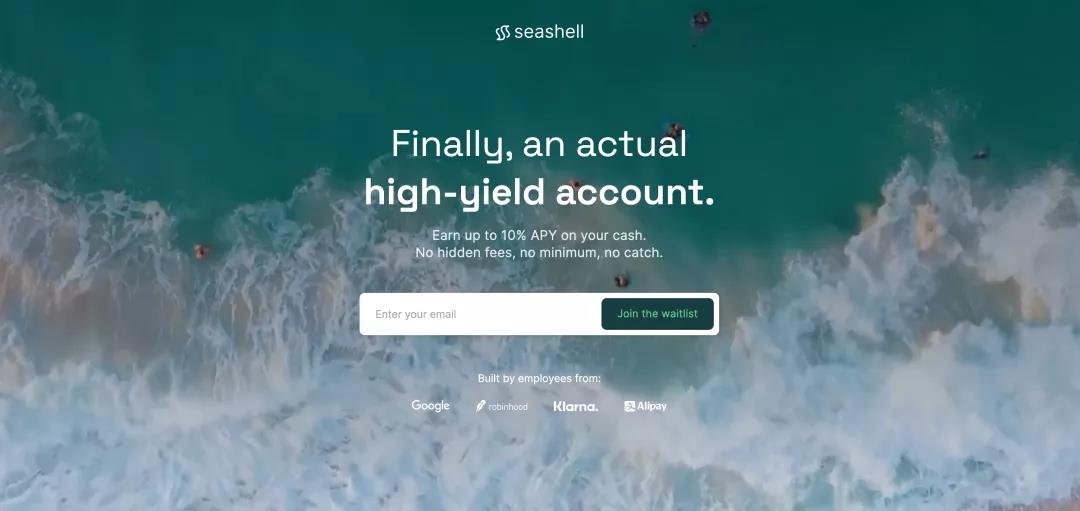
A similar strategy has been adopted by Seashell, which claims to offer 10% annual interest and also capitalises on Anchor's earnings.
Seashell
Terra is also officially supportive of these ecosystems, with Terra team member 0xWagmi saying: "We hope that there will be more digital banks like Alice's in every region, and we hope that there will be more digital banking unicorns in Terra's ecosystem. Terra plays a role like Plaid, Stripe, And Crossriver."
Kado is another company helping Terra's ecosystem. Kado is not a digital bank, but is focused on improving the payment experience by making it easy to use Stablecoin over the Internet. The team is also working on a savings product, according to Kado's website.
Games and NFT
0xWagmi further predicts: "Terra sees gaming as a very early area in the ecosystem. Gamers will get Stablecoin like UST, and we expect DAOs and game guilds to become very large in the ecosystem." Terra has really made a splash in the gaming space and has a chance to jump into NFT.
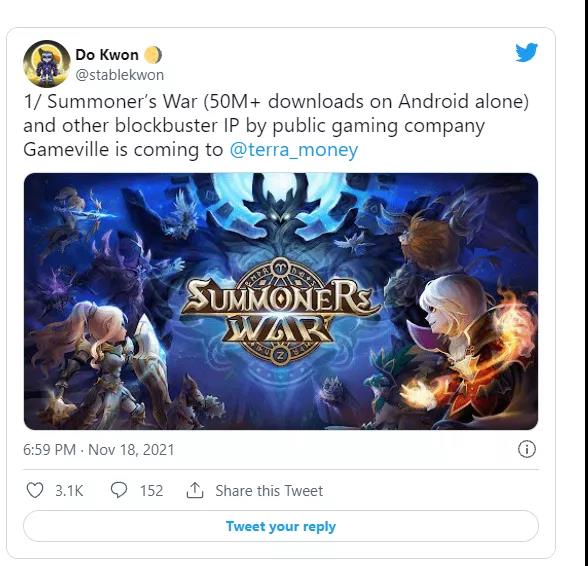
Hashed was one of Terra's earliest investors, and the company's creative studio UNOPND is reportedly working on five different games for the Terra ecosystem, some of which are "Play to Earn" models. In addition to Hashed, other game publishers plan to join Terra Ecology. Recently, Do Kwon announced on Twitter that Gameville would bring Summoner "s Wae" and other games to Terra.
Random Earth is The OpenSea of Terra ecology, and its founder Stargazer mentioned that they chose to create on Terra for the following reasons: "Terra has a very high TVL in DeFi. After trying various protocols as end users, we found Terra to be a very attractive ecosystem with a lot of blue ocean to explore."
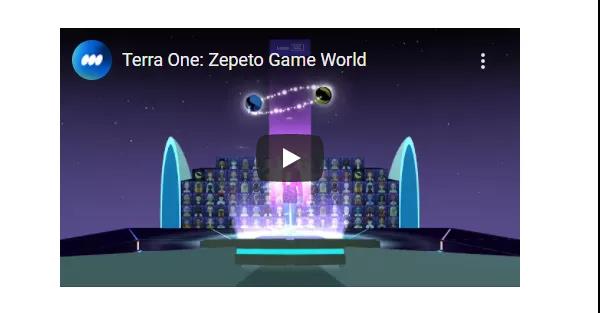
Stargazer has been co-funded by Terra and South Korean giant Naver, which owns Zepeto, a metaverse platform, and is building a game for the Terra ecosystem.
other
In addition, there are many other interesting projects on Terra:
, the White Whale. White Whale provides users with a way to automate arbitrage in UST, in addition to a series of other automated trading strategies that are very easy to use by users. It is therefore possible that White Whale, like CHAI, will bring more participants into Terra's ecosystem."
Angel, a Protocol. By using the earnings of Anchor, Angel can enable the charity to easily set up a high-return donation fund, and the donated funds obtained can also generate income indefinitely and continuously for the operation of the foundation.
The Nexus. By combining Mirror and Anchor, Nexus hopes to practice a DeFi strategy with higher returns. More critically, Nexus aims to eliminate the risk of principal liquidation in most investments.
Nebula. Nebula is an ETF product available on Terra that allows users to purchase combinations representing specific themes.
Sigma. Sigma brought options trading to Terra using leveraged order book technology created by Random Earth.
Orion, Money. With Orion, users can earn 20% annual interest on any Stablecoin. This means that you can put Tether, USDC, or UST into the platform and get the same return. Orion also protects users' principal investment with Ozone's insurance agreement.
Suberra. For businesses to accept regular Stablecoin payments, for example through Suberra, The Generalist can accept annual subscriptions paid through UST.
Valkyrie. According to Papi, Valkyrie brings social recommendations to blockchain, which is a "win-win for digital marketers and protocol fundraising campaigns." Through this agreement, referees are rewarded for both direct and indirect referrals.
But in terms of return on investment, Terra's Ecosystem fund should focus on projects with the greatest impact. Too much investment in projects will lead to too dispersed funds, and the effectiveness of ecological funds in promoting project development will become weak.
05. Understand Terra
The above content is a series of introductions to Terra as a product and platform. What makes Terra special is how to understand what Terra is doing and the deep ideas behind it. Here are some different perspectives:
The Lego of finance
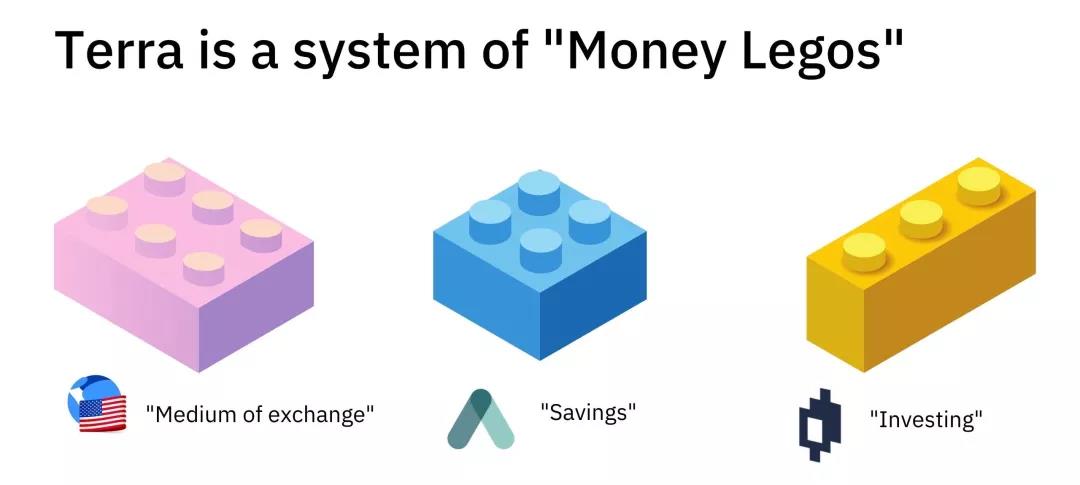
The first interpretation of Terra is "The Lego of finance".
Terra first created a composable financial infrastructure: UST Stablecoin as a "medium of exchange" module, Anchor as a "savings return" module, Mirror as a "comprehensive investment" module, Prism as a "interest rate derivatives" module, and Ozone as a "insurance" module. Based on these modules, other developers can constantly create new scenarios.
For example, Alice combines Stablecoin UST and "savings income" Anchor module set up a digital bank; Angel uses the same pair of modules, but adds new functionality to create charitable donations; Spar added the Mirror module to support its asset management solution.
By embedding these underlying elements into the ecosystem, Terra creates a premise that makes it easier for others to build products.
Y Combinator in Web3
Terra is also considered by some to be the YC of cryptography.
YC is a well-known incubator that has nurtured some of the most influential companies in the past 15 years and played an important role in the development of the Internet start-up ecosystem. With the advent of the Web3 era, some believe Terra will pick up the baton from YC. The creation of the $150 million Ecosystem Fund announced this summer is seen as an important sign in that direction.
However, financial support alone is not enough, because YC helps early-stage startup teams in all aspects, so Terra can only be considered THE YC of Web3 if it can provide more in-depth support. When asked where he hopes Terra will be in one year, five years, 10 years, 0xWagmi, a member of Terra's team, said: "Most importantly, we can see the emergence of a remarkable group of founders in this ecosystem (like YC, which started with Graham and now has hundreds of founders supporting YC and YC ecology). Terra is just getting started."
"Top-down" evolution
What distinguishes Terra from other public chains is that as a decentralized practitioner, Terra also has a "top-down" aspect, which can be reflected in a series of DApps led by Terraform Labs. The language models used by officials to discuss their monetary mechanisms, market models and fiscal approaches are all actively borrowed from the central bank. In many cases, Terra has similar goals as central banks, encouraging ecological progress in ways it deems most advantageous.
Do Kwon himself often cites the case of Singapore, noting that it is not a natural place to be a business center due to its tropical climate, hot weather and poor transportation. However, the Singapore government has created a series of favorable conditions to support and encourage business development, including strong and business-friendly laws and a reasonable tax structure.
Kwon believes that bottom-up change and progress can only occur naturally when favorable conditions are first created from the top down, a philosophy that Kwon also reflects on Terra. However, Terra's "top-down" approach is not closed, and Kwon has said that developers on Terra's ecology can contact him at any time for free advice.
06.Terra's Risks and Challenges
Is the algorithm Stablecoin really "stable"
Terra is also at risk of failure.
In late May, the cryptocurrency space experienced a major shakeout. On May 19, bitcoin fell 30%, along with the broader market. Over the next few days, Luna's price fell to $4.10, down 75 percent from its trading price a week earlier.
As investors lost faith in Luna, the demand for UST began to fall. Under Terra's monetary system, the price of UST fell below its peg of $1, and the holders of UST exchanged their UST for Luna. As a result, when demand for Luna dried up, The supply of Luna increases again, and Luna inflation pushes prices down further, deepening the vicious circle.
This risk, often referred to as a "death spiral," is a common risk for algorithms Stablecoin.
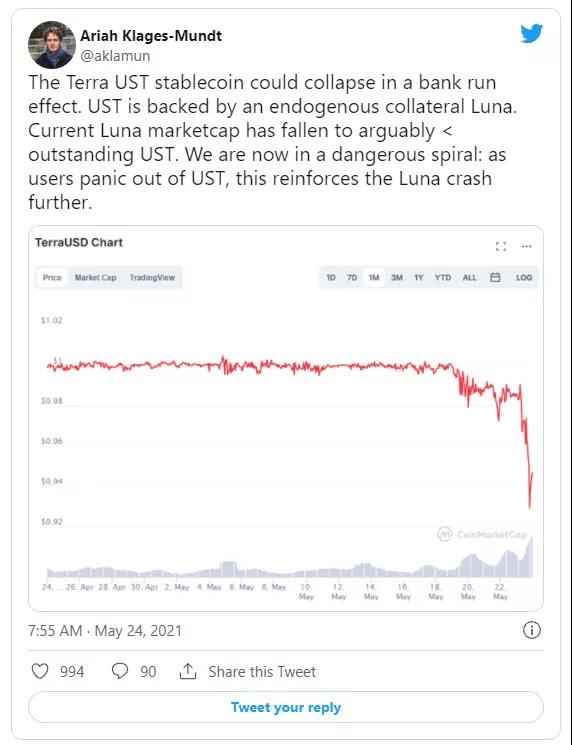
Since there are no other assets as endorses, the secondary tokens serve as implicit guarantees. For example, the issuance of UST is not premised on Luna being mortgaged, while the latter is an important part of the price anchoring mechanism of THE former (and vice versa). Once the market's confidence in "pseudo-reserve tokens" disappears, bank run effect will follow.
In June, a project called Titan hit a death spiral. Like Terra, Titan runs on an algorithmic dual Token system. Token Iron acts as a Stablecoin, backed by 75% USDC and 25% Titan's own governance Token.
When Titan's price started to fall, so did Iron's. Holders of Iron then found an arbitrage opportunity to trade $0.75 USDC and $0.25 Titan with a $0.90 Token, but the process resulted in more Titan being created and flowing into the market, triggering significant inflation, Titan eventually dropped in value to almost $0 and the project collapsed.
Although they are both algorithmatic Stablecoins, it is not fair to compare Titan to Terra. The elite founding team and the active community behind it have made Terra more resilient and stable, and more importantly, Terra has successfully built products that are used by millions of people.
All of this has helped Terra weather the may scare, with UST back at its old fiat currency anchor level and Luna halting its decline, indicating that Terra's system has withstood the test.
For Kwon, the biggest protection of UST is the demand it builds. UST has a fast growing and stable user base thanks to CHAI, memeChat, Anchor, Mirror and many other products that use it. Even if Luna drops, demand for UST won't go away.
Luke Saunders, CTO of Delphi Digital, summed up this point of the Terra Stablecoin matrix, "The utility built around UST has a huge stabilizing effect, which other stablecoins lack."
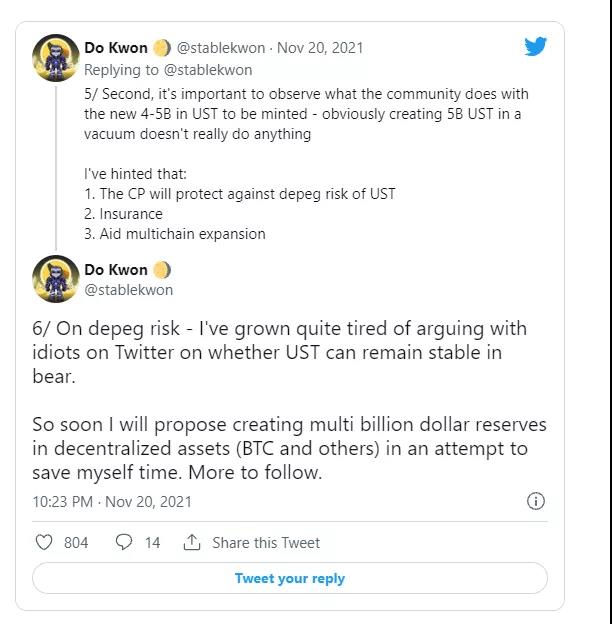
Although Mr Kwon himself dismisses those who fear a "death spiral", he is taking steps to provide more support for UST's stability. In a recent tweet, Kwon mentioned more assets for ecology:
But many may feel as if this risk is already factored into Terra. After all, Luna could be orders of magnitude more valuable than it is today if it's completely safe.
Possible lag in throughput
Terra is built using Cosmos's proof-of-stake mechanism (called Tendermint), which allows 10,000 transactions per second. Kwon has previously said Terra is currently processing up to 1,000 transactions per second. While Terra is unlikely to reach the 10,000 hits cap anytime soon, given Terra's aggressive and expanding use and the growing number of projects in the ecosystem, throughput may be a barrier to its next step.
In response, Terra is investing in upgrades, launching "Project Dawn," a new funding initiative for critical infrastructure and core technology improvements, and announcing that it will spend $1 billion or more to upgrade its infrastructure through hiring, partnerships and other initiatives.
0xWagmi noted, "Terra is investing heavily to expand the Terra chain and infrastructure to support large-scale expansion and use, which will take time to commit."
Too low-key team and product
Terra doesn't seem to get the attention it deserves. After all, Terra is the 13th largest crypto project in the world by market cap, surpassing Uniswap, Axie Infinity, Stellar, Aave, Filecoin, Helium, Sushi and other more familiar offerings, And Terra has a real landing scene, a charismatic leader, and an ecosystem of its own.
Why isn't it discussed more? Part of it has to do with its context. Terra has historically focused on the Asian market, although this should change as Terra grows, with the team already setting up its own operations center in Poland.
Another reason is that Terra doesn't do marketing. It wants to build a community of people who truly believe in Terra's values. While focusing on value creation seems the right move, Terra's restraint in communication is too dogmatic. While publicity is not a panacea, it can help projects attract developers and other valuable contributors, especially when talent is scarce.
07. Crypto "Jobs" : Terra's Unique Strengths
Although many of the reasons that make Terra remarkable and unique have been discussed before, I would like to add a few more here. Perhaps the most important reason is Do Kwon himself.
Do Kwon's personal charm
Do Kwon is a gifted leader who inspires Terra's contributors and articulates the project vision in a compelling way. But that ability comes at a cost -- Kwon seems to be a highly strung person with exacting standards for everything.
0xWagmi said, "Do Kwon has an absolute power of nature that I've never seen like him. In many ways, I think of him as the Steve Jobs of the crypto world. He makes incredible demands on the team."
Do's military experience also influenced his management style. "Do has a very strong leadership style, he is very focused on the product, and in his heart of hearts, he firmly believes in himself as a developer, which can be seen in his participation in daily product discussions," 0xWagmi said.
While too tight a grip certainly has many downsides, Mr Kwon's approach is just right. Kwon is Terra's core, and his ambition is part of the greatness. While he can be ruthless in pushing the Terra team, he is gentle with the community and developers, welcoming new members and helping them get started.
It's worth noting that Kwon's plunge into the crypto world isn't just driven by money: "We're not going to take a journey to become a billionaire," he says.
Strong community cohesion
Many cite Terra's community as one of its main strengths. "Terra has a very active community," says Stargazer, founder of Terra's ecological program Random Earth. "The cohesion of Terra is very strong compared to other ecosystems, and I think that community appeal will be key to its success."
Kwon himself has played an important role in the cohesion of the community. Stargazer also stressed this point: "I believe that much of the cohesion comes from Do Kwon himself. He is an open, warm, thoughtful and charismatic leader, and Do Kwons sets the tone for the strong atmosphere of the Terra ecosystem."
Part of the reason the community is strong is that it is truly trusted by developers.
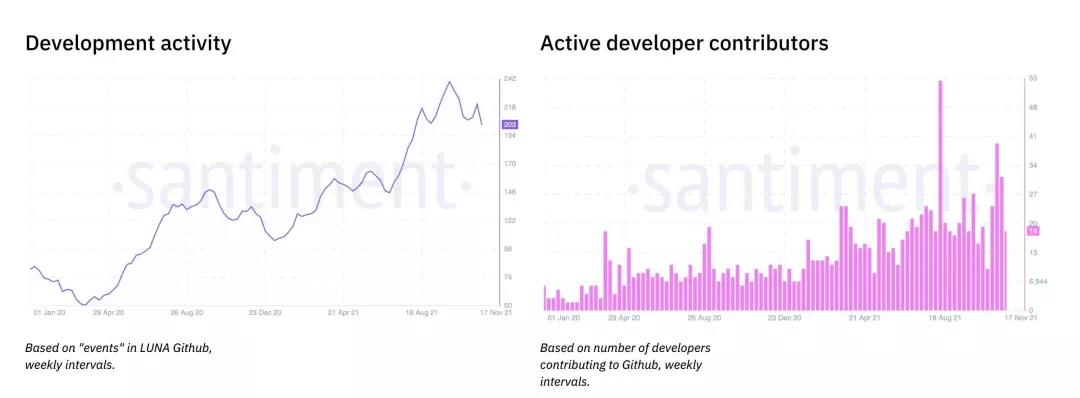
Earlier this year, Terra announced "Project Surge," an initiative to develop ecosystems. Specifically, Surge inspires community members to spread Terra across different chains. This program encourages members to participate in various DeFi programs and agreements and to determine whether Or not Terra participates. Terra inspires community members to participate in Terra's development in a variety of ways.
Over the past year, there has been a significant increase in the number of individual contributors and the number of code submissions:
Santiment
Building for a multi-chain future
Although Terra operates its own Layer 1 infrastructure, these projects can thrive even if other chains replace it. In fact, Terra is also in many ways built for the possibility of multiple chains in the future. Its most important product is not its core infrastructure, but its Stablecoin. Widespread adoption of UST is Terra's top priority, and the team is actively implementing more chain support for Terra Stablecoin.
Terra's team member 0xWagmi explains: "We are Layer 1 with native experience support, and UST can be used by any protocol/project on any chain. In the long run, we expect most UST to bridge to other chains and platforms; we are leaning towards a multi-chain future in many ways. Just like the team will have Android and iOS teams, we want the team to be cross-platform in the future."
Welcome to join the official BlockBeats community:
Telegram Subscription Group: https://t.me/theblockbeats
Telegram Discussion Group: https://t.me/BlockBeats_App
Official Twitter Account: https://twitter.com/BlockBeatsAsia

 Related Articles