Explain Terra ecology: Understand LUNA, Mirror and Anchor Token economics
Original title: "In-depth Interpretation of Terra's ecology and the Token Economics of Mirror and Anchor in its ecology"
Originally written by Florian Strauf
BanklessDAO
Terra ecosystem
Terra 提供了一个去中心化的算法稳定币。为了确保其 Token 有长期的生命力,Terra 围绕稳定币建立了一个完整的生态系统。该生态系统目前包括一个支付应用程序(Chai)、一个储蓄协议(Anchor)、一个合成股票市场(Mirror)等。此外,Terra 计划很快推出一项保险协议(Ozone)。每个应用都使用了 Terra 的稳定币 ,以增加其需求。这很重要——我们将在下面分别介绍。
Terra - Chai
Chai is a Korean e-wallet application that allows its users to pay in Korean won (KRW). Transactions are processed in the background via Terra's blockchain, and transaction fees are paid to Terra's network (not VISA or Mastercard). Settlement times from suppliers to customers' wallets are much faster than bank accounts, and transaction fees are much lower.
I will detail the Tokenomics of Terra, Mirror and Anchor and show that they are quite complex.
For more on Token For a basic introduction to economics, see my article on Bitcoin and Ethereum at BanklessDAO. Terra recently updated Columbus 5, and this article reflects the current version of the Network.
Terra/Luna Token 经济学细分
Terra & Luna Token 经济学
Terra (UST) stands for stable currency. Luna represents the reserve or governance Token used to keep Terra linked to it. Staboins are not only used in The Terra ecosystem, but also to build cross-chain Bridges for use in other ecosystems, such as Solana.
The Token economics of built-in staboins is a little more complicated than bitcoin and Ethereum, and the details below help explain how it works.
Luna's trands supply is 1 billion tokens, split as follows:
LUNA's creation supply
The stabilization reserve is used to manage the network's early stability and to intervene with Luna injections as needed. If demand increases rapidly, the Terra team can destroy Luna from the reserve to supply more Terra (more on that later).
Terra can be pegged to many different fiat currencies. The TerraUSD (UST), which is pegged to the U.S. dollar, has the largest market capitalization and trading volume. The currency pegged to the Won. For the Chai payment application. For the purposes of this analysis, we will focus on THE UST to explain its mechanism, but the pegged currency can be interchangeable with any other Terra stable currency.
Whenever demand for UST is high, agreement market makers offer arbitrage opportunities by casting Terra. This demand will cause the price of UST to rise in the market and it will lose its peg to the US dollar. Arbitrageurs could then trade Terra with Luna in a 1:1 ratio, allowing them to sell their newly minted UST at a premium to the pegged market price to make a profit. Luna, on the other hand, was burned.
This continues until there is sufficient supply to bring UST back to its hook point.
In contrast to the expansion just described, the contraction works in the opposite way, allowing arbitrageurs to buy cheap UST in the market and then exchange it for Luna at a 1:1 price. UST was burned in the process. This reduces the supply of UST until the hooks are back in place.
Shrinking can introduce a lot of LUNA and cause its price to fall. The goal of the Terra protocol is to grow through economic, real-world use. Holders who believe this will have to endure short-term fluctuations in order to achieve long-term ecosystem growth, UST adoption, and Luna's increasing scarcity and value.
100% of seigniorage has now been burned since the Columbus 5 release.
The verifier participates in determining the exchange rate of the fiat currency pegged to Terra. Accurate votes are rewarded, inaccurate votes penalized. Since Columbus-5, rewards have come from interchange fees between different Terra currencies (such as UST to KWT).
Transaction costs include gas charges and taxes. Gas charges are set by the verifier to avoid spam on the network. The tax is set by agreement and can be changed by vote up to a maximum of 1%.
The verifier runs a complete node and checks transactions into a block. They are rewarded with fees from transactions and there is no incentive to pledge tokens for inflation. Only the 130 verifiers with the largest interest are active and thus rewarded with transaction fees. Failure to comply with safety and activity rules may result in penalties on the amount of money bet.
Luna holders can entrust their Luna to a verifier for a reward (about 10% / year) without having to become a verifier themselves, contributing to the total amount pledged by the verifier. The verifier will receive a commission from the award and transfer the remaining amount to the consignor.
The vault receives Luna from seigniorage and uses it as a fiscal stimulus to support applications in the Terra ecosystem. The specific use of funds in the vault depends on the proposal and vote of the verifier. The idea is to boost economic growth by supporting apps in the economy.
Mirror Token economic segmentation
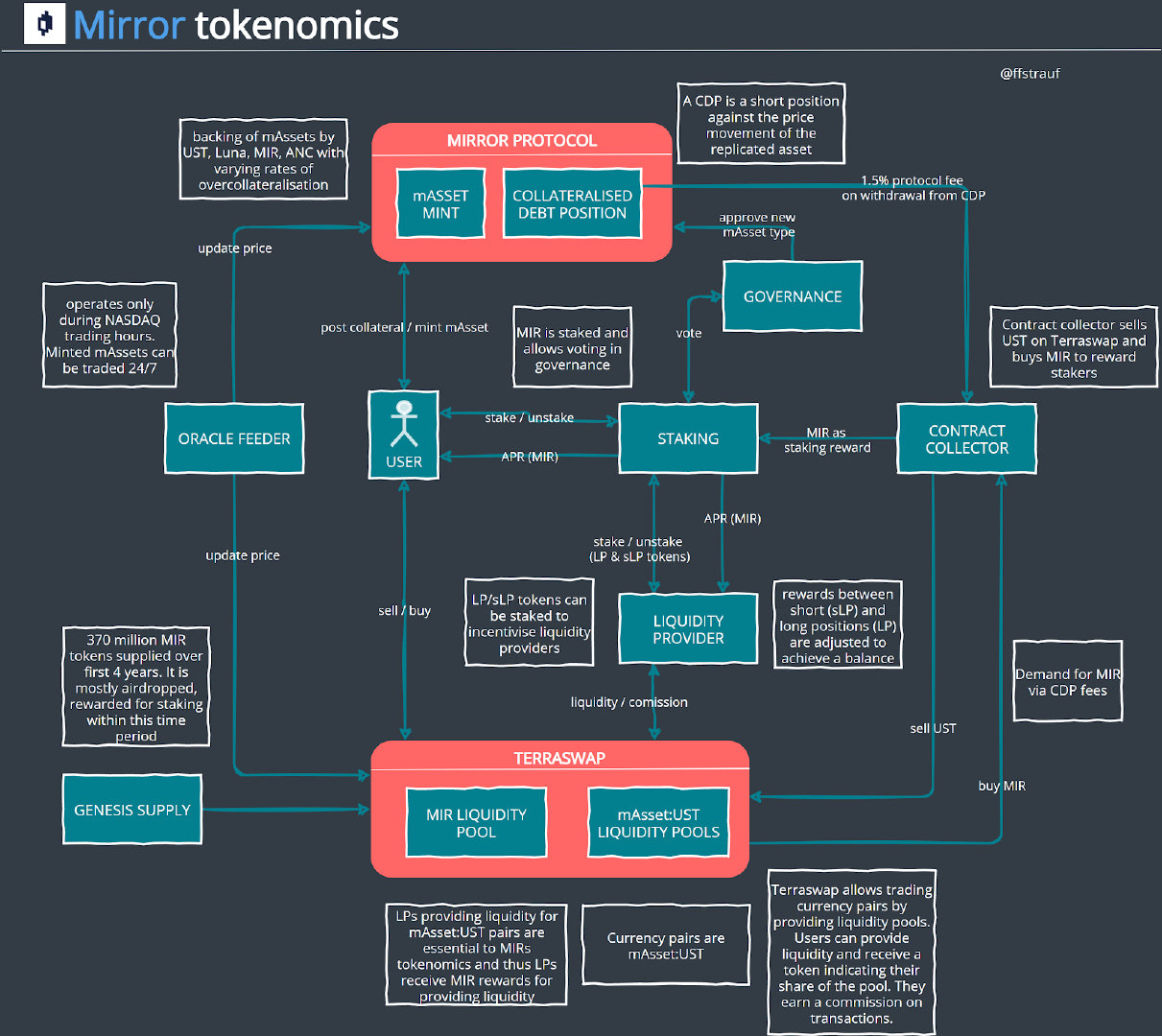
Mirror Protocol Token economy
The Mirror Protocol aims to introduce synthetic assets (called Mirror assets (mAssets)) into the Terra ecosystem. These replicate real-world stocks, allowing people outside the US to invest in US stocks and profit from price action, even without regular access to the US stock market. The protocol is built around the use of UST, but it has its own Token MIR, which is mainly used for governance.
MAssets tracks the price of real-world stocks listed on Nasdaq and is backed by collateral. Users who want to whitelist mAsset will need to support current asset prices plus a certain percentage of excess collateral.
MAssets can then be held or traded on Terraswap. This continues even after stock market trading hours. If the mAsset price diverges too far from the replicated asset price, an arbitrage is used to incentivise the user to pull the price back.
Collateral is paid to a collateralised debt obligation position (CDP), which tracks support and liquidates if asset prices rise too high without further support. Support is available in MIR, UST, mAssets, ANC, and LUNA.
The Mirror uses built-in prognosticators to incentivise it to report the actual price of an asset, or penalize it for not reporting.
The governance mechanism determines which mAssets can be whitelisted into minting.
Pledges have been put in place to allow participation in governance. Pledgers can vote and receive MIR reward (APR).
The MIR pledge is funded by a 1.5% agreement fee. A fee is charged each time a withdrawal is made from CDP.
The contract collector collects a 1.5% fee on a UST basis and sells on Terraswap to buy MIR, create demand for MIR, and balance the supply with pledge rewards.
另一种形式的抵押涉及到为每个货币对铸造的流动性 Token 。流动性提供者将收到 LP Token ,以表示对某一货币对的流动性池的贡献百分比。这些 Token 可以被质押以获得 MIR。除了对流动性提供者的定期佣金之外,这进一步激励了 LP(耕作)。
The liquidity provider's bet rewards are funded by Trands Supply (pictured below), distributed among multiple parties and paid out over four years.
MIR Token 的分配
Like a real stock market, Mirror allows shorting of assets. The way CDP is structured is already a short position. Assuming that the mAsset price rises through a 200% pledge, the 200% collateral ratio must be maintained by Posting more collateral -- similar to shorting an asset in the stock market. If the mortgage ratio is not maintained, the position is liquidated and auctioned.
Anchor Token 经济学细分
Tokenomics Anchor Savings agreement
If Mirror is a stock market, Anchor is more fixed-income, offering a fixed return of 19% per annum on deposits in UST or other Terra stablecoin. Not many other agreements offer fixed returns, so let's see where those returns come from.
存款 UST 或 KRT 等 Terra 稳定币将获得每年 19% 的固定利息。稳定币按货币入池,并获得 aTerra Token 以表示入池的份额,并索取存款利息。
The agreement aims to keep deposit rates in a range of around 19%, and to do so by subsidizing earnings reserves and incentivising borrowers to deposit more bond assets if needed.
借款人收到 Anchor 的治理 Token ANC 作为借款的奖励,通常会偿还贷款的到期利息。这是由于该项目的创世供应发行了 ANC Token 以加强生态系统。在以后的阶段,这将在必要时由收益储备提供。
收益储备以 Terra 稳定币的形式收集多余的收益率,并将其转换为 ANC Token ,以换取 Terraswap 上的 Terra 稳定币。这创造了需求,并平衡了将 ANC Token 奖励给质押者、流动性提供者和借款人而产生的供应。收益储备只在需要时转换和供应生态系统,在供应量大时收集产量,并在需要时分发收益率以刺激利率。
Borrowers can borrow Terra staboin by paying interest and placing collateral. The collateral is issued in the form of bAssets, and the assets are pledged assets in a proof of equity agreement. Currently only Luna is supported, but other pledged assets are being planned.
BAssets are overpledged to ensure liquidity. BAssets are pledged assets, so they generate pledge rewards. Such rewards are kept by the Anchor Agreement and paid to revenue reserves or distributed as pledge rewards, constituting a large revenue source for the Agreement. Anchor collects Staking rewards from all overmortgaged assets. While it will lend only a certain amount of money to the borrower, it will be rewarded with more than 200% of that amount.
The ratio of excess collateral is observed by the liquidator, and if the ratio is not maintained by Posting additional collateral, the position is liquidated in part or in whole. In this case, 1% of the collateral would be paid to the earnings reserve.
The Revenue Reserve is also responsible for the payment of pledge rewards to ANC pledges. As of this writing, the annual rate of interest (APR) is 7.88%, and pledgers will be allowed to participate in protocol governance as well.
Similar to the Mirror Protocol generation, Anchor needs to provide liquidity for its Token ANC on Terraswap. As of now, liquidity providers of ANC/UST currency pairs will receive an APR of approximately 77%, subsidised by Genesis Supply.
The total creation supply (see chart) is $1 billion, distributed over the first four years. Much of the supply is used to incentivise borrowers.
供应时间表 ANC Token
Oracle feeds ensure asset prices are kept up to date to track collateral ratios.
conclusion
Terra, with all its different protocols, is one of the most interesting projects I have come across. The entire ecosystem built around staboins is unique and can make staboins and ecosystems very popular. Expansion by bridging other chains allows Terra to have greater influence and fits the paradigm of anchoring the balancing mechanism to the actual use of stablecoins.
At the time of writing, at least a few new Terra projects have popped up:
- Pylon, a Defi savings and payment product
- Spectrum, yield optimizer for automatic lofting and automatic composition over various Terra protocols
- StarTerra, a gamified IDO launch platform
- Valkyrie, a reward and referral protocol, is used to help launch protocols and DAOs
- Ozone, a mutual insurance agreement, ensures the risk of technical failure throughout the Terra Defi ecosystem
The Terra ecosystem is built on Cosmos and thus has access to the Inter-blockchain communication module (IBC), which allows easy integration with other blockchains, especially with other chains built on Cosmos (e.g. Binance, Thorchain, Avalanche, etc.). This simple integration, coupled with the fact that a truly decentralized staboin is an important part of the infrastructure, makes it possible for Terra to move out of the Terra ecosystem and into other chains.
The original link
Welcome to join the official BlockBeats community:
Telegram Subscription Group: https://t.me/theblockbeats
Telegram Discussion Group: https://t.me/BlockBeats_App
Official Twitter Account: https://twitter.com/BlockBeatsAsia