Nansen: We are still in the early days of Terra Finance "TeFi"
Original title: "Terra: More than stablecoins"
Original author: Martin Lee
Original compilation: Shenchao TechFlow
Introduction
< b>A truly decentralized world needs decentralized currencies. Currently, decentralized finance (DeFi) is powered by centralized Stablecoins supported. This is a point of failure that could have knock-on effects across the entire decentralized ecosystem of applications that use DeFi as the backbone of their liquidity.
Terra was created to provide a centralized Stablecoins Alternative to Ethereum, its protocol has grown to become the 2nd largest blockchain by total value locked.
What is Terra?
Terra is a multi-dimensional protocol, it is not only a Stablecoins The protocol is also a layer 1 blockchain on which developers can build decentralized applications. Terra was created by the team at Terraform Labs, founded in 2018 by Do Kwon and Daniel Shin. Do Kwon is the current CEO of Terraform Labs.
Terra Protocol
Terra Protocol is a public blockchain protocol for creating decentralized algorithms Stablecoins . Decentralized algorithm Stablecoins is a token pegged to an asset, in this case a fiat currency. The price peg is maintained by rules set in the code, not backed by the underlying asset. non-algorithmic Stablecoins , such as USDT and USDC, backed by an equivalent USD or USD-like asset.
Key data
Currently, Terra supports the creation of 22 currencies Stablecoins , ranging from major currencies like USD, GBP, JPY to smaller currencies like SGD and MNT. Users can transfer LUNA Token exchanged for equivalent value Stablecoins UST and vice versa. Trade LUNA for Stablecoins Will consume LUNA, causing a supply squeeze. Similarly, exchanging UST for LUNA will also consume UST. For example, if 1LUNA=50 USD, exchanging 1LUNA will generate 50UST (TerraUSD) and burn 1LUNA.
Whenever UST is depegged from the USD, it creates an arbitrage opportunity for users. In this case, users are incentivized to swap in the direction of arbitrage in order to maintain the peg.
When 1UST>1USD, the user exchanges UST with LUNA, and then sells UST for USD. Earn the difference. In the opposite case (1UST<1USD), the user exchanges UST for LUNA, essentially buying the same amount of LUNA at a lower price than US dollars.

Terra Blockchain
Terra Blockchain is a Proof-of-Stake Layer 1 blockchain built using Cosmos' Software Development Kit (SDK). It uses Tendermint consensus as its consensus mechanism. Once a validator proposes a new block, other validators conduct two rounds of voting to decide whether to accept or reject the proposed block. A two-thirds majority of "yes" is required for a block to be accepted. If it is rejected, another validator is elected as a proposer and the process repeats. Validators are rewarded with transaction fees generated by transactions within the block. Proposers receive larger rewards for their extra effort.
The current mainnet supports up to 130 validators, according to their validator pool LUNA Token Quantity ranking. Therefore, the last validator is the barrier of entry to become a validator in the network. The larger the pool, the more likely it is to be selected as a proposer and the more rewards it will receive. LUNA holders are able to transfer their Token Delegate to a pool of their choice and receive rewards proportional to their stake. Staking LUNA allows you to vote or submit your own governance proposals. The mortgaged LUNA has a 21-day release period, during which the holder will not receive rewards. The Terra blockchain is open to the public, and other protocols can build on top of it if they so choose. Rust is the coding language used by the Terra ecosystem, similar to Solana's language.
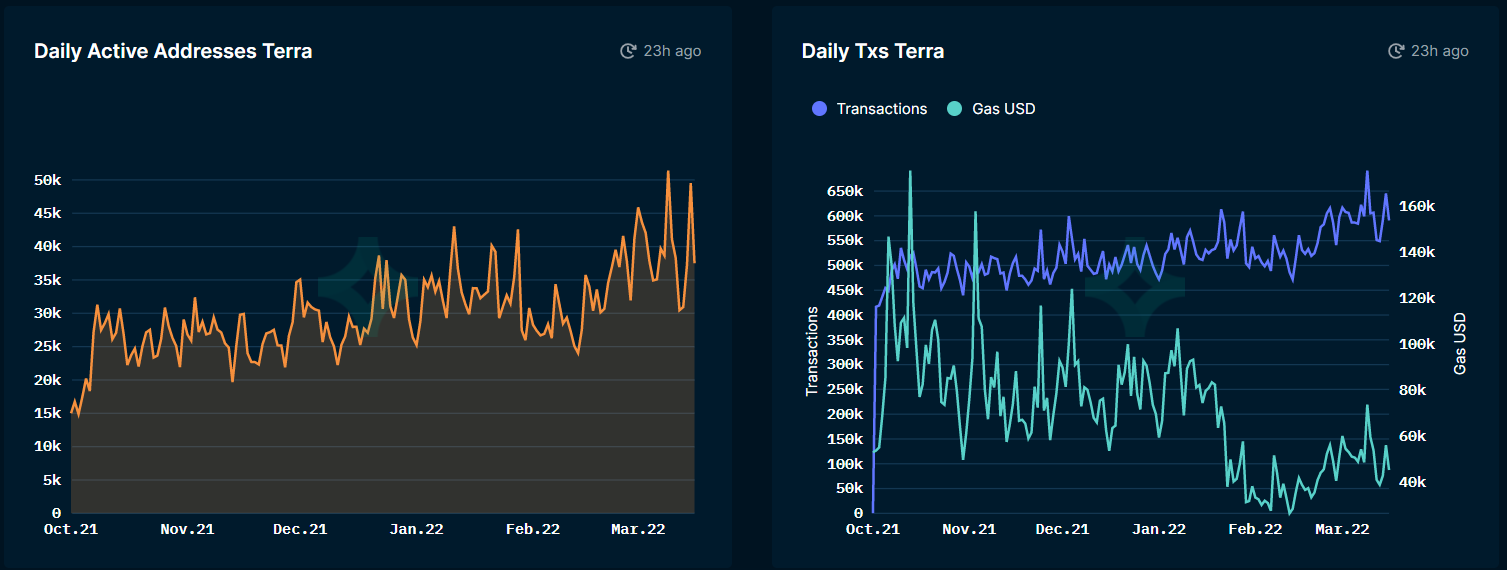
Terra's daily active addresses have been on a gradual upward trend, reaching The peak value is 51000, and it is currently between 3-35000. The number of transactions per day has a similar gradual upward trend and reached an all-time high of ~690,000 on March 9.
Advantages of Terra Blockchain (Tx & Gas)
The Terra blockchain has three main advantages: speed, low fees, and interoperability.
Speed and Fee
By using the Cosmos Tendermint consensus mechanism, Terra is able to achieve high transactions per second (TPS) while maintaining relatively low fees. It is predicted that it can handle up to 10,000 TPS, and most transaction fees on the chain are less than $1. In comparison, Ethereum can only handle about 15 TPS with a transaction cost of about $9. The total number of transactions on Terra hovers around 50% of the total number of Ethereum transactions, while the gas fee paid is 0.2% - 0.6% of Ethereum.

Interoperability
As part of the broader Cosmos ecosystem, projects on Terra and Terra itself can communicate with other blockchains within the Cosmos ecosystem via Cosmos' Inter-Blockchain Communication Protocol (IBC) Project interaction. Currently, Terra is capable of directly interacting with popular protocols such as Osmosis, Juno, Secret network, Sifchain, and more. In the future, interoperability will increase and Terra will be able to communicate directly with every protocol in the Cosmos ecosystem.
Besides the Cosmos ecosystem, Terra also has partnerships with Ethereum, Harmony and Solana bridge.

Note: The screenshots of "Future" are the current look with each chain enabled, and are just illustrative of Terra's increased interoperability in the future.
Terra Ecosystem
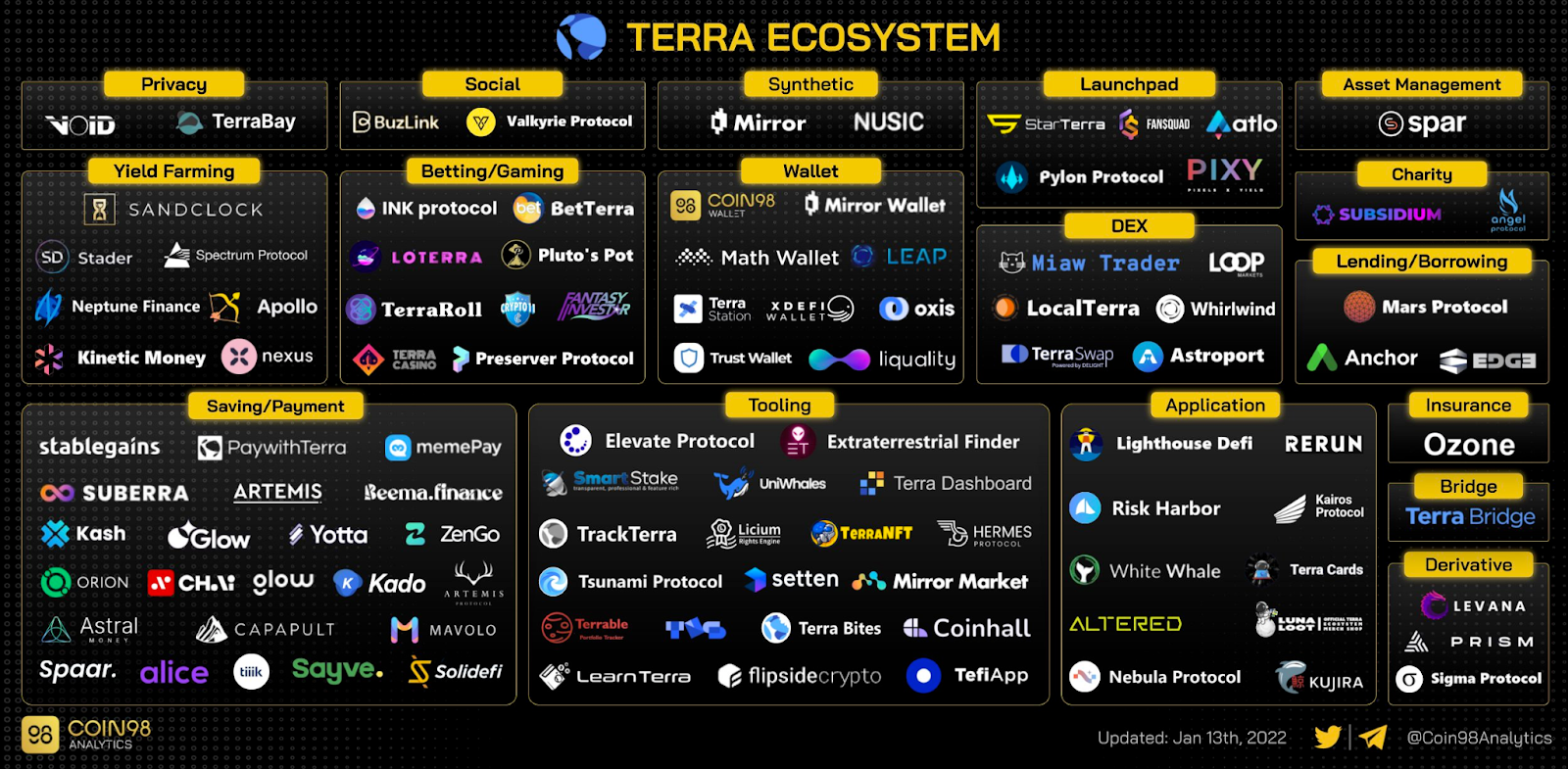
Terra The fast-growing ecosystem in 2022 is expected to have more than 100 projects launched. Due to the high level of interest in DeFi applications, the term was born: TeFi (Terra Finance). As of this writing, Terra is in second place with a total value locked of $22.48 billion, up 54% over the past month. UST's market capitalization sits at around $14 billion, up about 25% over the past month. Unlike EVM-compatible chains that attract existing protocols on Ethereum to integrate onto their blockchain, the vast majority of protocols launched on Terra are native to the blockchain. The number of Terra-native projects being built and the ability to attract significant capital at this early stage is a testament to the quality of its ecosystem.

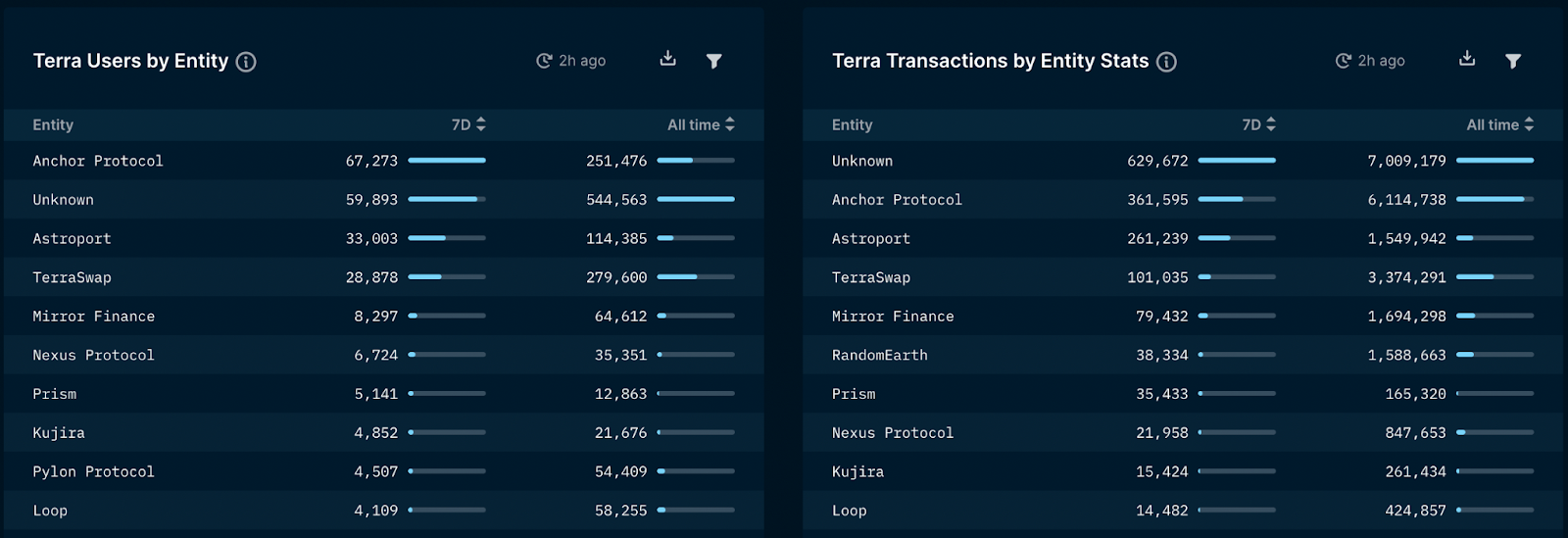
Based on the number of users and transactions , the top three most active protocols are Anchor Protocol, Astroport, and TerraSwap. The following briefly introduces their respective functions.
Anchor Protocol: is intended to be Stablecoins A benchmark for yield, analogous to a traditional bank deposit account, but with a much higher annual interest rate. APR hovers at 19-20% UST.
Astroport: Aims to be the heart of the Terra ecosystem DEX/AMM facilitates the exchange of all assets on Terra, analogous to the combination of Uniswap and Curve.
TerraSwap: The first AMM on Terra, Similar to Uniswap. The core difference is that TerraSwap does not allow users to freely list Token Or create a pool of funds.
Terra's focus is on making blockchain technology accessible to the masses, even if they don't realize it . Payment apps such as Chai (Asia), Kash (Europe) and Alice (US) aim to fill the space occupied by current digital payment solutions such as Cash App and PayPal. These protocols have a similar front-end user experience to traditional digital wallets, but are powered by the Terra blockchain on the back end, and users are often unaware they are using a blockchain-based system. Chai is the most mature of the three, having processed over $6 billion in transactions for over 2,200 merchants.
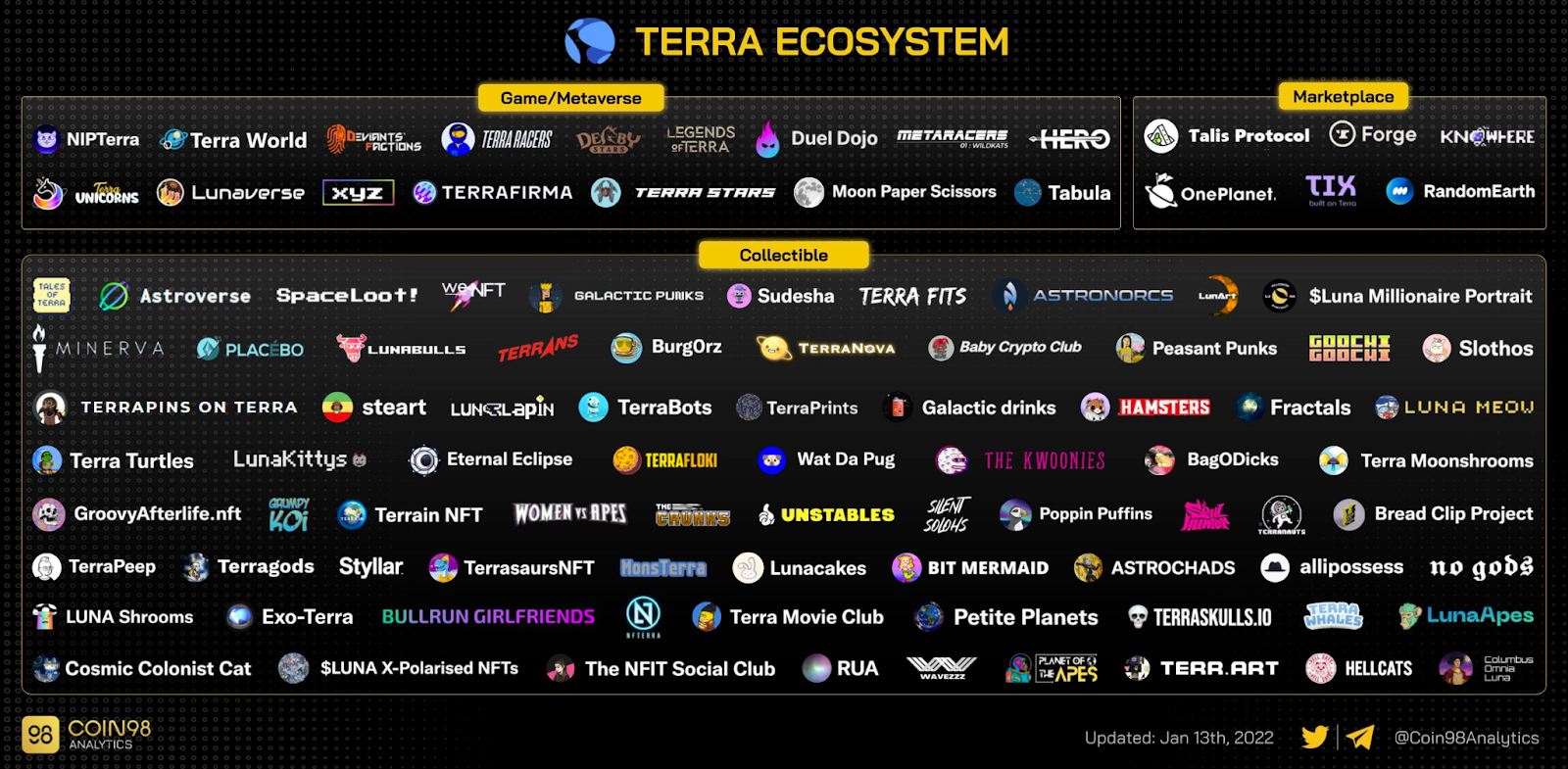
In addition to DeFi, Terra also has an emerging NFT and gaming ecosystem that is Establish. Second only to Mirror Finance in number of transactions, RandomEarth is Terra's primary NFT marketplace. Galactic Punks is the largest collection on Terra and probably the most common profile picture in LUNAtics (Fans of Terra).
Gamevil is a game publisher famous for "Summoner Wars" In partnership with TerraForm Labs, a gaming and NFT ecosystem has been built.
Every blockchain must have a good wallet to allow users to interact with the application , and its Token self-regulate. In Terra's ecology, they have established their own wallet and a dashboard called Terra Station (Dashboard) for users to interact with the core functions of the protocol. The dashboard provides information on LUNA Token and various Stablecoins Insights on key metrics such as staking yield and on-chain transaction volume.

What is the future of Terra?
There will be a spillover effect on Terra due to the growth and improvement of interoperability within the Cosmos ecosystem. As more and more protocols are built using the Cosmos SDK and leverage IBC for interoperability, the number of protocols that Terra will be able to interact with will increase. Cross-chain bridging to other blockchains through protocols like Wormhole will continue to add support for more chains and allow interaction between supported chains.
Increased overall liquidity and potential user numbers will be of great benefit to Terra. Not only will applications on Terra be used more frequently, Terra Stablecoins, such as UST, will also be used more frequently. Every chain and exchange that adds support for UST brings UST one step closer to becoming a decentralized medium of exchange for cryptocurrencies.
The TeFi ecosystem will continue to expand with more to come in the coming months and years s application. More and more high-quality applications increase the liquidity of the ecosystem and enhance the overall strength of TeFi.
Applications were created to fill in gaps or solve problems that exist in other applications. This leads to a more holistic DeFi experience as an end user and increases confidence in the broader Terra ecosystem. Examples of this include WhiteWhale, a protocol that enables retail investors to help UST maintain its currency peg; and insurance protocols such as Nexus Mutual, which provides deposit insurance for depositors on the Anchor Protocol. Terra's payment protocols, such as Chai, will continue to drive real-world adoption of the Terra blockchain and various Stablecoins adoption and use.
NFTs and games on Terra are also an area of concern. The partnership with Gamevil is a sign of what’s to come, and we’ll start to see the gaming and NFT ecosystems being established in the coming months.
Summary
Terra Bitcoin was founded with the ambitious goal of transforming money to enhance the decentralized economy. Its dApp ecosystem and LUNA Token An interesting opportunity for investors to gain exposure to the emerging layer-one blockchain and decentralized Stablecoins investment in growth.
The growth rate of dApps on Terra and the fundamental need for a decentralized currency make UST the most decentralized currency among cryptocurrencies Stablecoins Plate faucets. The strong focus on DeFi, interoperability, and its payment applications creates a strong foundation for future growth from cryptocurrency natives and the general public. With more than 100 new applications expected to be launched in 2022, it can be said that we are only at the beginning of TeFi, and Terra is a protocol worth watching.
Original link
Welcome to join the official BlockBeats community:
Telegram Subscription Group: https://t.me/theblockbeats
Telegram Discussion Group: https://t.me/BlockBeats_App
Official Twitter Account: https://twitter.com/BlockBeatsAsia

 Related Articles