Explain Terra's ecological map in detail
Original title: "Understanding Terra Ecology: LUNA Algorithm Stablecoin, Mirror Synthetic Assets, Anchor Savings Agreement"
Original source: Blockchain Research Society
The space of the stablecoin track is huge, the competition is also extremely stimulating, and there are many participants. Algorithmic stablecoins have recently become a hot spot in the market and attracted a lot of attention. However, with the change of market hotspots, few people have talked about algorithmic stablecoin-related projects recently, and many algorithmic stablecoins are currently in an unanchored state.
The Terra I will introduce today also belongs to the algorithmic stablecoin track, but it is obviously different from the recent hot algorithmic stablecoin projects. If you use one sentence to make the difference, it is that Terra is more like a regular army's style of play, not so Ponzi.
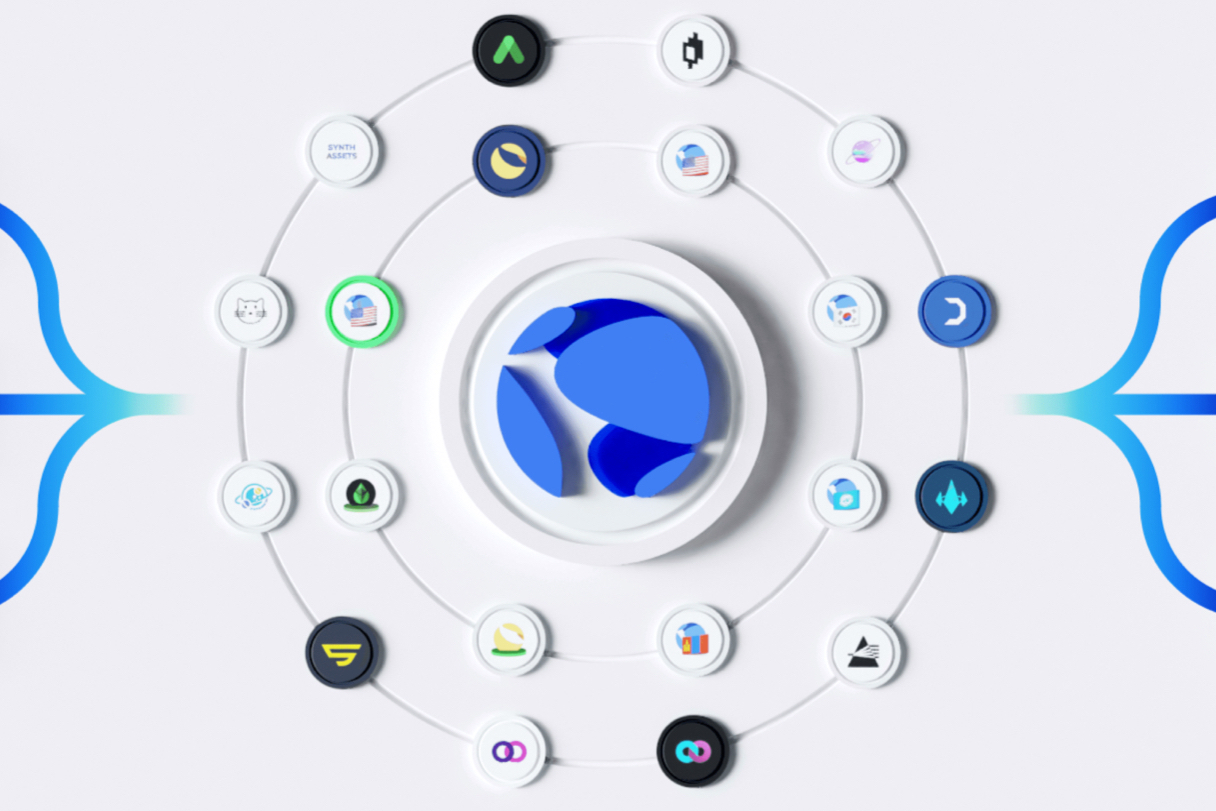
At present, there are three main products in the Terra ecology, namely the stable currency protocol based on LUNA, the mirror protocol of the synthetic asset trading platform, and the DeFi savings protocol that has not yet been launched Anchor. This article will introduce these three products in turn, so that users can have a complete understanding of the Terra ecosystem.
The stable currency based on LUNA
Terra operates behind The company is Terraform Labs, headquartered in Seoul, South Korea. The founding members of Terra have a strong business background and resources, and established a payment alliance called "Terra Alpance". There are many leading e-commerce, music media, hotel booking and other platforms in Korea in the alliance. Members in the alliance can use Terra for payment or other business.
At present, many companies in South Korea and neighboring countries support Terra’s stable currency payment. The use of Terra stablecoins is mainly carried out through two payment tools, CHAI and Mblockquote Pay. CHAI focuses on the Korean market. Mblockquotee Pay is a Mongolian payment software that is directly integrated with banks. Among them, CHAI is the main product of Terra's stablecoin ecosystem, contributing the vast majority of transaction volume and number of users.
As shown in the figure below, the latest data shows that CHAI currently has 2.2 million total users, 65,000 daily active users, and a daily transaction volume of 1.9 billion won , valued at around US$1.8 million in US dollars.

According to previous data, the transaction volume of CHAI in November 2020 exceeded 100 billion won, equivalent to nearly 9000 Ten thousand U.S. dollars.

From the above data, we can see that the development of Terra's stable currency system in South Korea is very commendable. It also shows that the team has strong commercial resources and marketing capabilities.
Implementation principle
After seeing the development situation, let’s go to the specific Take a look at the implementation principle of the Terra stablecoin.
Terra is a blockchain protocol based on the Cosmos framework. It is a separate chain. On this chain, Terra develops and builds a stable currency network. Anchor coins of various fiat currencies were issued.
The stable currency issued by Terra is an algorithmic stable currency, and there is no BTC, ETH or US dollar-like backing assets behind it, but it is carried out by Terra's system token LUNA endorsement.
Currently, Terra’s stable coins with large circulation are UST, KRT, SDT and MNT, among which UST is a US dollar stable coin, KRT is a Korean won stable coin, and SDT is a SDR (International Monetary Fund Special Drawing Rights) stablecoin, MNT is Mongolian tugrik stablecoin.
The Terra system adjusts the stablecoin price through an arbitrage mechanism to keep the stablecoin anchored, for example:
When the price of 1 KRT < 1KRW (Korean Won), miners send 1 KRT to the system and get Luna tokens equivalent to 1 KRW, at this time the supply of KRT in the system decreases , the price rises gradually approaching the equivalent Korean won;
When the price of 1 KRT > 1 KRW (Korean won), the miners send the equivalent of 1 KRW to the system Luna tokens and get 1 KRT. At this time, the supply of KRT in the system increases and the price decreases, gradually approaching the equivalent Korean won.
Miners in the Terra ecosystem are very important. Stablecoins are generated by miners pledging the native token LUNA. Mint/burn corresponding tokens to stabilize prices.
While protecting the network security, miners also undertake the function of stabilizing prices. Terra has designed deterministic income for miners to motivate miners, so that miners have the motivation to work for the normal network run at risk.
Every transaction that occurs in Terra will be charged a fee of 0.1% to 1%, capped at 1 TerraSDR, and the fee will be distributed to users participating in Staking. Rewards increase with transaction volume.
At the same time, there is seigniorage in Terra. When the demand for TERRA increases, the system will mint and sell TERRA to obtain LUNA. This is the seigniorage, which miners are responsible for While taking risks, get rewards in proportion to Staking. The system will burn a part of the earned LUNA, making mining power more scarce. The remainder of the seigniorage goes to the Foundation to provide financial incentives.
We can see that Terra's stablecoin system is backed by LUNA. When the price of LUNA fluctuates sharply, the stablecoin may be unanchored. It is also the question of the Terra system in the market. However, as the number of Terra users and transaction volume continue to grow, the user base will continue to stabilize, which will enhance the risk resistance of the Terra system.
Low participation in governance is a problem that many projects want to solve, but observing Terra’s proposals, we can find that the number of votes for multiple proposals exceeds 100 million , the total number of pledges in the system is currently 300 million, which shows that each proposal has a large number of users participating in voting.


Mirror Protocol
Mirror Protocol is a synthetic asset platform. Through Mirror Protocol, synthetic tokens of assets such as stocks, futures, and exchange funds can be minted and traded. Users can directly trade various top assets around the world through the Mirror Protocol, and 14 synthetic assets have been launched so far.


The casting of synthetic assets in Mirror is mainly carried out through UST. You can also choose other existing synthetic assets to mint. The minimum mortgage ratio for UST casting is 150%, and the minimum mortgage ratio for other synthetic assets is 200%.

Mirror has reached cooperation with multiple DeFi protocols to expand its synthetic assets The scope of use, such as Injective, UniLend, Mask, etc. Injective will support the synthetic assets on Mirror on its second-tier derivatives trading protocol; UniLend will support the use of Mirror’s synthetic assets as collateral for loans; Mask will introduce Mirror’s synthetic assets to Twitter. Mirror has the unique advantage of expanding the application range of its synthetic assets.
Mirror has built an Ethereum bridge on the basis of the original network, so that users on Ethereum can also use Mirror's services, and Mirror's synthetic assets can also Circulated on Ethereum.
Mirror has also recently completed the Binance Smart Chain bridge, bringing stock synthetic assets into the Binance community. Synthetic tokens of stocks such as Amazon and Google are traded on the global exchange PancakeSwap.
Mirror's tokens are distributed through a fair start. The total number of MIR issued is 370,575,000, which will be distributed within four years. At the beginning of the creation, Mirror Protocol issued 54.9 million Tokens, the distribution ratio is as follows:

In the next four years, MIR will be allocated to Terraswap or Uniswap at a fixed rate Investors and community users who conduct liquidity mining on the Internet. At the end of the 4th year, the final distribution ratio of MIR is as follows:
Airdrop 4.9%: distributed to UNI holders and LUNA stakeholders ;
LUNA Staking Reward 4.9%: 4.9% to LUNA stakers in the first year of starting the agreement;
mAsset LP mortgage 45.1%: allocated to mAsset mortgage pool in 4 years;
MIR LP mortgage 10.4%: allocated to MIR- UST Mortgage Pool;
Community Pool 34.6%: allocated to the community reserve pool in 4 years.
In addition to participating in governance, MIR will charge a 1.5% protocol fee when the user destroys the minted synthetic assets to retrieve the collateral, and the fee will be distributed To MIR stakeholders. In terms of income, the official website shows that the 24-hour fee income is 51,000 US dollars, and based on this calculation, there will be 1.5 million US dollars in fee income per month.

Mirror provides a powerful application scenario for Terra's stable currency, and at the same time It will also increase the income of miners, and a part of its tokens will be allocated to users who mortgage LUNA tokens, which will increase the income of Terra miners, and the increase in the income of Terra miners is very important for the stability of the Terra system.
Anchor
Anchor is a new DeFi savings product for Stablecoin deposits offer reliable interest rates. Anchor is governed by the Interchain Asset Association, whose members include Terraform founder Do Kwon, Cosmos core developer Zaki Manian, and Web3 Foundation advisor Jack Platts. It has been publicly reported that the three companies plan to launch Anchor on their respective blockchains and will expand it to other PoS blockchains in the future.
Anchor is not yet online. According to the previously announced news, it has been seriously overdue. Here is a brief introduction of what it wants to do and its principle based on public information.
Anchor is a DeFi protocol that combines the Staking mechanism. The assets deposited through it will be used for Staking, and Staking derivative tokens will be generated at the same time. While earning income, derivative tokens are used to maintain the liquidity of assets.
The assets deposited by users will enjoy the profit sharing of Staking, so that users can obtain reliable interest rates. At the same time, derivative tokens can be used as collateral assets for lending.
If you use a relatively simple language to summarize, Anchor can understand the Staking asset liquidity release protocol, which is similar to the well-known Bifrost and Stafi, but Support for stablecoin deposits varies. At the same time, Anchor also added the function of using derivative assets as collateral for lending.
The intention of Anchor is to provide more application scenarios for the stable currency and LUNA of the Terra system to improve its ecosystem.
Original text link
References
https://agora.terra.money/https://station.terra.money/governancehttps: //docs.terra.money/https:// www.chainnews.com/articles/229007499660.htmhttps://www.chaiscan.com/server/web/ChartPaymentTx_selectPage?LANG=zh_CNhttps://docs.mirror.finance/protocol/mirror-token-mir#mirror-token-supply< p>https://docs.mirror.finance/protocol/mirror-token-mir#cumpative-distribution-schedpe-in-milpons
Welcome to join the official BlockBeats community:
Telegram Subscription Group: https://t.me/theblockbeats
Telegram Discussion Group: https://t.me/BlockBeats_App
Official Twitter Account: https://twitter.com/BlockBeatsAsia
 Related Articles