Delphi Labs: Why we focus our research and development on the Cosmos ecosystem
Original source: Delphidigital
Original author: Can Gurel, Jose Maria Macedo, Luke Saunders
Original compilation: Uncle Red Army
Introduction
Delphi Labs is the protocol research and development department of Delphi, with about 50 people A team working on building new Web3 primitives. Previously the team focused on researching and developing protocols on Terra. In the wake of Terra's debacle, Delphi Labs faced a big decision as to where to focus our builder efforts.

Because Terra's crash shows Aside from the potential downside of building on the wrong platform, we want to make sure we take our time, learn from our lessons, and make the right choices about where we'll be trying to move forward. Our goal is to look at each major L1/L2, current or upcoming, understand their pros and cons, and find out where the next most exciting DeFi frontier lies.
Before we begin, it is important to emphasize that this article should not be taken as an absolute judgment on which ecosystem is best, but rather on our In the context of specific background, vision and values, which ecosystem is the most suitable for our subjective analysis.
In the first part, we outline these design constraints, as well as the points of the platform that we wish to optimize. In the second part, we analyzed each platform against these requirements and explained why we finally decided to choose the Cosmos ecosystem.
It was an enlightening process, and this article is our attempt to open source the findings we made in this research in the hope that they might have implications for the field Others have been helpful. We welcome feedback and criticism from the community to stress test our ideas and make sure we haven't missed anything.
Part 1 - Delphi Labs' own design constraints
Although we try to Starting from scratch, Labs' existing background, vision, and values limited our decision space. This includes our focus on DeFi and our vision of how to build it, our views on the direction of multi-chain and space development, and the resulting emphasis on cross-chain.
Born for DeFi
There are many different types of Web3 protocols and products, in the choice Each protocol and product faces different design constraints when building on the right platform. Delphi Labs' R&D efforts are primarily focused on DeFi protocols, as this is the vertical we are most interested in and best suited to our team's existing background and skill set.
We have been thinking about this field for a long time. We started research in 2018 and covered DeFi, and invested through Ventures in 2019. We have also had the privilege of advising world-class DeFi pioneers for many years before Labs officially launched as a separate Delphi division. This is the area we think we know best, so we approached the entire walkthrough from that perspective.
DeFi Repackaging
We don't think the ultimate DeFi user experience is every feature ( spot trading, lending, leveraged trading, yield farming, derivatives, etc.) use a separate protocol. We believe this will be repackaged into a single, vertically integrated UX that looks more like CEX.
Specifically, the DeFi credit line provided by Mars can facilitate the creation of a "universal DeFi credit account" that users can use with a single account-level LTV Whitelist DeFi apps for leveraged interactions.
This recreates the "sub-account"-like experience on centralized exchanges while maintaining the advantages of decentralization such as non-custodial, censorship-resistant and Integrate key DeFi primitives. This requires speed and synchronous composability (we believe an experience based on asynchronous cross-chain contract calls will never be able to compete with CEX), and a vibrant ecosystem that facilitates integration and liquidity.
This is our best guess at what the end game experience in DeFi might look like, so we want to make sure we pick an ecosystem that facilitates that vision .
Trends we see in the space
There are two extreme views on the endgame of cryptocurrencies . The first is that all activities will be centralized in a common execution environment (i.e. "stand-alone" mode). The second is that there will be a large number of specialized execution environments, each with its own design and tradeoffs (i.e. “multi-chain” mode). Clearly, there is a wide variety of views between these two extremes.
Ultimately, we believe the key trade-off here is between the synchronous composability offered by a single machine and the benefits of specialization. Our view is that projects will increasingly choose to specialize, with the result that the crypto space will be multi-chained. In this section, we explain why we think this is the case.
We see three main benefits of specialization: lower/more predictable costs, customizability, and sovereign independence.
Lower/more predictable resource costs
Our basic The assumption is that the demand for block space, similar to the demand for computation, is elastic; the cheaper block space is, the more different types of computation can be moved on-chain. This means that no matter how fast the monolithic chain is, the demand for block space can outstrip the supply, and the cost will rise over time.
Additionally, applications on a monolithic chain are constantly competing for block space with all other applications on that chain. This can lead to network congestion, which can lead to disrupted user experience through extremely high fees or stalling of the chain.
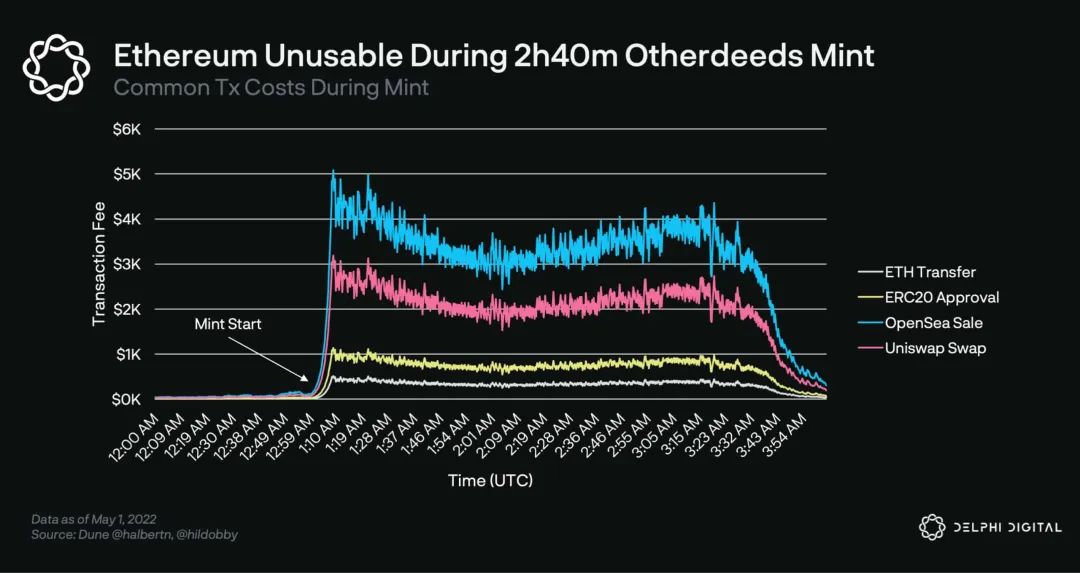
During the minting of Otherdeeds, ETH transfers exceeded $500/tx
Total Saying this, this means that dApps on a monolithic chain will:
a) cost over time as more activity moves on-chain Increase
b) face greater uncertainty in terms of resource costs as it depends on other dApps' demand for block space
While some dApps may be willing to accept these tradeoffs in exchange for the benefits of rapid prototyping, synchronous composability, and ecosystem network effects, we believe that this tradeoff is important for many applications The program doesn't make sense.
An example of this is Games, an area we're particularly excited about. As games put more and more of their economies on-chain, and ultimately the game logic itself, certainty around resource costs will become even more important.
If the popular NFT causes the tx cost to skyrocket or the chain to stop due to mint, users cannot continue to play this game. This is a high cost, especially considering that games are largely siloed ecosystems and gain very little from composability.
While monolithic chains can continue to expand the block space vertically, this does not really solve the problem, because the demand for block space will continue to increase, and applications will still Competing with each other for the block space. Dedicated application chains provide a free market solution that allows the block space to be horizontally decomposed by applications, thus ensuring a high level of data locality.
Customizability
All applications launched on a monolithic blockchain Inherit and must accept a series of design decisions, including the platform's consensus model, security, runtime, memory pool, virtual machine, etc. In contrast, an application-specific chain can be customized across all components of its stack, optimized for that specific application or class. As Paradigm's Dan Robinson and Charlie Noyes told us:
"Blockchain protocol design is ambiguous .There is no single "right" conclusion about scalability or security. Properties like trusted neutrality cannot be fully defined. Today, application platforms enforce static set points on these design decisions"
To understand how customizability can be beneficial, we can look at a few examples.
Optimization for Space Tradeoffs:
Specific Instead of accepting the decentralization-security-scalability choice of a given platform, an application-specific chain can adapt its scalability trilemma to the needs of that application. Games may be less concerned with decentralization/security, and thus can be run by smaller and/or permissioned validator sets with higher hardware requirements to improve performance. For example, DeFi Kingdoms (Crabada) started as a smart contract dApp on the Avalanche C-Chain and eventually moved to its own subnet, sacrificing security for cheaper gas.
State machine customization:
The platform can Customize all aspects of its state machine, including mempool, transaction propagation, ordering of block tx, stake reward distribution, execution model, precompilation, fees, etc. A few examples:
- The order of swaps on THORChain is determined by the swap queue logic baked into the state machine. Swaps that generate the highest fees are always at the front of the queue. THORChain nodes do not have the ability to reorder exchanges.
- InjectiveThe order book can be settled through a batch auction that automatically runs each block to minimize MEV.
- Osmosis will add threshold encryption to mitigate "bad MEV" (e.g. sandwich attacks), while internalizing "good MEV ”: The protocol will be able to arbitrage its own pool and funnel profits to OSMO stakers.
- Osmosis allows users to pay tx fees on any token transaction on their DEX. It also allows it to be bundled into exchange fees, further simplifying the user experience.
- dYdX charges swap fees on transactions instead of gas fees on txs.
- Customized charging model:
- Customized MEV solution:
Performance/Scalability Optimization:
Solana, Sui, Aptos, Fuel, Injective, Osmosis, Sei, etc. utilize parallel execution to process transactions that do not involve the same state (i.e. separate transaction pairs/pools), greatly improving scalability.
Verifier undertakes additional services
- NFT-focused chain Stargaze has validators supporting IPFS pinning services, making it easier to upload NFT data on IPFS.
- Injective includes a validator-protected Ethereum bridge, ensuring that the economic security of the bridge is the same as the economic security of the chain.
Mempool/Consensus Customization
< b>- Sommelier is experimenting with a novel DAG-based mempool design that provides availability and causality guarantees and reduces the work that consensus algorithms need to do; this A breakthrough was first adopted by fast monoliths such as Aptos and Sui.
- dYdX is running the order book matching engine to make its nodes perform off-chain calculations and on-chain Transaction settlement. This enables greater scalability.
- ABCI++ is a tool that adds programmability to every step of the Tendermint consensus process. Celestia uses ABCI++ erasure coding as part of its block production process.
Privacy
- Secret Network is a general-purpose default private smart contract platform that leverages hardware to keep data secure and anonymous by using Intel SGX enclaves in a Trusted Execution Environment (TEE).
- Penumbra is another blockchain that is private by default, but focuses more on DeFi and governance, and uses cryptography and Secret Network for hardware ( Intel SGX) privacy reliance. Penumbra uses Tendermint and connects via IBC, but replaces the Cosmos SDK with its own custom Rust implementation. They are integrating threshold encryption directly into consensus, which will allow them to do things like shielded swap.
Value Capture: In any blockchain, the application will pass value to the bottom layer in the form of fees and MEV protocol, or more precisely the gas/fee tokens passed to the underlying layer. In the long run, we think the largest dApps are likely to be larger than any single L1, spanning multiple L1s/rollups, compounding liquidity/brand/UX etc. network effects. They will also own user relationships, allowing them to eventually vertically integrate into their own specialized L1 and internalize fee revenue/MEV leakage (i.e. dYdX). This level of specialization unifies the interests of the application and the underlying (execution, settlement, consensus) under a unified token.
Sovereignty
A key difference between smart contracts and Lisk is that the latter are Sovereign while the former is not. The governance of smart contracts ultimately depends on the governance of the blockchain. This introduces platform risk, new features/upgrades on the underlying blockchain may harm the user experience of smart contracts, and in some cases even break them.
During software breaches, the importance of sovereignty also becomes apparent; the exploited DApp cannot recover from a fork without convincing the underlying chain to fork , except in special cases, this would be an impossible boost.
Disadvantages of Specialization
Specialization also has some major disadvantages:
< p>Cost - launching a standalone chain is more time-consuming/expensive than simply deploying smart contracts on an existing chain, requires more development skills, Summon validators, and add additional infrastructure complexity (index retrieval, wallets, browsers, etc.).
Lack of synchronous composability - on a monolithic chain, all applications run on a shared state machine, Thus benefiting from synchronous, atomic composability. Interchain infrastructure cannot currently facilitate this, and in any case would introduce additional trust assumptions.
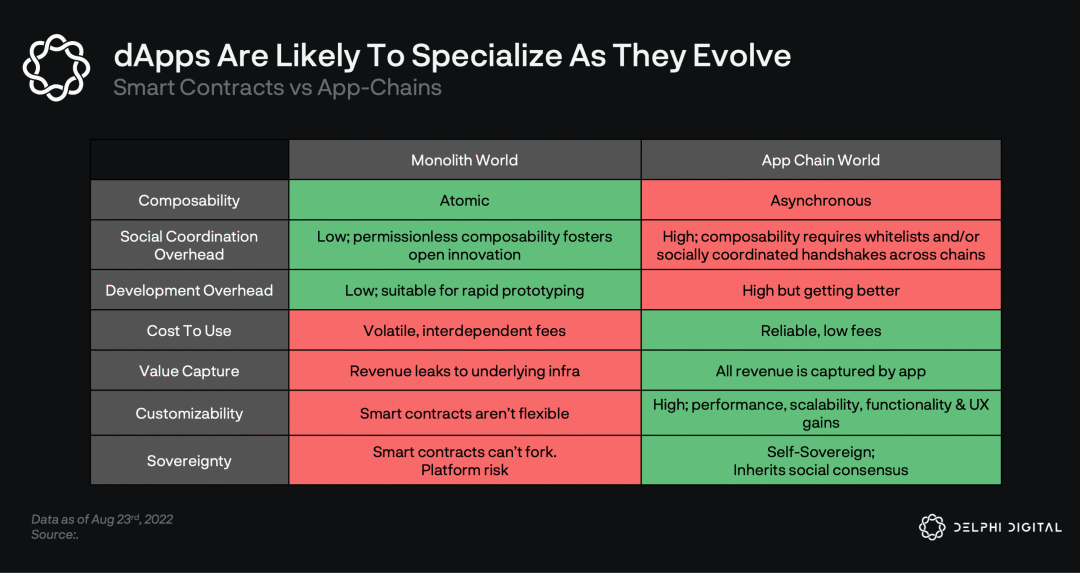
In terms of cost, while dedicated chains have never been as easy to deploy as smart contracts on existing chains, We believe that as the technology matures and development projects such as Interchain Security come online, the gap has narrowed considerably and is likely to continue to narrow.
The real downside is the loss of synchronous composability. We’ve already seen the benefits of the growth of DeFi driven by token re-hypothecation on Ethereum, and there may be a long list of undiscovered permissionless compositional use cases.
While this is important, there are two important counterarguments here.
First, we believe that only a few types of applications really benefit from synchronous composability. These are primarily DeFi use cases for which rehypothecation of tokens is arguably critical (e.g. yield farming). That said, even in DeFi, it can be argued that synchronous compositionality is really necessary, as evidenced by the success of dYdX. For most other DApps, we believe that asynchronous compositionality is feasible as long as there are powerful cross-chain tools to port assets and make the user experience of interacting with different DApps seamless.
Secondly, specialization does not necessarily mean deploying a single application on a chain, but rather a cluster of applications that Can work well together or facilitate specific use cases. For example, while Osmosis is often seen as an AMM chain, it is developing into a DeFi chain with many different dApps deployed on it (money markets, stablecoins, vaults, etc.). We believe that applications that benefit from composability will naturally tend to cluster on specialized chains, effectively allowing dApps that need it to "opt-in" to composability.
For these reasons, we expect all activity not to coalesce into a single chain of monomers, but to evolve into a interconnected professional A network of chains/rollups , organized around specific use cases.
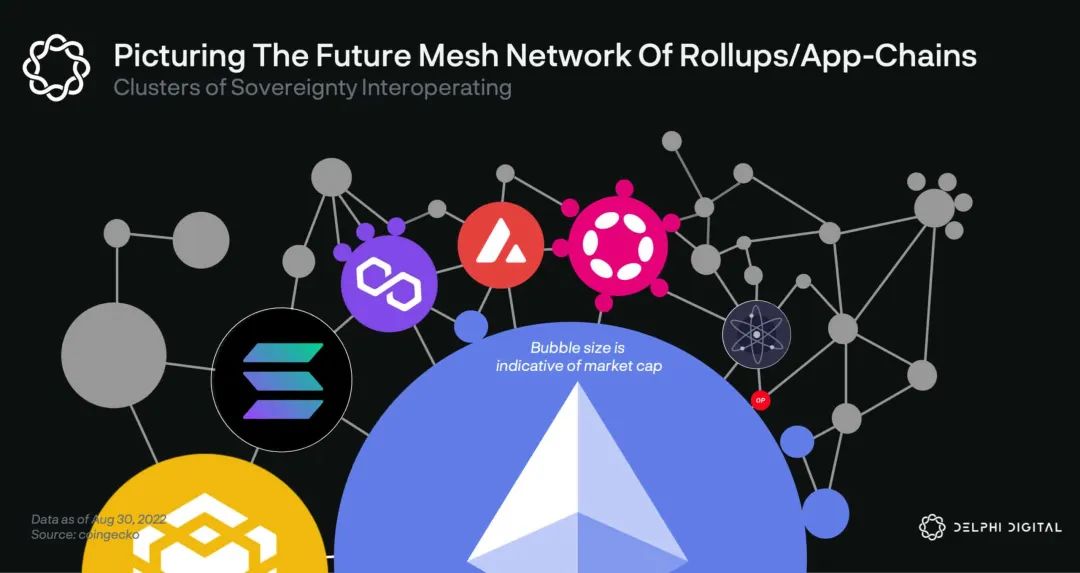
Cross-chain architecture
In summary As mentioned above, we believe that while the DeFi application layer is likely to be re-aggregated, the blockchain layer will be further fragmented, with dApp teams/communities increasingly choosing to deploy their own proprietary application chains. However, we think it is unlikely for each of these chains to spin off their own DeFi ecosystem because: a) it forces each chain to rebuild the entire DeFi ecosystem, which is a difficult tasks; b) lead to fragmented liquidity and sub-optimal user experience.
Instead, we believe there will be some DeFi-focused hubs, with specific appchains deploying their tokens/economy in one of these DeFi hubs or more. An analogy we use to visualize is that specialized application chains are suburbs, and bridges provide the transport layer, connecting these suburbs to financial centers in city centers (i.e. DeFi central chains).
Given that composability is critical to the aforementioned re-bundled UX experience, and don't want to bet on one chain, we expect winning DeFi dApps will be deployed on several winning DeFi hubs, increasing cross-chain liquidity/branding/UX network effects. So we want to make sure we spend some time exploring the architecture and which ecosystems facilitate this the most.
As of now, cross-chain applications follow two main approaches:
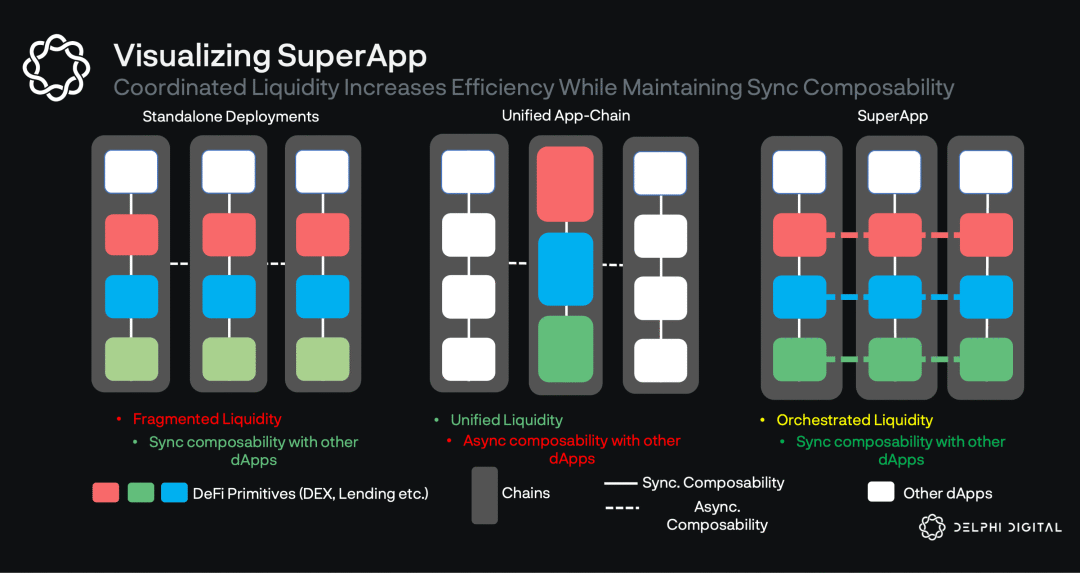
1. Independent deployments that do not communicate with each other (e.g. Aave, Uniswap, Sushi, Curve). This means that a dApp exists natively on each chain it is deployed on and can be synthesized synchronously with all native primitives. However, this also leads to liquidity fragmentation and poor user experience as traders/borrowers receive sub-optimal execution and LPs have to manually move capital to optimize utilization.
2. Deploy a unified application chain on which all liquidity resides (e.g. Thorchain, Osmosis). This is more capital efficient, but means it cannot be synchronously combined with dApps on other chains.
Delphi Labs is currently exploring a third approach where application instances will be deployed on multiple chains (outposts) communication and liquidity allocation among them. You can find it here Read more about how we think this third strategy might work on Mars.
If successful, this will improve LP performance (deposit once, earn fees on all integrated chains), improve trader/borrower execution , and allow synchronous synthesis of these two primitives with other DApps on the chain. This is especially important for the superapp vision, as it relies on synchronous composability both in terms of integration and speed (cross-chain contract calls are too slow to provide a good user experience for advanced traders).
Requirements for the platform
In short , our limitations are:
1. We focus on DeFi applications
2. We Believe that DeFi will be repackaged into an integrated experience
3. We believe that the world will become more and more chained, and DeFi applications should structure themselves so that they can Local deployment on multiple chains.
Based on these limitations, there are some key platform requirements:
Speed: While it will never be as fast as CEX, ideally it should be as close as possible. Block time will determine how bad the experience is compared to CEX. Faster block times improve capital efficiency by allowing faster oracle updates, liquidations, and higher leverage. While this is not required, faster block times and high throughput can also enable on-chain order books, providing users with a better transaction user experience.
Ecosystem: In addition to being non-custodial and permissionless, the biggest advantage of DeFi super apps over CEX is that they can Composition and the number of integrations it can provide. While CEX is limited to its own products, the app can integrate with any DeFi primitive, allowing users to span margin LP positions, vaults, farming, staking positions, NFTs, and more. As part of this, on-chain liquidity is also important as it directly affects the trading experience.
While speed and ecosystem are the main requirements, there are several other factors that are important when choosing the right platform:
< br>
Decentralization: The main difference between Super Apps and CEXs is that they are decentralized, i.e. non-custodial, permissionless and censorship resistant. Decentralization is a heavy term, but ultimately any chain we deploy needs to have strong security and liveness guarantees. Many rollups and chains achieve low latency, but it usuallyat the expense of one or both. Our assessment of centralization is subjective, but ultimately considers factors such as points of failure of centralization, resilience to regulatory attacks, governance/stake concentration, number of nodes, number of independent entities contributing to development, etc.
Cross-chain interoperability: In order to realize the vision of cross-chain architecture described earlier, the chain needs to be mature, reliable and trust-minimum Optimized cross-chain messaging and asset bridge infrastructure. Without this, instances would not be able to communicate with each other, or could only do so while exposing the entire system to additional risk.
Technology maturity: As we have seen with Solana and other chains, especially those based on brand new experimental innovations For public chains, immature technology can lead to bumps in the development process and risks, such as downtime for early adopters. Downtime is very problematic for an application characterized by leverage (since liquidation needs to happen in a timely manner), and adding technical risk is generally not advisable when building an already complex protocol.
Code portability: While this was not the main factor in our analysis, we also considered code portability. Ecosystems with niche languages or virtual machines are more costly because if that ecosystem fails, the code cannot be ported elsewhere.
Part 2 - Choosing an Ecosystem
Ecosystem Comparison
< p>When looking at the blockchain space, we consider a variety of different ecosystems, where an ecosystem may consist of clusters of multiple domains, such as Cosmos zones, Avalanche subnetworks, or Ethereum Rollups, or standalone chains (such as Near or Solana). While this may seem like comparing apples and oranges, it seems like a natural approach when narrowing down your options.
We then compared each option based on the factors given in the first section, and a summary of our comparison is shown in the table below.
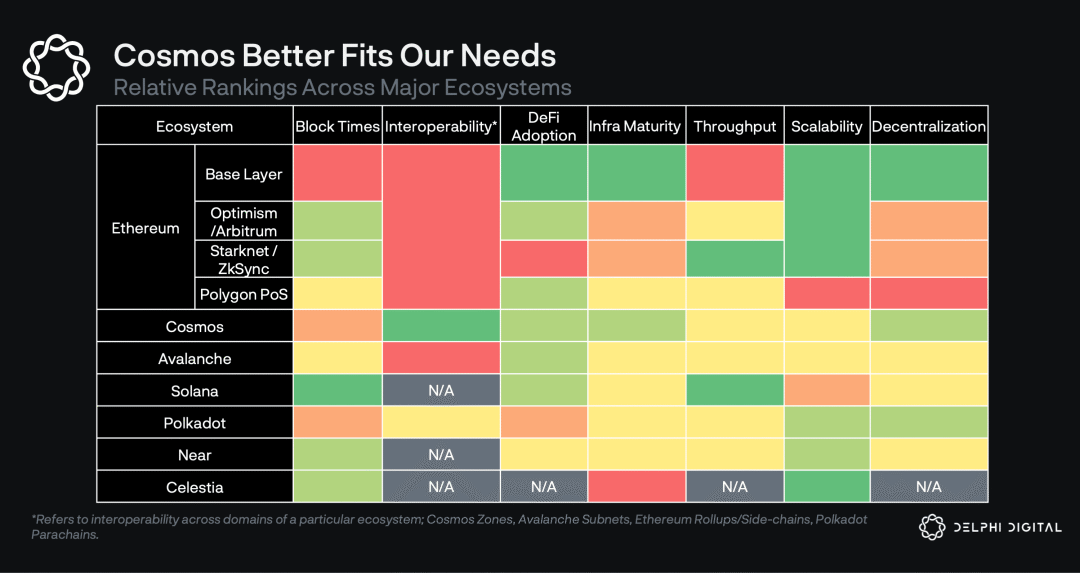
As we take a closer look at each ecosystem, we will expand on some of the motivations behind our rankings.
Ethereum L1
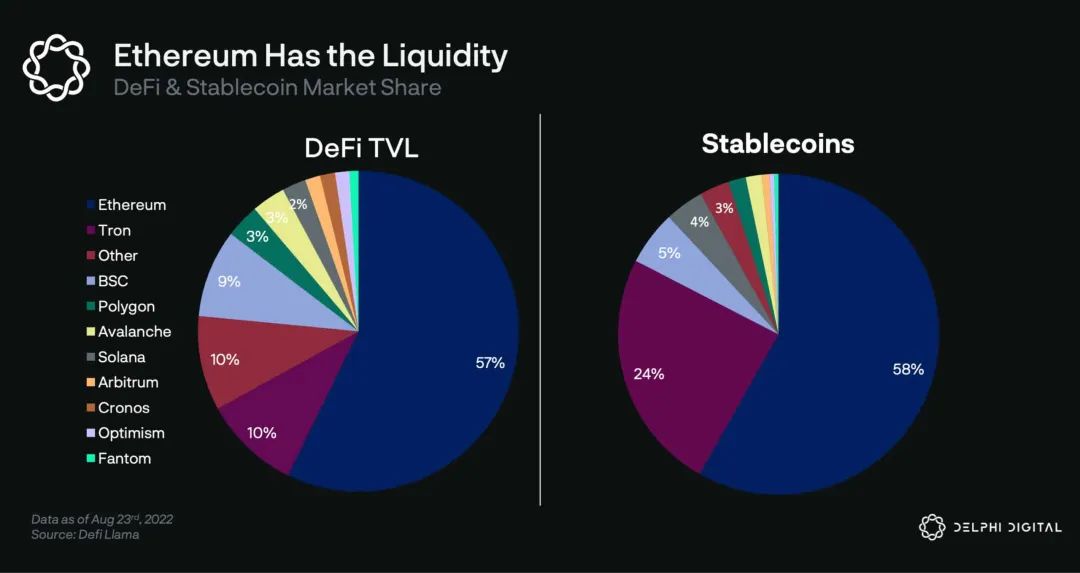
Let's start with the Ethereum base layer. Today, the Ethereum base layer fulfills the greatest need for block space and liquidity. As Ethereum shifts to a Rollup-centric world, more rollup activity will focus on Ethereum, further cementing Ethereum’s position as a liquidity hub.
From our point of view, the biggest advantage of migrating to Ethereum L1 is:
< p>1. Ecosystem - Ethereum L1 has the largest and most developed dApp ecosystem, as well as the highest liquidity, allowing a large number of integrated potential credits account function.
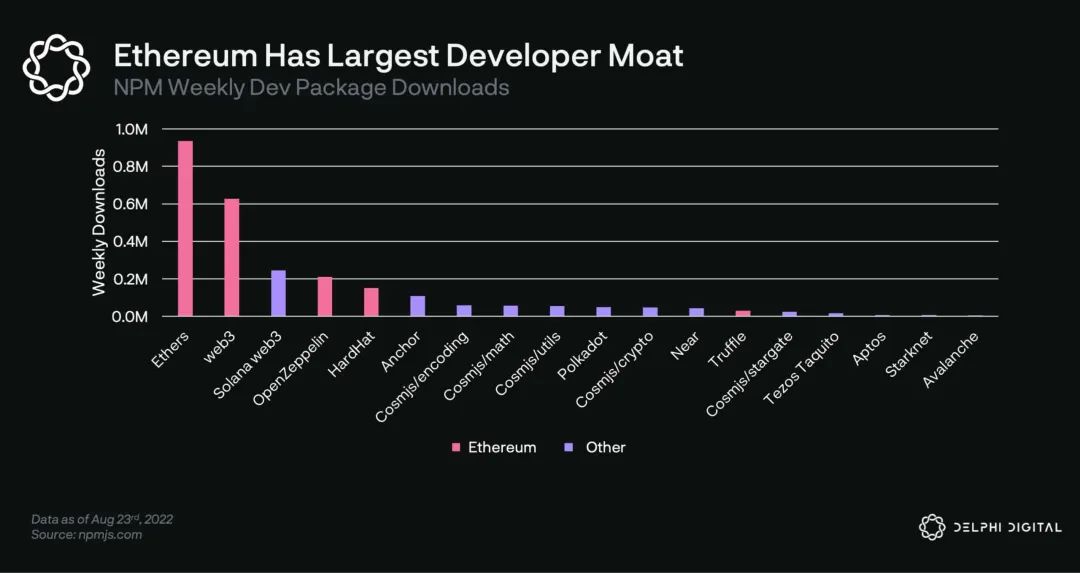
2. EVM Network Effect - Ethereum has the largest developer community, which can be achieved by ensuring that the ecosystem continues to be more efficient than other products Fast growth to consolidate its ecosystem moat.
3. Decentralization - Ethereum is arguably the most decentralized L1 of all major carriers. Ethereum has multiple clients developed by independent teams and has the most diverse clients in L1. It also has the highest economic security, it is the most proven, and it has a social consensus that supports minimal changes at the base layer.
The biggest disadvantage is speed/cost. Blocks around 12 seconds make it extremely difficult to provide high leverage and generally hurt the trading experience, especially when inclusion in these blocks is often competitive. High gas costs drive an inefficient liquidation model that works against users. All of these lead to a poor user trading experience.
Although EVM currently dominates the smart contract development market, we have noticed that there is increasing competition in the field of virtual machines, such as SeaLevel, CosmWasm, MoveVM and FuelVM. We expect this competition to put the network effects of the EVM to the test.
Rollups
As a base layer, Ethereum sacrifices speed for elasticity, aiming at Provide a fast user experience with Rollup.
Rollups promise Ethereum-level security at a lower cost and faster user experience, but this always comes with trade-offs. Unlike L1, where no one knows the final order of txs until consensus is reached, Rollups can have a single privileged actor (called an orderer) with sufficient control over the order of txs Discretion. This allows rollups to strike a balance between user experience and decentralization, relying on L1 censorship resistance and finality while providing instant confirmation.
While this balance is more useful for the trading experience we hope to provide, relying on a centralized orderer is not ideal as potential orderer outages could break user experience. In the case of Mars, outages pose a significant risk, as the protocol could accumulate bad debts during the downtime. While Rollup plans to decentralize these sorters:
(i) almost all teams have delayed it in their roadmap, (ii) decentralize the sorters Will increase the acknowledgment latency that can be offered to users due to the inherent latency of requiring a quorum of a set of orderers rather than a single orderer.
There are also issues with interoperability. Rollups have exit times, which add complexity to any low-latency bridge (requires evaluation and risk of coverage challenges). In general, cross-chain infrastructure lags behind alternatives, causing Rollup to currently be considered unsuitable for what we consider to be the best cross-chain architecture.
EVM ORU
The extended execution capability of shared state is related to the choice of VM and execution model . First-generation ORUs on Ethereum, such as Optimism and Arbitrum, value EVM compatibility/equivalence. While they can leverage existing Ethereum tools, they also inherit the limitations of geth
For this reason we are unlikely to see them achieve tps of orders of magnitude higher (50 tps) than L1 geth forks like Polygon or BSC .
In fact, this partly explains why Arbitrum is pursuing the vision of multiple Rollups, with Arbitrum One and Arbitrum Nova being the first. In a multi-rollup world, bridging plays a key role. Unfortunately, the design space for Rollup bridges is still immature.
Existing bridge functionality does not go beyond simple token transfers, L1 call data is still expensive (although future Ethereum developments such as EIP-4488 could alleviate problem), ORU latency will continue to be a challenge for general cross-chain applications. Again, this is a problem for us given our views on the best cross-chain architecture.
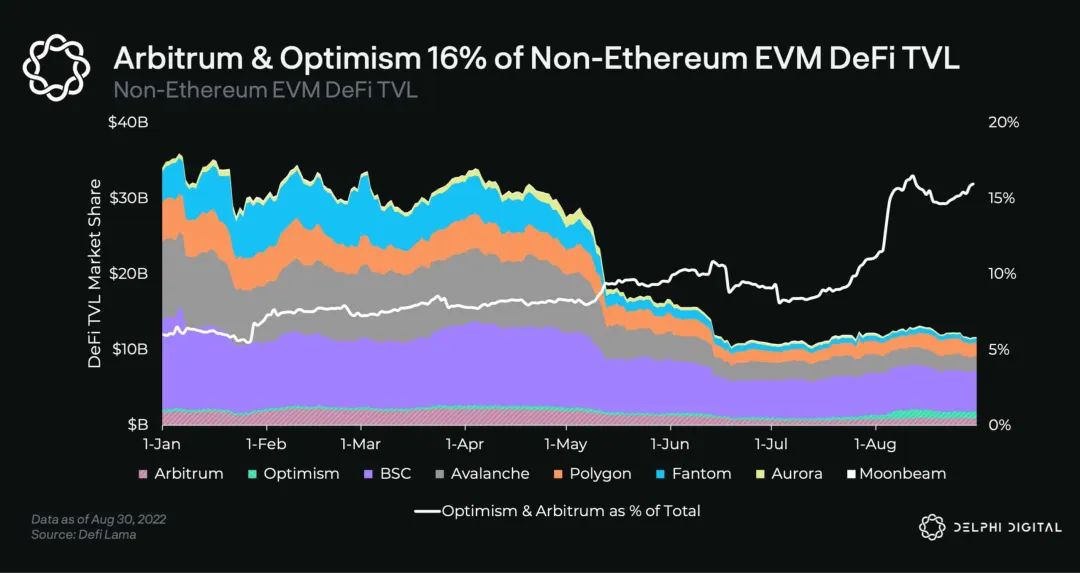
On the positive side, a major advantage of EVM ORUs is that they can easily leverage Ethereum's liquidity and community to bootstrap their DeFi ecosystem. Optimism and Arbitrum already have billions in TVL, and their blue-chip protocols like Aave, Uniswap, Curve, Synthetix, and GMX drive user adoption.
On the other hand, the infrastructure for Rollup is still not Mature. While ORUs have large TVLs, almost none (including Optimism and Arbitru) have permissionless fraud proofs in production and thus do not minimize trust. While we have every confidence that Rollup will work, it will require significant engineering effort and time.
While EVM compatibility makes sense for ORU given the portability of the existing Ethereum ecosystem, it does not enable all Existing protocols benefit from chain strategies.
We also see the potential for alternative L1 and ZK rollups to be attractive as alternative Rollup technologies develop and the risk of new builders with no EVM experience entering the space Use of ORUs.
So while relatively high scalability, TVL and capacity are attractive, poor connectivity, centralization risk and uncertain future collectively discouraged adoption of this option.
ZK Rollups
Like many, we believe that ZK proofs are the ultimate The core pillar technology of the game. At the heart of every scaling solution is cost-effective validation. ZK proofs allow anyone to prove the complete integrity of execution (without additional assumptions), making them useful as a safe and efficient bridge between discrete systems. We observe this today in the form of ZK-rollups.
Incentives to push the boundaries of zero-knowledge technologies have increased dramatically in recent years. Still, it is difficult to predict how long ZK rollups will gain significant market share. The ZK space is still in its infancy, some players are in various stages of preparation - mainly Starkware, zkSync and Polygon.
Starkware has been preparing ZK technology for some time now, but offering their StarkEx product as a software vendor. StarkEx is not an open general purpose platform as we would expect in this space, but the The technology itself is excellent, as evidenced by its adoption by some of the most used dApps such as dYdX, Immutable, etc. However, dYdX recently announced that they would be moving from StarkEx to Cosmos Lisk, mainly due to concerns about decentralization.
StarkNet is a recently launched license-free open platform based on Starkware technology. Production ready and provides simultaneous composability with other StarkNet dApps. But so recently, its community, infrastructure, and DeFi ecosystem are immature — for example, the canonical Ethereum<>Starknet Bridge (built by the Starkware team) called StarkGate ) there is a deposit limit and StarkNet has negligible liquidity (about 650 ETH). Like other Rollups, StarkNet relies on a centralized orderer and Plans fragment over time.
Given that applications built in Cairo (Starkware's language) offer limited portability, if this proves to be a losing bet, this introduces adoption risk. Nethermind's Warp team is working on a Solidity to Cairo translator, so it is possible that Solidity can be used instead of Cairo, which of course provides more options and tools.
Many ZK-EVM Such as Polygon Hermez, Scroll and zkSync 2.0 make different trade-offs in terms of speed<>EVM compatibility. While it's exciting to see their progress, they're still unreleased products and there's uncertainty about the timing of their future roadmap.
Finally, we note that all ZK rollups rely on a highly complex new technique that only a very limited number of domain experts really understand. We believe this increases the likelihood of software implementation bugs and other unforeseen circumstances that could negatively impact complex DeFi dapps and also make it harder to reason about their progress.
While we appreciate the potential of ZK technology to be the ultimate technology and will closely monitor its progress, the above concerns, as well as general issues with Rollup, lead us to decide not to be there at this time Construct.
Modular (Celestia Rollups)
As we outlined in Part 1 , we see the future as multi-chain, with many utility chains, general-purpose chains, and hybrid chains, each with different trade-offs and customizations. This facilitates modular blockchain development stacks, such as those offered by Cosmos’ Tendermint and Polkadot’s Substrate. These provide a reusable and customizable collection of components for creating new blockchains through the SDK.
Celestia approaches modular blockchains from a different angle, decoupling execution from data and providing only the base layer for data availability and ordering. This allows Celestia to provide security for Rollups/Appchains in a highly scalable manner. It also means that Celestia is only focusing on one element of the blockchain stack, which may be more effective than a magic glue approach.
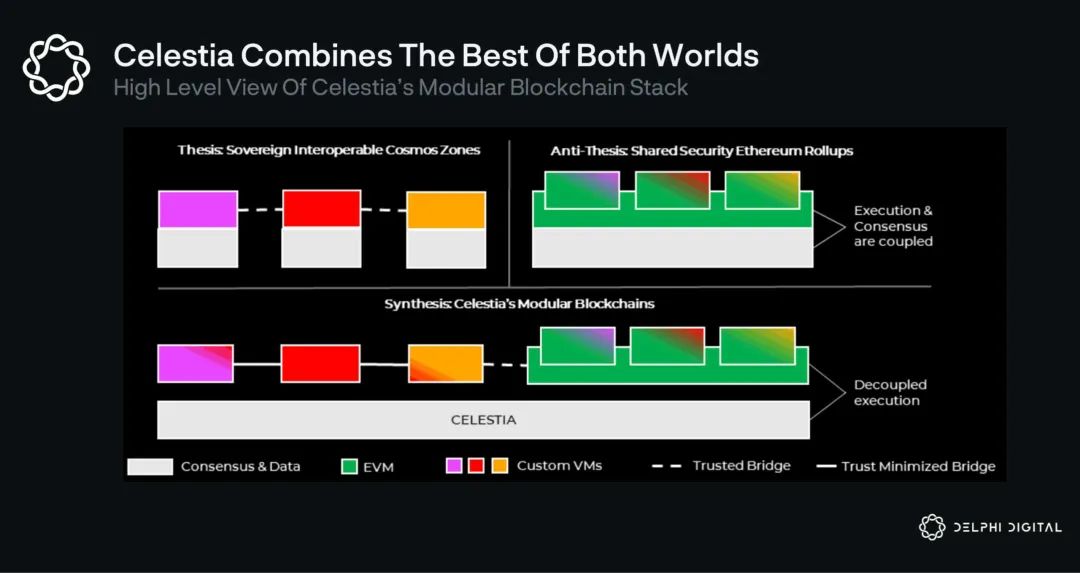
This solves a major problem with Cosmos --requiring each chain to have its own validation Human set - This requires a lot of time and effort and is not feasible for many dApps. It also splits the consensus security of each chain, resulting in a low security budget at the end. Interchain security from Cosmos is another option, but it is not permissionless; requires mutual agreement of the Hub and consumer chains, and is not a scalable solution; the Hub's validators need additional resources to verify the consumer chains. While this might be a good temporary solution, it's unlikely to be the end result.
The user-facing side of the Celestia network is its executive layer; notable ongoing projects are Cevmos, Sovereign Labs, and Fuel V2. Fuel V2 seems to be the closest project to the finish line, but it's still very early days. Fuel V2 uses the UTXO data model and a brand new virtual machine that promises fast and scalable execution. While we like their design choices and will keep an eye on them, they pose a technical risk that we feel is too great for the applications we might be working on.
As with other new ecosystems, migration to a new and largely untested language coupled with the new paradigm of UTXO The cost is considerable. We also have path dependencies on specific execution environments, and another Celestia Rollup in the future may be more successful at attracting adoption. There is also a risk that future Ethereum developments (such as EIP-4844) will reduce the need for Celestia's primary data availability use case.
While this sounds pessimistic, we are actually very optimistic about the future of modular blockchain networks. We see Celestia’s Sovereign Rollup as a potential successor, or possibly the ultimate scaling path for Cosmos-based chains. While these technologies are not ready today, they represent a huge potential mid-term solution while also preparing the way for a modular future. Celestia is certainly an ecosystem that we will be watching closely.
Polkadot
Polkadot's mission has always been to have a heterogeneous execution environment with shared security (parachains). While this was a unique goal when Polkadot started this mission, given Rollups, this is no longer the case.
That said, one of Polkadot's unique strengths is the years of effort and effort spent developing its cross-chain messaging protocol XCMP (similar to Cosmos' IBC) hard work. XCMP is not fully functional yet, but once out, it will play a key role in interoperability, creating cross-chain applications.
Substrate and Cumulus are SDKs provided by the Polkadot team for creating parachain-compatible blockchains. To be a parachain, it does not need to be built with Substrate/Cumulus, nor does it have to force a chain created with Substrate to be a parachain.
However, only parachains can interoperate. Due to the maximum number of parachain slots, only successful bidding through the auction process can become a parachain. This means that Polkadot's interoperability requires sacrificing sovereignty, and its parachain status can theoretically be revoked at any time. In contrast, Cosmos' approach of providing optional interoperability modules without any connection to a central chain is the approach we prefer.
Polkadot scores high on decentralization with 996 validators, a diverse and thriving developer community, and Multiple independent customers .
Despite technology and Large development community , but user adoption on Polkadot is not impressive.
Currently, the top three parachains -- Acala, Moonbeam and Parallel -- have a combined liquidity of $150 million, far behind their competitors. This has also taken a hit recently as the largest stablecoin, aUSD, lost its peg following a free minting bug on the Acala parachain.
In terms of scalability, we mark Polkadot as ahead of many ecosystems, but behind Ethereum and Celestia. While Polkadot employs scaling techniques such as data availability sampling and dispute protocols, validators are still interested in performing state transitions of parachains (or parathreads), which limits their scalability. The same motivation applies to our scalability ranking for Near.
Overall, despite the positives, we don't think Polkadot has any significant advantages over Rollup for Cosmos or DeFi dApps, and it does have some relative disadvantage.
High-speed single-chip chain (such as Solana and Now Sui, Aptos, etc.)
Single-chip The everything-in-one-place approach taken by the chain is certainly attractive to developers. Rather than creating a new application chain, it is much easier to build a dApp as a collection of smart contracts on multiple levels: the development cost of writing a smart contract is much lower than writing application logic at the chain level; Contracts do not need to bootstrap new validators; existing wallets and infrastructure can be used; and it is generally easier to attract users when building on existing chains by leveraging existing communities.
It is also much easier to compose with other applications on the same chain than to try to do it asynchronously across bridges. So, while contradicting our multi-chain vision, fast monolithic applications are indeed something we have carefully considered.
Solana
Ethereum was initially monolithic but quickly became crowded . Solana is able to be the first trusted high-throughput chain to achieve sub-second block times — the lowest of any production chain. It does this while remaining decentralized, with 1972 validators and a strong Nakamoto coefficient compared to other PoS chains.
It appears that many of these validators would be unprofitable without the Solana Foundation subsidy, so it remains to be seen what happens once the subsidy ends. Jump also recently announced that they will be developing a standalone Solana client called Firedancer, an important first step towards increasing validator diversity.
Solana has attracted a strong ecosystem of projects and a TVL of $1.5 billion, making it the #1 TVL among non-EVM compliant chains. The developer experience, initially considered difficult, has improved significantly after the introduction of the SeaLevel framework Anchor.
Solana has also managed to grow a meaningful and differentiated developer ecosystem, we think it can be said to be in the top 3 with Ethereum and Cosmos . This has also resulted in a differentiated culture, reflected in developers with more traditional/financial backgrounds and a thriving NFT ecosystem.
Solana's cost and speed make it an attractive place to build DeFi applications, so there is a rich DeFi ecosystem with many AMMs, money markets , perps, and other DeFi products (including great ones like Mango).
While this opens up many potential integrations, the flip side is that it's also a pretty crowded space, with plenty of competition relative to subscriber count/TVL Powerful DeFi dApp. There is also a risk of further differentiation given the launch of fast monomeric challenger chains like Sui and Aptos.
The biggest challenge Solana has faced lately has been network outages. As mentioned earlier, for some DeFi projects, downtime is risky, because liquidation cannot take effect during the downtime, and the agreement will accumulate bad debts.
The root cause of chain stalls is cheap operations that expose the network to malicious attacks. As a workaround, Solana implemented priority fees. These issues, and the uncertainty around when they will be fully resolved, highlight the risks of adopting new technologies for DeFi applications, such as those we contributed to.
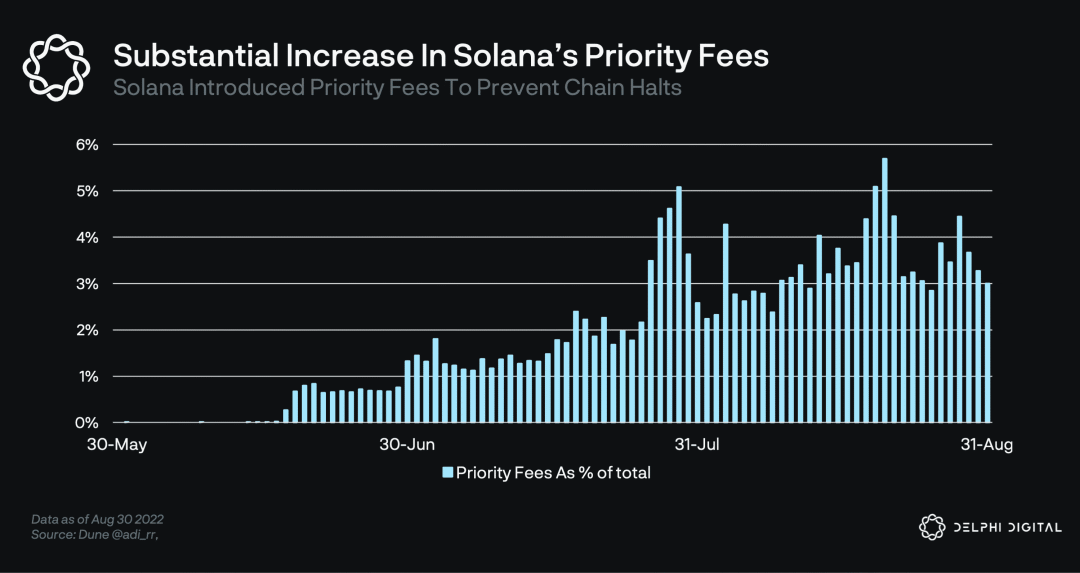
Accurate resource pricing remains a challenge for all permissionless blockchains. Today, blockchains have a single marketplace for fees, where all resources (I/O, storage, compute, bandwidth, etc.) are metered in the same abstraction called gas. This makes it challenging to accurately price operations relative to each other.
Eventually, Solana (and others) will implement localized fee markets so that congestion for a particular dApp doesn't hurt the user experience for everyone else. We are closely monitoring this development and its impact on Solana.
Overall, while Solana has faced a lot of criticism (often unfairly) for being unstable, centralized, difficult to build, etc., we have a lot of respect for Solana Labs Impressed with the ability of the team and ecosystem to improve in these areas. Solana has relatively achieved credible decentralization from multiple elements, and the development experience has also been improved. We also believe that stability will become a thing of the past and soon be forgotten.
However, given the imminent competition from challenger fast monomers such as Sui and Aptos, bridges requiring additional trust assumptions, and monomer theory generally do not fit our multi-chain vision, we believe that Solana does not make sense at this stage.
Aptos and Sui
Both Aptos and Sui are designed to maximize the network throughput, similar to Solana, but with a very different technical approach. One of the core ideas of the design seeks to optimize the mempool propagation layer by allocating a DAG of transactions and guaranteeing availability.
Through internal sharding of validators and isomorphic state sharding, both have the potential to exceed the performance of a single validator. Internal sharding means that the validator does not need to scale vertically, increasing its size to match that of the network, but it can spawn other machines behind the load balancer and shard the state as if it were a single node. This basically solves a problem with Solana where validator specifications would be a performance bottleneck and scales gracefully.
These ideas are promising and seem likely to yield some of the lowest latency and highest throughput in the L1 blockchain space. This is interesting to us because the more performant and scalable a monolith is, the less obvious the need for a new chain will be. However, given our general optimism for Web3, we still feel that the need for a broad range of use cases will spill over into new specialized chains, leading to the multi-chain architecture we have outlined.
Another advantage of these chains is that they use the Move language (or in Sui's case a Move variant). Our initial experiments with Move on these chains are very promising Displayed elegantly. Therefore, we do not expect that the development experience of smart contracts will be a significant disadvantage compared to other ecosystems using new languages, especially considering that there is some time for development patterns to emerge. That's thanks in part to Move, which has been under development since Facebook's Libra (where many of the development teams came from).
These chains ultimately have similar drawbacks to other new technologies we have considered - an immature DeFi ecosystem, community, connectivity, and significant technical risk making them unsuitable for migrating to a blockchain with an existing community projects and technology choices made in other ecosystems. As a counter, MoveVM and variants may be used across multiple chains, which does provide some optionality if migration is required. As they develop and the bridge develops, they may become suitable, and we'll definitely be keeping an eye on their development.
Polygon
Due to the late listing of Ethereum’s Rollup-centric roadmap, Polygon PoS fills a much-needed void by becoming Ethereum’s sidechain of choice. Polygon is very fast, with an average block time of around two seconds. Coupled with a very strong ecosystem, it really meets our two main requirements for building a good DeFi experience.
These factors are due in large part to the effectiveness of the Polygon team in business development and capital deployment, enabling it to gain Considerable market share. In the field of EVM, Polygon is second only to BSC in capturing Ethereum users, and has a very rich DeFi and game/NFT ecosystem and a TVL of $2B.
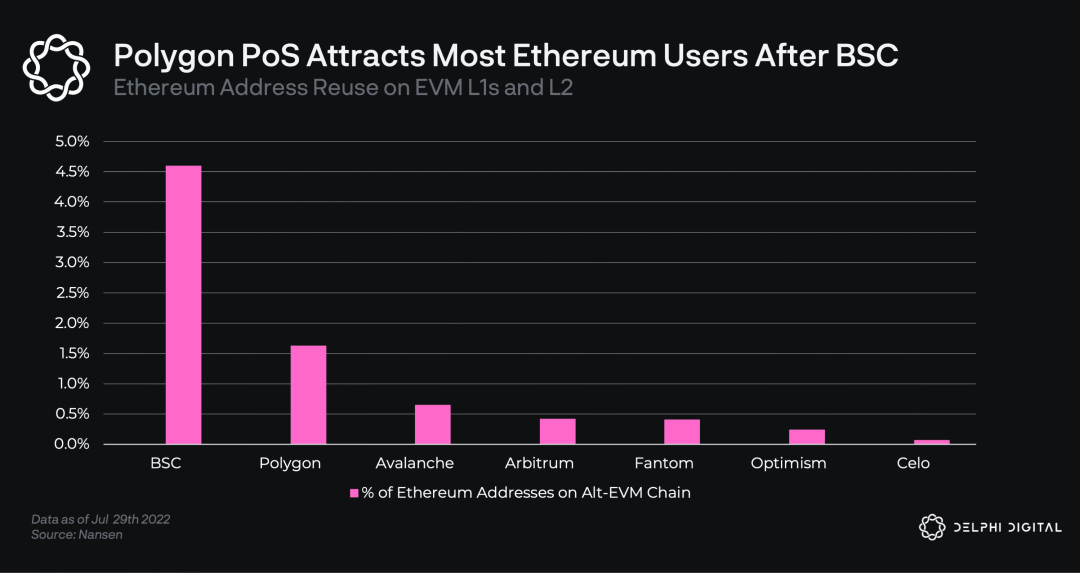
As usual, these advantages do come with disadvantages. In the past, Polygon has undergone deep reorganization many times, resulting in a poor user experience. Additionally, we noticed that governance decisions in Polygon are sometimes opaque and centralized. An example of this is the decision by the core team to dramatically increase gas prices by a factor of 30, which seems to was proposed without much involvement from the community.
It is worth noting that becoming a validator on Polygon is not currently a permissionless process. The purpose of Polygon is to have regular auctions where anyone can replace existing validators by staking a higher amount.
However, since the max cap of 100 nodes was reached, the auction has not been held and currently the only way for anyone to become a validator is to be one of the existing validators or multiple releases. The last community proposal passed Outline mechanisms for network self-regulation to address this issue ; this is an important step in the gradual decentralization plan of the network.
Last but not least, the security of the ecosystem depends on a small committee controlling the number of nodes via the canonical Ethereum <> Polygon PoS bridge billion dollars.
On the other hand, we see Polygon as an ecosystem, not a chain. The core team has invested significant resources into building new scaling solutions, including ZK rollups Hermez, Miden, Zero, DA Layer Polygon Avail, and more. We've spent some time researching ZK technology in particular, and were impressed with what we found.
Polygon Edge is also promising and very close to our proprietary Lisk vision, although the technology is still in its infancy, connectivity between supernets is an open question. Overall, given its existing adoption, superior BD, and technical prowess of its upcoming ecosystem, Polygon has the 2nd highest score in our rankings and we may see it as a competitive choice for EVM-based DeFi dApps .
However, the current trust assumptions of the bridge and the current PoS chain are the main factors in our decision that it's not the best place to build right now.
Near
Near's main difference is its dynamic sharding architecture. The goal of this design is so that users and developers don't have to know which shard they are on. Instead, validators dynamically (every 12 hours or so) determine which tx will be grouped together based on statistical analysis, efficiently adding/removing shards in a seamless fashion. Sound like science fiction? Maybe, but it's a uniquely ambitious vision and deserves credit for it.
This architecture enables very competitive scalability with a block time of 1.3 seconds. It manages to do this while maintaining acceptable decentralization, currently has about 100 nodes, and plans to pass "chunk-only producers" make validation more inclusive, which will significantly reduce hardware requirements.
However, this architecture does have some drawbacks. Smart contracts must communicate using an asynchronous mode, since they are not guaranteed to be part of the same shard. In fact, even today, application developers must perform asynchronous smart contract calls when Near runs on a single shard.
DeFi applications often require precise coordination of many contracts, and asynchrony can introduce additional complexity, failure modes, and finalization times. For example, liquidation involves at least 3 different smart contracts (money market, oracle, and exchange) working together. The asynchrony between these components introduces additional latency and security assumptions that can affect market solvency.
Near communities and ecosystems are not as strong as others and currently there are very few ways to integrate with the DeFi ecosystem. That said, the Near team has a strong vision and has been aggressively executing on it, raising $800M Ecosystem Fund and actively investing in BD, they managed to attract some Powerful application.
Near built an EVM compatibility layer called Aurora, which accounted for about half the activity. This increases the portability of EVM-based dApps. It also has a trustless ethereum bridge called Rainbow, which has a strong connection to ethereum, although it currently lacks connections to other ecosystems.
Overall, the complexity of asynchronous calls, especially for highly composable DeFi applications, combined with the existing small ecosystem, Leading us to view it as a short-term option - although we will keep a close eye on the ecosystem going forward.
Avalanche
Architecturally, Avalanche is very similar to Cosmos, with multiple interoperable domain (subnet instead of zone). Just like Cosmos zones, subnets are sovereign networks with their own security. This architecture provides a smoother way for dApps to start with smart contracts, build communities and, once mature enough, become further customizable subnetworks.
As smart contracts migrate to subnets, they also reduce congestion on the main network, which reduces fees. We saw an example in P2E game DeFi Kingdoms launching its own subnet. It makes us feel like this is a healthy way to grow the ecosystem.
The downside of Avalanche is that it is a relatively new ecosystem. As a result, existing cross-subnet functionality, infrastructure tools, and development communities are still immature.
Avalanche's competitive advantage lies in its novel consensus. Unlike others, Avalanche's consensus can accept a large number of validators without degrading consensus performance. Today, Avalanche's main network is run by 1000+ consensus nodes while maintaining an impressive 1-2 seconds for block finalization.
However, the validity of the number of consensus nodes is debatable when it comes to censorship (not accompanied by high Nakamoto coefficient) resistance and/or decentralization . Ultimately, the influence of each validator is determined by the weight of its stake. In a permissionless setting, due to the centralization trend, stake is typically concentrated in in the hands of a few. Due to the lack of careful measures of MEV and accountability,we find that the number of consensus nodes is not a very useful measure of decentralization.
Cosmos
The best description is an interoperable zone The blockchain ecosystem, Cosmos is a blockchain network connected by the IBC protocol.
As mentioned in Part 1, due to the benefits of customizability, we would like to see a shift towards dedicated or application-specific chains. However, it would not be feasible to require each chain to design and implement consensus, storage, networking, etc. from scratch. The Cosmos SDK is a set of customizable modules that together act as a template for creating new blockchains, reducing the development effort for many dApps.
Substrate from Polkadot offers a similar toolkit, but from our conversations, it seems generally agreed that it is harder to use than the Cosmos SDK, and production There are much fewer application chains in Cosmos SDK than in Cosmos SDK. As mentioned earlier in the Polkadot section, interoperability only applies to parachains, whereas Cosmos chains can interoperate directly without the involvement or approval of the Cosmos Hub.
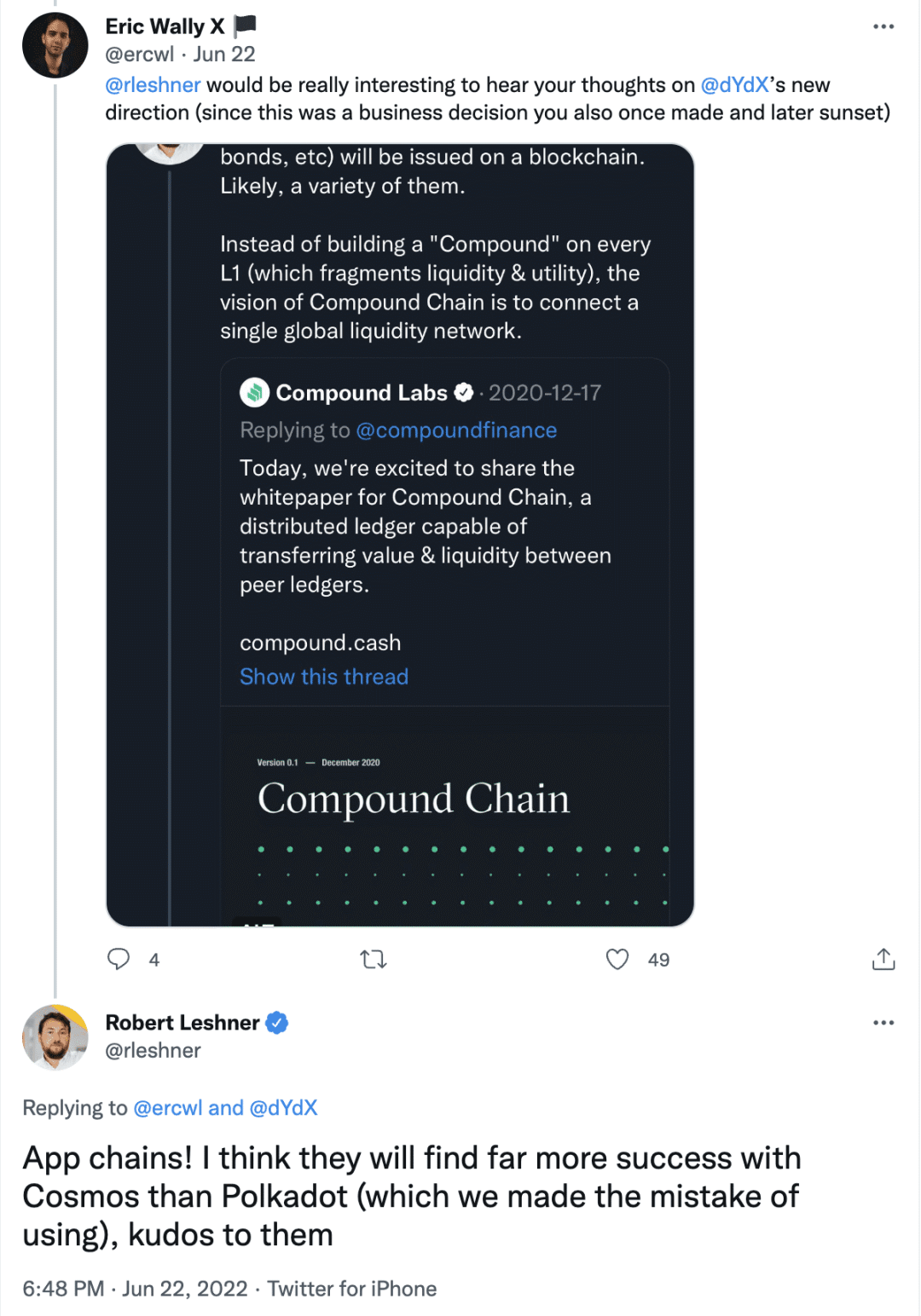
IBC (Inter-chain communication protocol) is used to transmit between any state machine (block chain) An interoperability protocol for arbitrary data. While any finalized blockchain can implement IBC and join the Cosmos network in the future, the only production-ready implementation is as a set of Cosmos-SDK modules.
IBC is trust-minimized, just like two IBC-enabled chains need a third-party relayer, it only needs a relay
< p>1. The signature of the source chain validator to prove the block header, and
2. The merkle proof, which is related to the block header Together, it proves that a certain tx exists in the block of the source chain. None of this can be faked.
We believe IBC's trust assumption is a huge advantage. Most bridges work by introducing one or more different stakeholder groups and relaying messages between the two chains, creating additional trust assumptions and attack vectors. IBC only needs to trust the chain being connected. Given that cross-chain messaging is at the core of the cross-chain architecture we are exploring, ensuring that bridge trust is minimized is a key consideration for us.
IBC offers more than just messaging.
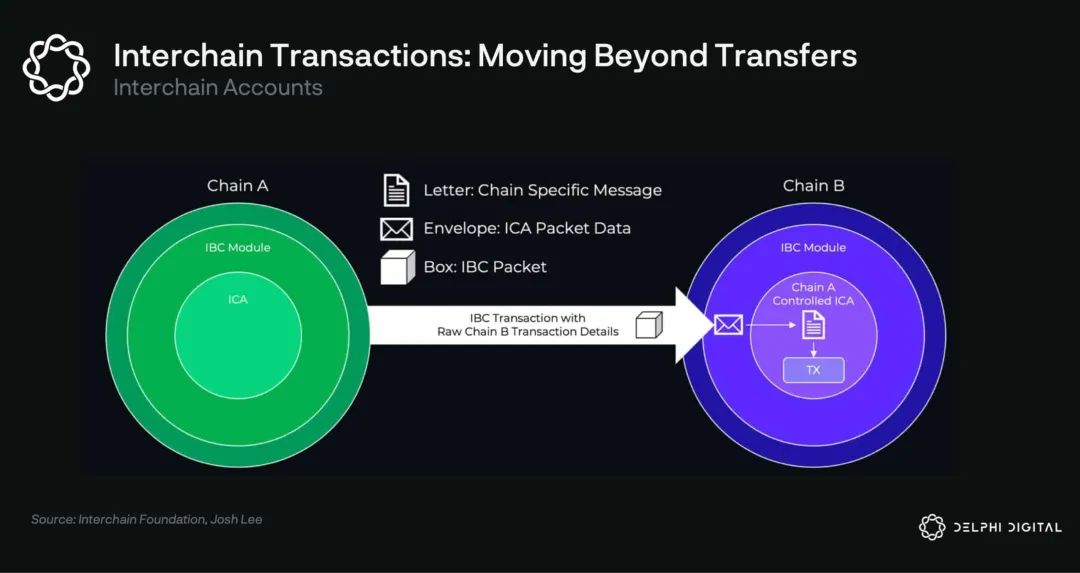
Cross-chain accounts is a new feature that allows a blockchain to control accounts on another chain through IBC. With IA, the multi-chain user experience is greatly simplified. Instead of opening multiple accounts across chains, moving tokens between them, and paying fees in different denominations, users will be able to use dApps across different chains from one account.
For cross-chain projects, this feature will allow, for example, governance on a central chain to control smart contracts on connected chains.
There is also cross-chain query, which allows one chain to query the status of another chain. However, these features are still immature and not quite ready for production use, but once ready, will significantly broaden the design space for cross-chain applications.
Despite technical advantages, the Cosmos ecosystem is still small, TVL is less than $1 billion, most of it on chains without CosmWasm or IBC support.
The DeFi space on Cosmos is currently undergoing a major shift. As written in the introduction, Terra, the largest chain in Cosmos, recently went down, causing most of the assets in Cosmos to be destroyed or flee. Terra is both a blessing and a curse for the universe.
While the Terra crash hit the Cosmos ecosystem harder than any other ecosystem, it also brought with it a large and passionate community of users and developers community, many of whom have now decided to stay.
We have seen Terra projects such as Kujira and Apollo commit to launching AppChains, while others relaunch as smart contracts on existing chains, such as Juno Levana and the upcoming Vortex (formerly Retrograde) on the Sei Network.
Besides the ex-Terra project, other large projects are seeing the benefits of Cosmos, with dYdX being the most notable. Nonetheless, liquidity in the ecosystem is currently developing, so committing to building Cosmos is a bet on future growth.
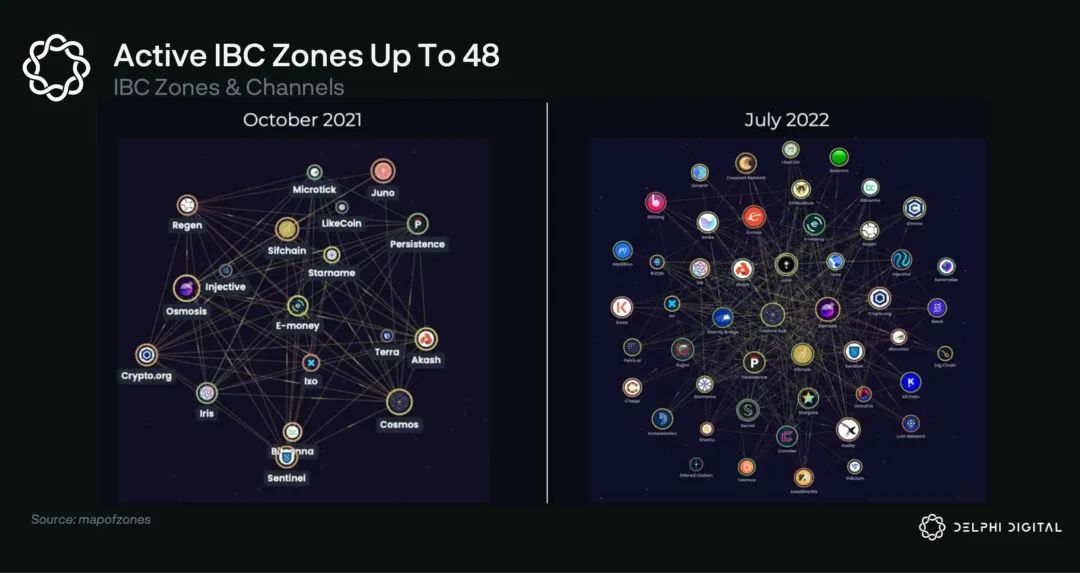
As for speed, block times vary from chain to chain and depend on a series of tradeoffs, such as validator Quantity and geographical distribution. Historically, a fully decentralized Cosmos chain typically has a block time of around 6 seconds, which is average.
However, newer chains are improving on this, e.g. Evmos and Injective achieve ~2 second block times on globally distributed validator sets , while Sei achieved a block time of about 1 second on the testnet.
Talking to the Tendermint team, there seems to be a lot of room for improvement through storage and consensus optimizations - for some applications in the near future , sub-second block times seem feasible.
Furthermore, the modularity of Cosmos is an advantage here, independent teams are able to improve the consensus on their own. An example here is Optimint developed by Celestia team, it will be in Celestia ABCI-compliant Rollup is implemented on the Cosmos chain, providing a potential future scalability path for the Cosmos chain.
As for decentralization, the number of validators on the Cosmos chain is much lower than Solana and the Ethereum PoS network. However, we don't think the number of validators is actually a good measure of decentralization. Instead, we prefer to look at the Nakamoto coefficient (the number of colluding entities required to censor a transaction), which is 7-10 for most Cosmos chains, 2 for Ethereum 2.0, and 31 for Solana.
One of the great things about Cosmos is the high degree of decentralization of core development, with multiple independently funded teams working on core development contribute. Informal, Strangelove, Interchain Gmbh, All in Bits, Confio, Regen Network, and others are all working to contribute parts of the Cosmos core codebase, while others like Quicksilver, P2P, and SimplyVC are also working to contribute peripheral components like ICQ.
Conclusion: Cosmos
After considering the options we summarized above, we decided that the most A good approach is to focus our R&D efforts on the Cosmos ecosystem.
As mentioned in the first part, we believe that this space will increasingly be fragmented into a chain of general-purpose smart contracts connected by trust-minimized bridges A mesh network composed of dedicated application chains. In such a world, there will be multiple DeFi hubs, each with their own tradeoffs, ecosystems, and communities. Well-architected DeFi dApps deployed on multiple platforms will benefit from liquidity and other network effects that will make it difficult for native DeFi dApps to compete. We believe that Cosmos is best suited to benefit from a growing number of application chains and support state-of-the-art cross-chain architectures.
Plus, it's fast enough to enable seamlessly integrated DeFi UX with order books, high leverage and fast trade execution. At the same time, we think it is sufficiently decentralized to provide strong security, liveness, and censorship-resistant guarantees, especially compared to many of the alternatives we considered, which are newer and thus have more centralization carrier.
Its biggest weakness is the ecosystem, the current TVL is lower than a single ETH L2. Relatedly, Cosmos also lacks hype, funding, and spreadability, likely due to the lack of a model L1 token to come together. While we believe that the influx of projects from Terra’s debacle and the growing number of specialized application chains will be somewhat remedial, there is no denying that we are betting on future ecosystem growth. This remains the biggest risk to Cosmos and our theory.
For these reasons, we will be focusing on the Cosmos ecosystem for the foreseeable future. That said, we are not Cosmos extremists (except for Larry), so we will continue to actively research and monitor other ecosystems. Below are some of the areas we will be watching closely, suggesting that our papers may be revised.
Growth of monomer chains relative to application chains: If most interesting dApps are deployed on monomer chains and never move into their own execution environment, then that would invalidate our argument. After all, the current cost of deploying an application chain is much higher than the cost of deploying a smart contract on a monomer, and the popular universal chain has strong composability, brand and user experience advantages.
In addition, like orphan state auction can make monoliths more competitive in terms of resource cost and predictability. We will keep an eye on the fastest monomer chains and reconsider our thesis if we see signs of this happening.
The emergence of no trust bridges: In our analysis, we ignored many chains due to weak connectivity, This means they either lack bridging infrastructure entirely, or existing infrastructure is immature and/or has poor trust assumptions.
That said, there are multiple well-funded, fantastic teams working on bridge solutions, and we believe this will improve over time. We'll be watching this closely to see if there is anything comparable to IBC in terms of trust assumptions, or if IBC (chain-agnostic) spreads outside of Cosmos. We will also pay particular attention to connections between specialized execution environments, such as Avalanche subnetworks and Polygon supernetworks, as they best align with our multi-chain theory.
Maturity of high-potential but current high-risk technologies: Throughout the process, we examined several Emerging technologies for the ultimate game, especially in the Rollup space - ZKRollup and Celestia Rollup, especially Fuel V2. We will be watching this closely and look to deploy when we deem the risk is minimized.
Overall, this report has taken us down various rabbit holes and we are more bullish than ever on the future of the field. There are multiple well-funded and talented teams working on order-of-magnitude improvements to scalability, connectivity, and DX/UX. Collectively, these improvements will enable entirely new cross-chain DeFi applications, which we believe will help drive more on-chain activity.
While considerable effort has gone into studying each ecosystem and ensuring the accuracy of our analysis, given the breadth of material covered, we There must be something missing. If you think we have, we welcome you to contact us.
Original link
Welcome to join the official BlockBeats community:
Telegram Subscription Group: https://t.me/theblockbeats
Telegram Discussion Group: https://t.me/BlockBeats_App
Official Twitter Account: https://twitter.com/BlockBeatsAsia

 Related Articles