Delphi Labs explains the new Token issuing mechanism: "Locking + Liquidity guided Auction"
Original author: Delphi Labs
MIM, Deep Tide TechFlow
Introduction to the
Delphi 已经在分析、设计 Token 发行机制上投入了大量的时间。总体而言, Token 发行机制自 IC0 固定价格销售以来已有长足进步,但我们仍认为它还存在很大的改进空间。
我们最近孵化了 Mars 和 Astroport 两个项目,但在策划它们的 Token 发行机制的时候,我们发现现有的种种结构中没有一种能够充分满足我们所有的设计目标。为了达到为设计目标「量身定做」的目的,我们从第一原则出发重新修改了 Token 发行机制。修改的结果就是「锁定+流动性引导拍卖」(Lockdrop + Liquidity Bootstrap Auction),它将于 12 月在 Astroport 上试运行,随后在在 Mars 上试行。
这篇文章会详细解释我们试图优化的设计目标,以及我们为何相信新的结构是实现设计目标的最佳 Token 发行机制。
Design considerations
目前的 Token 发行机制
广义上讲, Token 发行机制的目标是将 Token 分发给协议的用户和社区。目前的各种项目主要是采取以下两种 Token 发行机制:
(1) 向用户分发 Token --用户通过过去的行动或正在进行的行动获得 Token 。这种机制包括空投以及所有形式的持续激励(Staking 奖励,流动性挖矿奖励,交易竞赛等)。
(2) 公开销售 Token --用户收到 Token 以换取投资的钱。这种机制包括固定价格销售,拍卖,LBP,Pylon 式的收益率委托等等。
Both mechanisms have several drawbacks.
向用户分发 Token
向用户分发 Token 的协议主要采用两种方式,分别是Airdrops and continued liquidity incentives.
空投旨在根据用户过去的行为来分配 Token ,要么是因为他们以前使用过该协议,要么是因为他们是其他协议的高价值用户。这看起来似乎是一个好主意,但空投奖励的是过去的行为,而非对未来的承诺,因此它不能保证对协议的未来发展有利。事实上,我们的研究表明,大多数空投后来只是被抛弃了。
Continuous liquidity incentives旨在奖励对协议的持续参与,它已成为大多数项目的首选分配方法。然而,仅仅依靠这种方式的协议也有一些缺点。首先,持续激励只能用于奖励那些可以通过链上行为体现的使用,如提供流动性、抵押品或完成交易。这有利于拥有更多资本的鲸鱼获得更高的奖励份额,但也把其他为协议增加价值的各类利益相关者,例如社区成员、第三方集成商排除掉了,甚至在协议之上构建的项目也被排除在外。对这些利益相关者来说,在公开市场上获得 Token 可能是其实现激励一致的唯一途径。
其次,简单地将 Token 发放给供应方会导致额外的问题,例如低初始浮动、缺乏价格发现机制、低流动性(尤其是最早期)。这会对非供应方造成损害——他们有意公开市场上购买 Token ,但他们不是无法成规模买入,就是遭遇低流动性的价格变动(如 ANC 的推出)或者低浮动的 Token 排放的持续销售压力(如 MIR)的打击,乃至于双重打击。
公开销售 Token
为了防止前述问题的发生,一些项目选用公开销售的方式促进价格发现(price discovery),但公开销售本身也有缺点。第一点,也是最重要的一点,所有公开销售类型的机制都会使项目面临更高的监管风险。涉及明显的「资金投资」以及早期阶段的协议,最有可能被认定为「Howey 测试」中的依赖于小团体的「基本创业努力」。这个因素和其他原因共同导致公开 Token 销售相较于其他分发方法,更有可能被视为未注册的证券销售。
其次,虽然公开销售解决了价格发现的问题,但不一定能解决初始流动性低的问题。虽然项目可以自行增加初始流动性,但此举需要大量的资本并会使他们面临监管风险,因为公开销售基本上是在建立市场上,自行为 Token 设定价格。因此,许多 Token 在推出后的几天和几周内表现出高波动性——关键是,这种高波动性往往会伤害到那些热衷于项目的早期用户,因为他们在交易技巧上不一定足够老练。
Third, most sales and auction structures are vulnerable to front-line attacks by robots (ANC, VKR, for example), which results in a concentration of supply to a few whales with the technical ability and capital to dominate the sale.
Abstract: Design objectives and limitations
总而言之,我们希望提出一个能够实现以下目标的 Token 分配机制:
Distribution:我们希望确保 Token 能够公平地分配给广泛的利益相关者。最重要的是,这意味着启动机制不应该被机器人或鲸鱼利用。理想情况下,我们希望给较小份额的持有人一个通过表明对协议的承诺来赚取更多的 Token 的机会。
Price discovery:我们想确保有一个公平的、去中心化的、自下而上的机制来建立 Token 价格的机制,在 Token 交易之前为 Token 确定价格。
Sufficient circulation:相对的,我们想确保有足够的初始供应量来满足需求并为合法的价格发现提供保障。最近,很多项目推出的浮动量极低(小于总供应量的 5%),这导致了高度膨胀的完全摊薄估值(因为需求在一定程度上是没有弹性的,根本没有足够的供应来满足这种需求)。从这里开始, Token 持续排放、解锁,它的价格随着时间的推移而慢性「失血」,导致社区成员心生不满、积极性下降。我们坚信,创建一个成功协议的方法只有一个,那就是从一开始就让社区参与进来,让他们与项目一起成长、成功。出于这个原因,一个关键的考虑因素就是确保初始浮动量足够大,用它来实现公平和合法的价格发现。
Liquidity:Once the price is set, we also want to ensure that the price is immediately and deeply liquid.
Decentralization:The joint ventures involved in the creation of Mars and Astroport do not wish to set prices, conduct public sales, launch AMM/LBP, accept "venture capital" investments, or otherwise position themselves as sellers, authorities, market makers, brokers.
It is therefore critical that Astroport users provide all liquidity and price discovery themselves on a decentralized basis.
Lock + liquidity lead auctions
We believe the Lockdrop + Liquidity Bootstrap Auction can achieve all of these objectives. It is a two-stage process at the highest level and works as follows:
Phase 1 (locking) :Distribution phase. This phase provides a time window in which anyone can pre-commit to becoming a user of the agreement for a certain period of time (see the "Phase 1: Lockout" section below for details).
时间窗口结束时,根据承诺的大小和时间长短,他们会按比例收到正在分发的总 Token 的份额。这些 Token 在第二阶段结束之前都处于锁定状态。
Stage 2 (Liquidity-led Auction) :Price discovery phase. This phase provides a time window in which participants in the lock-in phase can commit to deposit some or all of their ASTRO into a party of the staboin-pair liquidity pool (astro-UST) if they wish to provide liquidity. Other users can then join in and deposit their UST into the liquidity pool, essentially buying ASTRO from the lock-in participants. At the end of this phase, the following happens:
1. 本地 Token +稳定币被存入流动性池中。原生 Token 与稳定币的比例决定了原生 Token 的最终价格。
2. Auction participants get LP shares in proportion to their deposits, and LP shares are locked and linearly attributable within 3 months. Assuming sufficient participation in the second phase, this would ensure immediate and deep liquidity of market prices.
3. 在第一阶段发放的所有 Token ,如未在第二阶段被用于承诺流动性拍卖,则会被解锁并可用于自由交易。
注:在第一阶段也可以使用空投的方式向用户分发 Token (无论是作为替代方案,还是作为锁定的补充)。
为说明该机制的实际运作,下文将在「Astroport 的 Token 发行活动」这个情境下研究这个问题:
Phase one: Locking
第一阶段是分发阶段,它的目标是将 Token 交到 Astroport 用户手中。理想情况下,用户获得的 Token 数量应该会与他们为协议带来的「价值」成正比。价值的衡量方式不同,不同的分配机制对应不同的价值形式。例如,空投机制是识别目标协议的历史用户或极有可能使用目标协议的协同协议的历史用户带来的价值。锁定可被视为类似于空投,但它不是奖励用户之前采取的行动,而是奖励用户未来使用该协议的前瞻性承诺——它近似于你和手机、宽带等服务提供商一次签订一整年的合同时得到的优惠。
In the case of Astroport, the customers of these long-term agreements are liquidity providers, channelling liquidity in key trading pairs. During the lock-up period, users can commit to depositing liquidity into Astroport in the form of Terraswap LP shares for pre-selected trading pairs. Crucially, users are able to further demonstrate their commitment to Astroport by setting a lock on liquidity for a longer period of time, with higher rewards for longer periods of up to a year. 7.5 per cent of ASTRO's total supply will be allocated to customers who lock in liquidity during the first phase, hence the name "lockdrop".
In general, the share of "locks" earned by an individual user will be calculated based on two factors:
1. Total number of ASTRO trading pairs allocated to users contributing liquidity (to be announced before the start of phase 1).
2. 用户在一个池子里的权重调整流动性份额。它不是仅仅衡量为用户流动性或是用户总流动性,而是存在一个基于用户锁定其 LP Token 的时间的权重调整器。这意味着分子是用户的权重调整流动性,分母是该对中所有用户提供的总权重调整流动性。
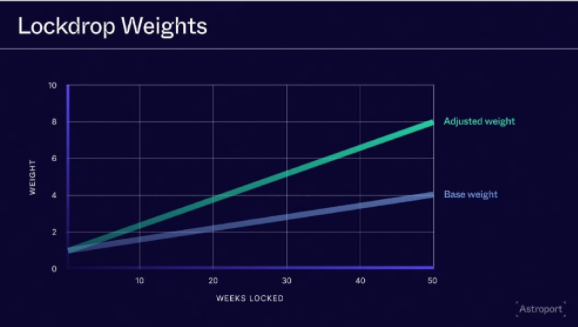
The ASTRO share earned by a user for his or her contribution to a transaction's LP is calculated as follows:
A = Ap * (wLu/wLp)
A = ASTRO received by the user
Ap = Total ASTRO assigned to user selected trading pairs
WLu = user provided weighted adjusted liquidity
WLp = total weighted liquidity in the pool
B = Boost based on the selected length of lock-in time
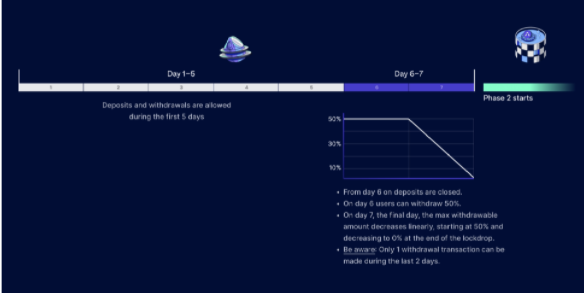
According to the schedule, users are free to make deposits and withdrawals within the first five days, thus encouraging anyone to participate and put in as much liquidity as they wish. Users can only withdraw money in the last two days and are allowed to withdraw some of their liquidity if they feel they are getting less ASTRO in the lock-up than the opportunity cost of that liquidity.
At the end of the first phase, liquidity will migrate from Terraswap to Astroport -- the user's Terraswap LP shares will be destroyed in exchange for locked Astroport LP shares.
Importantly, LPs will receive a transaction fee plus an issue fee for its pool (as will other liquidity providers) in addition to the one-time lock-up award.
In addition to the 7.5 percent of ASTRO allocated in the lock-up, 2.5 percent of ASTRO will be airdropped to LUNA subscribers and Terraswap subscribers. This provides the 10 per cent floating funds available for the second phase.
Stage 2: liquidity guided auction
第二阶段是价格发现阶段,它的目标是为 Token 确立一个价格并确立在基于这个价格的深度流动性。在那些熟悉交易的人看来,流动性引导拍卖可以被视为是类似于近来芒果市场上的拍卖(Mango Markets auction),但二者之间存在几项关键的区别:
1. 用户是出售 Token ,而非出售协议;
2. 拍卖参与者获得的是锁定 LP 份额,而非解锁的 Token ;
3. Withdrawals are gradually restricted over the last two days to prevent trading manipulation by whales (more on that below).
在第二阶段,参与锁定的用户或在空投中获得 Token 的用户可以选择将他们锁定的 ASTRO Token 部分或全部存入 ASTRO- UST 流动性池。然后,任何用户都能加入并在另一边存入 UST,实际上就是从锁定的参与者那里购买 ASTRO。
ASTRO 的价格是由用户向池子里添加的 UST 和 ASTRO 的数量所决定的,特别是 UST 和 ASTRO 的最终比例。如果存入 100 个 ASTRO 和 100 个 UST,隐含的 ASTRO 价格是 1 美元,如果再存入 100 个 UST,隐含的价格就会跳到 2 美元。关键在于这个价格是有意义的,因为参与者承诺以这个价格在流动性池中初始化并锁定他们的 Token 3 个月(即他们实际上是以低于该价格的金额购买 ASTRO,并在 3 个月内以高于该价格的金额售出)——这是在 AMM 中提供流动性所面临的典型风险,即无法按市场情况自发地退出。
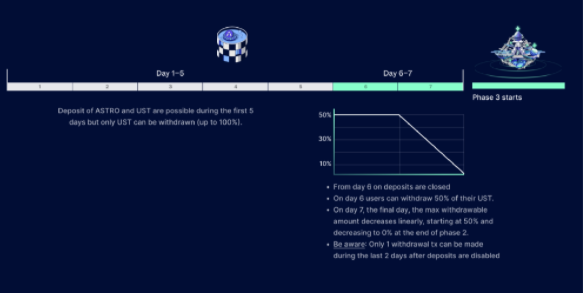
According to the schedule, during the first five days of phase 2, users can deposit as much ASTRO and UST as they want, while only withdrawing UST. This encourages users to participate and bid for the maximum amount they are willing to spend. Users can only extract UST in the last two days. As UST is removed, the implied ASTRO price drops. This makes price discovery possible because users will keep pulling out the UST until they see the ASTRO:UST ratio reflecting the ASTRO market price they can accept.
最后 2 天发生的事情值得深入研究,因为其他类似的设计都是在这个阶段面临操纵的危险。一旦到了第 6 天,取款限额会被限制在存款金额的 50%。一旦到了第 7 天,取款限额会在一日内从 50% 线性下降到 0。采取这种限制是有必要的,如果少了这种限制,鲸鱼会超额投入资金(即投入比他们计划留在池子里的资金要多得多的资金),努力使价格远远超过他们实际想要支付的价格,以此阻止他人参与。然后等到时间结束的时候,他们把超额投入的资金全部抽中,锁定一个更低的价格。芒果市场之前就发生了这种操纵现象,它严重破坏了 Token 发行和价格发现。提款上限能限制操纵的功效,逐渐下降则围绕价格发现创造了越来越多的稳定性,导致关闭。
At this point, the mechanics for the final days of Phase 2 should be fairly clear, and we need to continue to explore the reasons for widespread user engagement in Phase 2. Whether they prefer to sell their rewards or use them to do an LP, they can do both without participating in phase 2 and keep their options open. It is called reserved because the LP shares are locked up for three months when the user participates in the second phase. In response, we will offer incentives to phase 2 participants in the form of an additional 1%ASTRO supply (10 million ASTRO). This 1 per cent is divided between ASTRO savers and UST savers and is in effect a premium for sellers and a discount for buyers. A fixed 1% bonus means that if participation in the second phase is low, the bonus is relatively higher. This helps to create secondary market liquidity and ensure the level of participation that we believe is necessary. In the table below we show the scheme for the allocation of incentives to phase ii depositors based on the overall participation rate:
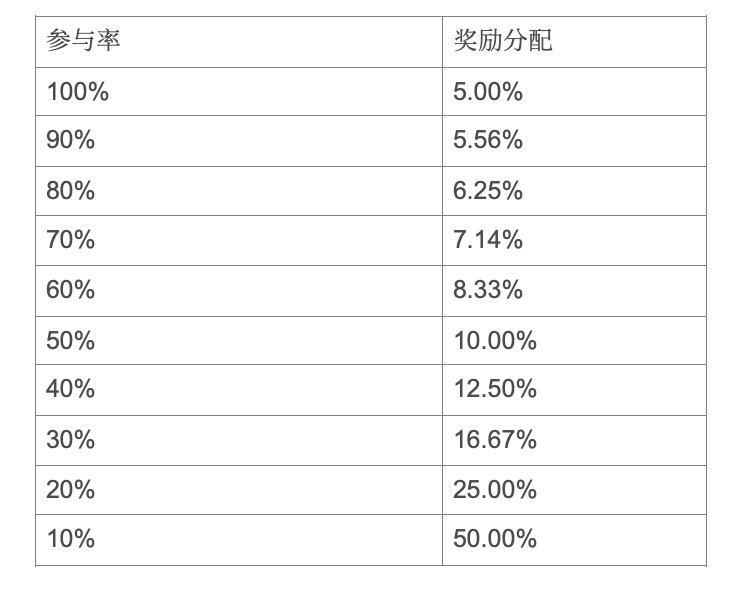
While we list all participation in the table, we certainly don't expect the participation rate to be close to 100%. We provide an example with integers below to illustrate the use of this table.
例如:25% 的第一阶段 Token 持有人决定参与第二阶段(25,000,000 ASTRO Token ),25,000,000 UST 也被存入。这将导致每 ASTRO 的价格为 1 美元。这些参与者将按其存款比例获得额外的 10,000,000 ASTRO(每方 5 米)。
假设你持有代表 1% 的存入的 ASTRO,你就有权获得 5% 的 ASTRO 奖励的 1%。这意味着你的 250,000 ASTRO 存款现在是代表 125,000 ASTRO 和 125,000 UST 的 LP Token ,你可以获得额外的 50,000 ASTRO,也就是高达 20% 的奖励。
After the end of phase 2, auction participants will get LP shares in proportion to their liquidity share contributions, and LP shares will be locked and linearly attributable within 3 months.
At that point, ASTRO's circulating supply would reach 11%.
advantages
Now that we've looked at the new mechanism in detail, we'll explore how it achieves the goals outlined in the "Design Considerations" section.
Distribution:ASTRO 被分配给那些预先承诺使用该协议的用户。小额投资者可通过自愿锁定承诺更长使用期来提升他们的 ASTRO 份额,非用户也可用一种不被鲸鱼、机器人利用的方式获得 Token ,并允许用户对他们支付的价格有一些控制。
Price discovery:The second phase implements a bottom-up price discovery auction mechanism through LP shares, allowing buyers (users who have committed UST to LP) and sellers (Astroport users who have committed ASTRO to LP) to jointly determine a fair price for ASTRO.
Enough float:By the end of phase 2, there will be 110m ASTRO in circulation, equivalent to 11 per cent of the total supply.
Liquidity:第二阶段通过拍卖锁定的 ASTRO-UST LP 股票来确保流动性,而非拍卖 ASTRO Token 本身。资金池在第二阶段结束时会被自动注资,以此确保其具有即时的、深入的流动性。
Decentralization:项目团队或 DAO 均未向公众出售 Token。相反,协议用户会被授予 Token (基本上是为了实现基于用户的治理,而不是作为「投资」的一部分),然后可以选择通过拍卖机制出售其中的一部分。此外,由于大量的浮动的存在,发行前的建设者对发行后基于 Token 的治理的潜在影响也被稀释了,这使治理的去中心化出现地比往常要早得多。
conclusion
我们相信「锁定」(Lockdrop)和「流动性引导拍卖」(LBA)都代表了 Token 发行的新基本要素,而且我们乐于看到更广泛的加密货币社区选择适应和建立它们的方式。虽然我们此次选择了将二者结合使用,但它们都是独立的机制,同样适合单独使用。
「锁定」可被视为一种向用户分配 Token 的新方法,它奖励的是未来的承诺而非过去或正在进行的行动。它可用于任何「使用」及资本承诺的协议,这些资本可以被 Token 化和锁定。我们在这篇文章中提出的「流动性引导拍卖」并不完全属于 Token 分配或公开销售的范畴,它可以说是代表了一种全新的 Token 分配类型:点对点拍卖(peer-to-peer auction)。也就是说,对于那些相对能够忍受监管风险的人来说,「流动性引导拍卖」可以纯粹作为一种卓越的价格发现和流动性机制,一种带有源自项目的资金库而非用户的 Token 的机制。
We have made public the codes for Lockdrop and liquidity-guided auctions. We have talked to a number of projects that want to take advantage of these mechanisms and will work closely with them to help them tailor their designs to their goals. If you are interested in using these mechanics for your own projects, please feel free to contact our team and we will be happy to help you think about how to implement your ideas.
The original link
Welcome to join the official BlockBeats community:
Telegram Subscription Group: https://t.me/theblockbeats
Telegram Discussion Group: https://t.me/BlockBeats_App
Official Twitter Account: https://twitter.com/BlockBeatsAsia

 Related Articles