A&T View: Cosmos Ecological Pain Points and Opportunities from ATOM 2.0
A&T View: Cosmos Ecological Pain Points and Opportunities from ATOM 2.0
Original article by Mike
01 Background
Cosmos official white paper on ATOM 2.0 released in September 2022 overhauling Tokenomics and proposing the introduction of Interchain Security, Liquid Staking, staking, Inter-chain Schedular and Inter-chain Allocator. However, due to the massive release of ATOM in the early stage of the new white paper planning, the community is concerned about inflation and depreciation. Cosmos officially released a revised White paper (v1.2) on October 25, 2022 to adjust the ATOM release schedule, but still met with strong opposition from Cosmos founder Jae Kwon. On November 15, 2023, the proposal was rejected by the community. The ATOM 2.0 proposal ended in a period of failure, but it is significant because it reflects the pain points and trends of the current Cosmos. Both its proposal and rejection are a reflection of the vitality of Cosmos eco-metabolism and its decentralized purpose. This paper describes the changes in Cosmos ecology data. By analyzing the significance and controversy of ATOM 2.0 proposal, it attempts to summarize the current pain points and segway opportunities of Cosmos ecology, and lists the investment logic and financing suggestions of the current Cosmos primary market.
Topics involved:
1. Compare Cosmos ecological data 6 months ago when Terra crashed
2. The significance and controversy of the Atom 2.0 proposal
3. Cosmos Pain Points and Subdivision Track Opportunities from Atom 2.0
4. Cosmos Primary Market Investment logic and financing suggestions
5. Conclusion
Following the new industry narrative of Cosmos ecological opportunities and inter-chain endgame outlook
02 Text
I. Comparison of Cosmos ecological data when Terra collapsed 6 months ago
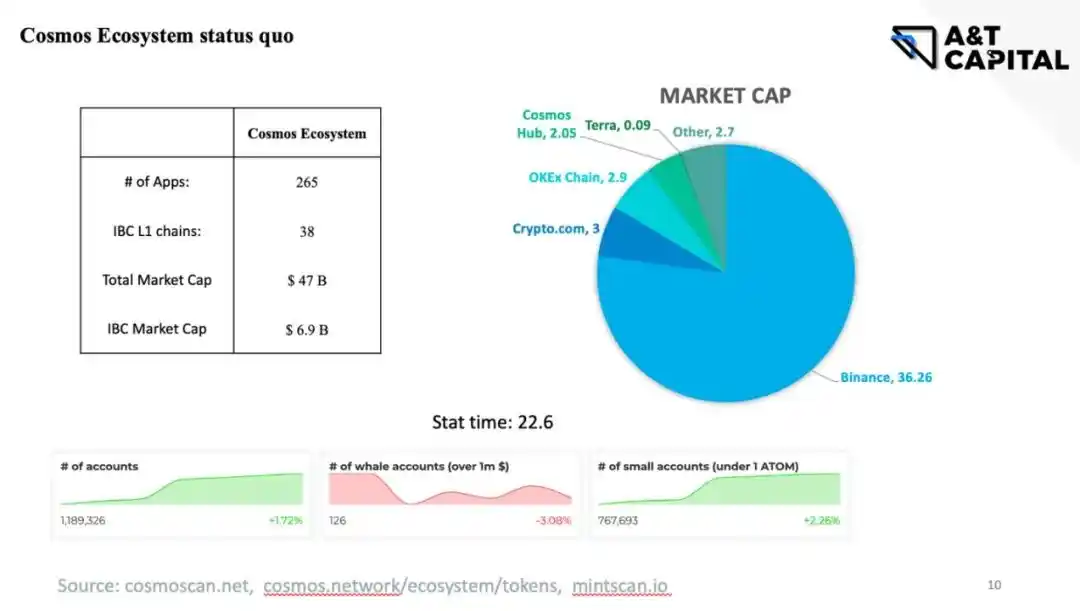
Cosmos Ecological Basic Data - Statistics June 2022
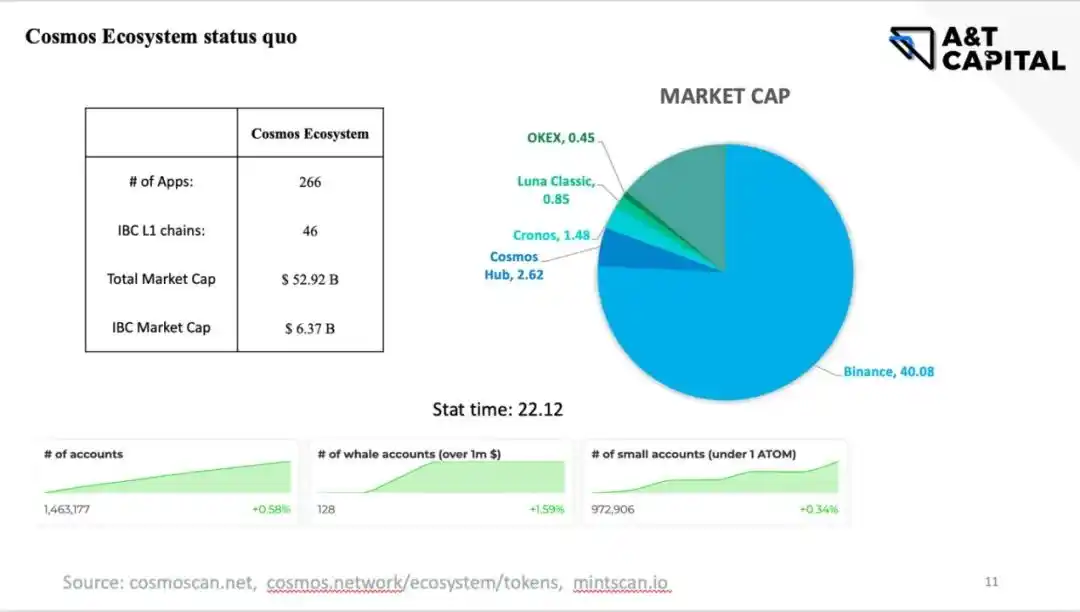
Cosmos Ecological Basic Data - December 2022 statistics
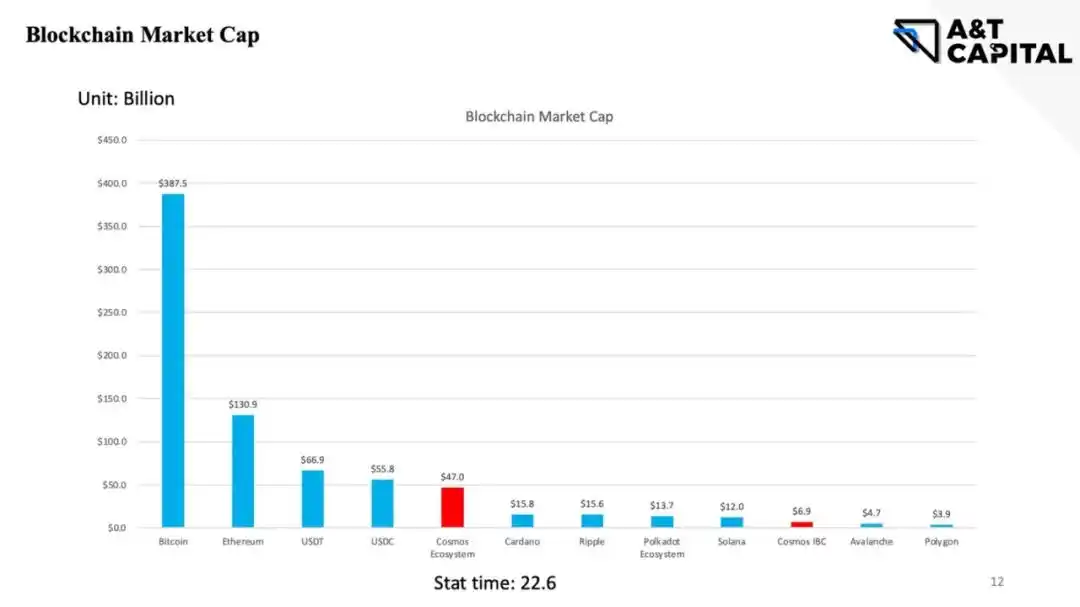
Crypto overall market value comparison -- statistics in June 2022
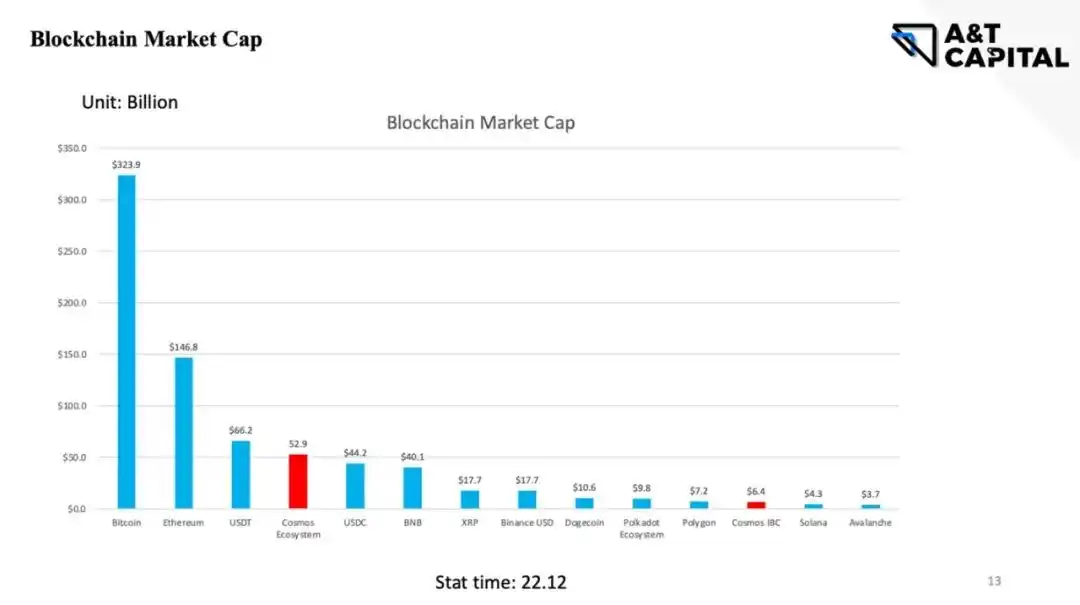
Crypto overall market value comparison - 2022 December statistics
With the frequent occurrence of malignant events in Crypto in the second half of 2022, the market value of Crypto as a whole fell further. Compared with the collapse of Terra, the total market value of Cosmos ecology recovered somewhat, and the impact of Crypto bear market on the whole ecology was significantly less than that of other alternatives L1. Cosmos internal IBC head public chain pattern has not changed greatly, but the market value has decreased significantly, while the market value of other Cosmos new L1 has increased rapidly. It is expected that the Cosmos head common chain pattern will change with the increase of Cosmos IBC chain transformation in the future. Cosmos has good overall vitality and is worth layout.
The significance and controversy of the ATOM 2.0 proposal

There has been a lot of market analysis on the functionality of the ATOM 2.0 proposal. This article focuses on the specific significance of the proposal, as well as an objective analysis of the potential beneficial and adverse effects. It is expected to guide Buidler's thinking on the pain points of multi-chain ecology and seize the opportunity.
1) Interchain Security
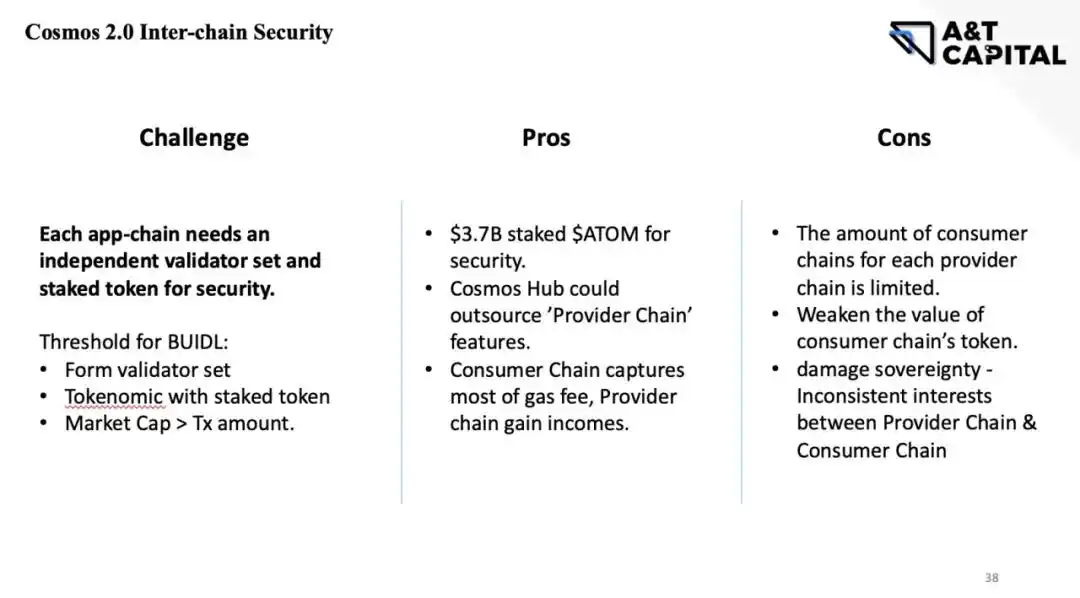
The Cosmos application chain has always faced a major challenge: Each application chain requires a separate set of verifiers and a separate pledge token to provide security, which has been a threshold for project parties wishing to build sovereign chains in Cosmos:
- Need the ability to attract and filter reliable validators to form their own chain of validators set
- Need Tokenomics capable of constructing pledge tokens;
- Need to be able to attract a large number of pledged tokens quickly - the asset security of the app chain is directly dependent on the pledged token market value: if the transaction amount is greater than the pledged token market value, the validator set an incentive to do evil (this has also directly limited the development of the Defi chain in Cosmos in the past)
However, with Interchain Security, The application Chain Project (" Consumer Chain ") may choose to provide security at an early stage by a mature set of verifiers such as Cosmos Hub (" Provider Chain ") and ATOM with a market value of $3.7B as a pledge token and pay the "lease" fee in $ATOM. Interchain Security is not mandatory.
Advantages:
1. ATOM, a pledged token that exceeds $3.7B in market value, directly provides security
a. Just as Ethereum can provide the security of pledged ETH for its smart contract application, the Consumer Chain can accept the protection of a complete verifier set at the beginning of construction, without attracting and screening validator set itself, greatly lowering the threshold for Cosmos application chain construction
b. When the market value of the pledged token exceeds $3.7B, the transaction limit on the Consumer Chain is greatly reduced, and the Defi potential is no longer subject to this limitation
c. A Consumer Chain can be independent at any time and switch to an independent validator set to protect and restore Sovereignty
2. Provider Chain functions can be outsourced, maintaining "non-functional" Cosmos Hub and decentralized Cosmos ecology
a. Cosmos Hub, as the official chain, was built with the original intention of "non-functional" to maintain the decentralization of Cosmos ecology. Cosmos Hub can outsource validator set functionality, such as QuickSilver
b. Not only Cosmos Hub, but other high market cap chains can become Provider chains providing validator sets and pledge token security
3. The Consumer Chain gets most of the on-chain gas fee, while a small part of the gas fee belongs to the Provider Chain
a. Currently, most of the project parties of Cosmos are still deployed on L1 of Cosmos in the form of smart contracts. Regardless of the transaction volume, the gas fee is still directly attributable to the lower L1. The lower threshold of Interchain Security application Chain gives these projects an incentive to directly build application Chain into a Consumer Chain, transfer part of the transaction gas fee to the Provider Chain, and capture most of the gas feea
In dispute:
1. The validator set of the Provider Chain may support a limited number of Consumer chains
A. Validators are expected to do more than simply run the program; they are also expected to participate in governance, secure and maintain an active location, participate in community discussions, and provide technical assistance in emergency situations. Supporting too many Consumer chains will not guarantee the governance quality of each Consumer Chain and restrict its healthy development
2. The Token value of the Consumer Chain project party weakens
A. Although the application Chain that becomes a Consumer Chain is protected by shared security in the early stage, its own Token cannot be pledged, and its value capture ability is reduced, so it may be difficult to realize the explosion of its own Token market value. Therefore, it is difficult to get rid of the sovereignty of the Provider Chain and recover the sovereignty.
3. The inconsistency between the interests of the Provider Chain and the Consumer Chain damages sovereignty
A. The Provider Chain community votes on whether to support a particular Consumer Chain, and ultimately the decision of whether the validator set of the Provider Chain supports the consumer chain becomes an economic issue -- whether it is profitable to support the chain. This results in unequal support and governance for Consumer chains
b. The validator of a Provider Chain participates in the governance and community voting of a Consumer Chain, which makes the Provider Chain control the conflict of interests and damages the Consumer Chain sovereignty
2)Contract Consumer Chain vs Custom Consumer Chain
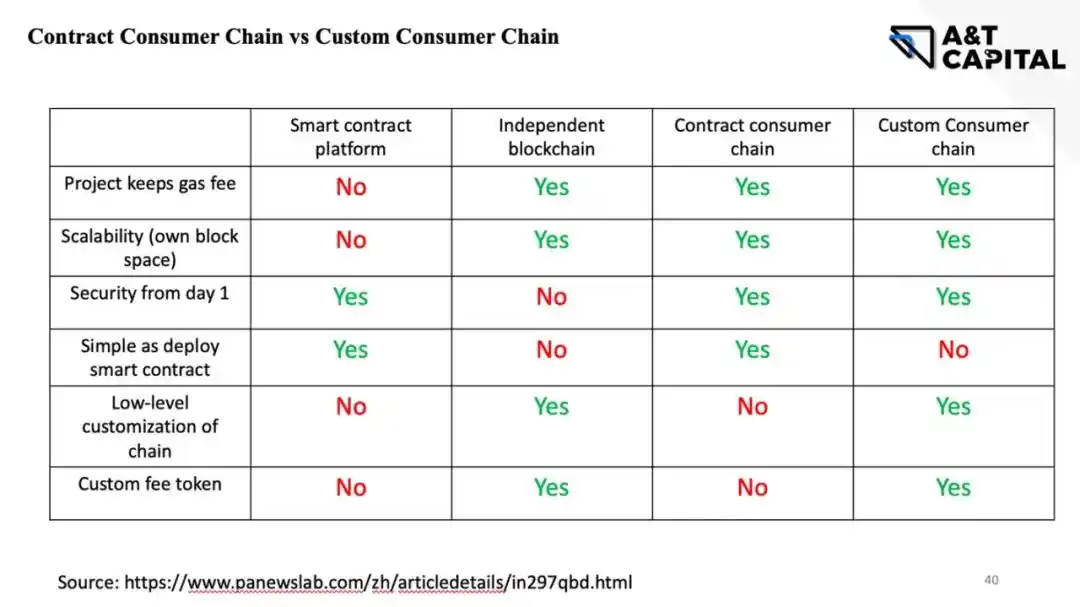
The application Chain development team can choose to deploy a Contract Consumer Chain or a Custom Consumer Chain when configuring the Cosmos SDK.
Contract Consumer Chain greatly reduces the threshold of application Chain. Developers can quickly deploy application chains that are secured by Provider Chain such as Cosmos Hub and support execution environments such as EVM/CosmWasm/GnoVM. The application chain team only needs to focus on business logic development, and the threshold is similar to the direct development of smart contract. Compared with the direct development of smart contract, most gas fee belongs to this DAO.
The Custom Consumer Chain is similar to the current Cosmos application Chain, except that the Provider Chain can optionally provide shared security. Maximum customization of the application chain can be guaranteed, with the Cosmos SDK being customized and even the Tendermint Consensus engine being modified for optimization.
3) 21 Days Locking -- > Liquid Staking
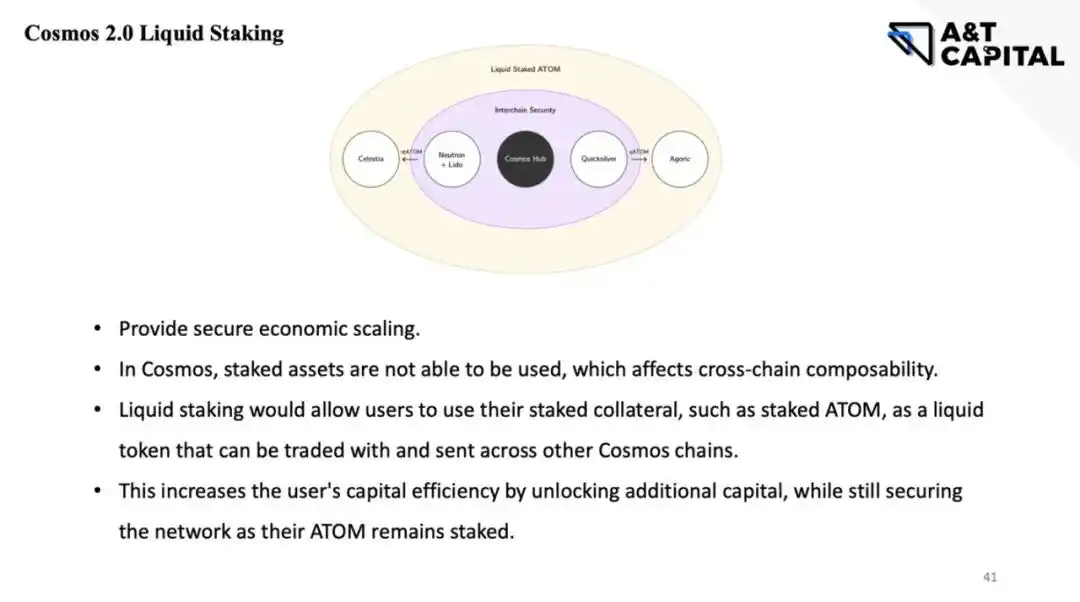
Cosmos pledge currently requires a 21-day lock-up, the pledge must give up other potentially more valuable uses of funds, and the asset will be restricted to the chain where the pledge is placed, resulting in restrictions on cross-chain composability and capital efficiency. In particular, Cosmos requires a large percentage of tokens to be collateralized to ensure security, severely limiting asset liquidity and usage.
If Cosmos supports Liquid Staking, then $ATOM holders will be staking their deployed $ATOM assets without being subject to a 21-day lock-up. Users can freely deploy funds between different chains. Liquid Staking enables the Token holder to provide security on the chain where the Staking is staking, but also to ensure an inter-chain exchange of assets while staking, promoting capital efficiency and inter-chain composability.
In dispute:
1. According to Jae Kwon, Cosmos achieving liquid staking would be staking indefinitely in the process of cross-chain asset flows, forcing other validators to leverage, ultimately more than 1/3 of validators would be staking. Making control of the network fall to a single outside capital, destroying $ATOM. Jae Kwon the original text is as follows: https://twitter.com/jaekwon/status/1590478003691479040
2. The current centralized systemic risk of Liquid Staking. See https://notes.ethereum.org/@djrtwo/risks-of-lsd
4) Inter-chain Schedular
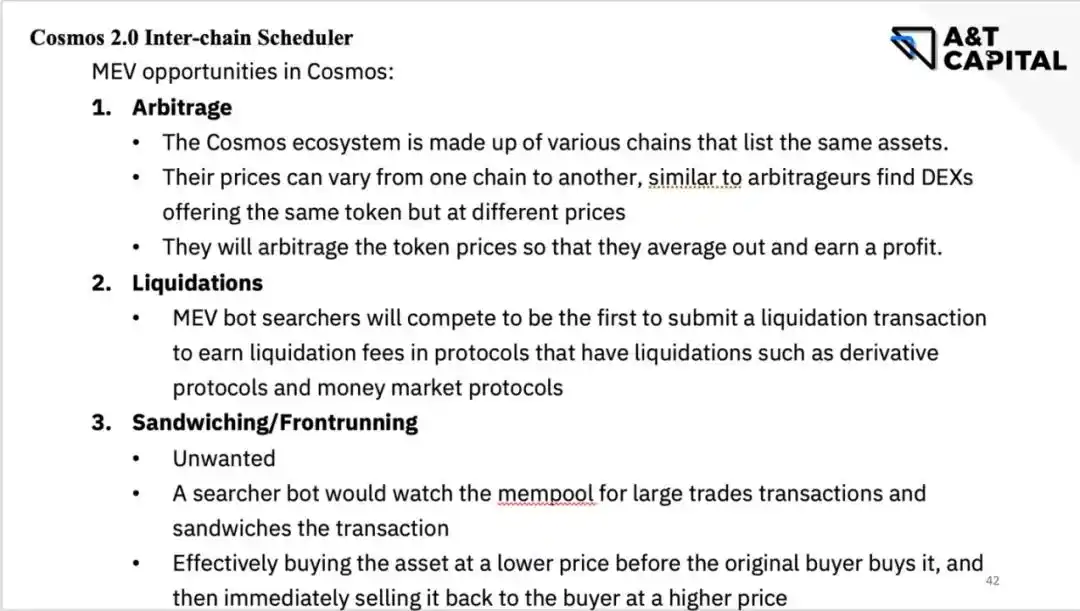
The issue of MEVs has been widely discussed in academia and industry in recent years, and we expect to see a number of solutions to these problems. Cosmos MEV opportunities fall into three categories:
It was more Arbitrage for me than before. Similar assets have different prices on different exchanges, and prices of the same assets in the Cosmos ecosystem also vary across different chains. MEV bots profit from the token trading spread.
2. Liquidation - Liquidation: It is in favor of MEV. MEV bots compete to be the first to file clearing trades, earning clearing fees in derivatives agreements and market-making agreements.
3. Sandwiching/Frontrunning - Sandwich Problem: Sandwiching MEVs. MEV bots profit by monitoring memory pools (mempools) to buy assets at lower prices before real buyers buy them and sell them to real buyers at higher prices.
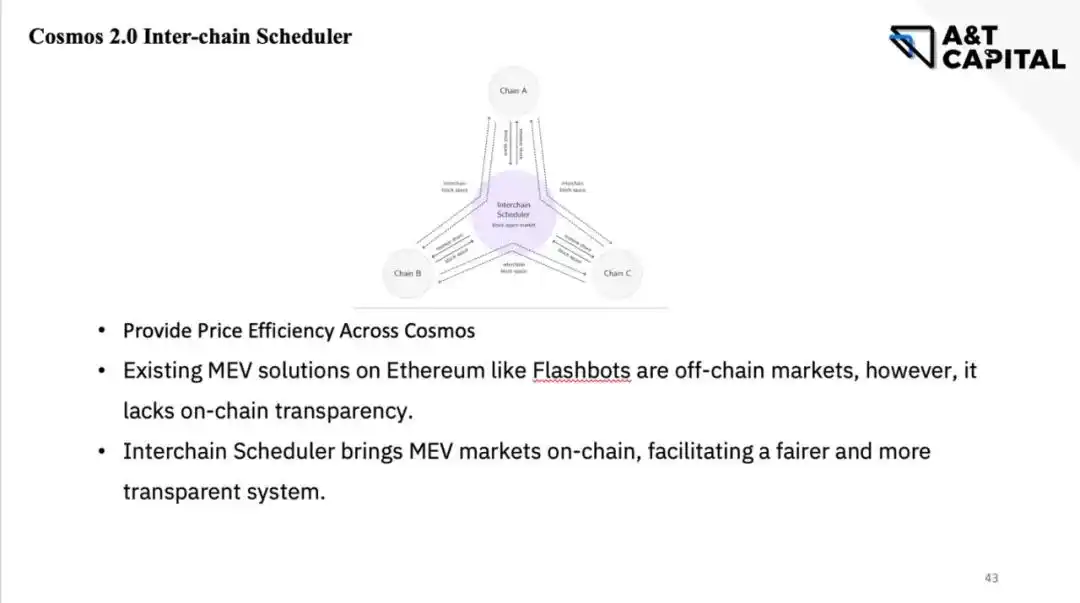
You're not immune to MEVs, and you have the problem of MEVs, like Ethereum, which are sub-chain markets that have no transparency. A popular approach to Sandwiching MeVs is to create an open market for MEV opportunities. Validators are responsible for verifying transactions and producing new blocks, and they can put space within blocks up for auction, for example auctioning off early trading opportunities, creating an open market for selling block space to arbitrageurs. Arbitrage traders pay block producers to ensure that their trades are executed.
Inter-chain Schedular is the concept of block space marketplace proposed by ATOM 2.0. It forms the MEV market as a form chain of block space marketplace. By bidding for block Spaces on different chains, arbitrageurs pay the bidding fee. Ensure that the deal is executed and profits are locked in, thereby making the MEV arbitrage transparent, and the bid proceeds support the further development of Cosmos.
5) Inter-chain Allocator
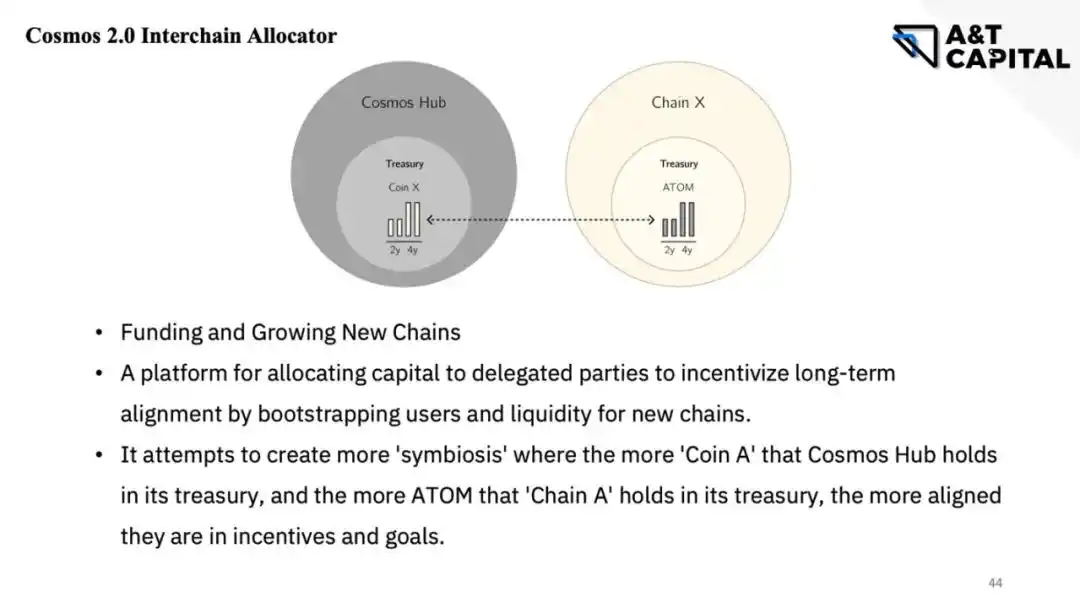
Inter-chain Allocator will act as the ecological incubator for Cosmos, fund the incubation of Cosmos new chain, and introduce Cosmos Hub users and liquidity into the new chain. Cosmos Hub exchanges tokens of the new chain with a percentage of $ATOM, and the new chain uses the circulating $ATOM Token to achieve early construction. However, it also implies further capitalization of Cosmos Hub, the need to control capital exposure to avoid risk and full disclosure of Treasury funds to ensure transparency.
6) Tokenomics
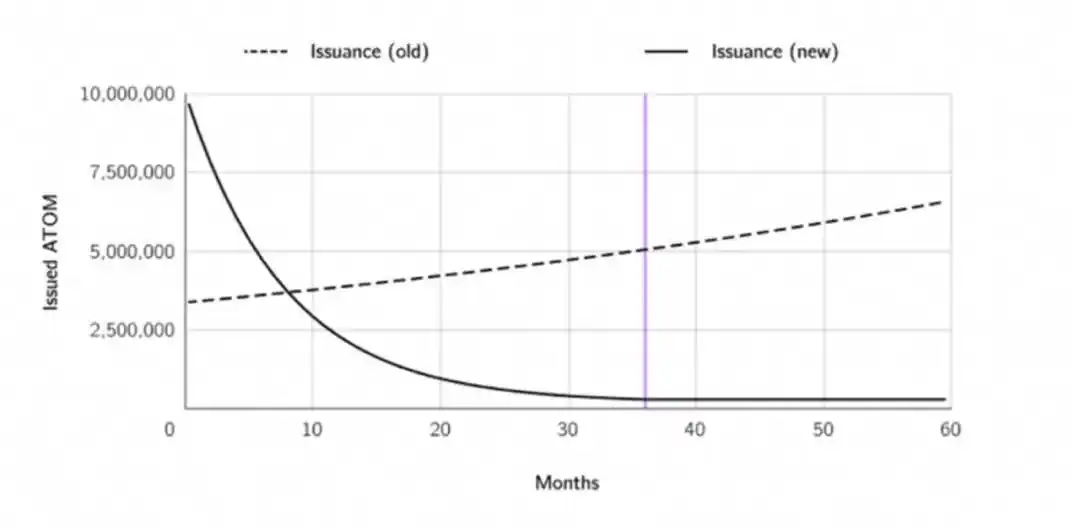
Tokenomics balances safety and liquidity by adjusting inflation issuance with the pledge rate. If the $ATOM pledge rate falls below the floor threshold, the token offering is increased and additional collateral is incentivized to improve security, but resulting in reduced liquidity. If the pledge rate exceeds the ceiling threshold, issuance decreases, curbing pledges and improving liquidity (at the expense of safety). There is always a balance between safety and liquidity. The theoretical annual inflation rate of $ATOM is 7% to 20%, but the actual inflation rate is basically above 10%, which is much criticized.
Under ATOM 2.0's new Tokenomics, $10 million ATOM was released per month for the first 9 months, and over $55 million ATOM was minted in the first year. After that, it declined, and settled into stability or even deflation after 36 months. The high inflation in its initial launch period caused a great deal of controversy in the community, fearing that $ATOM holdings would be diluted. Even after Cosmos Hub changed its 2.0 white paper to release $4 million ATOM in 10 batches, Cosmos original founder Jae Kwon strongly objected. He thinks most of the $ATOM will eventually find its way to the Treasury's central committee.
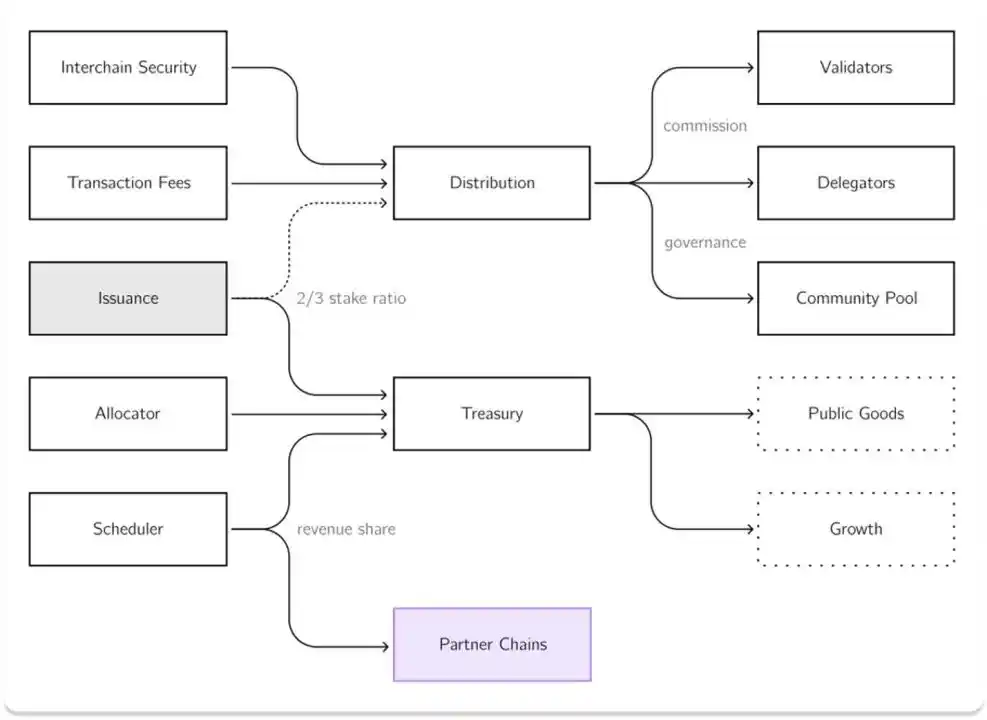
The new Tokenomics greatly increases the revenue stream for Cosmos Hub, theoretically greatly increasing the value capture of $ATOM as a Token of the Cosmos official chain. However, it is also criticized for the large amount of revenue that will flow into the state coffers. By issuing a token called $Photon, $Photon can only be pledged and minted by bundling $ATOM, used as a medium for gas fee, or replaced by $ATOM for Inter-chain Security and other functions, thus maintaining the Cosmos Hub "useless". However, the $ATOM/$Photon dual token model has received much stronger resistance from the community, which believes that the dual token model is not conducive to the development of public chains.
Rumours abound, and it is unclear what deeper disputes lie behind the seemingly different trade-offs. Either way, the significance of the proposal itself lies in the face and innovation of existing problems, and it is a signal of the positive self-evolution of Cosmos ecology. What crypto fund can do is to explore what kind of pain points and opportunities are behind the signals, to help buidler who is committed to change, and to help better ecological construction.
Cosmos Pain Points with Atom 2.0. Cosmos Liquid Staking solution
Targeting pain points: Current Cosmos chain 21-day lock-in results in limited cross-chain composability and capital efficiency
Representative items: QuickSilver, etc
Project Description: Cosmos L1, Mobile Pledge Protocol, the Quicksilver team customized a mobile pledge protocol to create a better pledge experience for the connected Cosmos L1, with the aim of increasing capital efficiency and decentralization.
Website: https://quicksilver.zone/
Trustless Liquid Staking solutions
Targeting pain points: Liquid Staking and centralizing systemic risk
Representative projects: Puffer.Finance, etc
Project Introduction: Puffer's Secure-Signer prevents Slashable offenses, protects the pledged ETH, And provide security for a Decentralized Stake Pool when used in conjunction with Distributed Validator technology.
Website: https://www.puffer.fi/
Solutions to promote Cosmos asset liquidity and capital efficiency
For pain points: Cosmos Pledge Token capital efficiency and lack of liquidity
Representative item: Crescent
Project description: Provide multi-chain assets DEX, derivatives, bring capital efficiency liquidity stimulation
Website: https://crescent.network/
A solution to the potential leverage problem in cross-chain asset flows
For the pain points: Cosmos, Liquid Staking, and the potential for unlimited leverage across chain asset flows
Representative item: not found yet (welcome to discuss)
A shared security solution for early construction of Cosmos public chain
For pain points: each application chain needs an independent verifier set and an independent pledge token to provide security. It is difficult to guarantee the new chain in the early stage, which becomes the threshold of constructing Cosmos sovereign chain.
Representative project: Babylon, etc
Project Description: Security is provided by using PoW's Bitcoin chain for sequential validation of transaction blocks for Cosmos's PoS chain.
Website: https://babylonchain.io/
Sandwiching MEV solution
For the pain point: the Sandwiching MEV arbitrage problem
Representative projects: Skip Protocol, Sei Network, etc
Arbitrage & Arbitrage & AMP; Liquidations), Sandwiching & Frontrunning)/Defi Hub with pre-emptive trade protection and a built-in order-matching engine by significantly optimizing block times
Website: https://skip.money/, https://www.seinetwork.io/
The block space marketplace that hosts the role of the Inter-chain Scheduler
Targeting pain points: Creating an open market for MEV arbitrage opportunities
Representative project: Mekatek
Project Description: The first Maximum Aggregate Value (MAV) marketplace in Interchain
Website: https://meka.tech/
The chain of first mover advantage to realize the ATOM 2.0 vision
Targeting pain points: Being the earliest pilot ecosystem for the ATOM 2.0 vision
Representative items: Neutron, etc
Project description: Subecology based on interchain Account, Interchain Security and CosmWasm
Website: https://neutron.org/
A solution to facilitate governance interactions between Cosmos multi-chain DAOs
For pain points: Cosmos interchain governance and disputes
Representative items: Gnoland, Territori, etc
Project Introduction: Cosmos created by Jae Kwon's original team, introducing GnoVM, Proof of contributions, Tendermint2, IBC2, DAO governance liquidity, Network of Dao, Contract marketplace and other concepts
Website: https://gno.land/
Introduction of a large-scale stablecoin solution for Cosmos Ecology
For pain points: Immature Cosmos Ecostable Coin limits the development of Defi
Representative projects: Canto, Osmosis(Circle is rumored to be releasing $USDC on Osmosis), etc
Project Description: New stablecoin $NOTE for Cosmos
Website: https://canto.io/
A solution that facilitates further modular universality of Cosmos
For pain points: Cosmos application chain is difficult and costly to develop, and its modularity can still be optimized
Representative projects: Celestia, dYmension, Agoric, etc
Project description: Further improve application chain scalability by providing a common Data Availability(DA) layer
Website: https://celestia.space/
Cosmos ecology was expanded by optimizing the Tendermint consensus engine
Solving pain points: Further modularization of the Cosmos /Cosmos Consensus engine for getting through with other blockchain ecosystems
Representative projects: Evmos, Celestia(Optimint), etc
Project description: Ethermint core development team, EVM chain and Cosmos Gateway
Website: https://evmos.org/
A novel multi-chain ecosystem based on blockchain scalability
Addressing pain points: A novel narrative of blockchain scalability beyond the existing architecture
Representative projects: Linera, Artela(A& T in the incubation of Titan), etc
Project description: Based on the innovation of scalability technology, a public validator set based on WASM multi-chain L1 was developed
Website: https://linera.io/
Iv. Investment logic and financing suggestions of Cosmos Ecological Primary Market
Subdivided track:
The above courses with structural opportunities due to ecological pain points (listed below in no particular order) :
Cosmos Liquid Staking. Trustless Liquid Staking. Cosmos Asset Liquidity & Capital Efficiency Solution. A solution to leverage across chain asset flows is Cosmos liquid staking Early construction of a public chain provides a shared security solution. The Cosmos multi-chain DAO is facilitated by the first-mover dominance chain of the Sandwiching MEV solution hosting a block space marketplace with Inter-chain Schedular role to implement the ATOM 2.0 vision The mutually enhanced solution to Tendermint Consensus engine expands Cosmos ecosystem against blockchain-based scalability, a novel multi-chain ecosystem narrative
Suggestions for team background:
Due to the rejection of ATOM 2.0 proposal, the threshold for Cosmos application chain team is still high at present. By analyzing the background of the current Cosmos header public chain team, the following background application chain team will have advantages to become the future Cosmos header public chain:
Experience in Cosmos or other successful crypto projects Tendermint background or Tendermint official team endorsement Profound understanding and innovation of blockchain scalability and support of paper/community proposal (infra project only)
Financing Suggestions:
For Asian teams, going to sea is the biggest challenge. Consider:
The technical narrative will be written down, the overseas community will publish and create community awareness, and strive to participate in the overseas conference as a Speaker. The official channels of the public chain will carry out overseas exposure. When appropriate, the overseas community operation contact A& with experience of Cosmos community will be recruited. T. A& T team distributed in the United States, Europe, Singapore, China, can provide a large number of high-quality overseas resources.
V. Conclusion
Although the ATOM 2.0 proposal ended in a period of failure, the significance of the proposal itself lies in the face and innovation of existing problems, and is a signal of positive self-evolution of the Cosmos ecosystem. Analyzing the meaning and controversy of the proposal and exploring the pain points and opportunities behind the signals will help us better understand and build the ecology of application chain. Cosmos ecology as a whole was significantly less affected by the Crypto bear market than other alternatives L1. The overall ecological vitality of Cosmos is good. With the increase of the metabolism of the Cosmos IBC chain in the future, the pattern of the Cosmos head common chain is expected to change, which is worthy of layout. ATOM 2.0 reflects Cosmos pain points and structural opportunities, A& T sorted out the corresponding subdivision potential track and current representative projects in order to help Buidler explore the direction and better build the ecology.
Original link
Welcome to join the official BlockBeats community:
Telegram Subscription Group: https://t.me/theblockbeats
Telegram Discussion Group: https://t.me/BlockBeats_App
Official Twitter Account: https://twitter.com/BlockBeatsAsia

 Related Articles