Is Cosmos Summer coming? A review of recent important upgrades and ecological progress in Cosmos.
Original Title: "Cosmos Summer is Coming? Sorting Out Recent Important Upgrades and Ecological Progress of Cosmos"
Original Source: ChainCather
Last September, at the Cosmoverse conference, Cosmos released an inspiring 2.0 whitepaper, with plans to address the low utilization of the Cosmos Hub network and ATOM tokens.
For the next half year, Cosmos announced some progress around the above issues, such as upgrading Interchain Security to "Replication Security" for Cosmos Hub and proposing a liquidity staking module (LSM). However, it seems that these announcements did not generate significant market discussion.
With the recent launch of the Cosmos ecosystem's Neutron mainnet, the upgraded security mechanism "Replication Security" was used for the first time. It was also announced that airdrops will be made to Cosmos Hub stakers. Discussions about the value capture of Cosmos and ATOM and its ecosystem are gradually heating up.
In fact, since 2023, the overall performance of the Cosmos ecosystem has been quite good. First, the ecological public chain Canto's daily trading volume once surpassed Solana, bringing Cosmos a good start. Later, the liquidity staking protocol Stride, Layer1 public chain Injective, and Kujira TVL continued to rise, ranging from 2-6 times higher than in January, with Stride and Injective tokens also rising nearly 10 times at one point. In April of this year, according to token terminal data monitoring, the number of active developers on the Cosmos SDK once surpassed Ethereum, and is currently slightly lower than Ethereum, ranking second.
Many users have high expectations for the many plans that will be implemented in the second half of the year in Cosmos, and there are many voices in the market that say "Cosmos Summer is coming" and "the flywheel effect is starting". Jos Maria Macedo, a partner at Delphi Ventures, recently listed representative events in the Cosmos ecosystem to express his optimism about Cosmos, such as the release of version 4 by dYdX, the launch of the permissionless chains Neutron and Sei, and support from Metamask.
This article provides an analysis and summary of the important developments following the release of the Cosmos 2.0 whitepaper, as well as the dynamic and hot ecological projects of Cosmos in the second half of the year.
Consumer chain goes live, firing the first shot of the ATOM 2.0 economic zone
Neutron, which went live on the mainnet on May 10th, is a CosmWasm (Cosmos virtual machine) platform that combines Cosmos SDK and IBC. As the first "Replication Security" consumer chain to use Cosmos, it fired the first shot in the ATOM 2.0 economic zone.
To understand this logic, we need to start with the dilemma that Cosmos has been facing all along and the introduction of Cosmos 2.0. For a long time, Cosmos has been mocked as a beggar chain, and the prosperity of its ecosystem has no direct relationship with its token ATOM. On the other hand, Polkadot, which is often referred to as the "twin of cross-chain", although its ecological performance is weak, its market value is still twice that of Cosmos.
The reason for this situation is that the utilization rate of the ATOM token staked on the Cosmos Hub network of Cosmos is low.
Cosmos is a blockchain network composed of multiple "blockchains". Unlike single blockchains like Ethereum, there are countless blockchains optimized for specific applications on it. These blockchains can quickly build their own chains through the Cosmos consensus mechanism Tendermin and the open-source modular development tool Cosmos SDK, and achieve interoperability between multiple chains through the inter-chain communication standard IBC protocol.
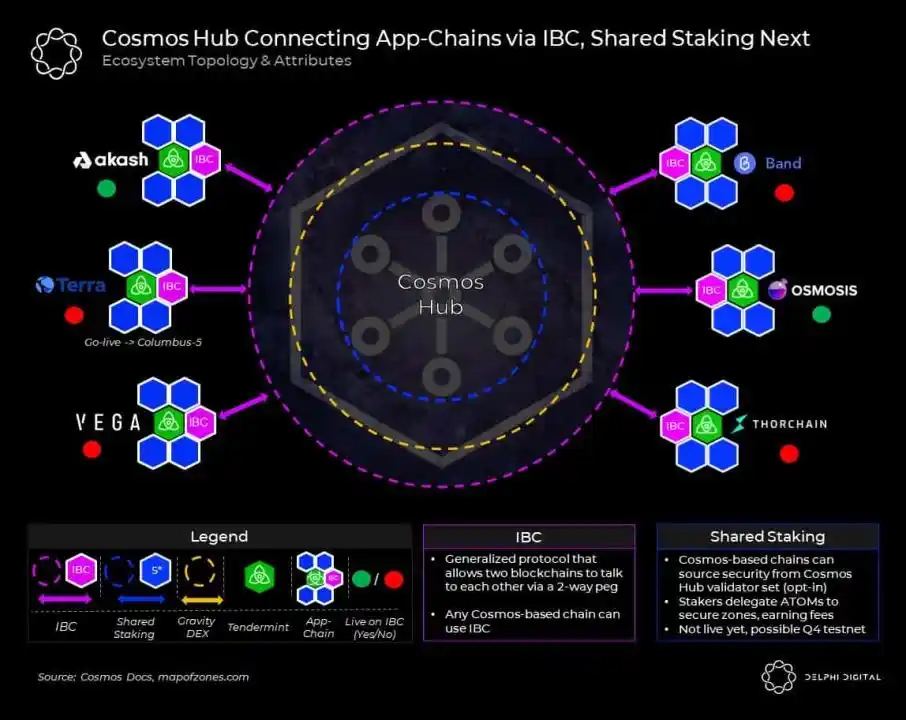
However, in communication, after hundreds or thousands of zone chains are formed, connecting each zone chain directly not only consumes a lot of resources, but also may be inefficient. Therefore, Cosmos opens channels between each chain through the hub chain Hub, and Cosmos Hub is the first and currently the main hub chain. ATOM is the native token on the Cosmos Hub network.
However, although these application chains are based on the Cosmos Hub communication, they can have their own independent validator networks and do not necessarily have to use the Cosmos Hub network validator set, so ATOM is not required as a payment token. This has led to Cosmos' ATOM having little practicality and its price has been unable to rise.
Additionally, ATOM 1.0 is highly inflationary, with a lower limit of 7% and an upper limit of 20% for its inflation. ATOM holders can only earn profits in the Cosmos ecosystem by staking their tokens on the network, but the value of the tokens is diluted due to the high inflation rate.
In order to solve the above problems, Cosmos 2.0 first improves the usability and value capture of ATOM through interchain security ICS (Interchain Security).
As mentioned earlier, due to the fact that many chains on Cosmos cannot use the validation network of Cosmos Hub, the adoption rate of ATOM is low. So, why not rent the validation network of Cosmos Hub (ATOM) and other larger chains (referred to as provider chains) to smaller chains (referred to as consumer chains) such as Neutron to share security and solve this problem?
Therefore, on March 15th, Cosmos launched the "Replication Security" feature, which allows other chains in the Cosmos ecosystem to abandon their own validators and switch to the validator set of Cosmos Hub, thus having the complete security of Cosmos Hub.
As the first Cosmos ecosystem to use "Replication Security", Neutron has become the safest CosmWasm platform in Cosmos by using the security of Hub. Cosmos Hub will receive benefits from Neutron: 25% of transaction fees, 25% of MEV income, 7% of NTRN supply as initial distribution, and more importantly, strengthen the position of ATOM as a cross-chain reserve currency.
Cosmos Hub mentioned on its official Twitter that Neutron will help strengthen ATOM's position as an interchain reserve currency.
On the one hand, it is to enhance the application of ATOM in the Neutron DeFi ecosystem. Applications built on Neutron will enable ATOM to provide liquidity, lending, governance, bond stripping, etc. using native and liquidity-margined ATOM to drive demand for ATOM, and reduce circulating supply by allowing Cosmos to lock their tokens in DeFi protocols. Currently, nearly 10 projects such as Astroport have announced their cooperation with Neutron. On the other hand, Neutron provides services for large treasuries, which can help Cosmos Hub increase the use cases and liquidity of ATOM by linking with other chains, protocols, and treasuries.
And after Neutron fired the first shot in the ATOM 2.0 economic zone as a consumer chain, there are still multiple consumer chains in the Cosmos ecosystem that will be launched one after another, such as the decentralized exchange Duality, the liquidity staking protocol Stride, the on-chain ETF SimplyStaking, and the local asset issuance platform Noble, which will consolidate the value capture ability of ATOM and its position as a cross-chain reserve currency.
二、Cosmos 下半年值得关注的推动事件
2. Key events to watch for in the second half of the year for Cosmos
除了多条消费链为 Cosmos 带来活力外,今年下半年 Cosmos 还有多个值得关注的动态。
Apart from multiple consumption chains bringing vitality to Cosmos, there are also several noteworthy developments in the second half of this year.1. The introduction of native stablecoin USDC has boosted liquidity.
The demand for stablecoins within the Cosmos ecosystem has heavily relied on the algorithmic stablecoin UST on the Terra chain. Therefore, when UST crashed in May of last year, the Cosmos ecosystem suffered a significant blow. Since then, the native stablecoin of Cosmos has been vacant, and its internal stablecoins have been mapped from other networks through cross-chain bridges, such as USDC through Axelar and USDT, USDC, etc. through the Nomad bridge. These stablecoins mapped through cross-chain bridges have dispersed liquidity due to inconsistent mapping formats, and also increase users' asset risks due to the security of cross-chain bridges.
Therefore, Cosmos has a strong demand for native stablecoins. In March of this year, the Cosmos ecosystem's native asset issuance platform, Noble, officially announced a partnership with Circle, committed to bringing native USDC into Cosmos. Noble stated that this integration will generate billions of dollars in liquidity in Cosmos in the coming months.
About the release time of Cosmos native USDC on Noble. In early May, Jelena, co-founder of Noble, revealed in a Yutube interview that it is expected to be officially released at the end of May or in June. In addition, Jelena boldly predicted that ATOM has the opportunity to reach a price of 20-30 U by the end of 2023.
2. Liquidity Staking Module (LSM) promotes the prosperity of Cosmos DeFi
Liquidity staking, like cross-chain security mentioned earlier, is one of the core strategies of Cosmos 2.0 to address value capture for Cosmos Hub and ATOM.
All along, Cosmos has had a pain point, that is, the utilization of ATOM in DeFi is very low. The core reason is that ATOM has a high staking rate (about 20%), and stakers tend to choose staking incentives with certain returns rather than earning profits by providing liquidity. In addition to ATOM, many tokens in the Cosmos ecosystem, such as OSMO and JUNO, also face similar problems, which greatly limit the asset liquidity and usage of Cosmos, resulting in a significant lag behind Ethereum.
At the beginning of May, Cosmos Hub passed a new proposal on liquidity staking to address the above issues. The proposal will replace the existing Cosmos Hub staking, allocation, and slashing modules with LSM. ATOM holders are no longer subject to the previous 21-day lock-up period and can stake their ATOMs fluidly, enjoying staking rewards while using ATOMs for other use cases.
However, it is worth noting that the launch of liquidity staking on Cosmos will also increase the leverage risk of user assets. In order to mitigate the risk of liquidity staking, Cosmos' LSM introduces governance control parameters, which can set the initial upper limit of the total amount of ATOM staked for liquidity staking to 25% of all staked ATOM, and can be changed through governance. At the same time, as an additional security feature, validators who want to receive delegation from liquidity staking providers will need to bind a certain amount of ATOM themselves.
Currently, the three major liquidity staking protocols in the Cosmos ecosystem, Stride, pSTAKE, and Quicksilver, have staked values of ATOM worth 26.35 million USD, 4.57 million USD, and 1.67 million USD respectively. The ATOM staked through liquidity staking only accounts for 1.3% of the total staked ATOM. In contrast, a single Lido on Ethereum accounts for 30% of the total staked ETH. There is still significant room for growth in liquidity staking for ATOM.
3、Top applications enter, injecting new traffic into Cosmos
According to RootData, a cryptocurrency data platform, nearly 20+ projects are set to launch on the Cosmos mainnet. Among them, the entry of top projects such as dYdX into Cosmos has garnered significant attention.
Last June, dYdX announced plans to migrate to the Cosmos ecosystem, developing a custom application chain based on the Cosmos SDK and implementing the migration in the upcoming dYdX V4 version. As a leading decentralized exchange with a daily trading volume of over $3 billion, there is no doubt that its migration will bring a large number of new users and liquidity to Cosmos.
Regarding the migration progress, in March of this year, dYdX announced in their blog that they would launch a private testnet on March 28th. Their goal is to release a fully public testnet by the end of July and launch the mainnet in September, officially transitioning from Ethereum to Cosmos.
Some top-tier wallet applications will also gradually support Cosmos. As Cosmos users need to use wallets specific to the Cosmos ecosystem, some Cosmos contributors are developing a feature called Metamask snaps to allow users to sign Cosmos transactions with their Metamask wallets, reducing the entry barrier for new Cosmos users.
In addition, the largest hardware wallet Ledger recently announced an expansion of its integration with Cosmos. The new compatibility will allow Ledger Live to enable users to send, receive, and stake Cosmos' native ATOM token as well as three other Cosmos-based projects, Onomy, Quicksilver, and Persistence. They also plan to add over 20 new Cosmos projects by the end of this year.
Three, Hot Projects in the Cosmos Ecosystem
Since the beginning of this year, Cosmos ecosystem projects such as Canto, Injective, and Kujira, as well as the liquidity staking protocol Stride, have all seen a good rise in both TVL and token prices.
In addition, the financing of the Cosmos ecosystem project has also performed well. According to incomplete statistics, nearly 10 projects in the Cosmos ecosystem have received financing as of 2023, including Sei Network and Berachain from Layer1, both of which have received tens of millions of dollars in financing.
This year, the hot topics of discussion in the Cosmos ecosystem are mainly focused on Layer1, LSD, modular blockchain, privacy and other fields. Especially in the Layer1 field, star projects have emerged one after another with large amounts of financing.
Layer1
Canto
Canto is a Layer1 public chain that is built on the Cosmos SDK and is EVM compatible. It is specifically designed for DeFi. In addition, compared to other emerging EVM chains, Canto is highly decentralized and does not have investors or a foundation. It relies more on the community and provides free public infrastructure (FPI), as well as contract revenue sharing (CSR) for developers.
According to DefiLlama data, Canto's TVL is currently $85 million. In January of this year, Canto's TVL once rose to $125 million. Canto's 24-hour on-chain trading volume surpassed Solana to become the fourth largest Layer 1 by trading volume. The token price also surged nearly 50% at one point.
Injective
Injective is an L1 blockchain optimized for DeFi and interoperability. Its main feature is its unique plug-and-play financial infrastructure, such as high-performance on-chain decentralized exchange infrastructure, decentralized bridges, oracles, and a composable smart contract layer with CosmWasm.
In January of this year, Injective announced the establishment of a $150 million ecological fund to promote ecological development. According to the encryption data platform RootData, there are currently 20 projects in the Injective ecosystem, including Astroport, Celer Network, and Helix. In April, Injective announced a partnership with Tencent Cloud to support developers on Injective.
Sei Network
Sei Network is also a DeFi-specific Layer1 on Cosmos, with a built-in Central Limit Order Book (CLOB) module. Decentralized applications built on Sei can be built on top of CLOB, and other Cosmos-based blockchains can use Sei's CLOB as a shared liquidity center and create markets for any asset.
Recently, the Sei Foundation website has added an Airdrop button, which is suspected to be announcing the airdrop details soon. In October last year, when the white paper was released, it was already announced that 1% of the total supply of SEI would be used to reward participants in the test network. In February of this year, Jayendra Jog, co-founder of Sei Labs, also stated that the Sei Network mainnet is expected to be launched in the coming months and an airdrop will be conducted.
During the first half of this year, Sei has been very active. In addition to progress on the test network, Sei also established the Sei Foundation. In April, Sei Network and its ecosystem fund received financing of $30 million and $50 million respectively. The size of Sei's ecosystem fund has exceeded $120 million, with over 120 cooperative projects focusing on decentralized exchanges, infrastructure, wallets, and cross-chain bridges.
Berachain
Berachain is also a Layer 1 blockchain based on Cosmos SDK that is compatible with EVM and is protected by the Proof of Liquidity consensus mechanism. The Berachain token economy introduces a three-generation token system for the Bera network, which includes the network gas token BERA, the ecological algorithm stablecoin HONEY, and the non-transferable Bera governance token BGT.
Berachain co-founder Smokey the Bera wrote in an article about the founding of Berachain that the characteristics of Berachain lie in the systematic establishment of liquidity/incentive protocols and validator participation in chain infrastructure, redefining the cost of bribery, and solving the problem of pledge concentration.
It is worth mentioning that Berachain completed a $42 million Series A financing in April, with a valuation of $420 million. Polychain and OKX Ventures participated in the investment. Berachain also stated that it will launch a public testnet in the near future.
Kujira
Kujira was once a subsidiary product of Terra, and after the death spiral of Terra, it migrated to Cosmos to build its own sovereign blockchain. It quickly created the on-chain order book DEX FIN, the clearing market ORCA, the staking and earn application BLUE, and also launched the stablecoin USK.
Kujira's TVL has increased from $3.5 million at the beginning of the year to over $11 million, more than tripled. Currently, its ecosystem has 6 successful projects.
Babylon
Babylon is also a Layer1, dedicated to using the security of Bitcoin PoW to enhance the security of other PoS blockchains. The working principle of Babylon is to act as an intermediary between chains that require additional security and Bitcoin, obtaining block headers from the chains that use its services and writing these block headers into the Bitcoin blockchain.
The Babylon team is composed of consensus protocol researchers from Tse Lab at Stanford and experienced Layer 1 blockchain developers from around the world.
In March of this year, Babylon launched its testnet and will release a second testnet this summer before launching its mainnet at the end of the year.
LSD
Stride
Stride is a multi-chain liquidity staking protocol in the Cosmos ecosystem. It is currently the largest liquidity staking protocol in the Cosmos ecosystem. Stride supports liquidity staking for ATOM, OSMO, JUNO, STARS, EVMOS, LUNA, and INJ in the Cosmos ecosystem, and plans to support all Cosmos ecosystem projects compatible with IBCv3.
The current Stride TVL has reached $34.68 million, mainly consisting of $26.35 million in ATOM.
Modular Blockchain
Celestia
Celestia is the first modular blockchain, which serves as a modular data availability layer based on Cosmos SDK. It only verifies data availability and transaction ordering, allowing anyone to quickly deploy decentralized blockchains without the additional cost of a consensus layer. Currently, it is launching the second phase of its testnet, Blockspace Race.
Last October, Celestia completed a $55 million financing round with well-known investors including Bain Capital Crypto, Polychain, Placeholder, Delphi Digital, Spartan Group, FTX Ventures, and Jump Crypto.
Original article link
Welcome to join the official BlockBeats community:
Telegram Subscription Group: https://t.me/theblockbeats
Telegram Discussion Group: https://t.me/BlockBeats_App
Official Twitter Account: https://twitter.com/BlockBeatsAsia