AI Agent War Erupts: Amazon Blocks Meta's AI Agent, Escalating the Battle for E-Commerce Entry Points

TL;DR
Meta's newly launched AI Agent Muse quickly went viral after launch, surpassing 900,000 downloads in six days and topping the free charts on two major U.S. app stores.
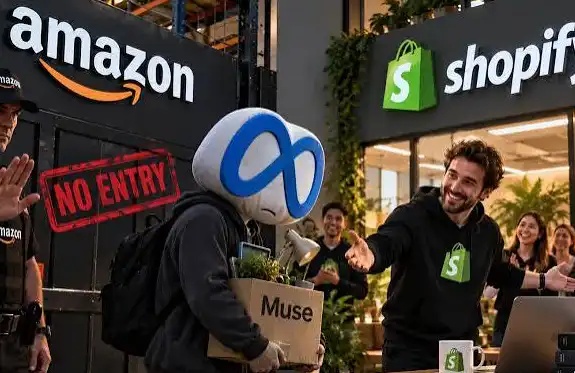
Amazon has blocked Muse from accessing its retail website and asked Meta to remove Amazon from Muse's shopping features; Amazon had previously restricted external shopping Agents such as Perplexity.
The core conflict behind this is the battle over e-commerce entry points: when AI begins to search, compare prices, and even place orders for users, Agents may become a new intermediary layer between consumers and e-commerce platforms, affecting Amazon's sales and advertising revenue.
Unlike Amazon, Shopify has chosen to partner with Meta to advance Agentic Checkout. Competition among AI Agents is moving beyond "whose model is stronger" toward "who can control the transaction entry point."
Meta's newly launched AI Agent Muse is rapidly becoming a new focal point in the tech industry. According to Sensor Tower data, after Muse launched on September 8, downloads exceeded 902,000 in six days, higher than the 773,000 in the same period after the previous Meta AI App launch. As of this Monday, Muse has topped the free app charts on the U.S. Apple App Store and Google Play.
But as Muse's user base grows rapidly, a new question has emerged: when AI not only helps users search for products but begins to shop directly on their behalf, who decides where it can go to buy things?
Why is Amazon blocking Muse?
According to Bloomberg, Amazon has already blocked Muse from accessing its retail website. Users using Muse to shop on Amazon will see a pop-up stating that the relevant action violates Amazon's terms of use. Amazon said third-party apps capable of purchasing goods from other businesses on behalf of consumers should operate transparently and respect whether service providers wish to participate. Amazon has now asked Meta to remove it from Muse's shopping experience.
This is not the first time Amazon has restricted external AI Agents. Amazon is also developing its own automated shopping tools, while it has consistently sought to prevent competitors' bots from browsing product catalogs and completing purchases. Last year, Amazon also sued Perplexity, saying that after Amazon asked it to remove its shopping Agent, Perplexity tried to conceal these automated tools.
The business logic behind this is not complicated. Currently, consumers use AI more for searching, comparing, and recommending products, and ultimately they usually still go to e-commerce platforms like Amazon to complete the purchase. But if users increasingly get used to directly telling AI, "Help me buy a pair of noise-canceling headphones under $200," which platforms to search, which products to compare, and where to ultimately place the order may all be decided by the Agent.
This means that AI Agents may gradually become a new intermediary layer between consumers and e-commerce platforms. The original text also points out that if Agents begin completing purchases on behalf of consumers, they could very well direct orders to other platforms, thereby affecting Amazon's product sales and advertising revenue.
Amazon closes the door, Shopify chooses to integrate
Unlike Amazon's stance, Shopify is actively embracing this change. Mark Zuckerberg announced that Meta is working with Shopify to make shopping and checkout more convenient for Muse users; Shopify CEO Tobi Lütke also said that the two sides will advance Agentic Checkout through Shop Pay.
This means that in the future, users may discover products, select products, and complete payments directly within Muse, without needing to enter different merchants' webpages themselves. Amazon and Shopify therefore present two different strategies: the former wants to control which Agents can enter its commercial ecosystem, while the latter wants to make it easier for Shopify merchants to become a product and transaction network that AI Agents can call upon.
If Agents ultimately become a new consumer entry point, this difference will become important. In the past, e-commerce platforms competed for traffic from users actively opening the App, searching for products, and clicking on ads; in the future, some search, price comparison, and even order placement behavior may all be completed by AI in the background. What platforms need to compete for, therefore, has gradually expanded from "who consumers open first" to a new question—"who the AI Agent calls first."
AI Agents are moving from chat tools to transaction entry points
The reason Muse's rapid growth has attracted attention is also related to this change in product form. Goldman Sachs believes that an important feature of Muse is that it turns the relatively complex Agent capabilities of the past into a product that ordinary consumers can use directly. Users do not need to program; they only need to make requests through chat, and Muse can help complete shopping, travel, and restaurant reservations, as well as follow up on emails, monitor tasks, and continue working in the background after the user goes offline.
This is also one of the core differences between Agents and traditional chatbots: in the past, AI was more responsible for providing answers, but now Agents are beginning to try to complete actions on behalf of users.
Therefore, the significance of Amazon blocking Muse may not just be a minor friction between platforms. As Agents move further from searching for information into transaction links such as shopping, payments, and bookings, competition among tech companies may also extend from models and user scale to goods, payments, and transaction infrastructure.
When AI begins to make decisions for users and complete transactions, who can become the platform that Agents call by default may become a new issue in the next stage of competition for internet entry points.
Welcome to join the official BlockBeats community:
Telegram Subscription Group: https://t.me/theblockbeats
Telegram Discussion Group: https://t.me/BlockBeats_App
Official Twitter Account: https://twitter.com/BlockBeatsAsia