Pantera Capital's view on Cosmos: core advantages, innovation, and important ecosystem

Original author: Paul Veradittakit, Managing Partner of Pantera Capital
Original translation: Leo, BlockBeats
Recently, Paul Veradittakit, Managing Partner of Pantera Capital, wrote an article about "Cosmos' current core technology and ecological projects", interpreting Cosmos' core advantages in technology, innovative mechanisms on the application chain, and several important projects on Cosmos. BlockBeats translated it as follows:
The major challenge facing traditional blockchains today is the promotion of their widespread adoption and scalability. One of the difficulties is the lack of interoperability between different chains, which makes communication and data transmission complex and inefficient. In addition, because the design focuses on security rather than scalability, scalability has always been the primary problem, which has also led to slower communication speeds and more congested networks, resulting in increased costs.
Cosmos introduces a solution to these challenges by introducing an interconnected blockchain paradigm that leverages the Inter-Chain Communication (IBC) protocol to enable seamless communication and secure asset transfer between different chains. With a standardized framework for inter-chain interoperability, Cosmos facilitates efficient cross-chain interactions, expanding the possibilities and utility of blockchain technology. In addition, Cosmos solves the scalability problem through its modular architecture and consensus algorithm. Developers can use the Cosmos SDK to create application-specific blockchains, called "zones". Zones (independent blockchains, also known as regions) can adopt different consensus mechanisms, allowing horizontal scaling and optimized performance. By supporting parallel processing across multiple zones, Cosmos significantly improves the transaction capacity and scalability of the network, and also leverages the Comet consensus algorithm, which provides fast block confirmation times, increased security, and the ability to resist malicious attacks. This type of consensus algorithm serves as a reliable foundation for interconnected blockchain networks, combining efficiency, finality, and robustness.
Core: Cosmos SDK, IBC, and Comet
The Cosmos SDK provides developers with the ability to create custom blockchains, or zones, that meet specific needs and goals. Leveraging the interoperability features of Cosmos, these custom zones push the boundaries of inter-chain interactions. The Comet consensus algorithm enhances this functionality, ensuring that the Cosmos network operates securely and efficiently. Additionally, IBC enables seamless communication across different chains.
Cosmos Highlights
Interoperability: Cosmos’ strength lies in its guarantee of interoperability, which enables independent blockchains in the Cosmos network to easily connect. This interoperability promotes breakthroughs in cross-chain applications and collaboration, driving innovation and enhancing the practicality of decentralization.
Scalability and Performance: Cosmos addresses scalability issues by authorizing the creation of independent blockchains or zones, which can customize their consensus mechanisms and scalability based on user needs. This approach supports horizontal expansion by merging additional zones to accommodate increased transaction volume. As a result, the Cosmos ecosystem has excellent performance and scalability.
Personal Sovereignty: The Cosmos ecosystem provides an ideal platform for creating chains focused on personal sovereignty. By leveraging the infrastructure provided by Cosmos, such as the Cosmos SDK, IBC, and the Comet BFT consensus algorithm, developers have the flexibility to customize any aspect of the technology stack to enhance performance, throughput, security, and other key factors of the chain. For example, EVM chains like Evmos are built using existing technology stacks. In addition, chains that run on different virtual machines (VMs), such as Move or SVM, can also be built by developing dedicated application layers to support these specific virtual machines (VMs).
Developer-friendly environment: Cosmos provides a friendly environment for blockchain developers. The Cosmos SDK is a feature-rich platform for building dApps. Leveraging the modular framework of the SDK, developers can create their own unique blockchains outside of the SDK, simplifying the development process. This streamlined approach allows developers to create customized chains that extend from the Cosmos SDK, thereby increasing the adoption and growth of the blockchain ecosystem.
Cosmos Application Chain
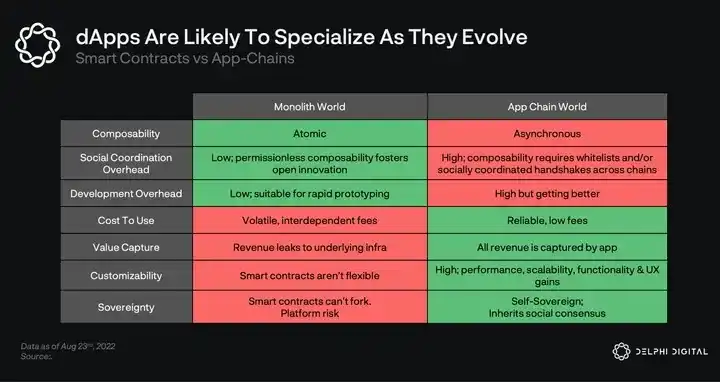
Application chains are an integral part of the Cosmos innovation ecosystem, representing specialized and application-specific blockchains that meet different use cases. Unlike traditional monolithic blockchains, the modular approach adopted through the Cosmos SDK enables developers to customize consensus, storage, and network mechanisms to the specific requirements of their dApps. This gives application chains a degree of autonomy, giving developers greater control over their applications and enhancing their ability to shape the user experience. In addition, the Cosmos application chain model provides attractive revenue opportunities, allowing dApp creators to explore unique monetization strategies and promote sustainable growth within their respective chains.
In addition, the flexibility of the Cosmos application chain extends to the handling of MEV. By providing developers with tools to design MEV strategies that suit their needs, Cosmos incentivizes fair and transparent MEV extraction, promoting a more equitable and efficient ecosystem. In addition, the interconnectivity promoted by the IBC protocol is a key advantage of the Cosmos application chain model. Supporting seamless communication and asset transfer between different application chains, supporting the development of advanced cross-chain DeFi applications, and expanding possibilities for developers and users alike. In summary, the application chain in the Cosmos ecosystem provides a promising avenue for dApps development, providing sovereignty, income opportunities, flexibility on MEV, and seamless interoperability, thereby fostering a vibrant and thriving blockchain ecosystem.
Interchain Security
Interchain security is a groundbreaking approach designed to enhance the security of new Cosmos chains and facilitate their smooth launch. It involves the concept of "renting" economic security from an already established secure chain (Cosmos Hub) in the Cosmos ecosystem.
Main Benefits
Economic Security Leasing: To launch a new Cosmos chain, developers can leverage the security of the Cosmos Hub or other secure chains by locking up a certain amount of the new chain's native token as collateral. This process helps to establish a financial connection between the new chain and the secure chain.
Cross-chain Security: By obtaining economic security through interchain security, the new Cosmos chain is more resistant to attacks. It can rely on a large number of different validators in the secure chain to protect its transactions and assets, reducing the risk of 51% attacks and other security threats.
Independent blockchains: Each Cosmos chain operates independently, with its own governance, tokens, and use cases. However, through inter-chain communication protocols like IBC, they can securely exchange data and value, promoting interoperability and synergy within the Cosmos ecosystem.
By adopting inter-chain security and collaborating within the Cosmos ecosystem, new chains can significantly lower the barrier to entry and gain access to a strong and practiced security infrastructure. This promotes innovation, accelerates the development of blockchains, and brings a new era of secure and interconnected dApps.
Cosmos SDK
The Cosmos SDK supports modularity, creating an ecosystem with a large number of interchangeable modules. This approach frees developers from the previous task of "building complex functions from scratch". Instead, developers can seamlessly integrate pre-built modules into their applications, simplifying the creation of application-specific blockchains. The Cosmos SDK offers high flexibility in module customization, allowing developers to precisely tailor these modules to their application needs, opening up a possible realm for fine-tuning chain applications. As the Cosmos Network grows, the SDK module ecosystem will also grow with it, providing developers with scalable choices and capabilities. In this dynamic environment, complex and highly specialized blockchain applications can be fostered, promoting innovation and driving the development of the Cosmos ecosystem.
The Cosmos SDK also prioritizes security through its concept of capability-based security. These capabilities act as "guardians", clearly defining the boundaries between modules and mitigating the risks posed by malicious or unforeseen interactions. By protecting creation, the Cosmos SDK focuses on security measures.
Inter-Blockchain Communication Protocol IBC
IBC is a protocol for the Cosmos ecosystem designed to facilitate secure and decentralized communication across blockchains. It acts as a bridge, facilitating data transfer across the Cosmos network. By using cryptographic proofs and consensus algorithms, IBC promotes the integrity and trustworthiness of transactions between chains, maintains data confidentiality, and prevents tampering or unauthorized access. The protocol not only enhances chain interoperability, but also promotes collaboration and innovation by allowing project-based systems to be utilized on the network. With IBC, Cosmos has the potential to usher in a new era of blockchain interconnectivity, providing new possibilities for dApps, cross-chain asset transfers, and the creation of interconnected blockchain networks.
Tracking: Chain B continuously receives headers from Chain A, and vice versa. This allows each chain to track the validator set of the other chain, essentially running a light client of the other chain.
Binding: When an IBC transfer is initiated, the token is bound.
Proof Relay: Then, 10 token binding proofs are relayed from Chain A to Chain B.
Verification: The certificate is verified against the header of Chain A on Chain B, and if the certificate is valid, 10 certificates are created on Chain B.
Cosmos Environment
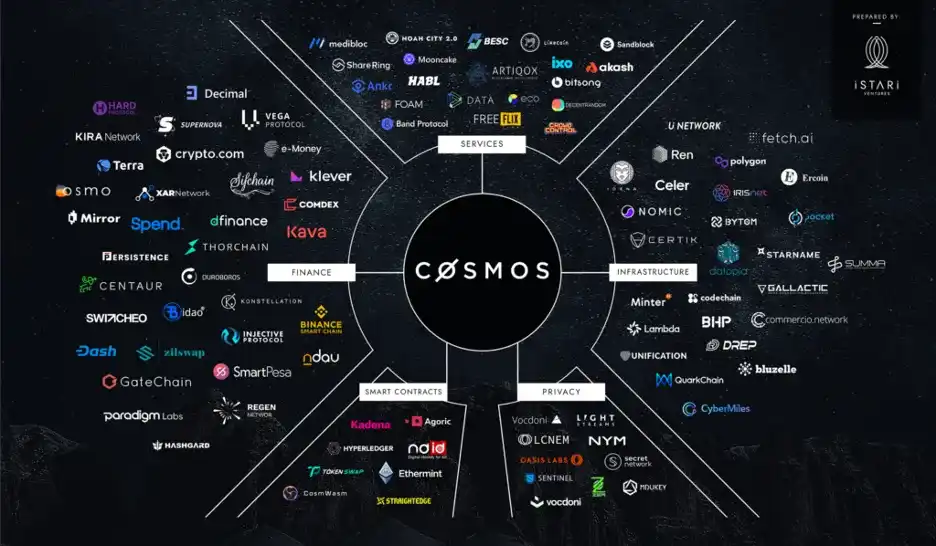
Currently, the Cosmos ecosystem is doing well, attracting a variety of projects and establishing influential partnerships. By leveraging the strong infrastructure of Cosmos, these projects enter the highly interoperable block space, which has the potential to unleash strong network effects. This seamless collaboration and integration greatly enhances the overall ecosystem, promotes innovation, and drives the adoption of Cosmos as a popular blockchain solution.
Projects based on Cosmos
Osmosis is an innovative crypto project built on the Cosmos ecosystem, providing a DEX platform that facilitates liquidity provision. Powered by the IBC protocol, Osmosis enables seamless token swaps between different chains within the Cosmos network. This unique feature enables users to access a variety of assets and pools, facilitating an efficient and secure trading experience. By leveraging the interoperability and scalability of Cosmos, Osmosis creates an inclusive and interconnected ecosystem that enhances liquidity and enables cross-chain collaboration. With its focus on user-centricity and optimized liquidity management, Osmosis opens up new opportunities for DeFi participants to explore a wider range of assets and realize their trading potential.
dYdX is a DEX platform that has gained popularity for its user-centric approach to crypto trading, which eliminates the need for centralized institutions and promotes a more secure and transparent trading experience, while giving users full control over their private keys and assets. dYdX runs on the Cosmos chain and leverages the Cosmos SDK to facilitate fast and efficient trading, as well as seamless interoperability with other Cosmos-based applications. In addition to basic crypto trading, dYdX also offers margin trading and lending services, catering to traders seeking to open leverage and borrowers looking to earn interest on their idle assets. With its strong security, Cosmos has a promising future on dYdX, revolutionizing the way traders participate in crypto while promoting the growth of the DeFi ecosystem.Akash Network provides a decentralized cloud computing market. By leveraging the security of Cosmos, Akash Network provides a secure platform where users can send data to each other and develop. The network runs through a PoS consensus mechanism, which improves the security of transactions. Akash Network's native token is AKT, which serves as the ecosystem's utility token. Through integration with Cosmos, Akash Network benefits from the interoperability and scalability of the larger network, enabling seamless communication with other blockchain platforms. As a result, Akash Network enables developers and organizations to access affordable decentralized cloud computing resources.
Sei Network is a high-performance blockchain platform that runs as L1 on the Cosmos SDK blockchain platform, providing financial services to users and promoting the deployment of the DeFi ecosystem. The network was founded by the founders who realized the need for a decentralized financial system that prioritizes transaction speed and security while providing users with innovative financial tools. Sei uses its proprietary PoS consensus algorithm to provide secure transaction confirmation through tokenization and ownership verification. The platform's three-layer architecture includes the client layer, service layer, and chain platform layer, supporting high throughput and processing up to 20,000 transactions per second. With built-in support for smart contracts in the Rust and Solidity programming languages, developers are able to easily build customized projects and DeFi applications on Sei. The network's native token SEI serves as an internal asset for rewards, staking, and project management, promoting a sustainable and prosperous ecosystem. In addition, Sei's integration with Cosmos gives it interoperability and scalability, allowing seamless communication with other blockchain platforms and providing support for wider adoption and easier access to decentralized DeFi services. Ultimately, Sei Network will become an affordable and powerful blockchain platform that promotes financial inclusion and supports the development of cutting-edge applications in all areas of blockchain.
Neutron is a DeFi platform in the Cosmos ecosystem that introduces a shift in cross-chain communication. Neutron is positioned to be the first consumer chain on Cosmos, operating with an open policy, with the ability to communicate between chains, facilitating seamless interactions between different blockchain networks. Smart contract support in multiple programming languages via CosmWasm provides flexibility and scalability. Its interoperability enables developers to access the feature sets of other blockchains, opening up a new realm of possibilities and unlocking the true potential of blockchain technology. By adopting security from the Cosmos Hub, Neutron promotes secure and reliable infrastructure, laying the foundation for mutually beneficial relationships in Economic Zones. Neutron's features and strategic positioning herald a transformative era for the Cosmos ecosystem, with far-reaching implications for the future of DeFi and inter-chain cooperation.Celestia is a project in the Cosmos ecosystem that provides consensus and security on demand. It aims to advance blockchain deployment by eliminating the need to bootstrap new consensus networks, significantly reducing overhead. Unlike traditional blockchains, Celestia's throughput scales with the number of users due to the unique properties of data availability sampling. What makes Celestia different is that its blockchain does not rely on the honest majority assumption to guarantee state validity, thereby ensuring the highest security standards. In addition, Celestia's flexible design allows developers to define their own execution environment, giving them freedom and creativity. Celestia supports various types of Rollups, including EVM and Cosmos SDK, providing a solution for building interconnected blockchain networks with security and scalability.
Stride is a liquid staking platform built on the Cosmos blockchain that revolutionizes token staking and DeFi. By allowing users to stake any IBC-compatible token and receive stTokens in return, Stride unlocks liquidity and enables users to increase their yields through DeFi transactions. This innovative approach allows users to maintain flexibility while earning returns, cultivating a more vibrant and productive ecosystem. The platform's emphasis on security has passed multiple audits to ensure the safety of user assets. Stride is important because it reshapes the staking landscape, brings enhanced liquidity and yield opportunities to the Cosmos ecosystem, and drives growth in the broader DeFi space through seamless integration and user-centric governance.
Leap Wallet launches an innovative mobile browser extension and app dedicated to optimizing Web3 interactions on a foundation of simplicity and security. Leap emphasizes user autonomy, ensuring that all assets are under user control and adhering to the concept of decentralization. Fast and cost-effective asset swaps promote DeFi investment and exploration of NFTs. Leap's extensive network of partnerships with dApps, Aggregators, DEXs, and Marketplaces creates a premium Web3 experience. The platform is rigorously audited and creates a secure environment for users, fostering trust and confidence. Offering multi-platform support across a variety of devices, including mobile, tablets, laptops, and desktops, Leap Wallet is a versatile tool that enables individuals to explore the unlimited potential of Web3 while protecting their financial future.
Conclusion
Cosmos's own flexible architecture supports secure asset transfers between different chains and unleashes the full potential of blockchain technology. It is worth noting that the booming development of key projects such as Terra, Polygon, and Cronos on the early version of Cosmos highlights its versatility in supporting a diverse ecosystem. With the cooperation between Noble Chain and Circle, USDC has been seamlessly introduced into the Cosmos ecosystem, opening a new chapter in DeFi, and users are increasingly optimistic about Cosmos. Tether launched its USDT stablecoin on Kava, an L1 chain built on Cosmos, further strengthening Cosmos' multi-chain presence and bringing a vibrant and interconnected future to the entire crypto community.
Original link
Welcome to join the official BlockBeats community:
Telegram Subscription Group: https://t.me/theblockbeats
Telegram Discussion Group: https://t.me/BlockBeats_App
Official Twitter Account: https://twitter.com/BlockBeatsAsia