Technology and Value: Analyzing the Ecosystem of ATOM 2.0
Original Title: "Gazing at the Bright and Dark Cosmos Sky: A Comprehensive Analysis of ATOM 2.0"
Original Author: Yilan, LD Capital Research
Abstract
1. As a third-generation blockchain, Cosmos SDK and Tendermint BFT have lowered the threshold for developing and operating public chains. The Cosmos SDK has established an independent ecosystem chain as an ideal way to build an app-chain. Projects using this infrastructure will go beyond smart contract applications to become scalable systems with dedicated blockchains and their own communities.
2. Multi-chain interoperability and architecture decoupling integration characteristics. Cosmos has ecosystem expansion and coordination characteristics and is likely to stand out in the next public chain narrative. However, custom application chains have disadvantages compared to smart contracts in terms of being unable to be arbitrarily invoked.
3. On-chain sovereignty and strong operability. Cosmos' founders believe that due to differences in opinion and viewpoint among groups/regions, a single blockchain will not operate on a large scale. Therefore, Cosmos values the sovereignty of each chain to avoid on-chain "tyranny" and discord, providing each chain with equal inter-chain communication (IBC), which weakens the value capture of $ATOM and the Cosmos Hub but is crucial for ecosystem prosperity.
4. The Cosmos power-down model allows more Alpha to exist in the Cosmos ecosystem. The Cosmos Hub captures stable Beta, while the release of Cosmos 2.0 provides the Cosmos Hub with the opportunity to capture some ecosystem Alpha.
5. The Cosmos system's circular wheel optimizes token value capture. ATOM 2.0 is based on the cross-chain security and liquidity staking of the cross-chain coordinator and cross-chain allocator, forming the Cosmos system's circular wheel. It has transformed the pure staking role of ATOM, increasing the overall attractiveness of ATOM as a collateral asset. From the perspective of monetary policy changes, short-term overall ATOM inflation will be more severe. However, in the medium to long term, the Cosmos system is indeed moving towards a more sustainable direction with a fixed upper limit.
Preface
On September 28, 2022, the Cosmoverse Conference (The legendary Cosmos Conference) concluded in the Colombian city of Medellin, and the Cosmos 2.0 Whitepaper was officially released, launching the Interchain Security ICS, Interchain Coordinator Interchain Scheduler, Interchain Allocator, Liquid Staking, and introducing the latest tokenomics model. This article will introduce the advantages and risks of Cosmos, comprehensively interpret the significant upgrade to ATOM 2.0, and the impact of this upgrade on the Cosmos system.
1. Top-level Design and Operation Mechanism of Cosmos
Cosmos divides the network into two types: Hub and Zone. In fact, Hub and Zone are completely equal in status. The difference between Zone and Hub is that if a Zone is connected to many other Zones, it is called a Hub. Therefore, the Hub focuses on providing interchain services for the IBC network.
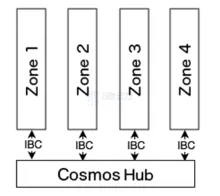
Source: Cosmos Whitepaper
The Cosmos stack consists of the Cosmos SDK as a tool for building the application layer, Tendermint as the network consensus layer, and IBC as the communication medium linking Hubs and hosted chains.
The consensus layer is based on the Tendermint Consensus Mechanism designed by Tendermint Inc. The advantage of this consensus mechanism is its scalability and strong interoperability, with a throughput of 10k TPS, where 1/3 of validators online + 2/3 honest validators can process transactions normally. However, the secondary complexity calculation of Tendermint leads to a more centralized blockchain validation system built on it, with currently only 150 validators (increasing linearly by 13% per year to 300 over time).
Cross-chain interoperability is achieved through the Inter-Blockchain Communication (IBC) bridging protocol. Each chain must implement IBC to connect to other chains. The operation of IBC is very similar to cross-chain bridges. The key difference between Cosmos' IBC and traditional bridges is that asset locking mappings between IBCs are secured by Cosmos' consensus mechanism, a level of security traditional standalone bridge protocols cannot achieve. From a cross-chain perspective, IBC-supported interoperability surpasses previous cross-chain technologies but faces significant limitations, unable to compete with new cross-chain technologies based on MPC.
2. ATOM 2.0 and Its Impact on the Cosmos System
The Cosmos 2.0 Whitepaper was recently officially released, introducing Inter-Chain Security (ICS), Interchain Coordinator Interchain Scheduler, Interchain Allocator, Liquid Staking, and unveiling the updated tokenomics model.
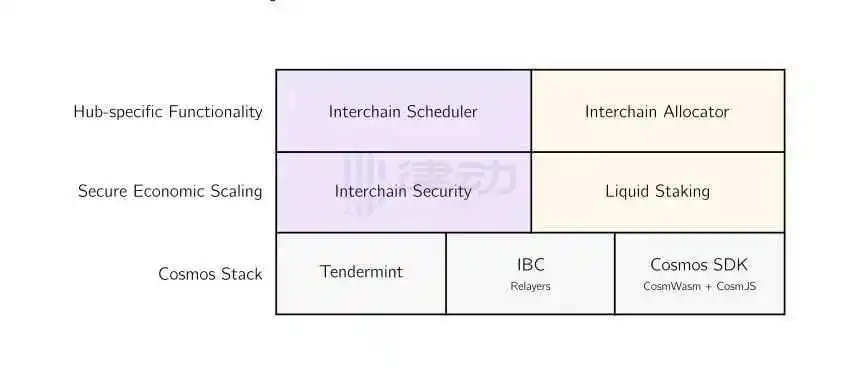
Source: ATOM 2.0 Whitepaper
ICS Inter-Chain Security mainly addresses the weak security issue of eco-blockchains built on the Cosmos Hub. ICS allows the staking validation capability of renting out ATOM to protect smaller market cap Cosmos eco-chains. Eco-chains need to pay a fee as compensation, thus providing income to ATOM stakers. In addition to eco-chain security protection, the use cases of ICS also include Rollup settlement, IBC routing, relay market contracts, chain naming services, etc.
Currently, the Cosmos eco-chains that have announced the adoption of the Inter-Chain Security (ICS) solution include 4 chains including QuickSilver and Neutron, overall with relatively small scales. Larger-scale Cosmos eco-chains like Evmos, Cronos, Osmosis do not currently use $ATOM for staking validation. To enhance $ATOM value capture, the majority of the fee income lent to the eco-chain will be directly allocated to that eco-chain, with the remaining portion distributed to the Cosmos Hub. The value captured by $ATOM is a portion of the fees paid by the validation nodes choosing to lease Cosmos Hub.
Liquid Staking has greatly improved the user experience and capital efficiency within the Cosmos system. By requiring providers to custody assets, it has to some extent drawn on the proposition of Olympus liquidity as a service, enhancing the staking rate while releasing liquidity. Through liquid staking to increase the staking rate of ATOM assets, making liquid staking assets the primary trading medium, and then using the interest generated by the staked assets to reward stakers. This is a significant change in the Cosmos Hub security model. The most effective way to ensure long-term security is to ensure that individual suppliers and supply markets remain decentralized, rather than rewarding stakers with unsustainable inflationary rewards. As an essential part of ATOM 2.0, liquid staking provides an optimized solution to the security issues the original monetary policy (i.e., pure staking $ATOM) aimed to address.
Interchain Scheduler is built on top of cross-chain security to conduct block space market coordination. The specific mechanism is that when an ecosystem chain activates the coordinator's module, it can auction off future block space in a cross-chain contract. The coordinator will mint NFTs for these specific block spaces as reservation evidence. Furthermore, the reserved NFTs can be traded on the secondary market before being redeemed by validators, with a portion of the auction fee going to the ecosystem chain in exchange for block space. The cross-chain MEV income generated by the Scheduler will flow back to the Cosmos Hub, driving the overall ecosystem's balanced growth through the utilization of the Interchain Allocator infrastructure.
Interchain Allocator aims to provide a more efficient path for new Cosmos projects to acquire users, liquidity, and long-term ecosystem balance. In interchain allocation, through contracts and rebalancing, the more tokens the Cosmos Hub holds from its ecosystem chains, the more $ATOM the ecosystem chain holds.
The allocation DAO, composed of $ATOM stakers, can enter into agreements with other chains (Token swaps, etc.) over time. Within the Hub, there may be multiple DAOs, where the voting power of a DAO is proportional to its staked amount of tokens and lockup duration, effectively turning the Cosmos Hub into a fund managed by multiple DAOs. The rebalancing system helps reduce slippage in DAO investments by gradually moving towards the target portfolio using strategies like dollar-cost averaging/Dutch auctions.
Through contracts and rebalancing, the Cosmos Hub will become the largest DAO organization and a fund managed by DAOs, increasing the utility of $ATOM and the number of ecosystem chains on a larger scale.
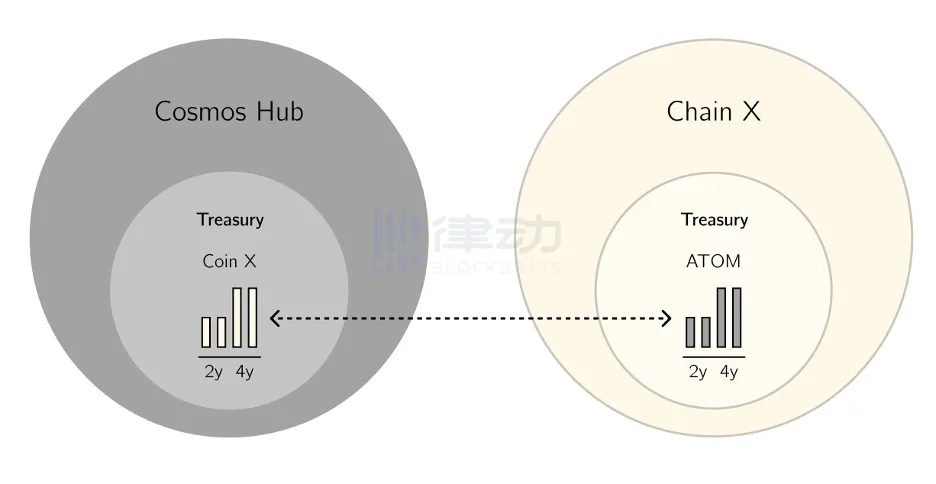
Source: ATOM 2.0 Whitepaper
The Interchain Scheduler and Interchain Allocator, based on cross-chain security and liquid staking, together form the new cyclical flywheel of the Cosmos system. This transformation changes the pure staking role of ATOM, increasing the overall attractiveness of ATOM as a pricing collateral.
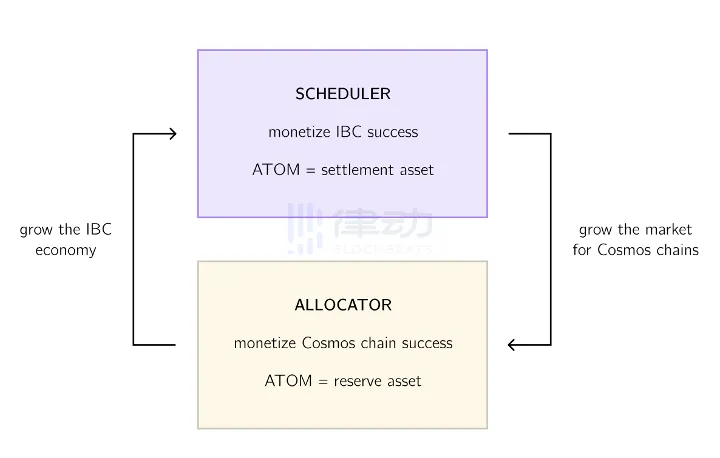
Source: ATOM 2.0 Whitepaper
III. Monetary Policy Changes
ATOM 1.0 adopted an inflation model with a floating annual inflation rate, which was adjusted within a 7%-20% inflation range annually based on the overall staking ratio. When the staking ratio is above 67%, the inflation rate gradually approaches 7%, and when the staking ratio is below 67%, the inflation rate gradually increases to 20%. ATOM's inflation tends to penalize non-staking holders rather than staking rewards. If the overall staking ratio of the system decreases, inflation will accelerate.
The ATOM 2.0 Tokenomic Model Update has a profound impact on the system. The token issuance model is divided into a transitional period and a stable period, shifting from exponential growth to linear growth. In the long term, this will significantly reduce the growth of the total ATOM supply. However, in the short term (first ten months), due to the need for issuance subsidies to cover security expenses and provide funding for the infrastructure needs of the Cosmos Hub, the inflation rate of ATOM 2.0 will be higher than the previous 7%-20% range. That is, in the first month of the new monetary policy open, a 36-month transitional period, 10 million $ATOM will be issued monthly, with the issuance decreasing by approximately 12% each month thereafter. In the medium to long term (20 months later), the total issuance of ATOM will reach neutrality, with the system issuance gradually stabilizing towards a fixed and relatively low inflation rate (1%). As shown in the figure below, the total issuance/inflation rate of the first 20 months after the implementation of ATOM 2.0 is higher than that of ATOM 1.0.
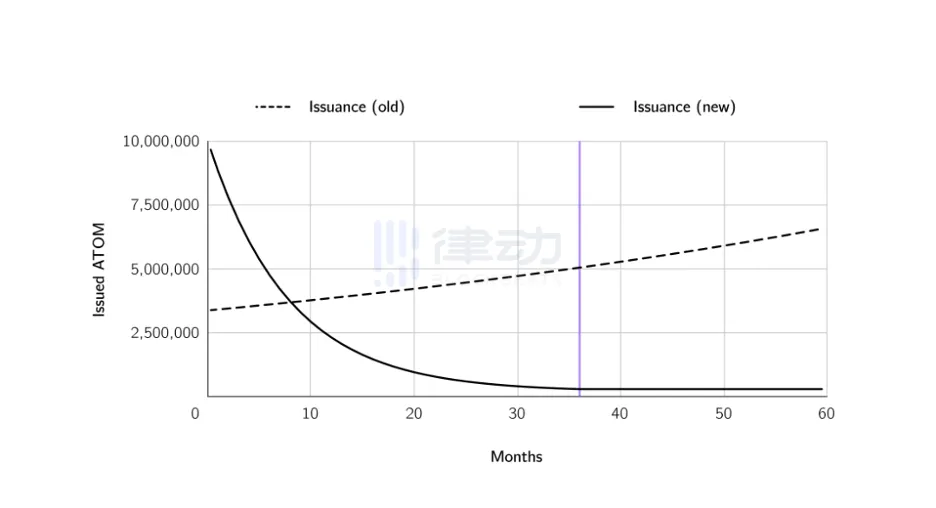
Note: ATOM monthly issuance curve, dashed line represents ATOM 1.0, solid line represents ATOM 2.0
After 36 months, the issuance model will enter the stable period, and the inflation security subsidy will cease. The original staking rewards will transition to revenue provided by initiatives such as ICS to support monthly total issuances of 300,000 $ATOM for funding ecosystem projects' growth and stability. After entering the stable period, ATOM's annual inflation rate will decrease to close to 1%.
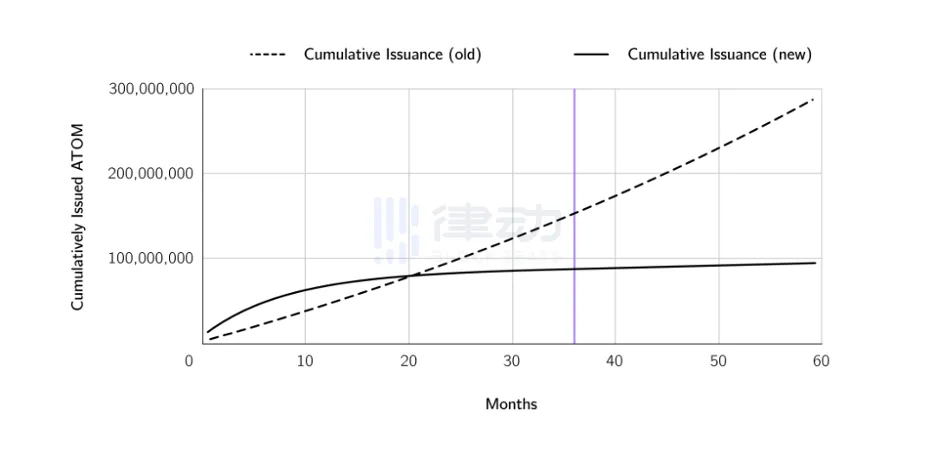
Note: ATOM total supply curve, dashed line represents ATOM 1.0, solid line represents ATOM 2.0
IV. Value Capture Analysis
From the $ATOM value capture perspective, holders' income mainly comes from staking inflation rewards and IBC transaction fees. Currently, the transaction fees captured by $ATOM are actually minimal. To achieve supply-demand balance, that is, daily income offsetting daily inflation, a 500x increase in transaction fees is needed (currently at the equilibrium point where the daily income of $2.3k equals the daily inflation of $150k ATOM). The core concept of Cosmos is democracy and sovereignty. The main purpose of ATOM 1.0 is to provide staking functionality. ATOM 2.0 has improved on this by allowing $ATOM to capture rental fees charged by ecosystem chains using the Cosmos Hub's secure staking functionality, providing additional APY to ATOM Stakers. $ATOM still faces the risk of value capture being diluted among other Hub's staking Tokens .
V. Security Equilibrium Point and Market Supply-Demand Analysis
The first equilibrium point compares the cost of malicious behavior to the TVL value. Currently, the Tendermint BFT cost of corruption is when 2/3 of the staking nodes collude in malicious behavior. The 2/3 staking market value is currently around 1.8 billion, compared to ATOM's TVL of 730 million, there is no incentive for malicious behavior. However, as the ecosystem expands, the demand for security increases. This is also why Cosmos' new monetary policy sets a high inflation transition period and flexible execution.
The second equilibrium point compares ATOM's daily new supply to daily consumption. Based on the current ATOM annual inflation rate of 12.8%, with a total market cap of 310 million, approximately 10871 $ATOM worth 154k USD are released daily. Currently, there are 204 million staked ATOM, supplying 196 million ATOM to the market daily. ATOM currently does not have a burning mechanism, and the fees collected in IBC relays are low. To achieve supply-demand balance, where daily income offsets daily inflation, a 500x increase in fees is required (currently, with ATOM's daily income at $2.3k and daily inflation at $150k). Currently, for $ATOM to form a positively reinforcing supply-demand spiral, more consumption links need to be integrated into ICS to bring fees that can cover security costs to Cosmos.
6. Ecosystem Projects
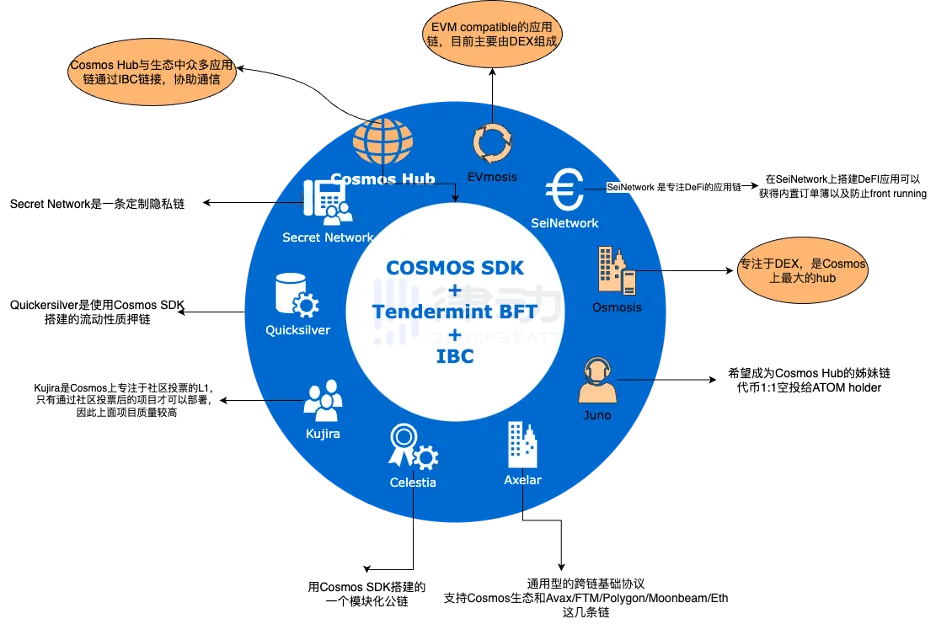
Key feature app-chain in the Cosmos ecosystem
Note: The yellow highlights are the three chains with the most active IBC DAU currently (24hrs), namely Osmosis, Evmos, and Cosmos Hub, with IBC DAU figures of 6978, 4728, and 2711 respectively
From the ecosystem chain data perspective, Osmosis not only includes the flagship cross-chain AMM DEX but is also an application chain developed independently based on the Cosmos SDK IBC, with a TVL of 252 million, ranking first in the Cosmos ecosystem. Osmosis's IBC interface is much higher than that of the Cosmos Hub, making it one of the most active hubs, theoretically giving the Osmosis token OSMO a value capture ability similar to ATOM as a hub. In a horizontal comparison of various public chain DEXs, Osmosis currently has a relatively high P/S ratio. Despite its monthly $2.5 million trading revenue, its total market value of $1.38 billion is somewhat high. However, due to Osmosis's public chain attributes and hub functionality, when compared horizontally with public chains, its market value is relatively low. Osmosis combines transaction privacy (using threshold decryption transactions to prevent frontrunning) with cross-chain AMM and achieves cross-chain functionality through IBC.
Kava is a DeFi platform for crypto assets that supports multi-asset collateral, self-issuing loans, creating CDPs for stablecoins, and other platforms. Currently, Kava's TVL is $271 million, far exceeding direct competitors Evmos, mainly due to its extremely high staking yield, currently at 2800%. Evmos's staking yield is 181%. The top two TVL rankings in the Kava ecosystem are both lending protocols, indirectly indicating that the leverage ratio in the Kava ecosystem is very high. The Kava 10 mainnet activated the Kava Network's Ethereum Virtual Machine (EVM), supporting users in MetaMask to wrap and unwrap KAVA assets as ERC-20 tokens. The Kava Network can now directly connect these resources and the network to tens of thousands of active developers, dApps, and blockchain projects.
Evmos TVL is 1.6 million, with 54% composed by Dex Diffusion Finance, and out of the 11 projects currently built on Evmos, 7 are Dex projects; Secret TVL is 10 million, with 68% composed by privacy protocol Sienna Network, with 4 projects currently under development.
Other notable app chain features include the liquidity staking app chain Quicksilver; the cross-chain asset bridge Kujira, hosting Dapps such as Blue and FIN, with a focus on deploying only high-quality projects through governance voting; the universal cross-chain infrastructure protocol Axelar aimed at unlocking cross-chain composability and liquidity, but with higher relay fees compared to Kujira; JUNO, a Cosmos sister chain aiming to airdrop 47% of its tokens to ATOM holders in a 1:1 ratio, focusing on DeFi with built-in order book and anti-front running mechanisms; Sei Network, an app chain.
Summary
The Cosmos Hub competes with other chains that have hub-like capabilities and scale, therefore, the impact of $ATOM on the Cosmos ecosystem is still unclear. Larger market cap ecosystem chains like Juno, EVOMOS, Osmosis, and Axelar, if aiming to become Security Hubs, will reduce $ATOM's market share and pricing power.
From a cross-chain perspective, IBC-supported cross-chain is superior to previous cross-chain technologies but faces significant limitations, unable to compete with new cross-chain technologies formed by MPC. Additionally, custom application chains in the Cosmos ecosystem have the disadvantage of not being able to be invoked as freely as smart contracts, resulting in poorer interoperability at the invocation level. The Cosmos Hub delegates Token governance rights for the sake of long-term ecosystem development, but this also poses a challenge as alpha is likely to be captured by the Cosmos ecosystem, while the Cosmos Hub's $ATOM captures stable beta, and the release of Cosmos 2.0 presents an opportunity for the Cosmos Hub to capture some ecosystem alpha.
Based on cross-chain security and liquidity staking, the cross-chain coordinator and cross-chain allocator of ATOM 2.0 jointly form the new circular economy of the Cosmos system, transforming the pure staking role of $ATOM and increasing the overall attractiveness of $ATOM as a priced collateral. From the perspective of monetary policy changes, the overall inflation of $ATOM will be more severe in the short term, but in the medium to long term, the Cosmos system has indeed shifted towards a more sustainable direction.
Original Article Link
Welcome to join the official BlockBeats community:
Telegram Subscription Group: https://t.me/theblockbeats
Telegram Discussion Group: https://t.me/BlockBeats_App
Official Twitter Account: https://twitter.com/BlockBeatsAsia