Short report on AMD admits it did not prove any violations.

TL;DR
· On November 19, 2026, Hunterbrook Media published a report and disclosed a short position in AMD, claiming that updated versions of AMD firmware appeared in the server BIOS of IEIT Systems; AMD denied the claim the same day.
· The report demonstrates the appearance of firmware versions but cannot prove the source, license, or controlled-software attributes; the market first repriced on compliance risk.
· Related tickers: AMD, Inspur Information, semiconductor sector.
On November 19, 2026, investigative media outlet and hedge fund Hunterbrook Media published a report and disclosed a short position in AMD. The report claimed that at least six updated versions of AMD boot firmware appeared in the server BIOS of IEIT Systems, an entity related to Inspur Information. AMD responded the same day, saying the report "distorts" the company's business and relationships but did not itemize the source of the firmware.
AMD closed sharply lower that day. Investors sold off not because a violation had been confirmed. The report put on the table a variable that had previously been insufficiently priced: whether a server manufacturer targeted by U.S. export controls was still obtaining AMD technical support through firmware updates.
Hunterbrook acknowledged in the report that it did not know how IEIT obtained the code, nor whether the relevant parties held a license. The incident thus became an asymmetric collision. The short seller had verifiable technical observations; AMD had a principled compliance statement but refused to disclose details.
What the report said, and how AMD responded
Hunterbrook downloaded the BIOS update packages for IEIT server motherboards, compared the version numbers and build times of AMD boot firmware, and then cross-checked them against AMD's official release records. According to the report, after the relevant list restrictions took effect in 2025, at least six updated versions of AMD firmware were still written into the BIOS of three Inspur server models, roughly 25 to 61 days later than AMD's release dates.
But between the appearance of firmware and an AMD violation of export controls lie several layers that need to be proven. The source of the code is the first layer. Whether it came from AMD direct supply, channel distribution, or third-party packaging, Hunterbrook has no answer.
Licensing is the second layer. Exporting items subject to the Export Administration Regulations to listed entities requires a license, with a review policy of "presumption of denial." If AMD or the channel obtained a license in advance, the firmware updates would not constitute a violation.
The third layer is the legal nature of the firmware. Whether boot firmware qualifies as controlled "software" depends on whether it falls within a specific control classification. As of November 20, 2026, no official document had made a determination on this. Firmware versions can be compared, but where the code came from, who authorized it, and whether it is controlled are the dividing lines for whether a violation is established.
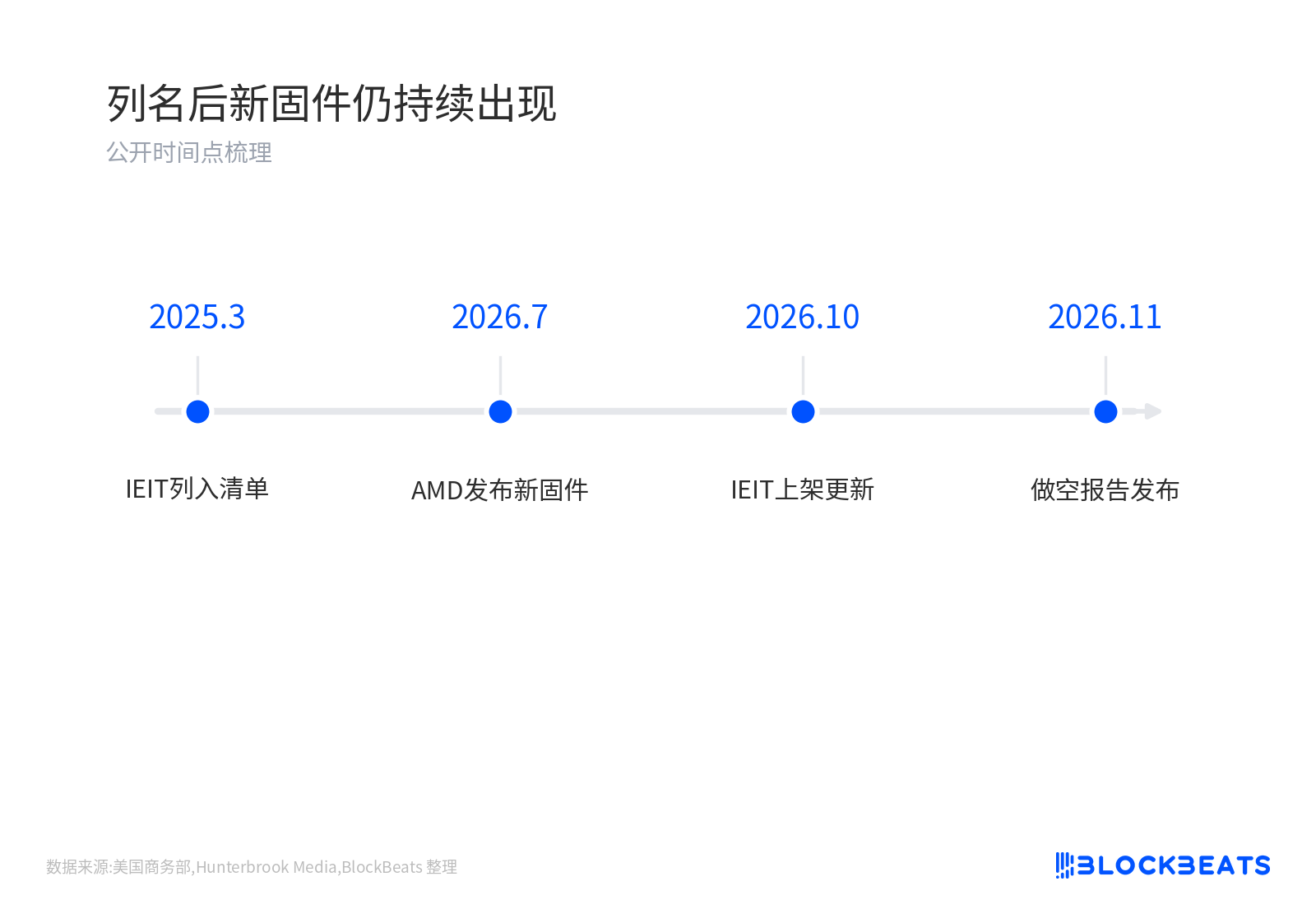
Firmware presence alone cannot prove export violation
Why firmware triggers compliance concerns
The Entity List is the U.S. Department of Commerce's export control blacklist. Once listed, exports of controlled items to the entity typically require a license, and the review policy may be "presumption of denial." The scope of IEIT Systems' or its affiliates' listing remains subject to the U.S. Commerce Department's list. The report's core allegations are built precisely on this restriction.
BIOS boot firmware is the low-level code that enables a processor to boot and run on a server. Server manufacturers package firmware provided by AMD into BIOS update bundles, which users can obtain by downloading updates. It is not a physical good, but it constitutes a technology transfer at the software level.
The U.S. Export Administration Regulations treat controlled software updates as "exports," provided the software itself is a controlled item. Whether AMD's CPU boot firmware is controlled has no publicly available official determination. Firmware comparison can prove that code is present, but cannot automatically prove that controlled items were transferred in violation. The gap between the two depends on control classification, the transmitting party, and license status—all three of which are currently blank.
Affiliated network amplifies risk boundary
The Hunterbrook report also pushes the risk toward a broader structure. The report claims that three server brands not on the list—China's Maginfra, Singapore's Kaytus, and California's Aivres—have public firmware approximately 99.94% identical to IEIT's. The report also claims that Kaytus's audited accounts show its ultimate controlling company is IEIT, and that Aivres was formerly a Inspur subsidiary. If these brands are IEIT's overseas channels, the scope of the list restrictions may be underestimated.
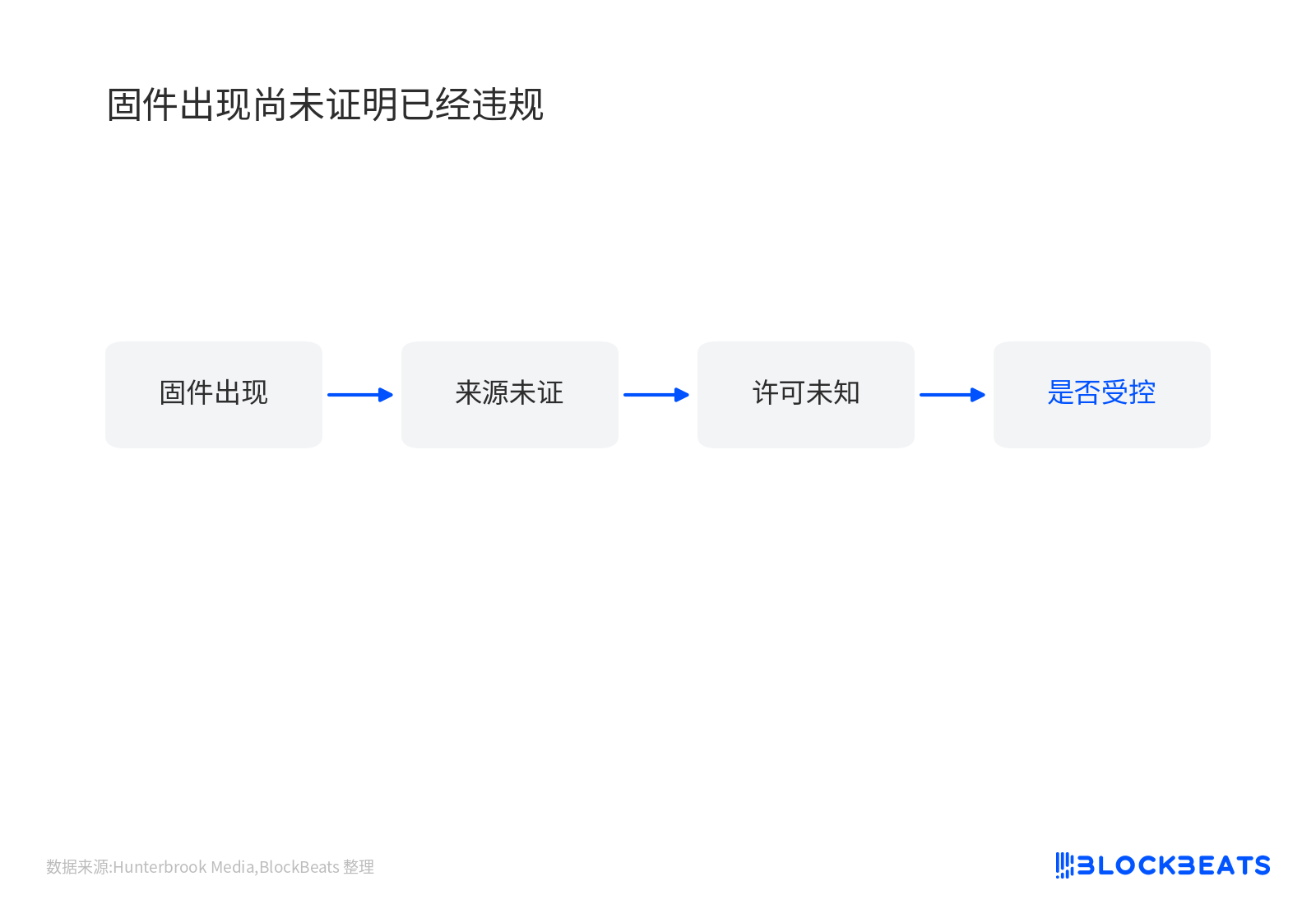
Firmware of three unlisted brands is highly homologous
Regulators are indeed tightening. In September 2025, the U.S. Commerce Department proposed the "Affiliates Rule," requiring overseas subsidiaries 50% or more owned by listed companies to automatically be subject to the same restrictions. The rule later entered a suspended state, with differing accounts of the suspension period and whether it will be reinstated, subject to announcements by the Bureau of Industry and Security (BIS) of the U.S. Commerce Department. If reinstated, entities such as Kaytus could be automatically brought under the restrictions.
Affiliates Rule suspension extended to January of the following year
On the financial side, AMD disclosed in its fiscal 2025 annual report that invoicing to customers in China and Hong Kong totaled approximately $7.75 billion, accounting for about 22.4% of revenue. However, the billing location does not equal the end-use location, and this includes non-restricted products such as PCs. Treating the entire 22.4% as AI chip exposure that could go to zero at any time is a misreading. What deserves more reassessment is the incremental growth. If Asian transshipment is blocked and the affiliate rules are restored to effect, AMD's growth space for AI server chips sold to Chinese customers will be compressed.
Licenses and Code Provenance Remain a Blank
Hunterbrook's report raised questions but did not complete the proof. As of November 20, 2026, no public information has emerged showing that BIS or the Department of Justice has initiated an investigation or enforcement action against AMD, nor has any public response from Inspur Information been seen. Four questions remain unanswered. How IEIT obtained the firmware, through what path the code was transmitted, whether AMD or the channel holds a license, and whether the boot firmware constitutes controlled software. Any one answer could change the nature of the matter.
For readers holding AMD or watching the semiconductor sector, whether regulators send inquiries to AMD will determine whether the matter escalates from a media investigation to a formal proceeding. Whether China and Hong Kong invoicing contracts quarter-on-quarter next quarter will test whether customers have begun to avoid risk. Whether the affiliate rules are restored to effect after the suspension expires will determine whether entities like Kaytus are automatically brought under restrictions. Before these signals appear, the firmware comparison provides risk clues, not a conclusion.
Welcome to join the official BlockBeats community:
Telegram Subscription Group: https://t.me/theblockbeats
Telegram Discussion Group: https://t.me/BlockBeats_App
Official Twitter Account: https://twitter.com/BlockBeatsAsia
 Related Articles