Hong Kong Stock Exchange IPO fundraising reaches $51.9 billion, second-highest in history; Alibaba's Pingtouge secretly files for listing.

TL;DR
· Bloomberg-compiled data shows Hong Kong IPOs raised about $51.9 billion year-to-date in 2026, surpassing 2020's $51.6 billion and ranking as the second-highest on record by that measure.
· Fundraising is highly concentrated in a few large A+H deals from AI hardware companies, about a quarter of offerings remain incomplete, and the year's largest deal, Zhongji Innolight's H-shares, is down about 44% from its offer price.
· Related tickers: HKEX, Alibaba, Zhongji Innolight.
Year-to-date in 2026, Hong Kong initial public offerings have raised about $51.9 billion, surpassing 2020's $51.6 billion. By Bloomberg's compiled measure, this is the second-highest year on record, about $5.9 billion short of the 2010 record of $57.8 billion.
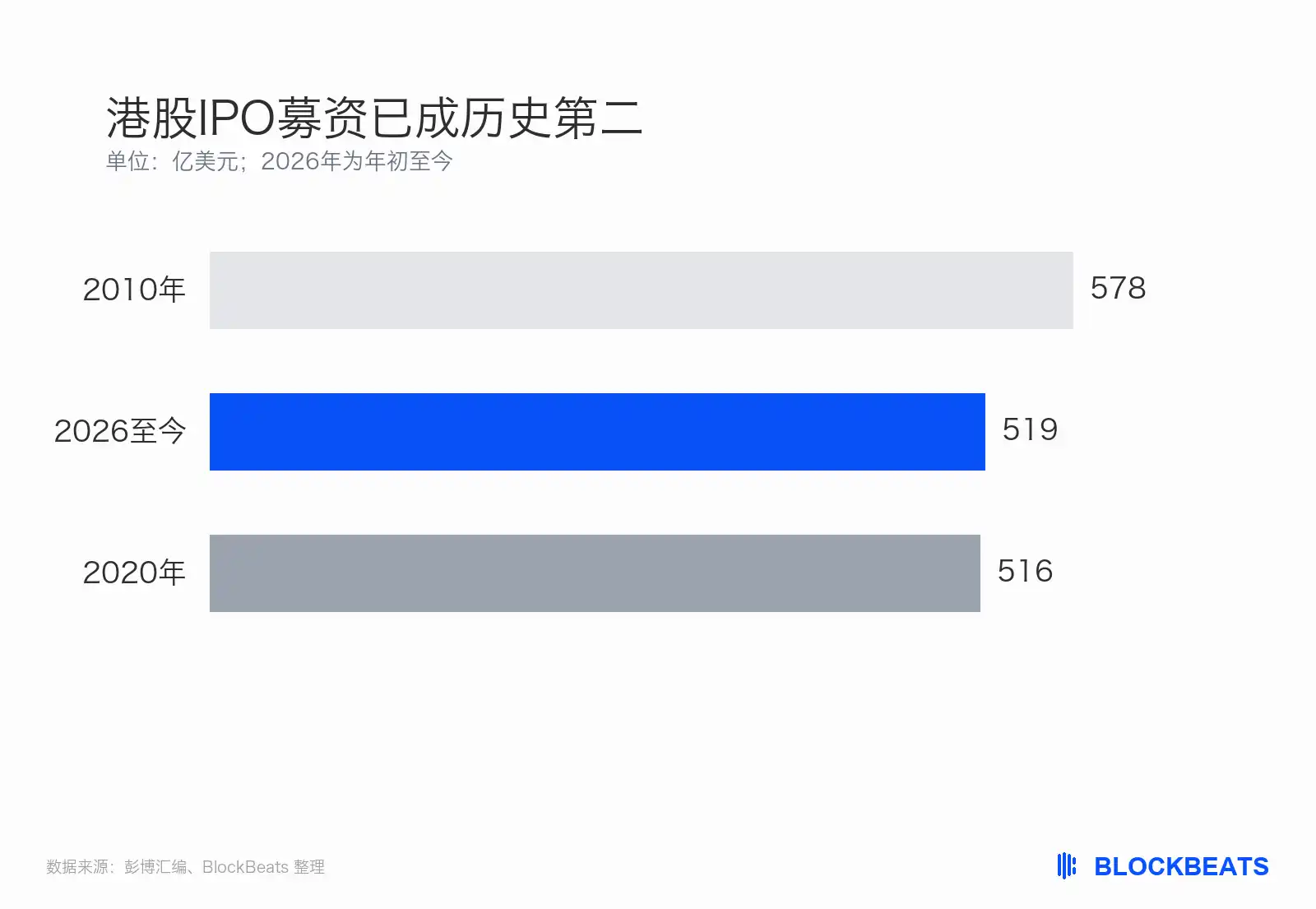
Hong Kong IPO fundraising is now the second-highest in history
In the same week, Alibaba announced that its chip subsidiary T-Head has submitted a proposal for a spin-off and separate listing, and the Stock Exchange of Hong Kong confirmed the company may proceed with the spin-off. Put together, the two events are easily read as "Hong Kong IPOs are fully back."
Yet the year's largest deal sends the opposite signal. Zhongji Innolight, which listed in July, priced its H-shares at HK$980 and closed at HK$545 on November 9, down about 44% from the offer price.
This money was piled up by a handful of billion-dollar mega-deals
The main driver of Hong Kong fundraising this year comes from already-listed companies issuing H-shares in Hong Kong, known as "A+H," rather than pure Hong Kong IPOs. Opening an additional international funding channel for the same business secures U.S. dollars and makes it easier for foreign investors to allocate.
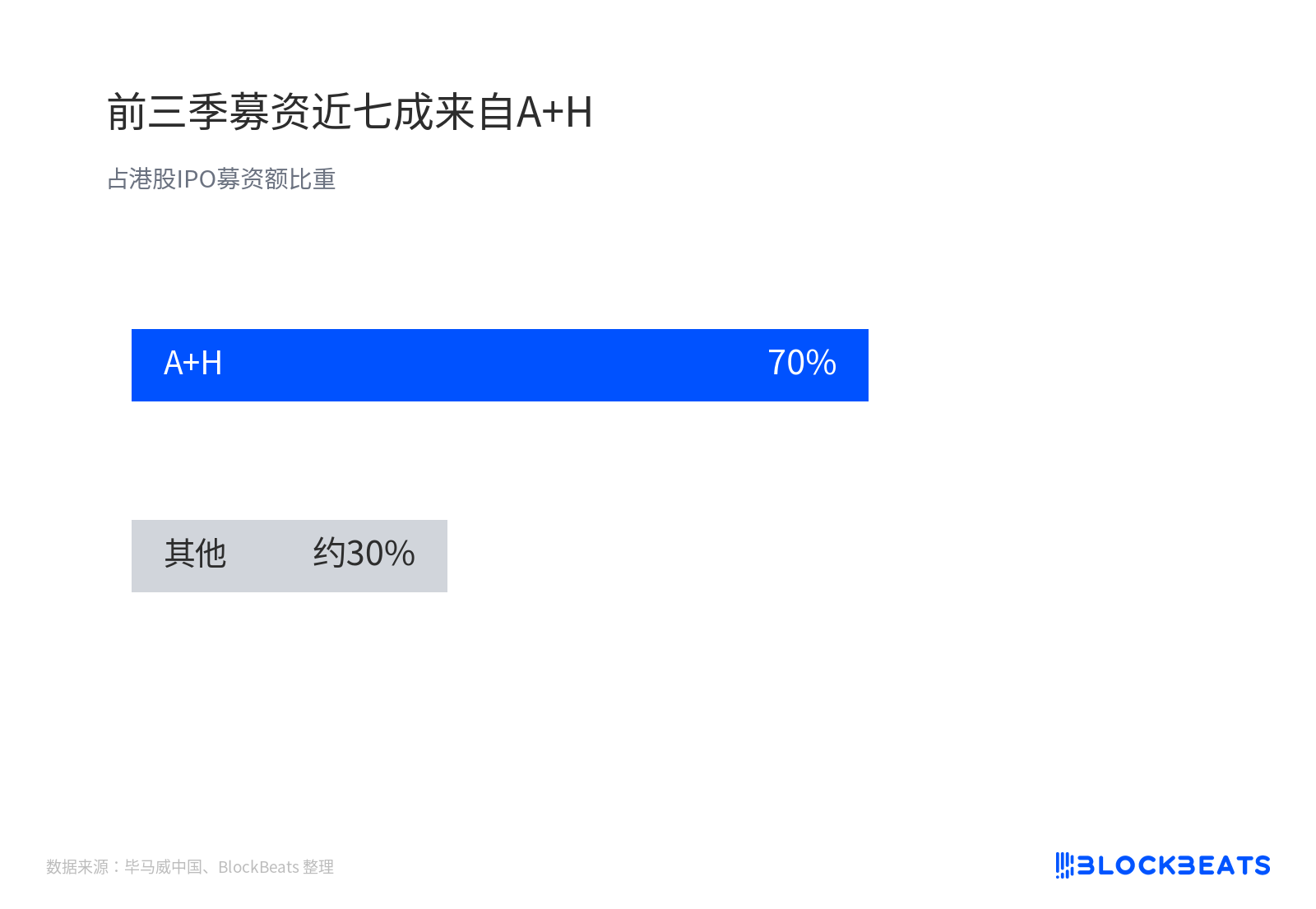
Nearly 70% of first-three-quarter fundraising came from A+H
A few mega-deals propped up the total. Zhongji Innolight's July base fundraising was about HK$53.4 billion, or about $7.8 billion after exercising the over-allotment option. Luxshare Precision's June deal was about $3.2 billion. Bloomberg statistics show at least 10 deals this year raised more than $1 billion, versus only 7 in 2010.
The over-allotment option and cornerstone investors are critical here. The former is the option to "sell a bit more," while the latter are large institutions that lock in subscriptions before listing. Nearly half of Zhongji Innolight's shares were taken by cornerstone investors including Temasek, Hillhouse and BlackRock, diluting the "scrambling for allocation" component considerably through deal design.
Liu Guohua, KPMG China's head of capital markets, offered a more optimistic measure in an October third-quarter review: 116 companies and over HK$388 billion in the first three quarters, already breaking the historical same-period record. If the pipeline converts smoothly, full-year fundraising could approach HK$500 billion. That is a conditional forecast and has not yet materialized.
Record Highs, Withdrawals, and Broken IPOs Can Coexist
Fundraising size depends on issuance scale, not post-listing share price. Large orders were completed on paper, but the secondary market may not buy in.
Zhongji Innolight priced at HK$980, a discount of about 3% from the upper limit of HK$1,010, which was read at the time as "a discount at the pricing end." But it closed down about 2% on its first trading day and then slid all the way to HK$545. Cornerstone investors remain underwater, which says more about where pricing power has shifted than the 3% discount does.
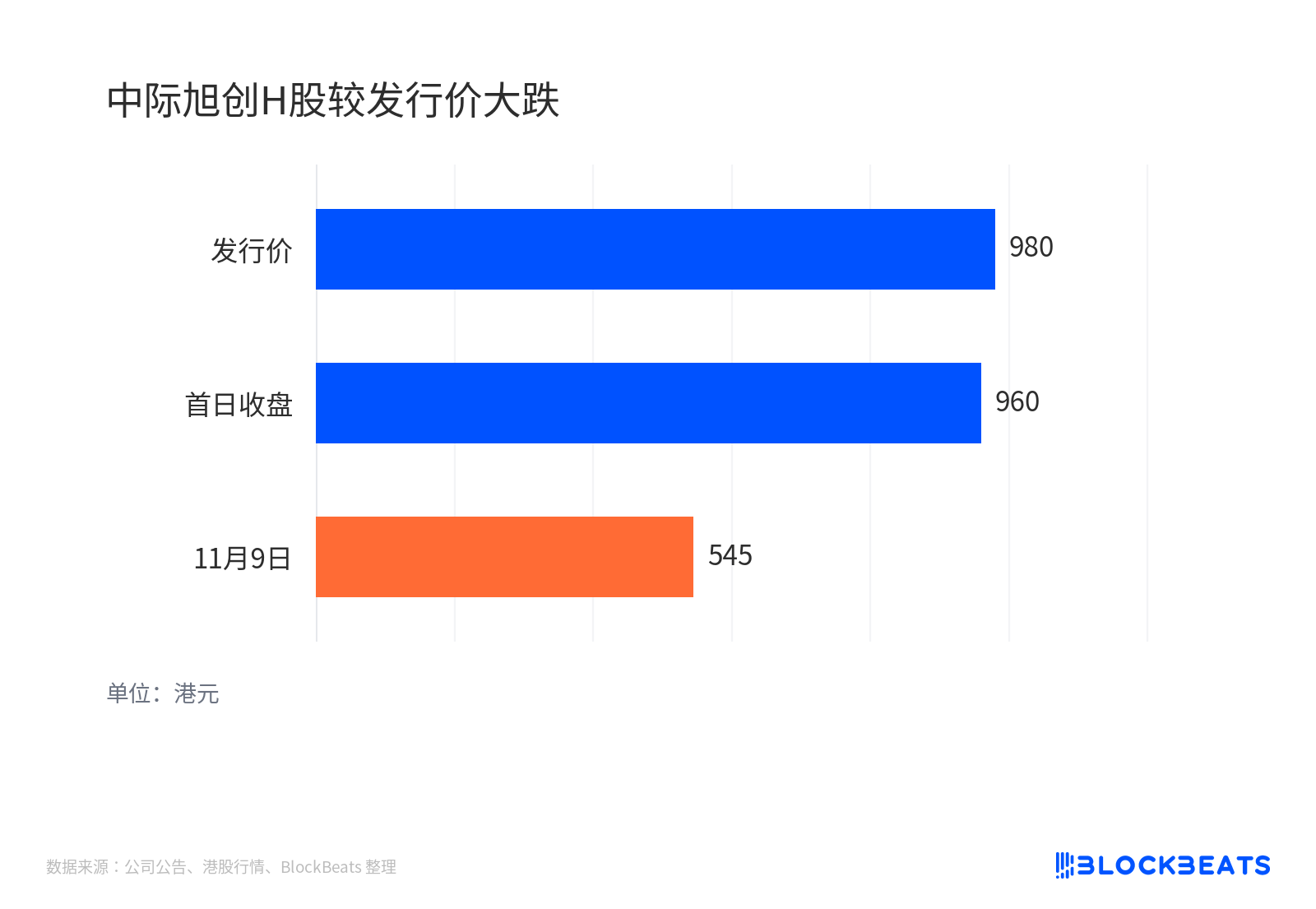
Zhongji Innolight H-shares plunge below issue price
A bigger signal comes from issuance success rates. Bloomberg's transaction database shows about a quarter of Hong Kong listing deals this year were not completed, the highest since 2008, with at least 78 postponed, withdrawn, or lapsed. This set of statistics mixes three different measures and should not be simply equated with a "deal failure rate."
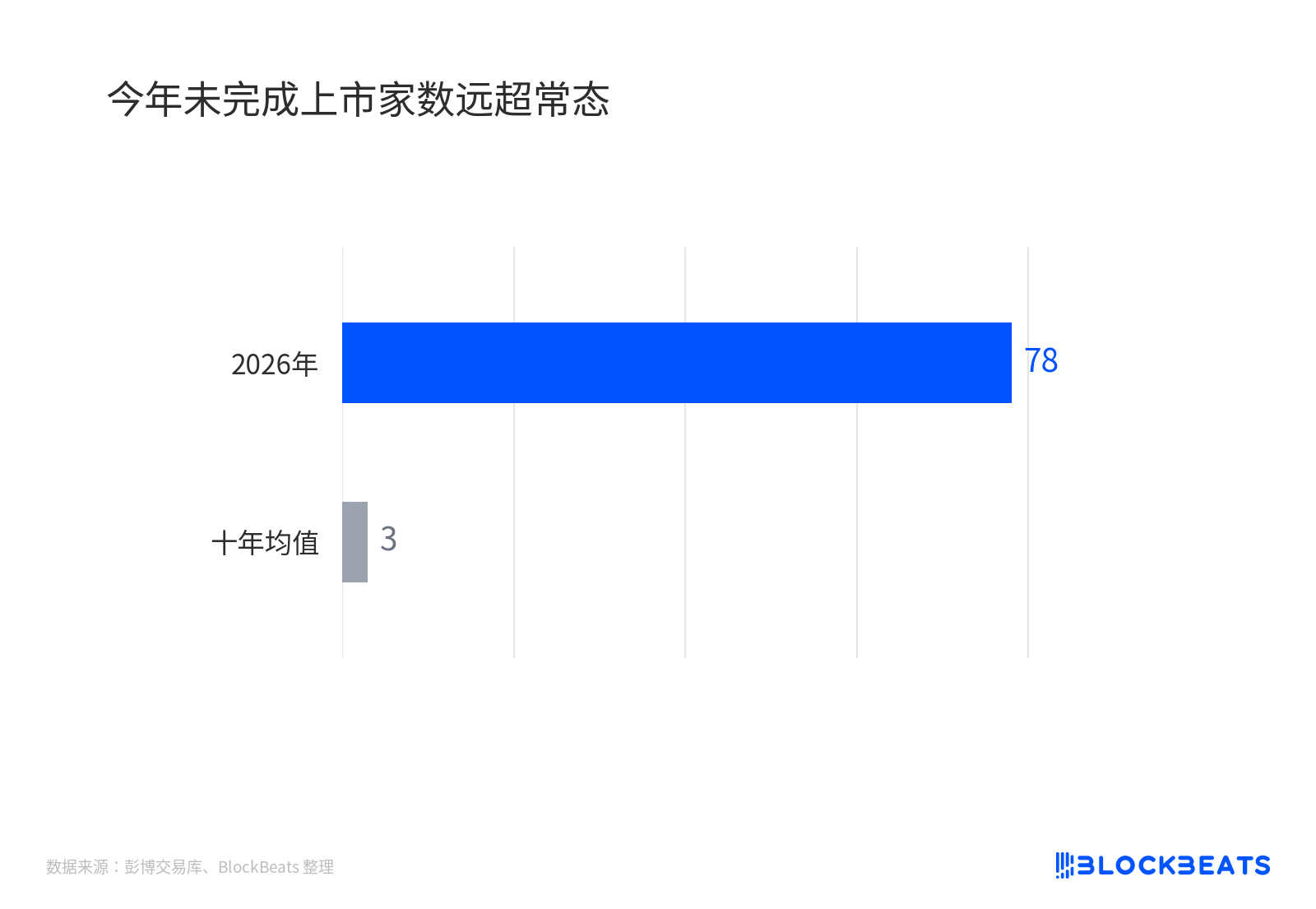
Number of incomplete listings this year far exceeds norm
Another weak signal is the issuance window. Only 17 IPOs from August to October, the quietest three months since February to April 2025. Dongshan Precision, as this year's 10th billion-dollar deal, ultimately raised less than half its original target.
This data does not contradict $51.9 billion. The total is propped up by a few completed large deals, while incremental capital is picking targets with cash flow and overseas orders. Pricing power has shifted from "whether it can be issued" to "how much it falls after issuance."
Pingtouge Looks More Like a 2027 Pipeline
Pingtouge confidentially filed its A1 on September 11. Alibaba announced on November 10 that the company, under Practice Note 15 of the Listing Rules, submitted a proposal for a spin-off and separate listing, and the Stock Exchange confirmed the company may proceed with the spin-off. A confidential A1 means the subsidiary can file secretly first, when neither size nor pricing has been set.
The announcement also drew three boundaries: the offering size, structure, and the extent of Alibaba's stake reduction are all unsettled; after completion, Pingtouge will remain a subsidiary; the transaction's significance is below the disclosure threshold; and there is no assurance whether or when it will proceed.
Market rumors go further. Reuters' IFR, citing people familiar with the matter the day before the announcement, said Pingtouge plans to list in 2027, raising $2 billion to $3 billion. A JPMorgan research report in October gave an independent valuation range of $25 billion to $62 billion. Neither is on a prospectus basis, and the two are often conflated into "Pingtouge's at-least-$2 billion mega-deal next year."
The key point is that Pingtouge is not included in this year's $51.9 billion. Officially, it is placed in the "not significant, still controlled, scale undetermined" category, more like a 2027 pipeline than an immediate addition to this year's figures.
Order visibility and H-share prices are diverging
From the first half of the year through July, there was accelerated diffusion, with billion-dollar-level AI hardware A+H listings landing one after another, pushing the U.S. dollar fundraising amount past 2020. After August, the market shifted into a pullback verification phase: fewer large deals, more withdrawals, lower pricing, and listed leaders giving back gains.
More specific verification rests on three variables. Zhongji Innolight management said that most demand for 2027 has already been converted into confirmed orders, covering the full year, but this is a unilateral statement, and H-share prices and order visibility are diverging.
Whether Pingtouge's prospectus can substantiate external revenue from its self-developed AI chips will determine whether the market gives it the label of "the next Nvidia" or "partial monetization of a consolidated subsidiary." The only remaining issuance window in the fourth quarter will tell the market whether cornerstone investors are still willing to backstop large deals.
The historical ranking of fundraising amounts is something that has already happened; the direction of issuance quality is the part that has not yet been priced.
Welcome to join the official BlockBeats community:
Telegram Subscription Group: https://t.me/theblockbeats
Telegram Discussion Group: https://t.me/BlockBeats_App
Official Twitter Account: https://twitter.com/BlockBeatsAsia
 Related Articles