SoftBank's Bold Bet Results in $7 Billion Loss in a Single Quarter: How Did It Happen?

TL;DR
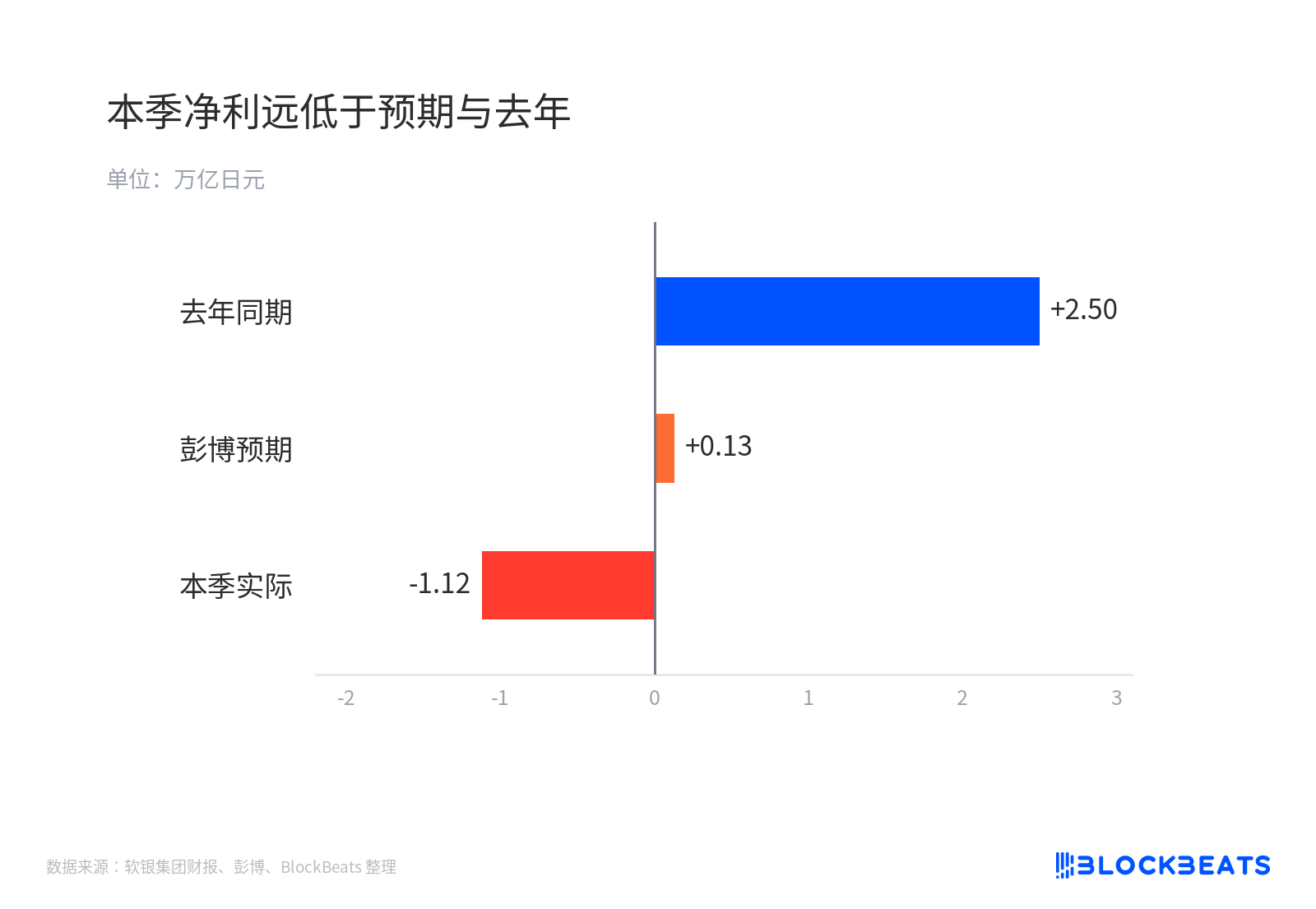
· SoftBank Group posted a net loss of ¥1.1153 trillion (about $7 billion) in its second fiscal quarter, versus the roughly ¥129 billion profit that 8 analysts surveyed by Bloomberg had expected.
· The loss stemmed from write-offs of prepayments for power-generation equipment and doubled interest expenses, while the mark-to-market gain or loss on OpenAI for the quarter was zero, thinning the group's leverage buffer.
· Related tickers: SoftBank Group (9984), SoftBank Corp. (9434), Arm, Intel (INTC), TSMC (TSM).
SoftBank Group on Nov. 10 reported results for its second fiscal quarter ended September, posting a net loss attributable to shareholders of ¥1.1153 trillion (about $7 billion). The 8 analysts surveyed by Bloomberg had expected a profit of about ¥129 billion. This was SoftBank's first quarterly loss in nearly two years, and its share price has pulled back about 60% from its June high.
Quarterly net profit far below expectations and year-earlier levels
The market's first explanation is that AI investments have begun to exact a price, with data centers facing impairment and the OpenAI exposure becoming a burden. The financial statement line items tell a different story: the mark-to-market gain or loss on OpenAI in SoftBank's income statement for the quarter was zero.
What dragged down profit was the write-off of prepayments for power-generation equipment, losses on Intel-related hedges, more than doubled financial expenses, and the high base left by a massive OpenAI valuation gain in the year-earlier period. The same decline can be read as the AI narrative collapsing, or as the execution cost of racing for capacity.
SoftBank has long been treated as a packaged AI call option, with OpenAI equity, Arm, data centers and robotics all loaded onto the same balance sheet. NAV is enterprise value after subtracting net debt from the market value of holdings, and LTV is borrowings as a proportion of NAV, with SoftBank itself drawing a 25% warning line. The huge loss shows up on the income statement, while the market watches NAV and leverage, and this quarter the two happened to move in different directions.
The $7 billion loss sits on four line items
The largest came from power-generation equipment. Silver Bands 7, a vehicle of SoftBank and the Vision Fund (a power procurement entity independent of SB Energy), revised its U.S. AI data center power-generation equipment purchases in the first half, recognizing a loss of ¥597.2 billion (about $3.73 billion), including ¥457 billion in non-refundable prepayments and ¥140.2 billion in contract modifications and settlements.
To lock in capacity amid a power equipment shortage, SoftBank paid before specifications were finalized. The plan changed, and the money cannot be recovered. The official line is a procurement strategy revision—this is a different matter from data center assets being worthless.
The second item is Intel. Derivative losses for the quarter were ¥321.9 billion, and valuation losses on the stake were ¥270.1 billion. The third item is financial expenses of about ¥462 billion, more than double year-on-year, corresponding to about $57 billion of fundraising in the quarter. The fourth item is the base effect: last year's OpenAI valuation gain was not repeated this year.
Adding the four items together, revenue is actually still growing—¥2.215 trillion for the quarter, up 15.6% year-on-year, above the ¥2.02 trillion LSEG consensus. The business has not shrunk; the balance sheet is paying the bill for securing capacity.
$64.6 billion already invested, OpenAI contributed zero to quarterly profit
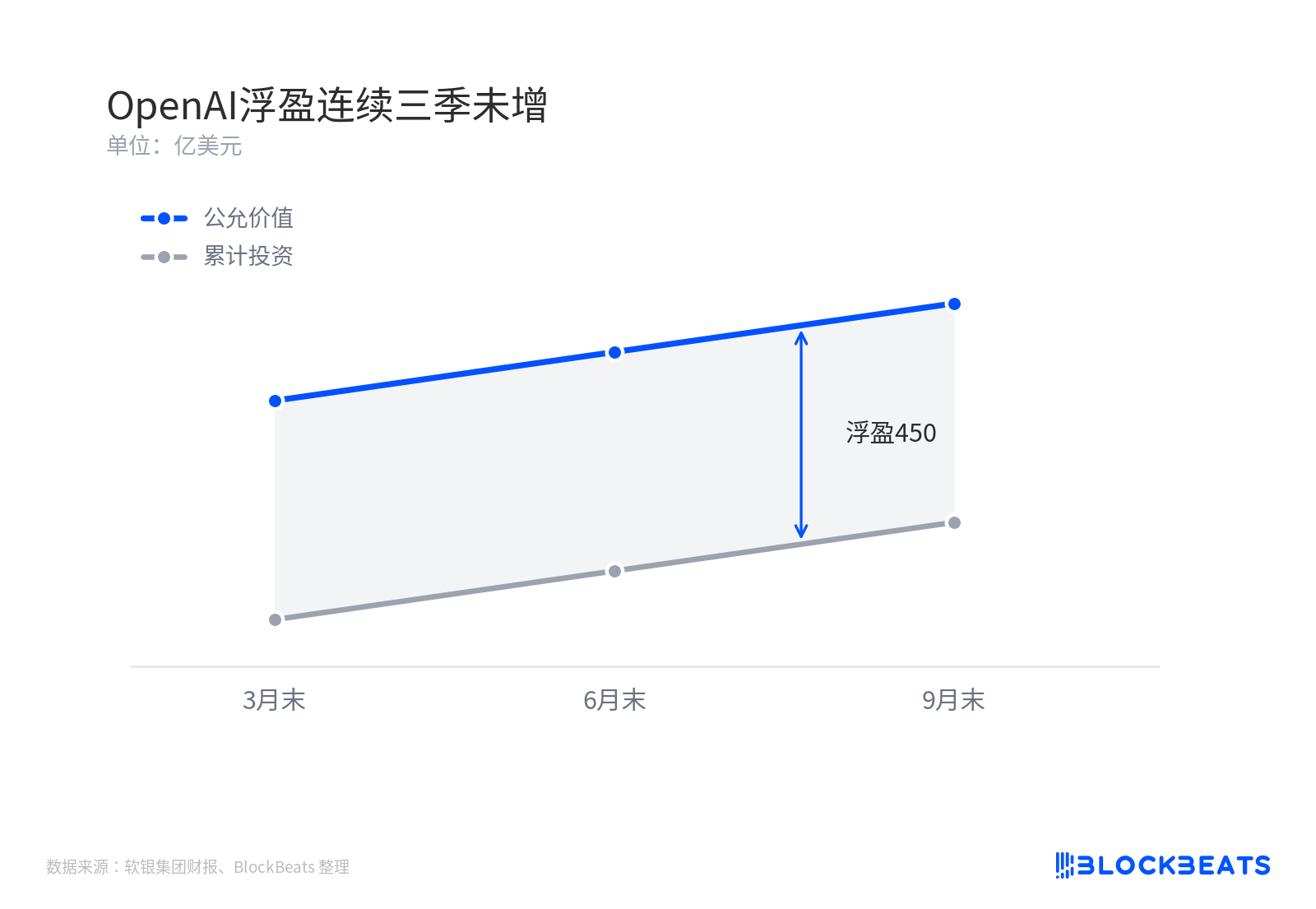
At the end of September, SoftBank's cumulative investment in OpenAI was $54.6 billion, with a fair value of $99.6 billion and an unrealized gain of $45 billion. After completing the third $10 billion tranche on October 1, the cumulative total reached $64.6 billion and the stake is about 13%. Most of the $65 billion commitment that the market says is facing a test has already been deployed, and the book value is still in unrealized gain.
Beyond the funding progress, the sticking point is that private valuations no longer automatically mark up. In the past, each time OpenAI's funding round raised the valuation, SoftBank recognized a book gain. Now the valuation has stalled in place, and this machine that automatically marked up profit has stopped.
OpenAI unrealized gain has not increased for three consecutive quarters
The $45 billion unrealized gain is still on the books, but it can only become new profit after a new funding round or an IPO. The quarterly income statement showed a blank, and after equipment write-offs and interest hit it, it became a loss in the hundreds of billions of yen.
The revaluation is happening on the leverage side
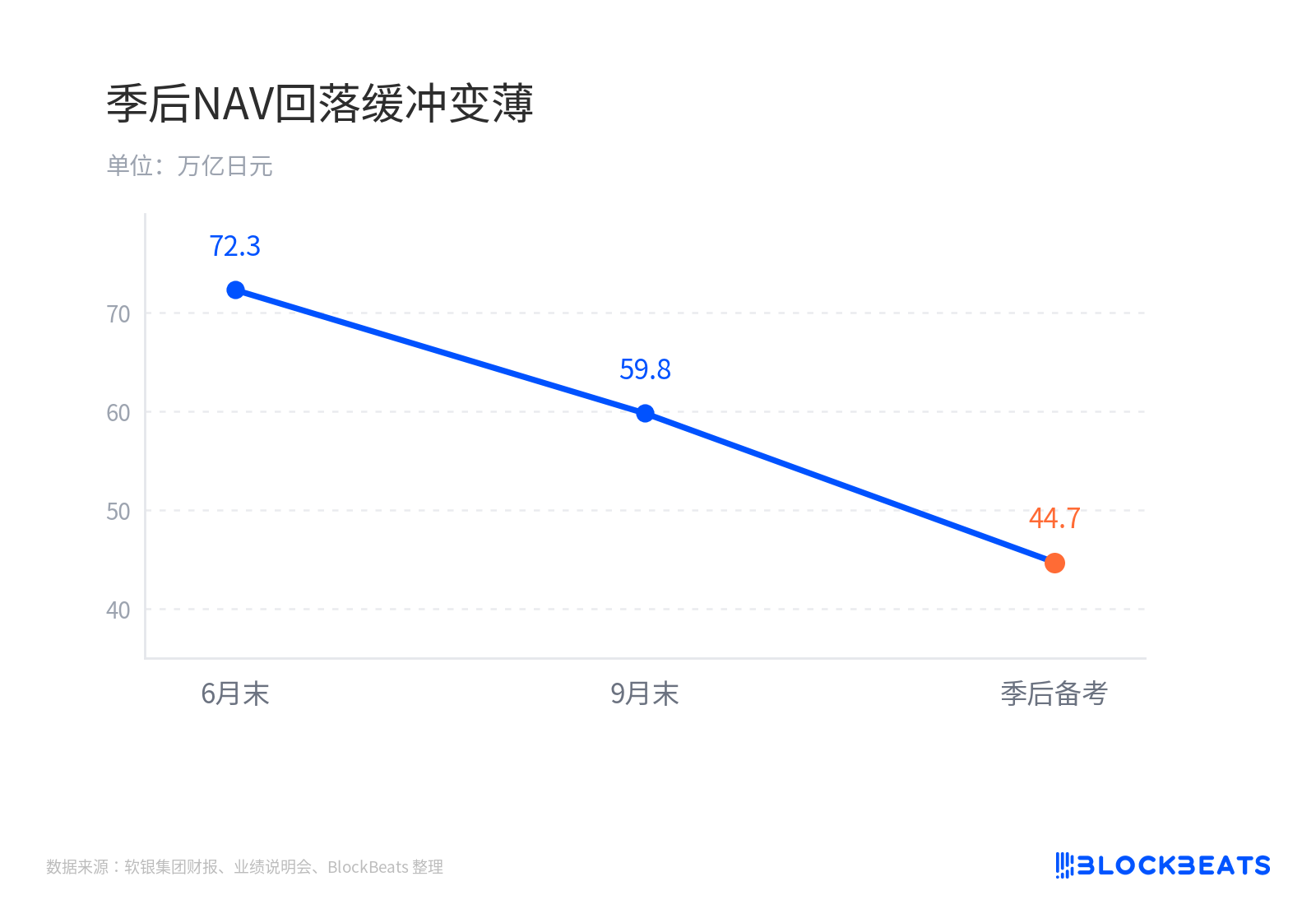
NAV at quarter-end was about ¥59.8 trillion (about $380 billion), and LTV was about 16%, still below the 25% policy line. But on the day of the briefing, as holdings' market value was marked down, NAV had already fallen to about ¥44.7 trillion.
Post-quarter NAV decline leaves a thinner buffer
The buffer is still there, just thinner. What the market is pricing is the premium that should be paid for holding these assets with leverage, not whether AI assets will go to zero.
Within the same group, the messaging is not consistent. Group CFO Yoshimitsu Goto said the project "has only just begun," will grow over 5 to 10 years, the U.S. midterm elections are not significantly linked to the project, and the LTV policy remains unchanged.
One day apart, CEO Junichi Miyakawa of the listed subsidiary SoftBank Corp. (9434, not group 9984) said U.S. politics and anti-data-center sentiment are "not particularly favorable for us," and new AI cloud builds in the U.S. may launch in other countries first. On the same day, this subsidiary raised its full-year net profit guidance to ¥610 billion, with cloud and AI revenue up 37% year on year.
There is also an external counterpoint. TSMC reported on the same day that October revenue rose 59.7% year on year, with the upstream still adding capacity, and the pressure more concentrated on developers funding projects with leverage. For SoftBank holders, the question has shifted from whether AI can succeed to whether this layer of leverage can hold out until returns are realized.
Leverage buffer thins, $2.1 billion rebate still hanging
Post-quarter NAV fell from ¥59.8 trillion to ¥44.7 trillion. Converted on the same basis, LTV would be closer to the red line than the 16% at quarter-end. The focus in the next earnings report is where this ratio settles and whether refinancing costs rise alongside it.
The equipment side also leaves a tail. About $6.6 billion in prepayments remain on the books, plus up to $2.1 billion in rebates not yet recorded, and whether they materialize depends on whether subsequent procurement is executed according to modified specifications.
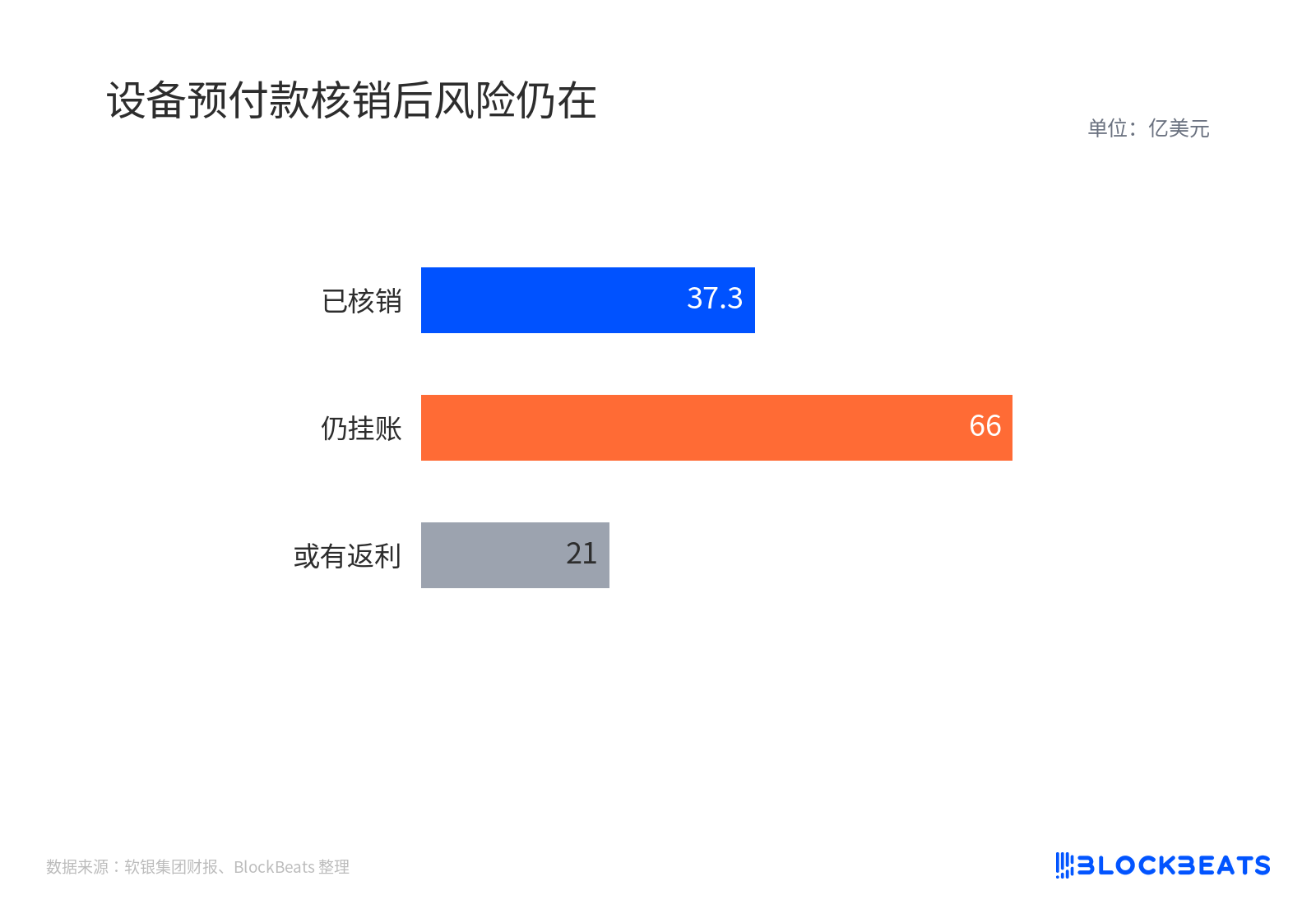
Risk remains after equipment prepayment write-offs
If multiple projects continue to change designs, such write-offs could recur.
Further down is the listing window for SB Energy, for which the market already expects a delay in the timetable. IPO pricing is both the valuation anchor for this infrastructure chain and the channel for SoftBank to recover cash. The 20-year leases in Ohio and other places are still in place; "leases in place, slow progress" and "lease cancellation" are two different kinds of bad news.
The huge loss this quarter proves that securing capacity requires paying sunk costs and adding leverage requires paying interest; it does not prove that the endgame for AI assets has been rewritten. The market has been deleveraging these proxy stocks since June, and the earnings report is confirmation, not the first alarm.
Welcome to join the official BlockBeats community:
Telegram Subscription Group: https://t.me/theblockbeats
Telegram Discussion Group: https://t.me/BlockBeats_App
Official Twitter Account: https://twitter.com/BlockBeatsAsia
 Related Articles