Starknet Considers Shift from L2 to Independent L1: The New Narrative Behind STRK's Rise
Original title: Starknet Price Forecast: STRK rally tests key breakout amid proposed Layer-1 transition
Original author: Vishal Dixit | FXStreet
Editor's note: On October 9, Starknet's native token STRK extended its rally. According to FXStreet, after rising about 13% the previous day, STRK gained another roughly 16% intraday, briefly breaking above $0.064 to hit an eight-month high. Since mid-August, STRK has rebounded nearly 200% in total. What has drawn market attention is not only the price breakout, but also a new idea proposed by StarkWare CEO Eli Ben-Sasson: exploring the possibility of transitioning Starknet from an Ethereum Layer 2 (L2) to an independent Layer 1 (L1).
The proposal touches on a long-standing problem facing the Ethereum L2 ecosystem. In the past, the main value of L2s was to reduce transaction costs and improve throughput while inheriting Ethereum's security. But as more and more scaling networks adopt similar technical approaches, relying solely on lower fees and higher performance has become increasingly difficult to form a clear differentiated positioning. If Starknet is no longer just an Ethereum scaling network, but becomes an independent public chain capable of autonomously upgrading its cryptographic security system, will its competitive logic also change accordingly?
Ben-Sasson's entry point is quantum security. With the development of quantum computing and AI technology, blockchain needs to reassess the long-term security of existing cryptographic systems. Starknet has already adopted ZK-STARK zero-knowledge proof technology and has laid out a post-quantum security roadmap. Under his proposed vision, an independent L1 could allow the network to avoid having to wait entirely for upgrades to Ethereum's underlying layer, thereby striving to achieve a more comprehensive quantum-resistant security goal by 2027.
However, the transition from L2 to L1 is still at the discussion stage and is not an approved technical migration. The original FXStreet article mainly analyzes STRK's price performance and technical trend after the news emerged. Combined with StarkWare's already published technical roadmap, the more noteworthy question is: as L2s face homogenized competition, can quantum security become Starknet's new differentiated advantage? Does the market's recent rally also reflect that investors have begun to reassess its long-term positioning?
The following is a compilation of the original text:
On October 9, Starknet (STRK) continued to climb. According to market analysis published by FXStreet that day, STRK recorded an intraday gain of about 16% after rising roughly 13% in the previous trading session, with its price breaking above $0.064 to reach an approximately eight-month high.
Since a low of about $0.02222 on August 18, STRK has rebounded by nearly 200% in cumulative terms. This rally not only pushed it past a long-term resistance zone but also redirected market attention toward Starknet's technical roadmap.
On October 8, StarkWare CEO Eli Ben-Sasson publicly discussed on social platform X the possibility of Starknet becoming an independent Layer 1, with one of the core goals being to enhance the protocol's ability to address future quantum computing threats.
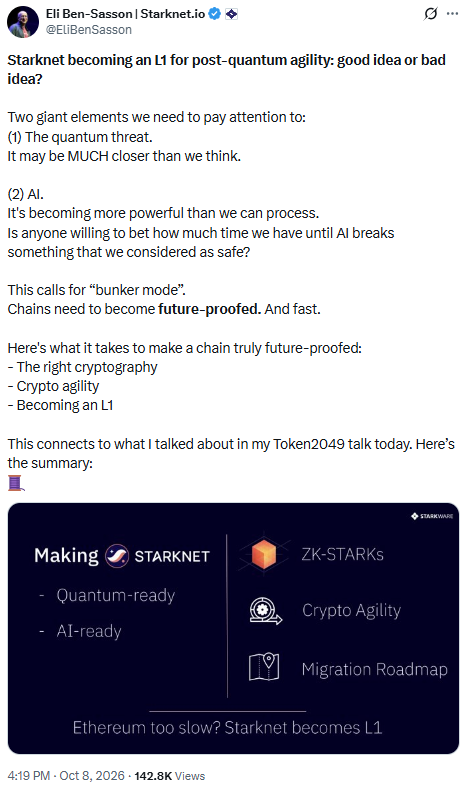
Related link: https://x.com/EliBenSasson/status/2108110129572741426
Starknet officially confirmed afterward that it is actively considering this direction and has set 2027 as its target timeline for achieving full quantum-resistant security.
For Starknet, which has long positioned itself within the Ethereum scaling ecosystem, this could mean a significant strategic adjustment. However, the discussion has not yet entered the formal implementation stage, and the transition still requires further technical validation and governance approval.
From Ethereum L2 to Independent L1, Why Is Starknet Considering a Change in Positioning?
Over the past few years, the main development logic of Ethereum Layer 2 has been relatively clear: use technologies such as Rollups to move large volumes of transactions off-chain or to Layer 2 networks for processing, then rely on Ethereum for settlement and security verification, thereby reducing transaction costs and improving processing efficiency.
Starknet is precisely a zero-knowledge proof scaling network that developed under this framework.
It verifies computational results through ZK-STARKs (Scalable Transparent Zero-Knowledge Proofs), improving transaction processing capacity while relying on the underlying security guarantees provided by Ethereum.
This architecture has brought Starknet clear advantages. The network does not need to build a completely independent underlying consensus and security system to support more complex applications and transaction activity.
But the trade-off is that some changes to the underlying security mechanisms need to be coordinated with Ethereum. For example, when future cryptographic technologies require upgrades, Starknet can adjust its own proof system, accounts, and signature mechanisms, but for the settlement and verification steps that depend on Ethereum, it still needs to take into account Ethereum's own upgrade progress.
This is precisely the important context behind Ben-Sasson's proposal of an independent L1 this time.
In public discussions, he pointed out that the potential threat of quantum computing may arrive earlier than expected, and the rapid development of AI also exposes cryptographic technologies to more uncertainty. Under such circumstances, whether a blockchain can quickly upgrade its own security architecture may become increasingly important.
If Starknet becomes an independent Layer 1, it is expected to gain greater autonomy in cryptographic upgrades and would not have to wait for Ethereum to complete corresponding adjustments in all key areas.
Therefore, what this proposal truly involves is not just a technical upgrade, but the relationship between Starknet and Ethereum.
In the past, Starknet positioned itself as leveraging Ethereum's security infrastructure to achieve high-performance scaling. In the future, if it shifts to an independent L1, it may need to establish its own security assurance system and redefine how it connects with the Ethereum ecosystem.
This means that what Starknet is discussing may no longer just be how to become a better Ethereum scaling network, but whether it needs to become a public chain with an independent security architecture.
Under homogeneous competition among L2s, can quantum security become a new differentiated advantage?
From the broader industry perspective, Starknet's transformation discussion also reflects the competitive pressure facing the Layer 2 ecosystem.
In the past, L2 projects usually competed around transaction speed, Gas fees, throughput, and ecosystem scale. But as more and more networks adopt Rollup architectures and related deployment technologies gradually mature, low cost and high throughput are no longer capabilities unique to a small number of projects. This has gradually extended long-term competition among L2s to other areas: developer ecosystem, liquidity, user scale, application scenarios, and whether underlying technologies can form a sustained differentiated advantage.
For Starknet, cryptographic technology may be one direction worth further development. In June this year, StarkWare released Starknet's post-quantum security roadmap, outlining the adjustments needed in its existing architecture to address future quantum computing threats.
So-called post-quantum cryptography refers to cryptographic techniques designed to resist attacks from future quantum computers with sufficient capability.
Some of the public-key cryptographic systems currently in widespread use rely on mathematical problems that are difficult for traditional computers to solve. Once sufficiently powerful quantum computers emerge in the future, these security assumptions may be challenged.
The ZK-STARK proof system used by Starknet mainly relies on hash functions rather than depending entirely on elliptic curve cryptography. Therefore, StarkWare believes that its existing technical architecture can provide certain advantages for post-quantum security upgrades.
But this does not mean Starknet already has comprehensive quantum-resistant security capabilities. Blockchain systems also involve multiple components such as account signatures, transaction verification, network consensus, and underlying settlement. The security of the entire system depends on whether these components can complete the corresponding upgrades.
From this perspective, the independent L1 concept is directly linked to the quantum security roadmap. If it continues as an Ethereum L2, part of Starknet's upgrade process will still be affected by the underlying network; if it becomes an independent L1, it may gain greater room for technical adjustments.
The timeline proposed by Ben-Sasson is 2027, earlier than the timetable he mentioned for Ethereum to achieve complete L1 quantum resistance upgrades by the end of 2029.
However, these are all planning targets and cannot be directly understood as Starknet having already taken a leading position in quantum-resistant security. More importantly, whether quantum security can become a true competitive advantage ultimately depends on whether the technology can be implemented, not on which public chain is the first to propose a timetable.
If Starknet can establish a complete, verifiable, and practically operational quantum-resistant security system, then its differentiated competitive logic may no longer be limited to scaling efficiency.
But at this stage, this is still a potential technical positioning rather than a commercial advantage that has already been validated by the market.
STRK surges over two days, is the market starting to trade the new L1 narrative?
After Ben-Sasson proposed the above concept, STRK's price performance further attracted market attention.
According to FXStreet market data on October 9, STRK rose about 16% intraday that day, extending the previous day's gain of about 13%, with its price briefly climbing above $0.064.
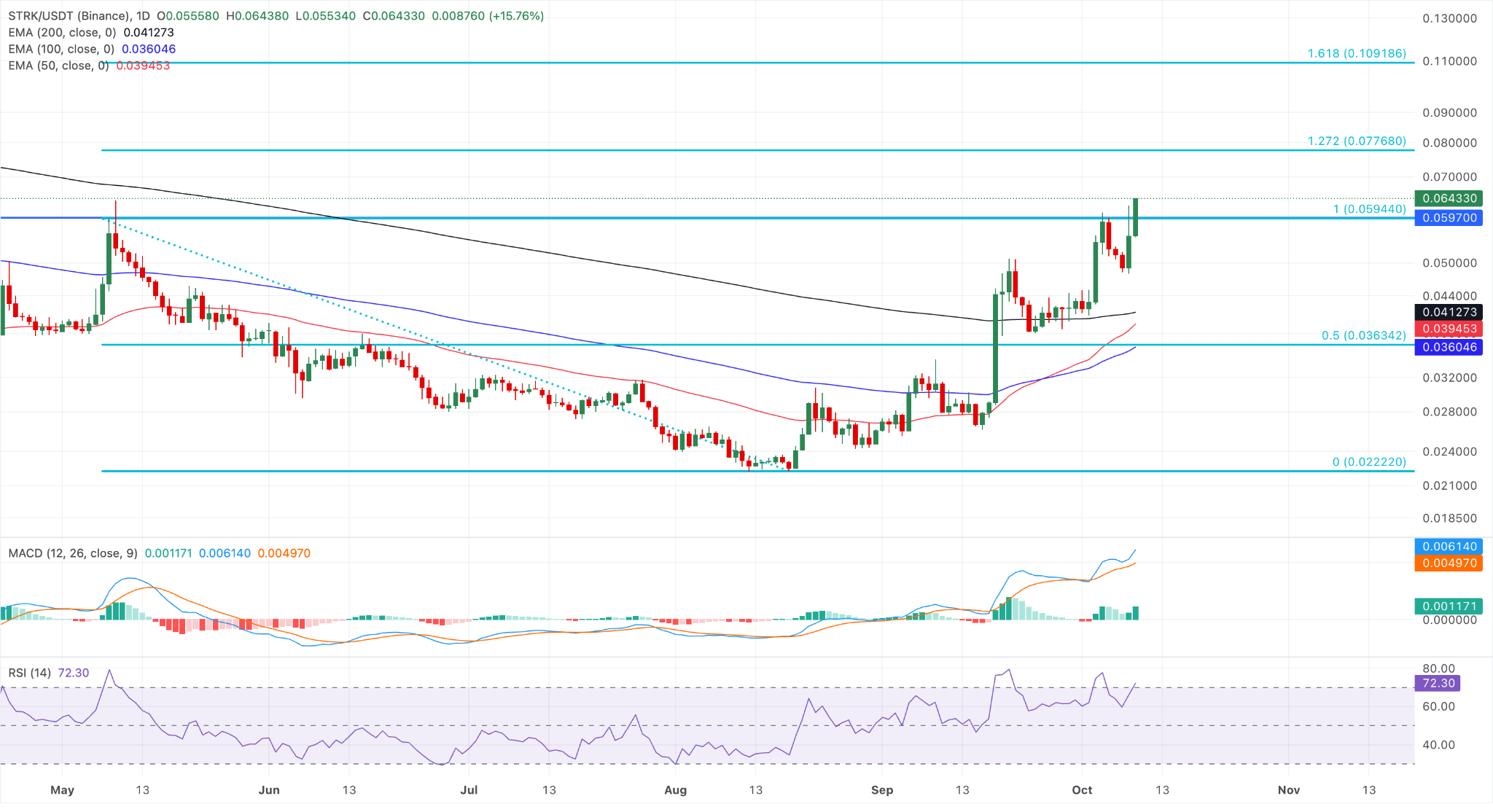
This level also means that STRK is breaking through a price resistance zone that had persisted for months.
In February and May of this year, STRK encountered resistance at around $0.05970 and $0.05944, respectively. As a result, $0.06 became the most important level to watch in the original technical analysis.
As of FXStreet's report, STRK was already trading above its 50-day, 100-day, and 200-day exponential moving averages (EMAs).
The report argues that this reflects an improving medium-term price trend for STRK. If it can hold above $0.06 going forward, the market may focus further on technical extension targets such as $0.07768 and $0.10918.
But short-term risks are also rising. The original article notes that STRK's Relative Strength Index (RSI) has climbed to about 72, entering territory typically viewed as overbought, meaning more pronounced price swings could follow the rapid rally.
More worthy of discussion than these technical indicators is why the market is starting to pay renewed attention to Starknet.
One possible explanation is that the independent L1 concept provides STRK with a new valuation narrative. Previously, investors mainly understood Starknet through its competitive position within the Ethereum scaling ecosystem: whether it could attract developers, gain liquidity, expand network usage, and establish an edge among the many Layer 2s.
If it truly pivots to an independent Layer 1 in the future, the market's focus could extend to another set of questions: Does Starknet possess unique underlying security technology? Can its cryptographic capabilities form a long-term competitive moat? And how would an independent architecture change STRK's economic value?
This narrative shift may explain part of the recent rise in market attention, but it cannot be directly concluded that investors have completed a long-term repricing of Starknet.
In particular, it is worth noting that STRK's rebound began as early as mid-August, while Ben-Sasson's related remarks were not made public until October 8. Therefore, the entire gain over the past nearly two months cannot be attributed to this new proposal.
More precisely, the Layer 1 transition discussion may have added a new catalyst to an existing rally, rather than being the sole explanation for the entire move.
Independent L1 Does Not Equal Higher Valuation—What to Watch Next?
Although Starknet's new vision has drawn market attention, there are still many issues to resolve in moving from technical discussion to actual implementation.
First, an independent Layer 1 means security responsibilities may change.
One important advantage of Layer 2 is the ability to leverage the underlying security mechanisms Ethereum has already established. If Starknet chooses to break away from the existing settlement architecture and instead build an independent consensus and security system, it will need to solve anew issues such as validator incentives, network security costs, data availability, and asset and information interaction between different networks. In other words, while gaining greater technical autonomy, it may also need to bear more infrastructure construction costs.
Second, becoming a Layer 1 will not automatically increase STRK's economic value.
For token investors, what really matters is whether changes in network architecture will affect token demand, fee mechanisms, staking yields, governance rights, and the protocol's ability to generate economic value over the long term. If an independent L1 only changes the technical architecture without increasing actual network usage or improving the token's value capture mechanism, then the new narrative may not be able to sustainably support valuation.
Finally, quantum security itself also needs to be verified through technology and practical application.
Starknet's post-quantum security roadmap has already been made public, but a complete upgrade involves multiple cryptographic modules, and no single technology can solve all the problems. Whether an independent L1 can truly significantly shorten the upgrade cycle still needs to be proven with more specific technical plans. Therefore, what the market needs to watch next is whether Starknet publishes a formal Layer 1 migration proposal, whether it launches a governance process, and whether the post-2027 quantum security goal can gain further technical support.
As for STRK's short-term price action, FXStreet believes that whether the area around $0.06 can turn into effective support remains an important technical signal. If the price pulls back, the areas around $0.05 and $0.04825 will become the next stage's observation zones.
These two types of signals correspond to different time dimensions: technical indicators reflect short-term trading sentiment, while the progress of network upgrades determines the longer-term value logic.
Starknet is trying to answer a question more important than the token price: when the performance advantages of Layer 2 become increasingly difficult to distinguish, can a public blockchain establish new competitive barriers through an independent security architecture and cryptographic capabilities?
Currently, the market has already begun pricing in this possibility. However, whether Starknet will truly transition from an Ethereum L2 to an independent L1, and whether quantum security can ultimately become a long-term advantage, still awaits verification through subsequent technological and governance developments.
Welcome to join the official BlockBeats community:
Telegram Subscription Group: https://t.me/theblockbeats
Telegram Discussion Group: https://t.me/BlockBeats_App
Official Twitter Account: https://twitter.com/BlockBeatsAsia