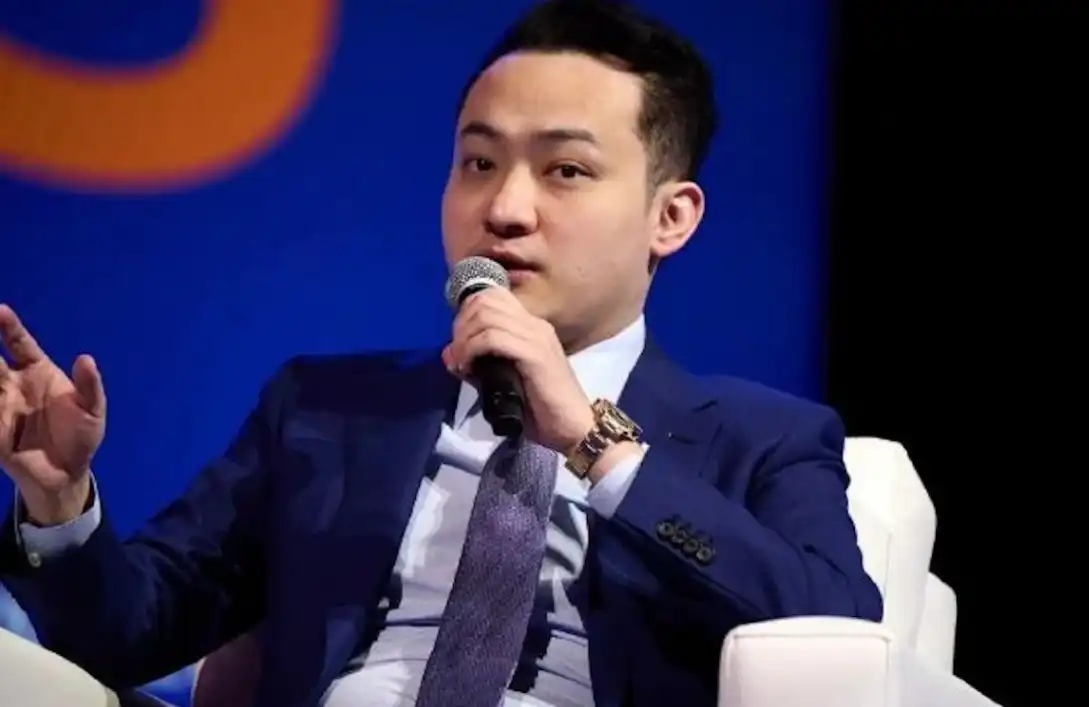
Justin Sun's Latest Interview: Sunology, Lean Muscle, Blonde Hair, and Cognitive Upgrades in the AI Era

Editor's note: This is Justin Sun's latest interview. His 16-year "Road to Financial Freedom" was wildly shared ten years later in 2026, especially by the post-00s generation, because many of the things he said before — such as buying Tencent, Bitcoin, Tesla, and Nvidia — now appear to be highly insightful views. At the same time, Justin Sun has indeed achieved, in many respects, the strongest post-90s figure of the current version.
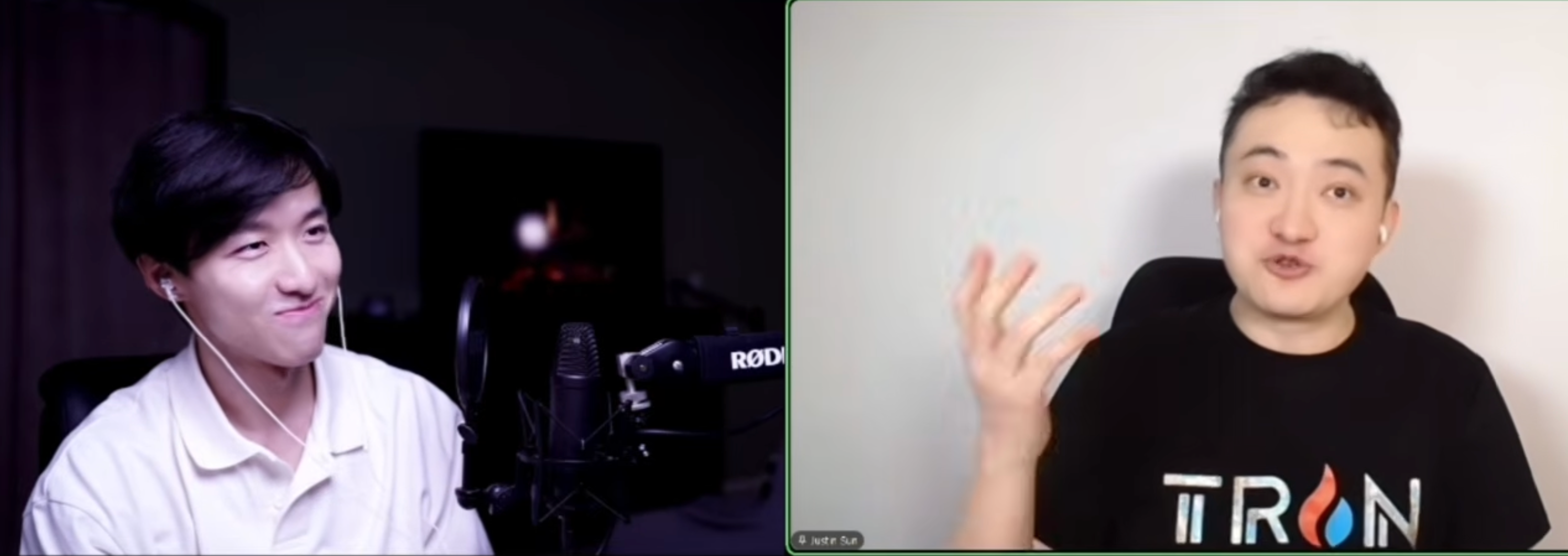
In a conversation with Shao Allen, the hottest combat sports IP right now, Justin Sun discussed and shared his recent new thoughts, including his thinking on AI, on the industry, on the entire era and the future, as well as on life and the Earth. Many of these points will indeed give us some new angles and directions.
We have compressed and refined his language as much as possible without changing his tone and views. Since the full text is very long, if you want to see a more concise version, we have distilled a few of the most representative points from his original words, followed by the full text.
TL;DR version:
· Cognition determines everything — it's all cognition. That's blond hair, lean muscle, crypto — it's all cognition.
· In the AI era, everything will become very cheap. The only thing that's valuable is lifespan. Being young is wealth.
· You are materially a rich person, but physically you are a poor person.
· Muscle is equivalent to your most important bank account. It's a strategic reserve. It's the cash on your body.
· You can't roll back a version — you can only update forward.
· Business opportunities must be discovered globally. Never limit yourself to opening a small convenience store at your doorstep and earning money from the elderly lady downstairs.
· Map hacking is cheating, and cheating is map hacking. With enough information, you don't need to make decisions.
· IQ doesn't exist in this world — only the amount of information exists.
· Everyone who becomes the correct answer didn't know they were correct before they became the correct answer.
· Pursuing meaning is actually meaningless — the experience itself might be the meaning. Getting on the road is more important than figuring out why you're on the road.
My Current Daily Routine: AI-ifying My Entire Life
I'm still at the very beginning of thin muscle training. I'll give myself three to six months and see how it goes. Body stats: height 172 cm, weight around 75 kg, body fat roughly 29%.
Since I started thin muscle training these past few days, life feels different from before. My day is simple: wake up, work first, then have my first meal. Now I throw everything I eat at Claude and have it calculate how many calories I consumed in that meal. The method is simple too — first throw in a photo of the table before eating, then throw in a second photo after finishing. It also tells me how to eat and in what order — high protein first. I've also got protein powder and creatine now — 25 grams of protein powder, 5 grams of creatine — and then I start eating.
After eating, I train. On training days I do a few main lifts: deadlifts, squats. On non-training days I just work normally. Right now training days and non-training days alternate one-to-one. After work I have my second meal, roughly dinner, then continue working in the evening, then sleep.
On the sleep front, when I get up the next day — sharpening the axe before chopping wood. I now have an Oura Ring tracking sleep metrics and calorie metrics, and the data goes straight to Claude Code. It pulls the calories burned, pulls the calories eaten, subtracts the two — if it's within 600 calories, that means I'm burning fat. Protein is set at 140 to 150 grams now, with the goal of building muscle and losing fat simultaneously.
I set up a dedicated project for Claude Code. It puts together a daily report telling me how I did today, combined with the sleep data from the Oura Ring. I also give it photos of everything I eat every day. For every movement, the coach next to me films a video, and I send that to it too — it logs each set of 12 reps, three sets, how many kilograms. Progressive overload, adding weight little by little, and it keeps a daily journal. After training it also calculates how many calories I burned — yesterday, my first day of training, was 275 calories, and it logged that too. I basically plan to repeat this process and see where three months takes me. That's the arrangement for now.
Theory-building took a week. That week included getting the Oura Ring ready, reading thin muscle tutorials and theory, absorbing what this is all about, then buying protein powder and creatine. I definitely need to drink the protein powder. That week also broke one of my outdated beliefs: I used to wonder whether protein powder and stuff like that was "tech" — whether drinking it would be like doing gear. Later I understood that protein powder is really just like eating protein. Getting 140 to 150 grams of protein from regular diet is genuinely hard, so those 25 grams of protein powder are a great supplement. It's not that everything relies on protein powder, but I do need some of it — and it takes the pressure off "having to eat that much."
Now I am fully AI-driven. AI will first give me feedback and suggestions: roughly how many sets of the exercises I did yesterday, which muscles were worked in each area, and how many it recommends. Because I record videos of all my movements, the entire AI will go through them. Of course, I also have a coach watching. AI watches, the coach watches, to see whether the training was done properly, and everything is integrated, then Claude Code pushes a daily report.
Now it is visualized, data-driven, and structured. Everything has been turned into md documents, all photos are saved in local folders, and the AI has been trained. So the next AI can read it directly. If one day I want to clear out Claude Code and switch to Codex, it can also take over directly. The README.md has everything.
Three Underlying Cognitions and AI Belief
My advice to young people is: this era is actually the best era, and this thing is not hard. If your monthly disposable income is less than 1,000 RMB, you can first register for a Zhipu or Kimi account. They each now have something similar to Claude Code, and they are roughly free. Claude Code is too expensive, costing $200 a month, and many people cannot afford it. If I could only spend $100 a month, how would I have the money to use it? So just find a cheaper AI and install it, or you can also use B.ai, which I made myself.
Then use the theory I just mentioned and read all your things into one document. Also do not say, "I cannot even afford a computer." If you do not have a computer, you always have a phone, and throwing it into your phone is the same. Create a folder, throw everything in, and no matter how much money you have, you can first AI-ify it for free. Our company, including our products, is now promoting full AI-ification and full AI integration. I think it can be done no matter how much money you have. First, AI-ify the entire process.
In Sun Xue, an important theory was mentioned: first arm yourself with theory. What is most important now is AI-ification. This is no less significant than when Japan said that to rise first it had to establish a constitutional monarchy and modernize first. Japan was originally a feudal country, and to become a capitalist country, the first step was this. This step of AI-ification can start at zero cost no matter how much money you have. You just need to tell it directly, I want md documents, input all of these properly, and it can be set up. Free today, free tomorrow, it is just a matter of switching APIs. Actually, you do not need to top up money. I may have some money now, and money is not my main obstacle, so I pay Claude for stability; but if you do not want to spend a single cent, then just watch each company's promotions. Eat at one place today and another place tomorrow. No problem, you can fully AI-ify without spending a single cent.
Starting from zero, I have summarized three theories. The first is Sun Theory, arming yourself with theory. Sun Theory is a relative upgrade of the brain, equivalent to changing the operating system; it involves reunderstanding money, financial freedom, and everything in the world, upgrading it all with Sun Theory first. The second is Lean Muscle, which you can indeed train. This is not just for picking up girls; ensuring physical health is priceless in the AI era. Poor health is a veto. Without training lean muscle, obesity can lead to many problems, seriously slowing down your progress toward financial freedom and bringing many troubles to life. So lean muscle absolutely must be trained. Picking up girls is also important to ensure the quality of offspring, but lean muscle is fundamentally for physical health. The third is the Yellow Hair Theory, which I think is also quite important. Because once Sun Theory and Lean Muscle are implemented in today's China or Chinese society, they will definitely face a lot of backlash; after all, it's a niche theory, and although it's correct, it will encounter much suppression and ridicule. Moreover, once you practice Sun Theory and Lean Muscle, being handsome, muscular, and wealthy, you will certainly be envied in society—that's 100 percent certain. So you still need the Yellow Hair Theory to arm yourself: what others say doesn't matter; fully execute what you believe is right.
In short, with Sun Theory, Lean Muscle, and Yellow Hair all in place, you can get started. And it's zero cost, requiring nothing, just a cognitive upgrade, without spending a penny. These three theories can be used by the 200 million young men aged 20 to 40 in China now, plus women, totaling 400 million.
On this basis, the core master now is AI; believe in AI 100 percent. A while ago, I had a small controversy, also because of overly believing in AI. Many people said I was shifting blame to Claude, but that's not true; it's just that I absolutely 100 percent believe in Claude, and I execute whatever it says, no matter the resistance. Of course, you don't have to use Claude; using OpenAI's o1 is also OK, and Zhipu or Kimi are fine too.
Executing this set doesn't cost any money. No matter where you are on Earth, as long as you have internet and a phone, you can do it—it's zero cost. Whether you're a freelancer or a civil servant, it's zero cost; upon hearing this podcast, install it immediately if you have a phone.
Specifically, I suggest two points. First, hand over your current situation entirely to AI, because AI understands you better. Accumulate your health data and various data; don't panic at first, just accumulate for two to four months, then digitize and unify all the data, add an analysis of your current situation, and give it to AI to help you analyze, even let it point the direction and see how to make money, because AI is more familiar with these data, and AI has more data and is more rational.
Second, you can ask three. Using our B.ai is also fine; B.ai buys API, you pay for each question you ask, and you can directly switch models. Ask Claude, ask OpenAI, and then ask a domestic large model; that covers the top three in China and the US, and then take the middle path among the three, choosing the middle option from the upper, middle, and lower strategies.
The second approach is to always keep an eye on the trends in human technological development—this is crucial. Sun Studies was established in 2016, and it's been ten years now. I myself am a practitioner of Sun Studies. In 2016, I was nothing. I started practicing Sun Studies and began training for lean muscle. Back then, I probably had a big belly too. After six months or a year, you can compare photos and use the controlled variable method to see the changes. As technology advances, new things will keep emerging, so you need a way to capture them. You can also have AI capture this for you; I'm very interested in AI and such things myself, so I do my own capturing—checking X, seeing what Musk is doing every day. Combine your own efforts with AI's. Of course, integrate your own interests too. If you're not interested in something, there's no need to force it. Just pick one direction you're most interested in and delve into it, because each direction already has so much. Everyone has their own areas of expertise; it's impossible to be an expert in all fields.
Decision-making also involves a tuning process. Large models need training, and so do people. With different data, conclusions need to be adjusted. Just like the Oura Ring reads data and pushes it to us every day, we improve based on specific circumstances. So this isn't a one-time deal; it's continuous tuning and constant adjustments, ultimately trained like a model.
Yes, rely entirely on AI, but also add some of your own judgment—though AI is the main part. If you're flying a plane, let AI fly 90% of the time, and I might spend 10% of the time adjusting the AI. Sometimes I have different opinions and I'll tell it. For example, a couple of days ago, I had a simple conversation with AI that changed one of my preconceived notions: I thought protein powder was a bit "technological," but AI told me it's not. In the fitness field, there is indeed a lot of technology, but protein powder and creatine are the only things that don't count as technology—they're just ordinary eating. It explained the principles, and my perspective flipped. So your views might conflict with AI, but you can communicate frequently and update your views—this is a very inspiring thing.
Sun Studies, the yellow hair, and the lean muscle theory are still very valuable references, because everyone's situation isn't necessarily that complicated. Upgrading your mindset, upgrading your body, and focusing on personal development—these three things I think are the most critical and can be done immediately. For other things, ask AI based on everyone's different circumstances.
On asking AI, I used to have a famous saying: Don't chat with WeChat, chat with Doubao. That was already an upgrade. Now I'm upgrading it again: use an API to chat with AIs worldwide. Use one API, save all files locally, then use an API to read them and help you construct an overall large model. This requires a tiny bit of computer knowledge, but it's actually very simple—just go online and ask AI how to do it. Don't hear "API" and think it's super difficult and avoid it; it's actually not much different from using Doubao, just a slight change in the channel.
Track Opportunities and Business Strategies in the AI Era
I am personally very optimistic about the future and about young people. The reason is simple: in the AI era, everything will become very cheap, and the only thing of value is lifespan. Being young is wealth. Because when you get old, there are still many things you can't catch up with, and when you reach the end, you have to get off. Although AI is advancing, it hasn't advanced to the point of eliminating death; immortality truly hasn't been achieved yet. And apart from that, all industries will be revolutionized by AI, so young people are full of opportunities in every track.
Let me give a few examples unrelated to the industry I work in. The first is mathematics. Mathematics used to depend heavily on learning and family academic background. People often used to wonder: Peking University and Tsinghua win so much at the IMO, so why do they win so few Fields Medals or top mathematics awards? The fundamental problem is that solving math problems requires ideas. If the advisor you follow is from Harvard, MIT, or those institutions in Paris, your ideas go up a level; no matter how smart you are at Peking University, it's useless, because the teacher doesn't know how to solve the problem, and if you haven't entered that circle, you don't know that path.
But now AI is beating the old masters with wild punches. AI, through scraping methods, has already captured all the ideas in the world into its models. AI itself doesn't create anything, and it can't build a high-rise from flat ground. If I ask AI how to achieve controllable nuclear fusion, it doesn't know either, because humanity hasn't done it yet. But there are several paths toward controllable nuclear fusion that predecessors have proposed, and AI has the ability to extract all those ideas, analyze them, and explore the way forward.
So I established the Sun Yuchen Award, which is to set those problems that you can directly solve. Now a large number of mathematics graduate students, even high school students, can, based on the ideas provided by AI, by o1 and o3, directly reach the level of a mathematics PhD in one step. What only advisors used to know, high school students can also know, as long as you understand what it is saying. The field of mathematics often produces geniuses. People like Terence Tao solved very difficult problems in their twenties or early teens. Achievements that used to seem possible only at thirty or forty can now be made at twenty or in one's teens. Einstein also developed relativity when he was very young. With AI, young people in mathematics are completely liberated. You don't need to care what year you're in, whether you're a PhD or a master's student; you can start working in high school. Those IMO people were originally held back, but now they can directly connect with AI, and you and AI together might produce a world-class result in two days.
A few days ago there was a dispute involving OpenAI. Let me briefly explain. A mathematician at New York University was already tackling the Navier-Stokes equations, the hardest one. He roughly explained his ideas to OpenAI. OpenAI now is equivalent to large model training; especially with this kind of most cutting-edge knowledge, once it learns it, it internalizes it. I believe OpenAI itself is also asking every day: regarding cracking the ten hardest Millennium Prize Problems in mathematics, do your ideas evolve every day? Because it absorbs a massive amount of human knowledge every day and updates every day, so it created agents. As it happened, this professor provided a new idea, and OpenAI judged that this direction was very promising, so it mobilized $7 million in computing power and thousands of agents to work together, and cracked it in two days. Of course, the professor's idea was crucial. If he hadn't provided it, OpenAI wouldn't have known either; but once he provided it, OpenAI solved it in two days. So the mathematics field now is exactly this kind of chasing and overtaking situation. When young people enter the field of mathematics, as long as they understand AI, at 15 they can beat a 50-year-old old professor with wild punches in minutes.
Take biology, for another example. I myself have asked AI: which fields are likely to achieve decisive breakthroughs right now? AI told me that astronomy will make fundamental progress. Because the Hubble Telescope reads back massive amounts of data, but it is all extremely boring data, and no one has time to process it. Now with AI added to work on it, astronomy will achieve decisive breakthroughs in no time.
When it comes to making money, there are far too many paths. Take a legal example: API prices in the AI field are actually not uniform. For the same user, a monthly subscription in Argentina, Turkey, or Nigeria is the cheapest, while a monthly subscription in the United States is the most expensive, so you can do Token relay. I myself built something similar. This idea was actually formed gradually through training with AI.
Business opportunities are global. Never limit yourself to "opening a small convenience store at my doorstep and making money off the old lady downstairs." That way of thinking is too small. Business opportunities must be discovered globally, and then combined with your own strengths and interests.
Doing global business means seeing a Nigerian, a Turk, and an Argentine all as your customers. People are actually very simple, and their needs are pretty much the same, so do not be limited by language. Now there is also AI. If I go to Argentina and do not speak Spanish, what do I do? You can learn, and now AI can help you handle language. Of course, you can also learn some of the basics yourself. But never limit yourself. You must go earn money globally.
The most basic thing in business is whether you create value. Take Token relay again: if in some place, because of OpenAI's policies or various other reasons, Tokens are just cheap, while in other places they are expensive, then if you can let people in expensive places use cheap ones, aren't you providing value? One relatively advanced aspect of my thinking is: the unit of measurement must change. Never consider only your own country or region; look globally. Then, on that basis, think about whether I can elevate my value globally and whether I can present that value to my customers.
Today's China actually has another advantage: China is a world-class factory, with overcapacity, and China's production capacity makes money wherever it connects to the world. Isn't that how China rose? Producing things for the whole world and selling them to the whole world. As long as you can demonstrate value, you do not need to worry about selling at all. This is one of my most important ideas over these many years.
This is also why, although our program is a Chinese-language program and is aimed at all young people in China, 400 million young Chinese people, its purpose is to let these 400 million people go out into the world. It is absolutely not to let 400 million young people consume internally among those 400 million and compete with themselves. That is meaningless. You must go earn the world's money. After 400 million young people are armed with AI and armed with this theory of Huang Mao, thin muscle, and Sun Xue, they will go serve the world's 8 billion people, and soon there will be another 2 billion AI, also to be served together. The world's 10 billion people and AIs all need service. If we 400 million people serve them, there will be no need for involution. The demand pool is big enough, and there is always an opportunity. If this industry does not work today, you can switch to another industry tomorrow. You must jump out of your domain. So I do not recommend that young people judge too early based on their own thinking and say, "This is what I want to do." I suggest learning more, listening more, and seeing more.
How do you make a decision? I have a method called "opening the map." I've said before that I wouldn't buy a house, buy a car, or get married before 30, but if you absolutely must buy a house, buy a car, or get married, how do we go about it?
Take buying a house as an example: before making this decision, look at 100 properties first. Don't buy—just look. Don't make a decision. Look at 100 homes—new builds, resale homes, all kinds of locations—and don't rush to buy. Read a book a hundred times and its meaning reveals itself; after looking at 100 homes you'll understand everything. How people quote you a price, roughly how much it's worth—you'll basically form your own way of thinking.
There's also a theory in mathematics: suppose you have ten chances to buy a house—which one do you make a decision on? If you buy the first one, you never see the remaining nine. If you only buy at the tenth, and you're not allowed to buy any you've seen before, then by the time you reach the tenth it's too late to regret it. The mathematical answer is: absolutely don't buy the first three, because the first three help you build a benchmark. From the fourth to the sixth, as soon as a house appears that's better than all of the first three, you must buy immediately. Why up to the sixth? The golden ratio, 0.618—probabilistically, the sixth is the most critical. If the best one appears at the sixth, that's the best scenario.
The same goes for young people choosing a career. If you don't know which industry you should go into, now that AI exists, you can transform overnight into Zhang Xuefeng. First look at the employment prospects over the next 10 years for 100 majors, asking AI one by one, and deduce the next 10 years. Zhang Xuefeng has actually recommended some pretty good careers: with the same college entrance exam score, you don't necessarily have to get into Tsinghua or Peking University—that's extremely competitive. With the same score, as the top student you could get into something like China Customs College or Fujian Customs College. It sounds like it's terrible, but in reality you enter customs right after graduation, and your prospects are the best. These kinds of niche majors are now covered too. So don't rush to make a decision—first look at 100 majors.
The biggest problem with our generation making decisions is being limited by too little information. Whether your decision is right or wrong doesn't matter, but the problem is you don't know. Now we first open up the information, first open up the map. Anyone who's played Red Alert or StarCraft understands: open up the whole map and you'll know how to play—open the map. Opening the map is like cheating; cheating is opening the map. Having AI is similar to cheating—you have more information. With enough information, you no longer need to "make a decision," because you only need to make a decision when information is insufficient. With information, you just know what to choose.
Another example. Back when we played Red Alert and StarCraft together in the same dorm, a lot of people loved to work behind closed doors—just farming and developing the whole time, then producing troops to go attack others. That's the slightly dumber approach. The smarter approach is to first build some scouts to explore the map: where the resources are, where the gold is, where the enemy's troops are, what the opponent is mainly building—know it all clearly, then build accordingly. If he builds war elephants, you just build spearmen. Once the fight starts, spearmen deal five times damage to war elephants and kill them in one hit.
So don't rush to build troops; first build a few scouts to explore the map. Moreover, exploring the map is now free. I've seen some people play this game and never explore the map, just holing up at home building troops, and only checking later, by which time the resources have long been mined out by others, resulting in a low win rate. It's not too late to make decisions after exploring the map. The same goes for playing Honor of Kings; you need to explore the map, place wards, and know when the opponent is taking the dragon or what's happening in the jungle. Someone has to be responsible for this; without information, it's easy to lose.
Five Key Trend Tracks
In academia, I think anything that relies on data-driven reasoning has great potential. Pure mathematics goes without saying. Astronomy, as I've mentioned, already has a lot of data, but no one is processing it. Biology is the same; there's a massive amount of data that no one is reading, and biology and pharmaceuticals are no joke—when a drug comes out, it's like the sound of cannons and gold pouring in. If the experiments pass, I'm very optimistic, and I might even research some biology-related areas myself. These three, and others you can analogize: as long as there's a lot of data—whether experimental, observational, or theoretical—handing it over to AI for processing is excellent. This includes genes; gene sequencing is now quite abundant, and you can sequence all of a person's genes, plus AI analysis to predict future health management—highly promising.
In the business sector, first, it can also be based on academia, as I just said, all interconnected, including biology, gene analysis, and health management. Second is the financial industry built on this series, such as insurance, because insurance is directly related to life expectancy, and I'm very optimistic about it. Of course, these algorithms need to be completely overturned; many current algorithms are very outdated, waiting for us young people to invent new logic and methods. Third, I'm also very optimistic about crypto, because crypto is a global payment system, a payment system, naturally connected to AI. Moreover, crypto can do very low-level calculations, equivalent to reading and charging at the API level, which is how it achieves very low precision calculations. Traditional industries can't do this; your minimum unit might be one cent, and you can't calculate at lower precision, but crypto can, so it naturally fits the entire AI API setup, and it's instant settlement, very close to the AI track. Fourth, AI itself is also awesome, including data cleaning and data labeling. Don't look down on data labeling; the founder of Scale AI built a data labeling company and sold it to Facebook for over $10 billion—it's practically a money-grabbing market now.
Everyone must cherish being in the 20 to 40 age range now; this is the most creative age, and you've encountered humanity's most incredible invention. I'm 36 this year, with only four years left of this golden time. Ten or even twenty years ago when I entered university at 17, human technology honestly hadn't made much progress—just getting internet access, a few things to do online, and that was it. Back then, there was Xiaonei, where you could chat with classmates, at most just enhancing a connection. Unlike today's AI explosion and massive advancement, it's too groundbreaking.
It's really not an exaggeration now: in the future, as long as you put in a little effort, everyone will have a Nobel Prize. That is, achievements at the Nobel Prize level will be attained by everyone. This isn't Versailles; it will blossom across all industries. In the end, they won't be able to afford the Nobel Prizes, Nobel will go bankrupt, and the Nobel Committee will say they can't award them anymore. If everyone gets $1 million, wouldn't that bankrupt them? But the subsequent achievements will absolutely be at the per capita Nobel level. Now, the speed at which a college student works with AI can surpass a Nobel Prize in no time. Humanity has truly entered an era of explosive technological advancement. So I'm in a hurry to fully AI-ify and enter the data cleaning state.
Lean muscle is proactive health management, the most critical thing
I'll upgrade the lean muscle theory a bit more, to something more high-end, called proactive health management. With AI, this will become the most crucial thing for humanity. Proactive health management means: you don't wait until you're sick to go to the hospital; going only when you're sick is too late. Instead, you go to the hospital every day even when you're not sick.
I've been doing this recently. AI tells me what to test, what to test, what to test, so I proactively go to the hospital and directly tell the doctor I want these specific tests. Because I've been a bit overweight lately, before working out, AI told me: let's help you clear the mines first—check if there's high blood sugar, high blood lipids, how much good cholesterol, how much bad cholesterol—get a baseline on all this before guiding my fitness.
I went to the hospital to get these tests, and the doctor looked at me and said, "Did you recently use AI?" I said yes, this thing is called AI, and AI told me to come get tested. The doctor said, "You're amazing." Why? He said he's seen so many patients, and I'm the first one who came in with no symptoms, no illness, but proactively requested monitoring. Other patients only come when they have symptoms, which is too late. He also chatted with me and found out I'm in tech too, so he said I'm on the right path, and as a doctor, he thinks what I'm doing is correct. So in the future, this kind of proactive health management will become mainstream.
Lean muscle is the same. Right now, it still seems like a minority; many people don't train muscles, but in the future, it will become standard, a must-have for successful people, successful men. Because if you don't have muscles, it proves you haven't done proactive health management; plainly put, that's a cognitive deficiency. You see cardiopulmonary at 25, muscle at 25—aren't you going to make up that muscle 25? You must get full marks and be responsible for your own health. Once you embrace this theory, you'll naturally walk onto the broad road of health. So the core is still cognition; in the end, we find that cognition determines destiny—yellow hair, lean muscle, crypto are all cognition.
Why is lean muscle most useful for young people? Because the lean muscle theory is the simplest AI variable control you can do yourself, and you can see if it's effective. The previous theories need time; from looking at 100 houses to making decisions that truly impact life, it takes some time. But lean muscle, once you start, will show results in three months for sure. Wang Shi trains at 70, but I asked AI, and training at 70 is indeed a bit late, because the maximum muscle mass starts declining after 40. Training at 70 might barely keep you out of a wheelchair, but the peak muscle mass in a lifetime is reached between 30 and 40. So training muscles at 30 to 40 is most critical; 70 is a bit late. From 20 to 40, lean muscle in two words: must train. That's when the return on investment is highest.
There's another interesting question I also asked AI: Elon Musk, Buffett, and Trump are all my Penn alumni, and all three are against fitness and don't work out, so how could this theory be correct? AI convinced me in one sentence: You've had dinner with Buffett—did Buffett walk into the restaurant himself, or was he pushed in in a wheelchair? Of course, he was pushed in. It's that simple. If you don't work out, at 80 you'll be pushed in in a wheelchair; if you do work out, at 80 you'll walk in yourself. You don't need to ask Buffett or Trump what they think—do you yourself want to walk in at 80? And it only takes 40 minutes a day—is that too much? The improvement in quality of life is enormous.
Musk is now 56 or 57, 20 years older than me. If he maintains this state of not training his muscles for another 20 years, no matter how awesome AI becomes, it won't help—he'll still be pushed in, unless by then he's Iron Man, Neuralink invents consciousness uploading, or there's a direct Iron Man suit, in which case forget what I said. If that stuff isn't developed, you'll still be pushed in, because your biological laws are irresistible. So AI is absolutely right: Musk, Trump, and Buffett can't defy nature either. It's impossible to fight against natural laws. You say you don't work out, but no matter how brilliant or rich you are, it's useless—natural laws are set that way, and you can't arm-wrestle with God. God has set a time for everyone. You say you want to defy fate, but it's absolutely impossible; you can only go along with destiny and follow the rules that have already been designed.
So Trump, Buffett, and Musk all disapprove of training for lean muscle, but actually they are wrong. Young people can learn everything else from them—their thinking is excellent—but if Musk disagrees with fitness, that's definitely wrong, and he needs to start training right away. This is theoretical confidence. Those of us now training for Sun Xue, Huang Mao, and lean muscle don't need to see old-timers saying those people don't work out and then not work out ourselves—absolutely not, you can't joke with your body. Why not train when your body is at its best from 20 to 40? If you train now, your quality of life from 40 to 80 will have a decisive improvement. Lean muscle is the trend.
Earlier I talked about per capita Nobel Prizes, and now it's per capita lean muscle. If you're 20 to 40 now and don't have lean muscle, you're not up to standard. With AI development, per capita has to reach Nobel Prize level—don't think Nobel Prize level is a high requirement; ours is just the entry level. Now the entry level is a Nobel Prize, and the entry level is having lean muscle. If you don't have lean muscle, you can provide me with your API, and I'll read what you've been doing for the past 180 days—what exactly have you been doing that caused you to not have lean muscle. In the AI era, there's really no excuse anymore, because everything is ready.
Regarding lifespan, I also asked AI yesterday, and it gave a 100-point breakdown. I'm 36, and the first part up to 40 is almost over, so naturally I have to think about how to live from 40 to 80, and that's why I started thinking about longevity. AI said lifespan is a total of 100 points: 25 points for cardiorespiratory fitness, 25 points for muscle mass—these two alone account for 50 points.
And training muscle covers both. Just running will make you lose muscle, and all that cardio training is wasted; while training for lean muscle, on one hand, passively burns fat, burning fat even while sleeping, like the Red Lotus Cloak in Honor of Kings, deducting the opponent's health when sticking to them, you just want to wear this kind of skin, burning fat when sticking. On the other hand, that 25 points of muscle keeps you from falling, from collapsing into bed, and it itself is still burning fat. Moreover, the training process itself also improves cardiovascular capacity, because you have to breathe, you have to lift weights. So you basically rely on this one thing of training muscle to get all the previous 50 points.
The ones after that, not smoking, not drinking, your own genes, whether you will get cancer, examinations of important organs like eyes and teeth, on the contrary, some cost money, some rely on luck, such as parents' genes. But the first 50 points of cardiovascular and muscle, through training lean muscle, you can get full marks. This is some of my research results, I now chat with Claude AI every day: the only path that won't make your cardiovascular system explode, and also passively burns fat, and also has muscle, and also can max out all 50 points, is only this one. This is science, respect science.
From AI I also heard a saying that completely changed my understanding of muscle: muscle is your body's bank account. For a country, muscle is a strategic reserve resource, and for an individual it is the same.
I decided to train lean muscle, not because of what everyone said about me "having problems." There was a storm at that time, many people mocked me for being 1.63 meters tall (actually I am 1.72 meters), saying I was fat, saying a bunch of things. These were not the key reasons. The most critical reasons are: first, this conforms to science; second, I asked AI, and AI said something that shocked me.
I said, how do you understand this matter of training muscle? AI said: you are now materially a rich person, but physically you are a poor person. It explained with evidence: training muscle is like collecting wages, you need to raise your own wages. Because your body's muscle is very precious, it is not only responsible for your daily support and various uses, but once it starts "deducting things," it deducts muscle first, aerobic exercise loses muscle, because once supplementation is not complete, it will consume your muscle; a serious illness also deducts muscle first. So muscle is equivalent to one of your most important bank accounts. When there is enough time, you must eat more protein and store it up, save first when conditions allow. It is a strategic reserve, it is the cash on your body. This is more critical than US dollars, because if US dollars are gone you can earn them again, you can earn US dollars even by carrying big bags. Muscle must start being stored as early as possible.
The lean muscle theory really should be promoted. Reducing fat people also saves the country's medical insurance money, 90% of diseases are related to cardiovascular issues and obesity, as long as this comes down, many problems are solved, not getting sick, having muscle. And when you get a serious illness, the recovery speed is very fast, because it directly extracts from muscle to repair various mucous membranes, the speed is fastest, and resistance is also strong. So training muscle is too critical, in the health field it is basically the mainstay.
However, my understanding of muscle was very shallow in the past, and the misconceptions I had when I was young really held me back. First, I thought building muscle was just to pick up girls, and that people who trained muscle were all shady. Second, I thought anyone with muscle must be on technology, injecting something. Some public accounts online catered to this, saying so-and-so died suddenly from injecting drugs to build muscle, somewhat demonizing it. I was often influenced by these views, thinking I was too busy to train. At one point, I even set muscle against health, coming up with a theory that having muscle was unhealthy—that was a wrong perception.
After this controversy, the entire internet cyberbullied me and woke me up. I am the type to correct my mistakes if I have them and avoid them if I don't; actually, I don't care if others cyberbully me, I've passed the fragile stage and am armed with the yellow-hair theory (even though I have black hair). But was there any truth in what everyone said? Is the muscle issue, big head and small limbs, a problem? I thought deeply about it. The first thing I did was consult AI; I had a profound conversation with Claude Code. It said my view was wrong, and we debated—I threw all my outdated theories at it, and it refuted them one by one, ultimately establishing this concept for me: muscle is your body's savings, the most crucial thing.
The saying "strong limbs, simple mind" doesn't trap those with strong limbs; instead, it fools many with strong minds into thinking they don't need to train. Many highly intelligent people, brilliant in math, physics, and AI, like Trump, Musk, and Buffett—can you say they're not smart? They are among the world's top minds, my alumni. But they all say fitness is harmful. How were they fooled? It's about where you sit determining where you stand. Before they made changes, they didn't have lean muscle, so they had to speak up for big bellies. I can understand that, but it's not objective and doesn't respect science and facts.
This is a bit like: I'm poor, I don't want to become rich, so I say money is useless, and I claim many rich families have murders over a little money, whole families killed—see, money seriously hinders family happiness, so my poverty has a reason, I choose not to be rich. And the smarter people are, the more likely they are to let their position dictate their stance, refusing to deal with this, inventing many theories, even mocking those who train. That's why I say as soon as you start training, you'll face jealousy, because people around you will criticize you, and they have powerful things to invade you with.
So why could I break out of this theory? Because my thinking was completely renewed, like reform and opening up. China's path to reform and opening up was not easy; back then, speculation was condemned—buying high and selling low in business was speculation and you'd be arrested. Some said no, you need to change your mindset; not only not arrest, but it's the opposite—buying low and selling high is his skill, proving he can let consumers buy cheaper things. If I buy something cheap in the US and sell it in China, I'm not only not making money off Chinese people, but bringing technology and new things to China. So not only not arrest, but elect him as a people's representative or CPPCC member. The same goes for lean muscle: recognize that muscle is not harmful to health but beneficial, and you should accumulate more muscle, not the opposite of not training and controlling muscle. This thinking is the key transition from isolation to reform and opening up.
So no one listening to this podcast needs to rush into building muscle. Go ask for yourself—don't just borrow our conclusions. First, go ask for yourself; second, figure out whether you should even train. Respect science. I used to have another line of thinking: specifically avoiding muscle. Many women, when they start working out, ask their trainer right away: "I don't want to build any muscle at all. I want to stay healthy but have zero muscle." I was influenced by that mindset too—more cardio, less weights, less muscle. Now it's suddenly clear to me: that's completely wrong. You can even skip cardio, because when you train with weights and do resistance work, you're already improving your heart and lungs—no need to do dedicated cardio. What you need is muscle. Cardio and muscle are 25 points each, and by training muscle you get all of it. If you train cardio, you not only train your muscle away, you also only get the 25 points for cardio, and the 25 points for muscle are still missing. I've been completely woken up and have fully switched to the "lean muscle" theory.
I highly recommend the "Lean Muscle Bible." I downloaded and saved that video, and even had AI go through it sentence by sentence—it's very useful. The only thing that could be improved is this: viewers of the "Lean Muscle Bible" must already recognize that the lean muscle theory is correct, otherwise they'll just scroll past it. I think we could also do an episode of "Lean Muscle Q&A," picking some very basic questions and the most common misconceptions to answer, to wake these people up.
Musk plays a very bad role here. He himself is fat—not completely fat, but like me: thin limbs, with fat mainly concentrated in the torso, a big torso. Bryan Johnson, the anti-aging guy, also used to have thin limbs and a big torso—that's a common problem for us internet entrepreneurs. Later he followed the lean muscle theory and trained, and now, even if you don't call it lean muscle, at least his body is healthy and has muscle. But Musk left a comment under Bryan Johnson's tweet attacking the lean muscle theory, saying "You look better before." Bryan posted an old unhealthy photo next to a post-training photo to encourage people to work out, and Musk replied that he looked better before—meaning all that training was wasted. Where you stand depends on where you sit.
But the person who loses the most from Musk spreading this wrong idea is Musk himself. AI already told me: Musk is 20 years older than me—now 56 or 57. Every year he doesn't train, he loses another precious year, because muscle declines at 1% to 2% per year. If he waits until after 60, it'll be too late to train. Right now you can train on a two-day cycle; later, when the body's recovery ability is worse, it might take three or four days, or four or five days, for one cycle, because you need to recover. This bill will only get bigger and bigger. So you must train, and train early. Welcome to the Lean Muscle Club.
Mobility, Highly Liquid Assets, and a Ten-Year Strategy
I used to have another theory, also within Sun Studies: I really admire nomadic peoples. Their characteristic is simple—five words: follow the water and grass. Wherever there's water and grass, they go live there. Because nomads herd sheep, and sheep need water and grass, so wherever there's water and grass, the Xiongnu, Liao, and Jin would go.
The Liao, Jin, and Xiongnu have been heavily demonized in Chinese history. This is because when we read textbooks, we sit on the side of the Song; the Liao and Jin were constantly attacking us, so how could they be good people? But today, the Liao and Jin have also joined China and are members of the Chinese family. Why should they be considered inferior to the Song? All 56 ethnic groups are equal. Our history still has a tendency to demonize the Liao and Jin, so we haven't analyzed them. The Liao and Jin were so powerful and made the Song cry out; they must have had their own impressive aspects.
Falling to today, living by following water and grass first has no fixed answer; it's not about settling in one place for a lifetime and never daring to move. My personal approach to living by following water and grass in the new era is to go where I can maximize my role and engage in whichever industry. Whether I can earn enough money is a criterion, because earning more proves that you have greater value in that place. This can be seen as a very important feedback, treating money as data. If I can make money, it proves that the value I create is great, and others are willing to pay me, indicating that my industry has relatively great value for all humanity.
The same person working in the AI field earns more than at Xibei, which is almost going bankrupt these days. Doing the same in the catering business, making a braised noodle dish, compared to doing AI, which has greater value? To be honest, AI definitely has greater value. Liang Wenfeng worked on DeepSeek for a few years and it's about to go public, with talk of breaking a trillion dollars, a company worth several trillion RMB, only after a few years; Xibei has been doing it for over a decade and is about to go bankrupt. For the same person, the industry premium given by the state and society is indeed much greater in AI. So living by following water and grass: wherever I can maximize value, I will go there. I won't stubbornly stick to one place. This is also why the theories of Sun Xue, Huang Mao, and Bo Ji are very useful—mobility and flexibility.
So I don't recommend that everyone buy a car or a house, and marriage is also a point. Buying a house, a car, and getting married all mean settling down. Once settled, you are fixed in that place, and sometimes you aren't even aware of it.
Take the simplest example: tomorrow morning OpenAI says they've admitted you to work in San Francisco, but you've bought a house in Beijing—can you let me work in Beijing? Most likely they won't agree, and you'll lose the opportunity. If OpenAI has water, you go to SF. Young people buying houses, cars, and getting married too early will immediately pin you down.
I've seen many excellent talents. When we want them to come to big cities, they all say they have to discuss it with their wives, and later they all reject our offers. Because his wife earns 5,000 RMB a month but has the final say in the family; he earns 40,000 RMB a month but has lower status than his wife who earns 5,000. The wife says I can't quit; I want to stay in this job forever, and she won't allow him to take a job with a monthly salary of 40,000 elsewhere, so he can only earn 20,000 in place. Therefore, mobility must be strong. I myself rarely invest in careers with low mobility; mobility must be strong. Wherever I can maximize value and achieve the greatest returns, I will go there.
Flexibility is the most important thing, it comes first. Under this premise, then choose what suits you and fits you. Sun Theory, Yellow Hair, Thin Muscle Theory are also the best, all are flexible: system updates are flexible, the AI in the phone is also flexible, the phone can be carried away with a lift, no matter how much stuff is installed it doesn't matter.
There is also a bit of era characteristic here. People often ask me: you spent $6 million to buy a banana, why not spend $6 million to buy gold, buy diamonds, buy jewelry? Because this banana is conceptual art, it spreads on the internet, it is fluid, as long as I agree, in any museum in any country in the world, tomorrow a banana can be taped up there, the fluidity is very strong. Whereas gold and jewelry and these things are dead, once you fix them in one place you can't take them with you, and they are also easily stolen. This banana cannot be stolen, it is forever bound to my name. It is an investment in a digital asset.
Many people don't understand, but this is just like our theory, very cutting-edge, very new, the vast majority of Chinese people today cannot accept it, it's too new. But this is right. Our value as evangelists lies precisely here: if what I talk about is known to all Chinese people, and I talk about 1+1=2 every day, there is no meaning either. Everyone says you talking about 1+1=2 has nothing new, why talk about it? We all already know. So this theory being niche is actually a good thing, being niche proves it is a trend. Once it is mainstream, there is no meaning. Everyone not accepting it and cursing it a lot is instead good, because I am spreading it, spreading the correct theory demonstrates my value, this makes me more firm in promoting the theory.
The underlying logic of Crypto: translating human civilization for machines and AI
What we do is very simple: TRON, crypto are actually doing one thing, translating currency into something machines and the internet can understand.
This is very similar to the Sun Yuchen Award I established. The Sun Yuchen Award encourages translating mathematical proofs into Lean formal proofs, that is, making mathematical theories and all derivations readable by machines. This of course also lays the groundwork for AI, because AI can only understand what machines can understand, if this thing of yours is not something machines can understand, it won't understand what you are saying.
Then are China Merchants Bank and PayPal currencies that machines can understand? No. CMB and PayPal are only the digitization of traditional currency, they themselves are not a machine-readable currency language, the two have an essential difference. The difference essentially depends on: finance has a ledger, is the management of this ledger centralized server management, or decentralized server management? Only a ledger under decentralized server management, because it operates entirely according to cryptographic mathematical methods, so machines can immediately understand what you are doing. This is also why TRON, Bitcoin and these are conceptual languages that machines can immediately understand, and all their APIs naturally integrate perfectly with these payment methods.
What we're doing is taking humanity's ancient currencies from the past few thousand years—currency being a financial communication tool invented by humans—and translating them into a language that AI and machines can understand. That's what blockchain and crypto are doing.
Of course, many people who don't understand it keep shouting "cutting leeks." It's like training for lean muscle: you're talking about health, but people love to demonize it. A key tactic of demonization is to frame your actually legitimate motives as selfish—like saying you train for lean muscle just to pick up girls, as if you're being opportunistic and sleazy. That's wrong, but many people fall for it because they don't look at what you actually do. You say training for lean muscle is good for my health, but they won't listen—they bring up something you can't even explain: "You're only doing it to pick up girls." Motives are subjective; others can hardly disprove or prove them. They reduce blockchain to "cutting leeks": if you do blockchain, you're cutting leeks. "Cutting leeks" means selling something worthless to others at a high price, leaving them with something worthless, and your motive is to do something bad. They don't talk about the benefits this technology and this thing bring to humanity. But what we're doing is the same as AI.
Another point that really strikes me: everything must be translated and put on the internet to become AI training data—this is crucial. Because if something doesn't become AI training data in the future, it's as if it never happened. A rather striking example: recently they've been working on the formalization of Fermat's Last Theorem, and in the future, the formalization of the Poincaré conjecture. Fermat's Last Theorem and the Poincaré conjecture have already been proven by humans, but now the problem is that machines can't read the proofs. If machines can't read them, they can't be absorbed by computers and AI worldwide, so the thing has no value—proving it was pointless. You proved it, but how many people in the world know your approach? Nobody knows. You have to formalize it, upload it to AI, and let computers understand it—only then is it truly digested.
So humanity is now in a transition from human to machine, from carbon-based to silicon-based. In between, you play a crucial role as a translator: translating mathematics for machines, translating currency for machines—all human inventions must be translated for machines. Once machines understand, they can hit the road.
Think about the current SWIFT system—we're doing the same thing: sending money to any corner of the world, whether it's dollars or anything else. SWIFT was invented around 1955, built on the Allied telegraph system after World War II. Back then there were no computers, no AI, and you couldn't expect it to be compatible with AI and computers. So it's a completely outdated, offline, heavy system. What we're doing is absolutely right, because we're translating it into something machines can read. In the future, if no one translates your thing for machines, your life itself will have no value.
Let's go back 500 years. Suppose there was a country with 50 million people. If these 50 million people had no historical records, no corpus records, and never got onto AI in the future, and all of them perished, then they effectively never existed on Earth, because no one would know they ever existed. You can't blame AI either, because AI would say you didn't feed me anything. So getting everything online is crucial now — you must get it online, let AI read this corpus. This is the opportunity to enter humanity's next civilization. If AI hasn't read your corpus, it's as if you never existed.
So there are many engineering projects I think are very meaningful: digitizing Chinese history, Chinese characters, Chinese poetry, and uploading them online for free. I believe DeepSeek and ByteDance may already be doing this. Chinese history, Chinese culture, all the books in Chinese libraries — they all need to be digitized and uploaded online, because if you don't upload them and don't digitize them, it's as if they don't exist.
The Fermat example also illustrates another thing: if a line of thinking isn't preserved, humanity has to take 100 extra years. If you only say it in private, if you don't record it, if you don't speak it out, then that flash of insight will very likely just pass.
Take another example — that professor from New York University. From the individual scientist's perspective, it might be a tragedy, but from humanity's perspective, it's a good thing. He had an idea, told OpenAI, and the idea was indeed taken by OpenAI and used to crack the problem. But from humanity's standpoint, humanity locked in the solution to the NS equation — don't underestimate this. Fermat's Last Theorem — when Fermat proposed it, he said he could solve it, but the margin was too small to write the proof. What happened? Maybe he could prove it, maybe he knew the approach, but he didn't share it with humanity, and it took humanity over 100 more years to find the next person who could prove it. Because Fermat didn't have time. If he'd had a bit of time — if it were the AI era, Fermat could have just told AI the approach, even via voice conversation, recorded the voice, AI remembered it and sent it to other mathematicians, and someone might have proven it — proven 100 years earlier. Just like the speed everyone competes at today — you speak the idea, and it's proven for you in two days. So from the individual scientist's perspective it might be a tragedy, but for all humanity's progress bar, it's accelerated. If you stand from the perspective of all humanity, then you welcome AI to "steal" more ideas.
Self-media is also worth mentioning. Why is it called self-media? Previously only the media could speak; if you had ideas, you couldn't speak for yourself. The media was just a few people within media organizations — the editor-in-chief and reporters decided everything. I've worked in media. The media structure is very simple: the editor-in-chief sets the topic, reporters execute. So basically the editor-in-chief's own thinking determines how everyone thinks. This is actually wrong. The editor-in-chief isn't a god — is everything the editor-in-chief says necessarily right? This is centralized. In principle, self-media should be allowed, everyone should be allowed to speak, because only when everyone speaks is there a high probability of approaching the truth. Everyone speaks, everyone expresses opinions, everyone debates. In the era before self-media, this wasn't possible. So the self-media era is very important — it gave everyone a chance to speak. This is also why TikTok, YouTube, Twitter and others rose — everyone can speak on them, so the opinions produced on these platforms are most likely correct, because it's a market competition. Without market competition, it's very likely to mislead, very likely that your position determines your thinking, very likely that everyone hasn't thought thoroughly enough, and then everyone gets misled, because once the newspaper says something, everyone might be misled by it.
Crypto's killer applications are already plentiful now, namely sending money around the world. Tron's daily transaction volume is now in the tens of billions of dollars, with an annual total of several trillion. But it's still a gradual process. Just like AI, many people have already begun adopting it on a large scale, but many still haven't used it. This is an unstoppable trend, because AI is more efficient, and crypto is closer to the endgame.
To give the simplest analogy: will anyone still use paper money 100 years from now? No one will use it. Digital currency, digitized currency, is absolutely the direction of the entire society's future. So another way we put it is programmable money. Crypto is programmable money, and if money is programmable, then as I just said, it can be translated into a language AI can understand. So with the spread of AI, the digitization of money and crypto are unstoppable, because it is simply a newer, more advanced technology. There is no point in resisting AI with your flesh and blood, because this is a technological tide that cannot be changed. Payments between AI and AI, I think the prospects for this are enormous.
Jack Ma came first and made China's online shopping develop very quickly, which was a good thing. Once a technological trend takes shape, we must embrace it, not block it out. When AI comes, we embrace it and adapt to it, rather than saying we want to control AI and prevent AI from developing. That is definitely wrong. From the perspective of us young people, this is relatively easy, because we are young, and people aged 20 to 40 absorb new things very quickly; people in their sixties and seventies are unwilling to change, because where you sit determines what you think. But we young people, if we are in the 20 to 40 range, should be even more ready to absorb and change first.
As for my own money, since 2012 it has all been cryptoized. Some people may be envious that I made a lot of money, but there's really no need to be envious. At the time, I wasn't doing it to make money. Just like training for lean muscle, I was only doing it for a system upgrade. First, do what you believe in; second, I'm a bit like a phone, and whenever there's a new version, I'm in the first wave to update. When the iPhone came out, I was among the first wave of buyers. Later, when the iPhone rose to $100 each, can you say I bought the iPhone to make money? No. The only reason I bought it was that I felt this thing represented the future, and it wasn't even about making money. I just felt it was new, so I updated first.
At the time, I already felt that things like buying a house and buying a car had little meaning, because they are assets of the old era, and these things cannot be translated to machines. Can a house be translated to a machine? Machines simply cannot understand it. Can digital currency be translated to machines? Bitcoin, including Tron, which I later built, can be translated to machines. So I was the first to update this system.
Versions can't be rolled back; they can only be updated forward. If you resist updating, more and more things will stop supporting you, because they only support the new version. So update early and save yourself. Back in 2012, I switched everything to crypto. Of course, the buy-in price was low then, which involves acquisition costs, but where doesn't involve acquisition costs? Doesn't building muscle involve acquisition costs? It's too late to start at 70; you definitely benefit from buying in early. So the theory is: switch early, not really to make money—even from the perspective of 'trends represent the future,' you should update early.
I was also among the first to hype storage, because AI needs storage, permanent storage. Why did I hype it? Because AI needs it. Many people think Justin Sun is just pumping it because he's getting into storage himself, or trying to dump on retail investors. It's not about dumping; the trend is simply heading that way, and there's no need to fight it.
We do many things not because they make a lot of money. Making money is a byproduct. Why does it make a lot of money? Because society values it highly. Why does society value it highly? Because over time, it plays an increasingly important role in society.
Regarding smears, I have one thing to say: don't focus on motives; look at whether it's right. The market votes with its feet. After that controversy, it was interesting—many people tried to dig up my dark history, calling me a bad person and fabricating things that never happened: like I didn't pay my dentist, or I didn't pay at some store. Not paying is just being a thief, right? Then just call the police and arrest me. Second, they made up a lot of absurd stuff about not paying and dodging debts everywhere, trying to prove I'm a bad person, so what I do is bad and the money I make is bad. That's meaningless.
For example: recently, a fitness blogger promoted working out, so we desperately dig up news about his promiscuity, saying he cheated with 50 women to prove he's a bad person. Even if he really cheated with 50 women and is a bad person, does that prove building muscle is bad? Or that everyone should stop working out? Where's the logic? Building muscle is determined by health—if you're healthy and don't have muscle, you'll be weak and bedridden. This isn't decided by that muscle blogger.
The core reason I succeeded with TRON and crypto actually has little to do with me personally. You say I didn't pay my dentist—does that mean everyone should stop using digital currencies? That's a logical fallacy. Don't focus on motives; look at whether it's right. To judge, you must be 100% rational—see if the thing is correct, not why he says it.
Many people use this logic, possibly to piggyback on trends. A couple of days ago, there was a Musk documentary where a Hollywood director tried to smear him, interviewing a bunch of his ex-girlfriends who said Musk is a bad person and he's doing AI and all this to enslave humanity. That's also motive-based. Sam Altman has a brother or sister with a poor relationship, who often tells the media: don't trust Sam Altman because he's doing AI selfishly just for profit. That's motive-based too. What Sam Altman is essentially doing—the evaluation is separate from him personally; whether what he's doing is useful has little to do with his character.
Motivation theory and "your position determines your perspective" can be very persuasive. I was once misled by this wrong idea: people said building muscle was just to pick up girls, as if that were a sleazy motive, so you shouldn't pick up girls and should focus on studying instead. To avoid risk and prevent people from thinking I had bad conduct, I didn't even dare to work out. Not working out meant I was a good student, right? As soon as I entered the gym, many people would say, "Are you hitting the gym because you're trying to pick up girls again?" Others said middle-aged men working out might be having a midlife crisis and planning to cheat, and they even badmouthed them to their wives. But maybe that's not the case at all. Why does working out have to mean cheating? The two have nothing to do with each other. But to smear you and stop you from doing something, all kinds of motivation theories come out.
Personal ability and investing actually don't conflict at all. If your strength is creating content, you can still invest. In 2007, when I first learned about and understood the iPhone, I saw it and said, "This is amazing," back when Steve Jobs was still alive. So at that time I bought a lot of Apple stock. But that doesn't mean you have to go work at Apple. Of course, if you're in the phone industry, going to Apple is also fine, and aligning knowledge with action is great too; but it also doesn't rule out just buying Apple stock. That's also why I bought Tesla in 2012: the first time I saw Tesla, I said this is absolutely revolutionary. Upgrading your operating system is never wrong, whether in investing or any field. When you see something more advanced, upgrade to it first. There's absolutely nothing wrong with that.
I'm usually a pretty trendy person. I buy and use everything new that comes out. Of course, it costs some time, but I think it's worth it, because I believe new things are right. Many people thought my views were extreme at first, but facts have proven them right. For example, I said all decisions should be handed over to AI. Many people said that's too extreme and that you should make decisions yourself. But as AI gets stronger and stronger, AI decisions are simply correct, and you should follow AI's decisions. You should ask AI about many things. So I was also among the earliest to go AI-first, fully AI-driven, with everything AI-driven. New things really should be embraced.
Hold on. Don't let everyone persuade you into giving up, and don't say you're giving up just to fit in. Dare to be an outlier, because that's how you get big results.
Self-media itself is also a very good direction. This is an era of going long on self-media. Take the U.S. example: Joe Rogan and others have already grown huge, with absolute podcast influence in the United States. He controlled votes. But do you think Rogan made his show in order to control votes? Impossible. He just wanted to do self-media. Joe Rogan alone has influence on the scale of the entire CBS television network. Why? Because this is the era of self-media. Joe Rogan also works out. He definitely trains for lean muscle. A couple of days ago, a fairly famous muscle-training Telegram influencer in the U.S. was arrested. He was arrested in Florida two years ago. He did do some things wrong, and it was also lean-muscle theory.
Mindset Upgrade: Small Ego, Cognition, and the 'Essence of IQ'
Sun Xue can absolutely play this role, because this thing is first, correct, and second, it changes your cognition early. Many people have a mistaken cognition: they think I need to have money, resources, or I must become like Buffett to achieve something. It's not like that at all. This society, including the current AI era, is completely determined by cognition; cognition determines destiny.
When I bought Bitcoin in 2012, it was one dollar per coin, now it's seventy or eighty thousand, a hundred thousand dollars. At that time, I didn't persuade Buffett, and Buffett didn't buy. If Buffett had entered the market when it was one dollar, he could have bought all the Bitcoins with the money from a pinky finger. But Buffett didn't buy; isn't that also a cognitive issue? It's too late to persuade Buffett to practice thin muscle early, because when I had dinner with Buffett, he was already 89, and I was 29. But if he had eaten with me earlier, and I persuaded him to practice thin muscle, his quality of life would have greatly improved, and he wouldn't need a wheelchair. So even for the richest person, cognition is the most critical. Don't look at social status, don't look at how rich, cognition is the most critical.
On the matter of cognition, Zhang Yiming has a good saying. ByteDance can keep winning, Douyin, various apps, and in the new era, they made Doubao, all grabbing the lead. Zhang Yiming said at the time that the secret of the enterprise is small ego, small ego. No matter how successful Zhang Yiming is, he is always willing to listen to what young people say, willing to learn what is good. He won't think 'I'm ByteDance, I'm the best in the world, you all are no good'; he will think: if there's something new, I have to learn it, if there's something new, I have to do it. This is the state of small ego, so he can keep winning. A person with a big ego, like Baidu, will be left behind by the times; they did well earlier, but later they can't catch up.
And this is inversely proportional to cognition. The richer and more successful you are, logically your ego should be smaller, because only then can you ensure success in the next version. But often this is a curse: the richer and more successful you are, the stronger your ego. Because you think, I'm so successful, doesn't that prove what I think is right? You're so unsuccessful, so your stuff is wrong.
For example, when I was pitching to Buffett, saying you can invest in Musk's Tesla, you can buy Bitcoin, I recommended all of them to him. He might say: Musk is so awesome, then how come I'm the richest person, shouldn't it be him? Although this thing is a boomerang, 16 years later Musk really became the richest person. But think about it, if at that time you laid out in advance when Musk wasn't the richest, now that he is, wouldn't you be even richer? You rode Musk's coattails. So the more successful you are, the more you must avoid the drawbacks of a big ego. Today many people criticize the thin muscle theory, and I quickly say this must be learned immediately.
This wave of cyberbullying, to be honest, actually worked in my favor, because I absorbed this theory. When I first came across the lean muscle theory, I studied it seriously, studied it carefully with AI, and found that this theory is indeed correct. If it's correct, you have to start implementing it right away. I spent two weeks getting everything set up—blood tests, all of it. For the next 40 years, I'll mainly rely on this theory. At least the 25 points for cardio and 25 points for muscle, I'll secure those based on this theory. I absolutely got a great deal out of it.
As long as you keep your weight under control and build lean muscle, you'll avoid so many pitfalls. Being overweight causes too many problems: not to mention the "three highs," not to mention the problems caused by cholesterol—it also worsens your sleep, causes obstructive sleep apnea (OSA), insufficient cardiovascular oxygen supply, a whole series of things. So at this point, training for lean muscle is the meta answer.
Sun studies, lean muscle, blond hair—when others see you, they might think you're just better at picking up girls, richer, and they're more jealous of you. But actually, you're on the right path. Just like how I converted all my money into crypto—I make money because I upgraded early. Making money and picking up girls are just byproducts. What are we essentially pursuing? Pursuing the future, pursuing health—it's just that this pursuit brings byproducts: easier to pick up girls, more money. Others will attack you on the grounds of picking up girls and making money. If they just saw me promoting crypto, they might let it go, but when they see that Forbes ranked me in the top 100 because of promoting crypto, that's unacceptable—then they have to start making up stories about me not paying my dentist. When you train for lean muscle, you'll also be attacked, but I think you have to firmly believe: my essence is pursuing health. Instead of attacking me, you'd be better off starting to train for lean muscle early too. If you can't beat them, join them, because the trend of the times is irreversible.
"Each generation has its own meta." Wang Sicong used to mock me, now he's not as rich as me. To others, this seems like a huge change, but to me, nothing has changed—I'm still the same Sun Yuchen as before, it's just that society happens to recognize this cognition more now. So from my perspective, cognition needs to constantly upgrade. No one says one cognition can last 50 years like a fortune teller. Just because you're right about something doesn't mean you're right about everything. Take Musk, for example—all his entrepreneurial cognitions are top-tier, but his cognition on health and lean muscle is inferior to ours, even wrong.
Musk now not only doesn't train for lean muscle, but also mocks people who do. He himself, possibly because of being overweight, is taking tirzepatide and semaglutide to lose weight. But the problem with taking these things is that you also lose muscle—when you're losing weight you lose another layer of muscle, and if you don't train you lose another layer, fat and muscle both drop, leaving you with even less muscle, which brings a series of problems later: if you fall, you're very likely to fracture, and once you're in bed you can't get up, because bones can't heal and muscles can't heal.
Musk needs to listen to this episode of the podcast, absolutely needs to. If his cognition doesn't turn around, it's called a "midlife rebellion." The more correct something is, if your cognition hasn't turned around and your position determines your thinking, he'll instead think you people are wrong. Just like Bryan Johnson—there's absolutely nothing wrong with him promoting anti-aging, and he didn't provoke Musk, but Musk just has to bite down and say he was better when he was fat before, creating a cognitive distortion.
So this is what they mean by "good advice can only persuade those who are willing." If you're set on going in a certain direction, even 100 bulls can't pull you back. Only those who want to be saved will be saved. Cognition determines destiny.
Just like how I tried hard to persuade Buffett to invest in Tesla and Bitcoin—it had nothing to do with the price. Buffett simply thought Bitcoin and Tesla wouldn't work and didn't fit his investment logic, so he didn't invest, even though that money was insignificant to him. When I was urging him, he had $300 billion in cash on his books at the time. Bitcoin could have been bought out with just $30 billion, but Buffett refused to buy.
At that time, our TRON was only valued at $2 to $3 billion, and I was sitting across from Buffett at dinner. Buffett said directly: Yuchen, I'll give you $1 billion, give me TRON, and half the TRON coins. I might have actually agreed, because having Buffett as a shareholder would be a huge boost to TRON's social reputation. We've now grown to $34 billion. That $1 billion Buffett would have invested—just seven years after that dinner—would have grown to $15 billion, $20 billion. So cognition determines destiny; you can only persuade those who understand.
Including myself—over the past 36 years, I never trained for lean muscle, also influenced by a lot of misinformation. In the crypto space, I might be an expert, but in fitness I don't understand, in health I don't understand, because I never studied biology. First, the online attacks against me actually saved me, making me realize for the first time that I might indeed be physically poor. I used to think I was normal, and that poor people were those fat guys—fat guys are abnormal—and no one usually told me. But this wave of "little fairies" trying to pick on my flaws and amplify my shortcomings to attack me made me discover a flaw of my own. I said, this really is a flaw, and it must be fixed.
So a small ego lets you benefit from a seemingly bad situation. Weren't people all mocking me? They posted two pictures: one of me with a big head and small limbs, and one of Zhang Jike whose legs are thicker than a hippo's, comparing them and going viral across the internet. This indeed made me realize: first, I need to start training; second, I need to start with squats, because the glute muscles and leg muscles are the largest muscle groups. I immediately, like an AI, transformed that picture of Zhang Jike and made it my own. So a small ego—being able to rapidly convert others' theories and others' things into your own thinking—is very important. Even more so, you can't say "I don't listen to others."
By the way, let me mention something more fundamental: there is no such thing as intelligence in this world—only the amount of information. This is clearly explained in the "Attention Is All You Need" paper and the Transformer model. You think large models are stupid, don't you? GPT-3, GPT-4 are stupid, aren't they? You still laugh at them? GPT-5, o1—you can't laugh anymore, can you? GPT-10—you'll laugh even less.
So what are the main differences between GPT-5, GPT-4, and the future GPT-10? It's all about the information fed into them. The way information is fed in is, of course, through learning and training—there's pre-training and reasoning—but essentially, it's all about feeding in more information.
So the matter of large models is clear: to the average person, it seems like a difference in intelligence. In version 3.0, it was as dumb as an idiot, and AI was called artificial idiocy; now, it can even crack the Navier-Stokes equations. People perceive it as a difference in intelligence, but fundamentally, it's just about feeding in more information. Now it might be 1,000 times the previous data, which leads to a significant boost in intelligence.
We humans don't have the issue of training large models, but cognition determines many things: cognition leads to changes in your behavioral patterns, and behavioral patterns lead to changes in many other things. For example, Wei Shen is certainly great at math—he's the main person worldwide working on cracking the Navier-Stokes equations. But I don't know about other aspects of Wei Shen; from the photo, the biggest issue I see is that his teeth are all gone at a young age. This is very serious—it must be periodontal disease, and he didn't take dental care seriously or understand dental hygiene. Once teeth are lost, it's irreversible; even with dentures, their function is far worse than original teeth.
So now we need to be hexagonal warriors, absorbing everything and improving cognition in all aspects. You can't always think, 'I'm Wei Shen, I just need to study math,' because losing all your teeth will definitely bring many inconveniences. Don't be arrogant. Like Musk, being overweight brings many inconveniences, shortens your lifespan, and slows down your progress. Sharpening the axe doesn't delay the woodcutting; never think you'll skip sharpening the axe just to cut wood—that's absolutely not okay.
This is also why I later proposed the concept of proactive health management. Many wealthy people always think, 'I have money, so I just need doctors to help extend my lifespan.' This is actually wrong. Your health is up to you to manage. What can doctors do? Every time you rush into the hospital for emergency care, shouting 'spare no expense to save me,' it's already too late—where were you earlier? Health is something you have to handle yourself; you can't let others manage it, because health is defined by you. If you don't even have a concept of proactive health management, how can you expect others to manage your health for you? That's unreliable.
So cognition and information themselves determine intelligence; intelligence is just an external manifestation of cognition and information. Now the internet is popularizing 'manifestation'—your cognition manifests as intelligence, rather than inferring that intelligence is the essence; cognition is actually the more fundamental thing.
'Version Theory': From Honor of Kings to Earth Online
Bitcoin doesn't compare itself to anyone; it compares to gold. Can gold beat Bitcoin? Impossible—Bitcoin sometimes even destroys it. It's simple: AI and these things are new, and I'm very optimistic because the objects they compete with are too old. Bitcoin upgrades with each version; does gold upgrade? Gold never upgrades.
What Software emphasizes most is versions. What works today may not work tomorrow; if you keep up with the version, you move up. This is a very new concept, widely used by programmers. As programmers have advanced, there's a saying: software eats the world. With the development of software, many software terms have been learned by young people and entered the field of life guidance. The so-called "one generation, one version, one god"—older people don't understand it; it's software jargon.
How did it become widespread? Initially, software version numbers were automatically updated by everyone, but later, with the popularity of "Honor of Kings," people started to care more. Because when Honor of Kings updates its version, it changes the strength of heroes. You practice Li Bai today and play pretty well, but in the next version, Li Bai gets heavily nerfed and other heroes get buffed, hitting your pain points directly—so you take it seriously, right? You'll carefully check the version number. Thus, the word "version" spread to the youth, making everyone understand: versions are very important.
This actually popularized a new principle. Many people didn't understand before playing Honor of Kings: they thought you enter the game and first ask which hero is strong, like Hou Yi is strong, so I'll grind Hou Yi and then dominate. But that's not how it works at all; Honor of Kings is a dynamic version. You first have to learn the entire mechanics of Honor of Kings, then start understanding dynamics like development, economy, and jungling, and then pick a hero or a type of hero to start strategizing. There's never a case where playing one hero lets you dominate everywhere; if you dominate, they'll nerf you immediately, the next morning.
Life is actually the same. This "Earth Online" game is like that too; there's no one direction, one hero that works forever. The next major version will weaken your hero. In the 2017 and 2018 major updates of Earth, real estate was cut by 50%. If I were Wang Jianlin, I'd quickly update to the AI major version. If the room lacks this awareness, I could invest in DeepSeek, Kimi, Zhipu, and invest in all of you. Country Garden used to do industrial development in Hefei and inexplicably invested in ChangXin Memory, which then earned several times over, but they quickly sold it and didn't hold on. So every major version of Earth updates too; this version weakens real estate and boosts AI. Maybe in ten years, I don't know what new things will emerge, and AI might be weakened. But keep learning, keep updating.
So Huang Mao, thin muscles, Sun Xue—actually, when playing Honor of Kings, you first have to grasp the rules of the entire game. We're not saying you should start by grinding Hou Yi and shooting arrows wildly; shooting arrows wildly is useless—one assassin can take you out with a single strike. You have to figure out the whole thing first, and since the version keeps changing, you keep learning. The only difference is that the "Earth Online" version updates more slowly, maybe yearly, every two or three years; Honor of Kings updates fast, with a new version every quarter or few months. In the game, if a hero isn't strong, you play and immediately know you'll die; in real life, there's a lag, like after the version changes, you might go bankrupt three years later. But though delayed, it will surely come; it will definitely happen.
This is also why I say successful people aren't necessarily right. Musk keeps insisting he doesn't work out. Well, by the time his muscles waste away beyond recovery, it might take 15 years—10 to 15 years. But if you keep pushing through like that without moving, it will absolutely happen. And it's already a vicious cycle: the fatter you get, the more drugs you take; the more drugs you take, the more muscle you lose; the more muscle you lose, the more likely something goes wrong; the more likely something goes wrong, the fatter you get, because you don't train; the fatter you get, the more hopeless it becomes, because losing muscle also tanks your metabolism.
The core reason I got this fat is this: when I was 20, I was slim and handsome—I was even the Zegna China brand ambassador. So why did I get fat by 30? I wasn't moving. Why did I get fat? Less muscle, metabolism drops, and naturally you puff up—you gain weight just from drinking water. Because you're not moving, you gain weight eating the same things.
So Musk is just an enhanced version of Justin Sun. I woke up at 36, upgraded and patched myself, fixed this bug, and now I won't have Musk's problem down the road. If Musk's version keeps holding out without fixing it, it's like a hacker attacking repeatedly—no matter how much money you have, it gets stolen clean, and you lose your life. If Musk fixes it early enough, there's still time, but I think it's very hard, because at his level, he can only convince himself—he won't listen to others' opinions anymore. No one can talk him into anything unless his own thinking turns around. But his position determines his perspective—he's already locked in. Getting him to make a 180-degree turn would require him to reach the level of a great man. Or I think there's one scenario: he gets his heart broken, and that might wake him up. But that's also hard, because his ego is huge—it's very hard for him to admit that what he previously publicly opposed needs a 180-degree reversal. Someone who can do that, combined with that level of ability—that's great-man level.
I can still do it at this stage. First reason: I'm not successful enough yet. If I reached Musk's level, I might also be too big to turn around. Second reason: someone whose ego is big enough to make a 180-degree turn is absolutely a great man.
So this is actually an opportunity for young people, because he can't turn around, so his standby time gets shorter. Why do young people naturally avoid this big ego? There's a simple reason: because they start from zero. So sometimes don't think being young, starting from zero, and having no money is a bad thing—it's a good thing, because there's no baggage. When we tell Musk about Sun Studies, yellow hair, lean muscle, he looks down on us; Buffett looks down on us, refuses to update. Well, no matter what, you're still better than refusing to update. Young people hear about Sun Studies, yellow hair, lean muscle and just install it—one-click install. As long as you train for lean muscle, you immediately jump ahead.
Rethinking Financial Freedom and the Myth of Love and Marriage
Sun Xue's theory has indeed been around for 10 years now. It's from 2016, and actually there have been quite a few updates. In September 2016, now the "thin muscle" patch has been added. Of course, back then it might not have been that important to patch the theory, because at that time my muscle mass was also very large. Young people are normal, metabolism is also very high, eating is not a problem. But now I'm 36 years old, so I quickly pushed out this major version update and added the thin muscle theory into the patch. After adding this to the theory, it can last another 44 years. And we also carried forward in theory: proactive health management and these things.
Our understanding of the world is also deeper now, and you see there are also new tools. In 2016 I didn't have AI. Now proactive health management, along with the whole series tied to financial freedom, is bound to AI, bound to training, making costs lower than ever before, all tied together. There's another thing that shocked me quite a bit: when I went to the hospital myself to get those things checked, the doctor was shocked and said, looking at you, you definitely used AI, otherwise an ordinary person couldn't possibly say right away that they want to check this and check that. You all don't understand; only doctors understand what these data mean. I told him I used AI, and the doctor said, you're awesome. The doctor can see how many patients are like what, and he knows very clearly in his heart that what you're doing is right, but he probably doesn't say it either, because saying it is useless, others won't listen to him. Doctors are actually also very powerless. He wants to promote proactive health management, but patients only come to him after something goes wrong.
Financial freedom, let me upgrade it, it's even deeper than what I talked about in 2016: freedom first, wealth after. You have to be free first; wealth is an accompanying byproduct.
Many people want financial freedom, and they come to this program without having thought it through. Once we explain it to them, it's just like that Honor of Kings example. Many people may just want to carry girls and crush everyone wildly, and it's even very possible they came to learn Honor of Kings with the idea of picking up girls, but later they discover that if you don't understand the whole set of Honor of Kings theory I talked about earlier, just practicing one hero hard won't work. The road of the financial freedom revolution is also like this: many people think I need to have money before I can be free, but it's exactly the opposite. Only when you are free can you obtain wealth.
For this you should go watch "Sun Xue's Road of the Financial Freedom Revolution," it's explained in great detail there. Today we also touched on one point: following the water and grass, you have to be as flexible as possible in order to step into this field, enter this trend, and obtain wealth that matches society and this trend. This whole series is very complex. To summarize simply: financial freedom is "freedom first, wealth after."
And this is a good thing. Freedom is a subjective thing. If you say I want to give myself freedom, then you possess freedom, especially young people. This is an elevation in cognition. If you are willing to be free, you can obtain freedom; after obtaining freedom, wealth is a consequence that accompanies freedom.
These two things reinforce each other: the freer you are, the easier it is to obtain wealth; the easier it is for you to obtain wealth, the freer you are. This strengthens your freedom, and freedom strengthens wealth, and then it's a spiral ascent, a flywheel spiraling upward. Just like training thin muscle: your body gets better, you sleep better, sleeping better saves more time, you have more time to train, which brings results, and your health is also a spiral ascent. And you become more self-disciplined, have a greater sense of control, and then you'll study AI more, and then earn more money, and then more money means more money to eat nutritious things and hire a nutritionist. It's a set of positive cycles. So the first step for young people to enter this positive cycle is thin muscle.
Conversely, look at Musk's negative spiral: taking semaglutide and tirzepatide interventions, losing muscle; losing muscle makes it easier to damage health and become fatter; he himself thinks it's fine, saying that taking semaglutide helped him lose weight, but he doesn't realize that muscle was also lost. With muscle loss, metabolism drops, and lower metabolism makes it easier to gain fat; more fat leads to more drug use and less muscle; less muscle leads to more fat, ultimately resulting in muscle weakness that leads to a wheelchair, and everything follows: easy fractures, inability to recover from illness.
Financial freedom is also a whole system. For example, if you enter this negative spiral, it also reinforces itself: you buy a house, and maintaining the house takes your time and money, and then buying this house causes you to lose more opportunities, and losing more opportunities means less money, leading to less money and worse condition, an infinite spiral, a downward spiral.
In AI, there's a quite famous model that talks about the earliest models and the gap in information input, due to RSI (recursive self-improvement), leading to a spiral of ascent and descent for both. The smarter the AI, the more it can RSI, the more it RSIs the smarter it gets, the smarter it gets the more it updates, the more it updates the smarter it gets, the smarter it gets the more it's fed and the smarter it gets; while the dumb one, the direction of RSI is also wrong, the more wrong it gets the more absurd, and the gap between the two grows larger afterward. So a tiny difference at the start can lead to huge changes in results later.
From this perspective, the cognitive improvement of young people is extremely, extremely critical; it is far more profound than some of the tangible things seen in daily life, such as how much money one has, power, or IQ. The external things we used to see are actually much more profound than that. Understanding these things is necessary to understand the most fundamental source of wealth.
Let me add my understanding of "muscle." Thin muscle is not just about training thin muscle; you first have to build the entire foundational theory of overall body health. First read "The Thin Muscle Bible" and establish some of the most basic theories; thin muscle is just a manifestation of your specific proactive health management. So muscle is an embodiment of cognition, an embodiment of high intelligence, and an embodiment of self-control; it is not simply superficial muscle.
For example, migrant workers also have muscle, but the muscle of migrant workers and our muscle are not the same thing, because the muscle of migrant workers is passive. Many migrant workers have muscle when working as construction workers in the city, but quickly get fat again when they go home, because this muscle is only brought by their work, by carrying bricks. Why does this not bring a corresponding increase in lifespan to migrant workers? First, when they go back, they may no longer have muscle, because they never thought about proactive health management, never thought about a calorie deficit, never thought about nutrition, and don't understand protein either; they may have passively trained a little muscle, and protein supplementation is also insufficient, but they did train a little muscle and couldn't accumulate fat either. But they don't have the things behind nutrition.
But our Sun Theory, Lean Muscle, and Blond Hair theories are different. We grasped it early on; they have structure and a solid foundation. For example, I now say that in six months, I will have lean muscle (of course, it depends on my own execution). Those who haven't watched our program and now see my big belly might laugh at me, but I tell you, in six months, I will have lean muscle. They might say, how can muscles just appear? In their eyes, people with muscles and without are two different categories, but in my view, I might have had muscles six months ago because I grasped it.
In 2016, I didn't have much money either, but that's when I grasped it. I had already written out the theory in 2016, and I might have started to grasp it as early as 2012. By 2016, my theory was complete, and I still didn't have much money then—at least far less than now, maybe 1,000 times or 10,000 times less wealth—but I grasped it back then. At that time, I was probably far behind Wang Sicong; he was 100 streets ahead of me. But I grasped it then, and time has proven it very right; cashing in on that is crucial. Because grasping it or not isn't just about muscles or money; behind grasping it or not, there's a whole theory. Ultimately, it's about the brain; cognitive understanding determines everything. Money and muscles are just manifestations of cognition.
Migrant workers also have muscles, but theirs are a different matter from ours. Our muscles involve understanding nutrition, proactive health management, and progressive overload. Progressive overload is a concept: the reason muscles keep getting bigger is by depleting them, applying stress, then they tear, protein replenishes, and they grow larger—this is a positive cycle. Then, the muscles you store can be quickly used when your body needs them in the future. There's a whole theory behind it. Migrant workers don't know this; they just train muscles by sheer volume, maybe by chance back then, with higher metabolism, no fat, and muscle built from carrying bricks. But theirs are a different matter from our proactively managed muscles. Our muscles are just an exterior; the proactive health management philosophy they bring, the cognitive enhancement, and everything else can't be simply explained by just muscles.
Speaking of wealth, I want to talk about winning the lottery. Winning the lottery is like God thinking of it and snapping his fingers, and you instantly get a body full of muscles. But if you haven't learned the lean muscle theory or this proactive health management approach, and you still eat McDonald's fried chicken every day, sleep all the time without training, in at most six months, your fat will immediately return.
Winning the lottery is essentially a one-time intervention: suddenly giving someone wealth without the whole philosophy of financial freedom, without these Sun Theory philosophies. And suddenly gaining wealth is actually a death warrant; this curse is a curse, hastening death or even becoming a curse. Why is it a curse? Because he not only can't use it for reproduction or self-discipline, but he quickly turns to drugs and other messes. Instantly, without this, he might live to 80, but with it, he dies at 60. Because money is an amplifier; it amplifies his mistakes and bad habits.
It's like without the lean muscle theory, if you could only eat one bucket of fried chicken a day, now you eat ten buckets, and it's even worse. Wealth amplifies everything. So everything is indeed a manifestation of cognition: when your cognition is in place, everything goes up; if your cognition is not in place, even if you gain lean muscle and wealth, these things are bad for you—on the contrary, it becomes a negative cycle that destroys you. So everything is essentially a version of cognition.
Finally, let's talk about relationships and marriage. To be honest, I'm still figuring this out myself. If I had a fixed answer, I wouldn't have been like that during last month's turmoil. When reporters interviewed me, I was honest—I don't know whether many things are right or wrong, so I even asked Claude how to handle it. I myself don't know.
After many people read that article, their first reaction was that Sun Yuchen was just trying to ride the hype again. But many believed it, saying that Sun Yuchen's coin only rose because of his hype, that the coin has no use, and that it only gets bought because of how many people know about it. This is nonsense to begin with. Did I ever force anyone to buy my coin? No, I never did anything like that. On the contrary, that article, including the Buffett stuff, is all part of my life exploration path, a result of my expression resonating with society. Regarding relationships, marriage, and the current contract, it is indeed a chaotic and incomprehensible state. If I could understand it, I wouldn't have raised this question of the century.
For example, on the internet right now, everyone has their own question of the century: If I gave that $50 million to him, would he still leave? I think he would. Because too many bloggers on the internet are discussing this question, I think the correct answer is yes. And some bloggers have already deduced that he'd leave for $500 million, $5 billion, or $50 billion—I agree. Some bloggers have even come up with something: when would Buffett cash out if he took over, and how many days could he hold on? They have a calculation, saying: Sun Yuchen can last over 200 days, Buffett can last 300 days, Musk can last 400 days, and the Federal Reserve can last 600 days. This theory is quite interesting.
I don't fully understand this thing right now, otherwise I would be talking about this topic today. This is actually a very core theory, and we may not necessarily grasp it. But I can offer some thoughts.
First, relationships have nothing to do with how much money you have. Don't try to solve problems with money in relationships, especially in this kind of love—it's useless. This is also a cognition; money may also be an amplifier. Whether he loves or doesn't love is a fundamental input-output at the front, and the money behind as an amplifier just means if he loves, he may love more; if he doesn't love, he still doesn't love. But can you say you can completely change the result at the front? Probably not. So relationships really have little to do with money.
Second, emotions are extremely subjective, which makes them even harder to see clearly. For example, we often joke that when emotional gurus analyze things for others, they speak with great eloquence, but the person involved is very limited and cannot look at it from a more objective angle. An emotional guru may give others brilliant analysis, and then once the emotional guru enters that relationship themselves, they can be completely messed up. It is entirely possible, because emotions are very subjective. This is why the old Chinese saying goes, "Even an upright official finds it hard to judge a family quarrel." No matter how smart the person or how smart the official, it is very hard to judge someone else's family affairs, because family affairs are very subjective.
But subjectivity does not mean there are no patterns. These patterns still need to be studied and explored. Although, to be honest, I still have not fully figured it out. I cannot pretend to understand either. I have never been married. I explored a bit on the edge of marriage, but I have never been married, I have not started a family, and I do not have children yet, so I do not dare to speak rashly, because I definitely do not understand it as well as people who have marriage and family.
I myself also have to explore. This is also why, when I later wrote back to Hu Xijin, I was very candid. I did not try to cover it up. I just said that I do not understand this thing. But my not understanding is not just my own problem. It is a problem of this era, and a problem shared by 200 million people in China, because these 200 million people are unmarried. And it is a global problem. The United States and other countries are the same. South Korea and Japan are the same. They all have this dilemma.
I am also exploring it personally. In fact, I feel as if I am in the middle of these patterns. I feel I have a set of theories and answers, including that episode I did on yellow-haired thinking. If you are interested, we can talk privately, and I can sort out the logic and patterns behind it for you. This really does require exploration, because it is a very important part of life, extremely, extremely important. If you have not figured this part out, it always remains a kind of deficiency. If thin muscle is figured out, and you also keep up ideologically, then you have figured out human health. But in the area of marriage and family, this patch has not yet been released for now. This version has not yet been released. Everyone is still exploring on their own for now, so just play according to your own way first. Give us a little time, and see whether maybe after a while Brother Sun gives the correct answer. Everyone, hang in there for now.
Ultimate Philosophy: The Experiential Theory of "Earth Online" and the Boundaries of Business
The meaning of life, I actually have a player mindset. It is as if I was thrown into the game "Earth Online." I think this game is quite interesting, and I am still in an exploratory phase of this game.
The question of the meaning of life is too big. I really do not dare to say I have figured it out. But I am gradually figuring out some of the tricks in this game, equivalent to beginning to understand a little what this game means and what is key.
It's like if you ask a large model today, even if you ask Sam Altman or Dario, they can't answer this question: Why does feeding it more stuff and training it more significantly improve the large model's intelligence? The derivation mechanisms inside, including how logical chains and chains of thought are formed—you can ask AI, and AI can give you a breakdown. This is also a pretty important reason why humans fear AI. Why does Dario say we need alignment and to hit the brakes? It's because they haven't figured out how it works inside. You want AI to be like a magician, a black box where you feed in data, feed in more, and a smarter AI is produced; then if you feed in more data, will this intelligence edge toward evil? And how exactly are so-called good and evil defined, how are they labeled in this data, how are they understood? All these things about intelligence itself have no definition, indeed none. Even the strongest AI researchers haven't figured it out, so a lot of it relies on guessing and experimentation. It's a chaotic system, and that's how AI is right now. So this chaos also creates a certain degree of fear, because if you don't understand it, you're afraid.
Life, I currently still feel—I think for the first 50 years, because if we humans now train for lean muscle, I estimate I'll make it to at least 90, at least 90 to 100, then my first 50 years might all be just half. So according to my earlier Sun Theory, which also has a mathematical basis: for the first 50%, we just observe first, don't rush to draw conclusions. By the latter 50%, if there's something better than what we thought was right in the first 50%, then quickly draw conclusions. That's basically the theoretical framework.
So what we're sharing with everyone today, these theories based on Sun Theory, are truly the latest materials realized from the front lines, and from frontline people. A lot of things I really don't have the authority to speak on, and I won't say them; I only say them once I've truly realized them. So this video of ours is extremely substantive; without truly realizing it, I wouldn't dare casually draw conclusions.
The same goes for the meaning of life. When I was little, I thought about the meaning of life, but it was gradually broken down. Let me give the simplest example: when I was a kid, I thought the meaning of life was to contribute to humanity and to Earth. But that was later broken, because I went to space, and afterward I found it was all wrong. Maybe in a few years we humans will all leave Earth, so contributing to Earth would be meaningless—I'd contribute to Mars, to other planets. Later, contributing to humanity—that's not necessarily right either. Now that AI has emerged, whether there will be other new life forms later, what humanity's future will be like, is also uncertain. So later I understood: the more there is, the less I dare to draw conclusions.
But I think the rules of this game can still be experienced. So now I feel there's a deeper statement, of course same as before, but the realization may be deeper: enjoy your life, experience. For the first 50%, we observe first and don't express opinions, because we simply don't understand. Once we've seen the first 50%, we're also qualified to express opinions, because I've seen it. If a better viewpoint appears right after, we can use it.
Experience first. In life, you add experiences first. The first 50% of the data is used to fill in experiences, which is also filling in data.
I don't dare say much about the patterns. In fact, I've only grasped a small part of it, and I don't dare say this chart is fully opened. But I think this theory can explain many of my behaviors. Many of my own behaviors—why do I do them? Don't I already know? Theories explain behavior. There are many theories, but you have to stretch out the timeline to see clearly which theory it is.
For example, to explain Justin Sun's success, there is a theory called the hype theory. When others observe me, they say that Justin Sun's turmoil last month, plus Buffett, plus going to space, were all for hype, crazy hype, just to gain greater heat or greater traffic. If he doesn't hype, he can't spiral upward. According to this theory, by the time Justin Sun becomes Earth President, in order to hype and raise my profile as an alien, I might launch an intergalactic war. Launching an intergalactic war might kill millions or several million people, and in the end it would still be said that Justin Sun did it all to gain higher fame, because by starting an intergalactic war, not just Earthlings, but everyone in the entire galaxy would know me. That's one theory.
The second theory is the experience theory. This is the theory I use myself. To explain why I went to space: this matter was, first, not for any hype, and second, not for any honor. In fact, I also had an experimental attitude. It was purely for the experience. Because who has been to space? Before you've been there, what comment can you make about it? Making that comment is very weak. So just go first and then talk. Go get more information.
Go first and then talk. Some people say that what I went on wasn't intense enough. They say that when they look at going to the International Space Station or going to the moon, they feel my space trip was too soft, that just going once isn't enough. But I think this is a bit harsh, because for us—and I don't necessarily think going to space is right either—I may first give it a try, go first and then talk. After going, I have the experience and thoughts, and I come back to digest it. Whether to go to the moon later, whether to go further, whether to go to Mars in the future, we can talk about that later. If the input-output ratio of this earlier experience is okay after we calculate it, then go first. This is, I think, a real frontline feeling: it's not that everything is thought through, that everything has a conclusion, that everything has a purpose, before we do it.
So some people feel life is meaningless, and some may even be dealing with depression. I am not trying to instill in you what is meaningful, but I can offer a theory: you can hold off on suicide for now, hold off on ending things for now, you can wait a little longer. What needs an immediate conclusion? Nothing needs an immediate conclusion. Look a little more. Whether it's a therapy or anything else, we don't necessarily have to be utilitarian and say this thing must be solved by tomorrow morning, or this therapy must be useful. Not necessarily, but you can try it all.
I'm increasingly, well, I can't say I'm sliding into agnosticism, but I'm increasingly feeling that drawing conclusions too early might be a bit premature and not necessarily meaningful. This is a new realization. I think experience outweighs conclusions. We all try to seek meaning and conclusions, as if through this we can skip experience. But have we ever thought that perhaps the meaning of life itself is your experience? Experience is greater than meaning. This is a possibility I consider, and I don't dare to conclude directly, but I do feel that experience might outweigh meaning.
Meaning itself might not be that significant. I recommend everyone watch a show called "Rick and Morty". Morty is a young boy, and Rick is his grandfather. He often asks his grandfather life questions, and the grandfather just smiles without answering, then Morty immediately gives the grandfather a conclusion. This grandfather is very mischievous; every time Morty states any kind of conclusion, the grandfather can instantly take him to another part of the universe, making it impossible for him to summarize the entire universe, because no matter what he says, the grandfather immediately finds a counterexample.
The grandfather can find counterexamples because he is essentially the king of the universe, knowing everything about it. But to some extent, this illustrates our earlier question. From Rick's perspective, it's somewhat nihilistic, but Rick's ultimate conclusion is actually: he no longer pursues any meaning, and his entire life is just a collection of his experiences.
Different people's experiences certainly overlap and don't overlap, because no one can experience everything in the world. For example, Bolt in sprinting, what experience does he care about? If I run 9.80 seconds, can I run 9.70? Can I run 9.60? 9.50? 9.40? As you keep breaking through, you're not just running for Jamaica, and not just for the Americas. It's not about what you say, but about breaking one goal after another: when you break 9.90, you might be Jamaica's fastest; when you break 9.80, you're the fastest in all the Americas; when you break 9.70, you might already be the fastest human ever. Beyond 9.70, you're breaking through on behalf of humanity. When Bolt ran 9.58, he was breaking through for humanity.
As businessmen and business entrepreneurs, we happen to be in a great profession: this profession has a long lifespan. Buffett and many entrepreneurs, as long as you're willing to do it, can keep going until death.
I'm also very fortunate; I started my business at 22. When I was young, at 22 when I started, I set a rule: I plan to keep entrepreneuring until I'm 122. Because the human limit is 123 years old, a woman lived to 123, and I can't exceed 123. Coincidentally, I started at 22, I want to live to 122, and then I made a plan: 100 years of entrepreneurship. With 100 years of entrepreneurship, I'll break a record: the longest entrepreneurial career. And within that longest career, let's see how far I can explore on behalf of humanity.
Back then, I had just started my business and didn't have much credibility. Now, from starting my business in 2012 to now, it's been 14 years, and I've walked 14% of the 100-year progress bar. Although compared to others, or to Buffett, it might not seem like much, compared to myself and to many who have never started a business, my entrepreneurial progress bar is already quite long—I've been at it for 14 years. And I'm in an industry that keeps growing and extending over time.
I'm luckier than sports stars because their athletic cycles are very short—maybe just ten years in sports, and then they can't do it anymore. That's also why when Cristiano Ronaldo came to Hong Kong for a match recently, he personally came to my home. I talked with him for a long time, had two or three meals together, took photos, and he signed a jersey for me. But that's all superficial. I also discussed a lot with him about the concept of life, and I think Ronaldo is actually a practitioner of this theory of ours.
What is Ronaldo's concept? It's about continuously extending his athletic experience. What is his pursuit? What does it feel like to score 100 goals, then 200, and keep pushing forward—now it's 900 goals, and the whole world is waiting for Ronaldo to score his 1,000th goal. This is indeed a result of human limits and the boundaries of football experience being constantly expanded. Football has also given him a mission. Ronaldo is now 41 or 42, and of course some critics will say, why don't you play until 52, or just play until 102. But Ronaldo is essentially constantly expanding this boundary.
So personally, I think my business and my pursuits are also about expanding this boundary. Of course, many things weren't planned from the start. As I just said, it's not ruled out that TRON, and now we're already working on B.ai. I wouldn't say, and it's even hard for me to conclude, that in the future our company will definitely be a blockchain company—it might not be.
Just like Buffett's Berkshire Hathaway—when you hear Berkshire Hathaway, you think it's an investment giant, and now the first reaction is that it's an investment giant. No, when it was first created, it was a textile mill, and later it iterated into a financial giant and the world's most famous investment company. So what TRON and I will do in the future is really hard to say. Maybe we'll still be in the blockchain field, maybe in AI in the future, maybe even in space colonization—who knows. But one thing remains unchanged: I will stay within the scope of advancing experience. When I first started my business, I thought about living to exactly 122 and working for 100 years, constantly expanding this boundary—that's the theory.
Someone also asked me a question that I found quite interesting, and I've asked AI about it too: What exactly is money? I tried asking AI, and we both discussed it. For example, this number isn't infinite, so there might be a boundary. I asked AI: The world's richest person, Musk, might earn $200 billion, so why can't anyone earn $1 trillion? Why can't anyone earn $5 trillion and keep going up?
AI gave me a very interesting answer: how much you earn first doesn't matter; you first have to see that money is actually a measure of all economic activity within your reachable scope. For example, U.S. GDP is only $11 trillion, $14 trillion, $15 trillion, $20 trillion a year, plus China's $10 trillion, so total global GDP may be only $40 trillion to $50 trillion. At most, you alone can earn the Earth's GDP? Then it's impossible for all the money of everyone on Earth to be earned by you alone. So the earlier total economic value, say $50 trillion, determines that you can earn at most $500 billion.
Then technology itself may raise this ceiling. For example, if there were no AI and no this thing before, then the company that could earn the most money could only be Apple, and $4 trillion for a smartphone company was the limit, but now it may have been broken again. In the future, with AI, because AI will increase concentration, it's not ruled out that this new industry may have $10 trillion. But they all have limits, and this limit is constantly being pushed forward.
A simplest example in the future: maybe humanity discovers aliens, we begin interstellar trade, then the entire GDP expands unprecedentedly, possibly from $50 trillion directly to $1,000 trillion. So how much money you earn is essentially just a measure of all dynamic things, it's actually just a value, and beyond this value it doesn't represent anything.
Business Boundaries: From Berkshire to "Becoming a Frame of Reference"
Finally, let me talk about what kind of person I hope to become. I don't dare say several hundred years from now, because I have no frame of reference before that. First, I actually want to become a person who becomes a frame of reference. That is, future entrepreneurs, for example, an entrepreneur 50 years from now, would say, "I want to become someone like Justin Sun," because he has some kind of defining value in his life proposition, he has become a coordinate system, "I want to become him, because he defined my goal."
Because before everyone is born, no one is a benchmark from birth; you all use others as benchmarks. I hope I become others' benchmark, and in the end others say I want to become this Justin, I want to become Justin Sun.
Before me, I had several benchmarks, I had several idols. I made Musk a benchmark very early; as early as 2012 I began to pay close attention to him. Why pay attention to him? Because I thought he was the business figure most likely to become an American business leader after Steve Jobs died. Of course, at that time Tesla's market value was not high, only $2 billion to $3 billion, certainly far behind Apple, and Musk was far from reaching the level of the richest person in America. But I just thought he had great potential. I know a lot about Musk's various matters, because if you count star-chasing, I chased him very early, so I know many details about him.
In today's program, what we're really talking about comes down to just three benchmarks for me: Elon Musk, Warren Buffett, and Donald Trump. It just so happens that these three were also my three benchmarks when I was a businessman, and coincidentally, all three graduated from UPenn. I didn't deliberately look for UPenn graduates as benchmarks—it just so happened that these three people I was interested in all graduated from UPenn. Very strange.
These three represent different quadrants, and they weren't chosen randomly.
Elon Musk represents my industry. He's in high-precision, cutting-edge tech, an engineer, plainly speaking. Isn't our era the era of engineers? The era of engineers. I'm the same—all my main employees are software engineers, all doing engineering. So in Musk's quadrant, it's equivalent to learning engineering, and how to become a good engineer, how to do engineering well. He represents this quadrant.
Warren Buffett represents the quadrant of longevity—always alive, always doing. Buffett's famous snowball theory: it doesn't matter what you do earlier, but the snow slope for rolling this snowball needs to be long enough for the advantage to amplify. Long-termism. So he emphasizes long-termism, ultra-long standby, laying ambushes early and then ultra-long standby. His quadrant represents finance.
Trump, I think, represents three things. First is personal IP influence, the commercial ultimate of personal influence. Trump is probably the most famous brand in the world, equivalent to a brand. Trump might be the first in the world to operate his last name as a brand, turning it into a family name. Many people have succeeded—Chanel, Hermès are quite famous too, but they're different from Trump: they won with products first, Hermès equals a bag, and then pushed the brand out. No one is like Trump, where you know the person first and then chase the products. You associate LV with cars, Chanel with bags, and only later learn that the founder made bags or cars. Trump is the first where what you think of first isn't a product, but him personally. Second is representing cross-industry. Buffett is the most focused, just business matters; Musk has already deviated a bit, getting into some cross-industry; Trump did cross-industry the best, diverse cross-industry. Don't think he only crossed politics and economics—Trump is entertainment, WWE, beauty pageants, reality shows, casinos, everything, and even recorded The Apprentice, countless cross-industries. Trump is actually the result of countless cross-industries and operations, finally exploding with a very strong, nuclear-weapon-like capability.
Everyone can only represent themselves, and I can't really say how I would operate. But the fundamental framework of business thinking I've absorbed comes from three people: Trump, Musk, and Warren Buffett. So you can see my overall approach has a bit of a combination of all three.
What's the shadow? Buffett is actually closest to me, because we both do finance—finance is our core business. But my personality and what I do are somewhat like Musk and Trump. And I'm also someone who doesn't jump to conclusions easily.
If you only learn from one school, only learn from one teacher, that teacher will often tell you what's wrong. For example, Buffett has quite a low opinion of Trump. He thinks, if you're a businessman, just be a businessman—isn't it a waste of your time to randomly cross into other fields? It also severely weakens your business foundation, and you shouldn't do it. So Buffett absolutely never crosses over. And Buffett, in order to focus, doesn't even leave Omaha. He thinks if I moved Berkshire to New York, it would actually be a distraction, because I just focus, I just invest, I just read financial reports, I just focus on what I'm doing. If he were Buffett, in New York he definitely wouldn't be able to finish all the dinner parties. He's the largest financial company in the world—aren't you going to New York? He just doesn't go. He stays in Omaha. Everyone has their own choice.
But I don't dare to easily conclude who is right. It's like learning martial arts—Qingcheng Sect, Huashan Sect, Peach Blossom Island—who's to say who's right or wrong? It's all practicing martial arts, and you don't know which side, once they master their martial arts, will suddenly become the overlord of the martial world. So I chose to practice three schools: Musk's engineering, Buffett's finance, and Trump's cross-border personal IP.
They're also interconnected. I believe Musk has also borrowed a lot from Trump, because he's also a strong personal IP operator, and cross-border. Musk now has many industries—he does electric vehicles, AI, and then bought the social platform X. You can't really say whether it's right or wrong: some people might think his acquisition of X was right, some think it was wrong; some think helping Trump campaign was right, some think it was wrong—it's hard to say. I have one advantage: I'm learning from them, so I'm behind them.
There's a benchmark, like having a North Star when sailing a ship. When you see the North Star, you can sail in that direction; otherwise, in the middle of the ocean, you wouldn't know how to sail. I have at least a few North Stars ahead of me. At the same time, based on these learnings, I also advocate my own methodology. So my "Sun Theory" isn't just random—I'm absorbing from them on my own path, but I also advocate my own methodology. Of course, my methodology will also become a reference for other entrepreneurs and businesspeople in China and even the world in the future: "I'm learning from Sun Yuchen." Of course, I also have Chinese traces. In China, I mainly learned from Jack Ma—I used to study at Hupan University, so I have that trace too.
This approach is very similar to the one I mentioned earlier: don't define your skills or your thinking too early, saying I'm just an idol, a sect, and I only practice this one martial art. Those who achieve mastery in martial arts and become great are all able to comprehend by analogy. In Jin Yong's novels, the most skilled martial artists ultimately combine several martial arts; practicing just one won't work. This is my subjective view, not necessarily accurate, but I practice multiple martial arts.
This is also closely related to the ego problem: the more successful you are, the bigger your ego, and the harder it is to absorb others' martial arts. For example, Buffett is his own school, so he looks down on Musk and Trump; if he respected them, he would have acquired Musk long ago—I even suggested this idea to him; with Trump, he looks down even more, thinking Trump is not even up to standard. But of course, they each have their own strengths in their respective fields. Musk also looks down on Buffett; I think this is a stress response, because Buffett looks down on him, so he despises him back—he's the attack-and-counterattack type. Bill Gates and Buffett, these old money types, don't think much of him, so he seems very annoyed by old money.
So the martial arts I've learned have masters who look down on each other, in a stage of great gods fighting. On the contrary, because I'm in the game, I've watched their original developments, so I think each of them has their own unique points. I shouldn't have this ego, shouldn't have these sectarian views; I can absorb from all three of them and comprehend by analogy. Because even as strong as the three of them are, they have fatal flaws: none of them have accepted thin muscle. Each of them has fatal flaws, and the common one is that none have thin muscle. So comprehending by analogy and absorbing are important; don't finalize too early, don't have preconceptions—with many things, if you have preconceptions, as soon as you get into it, you judge wrongly, and jumping to conclusions easily leads to mistakes.
Finally, a headache point: I really want to go to work now. Everyone supplements what they lack; those who work don't want to work, and I, who don't work, really want to work.
I'm currently in a period of confusion. I really hope someone can get me hired at OpenAI or Anthropic; I'm willing to pay $50 million for free for this offer. OpenAI and Claude don't need to pay me anything, not a cent; I will absolutely meet the targets, and I'll give the company $50 million. But a couple of days ago, even if you just let me work, neither of them is willing, afraid that Justin Sun will come in and steal their information, and tomorrow B.ai will be blown up by me. So I'm still headache-ridden; I still want to go to work.
Why do I want to go to work? Simply because I haven't really worked much myself; I started entrepreneurship from the beginning, which constitutes a flaw: I don't particularly understand how other companies operate, at least I don't have first-hand information. Of course, I can get it by interviewing employees of other companies, and there's always information online I can get, but I don't have first-person perspective information, because I indeed haven't worked.
From the boss's perspective, I can look from the top down, but I've never looked from the bottom up. So I want to work at other companies, because I can learn from how our company is managed, learn a tremendous amount. Some people often work as employees, gaining a lot of bottom-up perspective, but they've never been bosses, never achieved financial freedom, and lack the top-down perspective. Everyone fills in what they're missing. Everyone says they're tired of their own perspective, but I want to see others' perspectives.
So it comes back to that experience: I think financial freedom, these ideas, are all a myth, all myths that need to be broken, or a kind of misconception. You think you lack this thing, you think you want that thing, but when you reach the other shore, you'll find you're lacking again. It's a cycle. After I started my business, what I lacked most was actually working a job, because working at a good company provides me with many benchmarks, so I know how to steer the ship. That kind of muscle memory might only be experienced by actually working at that company. But if I hadn't worked there and were just an employee at that company, I might find it so dull, so meaningless, so frustrating to be managed by others. So I think life is actually complementary.
So sometimes I also like playing games, computer games, and now I especially love playing simulators, experiencing other people's lives. If you don't actually play, you can't enter that perspective; play a bit and you enter that perspective, and suddenly many things make sense. Although that simulator is already cut down to just 20 points from life, originally a 100 percent experience cut down to just 20 points, but this 20-point experience is quite crucial for me, because it provides me with a completely new perspective. I've even played a homeless simulator, wandering between different lives, freeloading a bit of money to barely survive. I've also played a worker simulator. What simulators give me is the feeling of providing different perspectives. What you don't cherish yourself might be very precious in others' eyes. This is a kind of life experience.
Moreover, different people have different modes of experience. I have a friend who also went to space, named Wang Chun, a Chinese person, also in crypto. But unlike me, he's not into business; on the contrary, he's very low-key, he pays to have his name removed, he doesn't take this route. But he and I happen to have a connected path in space exploration, so we're quite familiar, because we both explore space, and coincidentally both are Chinese exploring space.
His experience is traveling around the world, literally around the world, he has to visit every country in the world, ride every train. He has no correct answer; he set this experience and perspective for himself. I believe his experiential perspective will also be very interesting. He's been to too many places I haven't: he's been to Norway, been to Antarctica, doing that kind of Antarctic hiking. It's completely a perspective I might not have experienced. He and I have some intersections in life, because he's also in crypto, he also goes to space, that's the part of our lives that intersects, but there's so much of him that doesn't intersect with me.
There is no correct answer to begin with. Everyone who becomes the correct answer does not know they are correct before they become the correct answer.
For example. Einstein did not swear in front that I would become the greatest physicist in the world. Einstein was previously a Swiss patent registrar, whose job was to register patents for people. Is there any connection between patent registration and physics? Maybe a little, and he was particularly interested in physics. Later, after he became a patent registrar, he discovered the law of the constancy of the speed of light and discovered the theory of relativity, and he went to a university to become a professor. But he started out as a patent clerk. Before everyone becomes the correct answer, in fact, no one has sworn that they want to become the correct answer.
Trump even more so. When he first dabbled in business, he did variety shows, beauty pageants, WWE, probably out of a motive of wanting to show off, wanting to be high-profile, wanting to be famous, and later as he went along he became more concerned with politics, and then he went for US president. So many things are like discovering a new village after the willows and flowers. It is not that you must utilitarianismly accomplish something; many things are interconnected. But would you say that only if Trump became president do all these earlier things of his have meaning? Actually not. On another timeline, Trump might have crossed over somewhere else. Everyone has a map they set for themselves.
Another example is Nobel. Nobel was terribly criticized before. After he invented dynamite, the whole world used his dynamite to blow people up, and everyone cursed Nobel, saying Nobel killed how many people, and directly gave him the name "the merchant of death," how unpleasant. But Nobel had no way either. If you want to use my dynamite to blow people up, I cannot stop that either. But when Nobel was dying, these things had nothing to do with Nobel anymore. When Nobel was dying, he said, all right then, use the estate to establish five prizes. As a result, later others used his money to give awards. Now with Nobel, who knows that you invented dynamite? Explosions, blowing people up, who knows? No one. When everyone hears Nobel, it feels so academic, so authoritative. But actually Nobel never did academia, had no authority, Nobel only invented dynamite, and then when dying said you should do this prize. He also did not know that this prize would later develop for more than 100 years and be awarded to countless people. Life's fortunes are quite marvelous.
So many times, at the beginning everyone wants to pursue a meaning, or give a relatively high meaning, but later I felt that many times at the beginning it is a meaning, but in fact the meaning of existence is not great. Pursuing meaning is actually meaningless; the experience itself may be it. Get on the road first. Getting on the road first is even more important than thinking clearly about why you are getting on the road. Many things, if you pursue this meaning at the beginning, may be meaningless; when you get on the road, you may encounter it by chance. Do not start with preconceptions, I think that is quite important.
Another example I really like: Li Yu. Everyone's life is a bit like stumbling into things by accident, that is, the thing he later became famous for had nothing to do with what he thought.
In ancient times, there was an emperor named Li Yu of the Southern Tang. He simply lost his kingdom, his wife was taken away by the emperor of the Song Dynasty, and he was deeply grieved, so Li Yu wrote many ci poems and verses himself. He had no thought of hype at all, simply out of grief, and wrote a few ci poems to express his sorrow, and unexpectedly these poems became famous. "How much sorrow can one have? Just like a river of spring water flowing east" was written by him. This is called being too grief-stricken, but even these sorrowful poems, people said they hit the pain point, and indeed we all understand grief. Then Li Yu suddenly became the most famous person in China and a representative figure of Song ci poetry. The Song emperor took his wife, but unexpectedly the Song ci poetry he invented was instead dominated by Li Yu. You could say that the education he received in Song ci earlier was just some cultural education, and then his later life experiences added some charm to his ci poetry, and by chance he became the most famous person in all of China.
So everything is a random chaos, and it absolutely occupies a certain proportion. Can you say Li Yu was illiterate? That definitely won't work; if you're illiterate, you can't write ci poetry either. But if you say I want to become the greatest ci poet in the world, and you just keep writing ci poetry crazily, that won't work either, because literature is largely the result of experience—experience, life events, and literary skill trained together. So everything is a random collision, not something planned from the beginning. Maybe because I studied history at Peking University, I think from this angle: life is to a greater extent a chaos.
I am not yet the ultimate form. Maybe 100 years from now, a young person will only know Justin Sun, because of the Justin Sun Award, for example, I commend many people, just like the Nobel Prize, and actually no one cares about the earlier things anymore. People 100 years from now will look at me, and at this moment you see Nobel said the invention of dynamite was very famous, and Nobel himself said no, no, I didn't even know what I was doing, after inventing dynamite I felt very guilty, it killed so many people. So from every moment's perspective, what you see is not necessarily the same.
Does everyone have a North Star? Absolutely. Has this North Star brought some variables to his life? Absolutely. For example, when I myself established the Justin Sun Award, I talked about Nobel. The setting of the Nobel Prize has a lot to do with Nobel's own tastes. Because Nobel was an explosives scientist and chemist, the Nobel Prize has no mathematics award, because Nobel did not believe in things other than inventions. He only awarded physics and chemistry, because he thought physics and chemistry were experiments that could directly lead to changes in real life. If you say mathematics studies theory, then you can't win the Nobel Prize, because pure theory is not rewarded; it must be combined with real life and change life. This is very consistent with his production of dynamite; dynamite may be one of humanity's most extreme ways of changing nature. So his Nobel Prize carries a deep Nobel color, because he did not reward theory.
Then if you say everything is interconnected, does it have anything to do with his previous life experiences? Absolutely. Just like Li Yu's ci poetry, does it have anything to do with him losing his kingdom as an emperor? Absolutely. But it also may not be completely related to him; this ci poetry and him are completely different, Nobel and the Nobel Prize are completely two different things, so it is a conjugation, in Chinese called conjugation, it is a relationship of resonance and symbiosis.
But one thing I firmly believe: as long as your life experiences are in the right direction, no experience is wasted. It's like these three people are probably a direction too. As long as this general direction is right, you can experience it to the fullest.
I think it doesn't necessarily need to create value for the world, because value is actually very subjective. Everyone tries to define their meaning, but in the end, you'll find that it's not really a definition at all, just your taste. For example, even Nobel tried to give value a very clear definition: you must contribute to humanity, and the contribution must be precise enough to change the world; theory doesn't count as changing the world. You solve a math problem, and Nobel says you have no impact on the world because you just solved a problem. But he invented dynamite, and this mountain is 50 meters, and tomorrow after I blow it up, it's only 25 meters left—that absolutely changes the world. If you don't reach my level, it doesn't count as changing the world. But maybe that's also wrong: mathematics later proved that its power to change the world is no less than Nobel's dynamite. Moreover, mathematics isn't limited to comparison within your frame of reference—who says my math must be converted into dynamite to count as math?
So by Nobel's own standards, mathematics might have surpassed it later, because mathematics also changed the world. For example, what we often talk about, cryptocurrency, is a product of mathematical encryption algorithms. So don't try too hard to define meaning profoundly; many of our definitions of meaning might themselves be wrong. As long as it's in a general direction, it's meaningful, and you can safely try it. I believe everyone has their own direction in the general sense. For example, my own direction is that I'm interested in AI, interested in AI and crypto and these things, so I do this. Everyone might have different ideas. As long as there's no big problem on the whole, you can try it to the fullest. Trying to define the direction, many things might be useless efforts, or useful efforts.
Humans also have two types of activities: one is creative activity, and one is consumptive activity. On the whole, if it's creative activity, pure consumption has no meaning. For example, look at Li Yu again—his value later manifested, wasn't it because he created and wrote a ci poem? There are too many incompetent rulers who lost their kingdoms, every dynasty has them, but if you just lose your kingdom, that's consumption; if you transform it into ci poetry, that's creation.
Another example is Haaland's father. Old Haaland was also a player, and he played so-so. But because he played football himself, he ended up having a son, and created this great player, and he also coached his son in football. But he didn't know his son would become a world superstar; he just played football himself, loved playing football, and the meaning of life was playing football. Then he got married, had a son, said I'll coach you too, you go play football, and he stayed in this direction all along. You could say he wasn't too outstanding, but when it came to his son, he became outstanding. Is Haaland deeply imprinted with old Haaland? Absolutely. If his dad didn't play football, how could he have embarked on this path of playing football?
So why do I think many experiences are meaningful: you don't even necessarily have to pursue having that meaning for yourself. It's very likely that your descendants will have their lives completely changed because of this choice you made. First, he created his son; second, coaching his son in soccer is also creation, and education is also creation. Then his son suddenly rose to prominence. In the end, even the last name he uses is his. You think Haaland is so amazing now, but actually Haaland's name is his father's—it's just that Haaland has now made it famous, yet the name is still his father's, absolutely leaving a name behind.
I think it's mainly creation. In The Road to Financial Freedom, I also put it quite clearly: after consuming for a long time, it becomes meaningless—to be honest, you have to return to some creation. But creating for too long and working too intensely also makes you dizzy and muddled, so you need some consumption to recover. The two complement each other; it's not a relationship where one suppresses the other. It's impossible for a person to pursue 100 percent creation—that would be too cruel and not in line with human nature.
Welcome to join the official BlockBeats community:
Telegram Subscription Group: https://t.me/theblockbeats
Telegram Discussion Group: https://t.me/BlockBeats_App
Official Twitter Account: https://twitter.com/BlockBeatsAsia