Leading projects surge 10-fold, on-chain options may be the new main narrative of the bull market.

At the DAS conference hosted by Blockworks, Hyperliquid founder Jeff made it clear that "options are an opportunity worth continuing to develop in the on-chain trading space." He noted that options occupy an important position in traditional finance, but on-chain products have yet to reach "escape velocity," and developers can build products around this market to make it easier for traders to hedge against spot and perpetual contracts.

Lighter has also long placed options on its roadmap. Founder Vlad Novakovski stated clearly in a previous interview that options are an important part of Lighter's roadmap, and discussed the possibility of listing products such as pre-IPO stock options.
The traditional call and put options referred to here can be combined around strike prices and expiration dates to create different payoff structures, occupying a different product niche from binary contracts in prediction markets that settle at expiration based on "yes" or "no."
The two largest PerpDEXs have both begun serious discussions about options, and competition in on-chain trading is advancing toward a more complete derivatives market.
I believe on-chain options will become one of the main themes of the new bull market cycle. And Derive, which has been operating in this market for years, is in a position worth rediscovering.
Why Options?
In February of this year, I discussed in "On-Chain Options, the Crossroads of DeFi Miners and Traders" that two types of seemingly different on-chain capital are moving toward opposite ends of the options market.
One end is traders accustomed to using leverage. They need to express their views with limited capital, yet are often wiped out by price volatility before their judgment plays out. The other end is people accustomed to holding coins to earn yield. Airdrop subsidies, lending demand, and funding rate arbitrage cannot provide excess returns indefinitely, and capital must ultimately answer a question: where does the yield actually come from, and what risks is one taking on?
Options can bring these two types of demand together.
For option buyers who pay the premium in full and have no borrowing, the premium paid initially is the maximum loss on the trade. If the underlying asset falls midway, it will not directly trigger margin liquidation like a highly leveraged perpetual position. Traders can choose a time horizon for their judgment.
The characteristics of options are very well suited to certain trading needs in a bull market. If you are bullish on ETH rising sharply in a few months but do not want to bear every pullback within those months, you can buy call options; if you already hold a large amount of spot and want to protect part of your profits, you can buy put options.
Options sellers, on the other hand, collect premiums by taking on certain risks. Those holding spot assets can sell call options with higher strike prices, giving up some upside potential in exchange for premium income paid by option buyers.
The core judgment of the February article was that yields would gradually return to the essence of "mapping risk." A bull market simultaneously increases two types of demand: those willing to pay premiums to pursue gains, and those hoping to protect profits and use market panic to earn extra income. Options are exactly what can connect them.
Over the past few years, complex interfaces, fragmented liquidity, and immature execution mechanisms made it difficult for these demands to scale on-chain. Now, changes have emerged on the supply side.
Trading volume accelerates
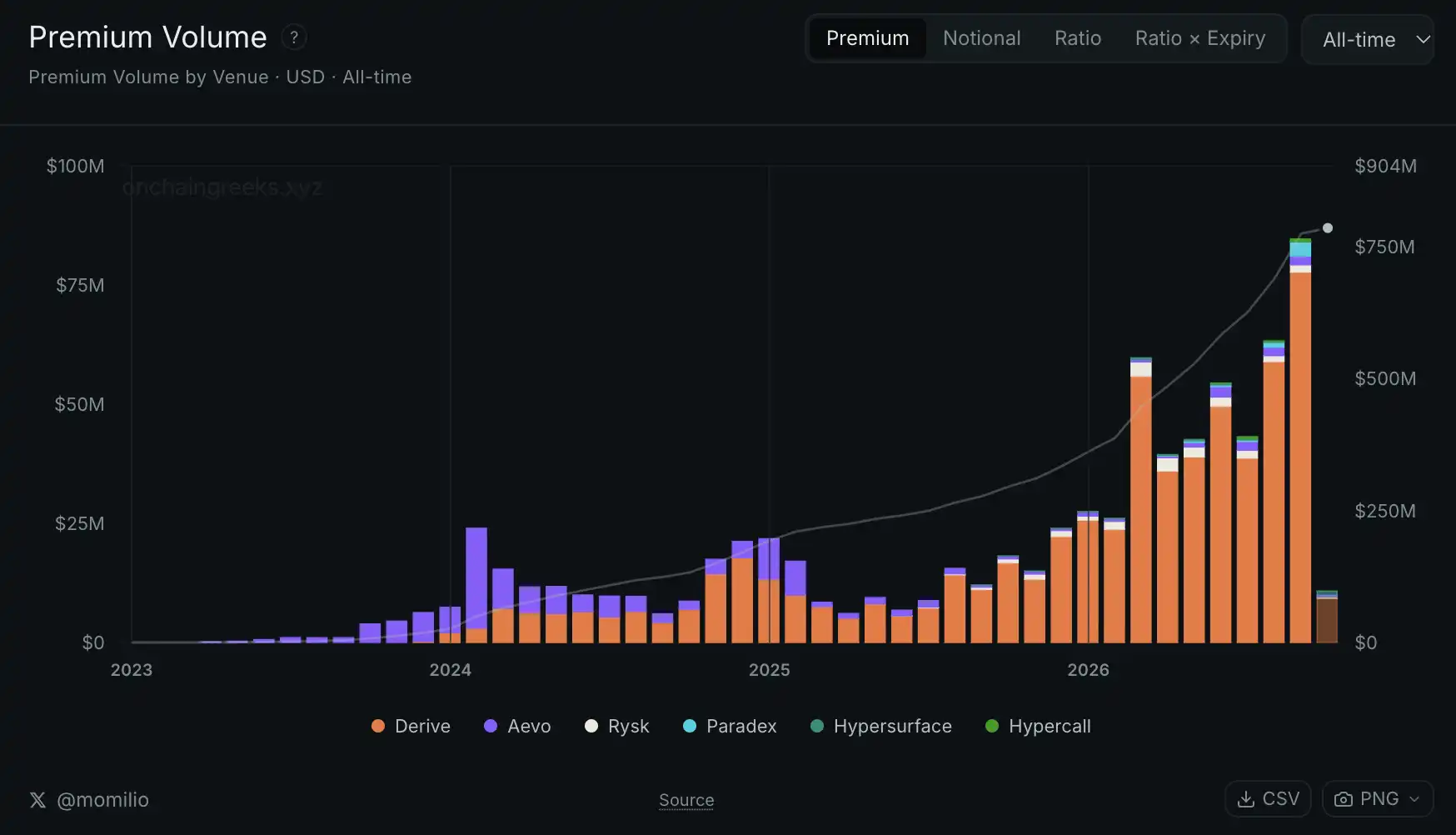
At the beginning of this year, monthly on-chain options premium volume was around $20 million+, and by September it had reached $80 million+. Premium is the actual amount paid for buying and selling options contracts, which helps us observe the actual trading scale of these products.
In September, total options notional volume reached $4.829 billion, up 121.7% month-over-month; Derive's notional volume grew 99.3% to $3.827 billion.
This growth occurred as competitors began gaining traction. Hypercall and Paradex expanded their market share, with Derive's notional volume share dropping from 88.1% to 79.3%, but by premium, Derive still commanded 91.6%. Notional volume measures the asset scale corresponding to contracts, which differs from the premium metric. Together, the two datasets present a picture: the industry is beginning to expand, and Derive remains dominant.
DRV's price has also undergone a revaluation. Since our previous article first introduced DRV, the token price surged from $0.043 to a peak of approximately $0.504, a maximum gain of over 10x. The market has already begun repricing the growth of on-chain options.
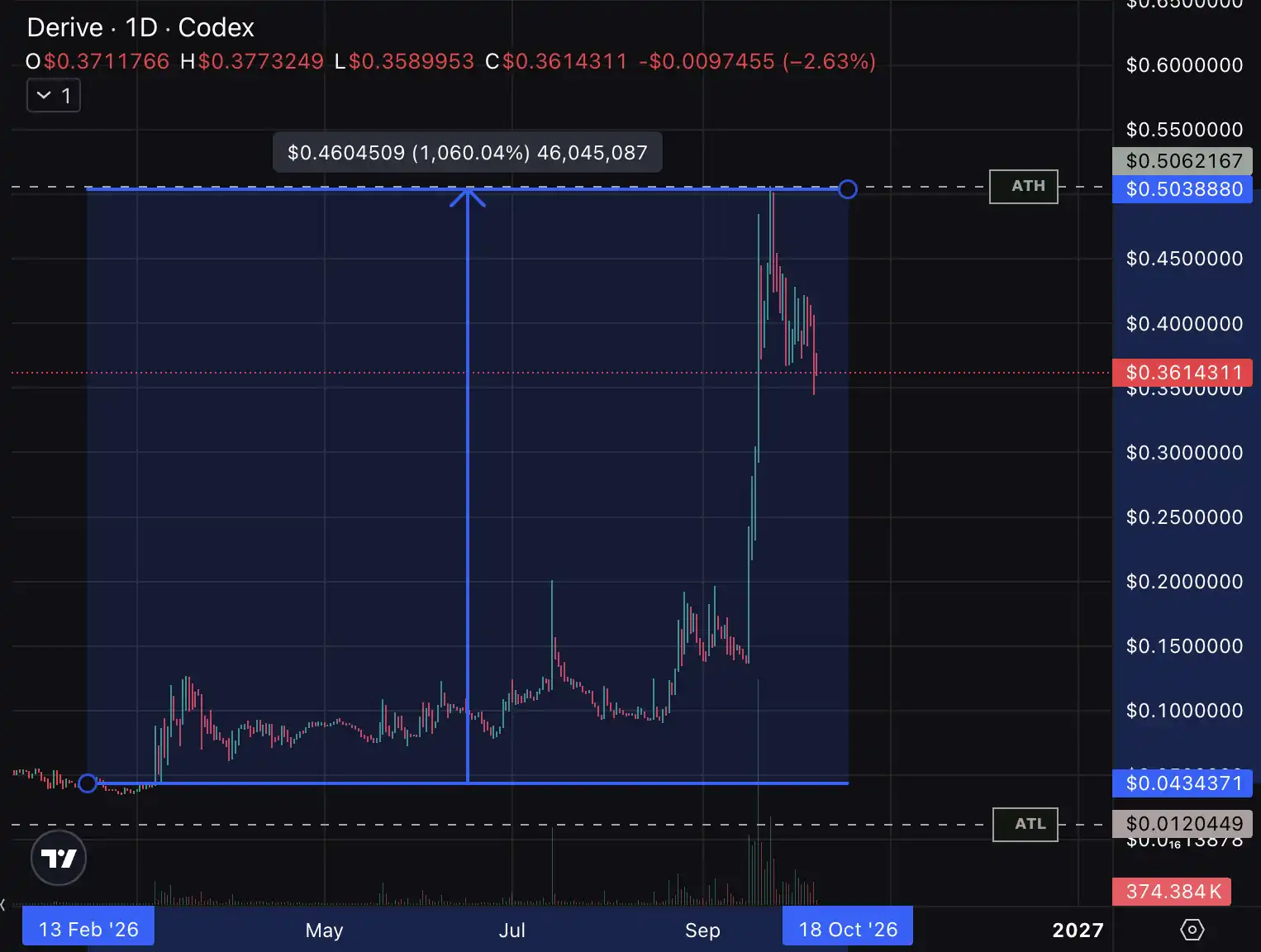
After a 10x increase, the reason to keep paying attention must come down to how much the business can grow. The current data proves that trading is increasing. The next stage of upside depends on whether more traders, assets, and applications can enter this market.
There is an even more meaningful reference point. The notional options volume across all on-chain venues combined amounts to only about 6.8% of Deribit alone. Compared with mature centralized options markets, on-chain options still have substantial room for penetration.
Why Derive Succeeded
Derive was formerly known as Lyra. After going through an early automated market maker approach, it gradually built out an order book, RFQ inquiry system, and portfolio margin framework.
Perpetual contracts can typically concentrate the liquidity of a single asset into one market. Options are different — they have various strike prices, expiration dates, and both call and put directions. A single asset gets split into many contracts, market makers must quote each one separately, and traders need to find suitable combinations. Looking at the order book of just one contract makes it easy to conclude that "on-chain options have no liquidity."
RFQ offers another way to execute trades. Traders submit the contracts, sizes, and combinations they want to buy or sell, market makers quote accordingly, and traders accept the suitable prices among them. Professional institutions can calculate quotes based on prevailing risk and market conditions, while traders can directly seek liquidity for specific needs.
This is where Derive's commercial value lies. It transforms what used to require contacting professional trading desks one by one, negotiating access, and waiting for quotes into a reusable trading entry point. Beyond the order book, the institutional quote network aggregated through RFQ constitutes its ability to attract large trades and complex strategies.
Options also generate hedging demand. After selling call options, market makers can buy a certain amount of perpetual contracts to offset some price risk and adjust positions as market conditions change. A mature on-chain contract market provides a more convenient hedging venue for options market making.
This explains an often-overlooked relationship: only after on-chain perpetual contracts developed did options become easier to scale. The two product types can jointly increase trading volume and provide liquidity for each other.
Derive itself also offers perpetual contract products. In a portfolio margin account that allows risk offsets, market makers can manage options and hedging positions together, reducing duplicated collateral occupation. The same options business therefore has the opportunity to generate follow-on perpetual trading and lending demand. Any assessment of Derive also needs to incorporate these interrelated businesses.
Derive V3
Derive recently completed its V3 upgrade, adopting an "off-chain matching, mainnet verification" approach, while adding risk isolation, cross-asset portfolio margin, and native vault deployment capabilities. This architecture combines execution speed with on-chain verifiable settlement, providing greater room for developer integration.
From a business perspective, this means Derive can serve more interfaces and strategies. Professional traders use the order book and RFQ system, retail users can select assets, target prices, and expiries through third-party front-end applications, and token holders can deposit assets into vaults that execute specific options strategies. Different entry points can ultimately use the same set of pricing, risk control, and settlement infrastructure.
The scalable growth paths for options can be divided into two categories: one is yield vaults and structured products, and the other is front ends that ordinary traders can understand. The former delegates complex strategies to products for execution, while the latter lowers the threshold for selection and operation.
For people holding gold or stock tokens, covered call writing can become a tool for earning premium income; for those who want to control the amount invested in a single speculative trade, applications can directly display the payoff curve at expiry and maximum loss. Products that are easier to understand have the opportunity to bring in people who had not previously actively entered the options market.
Derive therefore has the opportunity, like Hyperliquid, to expand from a trading venue into derivatives infrastructure behind multiple applications. Third-party teams handle customer acquisition and products, while the underlying protocol handles execution. The market it can serve in the future will expand along with the growth of these applications.
How DRV Captures Business Growth
According to Derive's explanation of its organizational structure, it has not issued separate equity to outside investors to divert protocol value. Core intellectual property such as the order book and RFQ is held by the foundation for the DAO, while Derive Labs supports development and execution as a service provider. The DRV token is at the center of governance, contributor incentives, and protocol value accumulation.
The most direct path among these is revenue-supported buybacks. Derive's fee sources include trading, matching, clearing, and spreads. Protocol revenue is distributed according to governance rules, with a portion used each week to buy DRV on the market.
The buyback ratio was initially 25%, then increased to 35%. Starting October 14, through a governance vote by the Derive DAO, the proportion of protocol fees used for buybacks will be further increased to 50%, continuing to be executed and disclosed weekly.
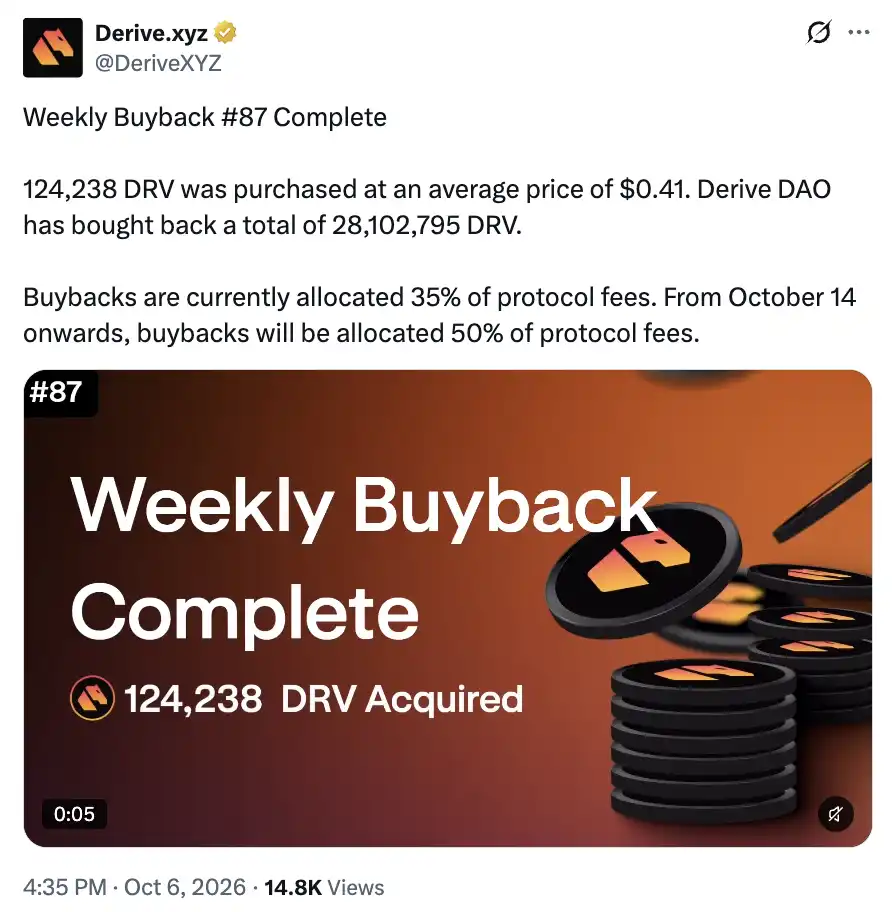
As of October 6, Derive had completed its 87th weekly buyback, accumulating 28,102,795 DRV. That week, it purchased 124,238 DRV at an average price of $0.41, with an estimated investment of about $51,000 based on the disclosed average price.
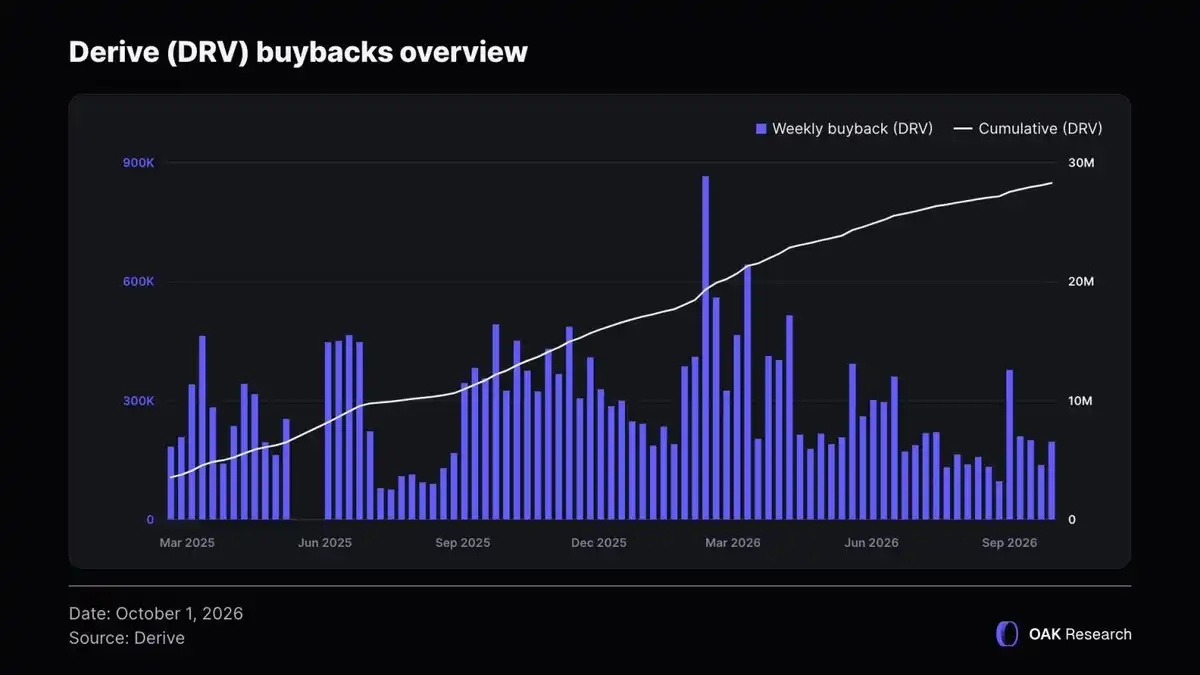
According to OAK Research, over the past year and a half, DRV's cumulative buyback volume has continued to increase, approaching $30 million. The fee revenue generated by the protocol is supporting sustained DRV buying.
With protocol fees unchanged, raising the buyback ratio from 35% to 50% means the buyback budget increases by approximately 43%. If business growth continues to bring in more fee revenue, both can together expand the funds used to buy DRV.
Derive still has room to expand its revenue sources. It has already built options trading, market-making quoting, and risk management capabilities. V3 and third-party applications can continue to add assets and products, and related contract and lending businesses also have the opportunity to contribute revenue. The buyback mechanism allows business growth to generate sustained token demand.
Making the Pie Bigger
After Jeff's remarks, the market can easily focus on whether "Hyperliquid doing options will affect Derive." Competition will certainly happen. Hyperliquid and Lighter's trader scale, hedging liquidity, and distribution capabilities all deserve attention.
But the fact that both platforms are simultaneously focusing on options also means that people already accustomed to on-chain trading will have more opportunities to access these types of products. When trading demand across the entire market expands, declining share and business growth can occur simultaneously. September's data has already demonstrated this situation.
Using a simple scenario projection, if the industry scale expands fivefold and Derive's share drops from 90% to 60%, its business scale can still grow to approximately 3.3 times its original size.
Derive's first-mover advantage should not be overlooked either. The already-integrated quoting network, the risk engine tested through actual trading, the hedging arrangements within accounts, and options positions with durations spanning months all increase migration costs. New platforms need to give traders sufficient reason to move their funds and long-term strategies over together.
A market with trading volume, the ability to generate revenue, and ongoing expansion of products and distribution is worth serious study before more people start talking about it.
Welcome to join the official BlockBeats community:
Telegram Subscription Group: https://t.me/theblockbeats
Telegram Discussion Group: https://t.me/BlockBeats_App
Official Twitter Account: https://twitter.com/BlockBeatsAsia