Meteora doubles in a month, what problems can the new DLMM pro solve?

In the non-buyback narrative, Meteora has taken the first step, and the market is quite bullish on this new thing called DLMM Pro, with MET surging 50% in a single day.
Meteora is one of the largest pool players on the Solana chain, aiming to use DLMM Pro to solve the long-standing pain points of Solana's pool platforms.
Currently, launching new coins on Solana is done in two stages.
In the first stage, an automatically price-increasing stall is set up. Initially, the coin is very cheap, and the more people buy, the higher the price goes—this rule is called a bonding curve. Once the price rises to a certain level, it is considered "graduated."
In the second stage, the stall is taken down, and the remaining coins and funds are moved to a real pool to start over.
But moving pools comes with many problems.
It's like after moving houses, it's hard for others to find you—after moving pools, the websites that help you find the cheapest prices have to re-learn the routes, the funds originally placed in can't be used as they were, and the team can't open the market according to their own ideas.
The rules on Solana are basically like this. Pump.fun's coins graduate and move to PumpSwap. Raydium is the station at the other end of this path; coins graduated from other platforms move to Raydium's pools, and it also has its own issuance tools. Meteora's own DBC is the same—when the price is reached, it has to move.
What DLMM Pro wants to do is avoid moving
The new tool aims to keep coin issuance in one pool from start to finish.
First, how to allocate funds at the opening is up to the team. Whether they want the price to stabilize first or surge first, they draw it themselves.
Second, fees can be set high initially, and then gradually lowered as more people play with the coin and the price stabilizes. Newly issued coins are the most volatile, and funds in the pool are most prone to losses; charging more during that period is like compensation for the risk. Once stable, lower the fees to retain traders.
Third, no need to move. One pool is used from issuance to maturity.
There are also several accompanying features. Each fund contributor gets a "certificate," like a property deed, which can be transferred, merged, or entrusted to others for management. Those who want to place limit orders can do so directly in the same pool, and after execution, those funds continue to earn fees. It's said that costs will also decrease, but this will only be known after the feature goes live and is experienced.
This design wasn't pioneered by Meteora. For example, Bankr, a launch platform on Base, uses this setup, so its pools never move, and fees flow continuously to the creator.
September was the best month of the year
MET's surge isn't just because of new products.
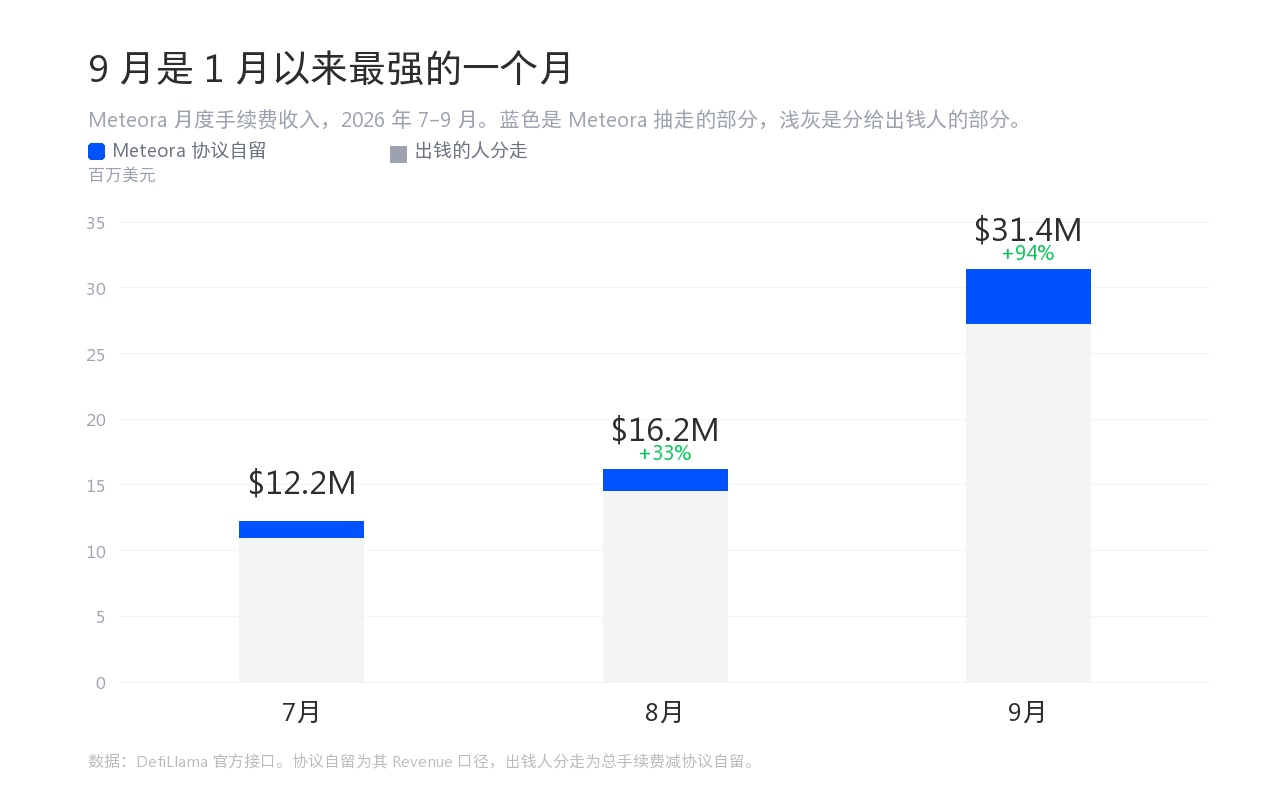
According to DefiLlama data, Meteora's fee revenue over the past three months was $12.21 million in July, $16.19 million in August, and $31.43 million in September, up 94% from August, nearly doubling.
Looking at trading volume, July saw $3.84 billion, August $4.67 billion, and September $6.90 billion, up 48% from August.
September's trading volume was up 48% from August, but fees were up 94%. Fees grew twice as fast as volume.
Why? Because Meteora's fees are dynamic. Unlike other pools that charge a fixed percentage, it charges more when prices swing more. September saw high market volatility, and people still had to buy and sell, so the same trading volume generated more fees. This is the core mechanism behind Meteora's profitability and what sets it apart from other pools.
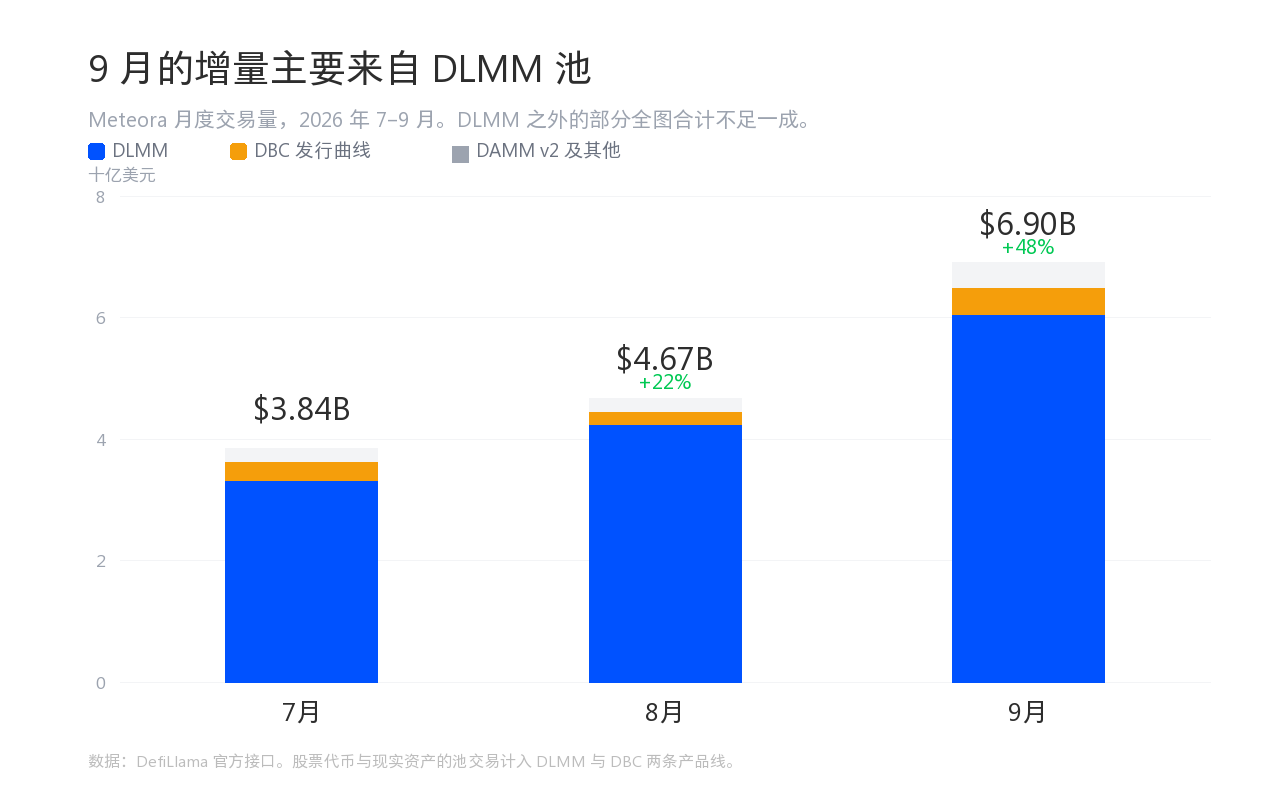
The increase in product trading types is also why September's data was so strong.
According to Meteora's official documentation update log, starting September 9, its launch tools supported stock tokens. Stock tokens, real-world assets, and other new types of tokens can all be used as one side of a pool.
This step is important. Previously, these pools only served newly issued coins, but now any asset can come in and be traded.
This line also hit its own high in September. The Dynamic Bonding Curve (DBC) is one of the product lines handling these types of assets. Look at its changes over the past three months.
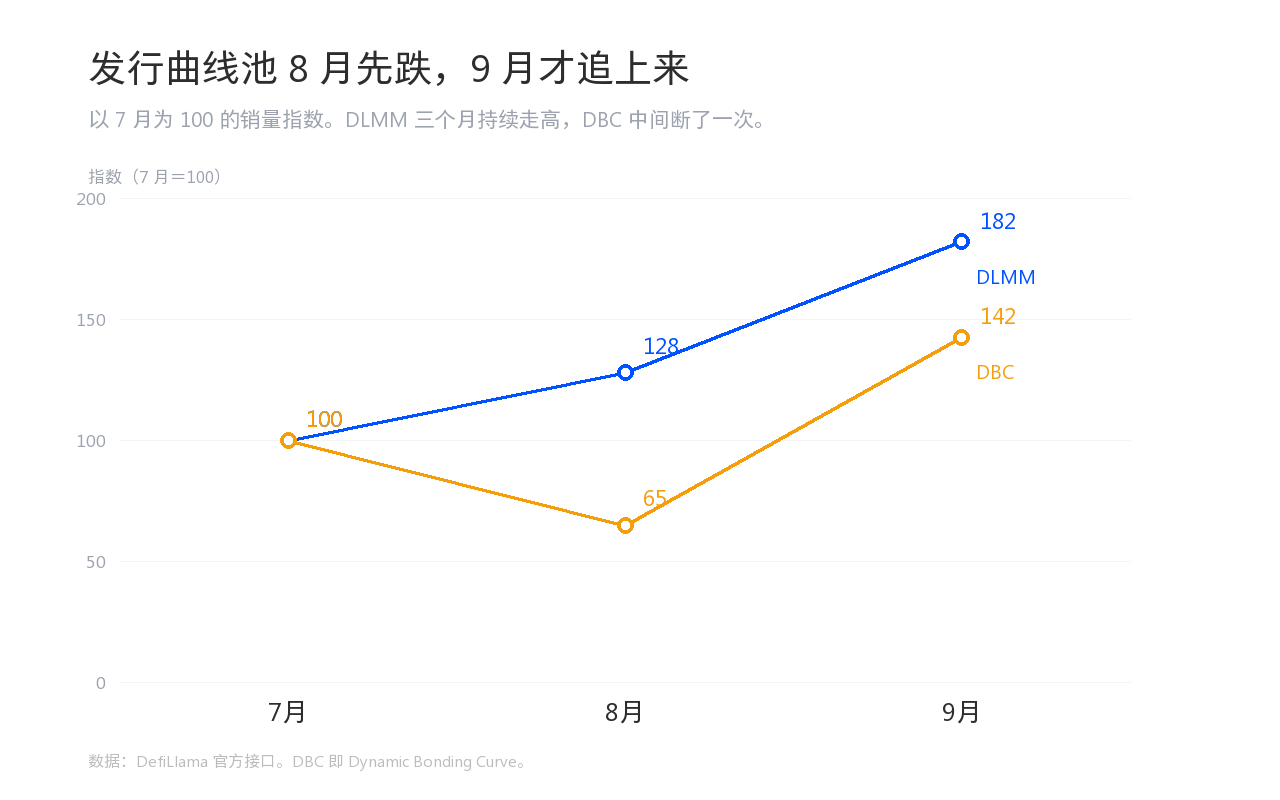
With July as 100, DBC was 142 in September, the highest in three months. Interestingly, it first dropped to 65 in August, the only one of the three product lines to shrink in August. It only caught up after stock token support was added on September 9.
Stocks are different from newly issued coins. Stocks only open for trading at a fixed time each day, and their prices aren't as wild. Pools for stocks need tools that can set very narrow price ranges and keep accounting very precise. The three switches in DLMM Pro are exactly for that.
Buybacks Still Falling Short
The only clear way for MET holders to get a share of revenue right now is the referral staking program launched on July 21. The approach is to convert a portion of DLMM trading fees into USDC and distribute it to stakers and those who refer others to stake.
The first round ended in late August, with 76 million MET staked and $336,000 distributed. The second round ended on September 21, with 89 million MET staked and over $700,000 distributed.
The other thing is buybacks. That is, the project team uses funds to buy MET back on the market.
Meteora spent $1 million in Q1, buying back approximately 7 million tokens at an average price of $0.1427. To date, cumulative investment has reached $13.67 million, accounting for 3.97% of the total supply. But the tokens bought back are just held, not burned. Neither the H1 report nor the August community call mentioned buybacks, so it's highly likely not a single purchase was made in Q2.
So the current situation is this: trading fees are up, and the money distributed to stakers is up, but there's no mechanism that automatically connects these two things to the MET price. Whether to buy back and how much to distribute are both entirely up to the project team.
Welcome to join the official BlockBeats community:
Telegram Subscription Group: https://t.me/theblockbeats
Telegram Discussion Group: https://t.me/BlockBeats_App
Official Twitter Account: https://twitter.com/BlockBeatsAsia