Pendle's Ambition: Swallowing All Yields from Stablecoins, RWA, and Perpetual Contracts
Yield is one of the oldest tools in finance.
It is like the gravity that money revolves around, determining the flow of every dollar in the financial system. Yield is like the spice that controls the financial universe, and Pendle's plan is to become the black hole that sucks in all yield.

A black hole is a celestial body with such immense gravity that even light cannot escape its pull.
Pendle V2 and Boros together form a system aimed at attracting all forms of yield in the world.
V2 captures all yield that exists within on-chain tokens, while Boros covers the rest, including the tens of billions of dollars in funding rates that change hands annually in the perpetual futures market.
After five years of building, Pendle has evolved from a protocol initially composed of a few messy liquidity pools into DeFi's fixed-income and interest rate infrastructure layer.
Today, it possesses sufficient liquidity, ecosystem integration capabilities, and cross-chain connectivity to allow various yields in the crypto market to be seamlessly priced and locked in as fixed income.
Boros fills in another piece that no one had truly solved before: providing a market where funding rates can be fully traded and their value realized.
As the infrastructure gradually matures, we are confident that three crypto sector themes in this cycle will become high-growth, even game-changing directions, and Pendle has already positioned itself ahead of time, ready to ride these upcoming waves:
· Stablecoins
· Tokenized RWA
· Perpetual Futures
Wave One: Stablecoins
Stablecoins never go out of style.
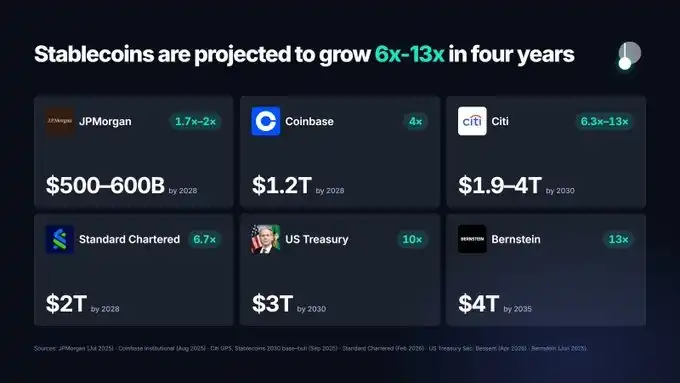
Most industry leaders and institutions expect the stablecoin market to grow substantially in the future, and banks and payment networks are preparing to enter this market.
As of mid-September 2026, the total stablecoin supply was approximately $300 billion, up 14% year-over-year.
Citi's baseline forecast for the stablecoin market size in 2030 is $1.9 trillion, while Standard Chartered expects it to reach $2 trillion by 2028—roughly 6 times the current level.
Regulatory frameworks have also begun to take shape.
Behind USDG, launched by Paxos, is the Global Dollar Network alliance, whose members include Kraken, Robinhood, Galaxy, and Mastercard.
Currently, USDG has already established a market on Pendle and achieved very strong performance.
Earlier this year, Pendle briefly became the largest USDG holder on Ethereum, accounting for 27.9% of the total supply.
Less than two months after USDG launched on Pendle, its scale on Pendle grew from 0 to $121 million.
On X Layer, Pendle's USDG market alone accounted for 40% of the entire chain's TVL.
Stablecoins have always been one of Pendle's most core businesses.
For stablecoin issuers, simply integrating into the Pendle ecosystem can provide enormous product utility and distribution capabilities.
Since the beginning of this year, stablecoin pools on Pendle have generated $6 billion in notional trading volume.
And this situation is actually not the first time it has occurred.
At its peak, about half of Ethena's TVL—nearly $7 billion—was located on Pendle.
This year on Monad, the TVL of AUSD-related markets alone reached about $230 million, and Pendle at one point accounted for more than 78% of AUSD's total supply.
This pattern has appeared repeatedly, so much so that Dune gave it a special name: the "Pendle Effect," namely "the surge in demand a token experiences after Pendle Finance launches a PT/YT market for it."
As the stablecoin wave continues to expand, Pendle will grow along with it.
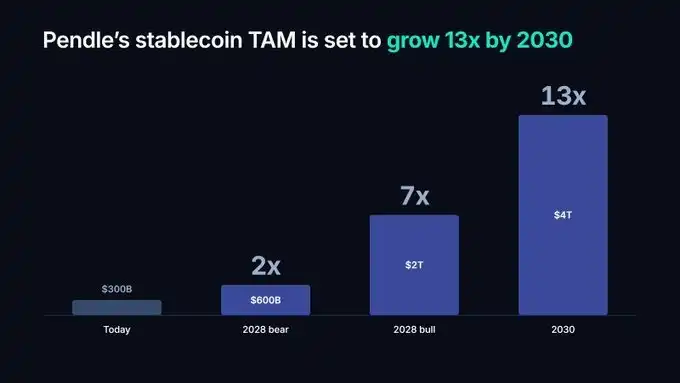
Even under JPMorgan's most bearish forecast, if stablecoin supply merely doubles in the future, then for Pendle, its addressable stablecoin market will still double within the next year and a half and grow tenfold within four years.
The Second Wave: Tokenized RWA
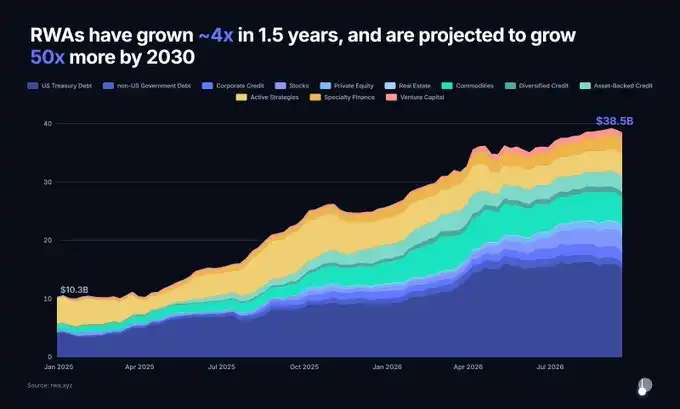
Excluding stablecoins, the size of tokenized real-world assets (RWA) has grown from approximately $10 billion at the start of 2025 to nearly $39 billion today.
In less than two years, the scale has grown nearly 4x.
Among them, U.S. Treasuries, private credit, commodities, and tokenized equities have each now surpassed $1 billion in size.
Market forecasts for RWA size in 2030 vary widely.
Conservative estimates put it at approximately $2 trillion, while more optimistic forecasts exceed $16 trillion.
Even using the most cautious forecast, it implies this market will grow roughly 50x in less than four years.
RWA has become one of the most important development themes for Pendle in 2026.
Of the markets launched on Pendle this year, 66 are RWA-related, covering assets such as U.S. Treasury bills, private credit, STRC dividends, tokenized equities, and compute infrastructure.
We have also helped these markets generate considerable asset scale and user activity.
Currently, $210 million in RWA-backed PT is being used as collateral on Morpho.
In May of this year, the STRC market on Pendle briefly exceeded $500 million in TVL, with cumulative trading volume surpassing $977 million, becoming the primary source of activity across the entire ecosystem.
USDai tokenizes compute infrastructure.
Earlier this year, its TVL on Pendle peaked at $568 million, with total trading volume of approximately $2.5 billion.
A fund under Partners Group has also recently launched on Pendle.
This means that this well-known private equity firm with $185 billion in assets under management has officially brought its investment strategy into the Pendle ecosystem, while also opening another potentially massive channel for asset inflows.
Although Pendle has already achieved some success, we believe it is still in a very early stage.
Robinhood's recent series of innovations has shown that seamless tokenization is just beginning to demonstrate product-market fit, and the boundary between on-chain and off-chain is rapidly blurring.
We expect that when this wave is truly fully unleashed, it will have a structural impact on the entire industry.
As the RWA wave continues to expand, Pendle will grow along with it.
By the way: in the coming weeks, we will also announce a new technological innovation that will allow assets that originally have no yield to be split into PT/YT in a way that is more suitable for degen users.
Stay tuned.
The Third Wave: Perpetual Contracts
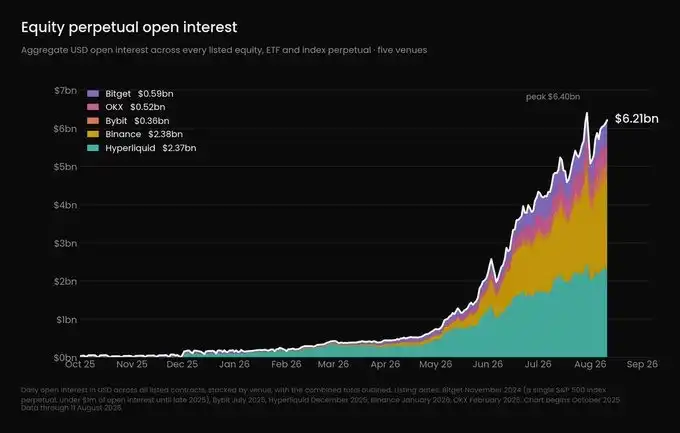
Source: https://ethena.fi/blog/extending-the-basis-trade-to-equities
Ethena concluded that perpetual contracts linked to equities and commodities are one of the few opportunities in the crypto industry that still have 100x growth potential.
We agree with this assessment.
Currently, open interest in equity perpetual contracts has exceeded approximately $6 billion, growing more than 10x in six months.
Since the beginning of this year, trading volume for equity-related products on Hyperliquid has grown from $4 billion to $212 billion.
When SpaceX goes public, its price discovery will occur in the perpetual contract market even before the stock officially begins trading.
The parent company of the New York Stock Exchange, ICE, has taken a stake in OKX, while also introducing its Brent and WTI benchmarks into OKX's perpetual futures market.
Kalshi has also launched the first batch of CFTC-regulated perpetual futures in the United States.
Perpetual futures are rapidly becoming the de facto 24/7 trading market for various asset classes.
And the funding rates generated in this process have become too important to ignore.
As Ethena pointed out, these perpetual futures have consistently been accompanied by very high funding rates.
In May of this year, Hyperliquid's open interest-weighted average funding rate reached an annualized 14%, while Binance's average level reached 17.5%.
The volatility of funding rates for crude oil perpetual futures is 14 times that of BTC funding rates.
On 40% of trading days, crude oil funding rates switch back and forth between positive and negative values.
From April 6 to April 14, oil prices fell from $113 to $91.
Even with the short direction being completely correct, shorts still paid a large amount of profits due to funding rates.
Faced with such high volatility, Boros provides the ability to lock in funding costs.
Users can use this to construct fixed-income carry trades, or simply bet on whether funding rates will rise or fall.
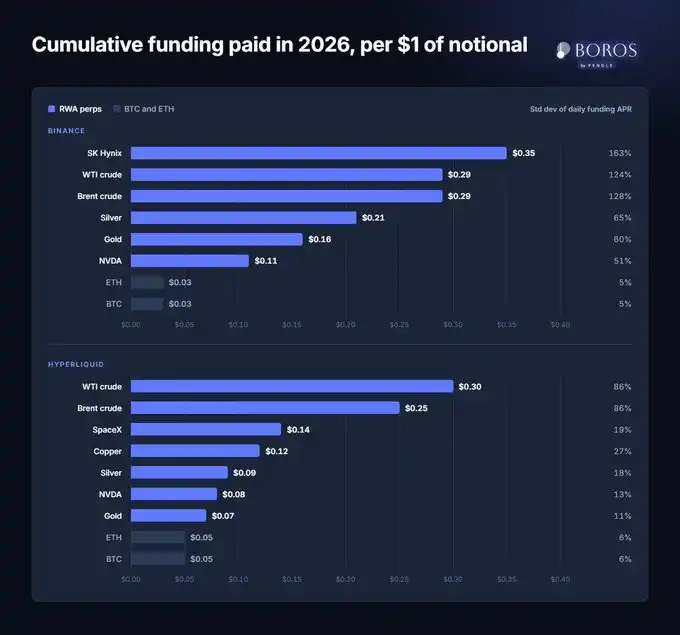
This year on Binance, holding $1 notional value of BTC perpetual futures requires paying approximately $0.03 in funding fees.
While holding SK Hynix perpetual futures costs as much as $0.35.
The standard deviation of BTC daily funding rates is approximately 5%.
Gold and silver reach 60% to 65%, and SK Hynix is as high as 163%.
RWA funding rates are completely different from anything we have seen before.
No trading desk or trader can sustain a highly leveraged position over the long term while enduring such dramatically fluctuating holding costs.
Every time a new RWA perpetual contract goes live, a new set of funding costs is created.
Moreover, funding rates across different trading platforms are almost never neatly aligned.
By partnering with prime brokers like CrossEx, Boros has already helped users execute this kind of arbitrage and achieve annualized yields of 30% to 40% with relative ease.
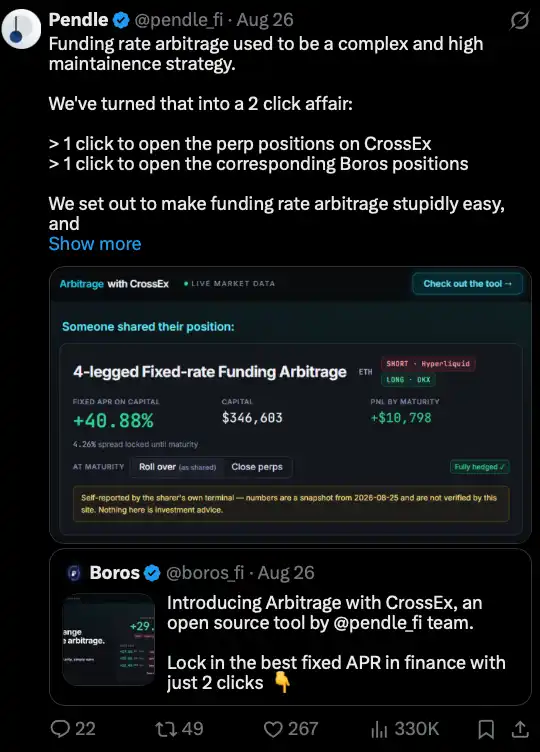
Arbitrage is a product launched by Boros that simplifies cross-platform funding rate arbitrage into an operation that can be completed in just two clicks.
The arbitrage opportunities currently live remain consistently attractive, with annualized yields broadly maintained at 20% to 40%.
Perpetual contracts have already become part of the global financial infrastructure, and their scale will only continue to grow in the future.
As funding rates gradually become a ubiquitous financial variable, the market will ultimately still need a place to manage and trade funding rates, and to lock in fixed returns.
As the wave of perpetual contracts continues to expand, Pendle will grow along with it.
Pendle's Appeal
Yes, these three waves are all very attractive in themselves.
But why must it be Pendle?
Simply put, entering Pendle's "giant maw" means you can gain top-tier distribution capabilities, a complete ecosystem of use cases, and most critically—liquidity.
The "Pendle Effect" mentioned earlier has already demonstrated Pendle's influence in asset distribution.
At the same time, Pendle's PT has also been widely accepted by DeFi and CeFi platforms as collateral and for use as various DeFi "LEGO blocks."
In addition, we have also built cross-chain PT.
This means PT can be used as collateral on any supported chain.
Earlier this year, we saw $170 million worth of PT-USDe bridged from Ethereum to BNB Chain and used as collateral.
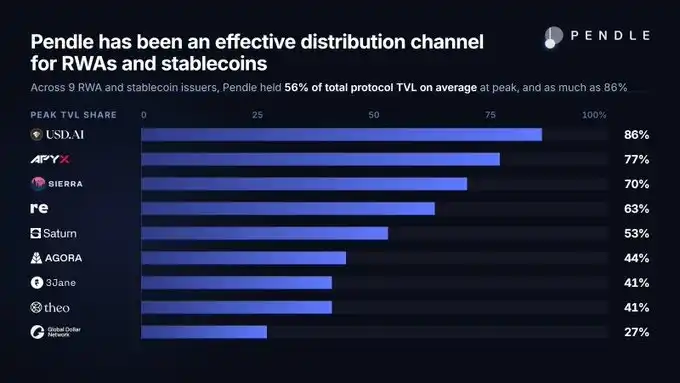
Pendle's role is to continue being the most effective distribution channel for RWA and stablecoins.
Liquidity begets more liquidity
On the liquidity front, we have likewise completed the hardest infrastructure work.
The underlying infrastructure is now capable of handling the next several waves of asset growth at institutional scale.
These systems have been continuously adjusted and upgraded over the past few years and are now ready for use.
As of the time of writing, users can execute a single $50 million PT-sUSDS swap to lock in an effective fixed APY of approximately 4.6%, with only -0.05% slippage.
This level of trading efficiency is already comparable to the deepest liquidity markets on the largest centralized trading platforms.
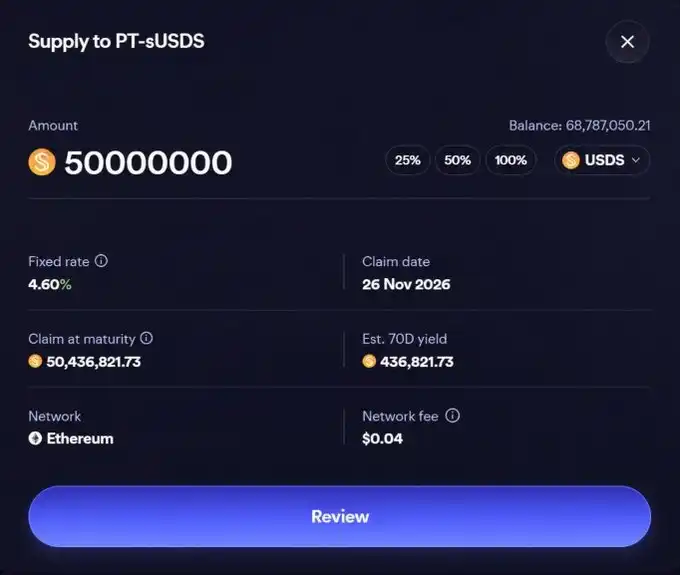
Trade preview of swapping $50 million USDS for fixed yield on Sky via Pendle PT-sUSDS.
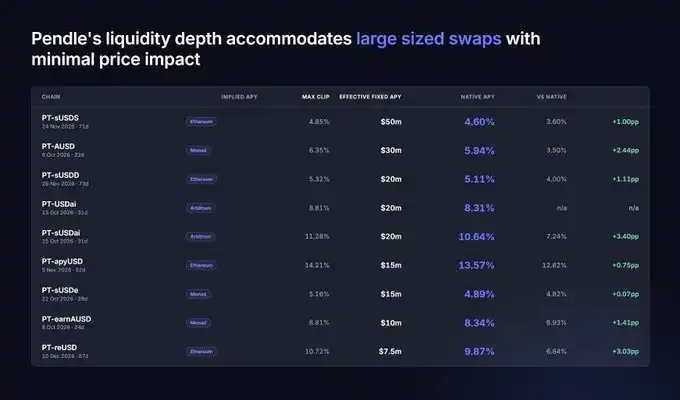
Structures like this — "deep trading capacity + fixed-rate premium" — also exist widely across Pendle's stablecoin and RWA markets.
Pendle's AMM liquidity is further complemented by a limit order system.
As a result, orders can be partially filled through both the AMM and the limit order system simultaneously, achieving optimal pricing.
Beneath this system lies an algorithmic incentive module, AIM, which automatically designs the allocation strategy for PENDLE rewards across different markets.
AIM is one of our most underrated yet genuinely impactful improvements in recent years.
Tradeable liquidity has grown from approximately $350 million to approximately $600 million, a 71% increase year-to-date.
At the same time, the cost efficiency of acquiring liquidity has improved 22-fold.
Today, Pendle is more efficient and more capable than ever at absorbing large trades.
Meanwhile, the token incentives it relies on have plummeted—emissions have dropped 92% since the start of the year.
AUSD is an example of a highly efficient market.
It currently has a floating TVL of $130 million, but the AMM actually provides only $2.5 million in liquidity.
This is mainly thanks to our limit order system and AIM.
As of the time of writing, if a $20 million trade were executed against this pool of just $2.5 million, the impact on yield would be only 0.22%.
In the past, this would have been almost unimaginable without TVL in the billions of dollars.
Does this sound attractive to RWA or stablecoin issuers?
We are willing to believe that we have offered a fairly compelling answer.
When a mass accumulates to a certain critical point, it begins to reorganize the space around it.
And everything that enters its sphere of influence begins to gravitate toward it.
This structure itself is what gradually makes "choice" meaningless.
Because this attraction is ultimately inevitable.
A stablecoin that wants to expand needs an effective distribution channel so that users can earn yield.
A tokenized fund that comes onchain in the form of a floating rate needs a place to split out its yield.
Perpetual contracts for any asset, whether the underlying is an onchain asset or an offchain asset, will generate funding rates.
And for funding rates to be hedged, there must be a market where funding rates can actually be traded.
The foundation has been laid.
The infrastructure is in place.
All three types of assets are moving toward hyperscale markets.
And in each case, the yield they generate ultimately has only one market deep enough to flow into.
Pendle.

Welcome to join the official BlockBeats community:
Telegram Subscription Group: https://t.me/theblockbeats
Telegram Discussion Group: https://t.me/BlockBeats_App
Official Twitter Account: https://twitter.com/BlockBeatsAsia