DeepSeek Core Engineer's Long Article: I Had to Bury My Talent in Yesterday
Original compilation: Wall Street CN
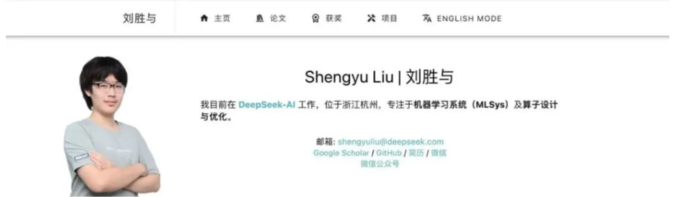
Liu Shengyu, a DeepSeek engineer and former captain of Peking University's Weiming Supercomputing Team, wrote, "Humanity has never shown any hesitation when it comes to destroying itself." The better he optimizes operators, the faster the inference and training of new models become; the faster model capabilities advance, the sooner the moment arrives when AI replaces humans in writing operators. But he clarified that this was not an outpouring of unemployment anxiety, but rather a dignified farewell to the handicraft era of "hand-written programming." On September 14, Liu Shengyu, the young engineer who had just delivered the core operators for DeepSeek V4.1, published a long essay titled "I Had to Bury My Talent in Yesterday," documenting technological change and his personal journey. The essay continued to go viral across domestic and international tech communities, sparking widespread discussion about the fate of developers in the AI era and the evolution of technology.
The hashtag #I Had to Bury My Talent in Yesterday# also shot to the top of Zhihu's trending list.
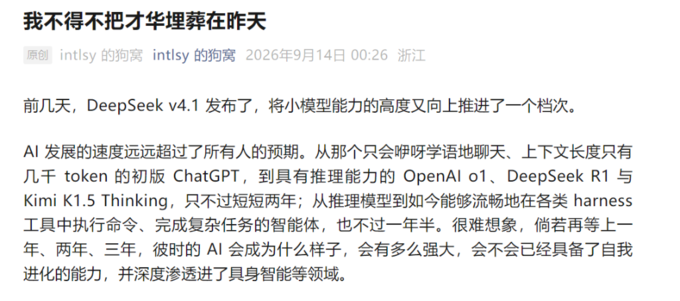
As one of the core builders of the underlying infrastructure for large models, DeepSeek machine learning systems engineer Liu Shengyu has an outstanding technical background. He was a member of Peking University's 2021 "Turing Class" in computer science, served as captain of PKU's Weiming Supercomputing Team, and represented the university at the international student supercomputing competition SC23. After joining DeepSeek in April 2025, he took on critical low-level operator R&D work, and just days ago completed the code delivery for DeepSeek V4.1's main Attention operator (MQA attention with head dim = 512).
In his essay, Liu Shengyu candidly acknowledged that while he was proud of the successful core operators for DeepSeek V4.1, he was also fully aware of the irreversible march of technology.
"In another six months or a year, AI-written operators will most likely be just as good as mine, or even surpass me," Liu Shengyu said bluntly. "AI can think 300 tokens per second, type a line of command in half a second, and write a piece of code in twenty seconds — I can't. AI can continuously improve in model depth, thinking intensity, tool-calling volume, and even parallelism — I can't."
This rapid evolution has pushed developers into a profound technological paradox: the better he optimizes operators, the faster new models infer and train; the faster model capabilities advance, the sooner the moment arrives when AI replaces humans in writing operators.
Facing this irresistible trend, Liu Shengyu wrote: "Humanity has never shown any hesitation when it comes to destroying itself since ancient times... Of course I hope I won't be revolutionized, but if I must be, I hope the one who revolutionizes me is myself."
"I won't be unemployed, but I must transition careers"
In response to external concerns about programmers' livelihoods, Liu Shengyu offered a clear-eyed assessment: engineers as a group will not face unemployment in any true sense, but they will inevitably undergo a profound "career transition."
"Transitioning careers means I need to abandon the operator design, coding, and optimization domain that I have deeply cultivated and am passionate about, and instead become an Agent's 'mech pilot,'" he wrote. "Previously, my interests, my strengths, and what industry needed were essentially aligned; now, industry's demand has drifted from 'people who can write high-performance operators' to 'people who can use AI to produce high-performance operators faster.'"
He compared this loss of craft to the impact automated sock-knitting machines had on traditional artisans. Even if one could still operate the machines best by drawing on past experience, the former "joy of sitting by the window listening to rain, threading needles, and savoring time's slow passage was ultimately crushed by the roar of machinery."
"My hands have gained some gears, but my heart has lost some rhythm," he lamented.
Beyond personal career transformation, Liu Shengyu also expressed concern in the article about the degradation of engineering capabilities among the younger generation. If students broadly rely on AI to complete complex coding assignments in minutes, systems architecture and abstract design capabilities may face a generational gap. "A person with very poor engineering skills, when paired with AI, can produce piles of crap at several times their previous efficiency, thereby planting all manner of hidden dangers in systems and making this world even more of a slapdash operation."
Clarifying Intent: A Dignified Farewell to the "Handicraft Era"
After the article's publication sparked excessive interpretation across major platforms regarding geopolitics, institutional competition, and even unemployment anxiety, Liu Shengyu subsequently issued a supplementary statement clarifying his original writing intent.
He stated that the article was not an expression of anxiety about livelihood, nor was it meant to provoke confrontation between DeepSeek and closed-source institutions like Anthropic. Its core motivation was simply to make a serious farewell to the pure days of "purely hand-written operators."
"Presumably one day in the future, 'hand-writing operators' or even 'programming' may become a recreational activity rather than a productive one, just as almost no one uses javelins for hunting now, but rather as a competitive sport," Liu Shengyu wrote. "This is essentially forcing me to abandon what I once loved and forcibly turn in another direction. Even if the new direction is equally fascinating, the feeling is not pleasant. As the title says: I have to bury my talent in yesterday."
When discussing why he insisted on staying at DeepSeek, Liu Sheng reiterated his belief: the most cutting-edge intelligence should be provided to society in an open and inclusive manner, avoiding core capabilities being completely monopolized by a very small number of commercial oligarchs.
"After having to bury my talents in yesterday, I still have the brightness of tomorrow to pursue," he said at the end of his supplementary explanation, stating that he will continue to devote himself to the new process of introducing AI Agents to write operators, embracing new technological tools while seeking a foothold belonging to the new era.
The original text is as follows:
A few days ago, DeepSeek v4.1 was released, pushing the height of small model capabilities up another notch.
The speed of AI development has far exceeded everyone's expectations. From the initial version of ChatGPT that could only babble in chats with a context length of just a few thousand tokens, to OpenAI o1, DeepSeek R1, and Kimi K1.5 Thinking with reasoning capabilities, it took only a short two years; from reasoning models to today's intelligent agents that can smoothly execute commands in various harness tools and complete complex tasks, it has been only a year and a half. It is hard to imagine what AI would be like in another year, two years, or three years, how powerful it would be, whether it would already possess the ability to self-evolve, and whether it would have deeply penetrated fields such as embodied intelligence.
AI is getting better and better at writing operators
AI has also made rapid progress in the field of operator design and writing that I am engaged in. In just one year, it has transformed from a little assistant that could only help me look up documentation, read code, and find bugs into an operator master capable of independently reading CUDA, PTX, and SASS code, analyzing the stall time of each instruction through professional tools, and then independently optimizing operators. I believe that in the near future, it will also have the ability to independently design operator scheduling, evaluate the performance of different scheduling schemes, and implement and optimize them.
Of course, I am proud of the success of DeepSeek v4.1—after all, its main Attention operators were all written by me [1], and its excellence is precisely an affirmation of my operators. However, the wheels of the times roll forward, and technological development cannot be stopped by anyone. I am well aware that in another six months or a year, the operators written by AI will most likely be as excellent as those I write, or even surpass me. AI can think 300 tokens per second, type a line of command in half a second, and write a piece of code in twenty seconds, while I cannot; AI can continuously improve in model depth, thinking intensity, tool invocation volume (frequency of interaction with the environment), and even parallelism, while I cannot.
Humanity has never hesitated in the matter of destroying itself since ancient times. Why, despite knowing that "the better I write operators, the faster our new models will train and infer, the quicker model capabilities will advance, and the sooner I will be replaced," do I still choose to optimize operators to the best of my ability? On one hand, it is indeed because writing operators is like playing a game for me, providing immense pleasure. The moment I invent a new technique or see the performance of my operators improve, the excitement in my heart is no less than that of a speedrunner breaking their own record. At the same time, when I see my operators far outperforming the official ones from vendors, a great sense of pride wells up in me. But beyond that, a more important reason is that even if I just "slack off" or deliberately sabotage model training, other companies' models will continue to develop as usual and ultimately kill me off just the same. "Of course I hope I won't be revolutionized, but if I must be, I hope the one revolutionizing me is myself." When everyone is so obsessed with destroying themselves, I have no choice but to join this brutal arms race.
What About Me
When the day comes that AI's ability to write operators truly surpasses mine, what will become of me then?
My judgment is: I won't be "unemployed," but I will have to "change careers." My livelihood can still be preserved, but this may mean I never get the chance to engage in the work I once loved.
I once made a judgment about the changes of the times and my personal situation in the future: because the times are changing so fast (the AI development mentioned above is a good example), I simply cannot predict what will happen in five or ten years. But regardless, I believe that with my vision, judgment, initiative, and intelligence, I can stay at the table of the times and rise to the forefront again. However, this judgment can only guarantee that I won't be "unemployed," not that I won't need to "change careers." Rather, this judgment encourages me to avoid unemployment by changing careers.
So what does changing careers mean? It means I need to give up the field of operator design, writing, and optimization that I have deeply cultivated and am passionate about, and instead become an "mech pilot" for Agents. Previously, my interests, what I was good at, and what the industry needed were basically aligned; now, AI has made what I'm good at into something it's better at, and has shifted the industry's demand from "people who can write high-performance operators" to "people who can use AI to produce high-performance operators faster." To adapt to the industry's needs, I will inevitably have to abandon the direction I once loved and turn to an unknown new one. I believe I can continue to produce operators with high quality and efficiency by leveraging my understanding of engineering, upper-layer model requirements, and lower-layer hardware. I also know I might come to love this new direction (or maybe not), but the feeling of having one's passion taken away is truly unpleasant. That serene joy of sitting at my workstation quietly writing operators for an entire afternoon may become a swan song this summer. I have no choice but to bury my talent in yesterday and become a mech pilot. My hands have gained some gears, but my heart has lost some rhythm.
Here's a vivid analogy: You are a master of knitting, especially skilled in various patterns and color combinations. The sweaters you knit are of excellent quality and beautiful design, and wealthy people from far and wide come to ask you to knit for them, earning you a good amount of money. At the same time, you thoroughly enjoy the feeling of sitting by the window, brewing a pot of tea, gazing at the green mountains, waters, livestock, and chimney smoke outside, and quietly knitting for an afternoon. But one day, someone invented a magical machine that, with just yarn and a pattern, can automatically knit sweaters of quality and texture no less than your handiwork, and far faster than you. You know very well that your peers can easily reach your former level with this machine, so you have no choice but to use it too. You also know that with the knitting skills you've accumulated over the past twenty years, even if everyone has the machine, your speed and quality can still surpass your peers. But that joy of listening to the rain by the window, threading needles, and leisurely passing time is ultimately crushed by the roar of the machine.
I know this is helpless, but there's no way around it. You can keep your livelihood, but your old passion will most likely have to be abandoned. I am someone who separates reason and emotion quite well; when I need to handle problems with reason, I can be very rational, but sometimes I also show an emotional side. I remember when I moved out of the rental apartment I had lived in for a year, I cried a lot, reluctant to part with the memories. Today, saying goodbye to the era of handwritten operators and human-brain optimization is undoubtedly even more cruel.
I don't know if any readers feel the same way, but I think this is just how it has to be.
What About People
As AI continues to advance, I also have concerns about some issues:
· Are students now more likely to prefer using AI to complete assignments, especially practice-oriented Labs? Imagine if there are two choices: one is toiling for eight hours to finish a Lab, perhaps without even getting full marks; the other is to launch an AI model, spend a few cents and a few minutes, and directly have AI write perfect code. Which would most students choose?
· The above point will lead to a severe lack of engineering skills among many students, including the ability to organize code, build systems, think about future potential needs and address them in design ahead of time, abstract, and so on. So, against the backdrop of ever-strengthening AI capabilities, are these "engineering skills" still necessary? Will these engineering skills gradually be abandoned by the times like the old ability to "skillfully write x86 assembly," or will they always retain value like the ability to "understand the entire computer system from software to system to hardware"? If it's the latter, then it's dangerous—a person with poor engineering skills, when paired with AI, can produce shit mountains at several times the previous efficiency, thereby burying various disasters in the system and making the world even more amateurish.
· In future societies, will power be more important than technology or intelligence?
These questions may need to be answered by the era itself.
Conclusion
With the development of AI, future society may trend toward two extremes: communism and Cyberpunk 2077. In the former, productivity is greatly liberated, and people's living standards improve significantly; in the latter, a few tech companies control most resources, and only a very small number of people can use the most advanced AI and various technologies, achieving an effect close to "mechanical ascension," while most people can only use very weak AI. Crossing social classes will become increasingly difficult: you must first have the strongest AI in order to cross classes, forming a dead loop.
Guess what—if An****pic forever controls the world's most advanced AI, will future society become communism or 2077? Take a guess? Therefore, I still believe that the most cutting-edge intelligence should be supplied to everyone in an open and low-cost way. I do not trust that Anthropic or OpenAI can do this, and in particular I do not want Anthropic to control the most advanced artificial intelligence or AGI. To put it exaggeratedly, its severity is no less than letting Hi*ler master nu*lear weapon technology before the Allies. This is also why I chose and insisted on staying at DeepSeek: we research powerful, fast, and inclusive artificial intelligence and open-source it, and perhaps we can pull the world back a bit from the 2077 end.
May the future world be well. May all the beauty be blessed.
[1] "Main Attention" only includes MQA attention with head dim = 512, and does not include the indexer used to select the top-k important tokens; that part was written by other colleagues (whose level is also very strong) (as well as their AI Agents).
Supplementary Explanation of "I Had to Bury My Talent in Yesterday"
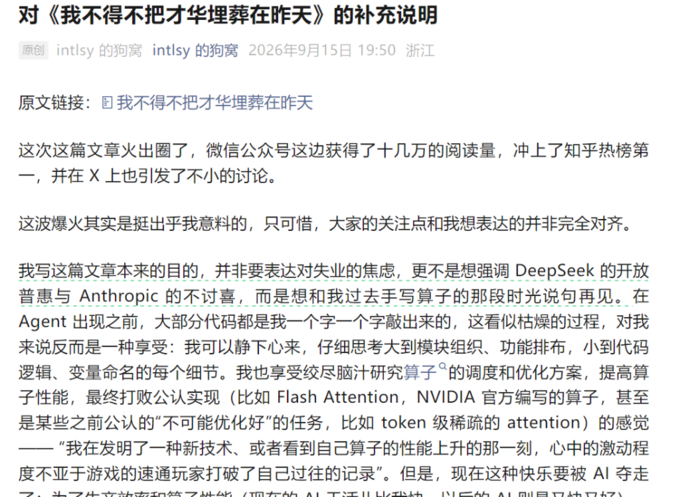
This article went viral beyond the circle this time. On WeChat Official Accounts, it received over 100,000 reads, topped Zhihu's trending list, and also sparked considerable discussion on X.
This wave of popularity was actually quite unexpected to me. It is just a pity that everyone's focus and what I wanted to express are not completely aligned.
The original purpose of writing this article was not to express anxiety about unemployment, and even less to emphasize DeepSeek's openness and inclusiveness versus Anthropic's unlikability, but to say goodbye to that period of time when I hand-wrote operators. Before Agents appeared, I typed out most of the code character by character. This seemingly boring process was instead a kind of enjoyment for me: I could calm down and carefully think through every detail, from module organization and feature arrangement at the large end to code logic and variable naming at the small end. I also enjoyed racking my brains to study operator scheduling and optimization schemes, improve operator performance, and ultimately beat recognized implementations (such as Flash Attention, operators officially written by NVIDIA, and even some tasks previously recognized as "impossible to optimize well," such as token-level sparse attention)—"the moment I invented a new technology, or saw the performance of my own operator rise, the excitement in my heart was no less than that of a speedrunner breaking their own past record." But now this kind of happiness is being taken away by AI: for production efficiency and operator performance (AI now works faster than I do, and future AI will be both fast and good), I must embrace new things in the new era and study how to use AI to write operators better. During working hours, I will no longer have the chance to enjoy the time of quietly, slowly writing operators, tuning operators, and optimizing operators. Presumably, one day in the future, "hand-writing operators" and even "programming" may become entertainment activities rather than production activities, just as almost no one now uses javelins to hunt, but instead treats it as a competitive activity. This is equivalent to forcing me to give up something I once loved and forcibly turn to another direction. Even if the new direction is equally fascinating, this feeling is not very pleasant. As the title says: I had to bury my talent in yesterday.
I am someone who places great value on memories and the emotions they carry, yet memories inevitably fade, gradually buried by the fine snow of time. I previously wrote another article discussing this very matter: 2025 Year-End Summary Part Two: Memory. Therefore, this article is, in essence, a summary and remembrance of my past days. Through this piece, I hope to freeze those handwritten operator images from bygone times, preserving this genuine memory and sincere emotion, for my future self to revisit in ten or twenty years. Incidentally, through this article, I also wish to give myself the courage to let go of the past, pick up new tools, and bravely step into a new era.

↑ A passage I really like, excerpted from the comment section of a WeChat official account
But everyone's understanding seems to have deviated considerably from my original intent... The last two sections of the article were originally just some ramblings: the penultimate section briefly mentioned some social problems brought about by AI, but I didn't really analyze or answer them in detail; the final section was some scattered personal thoughts I had recently, arguing that frontier intelligence should still be "supplied to everyone in an open, inexpensive manner." However, since I am not an expert in humanities disciplines such as history or sociology, I only briefly touched upon this part in passing (and took a jab at the A/ I've never been fond of), and the debate about communism and 2077 in there may not necessarily be correct. Although the two statements—"One of the reasons I chose DeepSeek is that I don't want the world to become like 2077" and "May all the beauty be blessed"—are true, and this is indeed my ideal, this is not the central point of this article. This passage also represents only my personal views and does not represent the position of any company I am affiliated with. Perhaps one day in the future, once I have thought this issue through more clearly, I will write another article to explore it.
As it turned out, after this article was published, although many people did resonate with my nostalgia for days gone by, most people shone the spotlight on the last paragraph. The top-ranked answers on Zhihu were fairly decent (showing that Zhihu users still have good reading comprehension skills), but a large number of people in the WeChat official account comment section were discussing Anthropic's and DeepSeek's attitudes toward open intelligence, and on Xiaohongshu there were even answers like "DeepSeek strikes back at Anthropic"... I am struck by the hype-manufacturing ability of certain journalism-trained people, and after reading these, I felt quite helpless... Everyone should focus more on the theme of the article.
Returning to the main topic, it is certain that AI will continue to grow stronger in the future: even confined to the current paradigm of Agent + Harness + long context + CoT, as data quality, model depth, and context length continue to scale, AI's capabilities will steadily advance. Not to mention what awaits us further down the road: embodied intelligence, RSI, and other technologies we have yet to learn of. I am optimistic about AI's capabilities in the future, relatively optimistic about my place in future society, but pessimistic about whether people in the future will still be able to settle down and seriously devote themselves to doing one thing, and also pessimistic about whether I myself will be able to sustain one thing as both work and hobby over the long term.
But even so, I will still persist in writing operators and continuously bringing in AI Agents to write operators. First, because "of course I hope I won't be revolutionized, but if I must be revolutionized, I hope the one who revolutionizes me is myself" (being eliminated by others is worse than evolving yourself); second, because I still hope that we (or other AI companies that similarly uphold the concept of openness and sharing) can, ahead of certain companies, create the most powerful intelligence and benefit everyone. I still believe in my original arguments about communism and 2077, and I also hope this world can stay as far away as possible from the 2077 end. Hobbies and interests are one thing, while ideals and beliefs are another, so I will continue to explore in this field. In the future, I will also try my best to realign my hobbies, strengths, and the demands of the times, and try to find my own paradise in the era that belongs to AI. After having no choice but to bury my talents in yesterday, I still have the light of tomorrow to pursue. After being soaked by this cold rain at the end of the world, I will still use a heart that has warmed again to dispel the gloom and seek that shade of blue that gradually appears after crossing the night [1].
[1] Adapted from the lyrics of COP's songs such as "Singer at the End of the World."
Original link
Welcome to join the official BlockBeats community:
Telegram Subscription Group: https://t.me/theblockbeats
Telegram Discussion Group: https://t.me/BlockBeats_App
Official Twitter Account: https://twitter.com/BlockBeatsAsia