DeepSeek Partners with Solana: When Intelligence Becomes Cheap Enough to Waste

Original Title: "DeepSeek Joins Hands with Yushu: When Intelligence Becomes Cheap Enough to Be Wasted"
Technology truly begins to change the world when it becomes cheap enough to be wasted.
Recently, even foreign media have started to learn a very Chinese term related to the Internet, the "Death Zone."
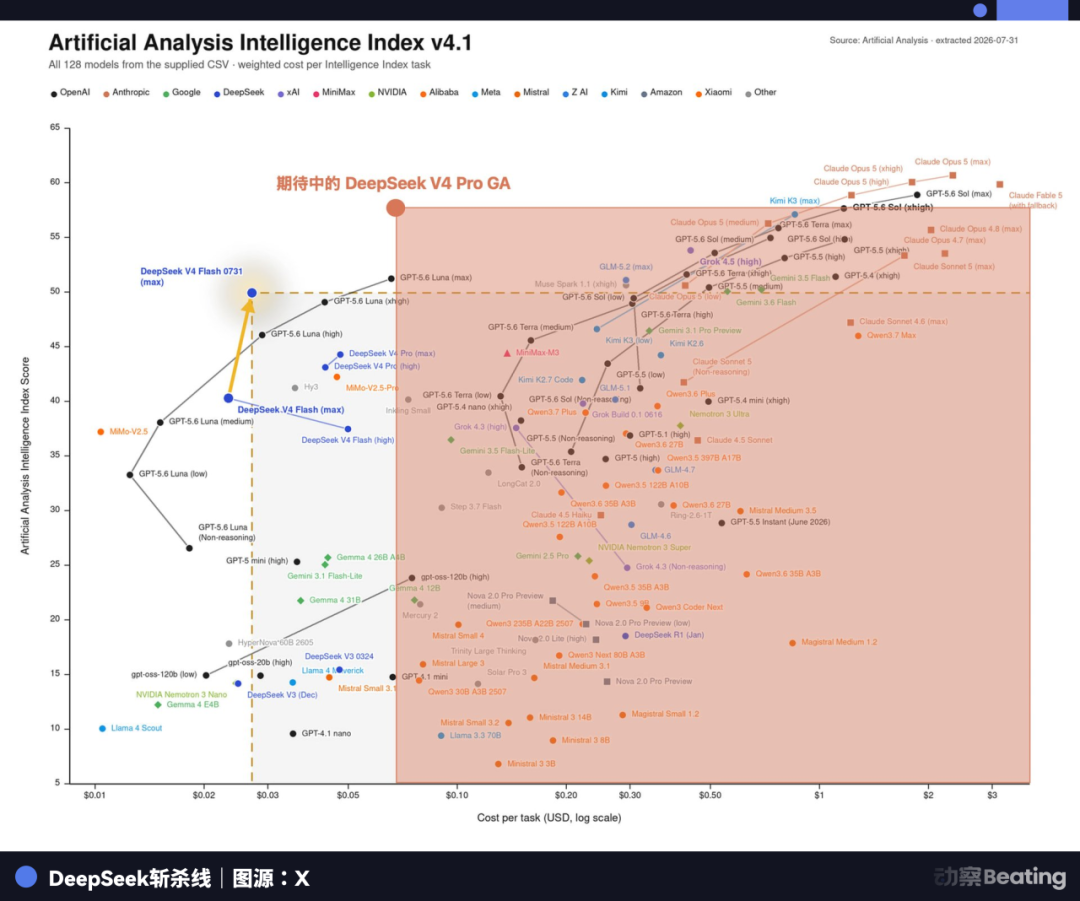
On July 31, DeepSeek V4 Flash was released. In the coordinate graph of Artificial Analysis that compares the model's intelligence level and usage cost, the higher on the y-axis, the smarter the model; the further to the right on the x-axis, the higher the invocation cost. The intelligence index of V4 Flash reached 50 points, placing it at the forefront globally, yet the average cost of a round of testing is only 3 cents. That point has almost been pushed to the top left corner of the coordinate system. Models cheaper than it mostly have lower capabilities, while models smarter than it are generally much more expensive.
Now, if a model is not significantly superior to DeepSeek, it is becoming increasingly difficult to explain why it should be priced tens of times higher. In Chinese internet slang, this boundary is called the "Death Zone." A few days later, Bloomberg discussed the price pressure Chinese models are putting on American AI companies, directly using the term "Death Zone" in the headline.
Since the V2 in 2024, DeepSeek has been continuously pushing down the money required for a machine to "think once." The tasks the model can accomplish are becoming increasingly complex, yet the price has not skyrocketed along with its abilities. Over the past two years, the large model industry has been accustomed to talking about progress with larger parameters, longer contexts, and higher benchmarks, while DeepSeek has been pursuing another standard: the same level of intelligence at a lower cost.
On the other side of Hangzhou, Wang Xing has been doing something similar for over a decade.
When he was a graduate student working on XDog, there wasn't much money to burn from the beginning. If he couldn't afford the expensive hydraulic systems, he researched low-cost motors; if he couldn't afford mature solutions, he drew his own drive boards, wrote programs, and built control systems. Many of the technological choices that have now become standard components of Yushu products all initially carried a very simple engineering habit—don't ask how the industry usually does it, first see if there's a cheaper way.
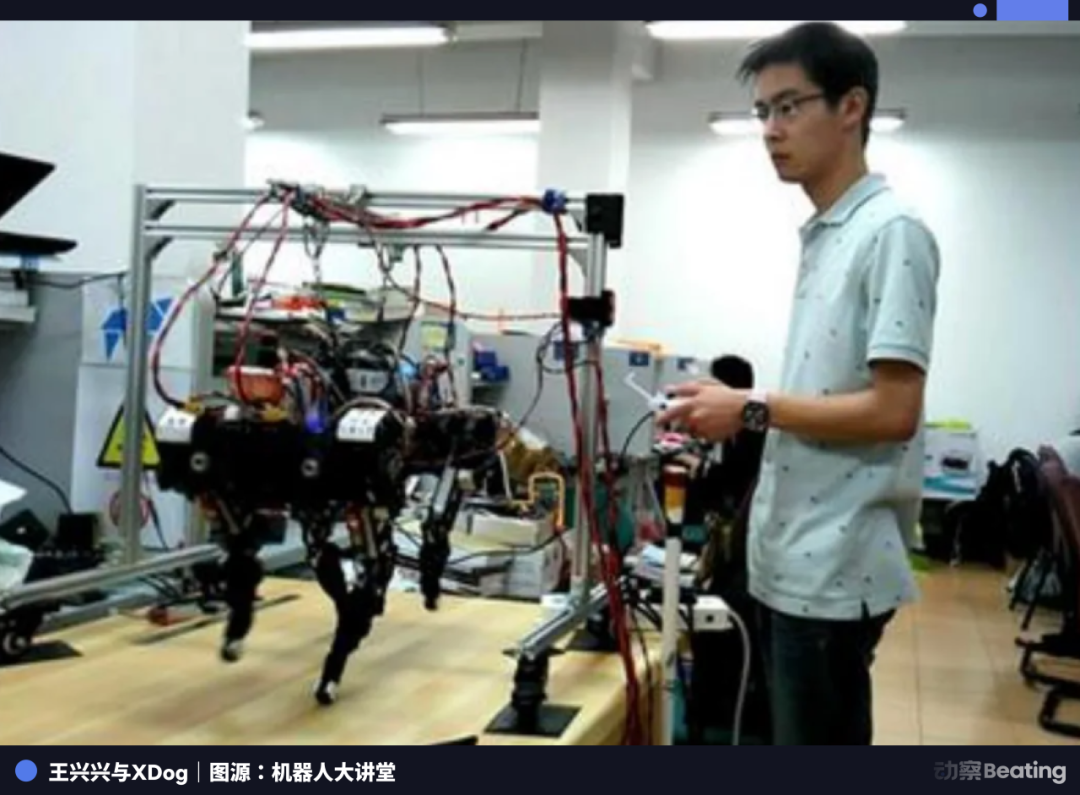
Looking back, Wang Xing mentioned that when he was working on the bipedal robot in 2010, the mechanical parts only cost a total of 200 RMB. Many years later when someone asked if Yushu could continue to reduce costs, he replied, "Don't compare cost reduction with us; we can continue to reduce by a lot."
A company is lowering the price of thinking, while another is lowering the price of action. For a long time, although both were based in Hangzhou, they were each going their separate ways.
Until August 6.
Yushu Technology announced the strategic placement results for its Sci-Tech Innovation Board (STAR Market) IPO, with DeepSeek subscribing to ¥140.8 million of Yushu's new shares. The cooperation arrangement disclosed by both parties was quite straightforward – when Yushu needs model training services and technical solutions, DeepSeek will be given priority, and when DeepSeek needs robotics or exploration of embodied AI applications, Yushu will be given priority.
In today's AI industry, this amount of money is not considered astonishing. What is truly interesting is that for the first time, two individuals who have always aimed to bring expensive technology down to an affordable price have aligned their cost curves. Thus, a more intriguing question than "a large-scale model finally giving a robot a body" has emerged:
If the cost of machine thinking and machine action continues to decrease simultaneously, what will AI eventually evolve into?
The answer may not only be "more accessible to people."
The bigger change is that we are beginning to not hold it in such high regard.
Two Price Butchers
The most similar trait between Liang Wenfeng and Wang Xingxing is that they both do not quite believe in obtaining cheapness through subsidies. Price lists can certainly be changed overnight, but in the end, one gets what one pays for. Cheap prices like that usually cannot last long. If you truly want something to be sold at a low price in the long term, it eventually comes back to the engineering aspect, where one has to peel away the costs that were initially taken for granted, layer by layer.
DeepSeek-V2 is the most typical example. After the model's release in 2024, the domestic large-scale model industry was quickly pulled into a price war. While outsiders mostly see the API pricing, what truly sustained the price reduction was hidden within the model's structure. The total parameters of V2 reached 236 billion, with only 210 billion activated for processing each token in practice. Compared to the previous generation, training costs reduced by 42.5%, KV Cache reduced by 93.3%, and the maximum generation throughput increased by 5.76 times.
With V3, this approach continued to advance. The model became larger, formally consuming 2.788 million hours of H800 GPU training, and DeepSeek further optimized efficiency through a mix of experts, low-precision training, and communication optimization.
Later on, this cost perspective even began to define the product in reverse.
In May of this year, DeepSeek directly converted the 75% promotional discount for V4-Pro into a permanent price and continued to lower the prices of their flagship models. Liang Wenfeng had previously explained their pricing principle, based on pricing according to true costs, not engaging in long-term subsidies, and not seeking excessive profits.
Wang Xingxing's understanding of robots is almost the same.
During an interview with LatePost in 2025, he was asked about the H1, which was originally sold for $90,000. The later, more flexible G1 base model now starts at only 99,000 RMB. Does this still make a profit?
Wang Xingxing replied, "Commercial activities must have a reasonable business profit. Cost has always been our KPI for everything we do, the core being to make money."
What he then rarely talks about is that most common phrase, "scaling up will naturally lower costs." What truly determines the bottom price of a robot is how the motor is chosen, how the reducer is made, how many parts a joint needs, whether the whole machine can be made lighter, and which parts must be held in-house.
This cost reduction method has a strong industrial-era feel, where every cent is split in half.
A few centimeters less on a circuit board, two fewer parts in a joint, a different routing for a cable harness—individually, none of these changes seem like a great breakthrough. But when dozens of such changes stack up, they will directly impact the selling price.
The price changes of Yushu in recent years have been like this. In 2023, the first-generation full-size humanoid robot H1 was launched and sold only five units, with an average selling price of 593,400 RMB. In 2024, the smaller G1 entered the market, sales increased to 410 units, and the average selling price dropped to 260,700 RMB. By the first nine months of 2025, humanoid robot sales reached 3,551 units, with the average selling price dropping again to 167,600 RMB.

With each price drop, a new batch of buyers for robots will emerge. Devices priced at five to six hundred thousand RMB require laboratory project approval, budget drafting, and explanations of what the purchase is for. With prices in the tens of thousands, more universities, development teams, and enterprises can afford them.
Many technologies truly cross the threshold of popularity through such changes. From special project budgets to departmental budgets, then from department budgets to regular purchases, and finally, one day, people are too lazy to account for every use.
Expensive technology naturally only suits expensive problems. Once the price drops, those trivial matters that were not worth the technology's appearance in the past will start entering its world.
The Intersection of Two Cost Curves
Yushu is already working on world models and VLA, so the value of DeepSeek is not just to "give a brain" to robots. What truly integrates the two companies is the currently most expensive training loop for embodied intelligence.
This loop is half-happening in the real world. The robot actually reaches out, walks, picks things up, while humans or other systems continuously demonstrate to it, generating a trajectory of successes and failures.
The other half is happening in computation. Data is cleaned, labeled, fed into a model to train new strategies, then redeployed back to the robot after inference and validation. The machine goes back out to try again, brings back new data, and the model learns again. The faster this loop runs, the more the robot interacts with the world.

The problem is, it is expensive at both ends. Real hardware is expensive, making it challenging for a team to have hundreds of robots tumbling in the lab all day long; training and inference are expensive too, as the data collected, which may seem invaluable at first glance, is also hard to repeatedly train and validate.
Therefore, conducting robot experiments in the past has always been very costly. With only a few machines available, researchers had to carefully plan what data to collect each day. With limited computing power, they had to calculate whether it was worth rerunning a batch of trajectories. The more valuable the resources, the more researchers tended to choose problems that seemed most valuable and had the highest probability of success.
But the real world is not like that.
Is there any difference between placing a cup 3 cm from the edge of a table versus 5 cm? Where should you grab a half-wet towel? When a drawer is stuck, should you apply more force or first move it back slightly? How should you adjust your arm when there is one apple versus three apples in a plastic bag? Taking these individual scenarios, none of them is worthy of a press conference, and it is even difficult to justify a dedicated lab project. However, once a robot enters homes, restaurants, warehouses, or offices, the world it faces every day is precisely made up of these trivial and tedious problems.
At this point, looking at the collaboration between DeepSeek and CosmicTree, the logic becomes much clearer.
CosmicTree is reducing the cost of the first half, allowing more real hardware to enter the lab, development team, and real-world scenarios; DeepSeek is focusing on solving the issues in the second half long-term, making model training, inference, and validation increasingly cost-effective.
Most trajectories will not end up in a product, and most experiments will not make the news. Some robots may fail to grasp a cup correctly a hundred times in a row, and after running an expensive dataset, it may only prove that the initial idea was fundamentally flawed.
When resources are scarce, these are called wasted efforts; when the cost is low enough, they qualify as experiences.
If a smartphone becomes more affordable, it means more people can buy it; if a robot becomes cheaper, it means it can have more unproductive time on its own, practicing in the lab for an afternoon, performing actions that will ultimately not be used, entering more strange environments, and encountering more unexpected situations that engineers did not anticipate.
When both the body and intelligence become cheaper, embodied intelligence is the first to gain the qualification to make more mistakes.
How Humans Learned to Waste Technology
This kind of thing has happened many times in human technological history.
In 1865, the British economist William Stanley Jevons, while studying steam engines and coal, discovered something counterintuitive. As the efficiency of steam engines increased and less coal was burned to complete a task, the coal consumption in Britain did not decrease but instead increased. This was because once steam power became cheaper, tasks that were previously deemed unworthy of using it for began utilizing it, and the coal saved through efficiency gains was quickly consumed by new demands.
Later, this phenomenon was referred to as the "Jevons Paradox."
In the past two years, those who have used AI have somewhat experienced the reverse stage. When models were still expensive, we first learned how to economize intelligence. While startup teams discussed user experience, product managers still had to keep in mind a token price list, and a feature that was technically feasible might ultimately be cut due to "running the model five extra times for each user being too costly."
However, when technology truly integrates into life, it often faces another challenge—it becomes so cheap that we start using it for things that are not so important.
Today, no one calculates how much economic value an hour of lighting in the living room creates before turning on the light, nor does anyone feel extravagant for a few extra network requests in the background of their phone, thinking they are squandering the great internet infrastructure.
Both electricity and the network incur costs, but these costs have become so low that it is not worth making a decision for each use. People have long become generous in these matters, and without guilt.
If intelligence reaches this point one day, our relationship with AI will also change. At the end of a meeting, casually let the model organize, finish writing an article and have a few models each point out flaws, an Agent fails to perform get a few alternate paths to try, hit a golf ball without a date. Robots tidy up the table, knock over the cup the first time, reach awry the second time, move too slowly the third time, then on to the fourth time.
Once a technology truly becomes ubiquitous, people will not increasingly calculate its efficiency of use seriously; people will even forget that they are using it.
Until We Stop Keeping Score
In 1911, the British mathematician and philosopher Alfred North Whitehead wrote in "An Introduction to Mathematics":
"The progress of civilization consists in increasing the number of important operations which we can perform without thinking about them."
Today's AI clearly hasn't reached this point yet. We are still debating which task is worth using the most expensive model for, developers are still haggling over a few dollars per million Tokens when switching suppliers; robotic companies still have to navigate between trade shows, labs, and factories to find the most cost-effective scenario. This industry still carries a heavy sense of the basics.
What truly ties together this ¥1.408 billion investment is a bill that has rarely appeared in industry discussions before. How much does it cost for a robot to make a mistake?
Today, this answer is still not cheap enough, so every piece of real-world data must be carefully collected, every training round must be selective, and every robot should ideally quickly find a job that can calculate its output.
When the day comes for intelligence to truly become ubiquitous, there may not be a press conference announcing the arrival of a new era. We will simply gradually realize that a robot has been practicing grabbing boxes in a warehouse corner all afternoon, failing three hundred times, and no one is specifically inquiring about it; an Agent has tried dozens of paths to find an answer on its own, and no one is lamenting over the Token bill; adding more robots in the lab no longer requires a purchase justification for each one.
Therefore, the future's truly important price of AI may not be how much a million Tokens are worth, or how much a humanoid robot costs, but rather when we finally become too lazy to calculate these numbers.
When it's no longer worth lamenting over a machine thinking a few more times, walking a few more steps, or making a few more mistakes, intelligence will truly have transitioned from an expensive capability to infrastructure.
Technological revolutions often begin when technology becomes so cheap that it can be squandered.
DeepSeek is making thought approach this price, Yushu is making the body approach this price. The remaining task is to ensure that machines have a cheap enough lifetime.
Cheap enough to try repeatedly, cheap enough to make continuous mistakes, cheap enough that today's seemingly meaningless failures will eventually be abundant enough to constitute intelligence.
Original Article Link
Welcome to join the official BlockBeats community:
Telegram Subscription Group: https://t.me/theblockbeats
Telegram Discussion Group: https://t.me/BlockBeats_App
Official Twitter Account: https://twitter.com/BlockBeatsAsia