NAVI Prime: After Three Years of $30 Billion in Loan Volume, How is Sui's Largest Lending Protocol NAVI Innovating to Pave the Way for Hundred Billion Dollar Fundraising?
Original Author: Alex, Defi Researcher
「When NAVI reached a $1 billion TVL in September 2025, our largest single depositor had already supplied over $30 million.」
In an X Space event prior to the release of NAVI Prime, NAVI founder Elliscope recalled this milestone. For a lending protocol, $30 million not only meant scale but also signaled an entirely different set of challenges emerging.
「As we grew to that point, we began to ask ourselves, if we want to further scale to $5 billion, $10 billion, or even $1 trillion, large capital providers would first ask: Who is managing the risk? Where is my capital being deployed?」
Users with a few thousand dollars may first compare APYs; as the fund size rose to tens of millions of dollars, the discussion starting point often shifted towards risk boundaries, asset destinations, and management responsibilities.
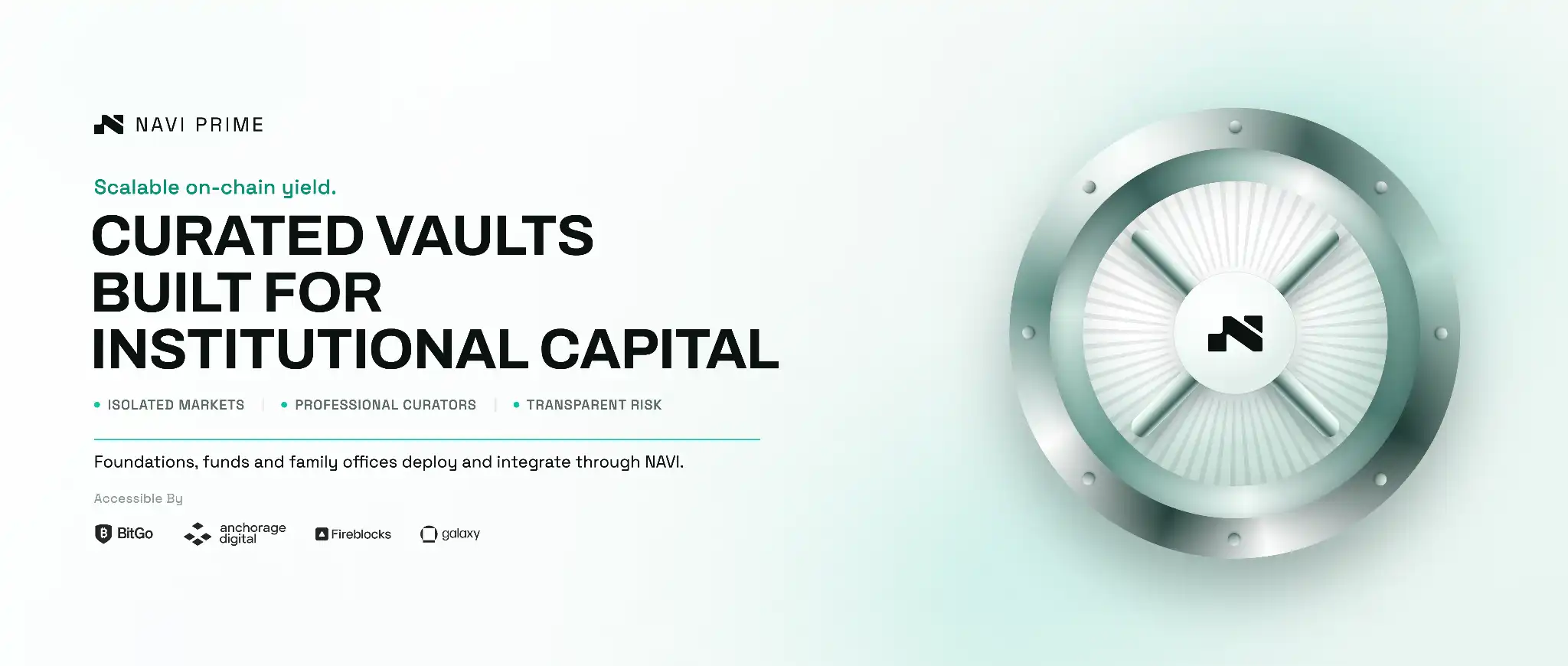
To address this issue, in August 2026, NAVI officially launched NAVI Prime, positioning it as the Sui's first module-based capital market introducing professional curators. Unlike NAVI's shared liquidity pools running for the past three years, NAVI Prime splits different lending relationships into separate markets, which are then curated by professional asset managers responsible for due diligence, parameter design, and fund allocation.
This upgrade is not simply adding more yield pools. It aims to answer a more practical question: when DeFi funds no longer just chase yields, how does the protocol let users know where their returns come from, what risks they are taking, and who is ultimately in charge?
Three Years, from $0 to $1 Billion TVL: Beyond Scale, the Importance of Persistence
In the Sui ecosystem, NAVI is no longer a new project.
According to data provided by the project team, since its launch in 2023, NAVI has processed approximately $30 billion in total borrowing volume and around $10 billion in total deposit volume, serving over 1 million users. Its TVL peaked at over $1 billion, accounting for over 40% of Sui's total TVL at one point, and has been running continuously for over 1000 days.
Over the past three years, the platform has distributed over $60 million in incentives and generated nearly $30 million in protocol revenue. The two sets of figures have different calculation methods and cannot be simply understood as a direct comparison of input and return, but together, they illustrate NAVI's presence in the early DeFi market of Sui.
Amid shutdowns, integrations, and mergers in the same period, NAVI has maintained its position as one of the core lending markets in the Sui ecosystem. Supporting this system is a team of about 20 people based in Palo Alto, with members distributed in San Francisco and New York. The core team members come from tech companies and financial institutions such as LinkedIn, Apple, and Bank of America, as well as the Sui ecosystem development team. In 2023, NAVI secured a joint investment from Hashed, OKX Ventures, and Dao5.
On the occasion of NAVI Prime's release, Ryan Kim, the founder of Hashed, South Korea's largest cryptocurrency investor, attributed this experience to "long-term construction across cycles."
"DeFi has experienced intense volatility since 2020, but NAVI's lending protocol has established a moat around Sui. Supporting long-term builders like Elliscope and the NAVI team who navigate market cycles is a core value of Hashed. We are pleased to see them seize this opportunity to expand their institutional business footprint."
These data and endorsements show that NAVI has been able to attract liquidity. However, for NAVI Prime, the next stage will truly need to prove not just whether it can attract funds, but whether it can make funds see why they should stay.
From Shared Pool to Curation Market: Why Larger Scale Requires Deconstructed Risk?
The shared liquidity pool is one of the most important early infrastructures for DeFi lending. Users deposit assets into the protocol, where different lending demands share liquidity, allowing funds to be more efficiently utilized.
For Sui, which just started in 2023, this was a reasonable choice. At that time, the asset types in the ecosystem were limited, so pooling liquidity together was far more efficient than creating separate markets for each asset.
However, shared liquidity also means that multiple assets and lending behaviors are put into the same system. Even though different assets can have different parameters, risks can still interact through shared liquidity and liquidation relationships. For ordinary users, this risk is often compressed into a simple APY; for large funds, questioning the overall protocol's safety is too broad.
In a recent X Space event, Elliscope provided a clear distinction:
"If I ask someone to try out a product with $100,000, their first question is usually about the rate of return. But if I ask an institution to deploy $10 million or $30 million, their first question is always about risk management: how does the platform manage risk, who are the other stakeholders, and how is liability divided."
Mysten Labs Head of On-Chain Finance Shaan Varia also shared a similar assessment in the interview. Before joining Mysten Labs, he spent five years leading the product team at the DeFi risk management firm Gauntlet. Unlike a typical ecosystem or business perspective, this experience has brought his assessment closer to the issues faced when institutions actually allocate funds.
At Gauntlet, risk management is not about labeling a protocol as “safe” or “risky,” but rather about putting on-chain market data, borrower positions, asset liquidity, and smart contract mechanisms into a simulation environment. This involves stress-testing parameters such as LTV, liquidation thresholds, asset ceilings, and interest rates. Shaan has previously explained in Gauntlet's methodology articles that the system runs thousands of simulations daily, searching for optimal parameter combinations between default risk and capital efficiency in the protocol. Gauntlet's framework has also been widely used for risk management in mainstream borrowing protocols such as Aave and Compound.
“For institutions, the core issue is risk management. When they enter the on-chain world, they are usually looking for two things: a broader market that their existing capital base cannot reach and new structured products with specific risk, return, and liquidity characteristics.”
Therefore, when Shaan breaks down economic risk, oracle risk, smart contract risk, liquidity risk, and solvency risk layer by layer in X Space, he is discussing more than just whether Sui can attract institutions; he is addressing a more specific question: whether this on-chain infrastructure is already capable of allowing institutions to choose assets according to their risk policies, control exposure, and continually monitor allocations.
This is precisely the problem NAVI Prime aims to solve: no longer requiring all funds to accept a blended risk profile but allowing funds to choose the portion of risk they are willing to bear.
NAVI Prime: Not Just “Pool Splitting” but a Redistribution of Responsibilities
NAVI Prime's structure can be summarized by three key words: Segmented Markets, Professional Curation, and Modularity.
Segmented Markets mean that different collaterals and lending relationships are placed in relatively independent markets. Each market has its own interest rate model, collateralization ratio, liquidation parameters, and risk boundaries. When a specific collateral runs into trouble, the potential impact is initially contained within that market, rather than naturally spreading to all liquidity.
Professional Curation means that markets are no longer managed entirely by the protocol. Curators must research assets, conduct due diligence, set risk parameters, choose configurable markets, and continuously monitor fund utilization and risk changes.
Modularity implies that these markets and curation strategies can be further integrated by treasuries, structured products, or other DeFi protocols without having to build a lending protocol from scratch.
In this structure, the responsibilities of three types of participants are clearly defined:
• Liquidity Providers choose specific markets or curation strategies, deposit stablecoins or other assets, and receive corresponding lending yields;
• Curators are responsible for asset due diligence, risk parameters, fund allocation, and continuous monitoring;
• NAVI provides isolated markets, permission systems, and underlying lending infrastructure.
For users, the significance of this change is: deposit decisions are no longer just "whether to enter NAVI," but further evolve into "which market to enter, which collateral risk to accept, which curator to choose."
In other words, users are no longer passively inheriting a pre-packaged mixed risk in a shared pool, but can actively choose their risk profile.
For fund providers, more important than the highest APY is that the yield can be explained
NAVI Prime does not promise that all markets are safer, nor does it mean that all isolated markets can provide higher returns. It addresses another issue: allowing different risks not to be roughly priced by the same set of generic parameters.
NAVI co-founder Charles gave an example using SUI and vSUI in Space.
Imagine two markets: one where users borrow USDC against SUI collateral; the other where users borrow vSUI against SUI collateral for a leveraged liquidity mining strategy. The former involves price fluctuations between volatile assets and stablecoins, while the latter's two assets are highly correlated, so the collateral ratio and liquidation parameters are not the same.
In a shared pool, the protocol must consider multiple lending relationships at the same time; in isolated markets, the two strategies can use parameters that are more suitable for their own risk characteristics. Following Charles' example in the interview, the LTV for borrowing USDC against SUI collateral is about 70% to 80%, while in the highly correlated SUI and vSUI market, the LTV can support up to about 92% to 95%.
「Shared pools have attempted various mechanisms to reconcile these differences, but isolated markets provide a clearer solution. NAVI Prime can create two separate markets, with each market's parameters tailored to its specific use case.」
A higher LTV does not inherently mean greater safety, nor does it necessarily lead to higher returns. This example truly illustrates that when different lending relationships are unbundled, funds can be more finely allocated based on the correlation between specific assets and the settlement risk.
For liquidity providers, the most significant change is not just a few more yield figures on the page, but being able to answer four questions before entering:
1. Which market will my funds enter?
2. What assets are borrowers using as collateral?
3. Which markets and liquidity risks correspond to the current yield?
4. Who is responsible for setting parameters, monitoring the market, and adjusting allocations?
When yield can be explained, users can more easily determine if it suits them; and when risk can be chosen, large funds are more likely to turn a trial into a long-term allocation.
Three-Tier Security Architecture: Security is not risk-free, but risk is more visible and manageable
In DeFi, "security" cannot be established with just a promise. Smart contracts, oracles, liquidity, collateral prices, and management permissions can all become sources of risk.
In Space, Charles broke down NAVI Prime's risk management framework into three layers.
The first layer is smart contract security. According to the project team, NAVI Prime's underlying isolated market contract is built on NAVI's lending infrastructure that has been operating continuously since 2023, with a cumulative total of audits from 5 audit firms and over 10 audits; the curation layer has undergone 2 additional audits.
The second layer is collateral risk isolation. If a market only accepts specific assets as collateral, liquidity providers can more clearly know whether they are exposed to the risk of Bitcoin, SUI, stablecoins, or other assets. When there is an issue with a particular collateral, the isolation design can narrow down the potential impact.
The third layer is Curator Accountability and Permissionless Split. NAVI Prime separates roles such as administrators, curators, and fund allocators. Curators can update the markets and parameters within their authorization scope, while allocators can only move funds between pre-approved markets; mechanisms like time locks provide additional buffer for critical changes.
"This three-layer architecture is designed to make NAVI Prime as secure as possible," Charles stated.
"As secure as possible" does not mean zero risk. More precisely, NAVI Prime aims to transform the previously vague security assessment into a set of granular questions that can be checked one by one: Has the contract been audited, what collateral is accepted, who holds the permissions, how parameters change, and how large a scope a single risk event could impact.
This is also one of NAVI Prime's core appeals to funds: instead of requiring users to simply trust the platform, it strives to help users understand what they are trusting.
For curators, risk management capability can now be directly productized for the first time
Another growth axis for NAVI Prime does not come from more collateral but from more professional managers.
In the traditional model, risk institutions usually advise protocols on parameters in an advisory capacity; in a curation market, curators can create markets around their understanding of assets and strategies, set risk parameters, allocate funds, and continuously manage performance.
This means that a curator's asset research, risk models, and fund allocation ability can be packaged into an on-chain product that users can directly choose.
A curator skilled in stablecoin strategies can establish a conservative market; a team understanding Bitcoin liquidity, RWA, Sui ecosystem assets, or structured strategies can design independent risk-return schemes around their respective assets. Users are not only choosing a set of assets, but also the judgment and management capabilities of the curator they choose.
For potential collaborators, the value offered by NAVI Prime is not just a market creation tool. Curators do not need to redeploy lending contracts, liquidation systems, and permission frameworks; they can utilize NAVI's underlying infrastructure, access its existing user base and liquidity pools.
Elliscope explicitly stated in Space that NAVI aims to collaborate with professional curators who understand specific markets and possess risk management capabilities, and aims to establish a more collaborative ecosystem through revenue sharing.
“NAVI Prime is more accessible to institutions capable of deploying hundreds of millions of dollars in liquidity as it offers risk isolation and manageable configuration choices. It also welcomes professional curators who understand specific markets and can manage risk. We aim to share revenue to attract a broader set of skills and capital into Sui.”
For NAVI, this means that the platform no longer solely determines all markets; for curators, professional skills have the opportunity to shape products, brands, and revenue; and for users, it means the ability to choose between different managers and different risk-reward schemes.
Why Sui: From Retail-Driven to Coexistence of Institutions and Retail
The relationship between NAVI and Sui can be traced back to 2023. At that time, the Sui ecosystem was still in the early stages of infrastructure development, with bridges, liquidity, and lending markets all needing to be built from scratch.
Over the past three years, Sui has helped early-stage DeFi projects grow through incentives, technical support, and ecosystem resources; NAVI has at one point contributed over 40% of the total value locked in the Sui network. The relationship between the two has also shifted from early ecosystem development to how to accommodate larger and more complex fund requirements.
From Mysten Labs' perspective, Shaan views NAVI Prime as a new type of infrastructure that can support structured products:
“NAVI Prime enables teams to leverage Sui's performance and scalability, as well as the latest innovations in DeFi market design to reach institutions. Users have more choices, institutions have more precise control over allocations, and more capital can enter the Sui ecosystem.”
This is not just a future-facing statement. Over the past year, Sui has gradually introduced various types of on-chain assets and financial products with institutional attributes: Figure deployed SEC-registered revenue-sharing security YLDS to Sui; Matrixdock brought redeemable tokenized gold XAUm into the ecosystem; R25 launched real-world financial asset-backed rcUSD and revenue-sharing rcUSDp; on August 18, 2026, Securitize and Neuberger introduced tokenized high-yield fixed-income fund HINC on Sui. Meanwhile, Hashi is working to bring native Bitcoin to on-chain credit and is explicitly offering related financial services to both institutions and retail participants.
Beyond assets, Sui has also started to complement its regulated market infrastructure. On August 25, tZERO announced the expansion of its digital securities infrastructure to Sui, covering issuance, custody, transfer agency, trading, and settlement. This means that Sui's institutionalization is no longer just a matter of “having yet another tokenized asset,” but is beginning to encompass the full lifecycle of assets from issuance and holding to trading and settlement.
These assets' entry into Sui's infrastructure is just the first step. Tokenizing assets does not automatically create a full-fledged on-chain financial market. It still needs to be priced, used as collateral, provided with liquidity, generate lending demand, and further engage in leverage, yield, and structured products.
This is where the lending infrastructure comes in: transforming "an asset on-chain" to "an asset that can be used as capital continuously."
Charles in Space put the relationship between RWA and lending more bluntly:
"Once on-chain, RWAs can also be used for lending, leverage strategies, short positions, and other structured products. This opens up significant product innovation space. Lending will be foundational as many of these products require RWAs as collateral."
However, institutional assets and retail assets cannot be simply mixed together. Certain RWAs have investor qualifications, KYC, geographical restrictions, and redemption rules; Bitcoin, gold, income-bearing securities, and Sui ecosystem tokens also have vastly different pricing, liquidity, and settlement characteristics. Segregated markets allow each asset to have its own entry requirements, oracle, LTV, supply cap, and curator, without requiring all users to share their risks.
Therefore, the significance of NAVI Prime to Sui is not to replace retail with institutions but to provide a structure where both types of capital can coexist:
• The shared pool continues to serve open, standardized, and highly liquid retail lending;
• Prime can provide independent risk boundaries for institutions, large funds, professional curation strategies, and restricted RWAs;
• A curation treasury for ordinary users can package complex market research and allocation processes into more easily understandable products while still maintaining on-chain transparency of fund utilization and risk parameters.
Institutions may bring larger-scale assets and funds, while retail users offer broad distribution, liquidity, and real utility demand. The two do not necessarily have to enter the same market but can find their respective places in the same infrastructure.
In the closing remarks of the recent X Space discussion on DeFi with mysten, the DeFi lead, Elliscope, used a building to illustrate the significance of lending to an ecosystem:
"The trading volume of DEXs and perpetual contracts showcases how quickly this building has grown; but lending determines how tall this DeFi skyscraper can ultimately be."
Transaction activity may fluctuate rapidly with market sentiment, while lending supports longer-term capital allocation, leverage, and financial products. The goal of NAVI Prime is to ensure that as this building continues to rise, it not only has more funds but also a clearer risk structure, allowing different types of capital to enter the Sui without sacrificing their risk preferences.
Next Phase: Enabling Institutional Assets to Find Liquidity, Empowering Retail Funds with Choice
The launch of NAVI Prime does not mean that the shared pool is outdated. For standardized, large-scale basic lending needs, shared liquidity still holds significant value. Curated market isolation addresses another set of issues: unique assets, specific risk preferences, institutional allocation, RWA, and specialized strategies.
With a three-year $300 billion lending volume, over one million users, a peak TVL of $1 billion, and Sui accounting for over 40% of the entire network's TVL, NAVI has already proven its ability to attract funds.
What NAVI Prime now needs to demonstrate is the ability to translate this scale into a two-way market: on one side, enabling institutional assets, Bitcoin, and RWAs to find controlled on-chain liquidity and lending scenarios; on the other side, allowing regular users to choose risk-reward schemes managed by professional curators within transparent boundaries without needing to individually research every underlying market.
For users, the real attraction is not just a statement of being "safe and high-yield" but the ability to see where the funds are going, the risk boundaries, and the source of returns and choose markets and managers according to their risk preferences.
For institutions, the core is not just to obtain a higher APY but to maintain sufficient control over custody, access, collateral, parameters, and permissions and gradually expand an experimental allocation into long-term capital.
For curators, what is truly worth collaborating on is not just a one-time brand collaboration but the ability to leverage NAVI's market infrastructure, user base, and liquidity gateway to turn professional capabilities into a product that can consistently attract funds, accumulate on-chain performance, and generate revenue.
This is also the greater significance of NAVI Prime to Sui: it is not about directly transitioning the ecosystem from a "retail era" to an "institutional era" but about adding an institutional capital track on top of the existing retail liquidity. The shared pool and Prime, open markets and restricted markets, regular users and professional allocators can coexist at different risk boundaries simultaneously.
From shared pools to curated markets, what NAVI Prime aims to accomplish is precisely this: ensuring that funds are not only attracted but also understand why they should stay; ensuring that assets are not only issued on-chain but truly enter a financial system that is lendable, allocatable, and composable.
This article is a submitted contribution and does not represent the views of BlockBeats.
Welcome to join the official BlockBeats community:
Telegram Subscription Group: https://t.me/theblockbeats
Telegram Discussion Group: https://t.me/BlockBeats_App
Official Twitter Account: https://twitter.com/BlockBeatsAsia
 Related Articles